Hi Ho, Hi Ho

I’ve been writing about reading. No surprises there, I suppose. My wife recently introduced me to BookRiot, and I wish I had more time to spend there. A recent post by Aisling Twomey describes how reading on her Tube commute helps keep her sane. Here is a good case of convergent evolution—I came to the same conclusion after about a week of what turns out to be about three hours a day commuting to New York City. We didn’t move to my current location to work in Manhattan. My job was in nearby Piscataway. It was only when a headhunter found me a job at Routledge that I began the daily trip. The problem is I get terribly car sick. To this day I can’t read in a car. Some days I can’t read on the bus either. Gradually, however, I trained myself to do it, and the results have been worth it. Ms. Twomey has read over fifty books this year on her London commute. I suspect my commute is a bit longer since I’ve read a few more than that. Still, we tilt against the same windmill, so we need to appreciate the dedication it takes.

I was talking to someone the other day who was complaining about cell phones. She said, “I used to read a lot. I worked in a book store. It was great.” Her cell, she said, gave her a stiff neck from constantly looking down. And a sore thumb from swiping and texting. And yet, she lamented, she just couldn’t stop. Books may well be a vice. I’m as bad as any addict. I have no idea how many books I’ve read in my life: the number is in the thousands rather than the hundreds, I know. And even the books I regret, I don’t really regret. Reading is a coping mechanism.
img_0670

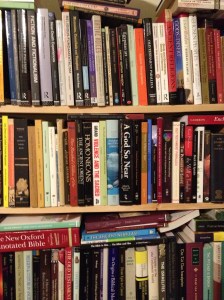
One of the things that the traditional ancient religions all have in common is books. Not all of them treat sacred texts the same way, but they all have some form of sacred writing. There was an implicit sense, I believe, from the first stylus on clay, that something truly special was going on here. Holy, even. Writing is one of the great joys of life. Reading is another. Both are sacred professions. In a way it seems a shame to have to be forced into a commute in order to find time to read books. Still, the constant flow of new material has a life-saving quality to it. I can’t imagine spending fifteen concentrated hours a week texting. I don’t know that many people to text. The ones I do know I know through their books. And they’re very good company on a long ride.
Lingering Memories

Visiting northwest Pennsylvania always makes me think of oil. I suppose the fact that I attended high school in Oil City has something to do with the fact. Many people suppose that the oil industry began in Texas, but Pennzoil and Quaker State have earlier roots back to the days when people flooded to Oil City and Titusville to get rich from the petroleum underground. I grew up in a refinery town that is becoming a ghost town, like Pithole City and Petroleum Centre before it. And when I returned home to New Jersey I wanted to find my Oil City book. Yes, there is a book. I first saw it in junior high school and I coveted it. Hardbound and large format, it was a book about my town. I had no idea where to get one, however. There were no bookstores in Oil City, or nearby Franklin. Any further afield than that and nobody cared.

I used to work as a janitor in my junior high school. It was my summer job for several years. One day our task was to haul out the garbage bins. I saw my opportunity. The library was discarding several copies of the book. They were in the trash. I dumpster-dived for the first (but not last) time in my life. I had the prized book. It had been locally printed. There is no publisher listed. It bears no ISBN. Nothing like a book to validate where you’re from. You see, I’ve always wanted to write a history of the area where I grew up. No major publisher would touch it—it can’t possibly sell enough books to cover its costs. It would be a labor of love.

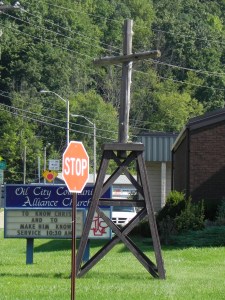
Not that I’m a fan of Big Oil. Quite the opposite, in fact. I don’t appreciate their proprietary arrogance toward ownership of the planet. Of their pollution of the world to gain more money for themselves. I support alternate energy. But still. This is where I’m from. Not that anybody’s making much money off of oil there these days. The shallow wells ran dry long ago. The local oil companies were bought out by larger corporations but they kept the local names. Once in a while I pull out my old, salvaged Oil City book and scan the pages with wonder. Many of these towns wouldn’t be here if it weren’t for the prehistoric sludge that flowed under the rocks and stones. It’s easy to believe that the town would stay the same forever. Heading out of Oil City there is a church. A crude cross stands atop a truncated oil derrick. I stare at it and the irony is only half complete.

dscn6574


Pay Attention

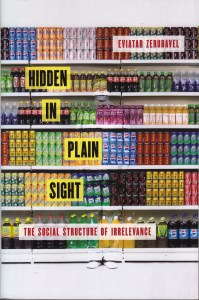
hiddenplainsightIt happened in seventh grade, but I remember it vividly. It was music class. I’ve always enjoyed music but have never been able to make it without the assistance of a device that plays recordings. This particular day, however, Mr. Butler gave us the assignment to write down whatever we heard for about ten minutes. He told us to start and I began listening. Hard. I didn’t want to miss a thing. When time was up he asked some people for their answers. The first person said the sound of Mr. Butler’s footsteps as he walked to his desk after saying “start.” I was utterly shocked. How had I missed that? More answers emerged and my sense grew that I was completely inept at hearing things—well nigh deaf—since I had only heard the sounds that I was listening for. Hidden in Plain Sight: The Social Structure of Irrelevance, by Eviatar Zerubavel, makes me feel a little better.

A lot has happened since seventh grade. I have now realized that I’ve missed most of it. We filter out stimuli constantly. What is really interesting about a sociologist’s look at what we fail to notice is that we often miss important things in life by assuming that figure is more important than background. Or that space between things is less important than the objects themselves. Or that we can indeed listen for silence instead of sounds. It is a matter of how we perceive things. There are millions of stimuli bombarding you right now. I’m flattered that you’re even bothering to pay attention to my musings here. Are you also feeling the clothes you’re wearing? The shoes on your feet? The taste of either your last meal or the toothpaste that might have followed it? We shove things into the “background” all the time, including other people. We can’t pay attention to everything.

Interestingly, Zerubavel raises the issue of moral inattention. We do sometimes consider things outside the realm of moral consideration. But should we? What are morals if not an indication of what society has taught us to value? Indeed, social attention, or inattention, teaches us from our earliest days what is safe to ignore and to what we must pay attention. It helps us survive. Reading this little book, however, has left me wondering about all the things I have habitually missed through the years. Some of them may have been important. Sitting in a silent room, after all, I failed to notice the sounds of my own pencil scratching on paper, writing down all the sounds I was hearing.


Paper or Plastic?

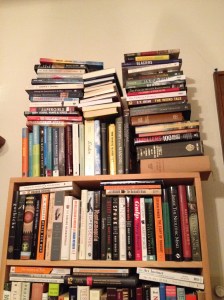
Perhaps the most frequent topic on this blog is books. I don’t discuss every book I read, but most end up here. I can’t help but be pleased then, that recent polls show the number of people reading books is rising. Not only that, but that paper is back. We all appreciate new things. In fact, our economy would grind to a dead stop if it weren’t for new things that keep us buying. Ebooks were a new thing. Sometimes they’re even convenient things. If you’re going on a trip and you tend to travel with lots of books, like I do (who knows what mood you’ll be in when you get there? You’ve got to be prepared!) then an ebook reader can save stress on your back and luggage capacity. But I still prefer to zip open my bag and see four or five books smiling up at me. Visitors (rare, but not completely fictional) sometimes ask why I keep them all. I must restrain myself from retorting “why do you keep all your children?”

img_2945

Books—print books—represent so many things. Yes, they often contain knowledge. But they also contain memories. The contain emotions too. I remember that book that I saw in the library window at the University of Wisconsin Oshkosh book sale display. I was only at Oshkosh one year, but I recall seeing the book that my advisor had recommended a decade and a half earlier. I was so excited I called the librarian to ask if it could be put on hold. He allowed as it couldn’t but if I were to pay in advance perhaps another book could be substituted in the display. I remember having my worldview torn open by books—that January that I read three books that changed my outlook on life almost completely over Christmas break. How can I bear to let any of them go?

I suspect ebooks were a fad. They are still useful and they still sell. But is there any feeling like taking a book, closing the back cover, setting it on your lap, and thinking about what you’ve just seen? I know nothing like it. Of the many books I’ve written, only two have been published. In some sense, those two are the only two I’ve done. I keep trying with the others, but meanwhile out there in a few select libraries people can find bricks of paper with my name on the outside. It wouldn’t been the same if the publishers had said, “it will only be an ebook.” I know that it shouldn’t make a difference if its paper or plastic, but it does. It makes all the difference in the world. No matter if it means having to build more bookshelves. They make excellent insulation.


News from around the Universe

In the last couple of weeks two large-scale news items caught my attention. One describes how a newly discovered galaxy is made up of mostly dark matter. The other tells how a new fossil find in Greenland may push the origins of life on earth back to 3.7 billion years ago. If you read my blog, you know that I’m a frustrated scientist. I’ve always tried to follow the developments in the field and even considered it as a profession until I ran into the wall of mathematics. Ran into the wall, banged up the car beyond repair, and was barely able to walk away. That’s the breaks in a world where ambition and ability aren’t the same thing. So I have to take my science like baby-food, mashed and strained before it makes its way to my brain. I know I’m not alone in this—the whole field of “humanities” proves that. (Originally science (astronomy) was one of the humanities, but oh how we’ve grown!)

Into the storm

Such frightening things as mathematics aside, these are exciting stories. I’ve been looking around this galaxy quite a bit, and I can believe dark matter outweighs light matter and I’ve never even been off the earth. The story is encouraging because it shows just how much we have yet to learn. Nothing could be more exciting for an erstwhile educator. The opportunity to stretch one’s mind should never be taken lightly. At the same time as dark matter is growing, so is the age of life on earth. I have to admit that I’ve not even been to Greenland, but the idea that life began so soon after the earth formed has cosmic implications. If we were such fast starters, doesn’t that suggest that elsewhere in the universe the same may be true? Ironically, here on earth uniformitarianism is considered a foundation of science. But once you get off earth scientists are reluctant to say the same processes could have happened elsewhere. But what do I know? I’m still trying to figure out trigonometry.

Earthbound I may be. Humble humanities specialist from start to finish. Nevertheless it is an amazing time to be alive. Once we’ve figured out that human brains—products of evolution that they are—aren’t capable of ultimate comprehension, we’ll be able to bask in the light of billions and billions of suns and raise a glass with our cosmic neighbors, made of light matter or dark, and proudly say that we’ve made some real advances at last.


Nobody’s Business

Working in academic publishing some insights are available that academics typically miss. For example, it isn’t unusual for a professor to ask why royalties aren’t higher on ebooks because “they don’t cost the press anything.” Ah, my poor, simple academics! If only life were so kind. Ebooks don’t require any ink, paper, or binding. They require a whole lot more than that. Ebooks require publishers to hire entire new divisions to oversee the complicated, technical, and swiftly-changing business of having ebooks in the format that they can be accessed by various reader platforms. Think of it this way: instead of buying materials, publishers have to enter an entirely new business area to sell what they always sold without it before. Now let’s twist the letter-opener just a bit more. Ebooks have exploded exponentially. Anyone with an Amazon account can be an author. Who buys academic books? University libraries. How to libraries decide what to buy? Well, let’s just say “it’s complicated.”

Now let’s go a bit deeper. Have you noticed that instead of fewer presses there are more and more of them? Stop and think about this. Universities have been churning out more and more doctorates for a system that has had a shrinking number of positions for at least the last three decades. Yes, someone’s entire academic career could have been spent in a vanishing profession and they never noticed. There are no jobs out there, my dear professors. Why do you continue to churn out graduate students? The student knows that s/he will be expected to publish. A lot. Librarians, whose jobs have gotten a whole lot more complicated, face budgets that have been simplified. That is to say, administrators say “Ebooks cost less, so libraries need less money. Besides, there’s Wikipedia.” A doctoral dissertation on a single word in a single verse on a single book in the Bible is not likely to get noticed in such a situation.

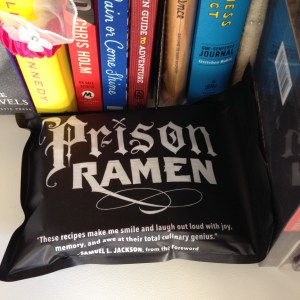
The fact is society is hungry for new knowledge. It just doesn’t want to pay for it. That’s the illusion cast by the internet: knowledge should be free. Tenured professors, however, don’t come cheap. Just ask the professional adjunct living out of his car and eating Ramen noodles heated up with the cigarette lighter. We don’t think about her, however, because she’s not writing books. Society wants an alternative to consumer capitalism. It just doesn’t want to pay for it. Presses start up because there is plenty of content out there—all those dissertations you direct—and anybody can make an ebook cheaply. Print-on-demand alone can keep a press in business. The knowledge pours out the facet, goes over the hands and down the drain. Professors, comfortable in their paneled offices, will never complain. You’ve beat the system—congratulations! But I just can’t help you with those ebook royalties. If you’ll excuse me, my noodles are getting cold.

img_2401


Intelligent Life

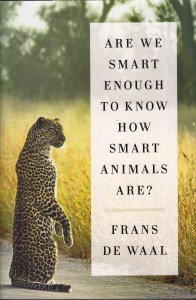
arewesmartPerhaps the most pervasive trait of religion is its ability to construct worldviews. Even when the religion is eventually abandoned, the worldview remains. Most scientists would deny that religion lies behind their perspectives, but in the case of human exceptionalism it remains the most logical cause. I always eagerly await new books by Frans de Waal. Ever since I read his book on empathy and apes, I couldn’t wait for the next one. His latest book, Are We Smart Enough to Know How Smart Animals Are?, although the title is a mouthful, does not disappoint. As I’ve noted before about his works, de Waal is perhaps the most sensible person writing in science today. He considers the evidence and takes his own biases into account. In a competitive world where science money is often doled out to those who can exclude others, de Waal is willing to leave the door open when the evidence demands it.

What is really ironic is that evolution has become the line in the sand between biblical literalists and science. As de Waal points out, the idea that people are different from the animals from which they evolved—in some qualitative way—is an idea based on religion. Many scientists still hold to it in a way that can only be described as, well, religious. This is very strange when evolution works by gradual changes over long periods of time. When did humans gain whatever trait that separates them from “the animals”? When I was a child it was tool use. When that was disproved, it became language. When that was disproved it became consciousness. The latter is the safest since nobody really knows what it is. As de Waal amply demonstrates the Behaviorist school was clearly wrong about animals (including humans). What no Behaviorist wants to admit is that the idea that we alone are conscious comes from the cultural interpretation of the Bible.

Are We Smart Enough to Know How Smart Animals Are? is, like many of de Waal’s books, full of wonderful observations of the ways animals actually behave. They solve problems. They learn from experience. They anticipate the future. In some cases they have been shown to outperform humans on cognitive tasks. And yet we still insist that people are somehow different. Better. Interestingly this is one area where religions and science tend to agree. People are just more important than animals. I wonder if one of the underlying reasons—not addressed by de Waal—is that we have come to depend on a lifestyle that unfairly exploits animals. After all, we eat them, use them for work, and even experiment on them. If we admit that they are intelligent we would need to, yes, rethink all of this. Given what’s happening in the world today, it is perhaps time to admit what we don’t really know.


Banned Truth

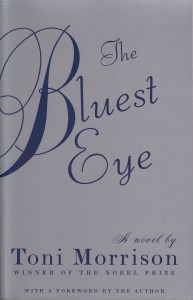
bluesteyeBanned Book Week is one of my favorite holidays. Don’t worry—you haven’t missed it—it occurs the final week of this month. I’m not very good, however, at guessing how long it will take me to finish a fiction book, so I start early, just in case. My banned book of choice this year was Toni Morrison’s The Bluest Eye. It’s not easy to read a novel which is so close to the truth. As any writer of fiction knows, just because something didn’t happen precisely as described doesn’t mean that it’s false. Indeed, fiction is often factual. It’s not easy to read because the “race”—a dubious distinction at best—to which I belong has often throughout history victimized others. While I’ve never knowingly participated in this criminal action—and despite what politicians might say, it is criminal—it’s never comforting to hear from the victim’s perspective. The Bluest Eye is about African American experience in the land of the free. At least in name.

What becomes clear from the beginning is that the families around which this story revolves are pushed to their limits. In an affluent society they are forced to live with less than their “white” neighbors have. Slavery may have ended, but the superiority mindset that permitted it in the first place hasn’t. I grew up in poverty but I didn’t have the added burden of being treated badly because of my “race.” Stories that remind us of that reality are never comfortable places to be. We’d rather think that since slavery ended prejudice went away with it. In reality, however, it is still here. Interestingly, the culture portrayed so vividly by Morrison is deeply biblical. Indeed, surveys of Bible reading in North America show that African Americans tend to actually read the foundational book more than their oppressors. The biblical worldview spills easily across the page.

Although the Bible made it onto the list of top ten banned books last year, The Bluest Eye was challenged because of its sexuality. That’s another defining aspect of the novel. It’s a frank exploration of the human condition. The protagonists are not only African American, they are also all female. Their perception of sexuality is, in many ways, inherently that of victims. Not that love doesn’t enter it, but rather that poverty often leads to a state where sexual gratification is held up as one of the few positives in a life that includes regular mistreatment, poor pay, and jail time. It isn’t an easy story to read. Morrison’s deft hand, however, prevents the story from becoming gloomy. It is like spending a sunny day knowing there’s something you shouldn’t see in the basement. Banned Book Week may be some time away yet, but it is always the right season to read about the truth.


Behind Left Behind

Now that September’s here, we can begin thinking back over the summer, scratch our heads, and say “huh?” We’ve been so blinded by the Trump that we haven’t had time to reminisce over what’s been happening fundamentally. I mean among the Fundamentalists. This summer Timothy LaHaye went to his reward, followed this week by Phyllis Schlafly. I’m sure they’re basking in an all white, straight, and Protestant Heaven. For those of you unfamiliar with LaHaye’s name, you’ll know his fruits. The Left Behind series was his brainchild and many other aspects of this not-yet-raptured world spun from his squeaky-clean mind. He and Ms. Schlafly spent their lives telling others how to be good. I’m sure their only regret is that they won’t be here to be raptured away so they can see the look on the rest of our faces. No matter, they’ve gone to a better place.

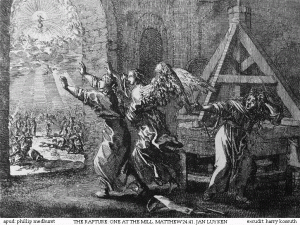
Also this summer Lyle Jeffs, another sort of Fundamentalist, also disappeared. Under arrest for some suspected crime or other, Jeffs escaped from the FBI by worming out of an ankle monitor. His attorney, however, has suggested that Jeffs was raptured instead. Come to think of it, that could explain these other disappearances as well. It’s a regular Bermuda Triangle of Fundamentalists, it seems. The rapture is the ultimate excuse because the Almighty can trump any suit, any hand. Maybe they all just wanted to get off the earth before this fall’s elections. Fundamentalism, it seems, is missing from the political docket this year. Whereas since I’ve been able to vote candidates have been raising issues of concern to the more right-wing contingent, this year the fundies seem to have vanished. Maybe the rapture did occur after all.

teachings_of_jesus_39_of_40-_the_rapture-_one_at_the_mill-_jan_luyken_etching-_bowyer_bible

You see, I’ve read enough of the scenarios to know that those left behind are always confused. They don’t believe in a rapture and the missing people are only part of the problem. Things are going awry (again, look at the politics and differ!). What will life be like in this post-rapture world? How will we survive with our conscience gone? All things considered, it’s going pretty well. Missing the rapture was one of my greatest childhood fears. Like all good Fundamentalists I assumed I wouldn’t be deemed worthy of that first reaping. I’d be left to suffer through tribulation and, hopefully, beyond that salvation might lie. LaHaye and Schlafly got out before the action started. Lyle Jeffs, his lawyer suggests, did too. The FBI found olive oil all over the ankle tag and, perhaps, the signs of a struggle. I’ve watched enough movies to know that when someone is raptured, however, all their clothes are left behind. The only way mortals ever face the Almighty is naked as the day they were born again.


Viewpoints

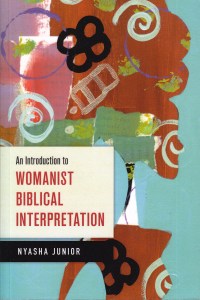
WomanistI first heard of feminism in seminary. Growing up as a poor, uneducated fundie in a small town, where would I have learned about it? I came to it naturally, though. Being raised for several years by a single mother I knew that women were just as smart and resourceful as men. I guess I was surprised to learn that others didn’t see it that way. This was in the eighties and angry feminism was around—I was occasionally attacked in class for my naiveté. After all, I had attended Grove City College not because of its conservatism but simply because I didn’t know any better. This is a lengthy preamble for a book that would’ve helped me a lot as a youngster, although I wouldn’t likely have known to read it. Nyasha Junior’s An Introduction to Womanist Biblical Interpretation is a very useful guide to those who don’t really know what womanism is.

I’ve been in biblical studies long enough to know that I really don’t know much. There are critical approaches to the Bible I’ve never even heard of. Not too shabby for a field that has already been written off as moribund by the academy. In any case, the title “womanist” doesn’t really say much beyond an implication of gender. Junior’s book explains that. Womanism didn’t really grow out of academia as much as it did out of African American women’s experiences. I admit that it took this book to teach me that. What is really being addressed, however, is how womanism is becoming, or is starting to become, an interpretive school. The Bible is in the public domain. It’s anyone’s book. Indeed, it strikes me as odd that translators copyright their work, especially if they believe it is the word of God. The word of God comes with a price tag, I guess. African American women have long been readers of the Bible. What, though, characterizes this method?

That’s the question with which Junior wrestles in this informative book. Just as being female doesn’t make a scholar a feminist, she notes, being an African American woman doesn’t make one a womanist. And we all approach texts with a method, explicit or not. “Objectivity” doesn’t really exist and even literalism is an interpretive approach. Junior traces the history of both feminism and womanism, especially in regard to biblical interpretation. Her struggle should reflect that of any scholar—how do I regard the text regardless of my demographic? While many churches have slumbered in doctrinal dreams, progress in reading the Bible has marched forward. The real danger often comes in the form of labels. This book, written just as a method is starting to be formed, is a trustworthy guide to both the history and to the larger questions.


Day Labor

It’s difficult to believe in Labor Day. Don’t get me wrong—I’m glad for the day off. It’s just that I don’t think people really believe in the idea any more. It’s hard to take professed goodwill for workers seriously in a plutocracy. Especially when money’s a fiction. When pay was in coin, although abstracted, you were literally handed something of value for your work. Now technicalities and loopholes and utter abstractions make some—including would be and actual politicians—wealthy. These are all tricks on paper, affirmed by accountants, and we watch like the audience of a magic show as the improbable is made out to be actual fact. And these who hold this imaginary wealth control the lion’s share of the waking hours of the rest of us. We’re given Labor Day off with a pat on the head and we’re told to go enjoy ourselves before summer is up and we really have to get back down to work.

DSCN5084

Many of us—I know because I can see the cars—use the holiday to travel. It’s not really so much a day of rest as it is a day of trying to get back home so we can be to work bright and early tomorrow. Since it’s the last break before Thanksgiving you’d better enjoy it. If there were really money in that pay envelope—not even real envelopes are used any more—it might be easier to buy the illusion. Like Amazon I take a small cut of the transactions between employer and debts I owe just to live near where I work, which isn’t really so near but as close as I can afford. At least today I can not go into the office. I can spend the day getting home instead.

I often wonder why we’ve let ourselves be fooled by a system that will only ever allow the very few to truly find financial independence. Like lemmings we run right after them, thinking that just beyond that cliff true prosperity lies. A chicken in every pot. A car in every garage. Right now all those cars are actually out on the road—I can see them—and they’re not really paid for because they cost too much to buy outright. Most of us need them to get us to and from work. Or to and from vacation. Summer’s winding down. Hurricanes are already spinning away in the Atlantic. I’ve grateful for the day off. I really am. I only wish I could believe that it meant something deeper about human nature.


Becoming the Past

Back home for a flying visit over the final dregs of the summer, I find myself in a hotel in my hometown. It’s an odd place to be. As I’ve often remarked to those who know me, I remember living in three houses in this area and all three have been torn down. Looking over the vacant lot where my elementary school once stood, I have a feeling of being erased. Just up the hill from my hotel is a blank space, like when a molar has been removed, where my junior high school once stood. Even the seedy shops I remember from childhood are gone, an entire block of buildings torn down. Wal-Mart opened up just a couple miles away outside of town, and all small businesses got down on their knees and prayed before dying. Being from somewhere is more than just a matter of going away. It’s also coming back.

IMG_2930

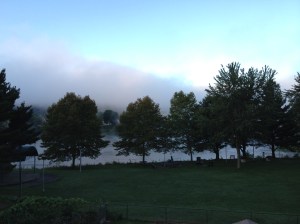
Standing outside in the misty morning sipping my coffee, I watch the river flow. There’s a fog rising over the Allegheny this morning and it makes this place look mysteriously beautiful. I think back to New Jersey, where I was at this time the day before, and how I can’t step outside without seeing other people. I go jogging at 4:30 in the morning sometimes. I’m never alone. On this balcony over the river I see no one. That person down by the river is really just a statue. Maybe I am too. What is left of a person when their hometown disappears? My fascination with ghost towns is catching up with me. Once someone said they thought I disliked small towns from the way I talked. Quite the opposite, the statue whispers. Quite the opposite.

If it weren’t for the people I know, would I ever come back here, I wonder. The warm coffee through the styrofoam cup reminds me of Judas. Even he knew how to kiss. This town, shrinking with age, gave me life. When I stamp the streets of Manhattan on my way to work, I know I’m a different man than I was back in this town. I would’ve found it difficult not to want to help anyone in need, back then. This homeless guy’s been sleeping in the same spot all week while millionaire wannabes look the other way. There’s a mist on the water this morning. The Allegheny flows on to the Ohio, and the Ohio on to the Mississippi. Down into the gulf that’s part of the ocean than encompasses us all.


Zoo or Farm?

It comes as no surprise, I hope, that I read lots of fiction. While not every book I read makes it onto this blog, a good many of them do, along with some I haven’t read yet. Bill Broun’s Night of the Animals is one of the latter. A suspicion is itching way down deep telling me that I’ll probably end up a fan. Part of my suspicion comes from having read a story on NPR about the book. First of all: dystopia. Need I say more? I admire those who try to paint a future with a lighter palette, but I’ve been observing the way those in power behave and it kind of makes me think optimism about improvement is just a tad naive. People are too easily lulled into apathy by things like sports and the internet. The Romans used bread and circuses. Meanwhile those in power help themselves to a bit more until you can’t even get on an airplane without a total stranger seeing you sans briefs. If I can’t be trusted by those I elect, what cause do I have for hope? But enough about me. The book’s the thing.

DSCN1969

Night of the Animals, according to the NPR piece, is kind of a reverse ark. The animals in the London Zoo are understood by a man and they ask him to release them. I don’t know what happens, but I sure hope to find out. When interviewers ask Broun what it was like to spend fourteen years working on a novel, he responded in a way that, I suspect, many writers would understand. He said that it was a spiritual journey. Writing this book was his search for God. Many of us must nod our heads to that.

Concentration is becoming a dying art. I’ve written a number of books in my life—by far the greatest number remain unpublished—and I know there’s nothing like the intense concentration you experience when lost in such a world. Yes, it is spiritual. It is also a cry to be heard. As George Orwell well knew, we are the animals hoping to be heard. Zoos represent entrapment. Broun states that he wanted to explore how people are trapped in his novel. Looking at a system that rewards greed and keeps workers in unfulfilling jobs just so they can keep the system going while their CEOs buy another hotel chain or sports team and decide to run for office, I begin to hear the oinks, whinnies, and neighs all around me. And I haven’t even read the book yet.


Mysterium Tremendum

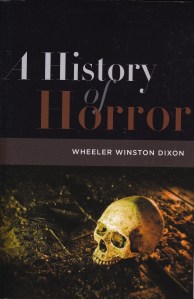
HistoryHorrorFor those of us accustomed to ancient things, horror movies are remarkably new. That doesn’t mean, however, that they are scarce or even easy to understand. While it is beginning to erode, the academic derision of popular culture has long avoided the decidedly low brow genre of horror. It doesn’t know what it’s been missing. Wheeler Winston Dixon’s A History of Horror is an insightful attempt to make some order out of a century of monsters and mayhem. Beginning at the stage when “horror film” was still just a demonic gleam in some vampire’s eye, Dixon points out that from the very earliest experiments with movies “horror” was a popular trope. It seems only natural that the idea of a full-length scary movie would be the expected development. What happened in Universal Studios in the 1930s is that business began making money out of monsters. Where there’s money, there be monsters.

Dixon takes us through the early days into the tired era in the 1950s when life was, apparently just so darned good that people weren’t really thinking about monsters. (Dixon’s analysis is a bit more sophisticated than that.) Horror films matured in the 1960’s and spun out of control in the ‘80s. His book continues up to the first decade of our current century. There’s obviously a lot that can be said about this, but what caught my attention, naturally, was how quickly religion entered the discussion. Those of us who approach horror with an open mind know that religion is its next-door neighbor. Indeed, one of the nihilistic aspects of the proliferation of horror movies since the 1980’s has been the lessening of this getting to know the neighbors. Horror, as Dixon notes, seems to have devolved to brutality and cruelty with no real message.

I’ve never been a fan of gore. I’ve watched my share of slashers, I suppose, but they’re not my favorites. Horror can—in the best of its offerings—be very profound. Indeed, it can even inspire thoughts not so terribly far from those generally classed as religious. For what is worship if not carefully managed horror? The concept of the holy as mysterium tremendum underscores this dynamic. Part of this connection is the appeal to emotion. Horror movies make you feel something, and that is a large part of their appeal. They can be more, however. A smart horror movie will feed your brain rather than just having zombies eat it. Academics, eventually, will catch up with it. Dixon starts to show the way.


Finite Gods

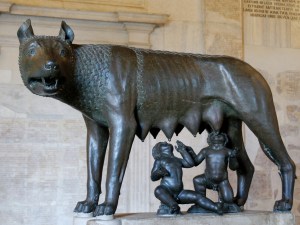
Just how many gods are there, anyway? Well, that’s not really a fair question. For one thing, do I mean “real gods” or gods that people believe in? Do I mean “believe in” or made up? Do I mean “made up” or intentionally fabricated? And the nesting questions could go on and on. Over the years in my professional capacity as an erstwhile teacher, I accumulated books listing the deities of various cultures with brief descriptions. I once even argued that using “god/goddess of” (the divine-genitival construct) as a phrase distorted ancient concepts of divinity. The fact is people have believed in many gods in many different ways. As modern scholars of religion we’ve only begun to reach the heavens (or underworld, or anywhere in between, for deities may be found anywhere). This issue comes to mind because a friend recently shared a story from IFL Science about a new Etruscan goddess. The piece by Ben Taub mentions a stone recovered from Poggio Colla, a site in Italy, written in Etruscan. The stone seems to mention a new “fertility cult” goddess. And once again religion and science have met, but not quite kissed each other.

Photo credit: Jastrow (2006), Wikimedia Commons

Photo credit: Jastrow (2006), Wikimedia Commons

Let’s begin with the Etruscans. Before the Romans, Etruscans lived in Italy, giving Tuscany its name. We know very little about them, as their language (Etruscan) is rarely found and imperfectly understood. Some of the classical gods may go back to Etruscan originals, and the Etruscans seem to have known of at least some of the cultures of the ancient Near East, or ancient West Asia. We have no idea how many deities the Etruscans recognized. Polytheism, for all its heathenish exuberance, never had a problem with adding more gods. Interestingly, the “new” goddess mentioned here, Uni, is someone I used to talk about in my Rutgers classes on ancient Near Eastern religion some five-plus years ago. Pardon my crowing—I seldom get to suggest I was ahead of my time.

What really interests me here is that websites that advocate science still take an interest in religion. Although belief is relegated to inferior minds (generally) science does admit, from time to time, that it’s interesting. The study of religion, in at least some schools, is a scientific enterprise. No, we don’t put gods under microscopes (telescopes might be more useful) but we use the same techniques as empirical studies of nature use in order to try to draw some conclusions about religion. Despite the fact that the vast majority of humans on the planet are believers, higher education has consistently under-funded or disbanded departments who apply rational thought to religion. We suppose that someone else can pick it up and study it, coming to useful conclusions without putting in all the homework. Don’t mind me, though. I’m just basking in the light of having known about Uni years before she was discovered.