De-programming

I’m no foodie. That’s not a trendy thing to admit, I know. I’ve never been a good consumer. I think it’s because I don’t like being programmed. One area of life where we are most open to programming is in what we eat. Raised to masticate animal flesh, we’re told that it’s healthy for us, and besides, where on earth are you going to get protein if you don’t eat animals? Without thinking too much about it, we step in line. I remember asking my mother, as a child, what part of the animal “the meat” is. I was kind of hoping, I guess, that it was some part that might be kind of painless to lop off, because I didn’t like to think of the implications otherwise. Even when the answer wasn’t satisfactory, I didn’t change my diet.

Once, when eating with a friend, my host commented that you shouldn’t be allowed to eat meat unless you were willing to kill the animal yourself. He wasn’t advocating vegetarianism—he was serving meat—but he was thinking through the process logically. I became a vegetarian, because of that logical thought process, about 18 years ago. I continued to be programmed, however. Yesterday I attended a vegan lunch. I always thought of vegans as spare, acsetical types, emaciated and gaunt. I learned that they are often people who think through the consequences of our love affair with meat. And other animal “products.” The problem is industrial farming. In a word, the commodification of animal suffering. Those who don’t work in the agri-business—to which most looming environmental disasters can be directly traced—are prevented from seeing the conditions in which their “food” is being kept. Animal cruelty on a scale that is, well, industrial. Decisions are made based on one metric—profits.

I don’t think about food a lot. It has become clear to me that my friend’s logic works. One of the things our vegan presenter pointed out is that pigs are considered the fourth most intelligent animal species. Our love of bacon has them kept in conditions where they literally lose their minds. We don’t see it, so we continue to be programmed. Go to the grocery store. The healthy foods are more expensive—“consumers” are punished for refusing to play the “no thinking” game. I don’t know much, but I do know that it’s often the things I do without thinking that ultimately lead to trouble. Capitalism rewards the greedy only. The rest of us, including our animals, pay the price. Think it through and consider the conclusions. I don’t like being programmed.
Persecution Myth

The myth of persecution is a great cover. Christians, we are accustomed to think, are timid and loving individuals eager to turn the other cheek. In this sophisticated world of science and technology, they might appear a little naive, but they’re not really out to hurt anyone. Or at least some of them aren’t. I grew up among what would now be called Fundamentalists. Harsh to their own sins, they’d not imagine harming others. The story went that in the Roman Empire days it was open season on Christians and the oppressors liked nothing better than killing off a dozen before breakfast. That myth has largely been debunked by historians. Yes, there were some brief periods of intensive persecution, but for the most part the early Christians were left alone.

Many of the more zealous among the literalist sects today feel the loss of that mythology keenly. What can you do when you learn that your primitive ancestry wasn’t as heroic as you thought it was? For some, that myth must be kept alive today. When it is acknowledged that our world has become a smaller place because of technology, we get exposed to those who give the lie to our prejudices. Moral Muslims (despite the media portrayals), Hindus, Buddhists, and even secular humanists, abound. News, however, thrives on negativity. After all, it too is a capitalistic enterprise. We see the violence, the hatred, the bigotry. The myth lives on. Christian Dominionists have simply given up on the rest of the race. The Bible, after all, says few will be saved. And they have thrived for decades based on the simple fact that nobody takes them seriously.

I have seen the lack of compassion in evangelical eyes firsthand. A coldness that declares education to be evil since the only truth was revealed long ago in unchanging form. The word of God stands forever. It says so itself. And among the most despised of all human beings are those who study that word instead of “just reading” it. Those outside this camp know there is no such thing as “just reading.” They also know that we have no original biblical manuscripts at all and that translations are merely approximations. It’s difficult to build absolute laws on approximations. Among themselves these groups claim that legislation to treat others equally is a direct affront and insult to them. In fact, they claim they are persecuted because of the fair treatment of others. The thing about democracy is that any system can be gamed. Even Putin can be your friend, for this is the world of myth.


Bible Practice

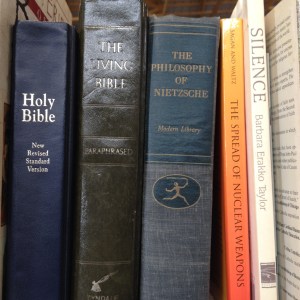
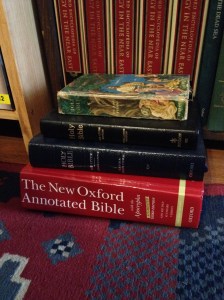
In a strange kind of oneupmanship, the horrendous murders in Sutherland Springs overshadowed the story of Scott Ostrem’s multiple shooting at a Walmart in Colorado. Ostrem apparently shot at random and killed three people. No motive is known, but when his apartment was searched a stack of Bibles was found. Plenty of people have Bible stacks in their houses—I know I do—but the odd element here is guns. The “reasoning” behind the NRA’s convoluted logic is that guns are for self defense. Everyone ought to have them, along with their Bible stacks. When those voices in your head begin to speak, which you grab—gun or Bible—may make all the difference. Fact is, you don’t have to be mentally stable to buy guns. And no matter how much the NRA says you should shoot back, guns in the hands of madmen obey no rules.

Trump promised to make America great again. One of the statistics at which we excel—indeed we’re a world leader—is gun deaths. We also do pretty well at opioid overdosing. Politicians can’t seem to figure out that the underlying causes here are related to the society they’ve built where you can’t ever get ahead and no matter what you do the 1 percenters will get richer while you spend your days struggling to get to the point when you can climb back into bed and sleep it off until it all starts over again. Watch them in congress. See them trying to thrust more money upon the wealthy. See them pocket the funds the NRA so generously offers. And then read the statistics. Some inexplicable disconnect exists that no amount of drugs will bridge. We are a hurting nation. And stacks of Bibles aren’t the answer.

A Bible stack in its natural habitat

In antiquity there was an ideal. Not that it ever existed in practice, but at least they had the idea. The ideal was that there was nothing wrong with wealth as long as the wealthy first ensured that everyone had enough. Then they could go on an accumulate as much as they wanted. The problem of course is that nobody knows what enough is. When do you know that you have enough? Today there’s no ceiling cap. Take your pick: money, guns, drugs, Bibles. You can have as much or as many as you wish. In just about any combination. Any combination that doesn’t involve money. Only the 1 percenters should be entitled to that. And the rest of us here below and fight it out over the remaining three.


Clean Living

One of the fun things about the Oxford Dictionaries blog is that you learn unexpected things about words. In fact, you can often find something profound in a matter of a couple of seconds that will make you stop and scratch your head. A recent post by Gary Nunn titled “Good clean fun? The shaming language of food and disease” makes the point that English, like other languages, shames by default. That’s worth considering. Religions are engines of social control, and many of them have highly developed techniques of shaming people into adherence. One of the most famous is the shunning practiced by some Anabaptists, but it certainly isn’t the only tradition that brings guilt to bear.

Some people, psychologists say, suffer from high levels of personal guilt. Shaming is particularly painful to such people and language, it seems, might not be their friend. Others, however, can take quite a verbal hiding and still not feel any remorse. In other words, shame doesn’t seem to work on them. If some people don’t need it and others are immune to it, why do languages excel at inducing shame? The article by Gary Nunn is looking at how “clean,” which was generally used to mean tidy, healthy, free from vermin, came to mean “standard behavior.” From its original usage, “clean” moved to describe—often by its antonyms—things that really don’t fall into that category; foods and sexual behaviors, for instance, can be labeled unclean or dirty, even if they are hygienic and natural. The purpose of this evolving usage seems to be another way to shame someone.

Human beings are social creatures. Although fascinated by violence, most people do not like to use it unless it’s necessary. We’d rather settle things civilly. One way to do that is by using words instead of weapons. Our languages are built for that. We all know individuals who can bring us down with a few harsh words. No physical pain has to be induced, or even threatened. Collectively, the will of the people—at least, so I’m told, outside the United States—influences decisions that governments make. I’ve mentioned before that even non-literate creatures, such as the great apes, will not tolerate injustice in their communities. Sure, alphas may be a necessary evil, but when they abuse their station the collective brings them down. In our culture where nearly all the wealth—by far the vast majority of it—is controlled by 20% of the population, and among them, the majority in the top 1%, we need some stronger words for shame. Or it may be that some people are simply immune.


Christian Story

The problem with the Bible is anybody can “interpret” it. As a book of unrivaled status in the American imagination, it can be tapped for anything from advertising to justifying pedophilia. So when stories of Roy Moore’s sexual dalliances with minors emerged, Alabama’s state auditor, Jim Zeigler drew the comparison with Mary and Joseph from his half-hearted knowledge of the Bible. There is no auditor for Bible interpretations. It’s the ultimate free market. Many, including evangelical clergy, were quick to jump on the inappropriateness of the analogy. What they didn’t see is that the Bible can justify just about anything. Despite what it says. That’s the problem with worshipping a holy book.

What the Good Book says about Mary and Joseph is very, very little. We do not know their ages—they are never mentioned in the Bible. The tradition about Joseph being older seems to go back to having to explain his continence to preserve Mary’s perpetual virginity—also not in the Bible. The church, in the early days, had issues with ideas such as “original sin.” When Augustine suggested it passed, along with bodily fluids, during sex, it became clear that Mary could have none of that. Even if she was a virgin by misquoting Isaiah, then she still had original sin from her parents. So Mary had to have been immaculately conceived. The Bible, of course, knows of none of this. Anybody can interpret it. And what senator-to-be wants to be bothered with consulting a Bible scholar? They’re hard to find. And besides, they might not interpret it the way you want it.

GOPolitics have sunk so low as to pressgang the Bible into justifying pedophilia. What’s more, the faithful don’t seem to mind. The Bible’s big enough that you can find just about anything in there. Except morality, apparently. You’d think that anyone running for public office would examine his—and it’s usually a guy problem—life pretty closely for possible scandals. We’ve lived to see the radical right, diligently groomed and oh-so-righteous, go after anyone who can spout insanity and be counted on to vote against women’s rights. You can be sure Roy Moore will be forgiven—already has been by many—because the Bible swings that way. We’ve already seen what happens when people like Moore take public office. They make America grope again. For the Bible tells them so.


Imagine Devils

One of the more encouraging events of recent times took place on Tuesday. In elections across the country many public offices were won by women. After a year of official misogyny from the Comrade in Chief—it started long before the election, of course—I felt hope for the first time. You see, I’d been reading Carol F. Karlsen’s The Devil in the Shape of a Woman: Witchcraft in Colonial New England. I’ve been interested in witches as part of my general exploration of religious views of monstrosity, and in the Early Modern Period, witches were still lurking in the imagination of many. Karlsen’s book isn’t focused solely on Salem. There were other outbreaks of witchcraft accusations, and a general air of suspicion had hung over New England from its founding.

Why women? Karlsen’s question haunts much of human history. Why one gender, or gender construct, why one race, or racial construct, feels itself superior to others is an issue not easily resolved. It doesn’t come, necessarily, from being a “white” male, but it is a disease that primarily effects that demographic. It’s a myth of superiority. The Devil in the Shape of a Woman is not an easy book for a man to read. Centuries of bad behavior don’t exonerate those who, although their belief was sincere, found an outlet for their faith in the destruction of others. Karlsen demonstrates that quite often the background issues were those of inheritance—in a patriarchal society, land passed to male heirs. Women who owned property complicated a social picture that was already under stress. Consider: any family with two sons would halve (although the proportions were not equal) its land each generation. The only way to keep the wealthy wealthy was to snatch land wherever they could.

It wasn’t so simple as that, but the basic economics—which haven’t changed much—set colonial New England up for disaster. Birth control was considered evil. Men still had to be gratified, however, and population increased as land size remained the same. The system is untenable. Just a year ago the electoral college made love to an angry white man. A man who “owns” lots of “valuable” property. A man who demeans women and those of other “races.” When his own shady dealing come into the light he cries “witch hunt!” History is full of ironies. One of the greatest of them in the fact that women have been held back long after circumstances had advanced enough to allow equality in a stable society. There may still be witch hunts, but they flow in the direction they always have—toward those denied autonomy and civil rights. Maybe Tuesday was finally a sign of hope.


Creating Annabelle

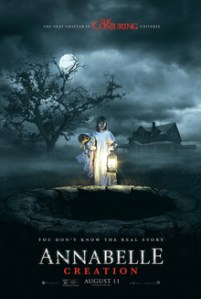
You might go crazy trying to piece it all together. The buzz for The Conjuring had a spinoff prequel, Annabelle, in the making even as the movie hit theaters. Love it or hate it, horror makes money. A more traditional sequel, The Conjuring 2, is leading to two further spinoffs, The Nun and The Crooked Man. And this summer a prequel to the prequel, Annabelle: Creation, came out. Only Annabelle isn’t really so much a prequel since it doesn’t have to do with Ed and Lorraine Warren. In any case, I finally had a chance to watch Annabelle: Creation and found it one of the more stunning examples of the genre in a long while. Intelligent, intricate, and slotted into the series in ways that required serious thought, it works as a stand-alone film or as part of a series. And, like much horror, it is deeply invested in religion.

First of all, the orphans moving into the Mullins’ large home are from a Catholic orphanage that has been closed. They are overseen by Sister Charlotte, so we expect religion to interdigitate with the horror here. Confession of sins, prayer, and crucifixes appear amid the unfolding lives of the girls in an isolated house inhabited by a demon. Some of the tricks we’ve seen before, but there’s enough new here to reinforce the thesis that religion and fear are close kin. Despite all this, and having a priest on call, no exorcism takes place. The doll, Father Massey declares, is just a doll. After the house has been blessed, there’s no need to fear. Of course we’ve already seen what comes next so we know the priest is wrong.

Some people watch horror to be scared. Others of us watch it looking for something a bit deeper. Not for everyone is religion a source of fear. We do, however, tend to cling to our beliefs because the world is such an uncertain place. We’re aware that we won’t last forever. Horror exploits that openly and without shame. Threats are constant and unrelenting, even if contrived. Religion is often a place to find consolation in the face of fear, so it becomes even more frightening when the place to which you’ve fled is the very place that’s out to get you. Annabelle: Creation is aware of this dynamic. The crucifixes, the Bibles, the prayers—none of this helps. What’s more, the girls manage to pull themselves together for safety when there are no men around. The real danger, after all, is inhuman.


Guns and Ghosts

The irony of a nation that has gun laws made by those with body guards is especially cruel in the shadow of Sutherland Springs. Just a month after the worst mass shooting in United States history, another cohort of corpses receives only empty answers from DC. The solution to all the shooting deaths, 45 asserts, is more guns. This from the same White House that can find no credible alternative explanations for global warming, yet continues to break down any emissions barriers it can. The real noxious emissions are coming from the greedy mouths of the chicks in the feathered GOP nest. What is the word for what lies beyond insanity? We need it now.

Like many thinking people I’m very pleased with the results of the gubernatorial elections in New Jersey and Virginia. It seems, temporarily, as if reason has found its voice. The mistake at this point would be to relax and feel as if the job were done. We have raving lunacy at the national level, gun violence out of control, and politicians who just can’t live without NRA blood money. The story of Sarah Winchester’s ghosts may not be true, but it doesn’t have to be. We have a nation full of ghosts. Barely elected candidates claim a mandate to destroy the infrastructure that has allowed them to become rich. The wealthy, you’ll notice, are those who want to take all the marbles and go home. And they live in houses with guards to protect them from all the firearms they’re handing out like candy on Halloween.

Stop and think about this. The White House admits that climate change is human caused. The conclusions are quite dire for those who own property in New York City, let alone entire nations that will be underwater in a few years’ time. The response? Ignore the facts. Boast a bit more about how great we are. Give tax cuts to the wealthy and guns to the poor. Why doesn’t this equation add up? Pardon my jeremiad on what is the first hopeful morning a reasonable person has had in a long time. We have to start taking back local politics and let the national government know that it no longer speaks for the people that somewhat giddily gave it power just a year ago. Otherwise there are bound to be many more ghosts about. And one thing we know for certain, Washington doesn’t believe in ghosts.


Keystones

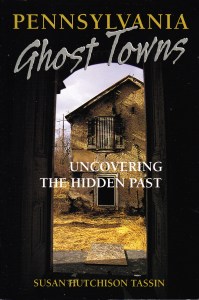
It was one of the very few parties to which I’d been invited in Edinburgh. “When a Scotsman asks you where you’re from,” one of the guests said to me, “he means where you were born.” Although we have no control or say over where we come into the world, we do feel that the place has a claim on us. Combined with my undying interest in local history, that means I like to read books about my native Pennsylvania. I was a first generation Pennsylvanian, to be sure, but to keep a nearly forgotten Scotsman happy, that’s where I’m from. Sarah Hutchison Tassin’s Pennsylvania Ghost Towns: Uncovering the Hidden Past is that familiar kind of book considered light reading, geared largely to the tourist and nostalgic past visitor or homebody crowd. Still, these kinds of quick studies often inspire the imagination. Lots of people lived here before you did.

A couple of factors stood out to me about Pennsylvania’s elder communities. One obvious feature is that a number of them began as intentional religious communities. Often breakaway sects from some major denomination, they established settlements to pursue spirituality in their own way, generally with strict rules, such as celibacy, that would spell their ultimate demise. Pennsylvania is well known for its separatist Anabaptist sects—Amish, Mennonites, and others who’ve been around for centuries and have integrated into the cultural mix of the state. I had no idea that a few ghost towns remain where some less successful spiritual seekers had broken ground. The second feature that stood out is how many communities were intentionally founded for commercial purposes. Often these were mining or lumber-processing towns. Some wealthy individual would buy a natural resource, build houses and a communal store, and permit workers to purchase goods only there. This meant individuals could never save money and never really afford to leave the mine or mill.

These are two very different conceptions of what it means to live in community. One is overly idealistic the other overly exploitative. At one end, the basic necessities of life—food, shelter, clothing—were kept from those who found themselves, like most of us, in need of a job. Or, at the other extreme, being held back from eternal life by failure to keep to the rules of a newly revealed religion. I never really thought of towns intentionally founded in these ways before. My naive view was more eclectic. But then, what do I know? I was born in a small Pennsylvania town and never thought to question why it was there. Where are you from? It’s a matter of perspective.


Joshua Fit

“Horrible things are going to happen!” shouts Grandpa Simpson. He ends his epiphany in church with the strange words “Epa, epa!” The Simpson’s Movie, among many other popular outlets, has had some fun at the expense of the Environmental Protection Agency. Over the years many people have concluded that it is ineffectual and that the heart of the government isn’t really behind it. One of the Dominionist creeds is that the government as we know it must be disbanded. Trump has been working hard at that, on his breaks from the back nine, since January. Appointing heads of agencies tasked with dismantling them, the underlying plan (not Trump’s, for he has no plan) is to take the current government apart while self-important Republicans simply can’t understand that they’re being used as pawns to be sacrificed as soon as a knight or rook comes along. Bishops don’t seem to be of much use anymore.

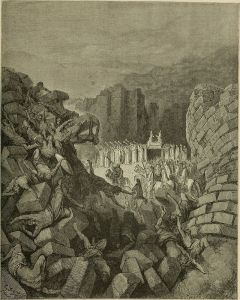
So when the head of the EPA cites the book of Joshua as science, some were surprised. Scott Pruitt, according to a story on BuzzFeed my wife sent me, has decided that the Old Testament is the new frontier. You have to choose who you’re going to follow. As for Pruitt and his house, it will be the Lord. And by “Lord” I mean money. Those who stand to gain by deconstructing the EPA are big businesses. Those who stand to loose? Only Homo sapiens and every other species on the planet. Although, in all fairness, rats and cockroaches have a way of thriving in our wastelands. In fact they seem to be thriving in Washington DC. I almost tripped over a rat on my way to work just the other day. They’re not just for the subway tracks anymore.

The Bible is the most abused book in history. This is what idolatry looks like. You take an object and make it a god. Nobody would be more surprised to find their words worshipped than those who wrote the Bible. Not one of them realized that their words would be taken the way that they are today. It’s pretty obvious that Paul of Tarsus would’ve taken a little more time in his letter writing had he known they’d be one day mistaken for God’s words instead of his own. And Joshua—well, we don’t even know who wrote that material. Whoever it was believed the earth was flat and that to stop a day from progressing all God had to do was hold the sun still for a day. No hot mitts needed either. This is, after all, the most powerful government in the world.


Stranger Things

Albert Camus preferred the label “absurdist” to “existentialist” to describe himself. The problem with labels is that we don’t always get to pick our own. As a young man fascinated with existentialism, I was introduced to Camus as one of their number that I should read. Categories, of course, are only abstractions to complex realities. So, for learning about existentialism Camus was recommended reading in those days. I selected The Stranger. So many years have passed since then that I only recollected a single part of the plot. Coming back to it as an adult is like walking down that beach a second time, unaware that you’ve just been down this way and something bad happened last time. Existentialism is like that.

Meursault is little effected by life. He has no strong opinions since, at the end of the day, everything seems pointless to him. He sheds no tears at the death of his mother because death is to be expected. When a heat stroke confuses him sufficiently he unintentionally kills a man. At his deposition the examining magistrate finds Meursault’s atheism inexplicable. In the face of the possible consequences of his actions, such indifference leads him to refer to the prisoner as “Mr. Antichrist.” Awaiting his execution, Meursault has a final confrontation with the priest that has come to his cell unbidden. The prisoner is convinced that even on death row he believes more sincerely than the man of the cloth. Camus’ story is surreal but realistic. A parable for his day and ours.

I’ve lamented before about the decline in philosophical literature. Taking philosophy straight requires the kind of concentration that I lack on the bus or before going to bed. Novels like The Stranger express such ideas in digestible form. The reader identifies with and despises Meursault. Why doesn’t he do something to help himself? Boredom and indifference will literally kill him. He is, however, steadfast, and that is something to admire. Along the way existential ideas are woven into the character’s thoughts and dialogue. Everyone is like an actor in a play—they did not write it, they simply perform the roles assigned to them. When it’s all over they end up in the same place. Absurdism and existentialism aren’t very far apart. They’re both categories devised to help us comprehend the enigma that we confront in books such as The Stranger. Meursault can’t give the chaplain any false belief since, as he notes, those who believe have more need of convincing than those who don’t.


Digging Even Deeper

What does it mean to exist for someone else? Isn’t this the very definition of slavery? Yes, we may voluntarily give ourselves to someone for the sake of love, but woe to the person who thinks he owns his spouse. Human beings may be an acquisitive lot, but that doesn’t excuse it. To be civilized, after all, means to be more advanced than we are by nature. These thoughts follow on hearing one of my colleagues interviewed on Game Plan on Bloomberg. In the light of the Harvey Weinstein scandal, Francesca Levy and Rebecca Greenfield are interviewing people in different professions to see what inappropriate treatment women receive at the behest of men. Their job is, unfortunately, not one where it’s difficult to find examples. In this particular case, they interview Beth Alpert Nakhai of the University of Arizona. Dr. Nakhai is an archaeologist and she describes the perils faced by women in the field.

In 1987 I volunteered on the dig at Tel Dor in Israel. I had just graduated from seminary, didn’t have a job, and was pretty sure I’d be going on to graduate school. Tel Dor, like many digs, had different loci excavated by different university teams. I was on the Boston University area, B1, next to the section being worked by one of the universities in California. At one point one of the seasoned men—I can’t remember who—remarked to me that digs in Israel were great because of the three A’s: “alcohol, adultery, and archaeology; in that order.” It was intended as a joke, but it had that time-worn feel of a sentiment that’s been around for a while. At the time I thought little of it. I was there only for the last A, and, had circumstances been different, I might’ve made that my career choice.

Listening to Beth’s interview, however, showed me the darker side of careless remarks like this. Archaeologists often work in remote locations where local laws treat women differently than men. University professors have great power over graduate students and are able to make or break careers. Often married men leave their families in safe locations while they spend their summers directing teams that include female students and other volunteers. I’d never thought of the experience from that angle before. As a man I didn’t have to worry about anyone coercing me into an unwanted physical relationship far from prying eyes or legal systems which, at least in theory, protect women. The truly sad thing about all this is that forces are, especially now, at work to make women victims again even in this country. The point of archaeology is to try to understand civilization writ large. And yet, civilization in the advanced world is now moving backward. How long before we too are buried under a pile of shiftless dust waiting to be discovered by some future excavators whom we can only hope are more advanced than we are?


Amityville Revisited

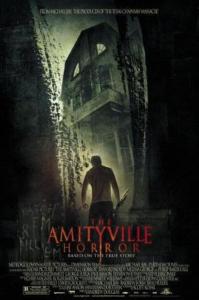
Remakes, standard wisdom holds, are seldom as good as the originals. When the original wasn’t great to begin with, the bar should be lower. Should be. I’ve been curious about the Lutz haunting in Amityville, having just read the book that started the phenomenon back in the late 1970s. I saw the movie first. That was several years ago now, but I do recall that even as horror movies go it had its failings. Some of that goes back to the book (presuming that anything happened)—nobody had a solid grip on whether this was a ghostly haunting or a demonic infestation. What the movie did do well is show how fragile family relationships can be, especially when under the pressures of supernatural supervision, not of the positive kind. Although, as is to be expected, the book was scarier.

Overcome by curiosity I finally watched the remake from 2005. Clearly I’m not the only one still curious about this alleged haunting, alleged hoax. I also have the alleged burden of looking for religion in horror. Only on this final count was it not disappointing. Well, that and in featuring burgeoning scream queen Chloë Grace Moretz. Although Father Callaway’s role is late in the film and brief, early on religious ideas are implicated. If the movie hadn’t tried so hard to be The Shining these themes might’ve been developed to good advantage. Instead it introduces Rev. Jeremiah Ketcham (also late in the film) as the first owner of the house in 1692 (did the real-estate agent’s mention of that date make you shiver?). Ketcham was a sadist to the Indians under his care, torturing them to death in the house. No time is left to explore the sinister minister’s motivation as the family implodes in its attempt to escape the house by boat.

As is frequently the case with the supernatural, we’ll likely never know what happened at the Amityville house. The story Jay Anson told is now generally classified as a novel. The preternatural can be judged neither in the courtroom nor the laboratory. The best that we can do is make celluloid adaptations to make some money on the deal. The DeFeo murders happened in living memory. The Lutzes left the house in a hurry shortly after purchasing it. Anson’s Indian “asylum” was never really there—and there were no such Native American practices in any case. What the remake left out was demons. Although the movie attempted other religious scares, the house just isn’t the same without them.


Turn the Other What?

The man next to me on the bus is reading his Bible. At one point in my life that would’ve made me feel safe. I would’ve known that the person next to me was committed to the same value system as mine—love for all, peace, equality, and acceptance. Now, however, I see that Bible and I’m afraid. You see, I’m reading Chris Hedges’ American Fascists: The Christian Right and the War on America. I can’t remember the last time I’ve been so scared. Hedges’ book was published a decade ago. What he wrote about then is coming true now and it’s because the elites of society—university folk and all—don’t take the radical religious seriously. In their delusional ways, they assume all will be well. If you think like that, read this book.

Dominionism is fascism dressed in Christian garb. It has no room for tolerance. It teaches that those outside its circle are to be ignored at best, and murdered without compunction at worst. This is not exaggeration. It is their teaching. It’s like that computer game that used to come with Macs where a time-traveling dinosaur collected the eggs of other species to save them from the coming asteroid. You could kill other dinosaurs without guilt because you knew they were going to die in 20 minutes anyway. That is very much the way Dominionists feel about you and me. We aren’t saved—their word is “Christian”—God has rejected us, and therefore we deserve to die. Many of them stockpile weapons just for this reason. Their goal, not at all hidden, is to take over the United States and make it a Christian nation. Already many in the houses of Congress are their candidates. They have a president who shares their values. We should be very afraid.

Hedges does a very good job providing the statistics that back his assertions. There is no question that this is real. Those who blithely vote Republican out of fiscal conservatism have risen to the bait. Trump has proved that once and for all. These “Bible believers” do not value or treasure love. They treasure treasure (many of them are very wealthy) and what they desire is power. Tolerance, in their view, is evil and compromising with the literal Satan in which they believe. Their Jesus does not love. He fights. And he fights for white, straight, privileged men. If you’re willing to forsake sleep, read this book. And if you think it’s exaggerating read the headlines.


Spirits and Souls

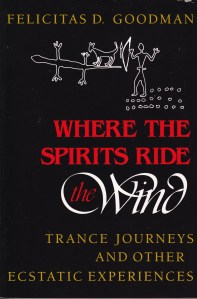
I first became aware of the work of Felicitas D. Goodman because of her classic text on spirit possession. Published by the reputable Indiana University Press, that book has become a standard for anthropological understanding of a strange phenomenon, which includes demonic possession. I found Where the Spirits Ride the Wind: Trance Journeys and Other Ecstatic Experiences in a used bookstore. Recognizing Goodman’s name, and always eager to learn about spirituality, I picked it up, It’s one of those books that makes you wonder. In an effort to experience trance states, Goodman began to experiment with various posture represented in the archaeological record. When she taught classes where students had no foreknowledge on the postures, she found they they reported similar visions during their trances while using the same posture. Matter, it seems, can effect mind.

I couldn’t help but wonder, as I read her account, what Indiana University Press must have thought about what they were publishing. This could be some serious woo, depending on how far you’re willing to go with Goodman. She was a doctorate-holding professor, so academic convention suggests she should be taken seriously. The BISAC classifications (those categories that often appear on the back cover of a book) tell the reader that this is Anthropology and Psychology of Religion. Neither field tends to give a whole lot of credence to the supernatural. At least not necessarily. And yet, there it is. Neither field really captures what Goodman describes in this book. Nobody really doubts that trances can happen; alternate states of consciousness are acknowledged phenomena. What we don’t have, however, is an explanation of what’s really going on.

A good deal of the this book consists of her students’ accounts of their visions. Although a native of Hungary, Goodman, through fieldwork and experience, became quite adept at Native American and other indigenous religious practices. The images that suggested the postures to her come from archaeological contexts around the world. This suggests that, according to Goodman’s worldview, these are some universal experiences. Attaining trance states, like meditation, takes practice. They can shift perceptions of reality. We tend not to hear too much about religion faculty who explore such things too openly. It’s a dangerous move in academia. Ironically, the institutions we build to understand our world tend to restrict themselves to the physical world or those fields that make ample lucre. I’m impressed that, even if by labeling it anthropology or psychology of religion, at least one university press took a chance at offering an exploration that might have some real world consequences.