Homework

I’m trying to organize a home office.  Gone are the days that this meant a stapler and mug full of pencils.  The office is essentially a laptop since work is essentially virtual.  Oh, there are days when I have to haul myself into New York City, but even making traditional print books is an exercise done largely online.  The office is a place conducive to work.  In the case of an editor, a room of books that can be used for reference.  In our apartment we had bookshelves (mostly homemade) around the inside perimeter, covering all wall space that wasn’t claimed by more necessary furniture.  We realized, as we were packing, that no free wall space reached to the floor.  We didn’t plan it that way, but a reading life can be a complicated one.  To write books you need to read books.

Our house has some built-in bookshelves.  Not enough to hold our surviving books, but it’s a start.  My office, however, is a spartan room.  Over the weekend I unpacked my “work books.”  That meant, for the most part, books about the Bible.  I filled three large bookshelves then ran out of room.  Not only was there that embarrassment, but there was the fact that a large number of “religion” books remained unshelved.  You see, I was a religion editor for a few years before being more narrowly slotted into the Good Book.  Some might say I should jettison these books since my career has moved on.  Those who suggest such heresy don’t understand the career of a displaced professor at all.  These books are still work books.  Job descriptions aren’t as stable as they used to be.
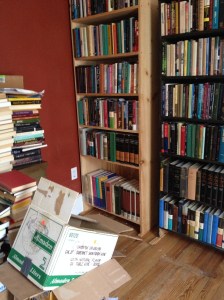
The complaint is an old one, at least to my wife’s ears.  In my mind I’m still a professor.  I still write—strictly on my own time—and I still research.  I do so without access to a university library so I have, over the past several years, made my own library.  This office, now out of bookshelves, is that amateur academic library.  My research has shifted from ancient Near Eastern studies (and that’s another whole discipline’s worth of books, some unfortunately washed away in the flood) to religion more broadly.  Not only is that reflected on this blog, but also in my publications.  The office isn’t done yet.  There’s a desk and a chair.  More importantly, there’s internet access.  There are some shelves, but in coming days there will need to be more.  Libraries are like minds; if they shrink they become less functional.  All books, no matter how dry, began in someone’s imagination.  That’s virtual reality.

Enoch Enough

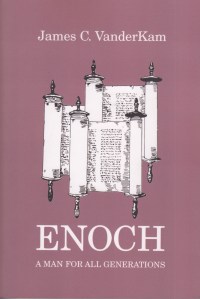
For a person referenced so little in the Bible, Enoch captured popular imagination in a way difficult to comprehend.  Even in ancient times speculation about him was rampant.  The seventh generation from Adam, and great-grandfather of Noah, Enoch lived a remarkably short 365 years before “he was not, for God took him.”  Now, there are lots of obscure people in the Bible.  Many of them have very little afterlife in later tradition.  Enoch, however, became the putative author of a collection of booklets that goes by the name of 1 Enoch.  This book fed speculation in antiquity and became a vehicle for many esoteric traditions that continue even into the present day.  It might seem that there’s little information to go on for an entire book, but James C. VanderKam’s Enoch: A Man for All Generations finds plenty of material with which to work.

A careful scholar like VanderKam doesn’t delve much into speculation, and he rather cautiously examines many of the ancient texts that discuss Enoch and draws some basic conclusions.  There’s a lot of information in this book.  With my own fascination concerning the Bible and popular culture, what stood out to me was how Enoch went from the “mere” man who didn’t die to become, in some traditions, the Metatron, or “the lesser Yahweh.”  Having been a fan of Dogma since teaching at the perhaps too sanctimonious Nashotah House, I’d never researched the late, great Alan Rickman’s character.  I supposed the Metatron was a character like the Muse—some extra-biblical quasi-divine functionary thrown in for fun.  I didn’t doubt such a figure was known in early Jewish or Christian writings, but I had no idea that Enoch had been promoted to that level.

Since I’ve been researching demons lately, the book of 1 Enoch has been a major source of interest.  One of its sections, The Book of the Watchers, expands on that odd story from Genesis 6 where the sons of God lust after the “daughters of men.”  Ever coy, the biblical passage doesn’t directly say that their offspring were giants, but this idea was developed by sources like 1 Enoch.  And these fallen angels—the nephilim—in some traditions, become demons.  Studying Enoch is a fine introduction to a mythological world every bit as rich as Dogma.  These characters—Enoch, nephilim, watchers, and demons—populated the imagination of early readers of the Good Book as much as they do modern speculators’ worlds.  Not bad for a character barely mentioned at all in the Bible.


Pretty as a Prayerbook

Stolidity.  Canons all across this deck are known for it.  Visions of unchanging texts, however, tend to be false perceptions.  Even the canon of the Bible differs, depending on who you talk to.  So it is to be applauded, I suspect, that the Episcopal Church is planning to revise the Book of Common Prayer.  The last revision was 1979, and before that, 1928.  This schedule should be telling you something—the BCP, or simply “Prayerbook” as it’s commonly called, was never a changeless canon.  We mere mortals rely on experts to change the words by which the Almighty is approached, and although Episcopalians are thin on the ground in this country, world-wide they’re a formidable sect.  They’re united mainly by their commitment to the BCP.  And with good reason.

The days of the British Empire are long gone, but when it ruled the waves (and even before) this island state contributed a number of religious elements to the world.  The Prayerbook was born out of struggles with Rome for secular power disguised as sacred.  We try to live with a fiction of separation, but churches and states have always had mutual influence—just consider the way secular Trump has changed Christianity and you’ll see.  The BCP was to define English Christianity and in doing so became a Scripture in its own right (or rite).  Phrases from the Book of Common Prayer pepper the English language so as to rival the Good Book itself.  When church attendance was an expectation, you couldn’t help but internalize it.

A certain seminary, nameless here forevermore, will not be pleased with such change.  When I taught there many still clung to the 1928, claiming the church had erred (a strange position for someone in a voluntary organization and who vows to support its decisions) by adding “inclusive language” in the ’79.  This, they averred, was a man’s religion.  And they meant biological males.  Stolid.  Or perhaps stale.  Like the fiction of unchanging canons, the myth of the rational male hierarchy exists only to be exploded.  The two longest reigning British monarchs have been queens, after all.  World wars tend to be the legacy of male rulers.  So, although a tiny seminary in the woods of Wisconsin will likely rage, the BCP could use a bit of a makeover.  The world has changed substantially since the 1970s.  Mainline churches have been steadily shrinking and redefinition with a declining financial base makes good sense.  “This is another day, O Lord. I know not what it will bring forth, but make me ready, Lord, for whatever it may be.”  Even if it be changing canons.


Be It Resolved

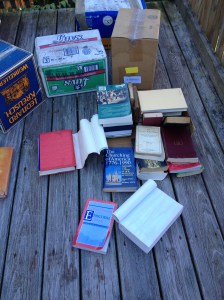
I’m not a believer in New Years Resolutions.  A constant and critical self-monitor, when I notice a bad behavior I try to correct it right away.  Sometimes I’m actually successful.  Now that I’ve finally removed all books from the garage—some were being held high above the water-line on plastic boxes—I’ve started to sort through systematically what is beyond redemption.  A comment of occasional visitors, however, has goaded me into a resolution; you see, people sometimes ask “Are you going to read those again?”  While aching to address the mindset betrayed by that very question, I cede a point; if I’m going to the expense of replacing a non-reference book, I should want to read it again.  My resolution—when I buy another copy, I will read it then and there.

One of the stinging parts of this resolution is that some of the books were read by me just this past year, or even earlier this year.  Jude the Obscure, although I enjoyed it, cost me a quarter year of my life of evening reading time.  On that basis alone I should replace it, but if I’m not going to reread it why should I incur the expense?  (Moving is anything but cheap.)   I will also face rereading old favorites that have been put aside for a while.  No house, for example, should be without Emily Brönte’s Wuthering Heights, although I read it again just months back, or so it feels.  

This is perhaps a way of making lemonade from a cloud.  Or finding the silver lining on a lemon.  Whichever it is, I sense that it will figure toward my reading goal for next year.  As I’ve spent the rainy weekend unpacking books, literacy is on my mind.  For those who see my literomania as some kind of disease, I was cheered to note just how many of the books on display I had indeed read.  The same goes true for a number of the academic books in the study, but, I must confess, while pulling them from their boxes I thought how boring most of them are.  Boring, however, doesn’t equate to useless when it comes to books.  Given their price points some of them may take years to replace.  That’s the point of a resolution, in any case.  It can cause some pain.  As I stuff the moldy, distorted tomes into their body-bags I hope that rereading their replacements will bring them back to life.  After all, resolution and resurrection are not so far apart.


August Mornings

It’s August and I’m already starting to feel haunted.  While science may declare it nonsense, there’s a feeling in the air—particularly in the early morning—that tells us the seasons are changing.  While it may be different for everyone, for me it begins in the tip of my nose.  I can smell the change coming.  That doesn’t mean that we won’t have more hot days—a long string of them yet awaits—but the shift has begun.  Autumn is perhaps the season closest to the soul.  While I like all seasons for what they represent, fall has always put me in mind of melancholy rapture.  It’s a difficult concept to explain,  a kind of blissful evisceration.  A hitching of the breath in my lungs.  A sudden rush of joy followed by sadness.  The ease of summer living is ending.

Summer is the growth season when we look out and see the promise of provisions that will see us through long months of cold and chill.  The times we huddle down only to be blinded by the arctic beauty of the sun on a snow-covered day.  The indoors time.  Summer is when we can dash outside without a coat, giving no thought to whether we will be warm enough.  The scent of autumn is a slight chill.  It reminds me that while the crops have been growing, the monsters have too.  There’s a reason horror films are released in the fall.  I’m not the only one who knows they are coming.

Late summer is a liminal time.  While the calendar may tell us summer lasts until the autumnal equinox, traditional cultures marked time in a different way.  Equinoxes and solstices were closer to the middle of a season than its start.  Most years we begin to feel summer in May, or even April.  Winter cuts through November, and the thaw may begin as early as February.  When I step outside just after sunrise and breathe deeply, I can feel the monsters coming.  In a way I can’t explain, their lurking fills me with a frisson of anticipation.  Already the days are noticeably shorter.  Daylight itself seems to be fleeing before the ethereal chill that is still available in our rapidly warming world.  The seasons are all about feelings.  Emotions suffuse the changes of weather and human habits that accommodate to it.  There are shivers and then there are shivers that the creatures of autumn bring.  They’ve already begun to gather.


Temporary Id

Who am I, really?  I can’t help but ponder this whenever I apply for a new form of identification.  While at the Department of Motor Vehicles I observed a room full of strangers—if there’s a melting pot in the United States, it’s the DMV.  Outside those cloistered in the major cities, you must drive to survive in this country (or at least to thrive) and the ritual of waiting your turn by number at the DMV is part of it.  I glanced at my application while waiting.  I’ve held drivers’ licenses in at least four states, but I’ve lived in at least six—how do you count where you live, really?  I think I must’ve had an Illinois license at some point, but I could find no record of it.  Who am I?  Are the Illinois years lost?  Big brother will find out, no doubt.

To apply for a license in Pennsylvania, as in most states, you have to prove you are who you say you are.  Swapping in your old license just doesn’t work any more.  While the actual “who” depends on government-issue documents (social security, birth certificates, or passports) the where question is more financial.  To prove your residence you must present bills with your name and current address.  You’re defined by your money.  Bills demonstrate that you’re integrated into the system, the matrix.  I spent one day, as a temp with Manpower, working for Detroit Electric (no, I didn’t have a Michigan license; I kept the Massachusetts one), processing requests for new service.  Despite not being asked back because they had expected a woman (really!), I learned that to get service you had to prove you were part of this matrix, with a history of paying your bills.

None of these agencies ask the deeper, more philosophical questions of identity.  None seem to care that each day is a struggle to define our spiritual selves in a world hopelessly secular and financial.  Yes, my birth certificate “proves” I was born in Pennsylvania.  The DMV records “prove” I learned to drive here and had my first license in this state.  They show nothing of the real question of who I am.  A reasonable facsimile of my visage appears on the plastic card that certifies my citizenship within these artificial borders.  But now my home state stamps “Temporary” on the card so that a security check can be run.  They want to discover if I am who my records say I am.  What the powers that be don’t seem to recognize is that although where we are born influences us every day for the rest of our lives, no little plastic card, despite the amount of information it conveys, can say who it is I really am.  “Temporary” may be the truest word on it.


A Few of My Favorite Monsters

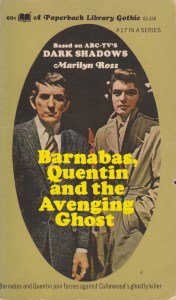
It was a guilty pleasure read.  We’d just moved and I needed a new novel for bed-time reading.  Most of our undamaged books were still boxed up and, well, enough excuses: I like Dark Shadows novels.  Hardly well written, these pulp potboilers are like extended, Gothic Scooby-Doo episodes.  I first started finding them used at Goodwill when I was a kid and I’ve re-collected a number of them as an adult.  Although they feature a vampire, and sometimes a werewolf and witch, the crisis of the story generally devolves to a hoax at Collinwood.  So it was with Barnabas, Quentin and the Avenging Ghost.  I hadn’t thought to write a blog post about it until I came across a passage mentioning Rocain.  In context, one of the characters explains how Rocain, the son of Seth, shows that sorcery goes all the way back to Genesis.

Genesis was one of my lines of research during my academic career, although I never published anything I was working on.  I didn’t, however, recall having read about Rocain.  The internet quickly pointed me to Legends of Old Testament Characters by Sabine Baring-Gould, chapter 8.  Clearly this was where Marilyn Ross, or his source, got his information.  Baring-Gould sits on my shelf as the author of The Book of Were-Wolves.  He also wrote the hymn “Onward, Christian Soldiers.”  There was an era, overlapping with Baring-Gould’s lifetime, when a minister could be an independent scholar of repute.  Although much that’s found in his many publications is now disputed, his was a lively and lifelong curiosity that led to several books.  

Upon reflection, Sabine Baring-Gould, who was a priest fascinated by occult topics, would have fit quite well into the Dark Shadows diegesis.  Although set in the late 1960s into the mod ‘70s when the television show aired, these were Victorian vignettes of a conflicted vampire and his strange, wealthy, and somewhat clueless family.  All kinds of guests, some of them quite Lovecraftian, drop into the Maine mansion and its grounds.  The writing of the novels is tepid at best, but the series was surprisingly literate.  Dark Shadows is nevertheless undergoing a kind of revival these days, and friends sometimes tell me they’ve just discovered this oddly compelling world.  I invite them in.  I’ve unpacked a few more boxes since selecting this pulp novel, and one of them, I note, holds books by Sabine Baring-Gould.  The guilty pleasure read?


Forever Jung

A funny thing about aging is that you recollect your youth, but you find yourself less able to do the things that seemed so easy when you were more spry.  We live in a world where the elderly are coming to outnumber the young, and that means a lot of memories of “the time when.”  This thought confronted me when reading a story about two missing patients from a nursing home in Germany.  Authorities were frantic to find them until they were spotted at Wacken Open Air, the largest heavy metal fest in the world.  The news stories seemed bemused—it was cute, in a way, wasn’t it?  Two old guys trying to recapture their youth, like salmon swimming upstream where they were born.  I’ve got to wonder if there’s more to it than that.

Music has a way of touching us deeply.  While I prefer my rock on the harder side, I’m not exactly a metal-head.  There’s something, however, in the rage of metal that resonates with some of us when we get older.  It’s almost religious.  You see, I recall hearing the music from my brother’s room when I was growing up.  As a naive fundamentalist, I sometimes went downstairs shaken, as if my virginal soul had seen some image it shouldn’t have.  Some teens reach a level of maturity before others, and metal speaks to them.  Let’s face it—life is unfair.  We see that every single day.  Music can help us cope with such unfairness and there are times when John Denver and James Taylor seem downright gullible.  Ask the elderly.

Our society harbors many myths.  One of them is that evolution doesn’t occur.  Not only is it a biological fact among species, but it’s also, on a macro-level, something that happens as we age.  Perspectives shift.  We come to see the wisdom of Heraclitus—no one steps into the same river twice.  Especially when it’s Styx.  Technology keeps us alive longer now, and sometimes it seems that it does so just to tell us what we can no longer do.  I’ve got, I hope, a number of miles left on the odometer, but my focus is on the car’s stereo system.  When driving to Wacken Open Air to pick up two men trying to plug into either the rage or the euphoria that heavy metal means to the elderly what comes through your speakers?  What would the “sweet Psalmist of Israel” have wanted to hear when not even Abishag could keep him warm?  Yes, Herman, there is a wisdom that is woe.  And banging your head may not be the worst option at such times as these.


Special Delivery

Apotropaic is a word that can be translated as “turning away evil.”  For all that, it’s a perfectly good English word, although seldom used outside realms such as religious studies and anthropology.  Although the word itself may be unfamiliar, the concept is one that everyone recognizes—the charm that wards off evil is the most common example.  The rabbit’s foot means good luck (except for the rabbit) because it’s an apotropaic device.  In perhaps one of the oddest twists in Christianity’s somewhat lengthy history is the fact that the Bible itself has become an apotropaic device.  You’ll see this quite a lot in horror films, and if you read Holy Horror when it comes out you’ll see it quite a bit, although I don’t use the technical term for it.  Apotropaic outlooks also pervade society as a whole.  A recent article on Mysterious Universe proves the point.

Pennsylvania is a weird state.  Having grown up here, I know that to be the case.  In Wilkes-Barre (which itself is a strange name) a ghost-hunter was arrested for breaking into a haunted house bearing a sword, shotgun, and Bible.  That should cover your bases.  Of course, I couldn’t help but notice the odd equivalence of these three weapons.  One is intended for close combat (the sword), one for a reasonable distance (the shotgun), and one for an enemy so close that they might get inside (the Bible).  Make no mistake about it; the Bible is indeed a weapon.  Probably intended as an apotropaic device in this context, it was nevertheless an object to defend the ghost hunter from evil.  The sword and shotgun, however, seem to betray a lack of trust in Holy Writ.

The Bible has been used for offensive purposes ever since people figured out that it can be used to control others.  Coercion, in whatever form, is a kind of violence.  Interestingly, reading the Good Book would seem to indicate that such usage of holy things is inappropriate.  Then again, the Bible doesn’t refer to the Bible.  The idea of Scripture as a powerful object developed only after the Good Book had become an iconic object.  The final authority.  Who can argue with what is claimed to be the word of God?  That idea has become more important than what the Bible actually says, as any “Bible-believing” Trump follower will prove.  Against ghosts, however, it might serve as an apotropaic device, but it won’t prevent you from being arrested, it seems.  A lesson worth pondering.


Trending Horror

It’s not often that I can claim to be ahead of the curve.  A “late bloomer,” I was a timid child whose reaction to most of the world was a species of phobia.  It probably didn’t help that I watched monster movies and was an early fan of the original Dark Shadows.  As I learned to relate to others and take consolation in religion, these more macabre interests became latent rather than obvious, only to come out into the open when working at a Gothic seminary in the woods of Wisconsin and then being fired from said seminary, casting me into the outer darkness.  I found myself being interested in horror again although I’d put it aside from bachelor’s to doctorate.  Now it started to feel therapeutic.

My wife sent me an NPR story by Ruthanna Emrys titled “Reading Horror Can Arm Us Against A Horrifying World.”  The premise is one I’d read before—we find horror compelling because it gives us skills that we need to survive.  It teaches us how to separate evil from mere shadow and how to (or not to) fight such evil.  In other words, horror can be heuristic.  Those who know me as a generally calm, quiet—shy even—individual express surprise when I confess to my secret fascination.  One of the most common responses is the question of “why?”  Why would anyone want to watch such stuff?  My observation is that those who ask haven’t tried.  Horror is not often what it seems.  Or perhaps they have better coping mechanisms than I have already in place.

The names of many writers of what might be considered horror have gained mainstream respectability.  Stephen King’s name alone is enough to assure the success of a novel.  These days you can mention the name Lovecraft and a fair number of people will have at least heard of it (him) before.  Jorge Luis Borges has respectability for having been Argentine.  Joyce Carol Oates for being both an academic and a woman.  If you’ve read their works, however, there’s no doubt that something scary is going on here.  As Emrys points out, with our world becoming a more polarized and frightened place, horror may be ready to hang out its shingle saying “the mad doctor is in.”  In fact, it may become even more popular than it is already.  We human beings set ourselves up for horror constantly and repeatedly.  I’m seldom ahead of the curve.  I hang back to see what might happen to those out in front.  Call it a survival technique.


Tintinnabulation

On a summer’s day when I can work with the windows open, I hear the bells of a local church.  We haven’t been in our current location long enough to know for sure, but they seem to come from the direction of the United Methodists.  Around noon each day they ring out hymn tunes to which I often find myself filling in the words.  These are traditional hymns that I’ve known from childhood, and there’s an easy familiarity about hearing them, although my own spiritual journey may have taken me in different directions.  The sound of bells is so pleasant, I think, that nobody really objects.  Then I wonder about what I thought.

Music in public places does impact other people.  Consider the heavy metal or rap booming out of a passing car with the stereo turned up too high for human consumption.  Or jazz in the park.  Music impacts other people.  What, I wonder, is the message those of other religions hear along with these old hymns?  Do they suggest more than the praise of the locals for their version of the Almighty?  Is there some subtle proselytizing going on?  Is the music for members of the parish only, or can outsiders hear it and be free of obligation?  In many ways this encapsulates, I believe, the conflicts rife throughout our nation.  Traditionalists who see nothing wrong with “white” Christianity spreading its message but who object to a mosque being built in their community would likely find church bells comforting, even if they personally don’t attend.  Those from the outside, meanwhile, hear a message of cultural superiority.

Some sects feel compelled to praise God vocally, often and enthusiastically.  Their religion insists they do so.  Hymns ringing from the steeple, even if they’re not exactly your brand, participate in that mandate.  The deity likes to be adored.    (Think Psalms.)  This specific divinity, however, isn’t alone.  Perhaps beyond the bounds of where these sound waves flatten out to inaudibility, there are others with religious beliefs often older.  They too have rules about how to behave.  They may not be friendly to those who come bearing a new message of a new truth.  Globalization follows in the wake of technology and no god beyond the laws of physics oversees tech.  Our smartphones have made the world a much smaller place.  In such tight quarters, sounds carry.  Church bells, innocent as they seem, may be heard as a war cry.  But I wouldn’t suggest such things on a day so pleasant that I can work with my windows open and listen to the bells.


Animal Rains

We may have been to the moon—if not personally, collectively—but we still don’t control the weather down here.  It’s probably not news that the eastern part of the country has been getting a lot of rain lately.  One of the factors that led me to write Weathering the Psalms was the overwhelming tendency for humans to attribute weather to the divine.  It used to be that we couldn’t reach the sky, so placing deities there seemed a safe bet.  Now that we’ve shot through the thin membrane of atmosphere that swaddles our planet, we’ve discovered beyond a cold, dark space liberally sprinkled with stars and planets but mostly full of dark matter.  The deity we thought lived beyond the sky somehow wasn’t anywhere our probes flew and recorded.

Still, down here on the surface, we live with the realities of weather and still think of it in terms of punishment and pleasure.  When we don’t get enough rain, God is destroying us with drought.  Too much rain, and the Almighty is washing us away with flood.  The true variable in all of this is, obviously, human perception.  Sure, animals experience the weather too, and they sometimes look to be as disgusted as humans when it snows too early or too late, or when the rain just won’t stop.  I have to wonder if somewhere in their animals brains there’s the seed of an idea that the bird, or squirrel, or woodchuck in the sky is angry at them for some unspecified faunal sin.

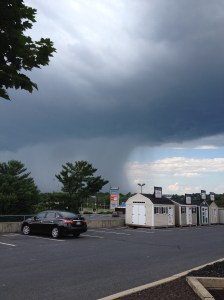
While heading to the store yesterday, after weather reports assured us the rain was finally over for the day, the skies told a different story.  The vistas around here are never what they were in the midwest—or what they are in Big Sky country—but the approaching storm was pretty obvious.  An opaque drapery of precipitation was coming our way and although a rainbow would cheekily show up afterward, knowing that we’d been caught away from home with our windows open felt like punishment for something.  Perhaps the hubris of buying a house when all I really require is a corner in which to write.  Somewhere in my reptilian brain I translated a natural event into a supernatural one.  When we got home to discover the storm had gone north of us, it felt like redemption.  I spied the birds sheltering in shadows from the sun’s heat.  Were they thinking it was some kind of divine avian displeasure, and hoping for some rain to cool things off for a bit?  If so, was our religion correct, or was theirs?


Soggy Symbols

House-buying is perhaps best left for the young.  Flexibility is, unfortunately, something that effaces with age, and house-buying is a rough transition at best.  For anyone following this blog over the past month, the theme of moving is familiar.  How we hired a moving company that didn’t get us in our new place until after 2:30 in the morning.  How torrential rains came later and flooded our worldly goods temporarily stored in the garage.  How mowing the lawn caused me to question my faith—wait—I haven’t told that one yet!  Well, you get the picture.  Suffice it to say that although I didn’t think moving would be easy, it’s been a lot more difficult than I could’ve possibly imagined.  In the midst of it came a dove.

At times, I must confess, I’m tempted toward superstition.  A strange significance between events that are, in actual fact, random.  We’ve all read of people who buy a house and discover some secret treasure left stashed away in the attic.  The former owners of our house only left undisclosed defects that become clear in periods of prolonged rain.  Even so, as I was feeling as miserable as one of Ray Bradbury’s astronauts on Venus—yes, the precipitation does begin to drive you insane after a while!—I decided to try an impose some order on the chaos that is our garage (we haven’t had a dry weekend since moving in to transfer the soggy stuff to our house) I looked down.  There, amid the screws and other little detritus left behind in the way of treasure, I found a dove charm.  A dove sent after a flood.

The symbolism of the dove with hope is ancient indeed.  It predates the Bible when it comes to a symbol that the flood is nearly over.  The Mesopotamians also had a dove sent out from the ark, and I’m given to believe this is something ancient mariners, whether they rhymed or not, regularly did to assess if land was near.  Unlike our heavy, wingless species, birds can soar over chaos.  At least for a while.  They are a symbol of hope.  Was that dove sent to me on purpose at a time when I needed it, or was it just a random find, one of those too much stuff in a small world moments?  There’s no way to assess that, I suppose.  For me, on yet another rainy day, it’s a symbol of hope.  The only other choice, it seems, would be to build an ark.


Water Monsters

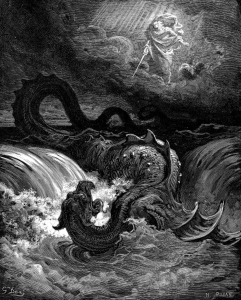
Chaos is a monster.  More than personal opinion, that’s a biblical view.  If, like many modern people with theological training, you’ve been taught that Genesis narrates a creation out of nothing, you’ve become a victim of this monster.  You see, although ancient Israel had no “systematic theology”—the Bible can be quite inconsistent if you’re willing to read what it says—the view that chaos was constantly lurking outside the ordered realm of creation was a common one.  One of the more intriguing episodes in Ugaritic mythology involves a broken text where the god Hadad, aka Baal, refuses to allow a window in his palace.  The reason?  Apparently he feared chaos (in the form of Yam, the sea) might slip in and kidnap his daughters.

More than a theological statement, the story of creation was actually a singular episode in Yahweh’s ongoing struggle against chaos.  Step outside and look at the sky.  If it’s blue it’s because there’s unruly water being held back by a great dome over our heads.  If it’s gray, it may be raining, or it probably will be soon.  Stroll to where the land ends.  What do you see?  Water.  That water is lapping at land, trying to take it over.  Although the ancients didn’t have geologic ages (the Mesopotamians came close, with ancient kings living thousands of years) rivers eroded land and they had tendencies to flood.  The thing about chaos is that it makes you start again, from the beginning.

One of the many unfortunate things about biblical literalism is that it loses sight of this biblical truth.  It exchanges something everyone can understand for a theological abstraction that makes no sense in the world that we experience.  Ancient belief held that the human role in the world was to fight chaos, not to get to Heaven.  In fact, in the Hebrew Bible there’s no concept of Heaven at all.  Instead, the commandments were all about order.  You can’t build on the water.  What you do build water tries to wash away—Israel has a rainy season, and one of the characteristics of such seasons is the occasional violent storm and heavy rains.  Although we need the water from the heavens, heavy rains cause, well, chaos.  In ancient thought, this was the monster hiding in plain sight.  That blue sky is a reminder that a dragon awaits.  Rather than starry-eyed Heaven-gazers, the ancient biblical person was a monster-fighter.  And that’s the biblical truth.


Shepherding Lies

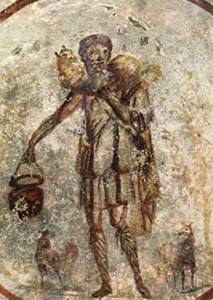
They’re going to look pretty ridiculous when this is all over.  Like sheep without a shepherd.  Evangelicals, I mean.  The fact is they’ve jettisoned everything they stood for to support a pseudo-president constitutionally incapable of telling the truth and now they must be wondering about what they’ve lost along the way.  Stories in “liberal” sources such as The Washington Post, The New York Times, and The Atlantic have raised the question repeatedly—why don’t Evangelicals hold Trump to the same standard they hold all other people?  His backing and filling have been obvious to anyone capable of thought, and yet the bestselling books in America for the past two weeks have been tomes about how the liberals are lying.  What’s an Evangelical to do when truth has lost its meaning?

While I was still an Evangelical, in college, we debated endlessly how to get at Truth with a capital “T.”  No matter how you sliced it, diced it, or even julienned it, Truth had to come from the Bible somehow.  Two things the Good Book was against unequivocally were lying and adultery.  Who’d have thought Southern Baptists would be standing in line to change divine law, by their own definition?  And for what purpose?  To support a man who clearly doesn’t share their values, and shows it daily.  These former Communist-haters now cozy up to Russia with a familiarity that suggests Trump isn’t the only one sleeping around.  As a former Evangelical, I have to wonder whatever happened to the concept of the double standard.  This was never considered right or fair or biblical.  Now it’s all three.

Just this past week the Washington Post ran a story about an Evangelical pastor preaching a series of sermons on the Ten Commandments.  Somehow they’ve made their way from courthouse lawns into churches, it seems.  The week he reached adultery, he didn’t know what to say to his Trump-supporting flock.  He himself supports a leader whose told an average of hundreds of lies per day since January of last year.  Among them allegations that he didn’t commit adultery.  Or pay to have it covered up.  Or know that his lawyer had paid to cover it up.  But when said lawyer realizes that the shepherd doesn’t care about sheep—can’t even find one in a paddock—he suddenly remembers that there is Truth with a capital “T.”  But Evangelicals don’t have to listen to anyone named Cohen.  After all, they have wool in their ears.  Just don’t read what the Good Book says about hearing what you want to hear.  What’ve they lost?  Not just their shepherd, but their very souls.