The Lagoon

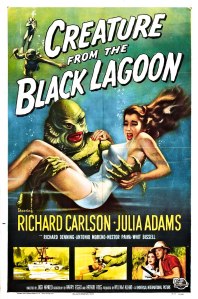
My current book project has me watching The Creature of the Black Lagoon again.  One of the Universal monsters—indeed, arguably the last of them—the Gill-man fascinated me as a child.  There was a strange contradiction here.  The creature had evolved in the Devonian Era and remained unchanged into the 1950s.  But the movie opens with a voiceover of Genesis 1.1.  There’s a mixed message here, appropriate for scriptural monsters.  Watching the film again brought back many of the innocent perceptions of youth, as well as the trajectory of my own life.  I don’t often get to the theater to see horror movies anymore, but at the same time the Universal monsters aren’t quite the same thing as modern horror.  As a genre it had to evolve.

Strangely, as a fundamentalist child, the evolution aspect didn’t bother me.  I was after the monster, you see.  The backstory was less important.  Growing up, at least in my experience, means that the backstory becomes more essential.  It has to hold together.  There are, of course, inaccuracies in the story—many of them, in fact.  Still, within the first three minutes Genesis and evolution are thrown together in a happy harmony that belied what I was being taught at church.  The Gill-man is a monster mainly for being a creature out of time.  When modern humans invade his lair, he defends his territory.  The story might’ve ended there, had he not spied Kay.  He doesn’t so much want to kill her as get to know her better.  For a movie posthumously rated G, it has a body count.  Five men die but the Gill-man apparently just wants to evolve.

There’s been a recent resurgence of interest in Creature from the Black Lagoon with both the publication of The Lady from the Black Lagoon and the death of Julie Adams this year.  The Gill-man seldom shows up in the same billing with Dracula or Frankenstein’s monster, or the Wolf-man.  He’s a bit more inaccessible in his watery abode.  Both cold and hot-blooded, he represents how science and Scripture might get along, at least on the silver screen.  The film holds up remarkably well, if a modern viewer can handle the pacing.  Underwater filming was pretty new back in the day, and watching humans swim in many ways suggests the truth of evolution in its own right.  These aren’t the childhood observations of the movie, but rather the reflections of a guy wondering if there might not be some hidden wisdom in the monsters of yesteryear.
Dolls and Puzzles

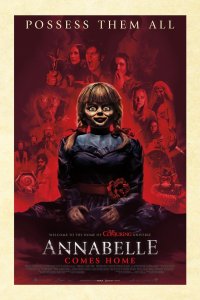
Maybe you’re anticipating it too.  Annabelle Comes Home, I mean.  My latest book, Nightmares with the Bible, has a chapter on The Conjuring universe, and with the recent death of Lorraine Warren I’ve been working on another piece trying to fit this whole puzzle together.  “What puzzle?” did I hear you ask?  The puzzle, I answer, between what really happened in the Ed and Lorraine Warren investigations.  You see, the paranormal is one of those things we’ve been taught to laugh at, and we’re told that people who “see things” are dweebish kinds of gnomes that don’t see the light of the sun enough.  Reality television has brought some of these ideas into vogue, what with ordinary people gathering “scientific” evidence of ghosts and the rest of us scratch our heads while hoaxes are revealed on the B reel.  But still, Annabelle lives.

It has also been announced that The Conjuring 3 is in development.  For some of us—and I’m well aware that movie-making is an industry and that profit is its goal—the question of what’s real can be as haunting as any ghost.  You see, I buy into the scientific method, as far as it goes.  That caveat is necessary, however, since science is neither able to nor interested in assessing all the strange things people see.  Our senses can be fooled, and a great many people haven’t developed the critical ability to scrutinize their own observations skeptically.  Skepticism itself, however, need not become orthodoxy.  It’s like any other tool in our mental box—each has its own purpose.  A car engine is dismantled in order to rebuild it in working order.  And there may be a ghost in the machine.

That’s what gets me about this whole Conjuring thing, and beyond that the contested livelihood of the Warrens.  There may be such a thing as mass hysteria (the current state of the US government can hardly be explained any other way), but the Perron haunting that was the subject of the first film provides, I think, a good test case.  A family of seven living in a house where they experienced things not only collectively and individually but also in different combinations would seem to be a place where multiple angles could be used.  According to Andrea Perron’s written account, the Warrens’ investigation never really took off there.  That didn’t prevent a very successful movie franchise from being launched, loosely based on their story.  And getting at the truth is never as simple as buying your ticket online and waiting for the show to begin.


Taking and Giving

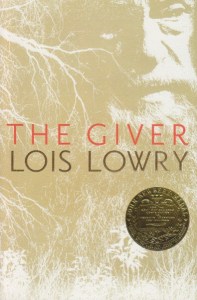
Dystopias are among my favorite kinds of literature.  Things tend to go wrong in human society, and although we’ve made great progress over the past couple of centuries, in many ways we’ve set ourselves back.  Dystopias are searching, thoughtful ways of addressing that slippage and they warn us of what me might become.  (Especially if Republicans remain in power.)  Lois Lowry’s The Giver is young adult literature, but I’ve been curious about it for some time.  Set in an undefined time and place, a highly structured society exists where things seldom go wrong.  There are no animals and people take pills to eliminate “stirrings” so that sex won’t complicate relationships.  Families are constructed by algorithm and children are assigned from a pool so they will match expectations.  In order to continue this bland lifestyle, memories have to be repressed in the person of the Receiver—the keeper of communal memories.

At first things seem pleasant enough.  Life, however, lacks color and music.  It lacks emotional engagement.  Those who, in real life, idealize the 1950s as before the madness of the sixties began, have trouble conceiving of how societies go wrong.  The dilemma is that no society is perfect and as time goes on we look for improvements.  For a very long time in American history, for example, nobody had bosses.  The majority of people were independent farmers.  They prospered by luck and hard work, but they worked for no one but themselves.  Now we mostly work for bosses who have bosses who have bosses in some kind of endless regression of power.  Our ability to change things is quite limited, even in professional positions.  Is this better than the uncertainty of farming?  With all the rain this year it might seem so.  Of such things dystopias are made.

The Giver follows a protagonist, Jonas, who when he becomes twelve is assigned to become the new Receiver.  As he gains memories of how things used to be, he’s fascinated.  Learning his society’s darkest secret, however, spurs him to try to make a change.  A lot of questions remain at the end.  (The novel is part of a series, as most young adult fiction tends to be, but it can be read as a stand-alone story.)  Those of us who’ve been around the block a time or two might be able to guess where this is going, but for younger readers to be introduced into the way of human problem solving this is a gloves-off approach.  Those accustomed to dystopias will find themselves in familiar territory.  As will those who live under Republican regimes.


Let It Lie

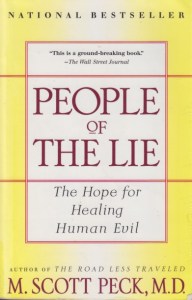
At the grave risk of over-simplifying, the list is brief: destructive scapegoating behavior, intolerance of criticism, concern with public image, and deviousness.  These characteristics, back in 1983 (note well the next year), were widely considered the description of evil.  Now look at the White House.  What do you see?  I know that I’m reading into the current situation, but how can one not?  I have never read anything by M. Scott Peck before.  Growing up I saw The Road Less Traveled on many, many bookshelves of friends and clergy.  I recently picked up Peck’s People of the Lie because, along with Malachi Martin’s Hostage to the Devil, it convinced many in my generation that demons actually exist.  At the time, still pretty much a Fundamentalist, I didn’t require any convincing.  Reading Peck’s People, however, in the era of Trump is a frightening thing.  And not just for the politics.

I always find books by psychologists and psychiatrists difficult to read.  I admit to having had a less-than-ideal childhood, and although self-healing is possible such books make me think I should spend my free time in therapy rather than writing.  In any case, People of the Lie is difficult in another respect as well—the labeling of evil.  Peck advocated for the scientific study of evil.  Good and evil, however, have generally been considered values rather than facts.  Science studies the latter while religion and philosophy deal with the former.  Not that lines in the sand are intended to be permanent.  Still, what one person calls evil may not be what others call evil.  Peck focuses primarily on narcissism and laziness as sources of evil.  He may very well be right, especially with the narcissism aspect, but some of the patients he described certainly didn’t seem evil to me.

Many aspects of this book could be discussed on a blog like this.  No doubt many of them will be, in sublimated form, in future posts.  Books, however, are part of the context in which they’re read.  In Peck’s day, the great political evil still fresh in many minds was the Vietnam War.  Today’s world, however, is one where Vietnam, Watergate, and even to a great extent the tragi-comedy of the W administration have all been eclipsed.  The cult of personality headed by one of the most obviously narcissistic individuals this nation has produced makes what Peck labeled “evil” seem perfectly normal.  And those who have the authority to do something about it either sit idly by, or worse, use it for their own means.  Roads less traveled indeed.


Targeted by Technology

We get along in life, I believe, by routinely ignoring the rather constant dangers that surround us.  Oh, we’ve taken care of the larger faunal predators, but we’ve replaced them with ourselves.  Our success as a species leads us to places we might not be comfortable being.  I was recently exposed to the documentary National Bird.  It’s about drones.  Not the friendly ones from Amazon that we hear will soon be delivering books to our doorstep, but the military grade kind.  I first became aware of how pervasive the military use of drones is while reading Wired for War (on which I posted here some years back).  The difference between that academic knowledge and watching the documentary is the human element.  Drones are assassination machines with high explosives and they are subject to no regulation.

Many of us feel, occasionally, some level of discomfort with how much information “they” have on us.  We don’t even know who “they” are or what they want.  Using the internet, we give them our information.  Caving to our desire for instant communication, we carry around smart phones that know where we are constantly.  Martin Luther once said you couldn’t stop birds from flying over your head, but you can prevent them from making a nest in your hair.  It’s becoming harder to shoo them away.  The nest is well established.  Our houses are easily found on Google maps, and drones can keep constant watch, like weaponized guardian angels.  Only they’re not our guardians.  As National Bird makes clear, drones kill civilians.  Women and children.  The conversations of the operators reveal how much they’ve bought into the jingoism of the “war on terror.”  The film also deals with the human cost of those who operate drones.

Technology stands to make life better, for some.  Watching people who have very little, who live in what would be considered poverty in this part of the world, being bombed by people remotely, is disturbing.  The operators, trained as if they’re playing a game, kill and then have to deal with it.  The use of tech to try to sanitize brutality was dealt with decades ago on a particularly famous episode of Star Trek appropriately called “A Taste of Armageddon.”  Rather than try to resolve conflict we, like those of Eminiar 7, readily accept it if it’s kept at a distance.  Only drones aren’t science fiction.  We’ve been using them for over a decade now, and we prefer not to think about it.  This isn’t an option, unfortunately, for those who’ve been targeted by technology.  The predators are still out there after all.


Identified or Not

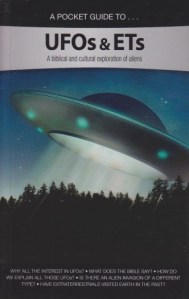
Okay, so this will require some explanation.  It came about like this: I was in a used bookstore.  (This in itself requires no explanation, of course.)  I noticed a slim book, cover out, called A Pocket Guide to UFO’s and ETs: A biblical and cultural exploration of aliens.  Biblical?  I picked it up only to discover it was from Answers in Genesis.  Please note: I do not buy books or paraphernalia of Fundamentalist groups unless I can get it used.  I don’t want to support this particular weirdness in any way.  Well, the money for this used book was going to support a used bookstore and not a religious aberration, so I figured it would be good to see what the Fundies have to say about a topic that seems to have started to engage public interest again.

The book begins by helpfully pointing out that if there’s life on other planets the Bible doesn’t mention it.  And since the only way it could’ve got there is by evolution—for surely the Almighty would’ve said something about it in his book, if he’d invented it—the whole idea is a non-starter.  Evolution, as everyone knows, is a satanic idea meant primarily to challenge the Bible and secondarily explain the diversity of life forms on earth.  And since earth is the only planet the Bible recognizes, it is the only one with life.  So, UFOs, it stands to reason don’t exist.  Well, that’s not quite fair.  They do exist but most can be explained away and those that can’t may well be demonic.  Since there can be no aliens, and since some sightings can’t be otherwise explained, then demons—which the Bible does mention—must be responsible.  They (demons) can also explain why other world religions exist.

There’s plenty in here to offend just about everyone apart from the Answers in Genesis crowd.  The screed spends quite a bit of time knocking down ancient astronaut ideas, and taking Erich von Däniken to task.  Science is useful in explaining how pyramids were built, but not in how the rock used to build them was formed (it takes far too long to make limestone the old fashioned way; God simply used a variety of different rock types to make the one inhabited planet more interesting geologically).  And those UFO religions?  Inspired by demons, no doubt.  In fact, even reading a little book like this could lead you to become interested in the subject, so be careful!  In fact, the safest thing of all (and I’ve only got your well-being in mind) is to leave it on the shelf.


Time Off

Perhaps you’ve noticed it too.  Time away from work has an utterly different feel from time on the job.  Those rare individuals who really love their professions probably feel differently about it, but a timid free spirit since childhood, I’ve always noticed a difference.  And it has become more pronounced as time’s gone on.  Recently I cashed in a vacation day near a national holiday (Memorial Day) so that I could drive across the state to see my mother without feeling utterly wiped out from a twelve-hour drive on a regular weekend.  As I slipped back into work mode on Tuesday the change was palpable.  Time was no longer my own.  I tend to work well over eight hours daily—the telecommuter must prove his/her worth—and something about the quality of the time itself was decidedly unlike that of the previous four days (two of which had been spent driving).

That quality, of which we’re not encouraged to speak, is the feeling of freedom.  More precisely, auto-determination.  Okay, I’ve read enough philosophy to know this is just an illusion, but work with me here.  Few and exceptionally fortunate are those who find careers they love.  What the rest of us love is time off work.  Time when we can decide what to do.  How long to sleep.  When to cut the grass rather than waiting until the bell rings at 5 p.m. and the inevitable afternoon rain begins.  Perhaps best of all is going to bed knowing that the next day you don’t have to get up and report for duty.  I’m not dissing employment here, I’m just noticing something.  What I’m reaching toward is a concept of sacred time.  Unstructured time in which creative types thrive.

Early in life the concept of summer was instilled in my soft and malleable psyche.  It said once May was over you have three months to do whatever before facing regimentation again.  I grew to appreciate this schedule.  To love it, in fact.  It was part of why I decided higher education was the best vocational fit for someone of my particular disposition.  Every year when June rolls around I still feel it, like a migratory bird.  The reality, however, is the quality of time changes on Monday morning.  It slows down and feels more like sandpaper than silk.  I can see there’s a holiday just a month away, if I can only reach it.  And it is, perhaps with a dose of unintentional irony, call Independence Day.


Premature Burial

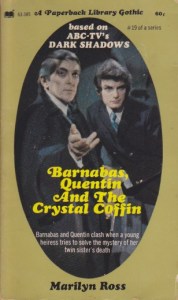
I have recently finished writing an article for a collection of essays on the Bible and horror.  Have no fear—I’ll pass along details once it’s published.  I do have to wonder, though.  All those years I was teaching and publishing regularly in ancient Near Eastern studies nobody ever approached me about contributing.  It took coming out of my monster closet for that to happen.  Monsters, you see, are a guilty pleasure topic.  They’re so much fun that they hardly seem like work to write about.  Or read about.  I was a child when Dark Shadows aired as a daily soap opera on ABC.  For reasons about which I’m beginning to speculate I found this series strangely compelling.  Marilyn Ross (W. E. D. [William Edward Daniel] Ross) based some 32 of his over 300 novels on the series.  I collected them as a kid and then got rid of them when I went to college.  I’ve been collecting them again in a fit of nostalgia over the past several years.

I just finished Barnabas, Quentin, and the Crystal Coffin.  The story was actually quite different than typical Collinwood fare.  What drew me to these novels as a child was their atmosphere and, if I’m honest, the fact that Barnabas was a vampire.  Memories of youth are fleeting things at my age, but it may be that Barnabas Collins was my introduction to vampires.  I was four when the series first aired, and I’m not sure if I discovered it before I came across Dracula or if it was the other way round.  Dracula, once I was experienced enough to have an opinion on such things, was my favorite monster.  I liked the others as well, but he was rich and immortal—the things sickly kids in poverty idealize.

In my fascination with Dark Shadows I’m not alone.  Despite Tim Burton’s movie version, Johnny Depp (who is my age) admitted growing up wanting to be Barnabas Collins.  Friends about my age have discovered PBS’s recent re-release of the original series in all its campy glory.  For whatever reason, however, it is the books that always draw me back in.  They, for me, defined the Gothic novel.  Ross’s writing is formulaic and predictable.  His adjective choices feel forced and subtleness was never his strong point.  Still I can’t stop myself from occasionally dropping into the world he manages to recreate in the woods of Maine.  Afterwards I move on to more profound writing, but then, his work is the very definition of a guilty pleasure.


Adversaries

Satan isn’t who we think he is.  Inheriting a tradition from across centuries, it can be easily supposed that modern ideas help to explain the reality of that tradition.  Sorry, let me try this with more specificity.  The character of “Satan” does not occur in the Hebrew Bible.  By the time of the Gospels, however, he’s there.  We tend to use modern ideas of Satan to understand the enigmatic person of “the satan” in the Hebrew Bible.  Peggy L. Day explored this idea decades ago in her revised Harvard dissertation, An Adversary in Heaven: śāṭān in the Hebrew Bible.  Reading this took me back to those heady days when I consumed Harvard Semitic Monographs like breakfast cereal.  To those of us not from Harvard we pretty much knew what to expect, but we read anyway.  Scholars are like that.

In any case, Day here explores what is sometimes surprising to those who read the Devil back into the Hebrew Bible: the satan is mentioned in only four passages and in none of them is he “Satan.”  In Numbers the satan is identified as a good angel sent to knock Balaam off his ass.  In the book of Job the satan is a member of the divine council and he does his job by accusing Job.  Day shows, by the way, that his accusation is really against God and not the mere human sufferer.  Her outlook on Job is still amazing after all these years.  After Job, the satan appears in the short book of Zechariah to accuse Joshua the high priest of the restoration era.  He’s no Devil here either.  The final reference comes in Chronicles where instead of God tempting David to take a census a satan does.  By this time the reader already knows a satan is an accuser and need not be superhuman.

This monograph raises the perennial issue of how to understand ancient texts without chaffing under the weight of tradition.  The character of the Devil developed over many centuries and, when he appeared, he was only one of many iterations.  The New Testament made Satan “biblical” and later readers tried to explain the Devil (who came from Zoroastrian mythology) as part of the Christian divine economy.  In Judaism he went on to play a much lesser role.  Once Christian writers established this character, he was read back into the Bible, even where the original writers didn’t see him.  Day isn’t the first to have noticed this, but she handles it very well and her book is still thought-provoking after all these years.


Tyranny of Plants

Notwithstanding what I wrote yesterday, there is a tyranny of plants.  Specifically those which make up lawns—in my case, mostly weeds.  A friend recently reminded me that weed is just a name for a misplaced plant, and I confess that I’m fine with weeds but neighbors may not be so open-minded.  Non-conformity is still a virulent stigma.  If an observer from outer space were to observe us during the spring and summer, they might well conclude that we were in the service of our yards.  The irony here is that yard care is perhaps the ultimate sign of success.  You have really made it if you can keep it neat and trim.  And you’ve excelled beyond that if you can pay someone else to do it for you with their tractor full of buzzing implements.

Because I’m concerned about fuel consumption, we purchased a reel mower when we bought our house.  I never mowed the lawn as a child.  First we rented, and when a stepfather came into the picture he didn’t let the kids mow.  (It wasn’t to be kind—it was a control thing.  If he saw a snake he’d race across the yard to dismember it.  More than once I’d be out playing only to find snake suey, with flies.)  College at Grove City involved carefully manicured lawns done by others, and after grad school we lived on campus at Nashotah House where the students cut the grass.  From there it was back to renting.  In other words, I never had the opportunity to learn how to mow lawns.  My lines aren’t straight, and I’m tempted to sneak out at night, when the grass is high, and leave crop circles at which the neighbors might wonder.  I don’t like being a slave to plants.

The reel mower is like pushing the grim reaper in a baby carriage.  Or at least it must seem so from the perspective of the grass and weeds I call my lawn.  The suddenness with which constant lawn care becomes a major concern has tightened my focus on the fealty we owe to ground cover.  We’ve had a break from the rain for a couple days and after work I find myself pushing that mower like a deadly thurible, releasing the scent of newly shorn grass.  Our particular town retains the right to fine those who let the grass get too long.  As I go along cutting back both grass and weeds indiscriminately, I wonder at the biblical nature of even this.


World Environment Day

Do you like where you’re living?  Planet earth, I mean.  Today is World Environment Day.  It’s not enough of a holiday to score time off of work, but it is well worth observing nevertheless.  More than that, it’s vital.  Other holidays tend to be the decaying remains of religiously appointed observances or sops thrown to the Cerberus of patriotism, but World Environment Day impacts every one of us, all of the time.  Whether sleeping, waking, working, or playing, it’s in the context of the one planet we have.  Even those in space have to check in here to survive.  We might try to make World Environment Day an international holiday, but I’m sure we could never all agree to it.  Business would collapse if everyone took the same day off, all at the same time.  Instead we’re left to dream.

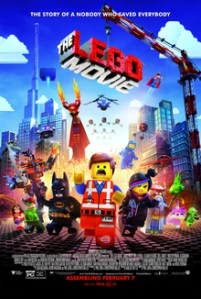
I recently watched The Lego Movie.  Although released in 2014 it perfectly anticipated 45 with “President Business.”  Overlooking for a moment that Legos represent big business, the film underscored the problem: the only thing hard enough to cut a diamond is another diamond.  And the only way to fight business is with business.  Perhaps there aren’t enough people to envision what life could be like without the constant stress of having to make more money.  It’s a sickness, really.  But it’s a pathology we worship.  There are some abysses, it seems, into which nobody dares peer.  Who doesn’t want to be in charge?  And those in charge care nothing for Mother Earth.

We have spent the past two-plus years watching helplessly as the Republican Party has done its level best to lay waste the planet.  Rolling back and abolishing environmental initiatives deemed detrimental to “business,” these are folks who need to feel what it’s like to lose a job or two and have to reinvent themselves.  Not that long ago, most of the humans on this planet lived on farms or supported those who did.  Daily in touch with the planet in a literal way that those who mow with industrial, sit-down lawn helicopters can never be—how can you be in touch when your feet never even meet the ground?—they knew that paying attention to the planet is crucial.  But that’ll have to wait.  It’s a work day, after all.  And a Wednesday, no less.  In the middle of the week-long worship at the altar of Mammon.  Still, I urge you to take a moment or two today to consider how to save the only planet we’ve got.  It’s worth celebrating.


Leggo My Lego

Given my proclivity to seek the profound in what is often considered the banal, I have been mulling over The Lego Movie.  Before you cast the first brick, yes, I know this movie is five years old and I know that it has sophisticated intertextuality with other movies and sly humor.  I use banal in the sense that Legos are, quite literally, plastic and they don’t work well in conveying the human form.  Our overactive psyches help here, and we give the characters their necessary humanity, but this is a movie for kids, even with its Trump-like President Business forecast some two years before the last election.  With all of that being said, and the word “forecast” already being used, my “Bible radar” zeroed in on the prophet in the movie, Vitruvius.

Vitruvius is based on a combination of Tiresias, the blind prophet, and any number of biblical characters who forecast the future.  Dressed like Moses, but named after a Roman author and architect, Vitruvius utters the prophecy at the beginning of the film and returns as a character that combines Obi-Wan Kenobi and the prophet Samuel.  (I said there was sophisticated intertextuality.)  Whether any of this is intentional is difficult to say—well the Obi-Wan part is pretty obvious—but it plays into the common view of prophets.  One of the points I make in Holy Horror (which deals with a different genre of movie) is that people understand biblical ideas through the lens of pop culture.  Prophets, through that lens, tell the future.  In the Bible itself they don’t do that very much, but since the New Testament reads itself into the Hebrew Bible (more intertextuality) the idea became pretty fixed that prophets told the future all day long.

Ironically, Vitruvius—a name that sounds like “virtue”—was famous for describing perfect proportions.  Indeed, Leonardo da Vinci’s “Vitruvian Man” sketch is based on this idea.  As ideas go, this is a false one against which many of us struggle our entire lives.  There is no perfect, Platonic human body.  Yes, certain people are attractive, but genetics and circumstances make us who we are.  And some of us grew up without Legos, but despite that deficiency we came to know the product.  The Lego characters aren’t in any sense of Vitruvian proportions.  Witty and intertextual, they’re made of plastic and they encourage us to buy for our children.  And one wonders whether Vitruvius is a prophet or a hidden symbol of that word’s homonym.  Let the building begin.


Epistemic Epistemology

I’ve been thinking about thinking, if you’ll pardon my meta.  More to the point, I’ve been thinking about what happens to thinking when it becomes writing.  Thoughts may or may not be safe if they’re left in your head, but once they’re on paper other people start to get concerned.  A diary, of which the weblog is a public variety, is often private.  You may write to remember.  You may write to stab at mortality.  You may do it just for fun.  No matter why you do it, if enough people read it, your writing will be misunderstood.  Ironically, even in a nation with freedom of speech, and the press, the writing rights of individuals aren’t guaranteed.  Take this blog, for example.  Over the decade I’ve kept it, a few jobs—two actual and one potential—have instructed me in what I could or could not write.  Like Niagara Falls, you’re getting only a portion of what flows in my river of thoughts.

Thoughts can change the world.  Considering the news lately that might not be such a bad thing.  In any case, the vast majority of writing remains private.  Even with Amazon and others making self-publishing simple, it’s not easy to get ideas out there.  Getting the attention of a major publisher has odds that are vanishingly small.  And the internet’s a big place, getting bigger by the day.  In cyberspace nobody can hear you scream, I guess.  Even on a smaller scale, my own computer complains that I write too much.  “Not enough space for updates,” it says in its dialogue box dialect, “too many documents.”  Never mind that I purchased it for writing, and a bit of surfing.  It wants more of the latter.  Other’s words, in other words, commodified.

My writing life began young, but not as young as that of many fictional writers like Jo March or Francie Nolan.  Our apartments and eventually small house had no space for one of the kids to hole up and write.  When I did start, in my early teens, I breached the dam without anticipating the results.  I’d been reading a lot, and writing seemed the right way to join the conversation.  I started composing novels before high school, but my first published book (and for many years my only one) was my dissertation.  I always believed that writing could be done on the side for any job, but that’s not the case.  Well, it is if you keep it in your diary, I suppose.  If you open the tap, however, you’d better make sure you have a mighty big glass in hand.


Refuge in Diversity

The Easton Saturday morning farmer’s market is a happening place.  Daring to spend a non-raining Saturday away from mowing, my wife and I decided to check it out.  If you’re not familiar with Easton, Pennsylvania, it has more than the Crayola factory that smells like childhood itself.  The downtown is marked by a traffic circle with an island in the middle large enough to fit, well, a thriving farmer’s market.  As usual, large gatherings attract those selling spiritual rather than material goods.  A very well dressed gentleman handed me a flier and when I got home I had to look up Refuge Church of Christ to find out what it it’s all about.  A New York City-based denomination of predominantly African-American membership, the church has over 500,000 members.  That I hadn’t heard of it before is no surprise.  There are well over 40,000 denominations of Christianity alone and it’s difficult to keep track of them all.

There comes a time in the life of anyone who takes religion seriously enough to study it professionally when s/he’s inclined to ask which is the original.  Think about it: you’re bartering with your eternal soul on the barrelhead here and don’t want to make the wrong choice.  When someone invites me to convert (I don’t know the secret handshake to show I’m already a member) I’m curious about them.  The unfortunate thing about all of this is that each tradition believes it has the truth and most, if not all, others have got it wrong.  Few are the faiths that declare, “Believe whatever, just believe.”

I once tried to make a denominational genealogy chart.  Part of the problem is that tracing things back to Catholicism isn’t quite right.  The Roman Catholic Church as it exists today is quite different than anything Paul, or Peter, or James would’ve recognized.  To say nothing of Jesus.  And that’s inevitable.  Religions don’t stay the same.  They evolve as soon as they pass from person to person.  Those who belong to denominations often do not know what the official teachings of the body are, and getting back to the original they’d find that their denomination started out believing things quite different than its own current theology.  If you’ve got only one soul with which to make that eternal decision and literally thousands of choices, well, let’s just say that you don’t want to think about it too much.  Besides, we’re here for fresh fruits and vegetables.  And it’s a rare gift of a Saturday without rain, no matter who’s responsible.


Q

If you haven’t spent much of your precious time attending to theories of how the gospels were written, you might not be familiar with the dilemma I’m about to describe.  A brief primer: Matthew, Mark, Luke, and John were not eyewitnesses of the events described in their gospels.  In fact, each of these books is anonymous—the titles were only added on later.  Despite their New Testament order, Mark was written first and Matthew and Luke borrowed from it rather extensively.  Mark is the shortest gospel and Matthew and Luke also share material that’s not in Mark.  Since John was written much later (and doesn’t have these common stories), scholars proposed many years ago that Matthew and Luke used a source—in German Quelle—that no longer exists.  This is called “the two-source hypothesis.”  As scholars are inordinately fond of abbreviations, Quelle is known as simply Q.  Other than in explanations like this you’ll never see it referred to by its full name.

So here’s the dilemma: many websites don’t allow for a single-letter search.  If you’re wanting to learn about Q, and you know no scholar worth their s (by which I mean salt, of course) who will spell it out, how do you search for it?  The same might be said for J, E, D, and P, who, along with R, put together the Pentateuch, but at least there you can search for phrases involving more than one letter.  You see, scholars existed before the internet and its search parameters.  Books and articles used to be written on paper, and the former had indexes, so looking up your sources—single letter or not—was fairly easily.  With electronic searching, it has become more difficult.  That’s not to say that single-letter searches can’t be coded—they can—but apart from biblical scholars and their alphabet soup of sources, apparently most people don’t want single-letter options.

This is the trouble with specializing in ancient things.  The internet was originally designed for academic and military purposes—serious stuff.  But then, like everything else in the world it became commodified.  Like a once pristine countryside it has billboards plastered everywhere after one’s Gelt.  (Scholars also like to throw in random foreign words to show how smart they are.)  And when it comes to searches, why enable atomistic, single-letter searching when it won’t end up in the sale of something?  In any case, my search did not end successfully.  I eventually gave up.  And in the light of the ever-shining internet, I’ve opted for the one-source hypothesis.

It must be in here somewhere…