Qohelet’s Advice

Academic hypersensitivity.  I fear it’s on the rise.  I know I’ve experienced it myself—that flushing rage and disbelief that someone has written a book on the very topic on which you also published a book, and didn’t cite you.  How could they have overlooked your contribution?  I’ve seen scholars angered to the point of wanting to ruin someone’s career for not citing them.  Now academics can be a sensitive lot.  Remember, some of them specialize to a point of general social incompetence.  Anyone publishing in their specialization is like making a claim to have slept with their spouse.  This subject is theirs!  They’ve spent years reading and researching it.  How dare some new-comer not know this!

One thing many academics don’t realize is just how much material is published.  The flip side of this is just how obscure their work is.  Trade publishing and academic publishing aren’t the same thing, and the former are the books that really get noticed.  When I wrote my dissertation, back in the early 1990s, I had read everthing I possibly could on the goddess Asherah.  When I proposed the dissertation topic there had been a total of about three books written on Asherah that I knew of.  Enough to have a research base, but not enough to suggest it was a crowded field.  While I was whiling away my time in Edinburgh, another American ex-pat was writing on the same topic in Oxford.  The day of my doctoral defense, the outside examiner came in with a book just out on Asherah—in German, no less—and asked how my dissertation related to it.  Even today when I see a book on Israelite religion I flip to the back to see if my book’s listed.  Generally it’s not.  Today it’s impossible to read everything published on Asherah.

In my own case, however, I’m slowly coming to perceive the reality of the situation.  Books continue to be produced.  Articles are published at a blinding rate.  Even Google has to take a little time to find them all.  An overly inflated sense of self-importance can be a painful thing when it meets with the sharp pin of reality.  Your academic book may well go unnoticed.  Even if it’s good.  It may be priced at over a hundred dollars—I still pause and fret and kick the dirt a few times before buying any book that costs more than twenty.  Silently and slowly, I suspect, the frustration builds.  You see a book, then two, then three, that seem to be oblivious to your contribution.  A new book for review lands on your desk and Vesuvius erupts—why am I not cited?!  Has my work been forgotten?  Calm down.  Breathe deeply.  The book of that neophyte before you will also become obscure in due course.

Dancing

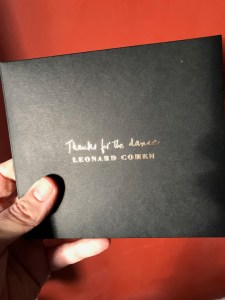
An artist is never really gone.  I have been listening to Leonard Cohen’s posthumous Thanks for the Dance.  Haunting in the way of Bowie’s Blackstar, there’s a poignancy to listening hard to the dead.  Especially when they saw it coming.  Artists are never really gone, and we can forgive them because they’re oh so very human.  Cohen was an exceptional poet and this album captures a man who knows the end is near.  Still he sings of girls and sins and God.  There’s an eternal soul there, and Cohen captures longing better than just about anyone.  The artist knows longing and understands not knowing for what.  The album struggles with religion and depression, a remarkably common combination.  Memories of glories that linger even as the body ages.

Listening to someone else’s music is taking a stroll through her or his head.  Someone once gave me a disc of songs built around a theme.  Although the theme came through I feared a little of what I heard here.  Some who know me primarily from my overly pious upbringing would be shocked to find Cohen on my favorites list.  For me he has no pretense.  Instead of ignoring religion, sexuality, or politics, he tried to make sense of them through song.  For me—and listening to music is a very personal thing—I think I understand when I’m drawn into his lyrics.  His experience of life was vastly different from what mine has been, yet he’d accurately mapped the direction my mind might wander, if given free rein.  Religion will hold your imagination captive, if left to its own devices.

Those who reduce Leonard Cohen to his over-used “Hallelujah” catch only glimpses of this complex man.  I once read an article about Bruce Springsteen in which a friend of his said that if he hadn’t succeeded in music he might’ve become a priest.  There’s an authenticity to these artists who write probing songs that have deep spirituality yet allow themselves to be human.  Cohen’s songs revealed he could see death with some ambivalence from afar.  Even in albums recorded thirty years ago the hints were there.  Instead of running and attempting to hide, Cohen’s lyrics, at least, indicated that he’d continue to try to live.  Maybe these are just the reflections of a middle-aged man who’s only glimpsed a fleeting connection between an artist in perpetual motion and a one-time scholar sitting up alone at 3:00 a.m., seemingly stuck in one place.  Whatever else they may be, such quiet moments will ones be haunted by Thanks for the Dance.


Atlas

The other day I had a hankering for Religion Index One.  I don’t think it exists anymore, at least not in the format I once knew it.  RI1 was a print volume produced by the American Theological Libraries Association, or ATLA.  This tome was an indexed list of journal articles that had come out on any given topic in the past year or so, and it stretched back to the 1940s.  The idea was that it was as close to “one stop shopping” as a scholar could get for finding publications while doing research.  I suspect it’s all done online now.  One of the tricks of the trade I’ve learned from not being part of the academy is that if you maintain membership in one of the larger bodies—the American Academy of Religion, or the Society of Biblical Literature—you can find out who’s working on what by searching the programs of their annual meetings.

This may sound like a terribly geeky thing to do; admittedly it is.  Nevertheless, I’ve uncovered lots of information by doing just this.  If you want to know who’s been researching a topic, look for who’s presented a paper on it over the past few years.  It’s not failsafe, of course.  Some of us aren’t really encouraged to give papers on company time anyway (and what time isn’t company time?) but we nevertheless research anyway.  All the journal articles and book chapters that I’ve contributed over the past six years or so have been invited submissions, with one exception.  Ironically, I taught and published full-time for nearly 15 years with no outside invitations made.  Once I was no longer in a position to access RI1 people started to invite me to submit papers.  It’s pretty difficult to do in current circumstances.

With the continuing factories churning out doctorates in religious studies—itself a stagnant job pool—there’s plenty being published.  Online sources mean even more venues to get things “in print.”  There really is no clearinghouse to find it all, beyond Google.  ATLA still exists, and they now produce a searchable database.  Like JSTOR, however, it’s only available to the traditional academic and the occasional wealthy bystander.  Since the AAR and SBL programs are open to the public for searching, even sorts like me can gain access to a small wealth of knowledge.  Or at least a wealth of papers and publications, which may not be the same thing.  Still, in quiet moments I reflect on walking to a physical library and thumbing through a book made of authentic paper, and feeling, at the end of the day, as if I’d accomplished something.


Smelling Winter

We’re experiencing the January thaw around here.  This isn’t a scientific thing, of course, and it doesn’t happen every year.  We had snow before Christmas, but it didn’t linger too long.  We’ve had cold days since, but none so bad that I couldn’t jog a couple miles over lunch.  The ground has started to freeze but much of the grass is still green.  The changing seasons are largely olfactory to me.  You can smell fall and spring coming.  I’m not talking about burning leaves in autumn or the first hint of magnolia in spring.  No, I mean the aroma of the earth.  Stuck indoors as we often are, we’ve been conditioned to think our sense of smell is under-developed and therefore unimportant.  Overall, however, humans don’t rate too shabbily in the nasal range.  We don’t experience the aromatic realm as much as dogs, vultures, bears, or mice, but our sense of smell is vitally important.

Not only does smell tether us to memory, it also influences moods.  Studies done on those deprived of scent by disease or accident indicate higher levels of depression.  All of us know how vital scent is to taste.  We don’t appreciate, I suspect, how the aroma of our earth can inspire us.  Yesterday as temperatures crept into the 60s, I stood outside breathing deeply. It was only in my back yard, and the clouds were low and gray.  Spring clearly came in the gusty air.  I know that the bulk of winter lies ahead.  January’s only just tuning up, and February has us in its sights.  The aroma of spring will once again be frozen to await release in more timely fashion.  I’ve been feeling chilly since October, layering up and reluctantly bidding goodbye to the scents of autumn.  Winter’s sterility has begun, but we’re being teased just now by a nature that likes to remind us who’s really in charge.

As I grow older, I’m hoping I’ll learn to smell winter.  My nose spends too much of it feeling cold, and when I wrap my face in a scarf, I have only my own breath to breathe.  What is the odor of winter?  The faint hint of smoke from a neighbor’s chimney?  The briny tang of a freshly salted roadway?  The pine of a newly cut Christmas tree?  Outdoors there’s life throbbing, pulsing slowly beneath the chill.  Even after the great ice ages, it was ready and eager to reemerge.  Today I smell spring in the air.  It’s not yet here, and won’t be for some time.  Scent is ever only temporary but today there’s yearning in the air.


Geocheating

So, we geocache.  Not as much as we used to, but over 15 years ago my family and I began the sport and really got into it for a while.  Geocaching involves using a GPS to find a hidden object (“cache”) so that you can log the find.  It’s all in good fun.  The organization that hosts the website also offers the chance to log “trackables”—these are objects with a unique identifier that you sometimes find in caches and you get credit for logging your find.  There are no prizes involved.  We started several of these “travel bugs” ourselves, years ago.  If you started one you got an email when someone logged it, and you could see how far around the world your little bug had gone.  For many years we’ve not heard much about any of ours and assumed them to be MIA.

Recently I started getting several email notices about a resurrected travel bug.  It was as if someone had finally found a cache somewhere deep in the Sahara where it’d been hidden for a decade.  Then I had an email from a fellow cacher, in German.  I figured it must be serious.  The message was that a Facebook page was publishing trackable numbers so that anyone could claim to have found them.  One of ours was on that list.  I went to the page to look.  It said, “Let’s face it, it’s all about the numbers.”  And they proceeded to list hundreds of numbers so that you could claim to have “found” the pieces with your posterior solidly sunk in your favorite chair.  This is annoying not only because we had to pay for the trackable dogtags, but also because it was cheating.  I said as much on the page only to have my comment blocked.

How sad is it when people cheat at a game when there’s no gain?  All they do is claim to have done something they haven’t, for no prize or recognition.  A fun family pastime falls victim to the internet.  Ironically, geocaching was really only possible because of the internet.  It required a place where players could log their finds in a common database.  Facebook, continuing its potential for misuse, allows someone to spoil it.  I, along with my unknown German counterpart, reported the page to the powers that be.  But since we live in a world where the powers that be don’t recognize any rules beyond inflating their own numbers, I shouldn’t be too optimistic of any results.  I guess this is how Republicans play games.


Strange Powers

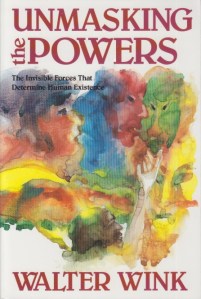
Some books take you to strange places.  Not all of them are fiction.  I began Nightmares with the Bible as a way of understanding the many, disparate ideas of demons I encounter in popular culture.  (I can’t tell you too much about my conclusions, otherwise you wouldn’t be tempted to buy the book!)  One of those nagging questions is: what does “based on a true story” mean?  I’ve known of Walter Wink’s powers trilogy for many years.  Because of my research I’ve now settled down to read Unmasking the Powers (number two, for those keeping count).  This book will take you into strange places.  Wink was very much a Christian in his outlook and orientation.  At the same time, he raises questions I’ve had other Christians put to me—were the “gods” of other nations, as in the Bible, real?  That word real is slippery, and Wink tries to hold onto it.

Unmasking the Powers is a kind of systematic exploration of the various “spirits” found in the universe we inhabit.  One of these is the Devil, and although Wink doesn’t see him as necessarily a “being,” neither does he find the Bible making him entirely evil.  Indeed, one of the great conundrums of monotheistic belief is theodicy; how is it possible to justify the goodness of a single, all-powerful deity in a world with so much suffering?  Wink approaches this question from an angle we might not anticipate.  He then deals with demons.  Since this is my subject in Nightmares, I found his discussion apt.  And yet again, strange.  Powers emanate from the institutions we create (you might have correctly guessed this was the book I wrote about on Tuesday).  Wink is willing to challenge materialism and take such powers seriously.

Finding a new perspective when we’ve been reared in a materialistic one, can be difficult.  For those of us raised religious, there was an inherent schizophrenia involved.  Our teachers told us of a mechanistic universe, but had Bibles on their desks.  (Yes, this was public school, but let’s not kid ourselves.)  While physics taught us everything could be quantified, church taught us that spirit couldn’t.  At least not by any empirical means.  Wink will unblinkingly take you there.  He offers both scientific and spiritual points of view on these entities, although he tries to refrain from calling them such.  Still, he records many people who have seen angels.  And although quantum entanglement wasn’t really known when he wrote this book, if it had been, Wink would’ve been nodding his head.


Cave Monsters

A story in Discover back in December discusses cave drawings from Indonesia.  Dating back almost 40,000 years before the creation of the world, these cave paintings represent the oldest yet discovered.  The interesting thing about such cave art is the representation of figures—both human and animal—that are instantly recognizable.  Scientists studying the art are able to identify likely species, but, as John Morehead pointed out on his Theofantastique Facebook post, there are also fantastical beasts.  We might call them monsters.  It’s interesting to see how scientific writers shift from their awe at life-like illustration to a nearly palpable embarrassment when the creatures become mythical.  Indeed, the article itself suggests such figures point to a very early sense of either fiction or spirituality.  The monstrous and religion have long trod parallel paths and we are only now beginning to explore the implications.

Monsters are beings over which we have no control.  They don’t abide by human rules and often the only recourse against them is religious.  When monsters come knocking, it’s often wise to drop to your knees.  Or at least reach for your crucifix.  Many rationalists like to claim that human civilization developed without religion.  The discoveries at sites such as Göbekli Tepe gainsay that assessment, indicating that humans first gathered for religious reasons and agriculture and all the rest followed from that.  Perhaps they came together for fear of monsters?  That’s only a guess, but I recall the defensive tower of Jericho.  The archaeologist lecturing us as we stood by this neolithic structure asked “What were they afraid of?”  He never answered that question.

Bringing monsters into the discussion isn’t an attempt to make light of these significant discoveries.  Rather, we need to learn to appreciate the fact that monsters are serious business.  Religion, whether or not literally true, is important.  Civilization has been running the opposite direction for some time now.  When surveys emerge demonstrating that the vast majority of the world’s population is still religious, analysts frown.  It does make me wonder, however, if nature itself programs us this way.  To other sentient creatures who experience us as predators, humans must look monstrous.  We come in a variety of colors and textures (clothing), we smell of deodorant, shampoo, soap, aftershave, or none of the above.  We emit strange sounds (our music).  Are we not the monsters of the natural world?  And should animals develop religion, would we not be one of the causes?  It’s just a guess, but I need to sit in my cave and think about it for a while.


Search Yourself

I was searching for someone on the internet (surprisingly, not myself).  Since this individual didn’t have much of a platform, I looked at MyLife.com.  Such sites draw in the curious and you soon end up paying (I suspect) for any salacious information such as arrest or court records.  In any case, what stood out is that we all presumably have a meter on the site that shows whether we’re good or bad.  It’s like a Leonard Cohen song.  Call me old-fashioned, but that’s what religion used to do.  Some forms of Christianity (Calvinism comes to mind) tell you that you can never be good enough.  Others are more lax (Episcopalians come to mind), as long as you go to mass enough and feel some guilt for misdeeds, you’ll get in.  All the various groups, however, have metrics by which you’re measured, largely based on what you believe.

The odd thing—or one of the odd things—about religion is that it is now categorized as what you believe.  Historically religions began as a kind of bellwether of what you do rather than what you believe.  The two are related, of course.  The motivation behind an action might well be good while the end result is less so.  Secular justice regularly seeks to answer the question of why someone did something.  Was there malice involved?  Aforethought?  Was it an unfortunate accident?  Religion drives over this ground too.  Without getting into the many shades of gray that are morality, value judgments as to the goodness or badness of an action (or a person) were traditionally the purview of religion.

The internet itself has become a kind of god.  We turn to it for all kinds of answers.  It’s both a Bible and encyclopedia rolled into one.  When we want to know something about someone we google them.  Some of us have tried to control the narrative about ourselves by making websites.  (This, of course, presumes others will be interested in us.)  Social media also injects us into larger arteries of traffic.  People judge us by what we post or tweet.  Often without ever meeting us or getting to know who we really are behind our physical walls.  So this person I searched had left little to find.  Scraps here and there.  I didn’t believe everything I saw on MyLife.  After all, not everyone wants to subject her or himself to the constant scrutiny of the connected world.  Maybe it’s a religious thing.


Social Madness

I’m reading a book written in the mid-1980s.  (All will become clear eventually.)  The author notes the connection between social madness and personal mental illness.  He cites the alarming rise of teen suicides.  This was over three decades ago.  Suicide rates have continued to climb, and this particular author got me to thinking about something that troubled me even as an undergrad.  Although I went to college intending to be a minister, I ranged widely in the subjects I studied.  (Being a religion major in those days allowed for quite a bit of flexibility.)  I took enough courses in psychology to have minored in it, if I had declared it.  Since my mind was set on church work I saw no reason to make said declaration.  The thing that troubled me was I had also taken sociology classes.

Like most people who grew up in uneducated households, I suspect, sociology was something I’d never heard about.  Asking what it was, in college, someone answered along the lines of “psychology of groups.”  My own experience of it was that it involved math and graphs—it was a soft science, after all—and now I read sociologists who say that such numbers can be made to declare what the sociologist wishes.  In other words, psychology.  The point of all of this is that the book I’m reading suggests societies exhibiting illness cause individuals to be sick.  Sociology leads to psychology.  In times of national turmoil, individual mental illnesses rise.  I had to pause and put the book down.  The eighties weren’t a picnic, but the national madness of the Trump era bears no comparison.  We are a nation gone mad, and when society can’t project health, the many who stand on the brink of individual mental illness simply get pushed over.  That sure makes sense of what I’m seeing.

Looking back, I often think I should’ve probably declared that minor.  Raised in a strong biblical environment, however, I wanted to learn as much about the Good Book as possible.  I was teaching Greek by my last year in college and in seminary I specialized in the Hebrew Bible.  It would’ve been a natural place to continue studying psychology.  By that point I’d decided to go on to a doctorate, and psychology required medical training.  For a guy as squeamish as me that wasn’t possible.  Ancient languages, though, they were something I could handle.  It’s rather frightening that those writing at that time already saw America (in the Reagan years, I might add) teetering towards national insanity.  We’ve gone far beyond that now.  And a society that doesn’t know it’s ill will sacrifice many individuals who realize that it is.


United, We Divide

I was a teenage Methodist.  Or, I should say, a teenage United Methodist.  My family had moved to a town where there were no Fundamentalist churches.  Indeed, the only Protestant church was the UMC.  Although very aware of religion, I hadn’t studied it deeply at that point—I’ve come to understand a bit better the marketplace of Christianties and how it works in a capitalist society.  The thing is, the more I learned about John Wesley and the Methodist movement, the more I saw how well it aligned with my own thinking and experience.  I became an Episcopalian largely because John Wesley never left that tradition and urged his followers in the same direction.  Of course, the “United” in United Methodism was due to mergers during the ecumenical period when Christians were learning to overlook differences and a strong base remained from which to draw.

The news has come out that the United Methodist Church has decided to split over the issue of homosexuality.  Most major Protestant denominations have made their peace, albeit uneasily, with the issue.  They recognized that while a source of guidance in spiritual matters the Bible’s a little outdated on its scientific understanding.  If God had revealed evolution to good old Moses things might’ve been a bit different.  We now know that homosexuality isn’t a “choice”—it is found in nature, and not rarely.  Homo sapiens (if I’m allowed to use that phrase) have developed in such a way that sexuality is a main preoccupation of religions.  Some animal species are monogamous and in our case many cultures adopted this as conducive to an ordered society.  Then it became codified in some sacred writings.

While homosexuality is mentioned in the Bible, every book of that Bible has a context.  Like it or not, close, serious study of Scripture raises questions you just don’t get if you read only authors who think the same way you do.  It is far easier to do that—who doesn’t like being right?—but thinking seldom gains credibility by never being challenged.  Iron sharpens iron, someone once said.  The emotion behind the issue, I suspect, is driven by a couple of things: fear of that which is different, and the inability to see the Bible as anything but “da rules.”  In those cases where the rules contradict one another you just have to choose.  At least in Christianity.  In Judaism they ended up with the Talmud.  In any case, we’re now seeing the fracturing of society based on party lines.  We could always use a few more choices, I guess, for competition is what spiritual capitalism is all about.


Droning On

According to the New York Times (I don’t have a link, but Google will bring it up), nighttime drone formations have been reported by law enforcement in the Midwest.  These obviously precision formations fly over small towns and prairies in Nebraska and Colorado.  Now, I write what I consider to be horror fiction, but this is downright scary.  We know our government is keeping tabs on us using all kinds of technology, and this could be a government program.  It could also, as the article points out, be the mapping project of some corporation (which can be scarier even than the government), seeking natural resources to exploit.  Twice this past year I’ve spotted mapping cars with their camera-stalks protruding from their roofs, multiple spider-eyes recording roads and their surroundings.  Smile—you’re on candid camera!

At least you could see this kind.

Please don’t think that I suppose myself important enough to be spied upon.  Heck, I can’t even get job interviews and my books don’t sell.  Still, I am concerned about surveillance.  I’ve seen articles suggesting that facial recognition software is now being used by some governments (notably China’s) for keeping track of “people of interest.”  I’m more a person of disinterest, but I thought nothing of pausing long enough for the camera at Heathrow customs to record my face and scan my passport as I entered the UK in June.  Coming back the same thing happened in Newark.  And people wonder why I won’t go into the full body scanners at the airport.  Some bits of personal information, particularly those down south, I’d like to keep out of government hands.

Watching the X-Files again has reawakened my suspicion that there are too many secrets.  Yes, I know the X-Files are fiction.  Still, we know black budgets are as real as the electronic money our banks tell us we have.  And some places aren’t even accepting cash any more.  I have no idea why fleets of drones may be flying over the Midwest, but the fact that it’s happening at night raises all kinds of worries.  The X-Files had us looking for UFOs, but drones come from a far more threatening species.  Technology has no controls built in.  Kids these days can run virtual circles (and very precise ones at that) around my generation.  Listening to them talk tech makes me think English might be a foreign language after all.  Nobody requires a permit to fly over your head and take a look.  While they’re up there, I wonder if I could convince them to take some pictures of my roof.  Those on Google maps don’t give enough resolution to tell the roofers where they should focus next.


New Year Reading

Childhood has a powerful draw.  I first started reading Dark Shadows books when they were published for (I kid you not) 60 cents.  I got them for cheaper than that at Goodwill.  Every time I read one I wonder what my young imagination found so compelling in them, but in an effort to trust my younger self I keep on.  So I read Marilyn Ross’ Barnabas, Quentin and the Witch’s Curse.  The book doesn’t really say anything about a witch’s curse, providing as it does some of the backstory for Quentin.  If you aren’t familiar with that background, and you want to be, Barnabas is a vampire and his cousin Quentin is a werewolf.  Both were made so by curses, a plight the Collins family has long faced.  

In recent years I have read the 19 volumes in the series preceding this one.  They tend to be formulaic, and often show the signs of having been written quickly.  W. E. D. Ross is sometimes listed as the most prolific Canadian author ever.  He wrote over 300 books, mostly in genre fiction.  It’s no wonder many of them sound the same.  Still, I have to admit that both from watching Dark Shadows and from reading these novels as a kid, I liked Quentin.  Yes, he was smug and self-confident, but as a werewolf he had the ability to become someone else.  Unlike other books in the series, this one focuses on Quentin and points a pretty heavy finger to him being a Satanist.  That seemed pretty harsh to me.  There’s a difference between being the victim of a curse and being a Devil worshipper.

Now I know I shouldn’t take this as belles lettres.  Ross is not remembered as a great stylist, master of character development, or for being all that creative.  Dark Shadows was a soap opera—one of the more intelligent of the genre—and there’s only so much you can do with it.  Satanism was a cultural concern in the 1970s.  In the following decades it would bloom into an outright panic.  I’m pretty sure that I never read this particular volume when I was young.  Even now as a relatively mature man I found the implications somewhat disturbing.  The Scooby-Doo ending doesn’t do much to ameliorate the undercurrent of evil.  Quentin always seemed like such a sympathetic character to me.  Maybe it just goes to show what happens when you go for a quick read rather than choosing a book of substance.  Childhood can be that way.


A Few Days

My fellow blogger over at Verbomania (worth following!) posted a piece on the word Romjul.  In case you haven’t read the post, Romjul is the Norwegian word for the period between Christmas and New Year’s Day.  It’s kind of a liminal period.  Not really holiday and not really not holiday, in northern climes it’s often cold and dark and you don’t feel like getting out to do much.  In many reasonable parts of the world it’s a given that this should be time off from work.  With all the preparation that goes into Christmas and the standard convention of starting the New Year with a freebie, and the fact that the days of the week for the holidays are movable, it just makes sense.  In these developed States, holidays are left to employers.  Mine granted two days off: Christmas Day and New Year’s Day.  What are your choices when they fall on Wednesday?

Romjul gave me a good feeling.  I cashed in a vacation day or two to take some time off.  The years when I’ve worked between the holidays I’ve found nobody in their offices or answering email, and that led to long hours of waiting for the work day to end so that I could actually do something productive.  In America we love our work.  At least employers love our work.  I talked to a young man who had to cut his holiday short to be into work on Monday, December 29.  He’d just returned from an international trip, but his employer insisted he be there.  There was no work he could do because his colleague whose input he needed had taken that day off.  Work is like that.

I recalled a snow day when I had to commute daily to New York City.  New Jersey Transit got me as far as Newark but the trains were shut down from there.  I had to take a PATH train that took me close to my Midtown location.  It was running late.  A woman was panicking about not being on time.  A wise, older gentleman said, “Employers just want you to show up.  They’re not looking for a full, productive day of work.  They just want you to come in.”  I believe he was right.  Employers like to make their puppets jump, no matter if there’s anybody there to watch the show.  In a civilized world, as in much of Europe, we would celebrate Romjul.  If not for religious reasons, then for simple humanitarian ones.  In late December we can all use a week off.


Seaing 2020

It’s funny what sticks in your head.  As a ten-year-old 2020 seemed impossibly far in the future.  And it was very wet.  Not because of global warming, but because of a Saturday-morning cartoon called Sealab 2020.  Suffering from thalassophobia, the idea of living under the ocean was both intriguing and terrifying to me.  I recall that these underwater scientists had “aqua-gum” that they could chew so they’d be able to breathe and talk when not in the giant domes of the lab itself.  While checking out the series online, I was surprised to learn it only had 13 episodes and lasted but three months.  I’ve been thinking about it for over 40 years now, silently waiting to see if we would have such places as the deadline drew near.

This image is protected under copyright by the owner. It is reproduced here under the fair use doctrine, in low resolution. From Wikimedia Commons.

Instead in 2020 we have a record low of scientific projects being supported by a science-denying government.  Ironically the sea levels are rising because of global warming.  We haven’t done our homework and we’re pouting that things aren’t turning out the way we wanted them to.  Ours is no longer an evidence-based reality, but one where a tweet of “fake news” is all we need to make the truth a lie.  And as the water laps our ankles my thalassophobia starts to kick in.  The thing about Sealab is that they had kids there too.  Kid scientists.  Even more ironically, Richard Nixon was president.  His downfall was Watergate—coincidental?—and now we have a president caught red-handed (very Red-handed, even) in crimes while in office and Nixon’s beginning to look like a saint.  When did the water get up to my knees?

They wore wetsuits and swim fins quite a lot in the show.  Moving under water looked so natural—unlike my flailing when I attempted to swim.  It was all about not being able to breathe, in my case.  They showed us all kinds of strange animals under the water in Sealab 2020.  Animals that we could drive to extinction, it seems, if they got in the way of unbridled greed.  I have to admit that I’m a bit disappointed that Sealab misled me.  We were heading for an optimistic future back then, even with Nixon justifying the Vietnam War and spying on his political opponents.  People were still able to look forward four decades ago, in hopes of a better future.  For all these years I’ve been awaiting 2020 only to find the world back behind where it was in 1972.


Hereby Resolved

Photo credit: chensiyuan, Wikipedia Commons

New Year’s resolutions have never been my thing.  Having had a good Calvinistic upbringing, I’m a natural self-corrector.  If I’m aware I’m doing something wrong, I attempt to change my behavior right away.  This makes annual reviews at work exceptionally uncomfortable for me.  I’d much rather have my boss point out foibles as they happen so that I can stop doing them right away.  I realize my mindset here may be weird to those who were raised in more normal ways, and employers love process.  So I sit here in Ithaca on New Year’s day, preparing to drive home to face all kinds of unfinished business from 2019.  I’m still doing research for Nightmares with the Bible, thus it’s not ready to go back to the publisher or series editors yet.  I’ve started a new round of queries to agents about one of my novels, but I haven’t sent them yet.  And don’t even mention projects that need to be done to the house.

Life is busy.  I’ve taken on some new duties at the church I attend, exemplifying that old saw “If you want something done, ask a busy person.”  As the pressures from that obligation mount, I start to think that most people don’t have any idea just how all-consuming writing a book can be.  I work long days and although I don’t commute much any more, most of the rest of each day is taken up with writing and reading so as to write some more.  I hesitate to call myself a writer since I make laughably little lucre from it.  I can’t stop myself from doing it, though.  And although it’s the season for resolutions, I don’t plan to stop.  I know from work that graphomaniacs can be a problem.  Anything can be overdone.  On days when I don’t have to work I have to be pried away from my computer.  Otherwise I’ll write all day long.  It’s an issue, I know.

Perhaps because life on the national scale is so depressing, writing about things like horror movies is a great release.  I’ve been so busy lately that I haven’t had the chance to write pieces for venues like the excellent Horror Homeroom.  I used to contribute to Religion Dispatches.  That time has been sucked into getting my books that nobody will read finished.  Having written that self-disparaging remark I have to remind myself that one of my alumni magazines published a notice about Holy Horror without me having to send said notice personally.  That self-disparaging thing requires some fixing, I guess.  And were I not too busy already in 2020, I’d start on it right now.