Running with Scissors

I suspect that, like many, I’ve come to see the coronavirus as an indictment of political foolishness.  Electing unqualified officials feels like all fun and games until a crisis emerges and the leadership has no idea what to do.  The Trump administration announced itself as anti-science and began breaking down the carefully built institutions that made our way of life possible.  His fans cheered.  Now they’re huddled in their bunkers with their stockpiled Purelle and toilet paper and Fox News on 24/7.  It’s a good thing that a stable genius is in charge.  He’s trying to get Germany to move production of the most promising vaccine to the land of his anti-vaccers, something Germany’s reluctant to do because 45 has a reputation internationally.  It seems he’s made America infectious again.

As those of us with brain stems try to find some way to comfort those we know and love, we keep coming back to the fact that this kind of pandemic is new in the internet-linked world.  No matter what you try to do right now you have to assess whether it involves meeting other people, potentially infected, and whether it’s worth the risk.  I had to go to a grocery store and Target over the weekend.  I’ve never seen so many empty shelves before.  This is what panic looks like.  The difference is that even W., who will never be considered among the smartest of presidents, recognized that institutions are there for a reason.  America’s greatness grew slowly by building on what’d gone before.  Tearing everything down in a narcissistic tantrum and claiming all we need to do is adore our autocrat, we now see how great this country has become.  Greatly afraid, that is.

Coronavirus closed schools more effectively than Betsy DeVos.  Businesses are reeling as the businessman president fumbles with facts and figures he can’t understand and can’t admit that science is real because, well, global warming and all that.  Internationally people are looking for solid leadership and finding that the autocrats they’ve elected have no idea what to do.  Self-aggrandizement is no basis for leadership.  The Republican senate had their chance just two months ago, but they were banking on their personal bank accounts, it seems.  Even in the face of this crisis Mitch McConnell persists on insisting it’a all a game.  As a child raised in a Republican home I was taught never to run with scissors.  But then, I had all my vaccines.  Mad dictator’s disease hadn’t yet been released upon the world.

Virtual Church

All the way back in seminary my friends and I used to joke about virtual church.  What made it so funny was that the idea seemed ridiculous.  The very raison d’être for church (which essentially means “gathering”) was, well, gathering.  We joshed about putting a communion card into an ATM and getting bread and wine.  Little did we know we’d live to see virtual church become a reality.  While I prefer not to tip my hand as to my affiliation (I began doing this when teaching at secular schools, for if a professor of religion is being academic about their specialization their affiliation should have no bearing on the class) I confess I am the member of a religious community.  That community has become virtual, as of today.

This isn’t a permanent thing.  Unless coronavirus is a permanent thing.  As I spoke with my clergy person about it, I wondered how many people would attend virtual services.  Sermons would need to be stellar.  Who would hear if I tried to sing hymns (this is not a pretty thing, take my word for it)?  My laptop doesn’t even have a disc slot into which I could insert my offering.  Churches, synagogues, mosques—they’re about community.  What does community feel like when you’re sitting there in your pajamas, at least on the part that the webcam doesn’t pick up?  Does the minister see you in virtual church?  Have I, like number 6, been reduced to a numeral?  I suspect the current crisis is going to be a real test for faith communities.  Meeting together would make us all feel like snake-handlers now.

The funny thing was, back in seminary it was a joke.  At Boston University School of Theology in the late 1980s we knew that churches weren’t really growing.  Some megas had started and we now see them following the mushroom cloud to its dissipation stage.  As little as we meant it, we could see devices creeping into the mix.  I did not use a computer until after seminary.  Funnily enough, thinking back to the pre-1990s, we survived without cell phones.  If you were going to church you were going. To. Church.  These days of pandemic in the pews will be a real test of the preacher’s power.  For Episcopalians the mediating of grace had to be done in person.  I remember watching worriedly as the priest, clearly with a sniffle, was the first one to take a sip from the community chalice before holding it out for others to drink.  We wondered about efficacy of ATMs dispensing consecrated hosts.  It was only a joke, then; really it was.


Travel Ban

I’m not at home.  I know in the current crisis that sounds like heresy, but I can honestly say that getting out of the usual routine where COVID-19 is all you hear about feels right.  More and more organizations are instituting work from home policies—many of them mandatory.  I’ve worked from home for going on two years now.  You need to get out a bit.  I know travel isn’t recommended, but I’m really not afraid to die.  Besides, I put a box of latex gloves in the car and when we stopped for a restroom break, wore them until they could be safely removed.  Exposed surfaces in the rest area were being continually wiped down.  Don’t get me wrong—for an introvert like me working at home is fine.  It’s just the idea of feeling like this virus is some zombie apocalypse happening just outside my door that I needed to dispel.

When I told a friend I was no longer going to be commuting on a regular basis he said if it were him he’d only ever buy sweatpants again.  Now that my reality is life with my wife being the only person I regularly see, I’m beginning to realize just how much our clothes purchases are for impressing others.  My haberdashery is akin to that of Henry David Thoreau; I wear clothes until they’re no longer functional.  They can be badly out of date but they still work.  The fashion industry is built on pride.  To put it in the words of my old friend Qohelet, vanity.  We want others to see what we’re wearing.  If we’re still donning last year’s gay apparel we’re not playing the game.  Never mind those of us whose wardrobes could be carbon-dated.  The pandemic can be revealing.

So I’m away from home for what is really the first time in months.  I had to stop in the grocery store for a few things.  Only one person I saw was wearing a mask, but I was wearing prophylactics, so who’s going to cast the first stone?  Many shelves were bare.  The CDC has become our new gospel provider.  I’m limiting my outside exposure.  Driving door to door, greeting no-one along the way (that actually is the gospel, but substitute the walking for the driving part).  I know when this weekend’s over I’ll be back to my cloistered existence as the rest of the world tries to get used to the loneliness of the sweatpants crowd.  If you’re one of them take it from me—the rest of the world is still out there.


Keystone

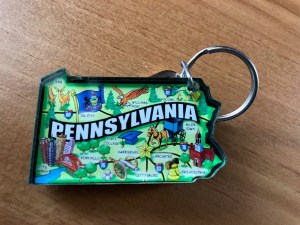
I don’t carry many keys.  Working at home has that distinct advantage, and combination/electronic locks of various kinds are becoming pretty standard.  I do wonder about the impact this has on the keyring industry, though.  Not a fan of bulky rings of keys and fobs in my pocket I tend to stick to novelty keyrings for entertainment purposes only.  A few years back, before we’d considered moving to Pennsylvania, we picked one up that was shaped like, well, the Keystone State.  Laid out like a tiny, very large scale map, it lists the big cities and some tourist sites.  Since you seldom hear people say, “I’m going to Pennsylvania for vacation” you might well wonder about the latter.  The reason that we bought this novelty was one of the places listed: Oil City.

Currently around the 82nd most populous city in the commonwealth, Oil City isn’t a place most folks would look for.  It is near the birthplace of the oil industry, thus its name, but it doesn’t seem to have the tourist draw to merit a keyring fob.  I grew up very near Oil City, and I attended Oil City High School.  It’s a pleasant enough town, although it has been ravaged by big box stores that left its downtown the haunt of ghost store fronts.  Many of the big boxes then left because the area has been economically depressed for decades.  It’s an example of the kind of victims that capitalism tends to leave behind.  The fob on which this “map” is printed is plastic, likely a byproduct of petroleum.  That industry had its start in this area and when larger oil fields were found elsewhere it simply moved on.

The keyring had been stuffed into a box within a box, well forgotten before we moved to Pennsylvania.  While going through some things the other day, it surfaced once again.  I had a key needing a ring, so it was put to use in its native state.  Often I ponder how oil has played into my life.  Pennzoil still had a headquarters in the area, and refineries dotted the river valleys, but larger fields with bigger payoffs lay to the south.  My gypsy-like family didn’t settle in the region because of oil.  Not part of the petroleum industry, we simply lived in its shadow.  I haven’t visited the area for a few years now, at least not to appreciate the life of a town that helped initiate the modern world, but then was quickly forgotten.  Even keyrings can tell a story.


Die Besuch

It was both sweet and perhaps misguided.  I’ve not written much about the coronavirus because I’ve really had nothing to say on the pandemic.  Also I’m squeamish.  Being a remote worker I spend most of my time alone anyway.  So when the knock came to my door, I wasn’t sure I should answer.  Afraid that some vital bit of information was to be conveyed, I gave in.  Two young ladies stood there and at first I thought they were selling Girl Scout cookies, but one of them had some copies of The Watchtower in a folder and I knew that the Jehovah’s Witnesses had come calling.  I didn’t invite them in.  I don’t mean to be inhospitable, but those who go around knocking on doors might have been exposed to who knows what.  They were here, the older one said, to give good news.

Although she didn’t mention the coronavirus directly, she said people were feeling anxious.  But God—our creator—had promised everything would work out.  She read me Revelation 21.4, about God wiping every tear from our eyes, from an iPad.  I’ve read that verse many times on my own, and, tainted with decades of specialist knowledge, knew a good deal about the context in which it was written.  The Witnesses didn’t stay long.  As they walked away I couldn’t help but think how this current scare has been affecting us all.  We are afraid.  I don’t need any advice when it comes to social distancing (I am an introvert, after all), but there’s a kind of hopelessness afoot.  I don’t read the papers but every headline is about the virus.  The world seems awfully quiet.

This will go down in history, I suspect, as a strange episode.  I feel guilty for conducting normal business, as if there is anything I could do to prevent the disease beyond isolating myself even further.  It’s perhaps the waiting.  Those of us in circumstances where joy is more fleeting than a visit from the Jehovah’s Witnesses often invest huge amounts of time waiting for things to get better.  The news, for example, that a piece has been accepted for publication.  Or that a long wished for promotion has come.  Or that somebody has actually read your book.  Such news is rare indeed and outside a disease rages out of control.  What else beyond missionary zeal would send you to strangers’ doors at such a time as this?  They didn’t even leave any tracts.


Coincidentally

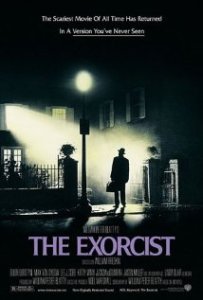
I hope I never become too sensible not to pay attention to coincidences.  With the death of Max von Sydow falling the same week as the time change, the full moon, and Friday the thirteenth, I’m left feeling a little vulnerable.  I mean, what do we do now that the Exorcist is gone?  A couple days ago, when the moon was full—the last full moon before the vernal equinox—I awoke before 3:00 a.m.  Thinking Daylight Saving Time would have me groping for a few extra minutes abed, instead I found myself wide awake at the hour when monsters are thought to be afoot.  As I put my feet to the floor I saw the brilliant lunar light beating through the blinds like midday.  It was remarkable how very light it was.

A bipartisan bill has been introduced in congress to make Daylight Saving Time permanent.  Of course, getting any law passed without numerous riders and bickering is unlikely, but I do wish they’d get on with it.  That having been written, the time shift has been remarkably easy on me so far this year.  Perhaps those of us regularly awake in the dead of night adjust a little more quickly.  Keeping out of New York with the coronavirus lurking, I’d rather deal with my own monsters anyway.  I remember my amazement at seeing Max von Sydow unchanged from Fr. Merrin to Dr. Naehring.  Then I looked up just how much makeup the Exorcist had to have to age himself several decades.  He was a young man when The Exorcist was filmed.  At this time of day anything is believable.

Friday the thirteenth is a bit of lore grown from Christianity.  Friday was inauspicious because of Good Friday and the thirteenth lot fell on Judas, who, along with the others, made thirteen.  It was as if some demon were afoot on such Fridays.  These bits of Christian lore made their way into popular culture and then crept into horror films.  A good deal of Nightmares with the Bible revolves around The Exorcist.  So I sit here before sunrise with a bit of just-past full moon shining in, not too tired from losing an hour on Sunday.  It’s not difficult to think of scary things at this time of night.  Of course, demons traditionally come out around 3:00 a.m.  This week has been like that.  And without Max von Sydow, we want to be very cautious around demons.


Merch

I recall the time I first heard the word “merch” used as a verb.  I was with some wonderful ladies on the second annual Women’s March, in New York City.  We had to leave fairly early to get there from Jersey and as we made our way to the march route, we saw the goods.  Vendors had all kinds of things on sale, from the ubiquitous tee-shirt to refrigerator magnets.  One of the women in the group said, “I guess you can merch anything.”  And so you can.  People will buy all kinds of identifying marks.  It’s a craze I personally don’t get into.  I buy plain clothes, having more of an Amish aesthetic.  Still, I was a little surprised to notice that the Society of Biblical Literature is now merching itself.

Now, who can blame a non-profit for trying to score a little on the side?  We all know what that’s like.  What I find myself most curious about is who would want to advertise that they’re working on a degree that will, in all likelihood, find them on the breadline when it’s all over?  I’ve known many who’re proud to be nerds—they’ve got employment to give them creds.  Those of us tormented by the meaning of it all, not so much.  My decision to go to grad school was accompanied by the blessed assurance that there’d be plenty of opportunities, but there was no merch.  Indeed, I was two years into my doctorate before  I even found out what the SBL was—the great connector whence came jobs.  At least in theory.  I found my post at Nashotah House because a friend told me about it.  I still have some of their merch.

Knowing what I do now, would I have done it any differently?  It’s difficult to say.  Who can recall the frame of mind of his younger self with such clarity as to know his choices?  Having studied Bible I was curious whence it came—to turn back even further the pages of history.  As I sit here in the early morning I have on my last two remaining pieces of Edinburgh merch.  My moth-eaten woolen divinity scarf and my blue alma mater sweatshirt.  I try hard not to think how close to three decades ago it was.  I was so sure I’d find a job with that rare Scottish degree, imprint of John Knox’s breeches still fresh upon my head.  Instead the merch of my current employer—a coffee mug—stands before me, reminding me that work alone awaits.


Data Driven

People just aren’t good at thinking things through.  Consider all the data on data.  Everything is data-driven these days, as if there’s no such thing as human spirit.  We do data all day at work and wonder why we having trouble making ourselves get out of bed in the morning.  If we had enough data I bet we could come up with a metric for arousing the soporific before the sun rises.  You could get the precisely correct amount of sleep.  Awake to precision-measured caffeine.  And get back to your data for another eight-plus hours.  There—feeling productive?

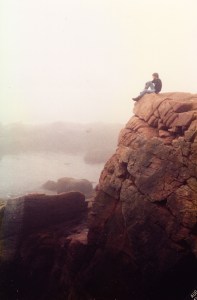
I miss the humanities.  There was a time when someone who didn’t give a fig about data could make a decent living pondering what it is to be human.  Even birds and bees know how to count.  Can’t we ratchet it up a bit?  Use our vast imaginations to come up with meaningful employment?  How you gonna measure that?  Some things just can’t be quantified.  How much joy is enough?  Too much?  Precisely how long is any coastline?  Even if we could measure it down to the nanometer, could that capture how it feels to sit on the rocky shore and feel the waves breaking against the cliff beneath you?  Even data has its limits.  Those who want to make a living without it will be sucked into its black hole nevertheless.  No light escapes.  Only numbers.

Companies like Amazon collect data.  Search engines like Google collect data.  All of those autosuggests?  They’re based on past searches.  I’m surprised just how wrong Amazon and Google are about me.  I was only searching dogs because I was curious about what kind the neighbor has, not because I plan to get one.

A wise man once said to a class full of wide-eyed neophytes, “If you want to get a surprise in your marriage just go home and tell your spouse you know everything about them.”  There’s no better way, he intimated, to get a completely unpredictable reaction.  Is that slap, or kiss, or knee to the groin driven by data?  Where’s the passion in that?  No matter whether you prefer Spock or Data, human motivation is emotional.  There are those who actually enjoy looking at data all day.  Dreaming about numbers and their hegemony over the workplace.  Others of us grew up with the classics and we have romanticism deep within our souls.  We nod our heads at Blake’s “dark satanic mills” and start to look for a coastline upon which to sit.  Perched upon this rock with the crashing waves, I suspect, I’ll be better able to think things through. 


Half of Us

Today is International Women’s Day.  We need to pause a moment and think.  We can’t change the past, but we can improve on it.  I think it’s fair to say that historically—before the Enlightenment anyway—domestic arrangements were the product of evolution rather than intention.  Like religion, however, domestic arrangements have a difficult time keeping up with change in real time.  By the time healthcare improved and women’s chances of surviving childbearing grew, men had become set in their ways.  Even now we still have trouble getting a female on a presidential ballot in “the most advanced” country in the world.  The week before International Women’s Day Elizabeth Warren stepped out of the race.  The rational world is so desperate to get the anomaly out of the White House that it hasn’t really dawned what a lost opportunity this was.

Although for most of history their roles have been hidden, half the advances of the human race belong fairly to women.  Males often have difficulty admitting that they require help, or had any assistance getting to where they are.  In fact, though, we know they had mothers and those mothers helped make them who they were.  Many of them had spouses who kept the situation stable enough that they could go on and follow their preoccupations.  History, unfortunately, would record only the names of the men.  In the western world this was often reflected in the changing of names during marriage.  Domesticity comes with a price, but it can be balanced out.

Capitalism, it seems to me, rewards the greedy.  Instead of evening things out so that those who don’t have the same opportunities can be cared for, our economic system rewards selfishness.  I often wonder if women would’ve been so suppressed had a more humane measure of human worth been adopted.  When I think of billionaires whose names I’ve never heard of before, I always mentally add, “they wouldn’t be billionaires if the rest of us refused to play the game.”  It’s only because we agree to an arbitrary and artificial valuing system that we allow the obscure to “own” far more than the rest of us.  Women, it seems to me, would know the realities of this way better than most men do.  What if the value system we shared measured worth in having had a mother?  It’s something we all share.  Yet in this nation we still haven’t passed the Equal Rights Amendment.  The time has come to ask ourselves what’s really important.  Today should be the answer.


See Index Saw

Too much of my life is taken up with indexes.  If life with technology is a teeter-totter, then my generation stands just above the fulcrum.  There are guys with whom I attended college who maintain no internet presence at all.  I’ve repeatedly searched for college buddies and come up blank.  Those in the decade following mine, if they want to work, have pretty much resigned themselves to tech.  Those in the decade before, not so much.  What does this have to do with indices?  Plenty!  You see, in academic publishing, and its consequent research, you need to look stuff up.  If you read multiple books on the same topic you’re not likely to be able to pinpoint a page number without an index.  You remember you read it here (you think) and so you stick a finger in the back and begin checking out the pages referenced until you (hopefully) find it.  That’s the old school way.

I’ve typed my fingers down to the marrow trying to explain to guys my age and older that the average academic no longer uses a print index.  Just about everything has been digitized.  Although I’m no fan of ebooks (I very seldom read them) looking things up is sure much easier with a searchable PDF.  Type in your search term and voila—an easy list of references appears that can be quickly clicked through and checked.  And yes, my colleagues, that’s what people are doing these days.  I lament the decline in print books.  When I set out to write a book I have a physical object in mind.  It has pages and a cover.  A spine.  I am writing a book, not “content” to be “exploited” in “multiple formats.”  And yet, the index is really no longer necessary.

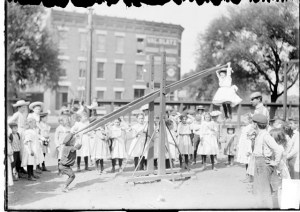
The typical academic author whose book is at the production stage fusses greatly over the index.  Calmly I explain that indexes are very rarely used.  They must have detailed indices, they insist.  The thing about teeter-totters is that they move.  I have an inner-ear problem.  As a child this prevented me from doing the usual playground things like swinging and seesawing and spinning, to different degrees.  I still can do none of those things well.  My wife and I bought a gliding rocker early in our marriage, that seats two.  We quickly learned that I couldn’t rock with her.  Indexes, you see, are on one side of that long board.  It’s the side on which the heavy weight of time rests.  So ponderous is it that the kids on the other side just can’t get it off the ground.  And I spend my days over the fulcrum trying to get the two sides to play nice together.  Without rocking the thing too much.

Photo credit: Chicago Daily News, via WikiMedia Commons


More Classics

Western civilization, in as far as it still exists, has traditionally identified itself with a heritage that includes the classics and the Bible.  As study of the Bible grew beyond a bunch of guys discussing what they thought the text meant, realization dawned that comparison with the classics might not be a bad idea.  The main difference between the two was that one was considered revealed by God and the other was mere human invention.  Nevertheless, an educated person was expected to be well acquainted with both.  In today’s version of “western civ” it’s sort of an embarrassment to admit to being interested in the dusty old classics, and the Bible has reverted to being a bunch of guys discussing what they think it means.  In the interim there was some fantastic work done that helped us understand whence we came.

Those of us born in the sixties or later were raised in a culture where the classics were diminishing.  Yes, I’d heard of Cicero, Seneca, and even Ovid, but I couldn’t tell you what they wrote.  By the time I really took an interest I had the hundreds of volumes of the Loeb Classical Library to tackle—a daunting feat even for an undergrad.  Those guys wrote a lot.  Compared to the classics the Bible—a pretty big book—is miniscule.  As someone who deals with biblical studies all day long (and who has done so for decades) I’ve had to pick up on the classics a bit.  Those of us who were more inclined toward the Hebrew end of the spectrum discovered the vast, and still not fully translated, archive of ancient West Asian material.  If you wanted to include these ancient classics that influenced our civilization only indirectly, you wouldn’t have time even to tweet.

There are those who accuse classicists of any strip of being backward looking.  Those of us so accused are often amazed at how current events so closely resemble things the ancients encountered.  Historians, relegated to their shadowy corners, have been the Cassandras of us all, warning that if we don’t learn this stuff we’ll end up repeating it.  As often as they prove correct the rest of the “civilization” scratches its head in wonder at how we’ve come to this point.  I’ve not read all of the classics.  I’ve not even read all of the Ugaritic tablets—more have been discovered since my ill-fated dance with academia.  We have much to learn from ourselves.  About ourselves.  If only we could spend our time in the classic pastime of reading.


Ash + Hera

I’ve obviously been reading about the Greek gods.  Apart from being borrowed and renamed by the Romans they’ve remained pretty much unchanged through the millennia.  Those who read a blog like this will recognize the names of many Olympians and would recognize the name of the head honcho as Zeus.  The name of Zeus is Indo-European—this is a linguistic group, and not necessarily an ethnic one.  That is to say, the languages of ancient India and ancient Europe are related.  Zeus, it has been postulated, is related to the word Deus, familiar to many Catholics as a Latin word for God.  In antiquity most gods had personal names as well as titles, but this is something we see a little more clearly in the Semitic linguistic realm.  The texts of the Bible and its surrounding cultures often preserve titles as well as names.

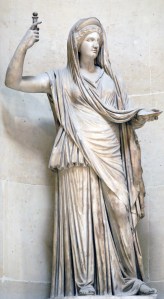
Photo credit: Marie-Lan Nguyen, via WikiMedia Commons

Hera is widely recognized as the consort of Zeus.  It’s a bit of a misnomer to refer to divine couples as “spouses” since they really don’t comport themselves according to human-style conventions.  In any case, Hera in Greek mythology is an underdeveloped character.  She’s jealous of Zeus’ many affairs, and she sometimes punishes his children by other women or goddesses.  Her name is a bit of a mystery, and the other day I was trying to remember where I’d read that she may be a shortened form of Asherah.  My research on Asherah is now nearly old enough to fit in with the classics, but much of it still remains fresh in my mind.  In any case, the reasoning went like this: Asherah always appears as the consort of the high god.  The Greek Zeus was clearly influenced by Semitic ideas associated with Hadad, or Baal.  And while Asherah was not Baal’s consort, Zeus is clearly the high god so his main squeeze should be that of the highest order.

Greek, as a language, had trouble beginning words with a vowel followed by the “sh” sound, like Asherah.  The argument went that if you knock the “as” off the front of that divine name you’re left with Herah, and the final h isn’t pronounced anyway.  This line of reasoning always made sense to me.  Deities in antiquity were defined more by what they did than by what their names were.  In a patriarchal world, being the consort of the highest male was about the most a goddess could aspire to.  Still, we all know of the more colorful individuals who take a more forward position: Athena and Artemis—both powerful virgins—and the somewhat more naughty Aphrodite.  All those names beginning with alpha!  They could teach us something today, I suspect, if we read our classics.


Classic Monsters

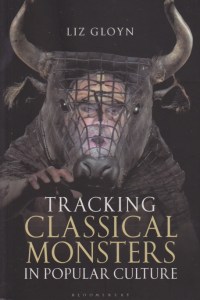
Convergent evolution is a term that’s used for when two unrelated species, separated by some gulf, develop a smilier trait independently.  I began studying monsters in biblical reception history before I really knew others were doing so.  After I’d written Holy Horror I discovered an article by another scholar who was doing similar things, even looking at some of the same movies.  Liz Gloyn, it turns out, was also doing something quite similar with classical monsters.  Her Tracking Classical Monsters in Popular Culture just came out a couple months ago.  Having taught classical mythology for a few semesters at Montclair State University, I have retained an interest in the subject and I was delighted to find a scholar who suggested that to get at the real substance you sometimes have to look beyond the heroes to the monsters they fight.  It’s the monsters who often prove more human.

Covering both cinema and television, Gloyn considers how classical monsters are represented in modern reception.  She looks at their appearance in literary forms as well.  Obviously not all of these reception avenues can be examined, but those she chooses are entertaining and informative.  In the case of biblical studies, I long ago came to the conclusion that biblical scholars pretty much just speak to each other.  The average person doesn’t read their books and the average pastor doesn’t either.  Laity, for the most part, get their interpretation of the Good Book from pop culture.  There’s a very good case to be made that, shy of sitting down and reading through a very big book, people would have little access to the Bible, or classics, if it weren’t for media representations.

Concurrent with my teaching classical mythology, the release of the reboot of Clash of the Titans transpired. (Gloyn covers both the original and the remake in her book.)  Students were really excited, anticipating the film.  It was one of the rare times (The Book of Eli was another) when I felt compelled to watch a movie as an adjunct professor, simply to share the experience with my pupils.  Clash of the Titans had made an impact on me in high school but the reboot failed to take me to the same place.  Still, here be monsters.  Those who’d never read Hesiod, Ovid, Pseudo-Apollodorus, or Homer, may have thought they were getting the straight dope from the silver screen.  That’s what reception history is all about.  Gloyn’s treatment kept me riveted, and I used to teach the subject.  Monsters have a way of doing that to you.


Remarkably Green

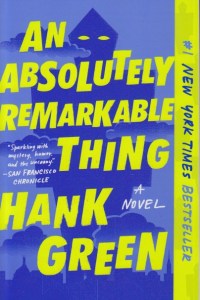
Fame is something most of us never experience.  In a world of billions we imagine what it would be like to have others pay attention to us.  Care what we think.  Admire us.  I can’t help but suppose that a large part of our political crisis is based on this concept.  It’s one of the reasons Hank Green’s An Absolutely Remarkable Thing is such a timely novel.  I’ve read a couple of Hank’s brother John’s novels, mostly in the Young Adult category, and I’ve been curious about this one for some time.  April May, the protagonist, isn’t seeking fame.  In an almost parable-like way it happens to her and she becomes addicted to it.  Safety and human relationships fall aside as she follows what seems to be the next logical step in order to secure more fans, more followers.  (There may be some spoilers below.)

There’s more than that, however, going on in the story.  Tales of “first contact” with alien intelligence often pose the question of humanity’s readiness for such an encounter.  The Defenders, a group that looks an awful lot like the right wing, are afraid.  They’re afraid of what humans might face once a superior power arrives.  Their response is to attack April, who, for some reason has been chosen as the first contactee.  Her fame isn’t accidental.  I’ve watched enough of Hank Green’s excellent YouTube videos to suspect he’s not exactly looking for a Christian parallel here, but April is a kind of messiah.  The book, in many ways, could be read as a recasting of Christianity’s foundation myth.  This isn’t a book with which most Sunday School teachers would be happy—there are adult situations and adult language.  They don’t cancel out the message of the book, however; I’ve known evangelists to use these techniques as well.  They help capture attention.

With all the books I read I have to admit that many are forgettable.  I sometimes read an old post on this blog, or a review on Goodreads, and find myself having forgotten a novel completely.  Something Hank shares with his novelist brother is the ability to make an impression.  It’s too soon to tell for sure right now, but this has all the marks of a story that’s going to be my mental companion from now on.  There’s wisdom and humor in it.  There’s a touch of Qohelet as well.  Whether intentional or not, An Absolutely Remarkable Thing follows the line of a classical story arc.  And the reason that stories have become classics is that they make us think.  I’ll be thinking about this for quite some time.  Fortunately, I don’t have to deal with fame—that would only be a distraction.


Email Discover

One of the interesting things that happens to religion editors (yes—there are occasionally such things!) is that we receive emails from well-meaning evangelicals trying to convince us of the truth of their religion.  I don’t get such emails too often, but they do come with, as the commercial used to say, “occasional irregularity.”  These emails often tend to be long, as if someone who reads books for a living needs excessive verbiage to be shown the truth, and a bit rambling.  They claim to show, sometimes scientifically, why their version of Christianity is the only true one.  As an editor you have to pay attention until you find out whether it’s a book proposal or not (generally they’re not), because it’s good form to reply to all actual proposals.

Just as I’m about to type about not knowing why people do this, I recollect my own evangelical youth.  I was a charter subscriber to Discover magazine.  Growing up in a town where science was considered an unnecessary luxury, I was fascinated by it.  We had no local bookstore, and our town didn’t even have a library.  I subscribed to Discover and read several articles from each issue.  I was, however, troubled that the editors of the magazine seemingly weren’t aware of the proofs of Christianity.  I had Halley’s Bible Handbook in front of me and it stated in no uncertain terms that all of this had been proven.  I considered all of this to be my responsibility, so I wrote a letter to the editor explaining that the Bible really had been proven true.  If they’d accept that their great magazine would be even better.  They elected not to publish it.

The point is, deep down I understand this compulsion to convert.  My thinking has matured with the hundreds of books and articles I’ve read on the subject, but I can’t forget the evangelical terror of my childhood.  For the good news, it was pretty scary.  Of course, advanced study of the Bible—learning the original languages and their ambiguities—casts the whole thing in a different light.  Those who don’t share the evangelical view may have had an enlightenment of their own.  The thing is, admitting this doesn’t feel as good as claiming to have all the answers.  Admitting to having questions, to some forms of Christianity, seems to be admitting weakness.  And so I sit, reading through rambling emails that are well intentioned, but pointless.  I wonder if they read Discover magazine too.