Hypersensitivity

Tell people you’re hypersensitive and the first thing they’ll say is “I’m sorry.”  The way I use the term is, however, somewhat literal.  Some of us experience sensory input in especially intensive ways.  Psychologists say that those of us who do often stop and assess in new situations.  We can become overstimulated and sometimes “shut down” if too much is going on.  It doesn’t mean I’m going to burst into tears if you insult my haircut.  (It’s homemade, we’re in a pandemic, after all.)  The reason I bring hypersensitivity up at this point is two-fold.  The first fold has to do with the fact that I no longer get out much, which means much of the “ordinary” now seems new.  The second fold is that I wonder if hypersensitivity had a role in leading medieval people into monasteries and convents.

Back to point one.  If sensory stimuli can overwhelm one, going back into TMI territory can be almost traumatic.  I commuted into New York City for about seven years.  Manhattan is difficult for a hypersensitive person to take.  Over time I became accustomed to it, and familiar environments are more easily navigated.  The pandemic, however, has me spending about nine or ten hours a day in the same small room at home.  Actually, working remotely had already done that, but I used to get out on weekends.  We recently took a safe weekend trip, stopping only at places with few people and staying with family.  Less than 24-hours out from home I realized I was feeling overwhelmed.  Too much interaction.  We had stopped at a town I’d never visited before.  The trees were spectacular.  I soon regained my bearings, because no matter how late I stay up, I still awake early to write.

This leads to the second point.  I suspect things moved much more slowly in Late Antiquity and the Middle Ages, but I can see why certain individuals might like to cloister themselves.  While I disagreed with the theology, I taught for fourteen years at Nashotah House, a cloistered seminary.  You saw the same people day in and day out.  The campus was suspicious about this thing called “the internet” for quite a long time.  You ordered books through the mail and waited a month or more for it to arrive.  In some ways this was a comfortable existence.  Of course, it blocked me from much of what was happening in the wider world.  The pandemic has, in some measure, brought me back to that space.  I wonder if, historically, they might be connected.  But right now it’s time to get to my ten-hour room and work.


Gothic Tales

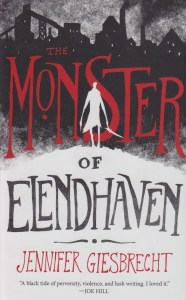
Each year when autumn worms its way into my consciousness, I begin looking for the ideal gothic book.  I can test this by looking at the Goodreads lists of best gothic novels and noting how many of them I’ve already read. The thing now, since I’ve already covered much of the canon, is to discover modern writers who can still evoke that feeling I seek.  This is all complicated by the subjective nature of what readers term “gothic.”  Many of the books on the lists don’t fit my own working connotation, so I keep looking.  One recommended title was Jennifer Giebrecht’s debut novel The Monster of Elendhaven.  I’m still trying to decide whether it is gothic or not.

It’s a little hard to classify, actually.  It certainly has some gothic elements, as well as some horror.  There are secrets and plagues and gruesome murders.  There is a monster from a polluted sea, but not quite your grandfather’s monster.  A human monster.  Or at least partially.  The tale is written with some tongue in some cheek.  There are funny elements and there are many serious moments.  There’s magic and mayhem.  If I were to try to characterize it the closest I might come would be a Tim Burton treatment of horror.  Like Burton, Giesbrecht creates a Halloween mood, but sometimes the humor undercuts it.  This makes it difficult to pin down the work as a whole and figure out if this is the gothic I’ve been seeking.

Set in a time difficult to define and in a fictional nation, it is the kind of novel that can be read without much consequence.  The references to the Allfather make comparison with Nordic regions natural, and there is perhaps a touch of Beowulf here.  In crafting the monster Giesbrecht has made a pretty unlikeable character.  He is a monster, after all.  But not a sympathetic one.  As in other modern treatments he is a stand-in for chaos.  There’s also an environmental sensitivity here.  The monster arises from a polluted sea that derives from, of all things, human greed.  So maybe there’s a parable here.  A short book, it doesn’t take too much of a time investment, but it may leave you wondering what exactly it is that you just read.  It is dark, and gritty, and fun.  A nice combination for an October night.  Is it gothic?  That one’s a little harder to answer.  It depends on how I’m defining it on any particular day.


Tooth Less

The words “difficult extraction” are not what you want to hear, seated in a dentist chair.  Fortunately mine was not difficult.  I’m squeamish about most things, and like many kids raised in humble circumstances, experienced dental care at the largess of various government programs.  I remember going home nearly every time in a state of shock regarding how much it hurt and what he had done to us.  It has taken a lifetime to get over the fear of the dentist.  Now I patronize a local female dentist who is gentle and caring—something that didn’t exist, and we couldn’t have afforded anyway, when I was a child.  Even so, she’s telling me a tooth has to come out.  I’m being stoic and starting my meditation mantra.

Health care in the United States, as Trump’s recent treatment for a virus to which he carelessly exposed himself shows, is horribly uneven.  Those who are systemically kept poor—especially those who are “of color”—often have few choices and die younger.  Yet supporters of 45 see no problem with this.  Now, I wish I weren’t in this dentist chair right now.  I’m not looking forward to the novocaine shots or the tugging on my jaw.  Or the hours of gauze in my mouth afterward.  But at least I can afford this.  It pains me even more that there are others who can’t.  And that those who claim to follow a man who healed for free are voting for a man who has pledged to keep inequality as “the American way.”

I grew up taking care of my teeth the way the poor often do—that is to say, not enough.  The solutions involve education and empathy, both of which our government has chosen to eject for jingoism and bravado.  I’m not so much worried about having one tooth less.  I am worried about a government that feels it has the right to oppress the poor so that the wealthy can continue to gain more money that can, in turn, be used to control the government.  This is wrong.  There’s no way that it can be made to be “Christian,” no matter what evangelicals may say.  I’m sitting here in the dentist chair and the needle’s getting closer.  I’ll have a mouth full of gauze for the next few hours and I’ll be on a soft food diet for a while.  I may be in some pain.  But still I know I’m one of the lucky ones.


Just Joking

I’m not sure when I’ll ever get back into a movie theater, given that our government plans to do nothing about Covid-19.  Still, I recently watched Joker for the first time.  In an eerily prescient move, Todd Phillips envisions the character as tapping into public dissatisfaction with the exploitative and unfeeling power of the rich, who often lead, through their greed, to outbreaks of public unrest.  The character of the vigilante clown coalesces the oppressed of Gotham and leads to riots in the streets.  I wasn’t quite sure what to expect of the film since I’d only briefly heard of it secondhand.  It is one of the most uninterrupted stretches of darkness that I can recall seeing in a movie, which, in some respects, makes it believable.

Comic book character films have taken on a life of their own.  Joker explore the backstory of mental illness in a culture that is bent on cutting care for those in need.  Not only that, the movie doesn’t let you think anyone is good.  All the heroes are flawed, and most of them fatally so.  Joaquin Phoenix’s acting, of course, solidifies the story and make the Joker sympathetic.  And there’s a fair amount of truth to the way that a capitalistic society is driven to hold down the many who need to be exploited for the system to work.  Although it is dark and gritty there’s a strong social commentary here.  It doesn’t surprise me that it was the highest grossing film of last year.  You don’t have to be a comic book fan to be drawn in.

Not too many other major films since One Flew over the Cuckoo’s Nest have attempted to stare unwaveringly at mental illness.  It is an extremely common condition, especially if we consider the number of people who require antidepressant, anti-psychotic and anti-anxiety drugs.  The culture we’ve created isn’t healthy for our mental development.  It’s often cruel and uncaring.  It never helps when people lie to us.  Joker addresses these  realities, exploring the “perfect storm” of factors that might lead to a psychopathic crime lord.  Of course, living through the Trump administration, led by an unfeeling, money-driven “president,” it’s obvious that we’ve set up a system that refuses to confront those who have no business making important decisions.  A system that could conceivably set up such pathological “leaders.”  None of the privileged people in the film cares for anyone beyond themselves.  And they wonder why violence erupts in the streets.  I think I have some recommended viewing to suggest to them.


Fire and Ice

Most people in our modern world consider a cooking device an important part of a household.  Many of us are also over-committed.  These two elements came together last week when our kitchen stove (“range,” I’m finding out, is the correct term) burned out.  We could tell when we bought our house two years ago that the previous owners had likely not replaced any appliances.  The refrigerator died our first year.  Now, in our second, the stove—excuse me, range—went.  Given that it’s turned cooler around here, a good hot meal in the evening has been a welcome relief, but with no stove how do you cook it?  This happened on a Tuesday.  My wife and I compared calendars.  The closest evening we could both get out to look for replacements was Friday.  Of course, once you shell out the money you also have to wait for delivery and installation.  It looked like at least a week without home-cooked food.  Grocery shopping, of course, had been on Monday.

It occurred to me how utterly dependent we are on our big appliances.  The refrigerator died just before a holiday weekend in pre-covid days, so we were on our way out of town when it happened.  A lot of food had to be wasted.  It took about four days before a new one could be delivered, and we had to cut short our trip to be here in time for the installers.  Food.  Unless you’re living on granola bars and trail mix you need to keep it cold or keep it hot.  Our ranges and refrigerators do the heavy lifting for us.  Our ancestors stuck things in the cellar to keep cool and chopped wood to keep what is properly called a “stove” hot in the kitchen.  It was pretty much a full-time job just to survive.  Now nightly Zoom meetings make any interruption of online connectivity difficult.

Weekends, given the circumstances, are gems.  They are the only time we can get things done.  Days are eaten up by ever-expanding work by people desperate to keep their jobs in a tanking economy.  Supply chains, interrupted by the virus, meant that a delivery of a new range would only happen in January.  Going without food until the new year steered us toward a DIY appliance repair solution.  I never thought I’d be sticking my head in an oven, but here I was, with a new part ordered from Amazon and the confidence of the friendly people on YouTube telling me I could do it.  Taking days instead of months, we were cooking again by Sunday, and I just might’ve learned something along the way.


Watery

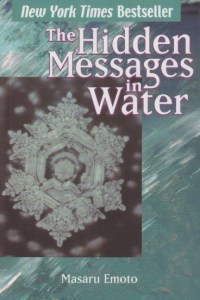
Having watched What the Bleep Do We Know? a few weeks ago, I became curious about Masaru Emoto’s The Hidden Messages in Water.  The book is highlighted in the film, and in a world where money decides truth, the fact that it was a New York Times bestseller must count for something, right?  I am of a skeptical bent, but I like to keep an open mind.  This itself is a delicate waltz at times since just about anybody can make truth claims and find a following.  Curiosity, as they say…  So instead of critiquing Emoto’s obviously slipshod methodology, I want to reflect on whether he really might have been onto something.  Many people around the world thought so, after all.

What it comes down to is water.  If you haven’t seen the movie or read the book, I owe you a brief explanation.  Emoto suggests that water crystals reflect the influences to which they’re subjected.  For example, water frozen as classical music plays forms beautiful crystals.  If heavy metal is played, it doesn’t.  Water frozen in beautiful surroundings forms beautiful crystals.  If that’s not controversial enough, Emoto suggested that emotionally freighted words typed on paper wrapped around the water bottle as it was frozen would reflect the emotions on the paper.  There are lots of problems here, but what I wonder is if water might not somehow be related to consciousness.  Emoto makes that claim, but since science can’t yet explain consciousness there’s no way to test it.  Could it be that water is a recording medium in some way?  Without raising the woo factor too far, some ghost hunters (it is October, after all) suggest moving water has something to do with “recording” spirits.

Like most critical readers, I left Emoto’s book not at all convinced.  I also left thinking that we shouldn’t throw the bath water out with the baby.  There are crazy ideas in the book, for sure.  But there may also be just a hint of insight as well.  That insight comes in the recognition of spirituality as an important aspect of human life.  The book was a bestseller.  Not all people are credulous.  We are, however, spiritual.  Many deny it.  Some violently rail against it but still have feelings along with their rationality.  Water can lift spirits.  The negative ions of breaking water tend to make people feel at ease.  We visit the coast where waves break against beach or rocks.  We visit waterfalls where cascades scatter water particles.  Even a fast-flowing stream will do.  Emoto clearly went too far with his ideas, but I think, deep down, he might’ve been onto something.


Twain Shall Meet

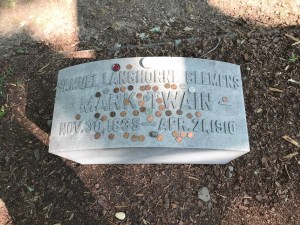
On a slightly hazy fall day, when the autumnal colors were alive, we stopped in Elmira.  To understand the significance of this stop, I should explain that from the time my daughter could appreciate it (and probably even before) we used to make fall literary trips.  We would take a long weekend and drive to where a famous author had lived.  Laura Ingalls Wilder in Pepin, Wisconsin, or Mark Twain in Hannibal, Missouri.  When we moved east we visited Edna St Vincent Millay at Austerlitz, New York, and Washington Irving in Sleepy Hollow.  More recently, in the spring, we went to see Rod Serling in Interlaken, New York.  So it was that we stopped in Elmira, New York, where Mark Twain rests.  I had always assumed Samuel Clemens was buried in Missouri, but his most productive literary period was his time in upstate New York, and it is here he remains.

His tombstone was covered with pennies and a few higher denomination coins, a rock or two, and a guitar pick.  People want to show their respects to the writers who’ve meant something to them.  I find this a moving tribute.  I suspect it happens at the tombstones of many famous people, but in Highgate Cemetery in London we found Douglas Adam’s small plot filled with pens stuck in the ground as mementos.  I travel through the world lightly, seldom carrying anything extra with me.  Somehow I never stop to think to bring a memory to the cemetery.  Fortuitously I had found a penny on the ground the morning we left for Elmira and I placed it among the others on Twain’s marker.  

What would make the appropriate calling card to leave?  I often wonder that.  If I had such a token, I suspect I would feel the need to revisit the various cemeteries of years past to leave a sign of my respect.  There are lots of them.  Edgar Allan Poe in Baltimore.  George Orwell in Sutton Courtenay.  H. P. Lovecraft in Providence.  Is there anything that ties them all together?  Pens seem an obvious choice, but stones are far more traditional (especially in Jewish settings).  The tradition is traced back to building cairns in biblical times, and the idea survives in that stones are more permanent than flowers and are a sign of respect.  Writers often have more elaborate items left, but it’s clear that they are removed from time to time by the grounds keepers.  Before I visit my next literary grave, I’ll give some thoughts to symbols and tokens and the importance of celebrating writing.


Not Sleepy Yet

Over a recent weekend I watched four versions of “The Legend of Sleepy Hollow.”  (I have two excuses.  One is that it’s October, and the second is that I have an article on Sleepy Hollow coming out on Horror Homeroom.  For the second, read on.)  The story is one that made an impact on me as a child, probably because of Disney’s Adventures of Ichabod and Mr. Toad.  The cartoon version, which was one of the four I watched, is silly and scary both.  It leaves it to the imagination whether the headless horseman is real or not.  Before that I watched the silent 1922 Headless Horseman staring Will Rogers.  Clearly in that film the headless horseman is what we’d now call a liberal hoax.  It was Brom Bones scaring Ichabod Crane away from Katrina Van Tassel.

The canon of characters grows with Tim Burton’s 1999 film Sleepy Hollow.  Although Burton is hit or miss for me, this strikes me as one of the best October movies I’ve seen.  The headless horseman is quite real and the spiritual world intersects with the rational, crime and punishment world in the haunted western wood.  I didn’t have time for the 1980 television movie this time around, but I decided to watch the 2007 television movie Headless Horseman.  A rather puerile splatter film set in Missouri, it posits that this is the real headless horseman behind Washington Irving’s story.  It has a lot of religious imagery, which is often what I’m looking for in horror.  The writing is poor and the characters shallow, but it isn’t a total waste of time.

What all of these films demonstrate is that Washington Irving’s story, as simple as it is, really resonated with Americans.  How can you reason or plead mercy from a headless man?  Look closely, for there is a parable here.  The headless are merciless and they have the ability to frighten.  The story is generally set in the harvest season.  The 2007 movie makes the horseman’s appearance as a crucified scarecrow.  Although the original story had no such religious elements, they’ve become a standard part of its accrued cultural heritage.  The headless horseman has gone from secular to religious, for it is an American story.  Originally set in the period after the Revolutionary War, it was part of an unsettled nation’s frustrated attempt at normalcy.  This, I believe, remains.  When we can’t make sense of our surroundings, we look back to those stories that seem to have some insight into who we are.  Headless horsemen are quite useful in that regard.


Keep Cool

I know national secrets.  You can too!  Bob Woodward’s Rage contains them because Trump is willing to talk about anything that aggrandizes himself.  The real takeaway, and in many ways the point of Woodward’s book, is that Trump knew about and decided to downplay Covid-19.  And not because he didn’t think it was serious, but because he didn’t want to hurt his chances of reelection.  Although Woodward had no way of knowing in the middle of the summer, when the book went into production, that 45 would be infecting his senior staff mere months later, he would likely have been able to predict the results.  With the best medical attention in the world, Trump would recover and immediately downplay the virus that has now killed over 210,000 Americans.  Why?  He wants to win the election.

Many of us knew in November 2016 that this wasn’t just another Republican nominee with questionable intellect.  We knew that Trump had a long, long track record of caring for nobody but himself and that isn’t the kind of person who can lead a nation.  He had seventeen interviews with Woodward as he was writing Rage, and, as we might guess before opening the book, those interviews indicate that being president, for some, is all about bragging rights.  Knowing how serious the coronavirus is, he decided to ignore it for political expediency.  Now we see his own party’s leaders daily falling into the epidemiological pattern of the science they disbelieve.  Early on wearing masks was politicized and now we’re being told a deadly disease is a walk in the park (if you’ve got the best healthcare in the world).

I’m reluctant to write about politics.  I find it boring and intellectually stultifying.  But even under George W. Bush I believed that the president had what he believed to be the best interest of America at heart.  All that has changed in the last four years.  The Republican Party has sold its soul to the cult of Trump and those of us who’d rather just watch horror movies and write books and stories have had to become political activists simply to try to save democracy from the slide into a fascist narcissism that is intended to prop up one man’s ego.  Woodward’s book is more than a series of interviews with a dangerous man, it is a condemnation of political leaders who’ve failed their country repeatedly, without recrimination.  Of course, it is only intended for those who read, or maybe I’m just angry.


Dangers of Experience

I’m so used to being behind everyone else that when I turn out to be ahead of the curve it occasions genuine surprise.  That’s the way it appears when I think about the dominance of the far right in American politics.  As an editor I get to read proposals for other editors on the board.  Political scientists are trying to analyze how we’ve come to be a nation of religious far-righters when we seemed so progressive that we put a smart phone in everyone’s pocket and Alexa in everyone’s voice range.  I grew up as a far-righter when it certainly felt alienating.  Apart from people we met at church I didn’t know any others outside my family.  People we knew were, well, just different.  Back in those days we didn’t judge them.  We accepted them for who they were.

One of the aspects of my life to which I’ve grown accustomed is being ignored.  I’m not a big person, nor am I a loud one.  It isn’t unusual for me to be overlooked at work and even at religious gatherings (a field in which I’m a bona fide expert).  Nevertheless, I have a wealth of experience among the far-righters and I think it might help to understand our political climate.  I think I have a pretty good grip on what motivates this crowd.  Since I grew up (serious study will do that to you) and am no longer arrested at that stage, I’ve blended into the crowd as someone just as perplexed as everyone else.  I do, however, have an idea of what they’re after.  Our particular sect didn’t push this—we seemed more worried about our own souls staying out of Hell—but many fundamentalists wanted to take over the nation.  In fact, they have.

The fact that 45 isn’t one of them is immaterial.  Power is the thing.  Power to make others conform or suffer.  This particular faith is built on fear, not love.  It’s as if their New Testament lacks the gospel of John.  You see, I was ahead of the curve.  I was part of it before it took over congress, the White House and the supreme court.  Things move so far these days that thinkers just don’t have time to think about everything.  Work days are long and covid still complicates everything.  Who has the time to seek out those who grew out of the very source that now endangers our democracy?  I think I prefer running a little behind, don’t you, Cassie?


What Smells

One of the stories I recently read had a character commenting on the smell of a place.  Although humans can’t rival many other mammals and some birds for sense of scent, smell is a keen reminder of location.  It is also one of the more personal aspects of the senses.  We get nervous when people start talking about smells.  We all know, however, that places have their own fragrances.  Home smells a certain way.  You always notice it going home from college, where the dorms have their own smell.  When I was visiting campuses as part of my editorial expectations, I returned to Boston University School of Theology.  Apart from the main corridor of 745 Commonwealth avenue appearing smaller than I remembered, the smell was so familiar as to be overpowering.  I hadn’t been there for at least a couple of decades, but my brain remembered it well.

I trust science.  I also think science can’t explain everything, particularly in the life of emotions.  One of the natural limitations of science is the data with which we have to work.  We have limited input.  I remember in chemistry class in high school we worked with chemicals that replicated scents.  The particular ethyls used to reproduce fruit scents were similar only by suggestion.  I remember thinking the banana combination only smelled like bananas because it was suggested to me that it did.  Smell is a complex world, and we know many animals do it better than we do.  Dogs, bears, even mice, know more of the world through their noses.  I suspect Fido knows home primarily by its smellscape.  We, the “masters” tend to miss a lot.  And that makes me wonder what science might be missing by our limited sense of smell.

If there is a supernatural world, I wonder what it might smell like.  We’ve all known someone whose dog wouldn’t go into a certain room, or who reacted to something we couldn’t see.  Perhaps Fido couldn’t see anything that we couldn’t but could smell it.  I often think that when dogs are tested humans try to understand their visual acuity because that’s how we experience our world.  Dogs, however, experience their world through scent.  We could stand to learn quite a lot about this planet we inhabit if we could somehow access the smells that we simply lack the capacity to reach and analyze.  We are only beginning to scratch the surface.


Ghosts, of a Sort

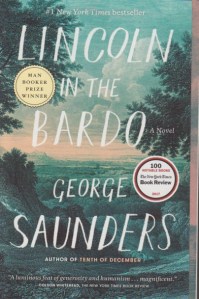
What happens when we die?  That question is perhaps THE question that drives just about everything we do.  Evangelicalism, masked behind love of Jesus, is really the desperate attempt to avoid Hell.  That idea is powerful and insidious.  The question of what happens, however, has also inspired a tremendous amount of literature.  Lincoln in the Bardo, by George Saunders, is a recent example of how diverse such views may be.  Written mostly epitaphicly, it is a conversation among the spirits in the cemetery the night Willie Lincoln arrives among them.  Fearing what is beyond, these ghosts don’t admit they’re dead, but rather think themselves sick, awaiting recovery.  When the profoundly bereft Abraham Lincoln arrives to mourn his son, things begin to change.  

All through my reading of this book I found myself wondering about the many ways we conscious creatures reassure ourselves about death.  Materialists say it’s like the turning off of a lightbulb.  All goes dark and there is no soul to remember anything.  Many of them claim science for proof, although science has no way to measure the non-physical.  Various religious sentiments of the eastern hemisphere posit reincarnation until one’s soul reaches the point of no longer having to cycle through all of this again.  Here in the western world, influenced by a Zoroastrian-inspired Christianity, we posit a Heaven and Hell.  Some include various shades of Purgatory, which, to the classic Greek, would’ve sounded familiar.  Those who’ve undergone Near Death Experiences often suggest a more dream-like reality of acceptance.

There are many more shades and nuances, of course.  We’ve entered the shadowy half of the year.  Those of us in temperate regions spend half of our lives with nights longer than the days.  Death, however, is generally a shunned topic.  We try to avoid talking about it since we really don’t know what comes after.  We have beliefs.  We have hopes.  We really just don’t know.  We often look to literature to help us explore these topics.  Lincoln in the Bardo does so with some humor, some sadness, and some soul-searching.  Those of us drawn to ghost stories naturally think about them as we wait later for the morning sky to lighten, and find it dark before we turn in for the night.  A great many options await us, some with a kind of historical anchor, and others that are completely made up for our edification.  The one thing they all have in common is they force us to think of that which we really don’t know.


The Hardest Part of Nightmares

In the process of writing a book, there comes the long time between when everything’s submitted and you hear nothing.  In fact, writing a book is often about waiting.  You spend years pounding your thoughts through a keyboard, send them off to some editor (guilty, as charged) who takes months to read and think about it.  If they like it they’ll send you instructions on how to change it and you start banging the keys again.  When it’s finally ready you submit it and wait while it gets transferred to production.  This handover is a complicated process and can itself take a month, easily.  Then the manuscript has to be copyedited.  I’m at the post-copyedited phase of Nightmares with the Bible, and this is, it seems, the longest wait.

There were only a few changes to the proofs I received.  These days your Word files (converted from Pages files for Mac users) get loaded directly into the production software.  What you see is your own words, in a different format.  You type your corrections directly onto the proofs.  Hit submit.  Then wait.  In my head I know that my book is one of many waiting in a queue to be printed.  I’m also a realist so I know the initial printing will likely be about 150 copies.  (When I first started in the publishing world academic books routinely sold 300 copies, but those days are long gone.)  At some point before then I’ll receive an email telling me the cover’s ready.  That’s what I’m waiting for at the moment.

We’re constantly told, in the business, that electronic books are what people want.  I can’t speak for others who write, but when I think of a book I think of a physical object.  Not some electrons sharing a screen promiscuously with any number of other books.  I haven’t published until I hold the printed object in my hands.  That’s still at least a weeks away.  Unless your book is anticipated to be a big seller, this is a period of absolute silence.  You just wait, nervously checking the publisher’s website every other day to see if your page has been updated, all the while working on your next tome.  Although it is priced expensively, I’m hoping Nightmares with the Bible will do reasonably well because of the subject.  Maybe some people will even get curious about Holy Horror, which was the precursor for it.  But for now, I sitting here with Tom Petty, waiting.


Unintentional Patterns

Time, they say, is what prevents everything from happening at once.  I’ve noticed something about my reading life (is there any other kind of life?).  One of my favorite topics on this blog is books.  Both reading and writing them.  When I wake up and try to clear the cobwebs of sleep from my head to think about the day’s post, I always feel relieved when I have a book I’ve just finished because that’s an eager and ready topic.  When I’m in the middle of a large book, it seems like a long time until I’ll be able to jot down some thoughts on it, and the ideas don’t always flow.  It’s here that I’ve noticed a strange kind of pattern and it has to do with the way I read.  Interestingly, it isn’t intentional.  It goes back to my post-commuting literary lifestyle.

I read nonfiction in the mornings.  I awake early and after about an hour of writing I try to get in an hour of reading before thoughts turn to work and its unraveling effect on the fabric I’ve been weaving before the sun rises.  The nonfiction I read depends, to a large extent, on my writing projects.  Not exactly the kind of research that time and libraries afford academics, but still, research in my own way.  Often these nonfiction books are large—400 pagers seem to be the trend.  I’m a slow reader, so they take some weeks to finish.  At night (or actually evening, for I retire early) I read fiction.  It isn’t unusual for my fiction choices to be briefer than the nonfiction books of the morning.  It always seems, however, that I finish two books very near the same time.  Then I have two book posts in a week and many days without any.

Since we married over thirty years ago, my wife and I read to each other.  Usually she reads while I wash dishes.  Those reading choices are by mutual consent.  They sometimes make their way into my research, but more often they show up in my fiction writing.  In any case, they also seem to fit this same pattern.  When I finish a large nonfiction book in the morning, the same day, or the next day, I generally finish my fiction book.  Shortly after that our dishes-reading book finishes.  I’ve noticed this happening over the past couple of years and I always wonder about unexpected patterns that I find.  It doesn’t always happen this way, but it does often enough to make me wonder.  If I intentionally set out to do this it would be understandable, but as it is, it simply happens.  As they say, things tend to occur in threes.


Belief and its Discontents

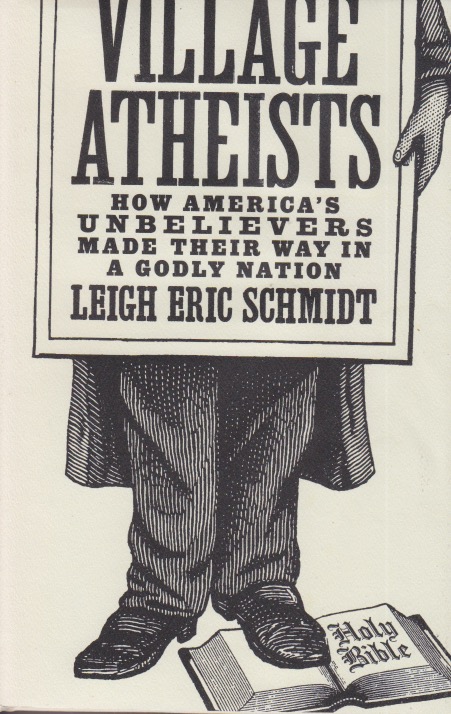
In this day of self-driving cars and instant, world-wide video conferencing, it is difficult to believe we still prejudice belief in God.  Village Atheists: How America’s Unbelievers Made Their Way in a Godly Nation isn’t exactly what I thought it would be.  Leigh Eric Schmidt is an historian, so this is an historical treatment.  Specifically focusing on four characters from the nineteenth (to early twentieth) century (Samuel Porter Putnam, Watson Heston, Charles B. Reynolds, and Elmina Drake Slenker), Schmidt focuses on a term I’d seldom heard before his book, “the village atheists.”  These men and women objected to the preferential treatment accorded to Christian believers in a nation founded on religious equality.  In the epilogue Schmidt shows that we are still not a nation committed to fairness.

The only crime these people committed (and two of them were clergy) was honesty in their search for the truth.  This was an actionable offense into last century.  Such was the hold of biblical religion in America that holding public office, being on a jury, or even protection under the law was disallowed for those who questioned the existence of the Almighty.  For sure Schmidt has picked out some colorful characters to sketch, but their common theme was that they were simply following where reason led.  In America this was a crime.  Secularists today who claim it’s not still haven’t come to terms with the power of religious ideology.  A deep distrust of the unbeliever remains, even after the four horsemen of earlier this millennium.

For me the question comes down to honesty.  Belief shifts over life, depending on your circumstances and your outlook.  Most people unreflectively stay with the religion into which they’re born.  Those who study it learn to ask questions and the result is belief that may shift over time.  Making what you believe a measure of your integrity is therefore a temporary thing.  This is well illustrated in Village Atheists; some of these people began as fervent ministers.  They, however, were honest about their thought process and were counted criminals.  You have to wonder about a religion that punishes honesty.  Perhaps it’s no wonder that evangelicals have no trouble with Trump’s incessant lying.  To be honest is to be vulnerable.  The people profiled in this study, tried for things we would have trouble believing count as a crime (consider what 45 has been able to get away with), came out of their trials with integrity.  It would be great if the same thing could have been said about their accusers.