One Host

I don’t want to seem an ungracious guest, but I don’t know if I met the right host.  I really need to start keeping track of film dates as well as titles.  I found two versions of The Host and one was free.  (This is the 2020 version.)  Despite what the critics say, I liked it.  It borrows quite a lot from Alfred Hitchcock, and, I’m told, from Hostel (which I’ve never seen).  The plot is complex and, it may be my own naiveté, but it kept me guessing.  It’s the story of how a down-on-his-luck Englishman mistakenly gets involved in a drug smuggling operation.  He travels to Amsterdam where his “hotel” claims they’ve lost the reservation but they can set him up in a stylish house with a local who has extra room.  The local turns out to be a very influential psychotic.  Herein hangs the tale.
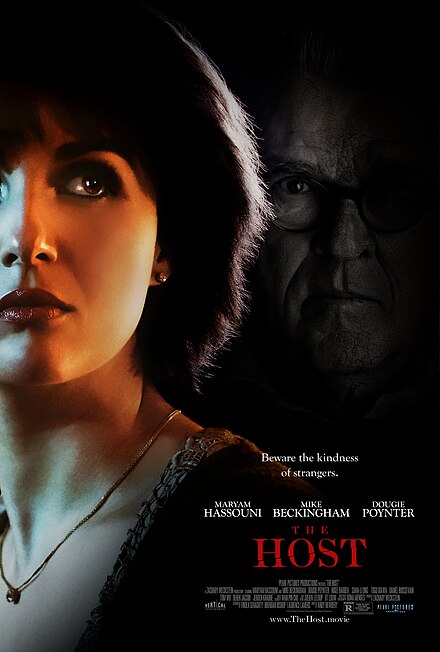
For me, I couldn’t guess where this was going.  I thought the drug smugglers were the real scary people but then odd things start happening with the Englishman’s host.  When he doesn’t show up to work on Monday his brother goes looking for him and he too meets “the host.”  The charming murderer is generally a male role, but Vera, the host, plays it well.  It seems to me that those who criticize the movie most strongly have some viewing experiences that I lack.  This is a polished effort and it doesn’t appear to have been cheaply done.  The story has many twists and although it may imitate others, that’s how new filmmakers get started.  Most writers are willing to admit that they borrow.  Doing so with style can make a huge amount of difference.

What remains unclear to me is whether this was The Host I was supposed to watch or not.  There’s a 2013 sci-fi thriller by that title and I also found a 2006 monster film from South Korea.  With a few exceptions, movie titles tend to be short.  You can’t copyright a title.  And sometimes the most appropriate one for your work has already been taken.  Here (the 2020 version) the title maybe gives away who it is you’re intended to watch out for.  The drug dealers aren’t an idle threat, but Vera is a spider waiting in her web.  And the movie has a moral—actions have consequences.  The original apparent protagonist has little to no self control which he blames on an abusive upbringing.  There’s quite a lot of father-relationship analysis going on here as well.  If anything, The Host (2020) may be a little too ambitious, but it’s worth staying a spell.


Best King

I suspect most people have read one or two at least.  Most reading folk, that is.  I mean Stephen King novels.  He’s sure written plenty.  By my count I’ve read nine: The Shining, Carrie, ‘Salem’s Lot, Pet Sematary, It, The Stand, The Tommyknockers, Revival, and Cujo.  I probably have one or two more in me.  The dilemma is that I like King’s writing—I’m not one of those nay-sayers who call it clap-trap.  There’s real literary merit to much of it (sometimes just too much of it), and he integrates religion into horror really well.  The thing is, not all of his books are made equal.  I suspect that’s true of any writer.  I’ve consulted some lists to see which are the best and I’ve watched some movies before reading the books, but I’m starting a ranking of my own here—it will probably be revisited from time to time, as events warrant.

What’s his best?  Well, such lists are supposed to start with the worst and work their way forward.  I’ll cave to convention this time.  So, The Tommyknockers and Cujo are tied for least favorite.  Each has a reason: The Tommyknockers is too long and lacks sympathetic characters and Cujo is just too nihilistic.  The premise is good but the bleakness got to me.  The Stand comes next primarily because of the length.  I like the way that one ended up, though.  Revival, my most recent read, comes here, about in the middle.  It was enjoyable to read, even with its length.  I think King has a little trouble writing convincing kids, but the story was good.  Next I would put ‘Salem’s Lot.  Who doesn’t like a good vampire story?

Not that kind of book.

My top three are, perhaps predictably, generally among the top ranked.  My order is perhaps a bit different than most, however.  I really, really enjoyed The Shining.  The movie, I believe, is better.  That may be heresy, I know.  Carrie has all the freshness of a novelist breaking through, and it’s effective.  Better than the movie.  That leaves Pet Sematary as my current favorite.  The story there caught me up and it’s the only one of my top three that I read before seeing the movie (both of them).  The book is way, way better than the movies.  Compared with Revival, which also deals with what happens after death, Pet Sematary offers a commentary on grief that doesn’t involve everyone dying by suicide.  It’s on a much more human level.  As I read more, I’m sure I’ll form other opinions, but for the time being, these three of the King’s early novels, are, in my standing, the most deserving of the crown.


Sodom Returns

Somebody really ought to write a book.  It’s not me, but when new archaeological discoveries with large explanatory value emerge, they begin to paint an interesting picture.  Archaeologists have determined that Tall el-Hammam, a city in Jordan of about 8,000 residents, was wiped out by a cosmic airburst, or meteorite.  If you missed it in the headlines it may be because this happened in 1650 BCE.  Barring volcanoes and other melting phenomena, since they don’t get hot enough, the cosmic airburst is the best theory.  Given that Tall el-Hammam is not far from the Dead Sea, it has been posited that the sudden destruction of this city led to the biblical story of Sodom and Gomorrah.  This makes sense to me.  Just like the theory that the flooding of the Black Sea by the Mediterranean led to stories of the flood.

Sodom and Gomorrah afire, by Jacob Jacobsz. de Wet; image credit: Daderot, public domain via Wikimedia Commons

People who had no other ways to explain such things would naturally consider them forms of divine punishment.  Deep-seated guilt seems to be a universal of human psyches, sometimes for good reasons.  In any case, an entire city wiped out by a meteorite looks like the finger of God just as much as lightning does.  Biblical scholars have long supposed that the story of Sodom and Gomorrah was an etiology, or origin story, of the formation of the Dead Sea.  This is partially based on the famous salt pillars, more than one of which bears the name “Lot’s wife” or the equivalent.  And the Dead Sea is unlike any other body of water on the planet.  

I suspect that over time other biblical stories may find logical explanations in ancient catastrophes.  I haven’t found convincing those that try to explain the “plagues of Egypt” based on a scientific daisy-chain of events, although they are interesting.  There’s no doubt that between the expulsion from Eden and the arrival of Moses there were dramatic events narrated by Genesis.  If these were ghosts of memories of ancient tragedies that makes sense to me.  They’re moralized, of course.  Aesop’s Fables also ended with the moral of the story.  We still like to know what a story means, and a good movie or novel will have some kind of message to convey.  There’s no way to prove that Tall el-Hammam’s destruction led to the biblical account, or that memories of a catastrophic flooding of the Black Sea led to tales of arks.  But still, somebody ought to write a book.  I’d read it.


Haunted Life

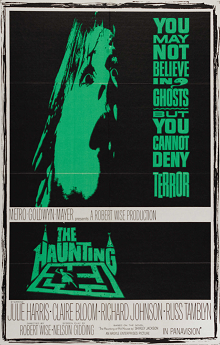
It’s funny what a difference that a few years can make.  I can’t seem to recall from where I sourced my movies in the noughties.  Streaming was extremely tenuous in our Somerville apartment—the plan didn’t include the required speed for it.  Like in the old days when it took twenty minutes to upload a photograph through dial-up.  In any case, I know I’ve watched The Haunting before.  I know it was in Somerville, but having watched it again I have to wonder if my mind is playing tricks on me.  I read Shirley Jackson’s The Haunting of Hill House there, and I saw the movie.  But how?  It’s all about mind games, but the mind games are played on a woman who has an abusive family, one that damages her psychologically.  Escape is important to her, even if it is to a haunted house.

I think the last time I watched this I was looking for something that might scare me.  That phase was one of thinking not much frightened me—but this movie is scary.  Even with its “G” rating, its lack of blood and gore, and black-and-white filming.  It scares.  One thing I’ve noticed when reading about these older movies after I watch them is that many improve with time.  Shirley Jackson was known during her life but you become a classic writer only AD—after death.  The Haunting has aged well.  I suspect it has something to do with Robert Wise, the director.  What must the psychology of a man be who directed The Sound of Music, The Day the Earth Stood Still, and The Haunting?  The latter is all about psychology.

Movies that make you think are those, I believe, that may become classics.  And perhaps there’s a bit of Eleanor inside all of us.  Wanting to be noticed but eschewing publicity.  Needing someone to love us, but pushing away those who try.  Children in bad environments learn unorthodox, and often unhealthy, coping techniques.  Eleanor has difficulty accepting that John is married when she thinks she’s finally found a place that accepts her for who she is.  Even if it’s a haunted house.  Especially if it’s a haunted house.  As a child I’d no doubt have found the movie boring.  There is, however, much for adults to absorb.  And, I expect, I’ll need to go back and read the novel again.  One of the reasons for watching horror is that the viewer is seeking something.  It’s not just thrills.  I didn’t write about the movie the last time I saw it so I don’t recollect when it was.  Or even how.  My thoughts now, however, are that I should’ve paid closer attention the first time.


Eclipsing the Earth

We need a new word.  One for the high an eclipse brings you.  I’m finding myself having difficulty coming down from it.  It seems so mundane to have to do something as ordinary as work after experiencing totality.  We only caught very brief glimpses of the moon over the sun through small breaks in the clouds, but we did get to experience totality.  How do you come down from that?  The next day we had a several-hour drive to get home so that we could all be at work yesterday morning.  What could be more ordinary than that?  And the eclipse happened on a Monday, not an unusual day for a holiday.  Only it wasn’t a holiday, but a “vacation day.”  So was the driving day.  At my age you need a day to recover from all the driving too.

Several friends have posted their amazing photos and videos of the event, so I’ve decided to “release” my video to the wild.  A few explanatory notes: we were in upstate New York, on the shore of Lake Ontario.  It was chilly and we were bundled up (we came home to 80-degree temperatures, which was quite a shock).  The video may seem to have not much happening for the first couple of minutes and this is because electronic cameras tend to “even out” the light (film photography is much better).  When I started filming this it was getting dusky but the phone smilingly tried to make it look like normal daylight.  That wasn’t the case.  (Be patient—drama takes time to build!)

It occurred to me that many people (who had clearer skies) thought totality was all about the moon over the sun.  I take a more Buddhist approach.  The Buddha admonished not to mistake the hand pointing at the moon for the moon itself.  The real experience of an eclipse is what is going on down here on earth.  My video shows how the sun faded, and then went completely dark and back again in a matter of minutes.  My experience of this was quite a spiritual one.  If I’d been looking up I very well might have missed it all.  In other words, being in a cloudy situation, totality was an opportunity to take in what was happening on earth, in real time.  There is a lesson in this.  Life tends to deceive us into thinking the most important thing is the peripheral one.  Experiencing an eclipse is all about being, and living, on earth. 


Adulting

Young professionals that I know often say adulting sucks.  Quite a bit of the time I tend to agree with them.  The 9-2-5 makes just getting along difficult, at times.  I’m sure there’s software to ease some of the woes, but you have to learn how to use it.  And that takes time.  Time I’d rather spend writing or reading.  For example, to get a small break on state taxes, if you work from home, you need to calculate your office space and then how much it costs to exist in your house for the year.  When I remember to do so, I can look utilities and mortgage up in Quicken.  Sometimes, however, when a book in my mind is distracting me I just tot all this up on the back of an envelope.  Then I need to type it in so my accountant can see it (taxes are far too complicated for mere mortals) and, I can’t underscore this too many times: numbers are adulting.

Photo by Tyler Easton on Unsplash

I’m an idea person.  The 9-2-5 (numbers!) that keeps you in front of a computer all week long means that things pile up.  Weekends seem too short to spend on numbers.  But you’ve got to balance that checkbook.  And even tot up the number of hours you give to “the man” each day.  What could be more adult than accounting?  Don’t get me wrong—at times numbers can be interesting.  Numbers, at their best, are philosophical.  One squared is one.  When you square any number greater than one, it increases.  One doesn’t.  And you can’t divide by zero and get zero for an answer, as handy as that’d be from time to time.  These abstract concepts come in useful but adulting involves serious numbers.  Numbers that imply liquidity.  Cash flow.  

Time is made up of numbers too.  If a social event comes up on a weekend, there goes your grocery and cleaning time.  And writing a book takes a tremendous amount of time.  It’s a second job on top of the other one you work 9-2-5.  All of this makes me think of those TIAA-CREF ads that showed prominent professors and captions that said “Because some people don’t have time to think of money.”  Or something similar.  That’s what I’m talking about.  Adulting is all about money.  And money must be taxed.  And you have to keep track of where it all goes.  I’m sure Quicken could help me with this, if I had time to learn it.  (We pay for it after all.)  But I’m kind of busy writing this book…


Eclipse 2024

Eclipses.  They’re fully explainable.  Or are they?  Yesterday’s solar eclipse, with totality within driving distance of many Americans, led to an inexplicable need to see it.  April, we’re told, is the cruelest month and upstate New York is known for its “ever-changing skies.”  I admit I was skeptical.  Together with some friends we arranged to meet near the umbra, in Penn Yan, and to drive from there to totality up on Lake Ontario.  As is typical in New York, the day started out fair, with a few high clouds.  It was chilly, but this is April.  Our destination: Fair Haven Beach State Park.  The location was nice; we arrived early and found a good spot.  The clouds, however, were willful and wanted to remind us, like last week’s earthquake, that we’re not really in charge here.

As the day went on—totality for us was 3:20 p.m.—more and more people came into the park.  To its credit, with what must be a limited state budget, it absorbed many eclipse seekers without any trouble.  By 3:00 the cloud cover was heavy-ish.  Our friends had heard a sponsored eclipse speaker, however.  Totality was nothing like even 99%.  This would be of a different magnitude, even with clouds.  I remember three previous eclipses.  One in school with the pin-hole method where you really don’t see anything, one in Wisconsin after teaching one morning at Nashotah House, and the 2017 which I saw in midtown Manhattan.  None of this prepared me for totality.  Around 3:18 it started to look dusky.  We could catch glimpses (but no photos) of the crescent sun.  Within seconds it was completely dark.  It was another of those transcendent earthly things, like the earthquake three days earlier.

Perhaps I’m getting old enough to realize that you can’t really describe such feelings.  Maybe I’m getting sensible enough to understand such things are called ineffable for a reason.  All the planning, worrying, anticipating, was for this moment.  Yes, there were clouds overhead, but the park was full of cheering people.  They too had come here for something extraordinary and to my surprise I found tears in my own eyes.  I captured no photos of stunning clarity, but I had experienced something I’d heard about since childhood but had only glimpsed in the most crude of facsimiles before.  We were able to experience a kind of rebirth that comes only after night.  Conditions weren’t ideal, but are they ever?  And an encounter with the numinous always comes on its own terms.

The sun, hours before being eclipsed

Colorless Sunday

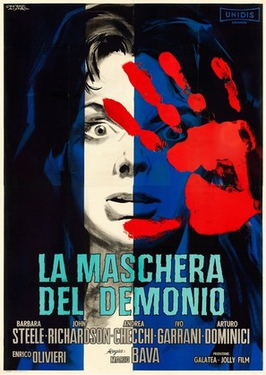
Growing up, my Saturday afternoon horror movies were catch as catch can.  I never really had a plan and I’m sure that there are several films I saw that I have forgotten.  I’m sure one of them wasn’t Black Sunday.  I knew nothing of directors and their reputations then and I was unaware that Mario Bava made quite a splash with this moody movie.  I can now understand why (thanks to Amazon Prime).  This is an unusual vampire and/or witch story, and one which had quite an impact on future films, including one of my favorites, Tim Burton’s Sleepy Hollow.  Indeed, Black Sunday is about as gothic as they come.  A witch is murdered as the film opens, along with her lover.  Two centuries later a couple of doctors stop for the night in the Moldovan town where this happened.  They find the corpse of the witch and accidentally reanimate it.

The monster the witch raises (her lover, initially) attacks people like a vampire does and the victims become vampires themselves.  The best (but not only) way to kill them is by driving a sharp spike through their left eye.  This is quite violent for a 1960 film, but it certainly cemented Bava’s reputation.  In any case, the younger doctor falls in love with the local princess, but the witch has designs on her too.  The older doctor and the princess’ father both get transformed into vampires and get killed off.  By the end, only the young doctor and the princess remain, along with an Orthodox priest who helps with deciphering how to take care of occult monsters.  The plot is more complex than that, and the film is now understood as a landmark.

At the time and place where and when I went to college, courses in horror films were not on offer.  (I was rather preoccupied with religion, in any case, and might not have taken one anyway.)  By the time I was in college, however, I viewed monster movies with nostalgia, but I was trying hard to be respectable.  You always have to be proving yourself when you grew up poor.  Learning how these early horror films fit together is a form of self-education.  And it’s fun.  And horror movies offer an escape from a world where you know you’re having trouble fitting in.  Many of the movies I watch are still catch and catch can, but I think it pays to be more intentional about them.  And I’m glad I caught Black Sunday at last.


Hopeful History

We could all use a little hope.  Given the rate of change in the world it often feels impossible to catch your breath.  And not only that, but the change often feels decidedly negative.  Few would opine, for instance, that we live in the golden age of politics.  And while it has its supporters, AI seems bent on our destruction.  So why not eat, drink, and be merry?  Scott Edwin Williams, whose last book Lightbulb Moments in Human History I reviewed here, has been at it again.  His basic idea is that our “lightbulb moments” give us hope for a better future.  Lightbulb Moments in Human History II: from Peasants to Periwigs, keeps the same general idea afloat, but barely.  As history progresses it’s harder and harder to say that the lot of humanity, tout court, has improved.  True, we live in relative comfort in “the developed world,” but we still have looming Trumps and other nightmares in the wings.

This book tries to cover large swaths of history, and that’s a difficult task.  Williams tries to keep it lighthearted but even he struggles to do so when discussing the rise of big business.  The chapter “Takin’ Care of Business” really showcases the negative traits that humans are too often willing to display when they form companies.  Capitalism may have been a lightbulb moment, but the untold misery it has introduced into the world gives the reader pause.  For example, the East India Company’s business decision to addict as many Chinese to opium as possible, seems quite strange in the context of a “war on drugs” being used as a means of incarcerating “undesirables” because, well, drugs are bad.

There are some signs of hope, and some lighthearted moments in the book.  It does, at times, seem to work against its own thesis.  It makes me glad for living in an age of anesthesia, and of general agreement that people should respect each other’s boundaries (unless you live next to Russia).  Even the lightbulb moments of Mesoamerican/South American history demonstrate the kind of cruelty humans often perpetrate against “outsiders.”  Williams notes here that two more books are in the works (authors know that a series isn’t a bad thing) but it does make me wonder if light and dark don’t balance each other out.  I know from my own family history that some of my ancestors died of things quite curable today, and they lived not all that long ago.  And that I can write these words and publish them instantaneously (whether or not anyone reads them).  And I can buy most necessities of life (apart from toilet paper during a pandemic) fairly easily.  And I do appreciate books that give me hope.  But balance isn’t such a bad thing either.


Craving Stability

As memorable events go, earthquakes are right up there.  Well, we don’t get them often around here, but at 10:23 a.m. yesterday a 4.8 hit about 30 miles east of us, in New Jersey.  The whole house was shaking and it took quite a while to calm back down.  (Me, not the ground.)  The only other time I experienced an earthquake was the Virginia quake of August 23, 2011.  Yesterday’s was much closer and therefore felt much stronger.  It took a few seconds to believe it was even really happening.  Work will do that to you.  Such an event, just 3 days ahead of a total solar eclipse, has an almost apocalyptic feel to it.  And we’d just come off of a punishing super-soaker storm that left puddles in one of our bedrooms.  Those of us out east just don’t get these kinds of things happening very often.  It’s a little difficult to process and it kind of makes me wish I’d gone into geology after all.

Since apparently nobody was hurt, this goes into the category of transcendent earthly things.  Ironically, confirmation came from social media before any news networks had anything to say about it.  Big wheels turn slowly, I guess.  The first minutes after it hit were a time of confusion—did it really happen?  Was that actually an earthquake?  What else could it be?  The same was true after the Virginia quake.  I don’t want to brag about surviving an earthquake if that’s not what it was.  Funny how you want validation, even at a time like that.  Such events remind us that we’re small compared to this planet we call home.  When the earth moves there’s nothing you can do about it.

Ironically, there are no maps detailing the Ramapo Fault line that was responsible for this quake. At least there aren’t any on the web. At 5:58 p.m. we had a 4.0 magnitude aftershock, much briefer than the main event.  An end-of-the-day reminder that we rely on mother earth for just about everything.  Earthquakes are times to call certainties to question.  Time to ask what we really know.  The tri-state area (in this case New York, New Jersey, and Pennsylvania) isn’t particularly susceptible to earthquakes—or isn’t prone to them, in any case.  I grew up in Pennsylvania and never felt one, although a bolide shook my childhood house back in January 1987, I believe it was.  Such reminders serve a purpose and in that sense they’re signs and portents.  We need to listen to the earth.  If we don’t, she will get our attention.  And then we must ponder.

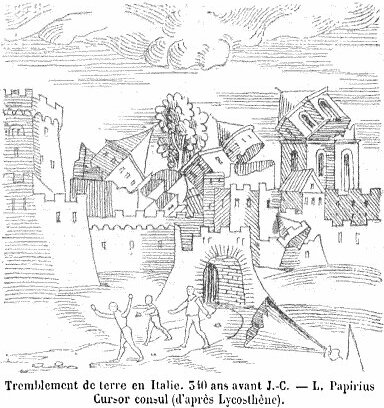
Nothing as bad as this! Image credit: illustration extraite Prodigiorum ac ostentorum chroniconde Lycosthène, public domain via Wikimedia Commons

More Omens

Brushing up on my eschatology, I watched The Omen again.  The original, that is.  One of the underrated aspects of cinema is that people learn their theology from it.  Movies tend to be more memorable than sermons.  It is opined among some that The Omen is responsible for the prevalence of dispensationalism among many Americans.  I’d put a bit of a finer point on it in that The Late Great Planet Earth was being raptured off the shelves all the way through the seventies (I personally bought two copies) and it caused a feedback loop with The Omen.  Many mainstream ministers, without benefit of a Fundamentalist upbringing, were caught unawares, I expect.  Scholars of religion have noted how several aspects of the narrative—the character of “the Antichrist,” the rapture, indeed, the Apocalypse—have been read back into the Bible by credulous believers.

What I found interesting in this viewing is the debt owed to The Exorcist.  Of the two there’s no doubt as to which is the superior film.  The name Damien in The Omen, I read somewhere once upon a time, was taken from Fr. Damien Karras.  During the late seventies and early eighties, unruly boys were routinely called “Damien” by frustrated camp counselors and others.  Apart from this nod, if true, is the fact that the abruptly introduced character Karl/Carl Bugenhagen is an archaeologist exorcist.  (He’s the guy who gives Robert Thorn the knives, if you haven’t seen it for a while.)  The scene shot in Jerusalem (said to be Megiddo) underscores that Fr. Merrin is also being channeled here.  I suspect that the film was getting a bit long in the tooth and some explanatory material on Bugenhagen was left out.

It has also been suggested that the number 666 entered popular culture because of The Omen.  I would temper that a bit with the fact that a lot of people were reading Hal Lindsey’s new apocalypse as well and the two of them got the job done.  There’s no doubt that after the film the evil number took off in a direction that would’ve left John of Patmos scratching his head.  This brings me back to the point that belief is influenced—sometimes constructed—by movies.  The Omen was a huge success at the time, despite the fact that many critics (also not raised Fundie) thought the premise was silly.  Most people aren’t film critics.  The Bible can be pretty impenetrable as well.  Preachers may not be inspiring.  Movies, however, wrap it up neatly and tell you what to believe.  Perhaps it’s some kind of sign.


Thinking Thinking

Something that’s been on my mind (anticipatory pun) lately, has been thought.  More especially, the quality of thought.  We are conscious beings, although we’re not sure what that means.  Beyond a Cartesian self-awareness.  Everyone knows what it is to have times when you’re not thinking clearly.  Or are feeling confused.  Those of us who tend to live quasi-monastically (keeping to a routine, early rising, writing and reading daily before the 9-2-5 routine) notice the ways subtle things can influence the quality of our thinking.  For me, first thing in the morning is the best time.  (Although I must confess that lately I don’t wake up with the crystalline clarity that I have for years, as if sleep is beginning to intrude on my earliest hours.)  Once I’m up and going, though, routine, you’d like to think, would provide the same results.  But it doesn’t.

Photo by Pierre Acobas on Unsplash

I’ve written before how the quality of sleep can affect the quality of awake thinking—something we’ve all known all along.  But even when I have somewhat identical nights (same quality of sleep more than one night in a row), the subtleties of difference in thought persist.  To understand this, you need to realize that I’ve been rising well before the sun for a dozen years now.  I awake to a quiet house and spend a couple, sometimes a few, hours writing and reading.  (It’s how I write my books, as well as this blog.  And my fiction.)  Even on “identical mornings” where the weather’s pretty much the same, and all other factors seem equal, the quality of thought differs.  Sometimes it depends on whether I’m writing fiction or non.  As I transition into my reading time, that can make a difference in the reading experience.  I suppose that’s one reason I value good writing.

We don’t understand consciousness.  Identity is also somewhat negotiable at times.  We’ve all known a family member or friend to act “not like themselves.”  More to the point, to think not like themselves.  We have no real way of understanding thinking itself.  I think about thinking quite a bit, and I marvel at how intensely personal it is.  We may, at our will, keep our thoughts to ourselves (and that’s a good thing, in many circumstances).  Thought, it seems to me, ought to be a very high priority in our academic pursuits.  It’s a powerful thing, capable of more than we’re even presently able to imagine.  And it can differ from day to day.  Do you suppose I wrote this after writing fiction or non?


Learning to Write

It’s a reciprocal relationship.  Ideally a symbiosis.  The publisher has a reach, and know-how, that an author lacks.  An author provides content the publisher needs.  Yet publishing is a business in a capitalistic world and has to (unless subsidized) turn a profit.  As an author who works in publishing I’m skewered on the horns of this dilemma.  It’s heartbreaking to see the lengths some authors go to only to find out their book is priced the same as a week’s worth of groceries.  Or three tanks full of gas.  Who buys a $100 book?  Libraries.  Well, some libraries.  Occasionally a publisher will run sales, if you order direct, but by then interest in your book (which may be timely) has passed on.  You become just another name on the shelf in the Library of Congress.

I’m looking for a publisher for my sixth book.  This has to be someone who understands that even $45 is beyond the reach of most intelligent readers.  “What the market will bear” feels like the death sentence to the years of your life you’ve put into writing the thing.  A friend once asked me, “Why do you do it?”  For authors the real question is “How can you not do it?”  The need for the validation through publication runs very deeply in some people.  More deeply than our national love for Taylor Swift.  It has to do with meaning.  Purpose.  A sense of what we’re put on earth to do.  

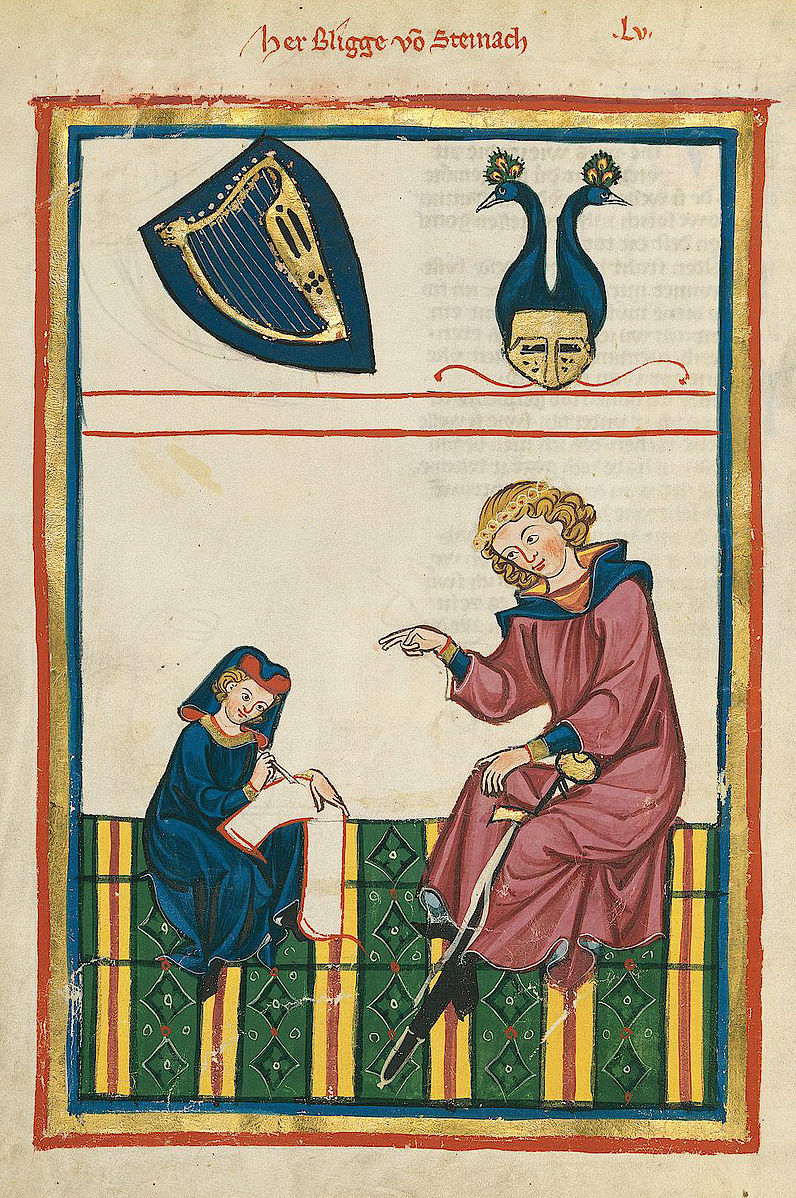
Image credit: Codex Manesse, public domain via Wikimedia Commons

The standard “wisdom,” and practice, is to publish in hardcover, priced for the library market, and if it sells well at $100, perhaps offer a paperback.  Hopefully priced lower than $45, but don’t hold your breath.  “What the market will bear,” should be your mantra.  It’s a wonder that civilized people ever got educated.  I grew up on cheap books from Goodwill, which is all I could afford.  College, on borrowed money, taught me the price of reading seriously.  It was a lesson I never forgot.  I’d begun my faltering steps to writing books while in high school.  I started writing short stories even earlier than that.  It has been a life of writing.  Even series books, I’ve come to see, are too easily exploited in this way.  My shortest book is priced at $40.  At least I know that I’ve written some collectors’ items.  Take heart, my fellow writers trying to emerge from academe.  There are other ways of being in the world.  And some of them may even be symbiotic.


Lying Beneath

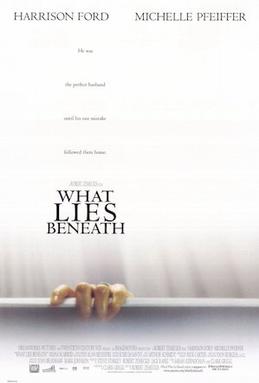
If you wait long enough you can find successful films for free on Amazon Prime.  What Lies Beneath had big-name star power and still retains a “horror” classification, although “thriller” is used about as often.  I actually enjoyed it and found some parts as scary as I am comfortable getting.  Although I guessed who the killer was well before the climax, I wasn’t sure how this would end.  This made the last fifteen minutes or so very tense.  There may be some spoilers as I ponder this a bit, so be warned.  Of course, the movie is nearly a quarter-century old, so you may already have an idea of what happens.  I’m a purveyor of older culture, it seems.

Claire Spencer, and her new husband Norman, live in an isolated spot in Vermont.  Norman is a genetic engineer and Claire used to be a musician, but the death of her first husband and adjusting to being an empty nester lead to her neglect of playing.  She starts seeing a ghost in the house Norman inherited from his father.  She comes to believe the ghost is of a missing young woman from the area, and she begins to find clues that link her husband to this unsolved case.  At first you think it’s going to be like Rear Window, but it turns into something very different.  The sense of unease is quite effective—you know something’s wrong but you’re not sure exactly what it is.

This is another of those movies where the genre feels up for grabs.  There’s an actual ghost and there are stingers.  Yet it’s directed by Robert Zemeckis, not really known as a horror director.  It’s stylish and has Michelle Pfeiffer and Harrison Ford in the leads.  It’s not really gritty at all.  There is blood and fear, though.  The more movies I watch the more I realize that genre is a tenuous thing.  Stories are forms of expression and sometimes they come in the varieties that explore some of the darker parts of life.  Norman’s tragic flaw is that he values his career above all else.  He tries hard to outshine his father’s accomplishments—he lives in his childhood home but refurbishes it.  He can’t get out from under that shadow and that drives him to extremes.  The movie received mixed reviews, but I found it gripping.  It’s well acted, as you’d expect, and hey, there’s a ghost.  It’s close enough to horror to work for me.


Easter Fools

One of the most interesting aspects of Easter is its peripatetic nature.  It wanders around the calendar awaiting the first Sunday after the first full moon after the vernal equinox.  By definition it’s always in spring, but it can range widely as to when it actually falls.  This year it meets up with another unusual holiday—one with very uncertain origins.  April Fools’ Day is poorly documented and understudied.  This is one of the reasons I find holidays so fascinating.  Scholars seldom take them seriously and, well, April fools.  Who’s going to look into that?  When working on The Wicker Man (which is about holiday horror), I found there was little to find about April Fools’ Day.  There’s no agreement as to why it’s called that or how it started.  I have a pet theory, but no evidence to back it up.

Image credit: Heinrich Vogtherr the Younger, public domain via Wikimedia Commons

We tend to think of April Fools’ as a day for practical jokes.  Indeed, the horror movie based on it is a big, long practical joke.  I wonder, however, if it goes back to my other old avocation, the weather.  The weather led me to write a book as well, of course.  For those in the northern hemisphere—particularly up in the more temperate parts of that hemisphere—April can indeed fool.  Around here it’s been decidedly cool for spring after a real warm spell a couple weeks back.  One year while living in Wisconsin we took a family trip for my wife’s mid-April birthday only to end up playing mini-golf in the snow.  April fools, you see.  We’re not out of the woods yet, regarding winter.  This understanding of seasons makes me think April Fools’ Day evolved from a statement about the weather.

Irish Celts believed spring began at Imbolc, at the start of February.  In that viewpoint, summer begins on May Day (Beltane), just a month away.  Now that Easter has fallen on the last day of March we’re left with an April bereft of official holidays, other than April Fools’ Day.  In fact, work-wise it’s a barren period from Presidents Day, in mid February, through Memorial Day at the end of May.  Just as the weather’s warming up to make the occasional long walk through the woods a magical journey of discovery, we’re confined to our offices—virtual or physical—gazing longingly out the window as nature invites us out to play.  Well, April fools, does it not?