Do I Know You?

How do you know someone without ever seeing them?  How do you know they are who they say they are?  I’ve been spending a lot of time on the phone, much of it trying to establish my identity with people who don’t know me.  This has happened so much that I’m beginning to wonder how many of the people I’m talking to are who they say they are.  I never was a very good dater.  Going out, you’re constantly assessing how much to reveal and how much to conceal.  And your date is doing the same.  We can never fully know another person.  I tend to be quite honest and most of the coeds in college said I was too intense.  I suppose that it’s a good thing my wife and I had only one date in our three-year relationship before deciding to get married.

Electronic life makes it very difficult to know other people for sure.  I don’t really trust the guardrails that have been put up.  Sometimes the entire web-world feels false.  But can we ever go back to the time before?  Printing out manuscripts and sending them by mail to a publisher, waiting weeks to hear that it was even received?  Planning trips with a map and dead reckoning?  Looking telephone numbers up in an unwieldy, cheaply printed book?  You could assess who it is you were talking to, not always accurately, of course, but if you saw the same person again you might well recognize them.  Anthropologists and sociologists tell us the ideal human community has about 150 members.  The problem is, when such communities come into contact with other communities, war is a likely outcome.  So we have to learn to trust those we can’t see.  That we’ll never see.  That will only be voices on a phone or words in an email or text.

I occasionally get people emailing me about my academic work.  Sometimes these turn out to be someone who’s hacked someone else’s account.  I wonder why they could possibly have any interest in emailing an obscure ex-academic unfluencer like me.  What’s their endgame?  Who are they?  There’s something to be said for the in-person gathering where you see the same faces week after week.  You get to know a bit about a person and what their motivations might be.  Ours is an uncertain cyber-world.  I have come to know genuine friends this way.  But I’ve also “met” plenty of people who’re not who they claim to be.  Knowing who they really are is merely a dream.


If You Do

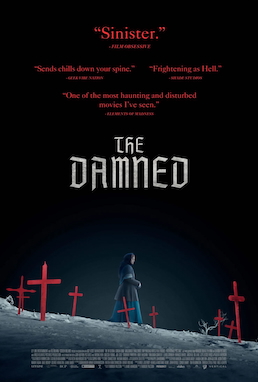
Folk horror is particularly open to religion.  The powerful Euro-horror film, The Damned, is nearly worthy of Robert Egger status.  Indeed, the movie reminded me of Egger’s work, so perhaps Thordur Palsson is his Icelandic incarnation.  Set in a fishing station in a remote arctic bay in the 1870s, the owner’s widow oversees the operations of six fishermen and the woman who cooks and keeps the house.  Her husband died at sea the previous year, and the fishing has been very poor, threatening their existence.  They need to eat their catches, as well as their bait, trying to stay alive until spring.  Eva, the young widow, sees a ship foundering on the distant, jagged rocks.  The men insist that if she orders them to help, their food supplies will quickly be depleted, and the rescue operation would put them all at risk.  Lured to the wreck by a food barrel that has washed ashore, they encounter more men than they can keep and have to fight them off of their small fishing boat, killing one in the process.

The helmsman of the boat falls overboard and drowns as the survivors try to climb aboard.  The small boat manages to escape, however.  Helga, the housekeeper, warns Eva of the draugr, a monster of Nordic folklore that is a kind of zombie.  If it gets into your head, she warns, it will led to death.  Skeptical of folktales, Eva begins to change her mind as her small group of companions begins dying off.  Helga disappears.  One of the men dies after being stopped from killing a companion.  Eva is now left with only four men.  One of the men insists they are paying for their sin, and begins erecting a large cross as an act of penitence.  After seeing a man in the mist, the new helmsman dies by suicide.  Now convinced the draugr is real, Eva leads an expedition to find and destroy it.  This leads to the death of yet another crew member.  The three remaining people decide to flee by night in the boat.  Eva, however, encounters the draugr in the cabin and destroys him by fire.  A spoiler follows.

The shocking end reveals that the draugr was actually a survivor of the shipwreck and his presence explains the “supernatural” events they believed the monster caused.  Eva, delusional, kills the man.  The story plays heavily on both the isolation of the fishing station and the guilt the characters all undergo after leaving their fellow sailors to die on the jagged rocks.  Their fear transforms fevers into deadly paranoia as they kill one another and themselves off.  This is set against the stunning arctic scenery of the fjord that houses the station in a stark winter landscape.  And the conflict between religious systems is right there on the surface and deep within the minds of those isolated, far from civilization.