Express Yourself

Do you ever get excited by an idea only to be let down when it comes to the execution?  I suspect that’s a standard human experience.  For me it often happens with books.  Especially academic books.  I get excited about the ideas that are sure to be lurking between the covers only to discover that the author has unimaginatively fallen into bad academic habits, such as “scholar A says, but scholar B says.”  Just tell me what you say!  Reflecting on this I realize that building a case has become conflated with taking a test.  A doctoral dissertation is a years’ long test.  Your ideas are being compared to those who’ve gone before you—the fact that they’ve published has proven that—and you are expected to show your work.  Did you read Smith?  Have you struggled with Jones?  Is Anderson in more than just your bibliography?

This kind of extended citation leads to turgid writing that slays any interest in the subject by the end of page one.  I’m not alone in this critique.  Some famous academics, such as Steven Pinker, have noted this.  In a not nearly frequently enough cited article, “Why Academics Stink at Writing,” Pinker lays out the bad habits that get perpetuated throughout the modern academy.  It comes down to, in my humble opinion, the fear of the exam.  Test anxiety.  Recently my draft of The Wicker Man came back from peer review.  While the comments of the reviewers were helpful, and quite complimentary, they felt there should be more academic dialogue going on.  I push back at this: if you don’t believe I’ve done the research, why approve the book for publication?  Most academic writing stinks and there’s no reason it should.

I’m a slow reader.  My average rate is about 20 pages per hour.  I know this because my morning routine sets aside about an hour for reading each day, and I note how many pages I consume.  Lately some of the academic books I’ve read have hobbled me down to 10 pages per hour.  I keep waiting for the narrative flow to kick in, something that I can follow and absorb.  Instead I’m learning what everybody else, often except the author, thinks about each minute point of his or her thesis.  Please, just tell me what you think!  I trust that you’ve done the research.  You wouldn’t have been granted a doctorate if you hadn’t.  The last thing I would want from my, admittedly few, readers is for them to close my book and say, “I’d rather be reading something else.”

Novelization

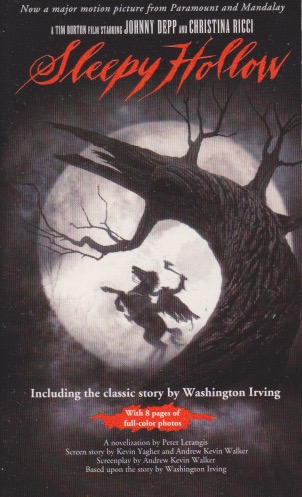
It must be both difficult and easy writing the novelization of a movie.  I suppose it depends on the movie as well.  Sleepy Hollow is a film based on a story already, but Washington Irving’s tale isn’t a novel and the movie was a collaboration between Irving’s original, re-envisioned by Kevin Yagher, Andrew Kevin Walker, and Tim Burton.  The novelization was done by Peter Lerangis and it, naturally enough, follows the movie.  As a novelizer, however, you need to try to make sense of some scenes where a film only implies what’s going on.  Now, in this case I’ve seen the movie many times and any deviations come across as “that’s not the way it goes” moments.  Still, it’s competently done.  It  even helped me make sense out of some things that had me puzzled since the start of the millennium.

In the “book or movie” debate I tend to think a book should be read first.  Sometimes it should go the other way around.  Novelizations are, of course, intended to increase the profits for a film.  You’ve got the box office take, and if there are advertising tie-ins or other merch, you can add to the haul.  A novelization can also help.  In this case, the movie has a somewhat complex plot with revenge and double-crossing, and so a novel helps to make all that clear.  However, when the novelist asks you to accept what a character is thinking you may have already come up with your own ideas on that point and any postmodernist would tell you that your opinion is just as valid as that of the writer.

Movie scripts tend to be a bit short for novels—if the movie isn’t based on a novel, of course—and sometimes extra material is needed.  This novelization includes the public domain story by Irving as well, even though the movie completely recasts all the characters into unfamiliar roles.  Brom, for example, is a minor part, whereas Katrina is a witch and Ichabod a constable from New York City.  All of that having been said, there really aren’t many surprises here.  I read this because I’m interested in the life of “The Legend of Sleepy Hollow.”  Its many retelling and re-envisionings.  The original story was published less than fifty years after American independence and has memories closer to the time.  It tells us something of what it was like in those early days.  And this novel both retells and redacts a movie already a couple decades old itself.


Who’s Calling?

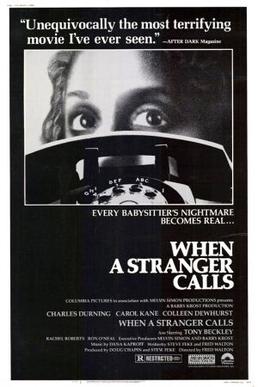
The first twenty minutes are impossibly scary.  I didn’t see When A Stranger Calls back in 1979, when it came out.  I prefer my monsters in non-human form, thank you.  But still, to be writing books on horror movies without ever seeing what is widely regarded as being the scariest opening ever?  Although the first twenty minutes were indeed scary, and extremely tense, for me the scariest part came after that because I didn’t have any idea what else would happen.  Of course I knew the initial calls were coming from inside the house.  That urban legend seems to have been around since I was a kid.  I wasn’t sure who survived, if anyone.  And psychopaths are scary in real life, let alone in fiction where they can break into locked houses pretty easily.

The story, as laid out, is better than most critics give it credit for being.  The only part that seemed difficult to believe (and don’t get me wrong—I love Charles Durning) was that an overweight John Clifford could do all that running (particularly up stairs).  It’s believable that the criminally insane can escape—Michael Myers seems to do it every couple of years—and even that they could blend in on the streets of any city.  I do have to agree with the critics that the writing isn’t great, but those who say it’s not scary enough, well, they’re made of sterner stuff than me.  Or perhaps they lack empathy, which is a scary thing in itself.

Curt Duncan, perhaps because he’s clearly killed at the end of the movie, never became the serial boogyman that the aforementioned Myers, or Jason Voorhees, or Freddy Kruger, or Hannibal Lecter became.  Although sequels were made, once you’ve seen that first twenty minutes of Stranger, you get the sense that they’re not going to be able to do it any better.  Snopes tells us the legend began in the sixties.  It was clearly a reaction to the proliferation of telephones and the potential to abuse such technology.  That’s an object lesson we still haven’t learned.  We now seem never to be more than inches away from a device at all times.  Except maybe when in the shower, but that’s a scary story for another time.  Although I won’t be going back to rewatch or analyze this one over and over, still I feel I somehow earned a stripe or bar for watching it.  And I now feel even more appreciative of caller ID.


Banning Together

Banned Book Week starts today.  As the political situation in this country continues to deteriorate into a Republican fascination with fascism, we find books challenged and banned for suggesting real fascists were anything other than nice, white boys misunderstood.  It will take decades, if not another World War to undo the damage Trump unleashed.  Instead of sitting in my corner worrying about the future, I read.  Banned books make up quite a bit of my reading, but I do try to read one every September intentionally in honor of the occasion of Banned Book Week.  It’s misguided to suggest children shouldn’t grow up.  A deep-seated fear of education reveals the hypocrisy at the very heart of book banning.  Adults should know better.  They should read.

I love America, but nationalism is poison.  Just like those who believe that only their religion can be right, many believe only their nation can.  Divide that up among the almost 200 nations of the world, with individuals in each thinking this way, and conflict logically arises.  Those who look at other cultures—read about them—and try to understand them, realize we each have our own way.  One of the major problems is that capitalism insists all must trade and barter the way that we do.  We think of people in terms of their “net worth”—which is, in reality, infinite—and want to know who owns more and is therefore more powerful.  Lackeys will always follow the wealthy, kissing posteriors and professing loyalty until they have enough of their own to challenge the more wealthy.  It’s enough to send any Bible-reader back to Ecclesiastes.

Books have stirred up ideas ever since they were invented.  The Bible wasn’t the first book, but it too appears on Banned Book lists.  Many of those who thump it read it with the acumen of a kindergartener.  That’s not why it’s sometimes banned, however.  It is full of sex and violence.  The bits about love and hope are far outweighed by it.  Books contain ideas and ideas will get out.  There’s a reason I surround myself with books.  They are a strange sort of castle that invites others in even as it protects.  It’s not comfortable to challenge the way that you think, but nothing fascinates like a new idea taking root and growing.  One of the best ways to meet people far distant and explore the way they think is to read.  Banning reflects our small-mindedness, and even worse, our desire to keep that small-mindedness intact.


Whence Dawn?

It’s rare, but that’s often what makes things so special.  Because of the way my mind works, I can’t have background music on when I work.  My concentration suffers.  The only real exception is when I have a mindless, repetitive work task that I have to do that lasts for an hour or more.  Then I can slip on the phones and start up Spotify.  I can only afford so many premium accounts, so I have the free version.  That means ads.  The thing about Spotify ads is that they too are repetitive.  I guess that’s how marketing people try to get things stuck in your head.  I can remember many jingles from childhood.  Mostly for products I never use, and a few from products that no longer exist.  They live on in memory.

The other day I had a repetitive task to do that was aided by a lack of early emails at work, so I was able to begin shortly after login.  You see, I tend to start work before seven.  An early riser, I like to work when I’m still able to concentrate well.  I had the headphones on and was listening to Spotify.  One of the ads, about insomnia (ahem), started out by stating they had to choose between a daytime ad and a nighttime ad.  They said something like “obviously we chose nighttime.”  It was seven a.m.  The sun was up.  Some of us were already at work.  Since my task took several hours, I was still at it after nine a.m. when the ad switched to its daytime version.  So night now lasts until work starts?  Whatever happened to dawn?

Perhaps the ads come from a different time zone.  Some of them are regionally specific, though.  Work defines much of our lives, and it also seems to dictate when Spotify switches to its daytime advertising.  For those of us who wake early, dawn is an almost magical time.  It has been many years now since I’ve awoken to find it light outside.  Although I get quite a lot of my personal work done before starting my paid job, I still keep an eye out for the first lightening of the sky.  At some times of the year, before the autumnal equinox sets in, it signals the time for my jog to start.  In September that gets delayed to 6:30 when many others are out and my work’s about to begin.  If I happen to be listening to Spotify when I start work, they’ll confirm I should still be sleeping.  Instead, I embrace the dawn.


Scary Holidays

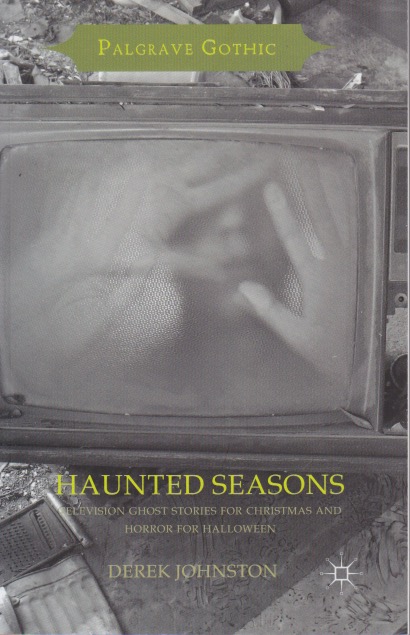
One of the real wonder of books is that they can spawn ideas outside their specific topics.  While revised dissertations can be somewhat difficult to read, Derek Johnston’s Haunted Seasons: Television Ghost Stories for Christmas and Horror for Halloween contains quite a few such moments of birthing ideas.  While being largely British-focused, it nevertheless explores holiday horror, a phenomenon that I’ve been researching for some time.  Not really a television watcher (not any more—as a child things were quite different), I don’t really keep up with many programs.  Still, I learned a lot from this book.  One of the main questions it addresses is something I’ve long wondered about—why is there a connection between Christmas and ghost stories in England?

Johnston points out that Celtic areas tended to have Halloween or its precursors to supply an occasion for otherworldly thinking.  The English, not wanting to think of themselves as these outer-lying cultures (I’m simplifying and abstracting a bit here), developed their own tradition of the Christmas ghost story.  It pre-dates Dickens and probably goes far enough back in history that there’s no way to trace it.  Telling ghost stories around the shortest day of the year makes its own sense.  Dickens’ A Christmas Carol was perhaps the most famous example, but M. R. James’ habit of telling ghost stories (later published) to students and fellow enthusiasts on Christmas Eve also plays into it.  In Britain this led to a series of BBC Ghost Story for Christmas shows.  Meanwhile, in America, where there was quite a lot of Celtic immigration, a taste for Halloween grew.

There are so many ideas that swirl around holidays.  I’ve been exploring the topic for nearly two decades now.  Publishers, always with their eyes on the bottom line, don’t produce much like this, figuring people will only buy it one season a year, and for books that means usually the first year only.  Some people (yours truly, for one) will buy books about holidays out of season.  So much of life is preparing for special times.  I suspect that ancient people also fell into humdrum daily existences also.  Humans require stimulation, we like variety and novelty.  Holidays are a great solution—they don’t occur every day.  If they did they wouldn’t be special.  They bring something different into our workaday world and, in modern times especially, we brand them so that each one is at least slightly different.  I don’t mind seeing the seasonal displays so early in the stores—it reminds me that haunted seasons are just around the corner.


Misremembered

There may be a name for it, but if there is I don’t know it.  Like the more well-known Mandela Effect, it’s a strange memory issue, only it affects the individual.  The Mandela Effect is a collective false memory, often involving the death of someone famous.  Many people—sometime very many—think, for example, that someone famous has died.  The death, or other false memory, is posted in the past and people who don’t know each other all agree that it happened, only it hasn’t.  Instead, what I’m talking about happens to me once in a while and perhaps it happens to others.  Most recently I was listening to The Proclaimers’ song “I’m Gonna Be,” also known as “500 Miles.”  It’s got a catchy chorus and I was thinking it was an oldie, so I looked it up.

First of all, I didn’t know The Proclaimers were a set of twins from Edinburgh.  Second of all, I didn’t know they were (only) my age.  Third of all, I was sure I knew and heard the song from when I was growing up, but it came out in 1988, the year my wife and I moved to Scotland.  I was just stunned by this.  I was sure I’d heard the song, for instance, when I was in college and that it was an oldie even then.  I didn’t and it wasn’t.  In fact, the very year I could’ve first heard it I was busy making plans for an international move, getting married, and starting a doctorate.  This kind of time distortion can be very disorienting, and it says something about memory.

1988

Our lives are the stories we tell about ourselves.  Memory, in an evolutionary way, serves some basic functions such as recalling which other people you can trust, where good food sources are, and where the saber-tooths tend to hang out.  Those with better memories survive longer and procreate more and over time the trait becomes common.  Memory isn’t intended to recall specific dates.  I often wonder if something like the Mandela Effect isn’t behind Trump’s unaccountable popularity.  A kind of memory that refuses to believe the song came out in 1988 although clearly it did.  Believing false memories is the stuff of drama, of course.  That drama can take in whole societies because we misremember that we knew all about propaganda because we learned that in high school, but now we fall for it.  Or it may be a lonely moment when a song comes to mind and we think we’ve known it far longer than we have.


Footnote Lament

I listened to a presentation on a famous novelist the other day.  It was noted that this writer was a master researcher, having read a lot for each book he wrote.  I don’t doubt it.  This novelist didn’t hold a doctorate, however, which makes even his historical novels suspect in the eyes of the academy.  I often think of the humble footnote.  You can’t read everything on a topic, not if it’s broad enough on which to write a book.  As soon as you send the proofs back to the publisher you’ll inevitably discover a source you’d overlooked.  And critics will delight in pointing this out to you.  I sincerely hope that my next book project will be devoid of footnotes.  There are personal as well as professional reasons for this.  One is that I like to believe what I have to say is important.

You see, the footnote is a way of backing up an assertion.  I remember many years ago reading a piece by a journalist who was scandalized that professors are so pressed for time that they rely on reviews rather than reading the actual book.  That journalist may not have been aware of just how much is published.  As an author you have to learn to say “Enough!”  The work is done and I’m not going back to it.  Footnotes will give you respectability.  Show that others agree with you—indeed, said it even before you did.  One of my great struggles with academia, besides the obvious, is that I’m more inclined toward creativity than your garden variety professor.  I like assert things because I know them to be true.  And those people I’m footnoting, they’re doing some of that themselves.

Finding yourself in a footnote

Academic respectability really comes into its own after death.  Even so, looking back at some of the “giants” in the field you can see that their ideas haven’t aged well.  They were important at the time, but now we look and see their western bias, how they didn’t take diversity, equity, and inclusion into consideration.  They simply accepted the dead white man’s version of the way things were.  They live on in footnotes.  You have to earn the privilege to be original.  Otherwise you’re just some patent clerk or editor and why should we take your word for it?  One of my zibaldones has written inside the cover Nullius in Verba—take nobody’s word for it.  I believe that, and yet I find myself having to put my source in a footnote.


Immature

I’m not immature, but I have to admit to having done a double-take every time I saw the name of the school.  While living in Edinburgh my wife worked for a short while at the Medical School and I couldn’t help but notice the official name of the associated veterinary school: The Royal (Dick) School of Veterinary Studies.  I was sure Dick was a surname and yet little boys never grow up, it seems.  Fast forward to just last week when I had occasion to look up Arcadia University, here in Pennsylvania.  For those of you who’ve never had the privilege of being an editor at an academic press, I’ll say that one of the things we constantly do is check out colleges and universities.  In the case of some church-related schools it’s easier to get the straight dope from Wikipedia before going to their actual websites.  I never rely on Wikipedia alone, of course.

A defunct college (Marvin College). Image credit: Nyttend, via Wikimedia Commons

Still, the Wikipedia page for Arcadia explains that the school had to change its name because internet searches were being blocked for sexual language.  The former name of the school?  Beaver College.  Human beings have a very wide variety of slang words to refer to our genitalia.  I suspect part of the reason is the fun of establishing, and violating taboos.  There are many schools that could fall into this category (Ball State comes immediately to mind), but when it gets to the point that search engines block you because they assume your mind is in the gutter, what choice have you got?  Changing names is a big expense and even bigger hassle, but everyone searches for everything on the web.  It’s our common reference book.

I don’t know whether to believe Wikipedia on this point or not, but I know from personal experience that employers or commercial servers can block “offensive” information.  I’m a religion editor.  When I took our car in for service some years back—they have free wifi for customers so they can work while they wait—I soon found I could not get onto any websites mentioning religion.  Given my job, that’s a bit of a problem.  The garage had blocked it as a taboo topic, perhaps for good reason—I have no way of knowing.  What it means is that my wife now has to take the car in for service.  Regarding Arcadia, it probably doesn’t help that it was an all-female school.  Its first name was Beaver Female Seminary.  Things have changed since 1853, but I’m afraid that those of us who are immature still find this a little funny.


Saints and Freedom

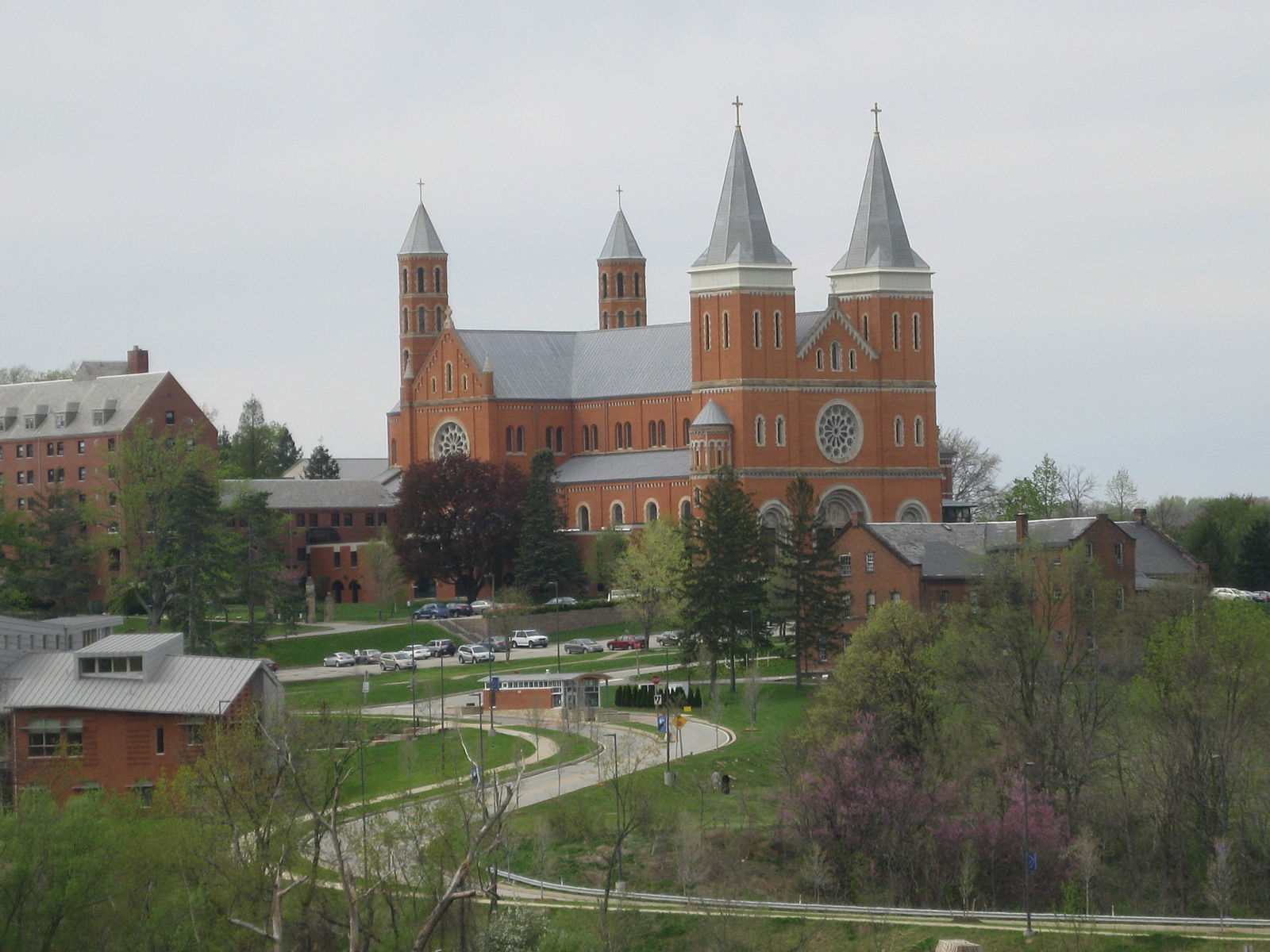
There’s a saying that all elections are local.  I suspect that’s true.  Location is important.  There are famous Americans not recognized in other parts of the world.  And there are, of course, local celebrities.  Having settled once again in Pennsylvania, I’ve taken an interest in local religions.  Although not part of the “Burnt-over District” of upstate New York, Pennsylvania, because of its early laws of religious liberty, has produced some noteworthy figures over the centuries.  And institutions.  When someone mentioned St. Vincent Archabbey, in Latrobe, Pennsylvania, I was curious.  I’m not Catholic and even though I’d considered a monastic life, I really knew little about it.  St. Vincent is the largest Benedictine monastery in the western hemisphere, as well as the oldest in the United States.  

Image credit: Guerillero, via Wikimedia Commons (Copyleft Free Art License)

Latrobe isn’t far from Pittsburgh.  There is a strong Catholic presence in the area.  Like many Catholic institutions, it has a cluster.  St. Vincent College, also in Latrobe, must’ve sent me—in those days, print—a prospectus back when I was looking at schools.  I’ve known about it for a long time.  There’s also a seminary, also called St. Vincent.  Probably it’s largest claim to fame is that the Pittsburgh Steelers use the College (I suspect the seminary has no athletic program) for their training camp.  Monks and football players—they must have some interesting conversations.  I grew up thinking Catholicism was basically some other religion.  Fundamentalists, misunderstanding the basics of history, tend to claim that Catholics aren’t Christians.  Indeed, until the recent politicization of conservative Christianity, they wouldn’t have had much to say to each other.

Catholicism was frowned upon by the early colonists.  While seeking freedom of religion, what they really wanted was freedom of religion for themselves.  In good, charitable Christian fashion, many colonies tried to exclude those that believed differently.  Especially Papists.   Rhode Island and Pennsylvania, however, notably allowed freedom.  I’ve lived in Pennsylvania long enough to know that even legal freedom isn’t protection from those locals who’d rather not have Muslims or Hindus for neighbors.  And in all likelihood William Penn, a good Quaker, probably couldn’t imagine people of “exotic” religions wanting in.  Indeed, the majority of people in this hemisphere weren’t really even aware of “eastern religions” until the 1890s.  The religions here were forms mostly of Christianity and Judaism.  By 1846 the Benedictines could establish a college, monastery, seminary complex in western Pennsylvania.  And it would become the largest and oldest such establishment in a country that still doesn’t grasp true religious freedom.


Double Feature

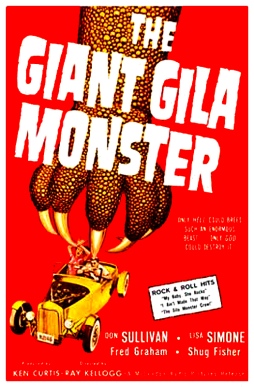
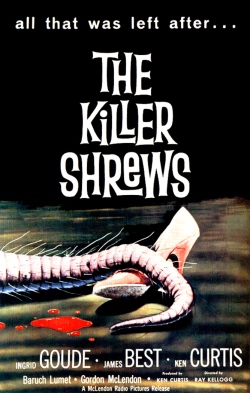
Creature features were a regular part of my youth, and, I suspect, where my appreciation of horror films began.  Nobody was really afraid of Godzilla or other monsters that were clearly people in rubber suits.  The use of forced perspective to make regular-sized animals into giants was obvious even to a child, but that didn’t make such movies any less fun to watch.  The Giant Gila Monster and The Killer Shrews both involve gigantic versions of rather small animals and both of them were produced outside of the studio system by Gordon McLendon, the owner of a chain of drive-in theaters.  Looking for B-movies for double features, he decided to make a couple of his own.  These two didn’t cost that much, but the special effects artist, Ray Kellogg, agreed to do them if he could be the director.  Together they make quite a double-feature of their own.

The Giant Gila Monster is never explained beyond the effectively shot beginning stating the who knows how big some things grow in the unexplored west.  Not even using a real gila monster, the lizard (unlike Komodo dragons, which one expects, were too expensive and untamable) isn’t aggressive and seems, from my perspective, to be just barely putting up with the fake trees and models it has to crawl over and around.  And everyone, apart from Mr. Wheeler, is nice.  The local Texas teens want to drag race but Chase Winstead, the gold-hearted mechanic, keeps them in line.  It’s a perfect world, in a Republican kind of vision, except for that darned giant lizard.  Winstead even figures out a way of getting rid of it so the authorities don’t have to.

The Killer Shrews, in reality puppets and dogs dressed up as shrews, is more adult-themed.  Four scientists on an island—contradicting the voiceover at the opening—have bred giant shrews.  The supply-boat captain and his Black mate are trapped on the island by a hurricane, where the mate predictably gets eaten by the escaped shrews.  McLendon himself appears as an over-the-top nerdy scientist while the producer, Ken Curtis, appears as another, more action-oriented man of science.  In a move a little unexpected for the fifties, Dr. Craigis’ bombshell blonde daughter is also a scientist.  But she’d be willing to be a sea-captain’s housewife if only she could get away from these awful shrews!  There’s a bit more tension in this one as one of the scientists is already engaged to Miss Craigis, but he’s a drunk and she wants out.  So might some audience members, but both films found international distribution and made money.  Now widely available for free, they are a slice of childhood served up in giant proportions.


First Choice

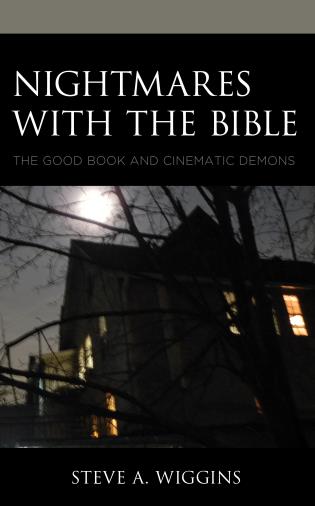
One of the first things I do when I finish a book, unless I know about the author already, is ecosia (google) her or him.  I want to know who it is that wrote this, and the internet’s right there!  So it came as a surprise to see my first (two-star) review for Nightmares with the Bible on Amazon, where the reviewer did no follow-up.  The reviewer is quite upset that I don’t take the Bible literally, but at least s/he bothered to leave a review.  A more positive rating might bring me up to three stars, but I’ve failed classes before.  I’m a big boy, I can handle it.  In any case, if you ecosia me you’ll quickly come upon this humble website that’ll tell you what you need to know.  No, I am no longer a Fundamentalist.  And the book was about demons in movies.  (I was actually searching for reviews of the series.)

I scrolled down.  The named reviews solicited for the book I knew, so I was surprised, and delighted, that further down the page I had a Choice review.  Even a disgruntled evangelical couldn’t bring me down after that!  In case you’re not a librarian, or an academic publisher, Choice is THE periodical librarians use for deciding on which books to buy.  It is very difficult to get a review in it—I work at a prestige publisher and seldom see our books in there.  If you’re a trade author that’s not so important, but if the only sales, or majority of sales, are for libraries, to get a “recommended” status is a big deal.  That’s worth celebrating.

If you’re wondering, authors do not get notified of reviews.  Some editors will let them know (my editor at McFarland hasn’t been in touch for years).  The journals are too busy doing what journals do to send every author a copy of their review.  So I swung by Amazon’s Holy Horror page.  I’ve got four ratings there now, mostly on the lower end of the scale.  If you’ve read it and liked it (not something I assume, of course) a nice review would go a long way.  Disgruntled evangelicals (aren’t they all, these days?) may make the books look bad, but colleagues who’ve read them seem to think differently.  I hold to the publishing adage that there’s no such thing as a bad review, but good reviews feel so pleasant.  I’ve only written one negative book review in my life, and that was because I felt any other would be utterly dishonest in that particular case.  It’s a choice I make because of the Bible: “For with what judgment ye judge, ye shall be judged: and with what measure ye mete, it shall be measured to you again.”


Religious Monsters

It began with monsters.  A religious monster-boomer, I couldn’t get enough of these scary creatures as a child.  For some reason they made me feel happy, secure.  With the real monster of parental alcoholism lurking outside the door this is perhaps understandable.  Growing up I soon learned that these were childish things—religion was adult.  And very serious.  Always trying to be a good boy, I followed the trajectory to seminary and then further study.  Monsters had faded.  I still liked them, but seldom encountered them and acted disinterested if I did.  Fortunately I came out of it.  Probably it was being ousted from academia that awakened what had once been my reality.  That, and I’d learned that some academics—mostly in religion departments—were now studying monsters.  Monster may I?

Maybe a decade ago, I’d read, I thought, just about every academic book on monsters.  Then the slight shift of focus from monsters to horror films started.  You see, movies are often where we learn of monsters.  There weren’t too many academic books on the topic, and the internet sites I found often lacked depth.  (Although a shout-out is due to Horror Lex here, if you’re not visiting, you should be. And of course, Horror Homeroom.)  Editors, you have to understand, are for some reason discouraged from writing books.  I’d been noodling away on the ideas behind Holy Horror for years.  Suddenly it occurred to me—I could write a book on monsters from an angle unused before.  (Later I discovered an academic had written an article on the topic, but seems to have dropped it after that.)  Writing about horror is really my sublimated love of monsters arising.  And they do rise.

Of course, those who know the religious Steve, still trying to be the good boy, are confused.  Our culture has poisoned the well for horror, I fear.  Not everyone likes slashers.  I personally don’t care for them.  A quiet haunting is more my style.  Still, what’s available on Hulu or Amazon Prime often dictates what I see.  If you’re going to write about horror movies you have to read about them.  Lately that’s driven me more toward film department studies.  That’s the thing about curiosity—it never rests.  There are always doors to open and rocks to turn over.  And books to read.  There’s no end to it, kind of like a good scary movie.  Like a monster you have to cross boundaries to learn anything.  Religion has its monsters, and denying that will only lead to complications.


Things that Appear

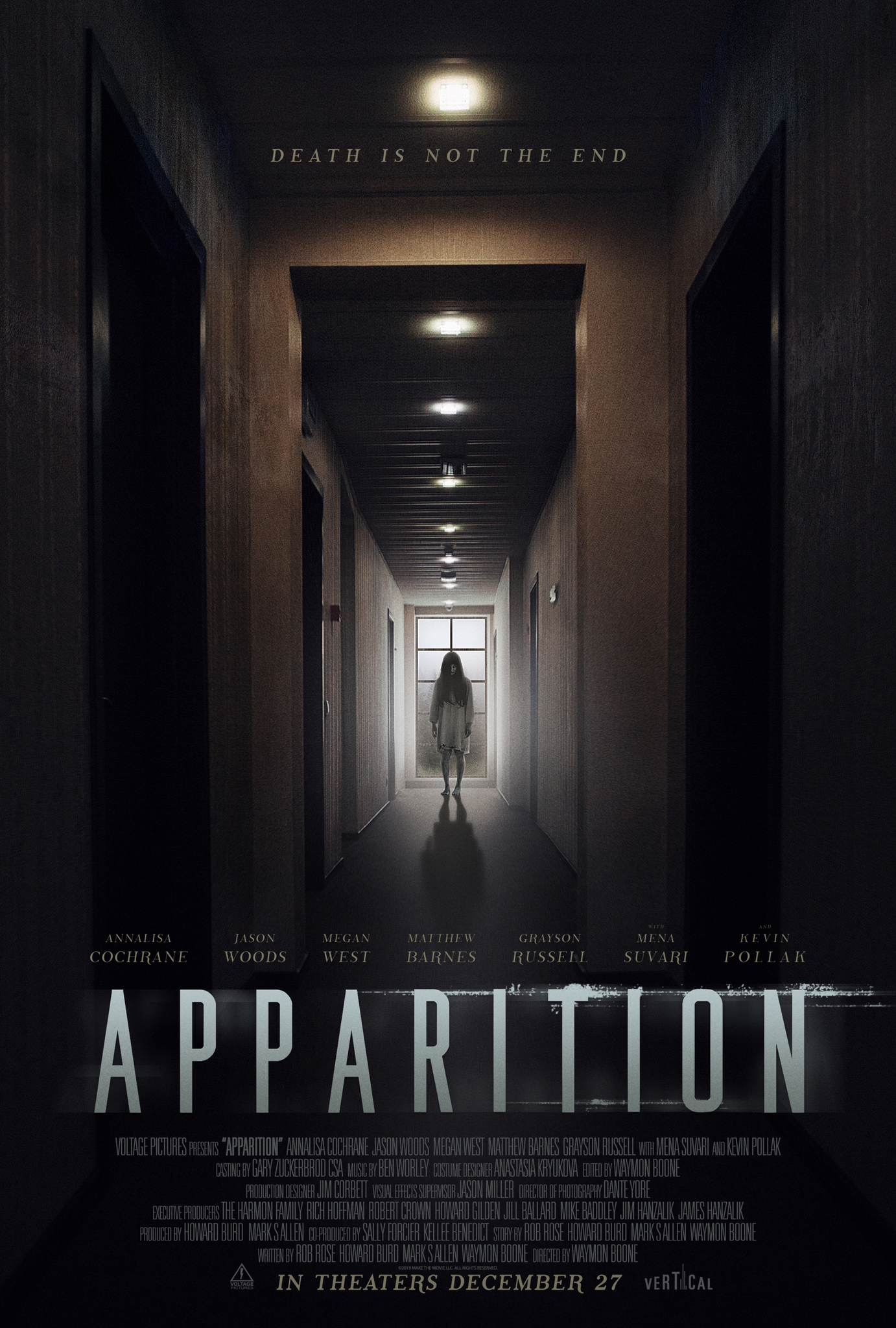
As a movie, Apparition fails on many levels.  One way that it passes is being free on Amazon Prime, which is how I found it.  The trick with Prime, of course, is that really good movies tend to be available for a limited time, keeping you on the website.  Time is money, after all.  I was drawn into Apparition from the “based on real events” tagline, even though I should know better.  It was a hot, sleepy weekend afternoon, and I’m not a good napper.  I’m not going to worry too much about spoilers here, so if you’re into penance, you might want to wait until after you’ve seen it.  Set at the real life Preston School of Industry—a boy’s correctional institution in California—the boys are tortured and sometimes murdered by the warden and guards.  This is one of the few real-life parts: a housekeeper at the facility was murdered in an unsolved crime at the site.

Fast-forward two decades.  The former warden (the place has been closed), is hosting the lavish rehearsal dinner for his son’s wedding.  The son is unloved (his father is a sociopath, after all), and doesn’t treat his fiancée very well.  Meanwhile a younger son is a nerd who’s developed an app called Apparition.  Through some unexplained technological wizardry, it allows the user to connect to the dead.  Another couple, son and daughter of two of the former prison guards, decide to try it and discover that it works.  When the bride gives it a try it leads the five young people to the Preston School.  There various ghost-hunter startles are used as the ghosts of the murdered boys take their revenge on the offspring of the warden and guards.  The bride discovers her father was a “good cop” and that’s why she wasn’t killed.  The younger son is actually the son of the murdered housekeeper, another of his father’s dark secrets.  The parents come and get what’s due to them.

What makes this unremarkable film (and very little comment has been given on it) worth discussing here is that during the opening credits a Bible is shown open to Exodus.  The verse called out is 20.5: “Thou shalt not bow down thyself to them, nor serve them: for I the Lord thy God am a jealous God, visiting the iniquity of the fathers upon the children unto the third and fourth generation of them that hate me.”  This isn’t referenced per se in the film, but the warden does suggest the school is a righteous place.  That’s a fairly brief reward for watching, but I hate to waste even a lazy weekend afternoon when it’s too hot to work outdoors.


Social Horror

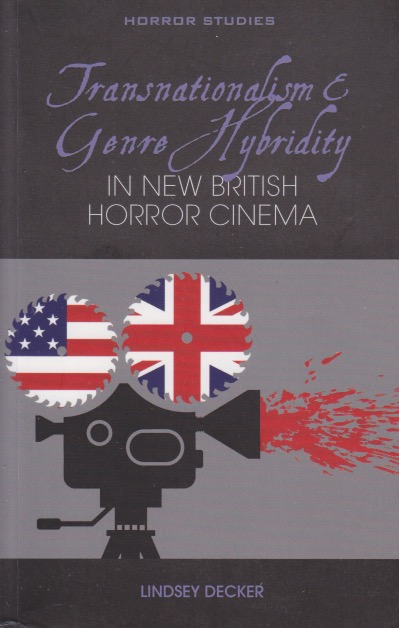
Some books get you thinking in ways you don’t expect.  That’s one of the pleasures of reading.  Lindsey Decker’s Transnationalism and Genre Hybridity in New British Horror Cinema may sound terribly specific—there are a lot of qualifiers in that title—but it actually has some very broad implications.  I was reading it specifically from the horror angle for a project I’m currently working on, but I was surprised at the social commentary I found while doing so.  One of Decker’s main ideas is to show that British horror is, well, transnational while maintaining its Britishness.  She focuses mainly on five films in the book, only two of which I’ve seen.  Very aware of the history of British cinema, she points out many characteristic features and situations that make British horror what it is.

The social commentary comes in when discussing “hoodie” horror films.  These are movies showing how the working class, particularly the youth, are dangerous and anti-society.  The more I read the more it occurred to me that imperialist, capitalist systems are built on the corpses of the poor.  Even good kids from bad situations have difficulty getting ahead in life and those above them on the “social ladder” more or less despise them and make policies to keep them in poverty.  This leads to anger and resentment, and often, in reality, this spills over into violence.  It all comes down to those who benefit from the system refusing to make it more equitable.  When the inevitable happens—those pressured without sufficient means boil over—they are blamed for their own circumstances.

Having grown up in a working class system and having struggled all my life to somehow maintain a comfortable existence for my family, I know the kinds of obstacles faced.  In my particular case, retirement is not a likely outcome.  I’ve worked, except for (and often even) when I was in higher education, since fourteen.  I’ve seen others with connections, educated parents or influential friends, get ahead.  I’ve also watched while many of us get shunted aside because, well, who are you?  Some people wonder why I watch horror.  There are many reasons for it, and at times I think maybe I’ve seen enough.  But then I look around at the corpse-strewn foundations of our current system and I see how reality plays into that fear.  Decker, I’m pretty sure, was meaning for her words to apply to mainly the fiction of horror, but there was a different kind of hybridity there as well, at least for me.