Columbo

I liked Columbo.  Peter Falk was an award-winning actor, and his working-class detective character was always entertaining to watch.  Unlike other TV cops, he didn’t carry a gun.  Hearing the tragic news from California where yet another shooter killed multiple people before himself, I think about the proliferation of guns.  The New York Times runs story after story showing that nowhere else in the developed world are gun deaths remotely anywhere near what they are in the United States.  Not only do we have a super-abundance of firearms, we have politicians on the dole from the NRA who simply won’t take action because they personally stand to lose money if they do.  And apparently they can sleep at night.  As a nation, our guns outnumber people.

Estimates for the number of guns in America stand at around 466 million.  98% of them are in civilian hands, as opposed to the military.  And we have multiple mass shootings per year.  Is there any chance that these facts might be related?  Ironically, many firearms are owned by those who loudly proclaim they hate the “culture of death”promoted by those who try to make gun ownership more difficult.  I’ve written on this topic so many times before that I really don’t know what else there is to say.  Perhaps it’s time to just give up and weep.  Last year, excluding suicides, there were over 20,000 gun deaths in this country.  There have been 15,000 or more per year since 2016.  Approximately 120,000 gun deaths in just six years.  And yet nothing is done.

The public strongly favors stricter gun laws.  Government officials do not.  In fact, some Republicans are now attempting drive-by shootings of suspected Democrats.  I’m not anti-gun.  I am anti-insanity.  You see, that was the thing about Columbo.  He never pulled a gun, but he doggedly pursued those who did.  The culture of hate that has swept this country since 2016 needs to be reminded of Columbo’s message.  Guns aren’t the answer.  Pursuit of the truth is.  How a purportedly Christian movement does nothing but support the gun lobby is a mystery requiring investigation.  It has to be asked where in the Bible does this idea of arming yourself come from.  It has to be asked which commandment declares obtaining deadly force and making guns easily obtained by the mentally unstable is God’s will.  I guess that about wraps it up.  Just one more thing—what would Jesus do, really?


Black Sabbath

I used to be afraid of them.  The band Black Sabbath, I mean.  I heard the songs from Paranoid wafting from my older brother’s room (separated from mine by only a curtain) and was secretly intrigued.  But the name of the band—wasn’t that satanic?  To a young Fundamentalist there was much to fear in the world.  More than once I bought Alice Cooper’s Welcome to My Nightmare only to replace the copy I’d thrown away in evangelical terror.  I recently learned, however, the the band name Black Sabbath was taken from a 1963 horror movie.  And I also learned that the film was, in part, based on a Russian vampire story by Leo Tolstoy’s second cousin Alexei, titled The Family of the Vourdalak.  And that this story was published decades after Tolstoy’s flop, The Vampire.  That novel was inspired, in turn, by John Polidori’s The Vampyre.

Polidori’s work was inspired by a fragment by Lord Byron, which he contributed to the ghost stories putatively told among friends a stormy night in Geneva that also led to Mary Shelley’s Frankenstein.  Connections such as this are immensely satisfying to me.  Although I taught mainly biblical studies, my training was in the history of religions—it just happened to focus on ancient semitic examples.  Finding the history of an idea is one of the great pleasures of life.  But we’ve left Black Sabbath hanging, haven’t we?  The band realized something that Cooper would run with, namely, horror themed songs and metal go naturally together.  Such dark things led evangelicals to condemn the whole enterprise, claiming the band name was satanically inspired.  (Michael Jackson, raised as a Jehovah’s Witness, was famously fond of horror, although Thriller is perhaps the least scary horror-inspired album ever.)

I’d never seen Black Sabbath before, so now I had to watch it.  Of course, there’s nothing satanic about it.  An Italian, French, American collaboration, it’s a set of three stories bound together by Boris Karloff’s narration, and it’s all in Italian.  One story is about a woman double-crossed but saved by an estranged friend.  The second, the one featuring Karloff, is the one based on Alexei Tolstoy’s Russian vampire tale.  The third is about a poor woman who steals from a dead patron and is haunted until the inevitable happens.  Not particularly scary, the film title was the inspiration for the band, not the content.  They were therefore labelled satanic because of a movie that has nothing to do with satanism.  The song “Black Sabbath” was actually inspired by Dennis Wheatley novels, which do, of course, deal with satanism.  The song itself isn’t satanic.  They decided to make songs like horror films in music.  And it all goes back to Lord Byron and the night near Geneva that inspired both Frankenstein and Dracula.


Truth and Belief

I met Claire Donner the way I meet most people these days.  Online.  I’m not sure how she found me in this dusty little corner of the internet, but she has one of the coolest jobs of all time: the New York City Director of Miskatonic.  If you don’t know Miskatonic, and if the title doesn’t at least give you a hint, you need to go back to your Lovecraft.  Its full title is Miskatonic Institute for Horror Studies.  They also have offices in London and Los Angeles.  Miskatonic offers a variety of one-session courses on horror and Claire had emailed me about the vexed idea of the nature of belief as it relates to horror movies.  Her course on the Amityville Horror—“‘Based on a True Story’: The Importance of Audience Faith in The Amityville Horror”—was excellent.  It left me in a thoughtful mood.

The way that I write books is that I have several projects going simultaneously.  Eventually one reaches critical mass and starts a chain reaction until it gets finished.  One of those projects that hasn’t yet attained critical mass is on Ed and Lorraine Warren.  It’s such an avocation that on a visit to Jim Thorpe on a family trip, I stopped into a shop where the owner proudly displayed articles about the Warrens in his window.  I asked him about the Warrens—whom he knew—but I wasn’t prepared for an interview (and I’m sure, neither was he).  Meanwhile, relatives waited patiently outside.  One thing I’m pretty certain about is that the Warrens sincerely believed in most of what they were doing.  There are nagging loose threads, however, that suggest they kept the financial angle firmly in mind.

To bring this back to Amityville, the course raises the question of the Warrens’ involvement.  They were among the earliest of “investigators” to take what was largely a hoax seriously.  They, however, didn’t get a cut in the profits.  I suspect this is what launched them into their promotional activities.  That book and movie combo brought in, and still brings in, the cash.  Who wouldn’t feel cheated?  But still, there’s belief.  For many of us belief requires some evidence, some tangible trace of truth.  These are the kinds of things explored in this fascinating course.  Horror and religion have been bedfellows for a very long time.  They often converge on this concept of belief.  There’s so much more to the Amityville Horror than meets the eye, even if we all know it was largely a hoax.


On Offer

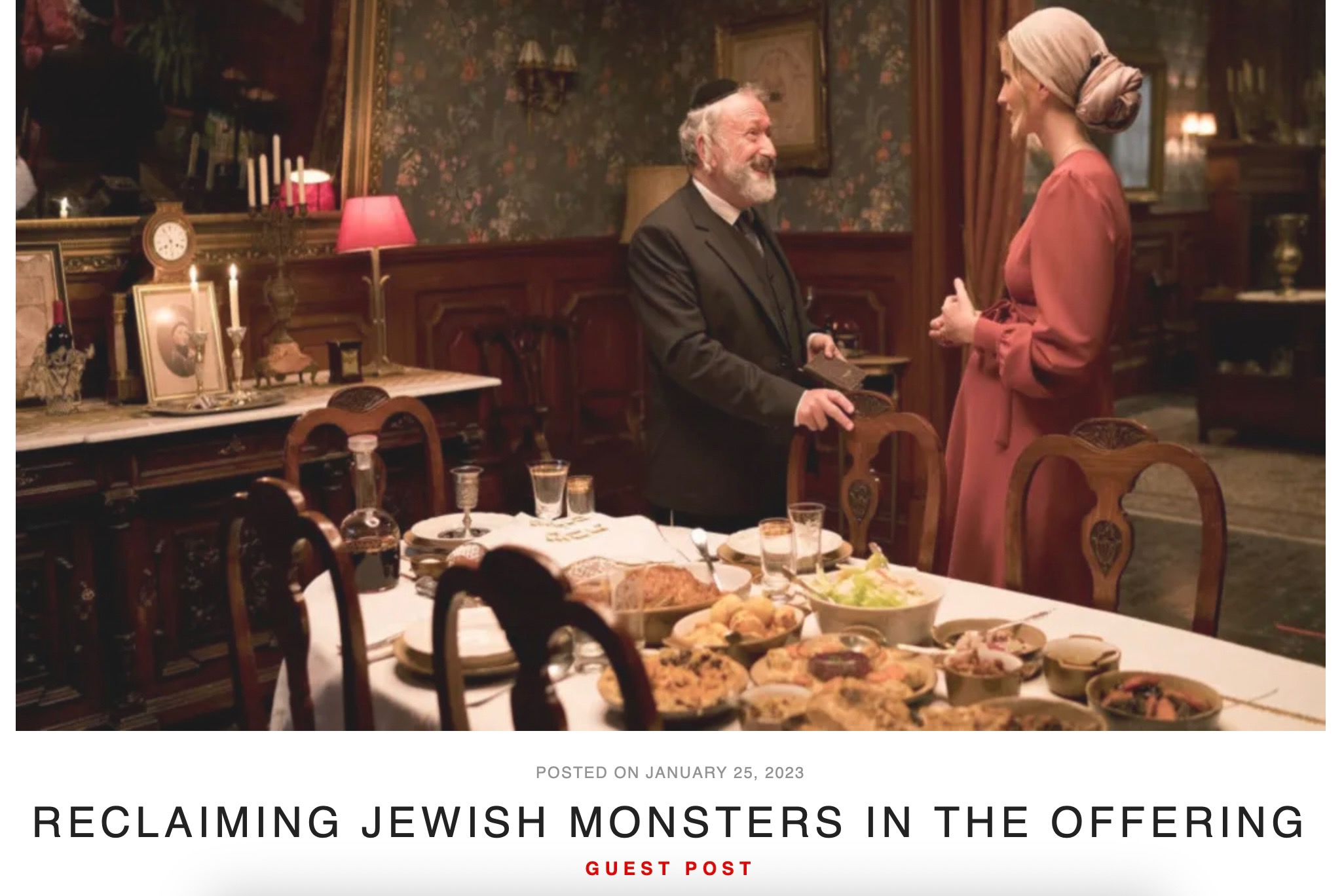
Feeling a bit overwhelmed by various January blues, I took me to my homegrown therapy of watching horror.  The newly released The Offering raises many questions regarding religion and horror, focusing again on Hasidic Judaism.  I say “again” because several movies from the past decade have begun to reflect Jewish monsters, often in Orthodox settings.  This is fascinating because Judaism tends not to emphasize spiritual entities, and perhaps that’s why they’re so surprising in such a framework.  I’m not a specialist in Judaism, and I worry about cultural appropriation, but horror is open to all people.  Religion often plays a central role.  A former author of mine, with Routledge, wrote a fascinating chapter in his book that dealt with Buddhist horror films.  So, The Offering. (I have an article on the movie coming out soon on Horror Homeroom, so be sure to check there for more.)

Like most Jewish-themed horror, The Offering is intelligent.  A Hasidic Jewish scholar, wishing to see his recently deceased wife again, accidentally raises a demon.  While demons aren’t especially plentiful in Judaism, this one happens to be Abyzou, a character familiar to anyone who’s seen The Possession, or, perchance, read Nightmares with the Bible or Holy Horror.  Abyzou targets children and so when Art, a non-practicing Jew, takes his pregnant wife to visit his religious father in Brooklyn, the tension is lined up.  Also, did I mention that Art’s father runs a funeral home out of his house?  The scholar’s encounter with Abyzou lands him in the morgue in the basement where, as demons are wont to do, it escapes.  And it wants that unborn baby.  There are also other family tensions which add to the complexity of the story.

I’m not in a position, without committing a lot of research time that I don’t currently have, to gauge the authenticity of Jewish lore associated with the demonic attack in this particular movie.  It is a film, however, that uses many familiar tropes in the service of horror that’s fueled by religion.  Demons are, after all, religious monsters.  Unlike The Exorcist, the goal here isn’t to exorcise but rather to trap the demon.  Exorcism always raises the troubling question of where a demon might go once it’s expelled.  The famous gospel story of Legion entering a herd of swine makes that abundantly clear.  The Offering also makes the threat to a pregnant woman a key element in the tale, and since we know that Abyzou wants the young, we’ve got built-in suspense.  There may not be a ton new here, but the movie addresses some important issues.  The dialogue about religion deserves some in-depth consideration—perhaps after I finish the book I’m currently writing.


The Point of It

It’s not difficult to feel overwhelmed by the scope of the problem.  Race was a construct developed to oppress.  The intention was to keep those of non-European, especially non-northern European, ancestry in servitude.  The rationale for doing so was part capitalistic, but also largely religious.  Convinced that Jesus was white, and that the “New Israel” had passed to Christianized Europe, it didn’t take much theological maneuvering to get to the point that others can be—in that mindset, should be—brought into line.  And since this religion comes with a built-in body-soul dualism, it’s not difficult to claim you’re trying to save a soul by destroying a body.  That way you can still sleep at night while doing something everyone knows is wrong.

Martin Luther King, Jr. stood up to such ideas.  His understanding of Christianity was more in alignment with what Jesus said and that threatened those in the establishment who found any challenge to profit heresy.  There can be no denying that racism is one more attempt to keep wealth centralized.  It’s something not to share, which, strangely enough, is presented as gospel.  There are many people still trying to correct this wrong.  It is wrong when a religion distorts its central message in order to exploit marginalized people.  The key word here is “people.”  Black people are people.  Their lives matter and every time this is said others try to counter with “all lives matter, ” a platitude that misses the point.  We need Martin Luther King Day.  We need to be reminded that we’re still not where we should be.  We’re still held in thrall to a capitalism that rewards those who use oppression to enrich themselves.

I was born in the civil rights era.  I suppose I mistakenly reasoned that others had learned the message as well.  All people deserve fair treatment.  Today we remember a Black leader, but we still have the blood of many oppressed peoples on our hands.  Those who first came to live in this country, whose land was stolen in the name of religion.  Those whose gender and sex put them at threat by those who believe control of resources is more important that care of fellow human beings.  It’s easy to feel overwhelmed, but in King’s words, “the arc of the moral universe is long, but it bends toward justice.”   If we believe that, and if we can act on it, there remains the possibility that we might actually achieve the reason we set this day aside to reflect.

Photo by Katt Yukawa on Unsplash

Disappearing

It might be easy to suppose that horror uses religion gratuitously.  Or it may be that the connection runs much deeper.  Yes, many people are still religious as growing numbers are becoming less so, but both kinds watch horror.  As is usual for a guy who doesn’t get out much, I learn about movies often by reading about them in various analyses.  That’s how I came across the box-office flop, Vanishing on 7th Street.  While various critics point out its flaws, to me it watches like an extended Twilight Zone episode, exploring interpersonal dynamics when a bad situation overcomes a community.  For reasons unexplained, people without a light source disappear.  This is somewhere not too far from Chicago, but we don’t know exactly where.  Five people have managed to survive and four of them end up in a bar that has power because of a back-up generator.

Jim, an African-American boy, is waiting for his mother to return to the tavern.  She was the bar tender but had run to the local church to find other people because the lights were on.  She didn’t return and three other people make their way to the bar.  Disagreeing on a course of action, or what has happened, they try to work together to stay in the light.  Jim eventually makes a break for the church.  He alone manages to survive there until daylight reveals a young girl named Briana, spotted throughout the movie, with a solar-powered flashlight.  The others have all vanished, so Jim and Briana decide to try to make it to Chicago together as night falls.

Wikipedia calls the film “post-apocalyptic,” but I would say it’s more metaphorical.  The only two characters to survive do so by finding refuge in a church.  No prayers are said, but candles keep the darkness and its dangers at bay.  There’s plenty to reflect on here, even though we don’t know what has led to this situation or why the shadows snatch people, leaving rapture piles of clothes all over the place.  Not a fast-paced movie, it’s a film with only one jump-startle and plenty of time to think.  That was my take on it.  Not all horror has to be slasher-oriented.  I was really puzzled why this one ended up with an R rating.  Sometimes horror just makes you think.  Often that thinking involves reflections on the meaning of life.  Some would call that philosophy, but those who consider the light and its relationship to darkness tend to call it religion.


Ideal Christmas

This blog is even open on Christmas.  I’m enough of a pragmatist to realize that few read it today, but even Carl Sagan knew that launching the Pioneer plaques into the void was the smallest spark of hope.  A quark in a universe so vast that we suppose it infinite.  And even so, it makes room for us.  So, if nobody reads this on Christmas I’ll certainly understand.  If you do, and if you celebrate Christmas, a merry one to you.  Thanks for stopping by.  For some folks, I know, Christmas is a time for gathering together.  A British colleague recently remarked to me, “But Thanksgiving is the big American holiday.”  I think he meant both for family gathering and for time off work—it’s the only regular four-day weekend capitalism deigns to give to those who live between the anvil and hammer of nine and five.  But today’s Christmas, we don’t have to think about that.

For me the ideal Christmas is one hunkered down with my family and when we don’t ever have to get out of our pajamas.  A bohemian holiday when you don’t have to go outside to check the mail.  As cold as it is this year, that’s really a relief.  And it’s also a time for stories.  Most of the Christmas gifts I give require explanation.  Even if they don’t, I like to tell stories about them.  That’s the way writers roll, even us obscure ones.  Holidays are based on stories and are made up of stories.  Those we tell only to our families are the most intimate kind.  You see, the brain doesn’t stop working just because it’s a holiday.  So all the books bear witness.

Although it’s too early to tell (the sun isn’t up yet), we might just eke out a white Christmas around here.  In eastern Pennsylvania we managed to avoid the worst of the massive storm that ruined holiday plans for many.  At the tail end of the rain, and at the knife’s edge of the frigid air, come a dusting of snow.  The temperatures have kept low, so if the sun hasn’t managed to warm the still green grass enough, we may see some white today.  It seems we have Bing Crosby to blame for this particular dream.  Christmas isn’t predictably white around here, and global warming only makes it less so.  But this is a holiday, and we don’t need to think about that.  I know not many will read this post, but if you are one of the few, and if this day is special to you, celebrate it for all it’s worth.


The Eve before Christmas

Even as we sit here on Christmas Eve, the work week finally over, my thoughts go to those who celebrate different holidays.  Or none at all.  Cultural Christians may find it difficult to believe that some sects—thinking themselves strictly biblical—observe no holidays.  Not even birthdays, some of them.  You may be doubting the accuracy of that statement, but my second college roommate was one of them.  He believed any holiday was idolatrous, and celebrating birthdays self aggrandizing.  Perhaps it’s not surprising that he can’t be found online.  Many of us, some without reflecting much on it, have been preparing for tomorrow for many weeks.  The older I get, for me it’s really the time off work I treasure.  It’s so rare, and more precious than gold, frankincense, and myrrh.

Like many people, I associate Christmas with music.  One of the songs—not really a Christmas carol—that has become seasonal by its inclusion on Pentatonix’s album That’s Christmas to Me, is “White Winter Hymnal.”  The song is a cover of a haunting song by Fleet Foxes, a folk band, who included it on their debut album, the eponymous Fleet Foxes.  If you’re not familiar with it you can find it here, along with the official video.  The claymation short portrays a group of old men outdoors watching time pass.  One of them begins to crank a drive that makes them younger as time reverses.  When he reaches that point (please forgive the sexist language) “when a man becomes a boy once again” (from another winter song), he releases the handle and the men rapidly reach the age they were when the song began.  Time is the greatest gift.

As the decades press on, their weight increases.  Dreams of what, as a young man, I hoped to accomplish slip away facing the grinding reality of capitalism.  The need to have money to spend for Christmas presents.  And food and shelter.  But mostly books.  Writing takes time.  Writing well takes a tremendous amount of time.  Time for reading, reflecting, and even listening to music.  Christmas Eve is all about waiting.  We hope for a quiet, if cold, tomorrow when maybe the phone and email will cease to solicit money and time, if only for a day.  I have to remind myself that not everyone recognizes Christmas.  For some it’s simply the season to make money.  I, weak as I am, cannot imagine life without it.  And so I watch the skies, eagerly straining my eyes for the light.


Yule Tidings

Happy Yule!  One of the things my British colleagues find hard to believe is how Dickensian American employers are about days off around the holidays.  Corporations tend to give one day for Christmas, and you can hear them grumbling, “I suppose you must have the whole day?” even as they give it.  Christmas is, however, a season.  The twelve days begin on the 25th, but Yule starts today.  Yule marks the solstice—the fewest hours (minutes) of daylight occur today.  Tomorrow daylight will start to grow longer, although it will take many days before we begin to notice any difference.  I know this reflects a northern hemisphere bias, but having read about how less time is necessary for work, given technology, I wonder if there might not be a more equitable solution to this hemispheric focus.

What if we regularly gave generous time off around the holidays to recharge our batteries—renew our spirits—for both hemispheres?  What if we gave our southern neighbors the benefit of, say, a week off in June, after the summer solstice?  And what if we joined them as well?  Only the most uninformed believe that Jesus of Nazareth was born on December 25.  The best that those facile with calendars and history  can do is that he was likely born in the spring, so why not split the difference and offer rest and respite in both December and June?  Bean counters who equate every second in front of the screen as adding to the bottom line (a fable as sure as anything the brothers Grimm recorded) might need to be the ones leading the way.  Rest is important.  Time to think about something else.

Yule is an ancient celebration.  We don’t know how far back in history it goes because there are no records of its earliest celebration.  Before computers, before the industrial revolution, it was recognized that little truly productive outdoor work could be done during the winter months.  Obviously we can’t sit around and do nothing all the way til March, but these very short days bridging the end and beginning of what we now recognize as the new year, are custom-made for reflection and renewal.  Why not encourage it?  Perhaps the bean counters could use it to read A Christmas Carol.  Maybe they could set aside their abacuses and reflect on the wonder of the seasons that suggest to us that now is the time to rest and wait for the light to return.  Let’s truly celebrate Yule.


Seasonal Sights and Sounds

It’s listed as one of the top ten Christmas activities in Pennsylvania.  Koziar’s Christmas Village, located north of Reading and really out in the country, has been in business for 75 years.  Family owned and operated, it’s a walkthrough Christmas lights display.  I’ve been to many drive-through displays over the years, but on Saturday we went to this walk-through.  I wasn’t quite sure what to expect.  In the end, it was like many such attractions—lots of lights and painted plywood cutouts, flocked animals and dioramas with mechanically moving dolls.  What was truly impressive, however, was the number of people there.  Opening daily at 5 p.m., just as it’s getting dark, the sizable parking lot was already filling up at 4:30.  Walking through the display was essentially letting yourself by moved along by the crowds.  There were thousands of people there on Saturday night.

Getting into our car to head home, there were yet miles of cars backed up wanting to get in, and this was at 8:30.  Such sights of Christmas put us in holiday mode.  Seeing so many other people getting into the spirit of things was, in its own way, inspirational.  The next night—this being the weekend before the holiday itself—we attended the Christmas with the Celts concert at the Zollner Arts Center in Bethlehem.  Bethlehem prides itself on being “Christmas City,” founded, as it was, on Christmas Eve by the Moravians.  Christmas with the Celts is an annual show with different line-ups having in common live music, Celtic tunes, and Christmas.  The auditorium was pretty full, so I was glad for our masks.  They didn’t get in the way of the sounds of Christmas and a few stories from Ireland.

The sights and sounds of Christmas are part of what make this time of year so memorable, and something to which we look forward each year, despite the shortness of the days and the coldness of the air.  There’s a hopefulness about the holiday season, an underlying awareness that things need not always be as they are now.  Just two days away, the winter solstice—the holiday of Yule in its own right—marks the slow turning point to longer days.  It means winter is just getting started, but the cold brings with it more and more light in compensation.  Holiday sights and sounds help us through this transition.  And maybe, if things go right, they won’t be just the same as before afterwards, they may be even better.


Dark Academia

Over the weekend I “dropped” a new YouTube video on my channel (you can see it here, or by visiting my “YouTube” page in this website’s menu).  It ended up getting a little flurry of interest (1,800 views in the first three days), prompting a friend to tell me that if you pay attention to what’s hot on the internet, you can actually get attention.  That makes sense.  What’s so hot?  Dark academia.  Of course, my video really moves to dark academia adjacent, to what happens to real people when they try to teach religion and run afoul of “doctrine.”  There’s a real disconnect here because if you earn a good Ph.D. you’ll be taught to question everything.  If you’re a doctrinal believer, you’ll question nothing.

I stopped posting on YouTube a few years back because my cheap camera no longer worked.  It lost about three episodes I shot and, discouraged and too busy with writing projects, I gave it up.  I started again because I realized my phone was capable of recording and I had a holder that would stop it from slipping.  So why not?  Topics aren’t really a problem, but shooting and editing a video take a lot more than the eight minutes that result from it all.  Finding the time to edit, and learning how to edit in iMovie, are tasks in themselves.  And I’m an old dog.  Still, I miss that classroom audience.  I’ve been told that blogging is passé, and podcasts take even longer to record.

Some people make a living vlogging.  In fact, “YouTuber” can be a profession.  Those who succeed are often young.  And let’s be honest, a middle-aged white guy in a book-lined study is a tired trope.  Well, it is, in reality who I am.  A teacher at heart, I now try to imagine a virtual audience.  When I first started doing YouTube videos I had a very difficult time imagining an audience.  I fumbled a lot—I don’t script my videos.  If you’re interested in scripted I’ve got this blog right here.  The bump in interest in my dark academia post doesn’t translate to my other videos about my books or related topics.  Still, those are the things I know best and so it’s easiest to talk about them.  And possibly reinventing yourself.  I guess that’s what I’ve tried to do here.  Sloppily, stumblingly, but nevertheless, I’ve been changing my identity.  My YouTube channel’s not that active, but if there’s interest I can explore further reflections on dark academia.


Split Personality

This may be the way to develop a split personality.  For the majority of my waking hours of the week I’m a biblical studies editor.  I do the usual, boring editorial work associated with that job.  Academics contact me supposing I’m just some Joe who majored in English and who has to pay the consequences.  Once in a very great while the person contacting me knows that I once was a professor as well, but that’s rare.  So I have one part of my life.  When I’m not at work I continue to research (in my own way) and write books, as well as this blog.  Being in “the biz,” I have a fair idea about how to get published in the academic realm.  Ever since Weathering the Psalms came out I realized I could use that knowledge to steer my books toward appropriate publishers, but all of this is very separate from my day job.

A third compartment of this personality is as the closet fiction writer.  I’ve had thirty short stories published (under a pseudonym, for work purposes) and anyone curious about that pseudonym’s life can’t really tap into this one because I have to keep them separate.  I’m also involved in a faith community.  Most of the people there are surprised that I watch horror and write about it, and even write it.  Only two have expressed any interest in reading what I write.  So it is that each of these discrete elements—and they’re not all!—prevent me from being an integrated personality.  I know other religion scholars who watch and write about horror.  Because they’re academics they can integrate it into their profiles in a way a mere editor can’t.  To be fair, they’re misunderstood too.

The possibility of living an integrated life is limited in the workaday world of capitalism.  Companies want you to spend as much time as humanly possible making money for them.  You shouldn’t try to shine any light on yourself, and if you do, well, keep the company name out of it!  Who wants to be associated with some horror pariah?  And yet, statistics reveal about half the population of the United States enjoys horror movies.  A significant number of those people attend religious services or belong to religious bodies.  So what’s a graphomaniac to do?  I write because that’s what I do, and have always done.  I started in fiction and moved to academic and now I blog.  Somewhere in there there’s a person and someday I may discover who he is.


Religion in Its Place

The other day at work I virtually “met” someone else from western Pennsylvania.  It came about in an odd way.  We were both in an online author talk and my colleague put something in the chat about a particular social issue being purely religious for some parts of the country, like his native western Pennsylvania.  I immediately knew what he meant.  For those who think religion is irrelevant, look at the make-up of our government.  Those preachers in rural places wield incredible power.  Their word is law and because of the shortsightedness of our founders, the rural few have amazing sway over the vast majority of the urbanites.  We need each other, of course, but not all have educated themselves on the issues.  When they want to vote they turn to their preachers for the answers.

Interestingly enough, churches lose their tax-exempt status (and thus many can’t afford to survive) if they openly back a political party.  They are required by the law they game to remain party neutral.  Of course, depending on who appointed a federal judge, they are often willing to overlook that particular law.  You get the sense that God favors some commandments over the others anyway.  But back to the homeland—western Pennsylvania is a preacher-dominated part of the country.  That may well have been what set me off on this strange track I follow instead of a career.  We were a church-going family in a church-dominated part of the state.  If you took what you heard on Sunday seriously, we should all be studying religion, down on our knees.

My colleague brought something into focus for me.  The religiously convinced will accept no other evidence.  They’ll refuse vaccines that could save their lives.  They’ll say women and blacks are lesser humans.  They’ll even—since I pay taxes this is okay—vote Republican.  Clergy have been sidelined by much of what’s going on in society.  They are hardly irrelevant, however.  I recently had a minister tell me that if I were to make a formal “questing” status with a denomination I could pick up some preaching cash on weekends.  Without that status, this clergy asked me, “why should anyone listen to you?”  Ah, there’s the rub, you see.  Although I’ve studied religion more than many clergy, and taught those who are now clergy,  I’m not qualified to make it official.  Perhaps it would be different if I were from somewhere else.  


In the Dark

I’ve read several of W. Scott Poole’s books, and each time I read one I want to read another.  Dark Carnivals: Modern Horror and the Origins of American Empire is my most recent.  At first I was a bit reluctant to pick this one up because I misunderstood the “carnivals” of the title.  I don’t find clowns scary and I’m not really a fan of carnivals.  I didn’t make the connection with Ray Bradbury’s early story collection Dark Carnival.  Bradbury?  Well, why didn’t you say so?  But there is serious darkness here.  Poole traces the history of the American empire alongside the truths that horror films reveal.  This isn’t an easy book to read despite Poole’s fluid style and literary gifts.  Historians are uniquely placed to find truths that our country has so carefully hidden in our efforts to make ourselves the international “good guys.”  In unflinching terms, Poole traces the darkness of our acts, domestic and abroad, that have created so many dark carnivals.

The first couple of chapters are nearly impossibly good.  The entire book is insightful, but as is often the case with pop culture I find my experience limited to movies and novels of the horror genre.  There is absolutely fascinating stuff here.  It really begins with Harry Truman, but Poole traces how Ronald Reagan’s presidency was in many ways guided by science fiction authors who projected proudly the idea of America dominating the world.  Even to the point of becoming fascists.  Often confusing movies for reality, Reagan prided himself on being an empire builder who was a boon companion to the rich while keeping the poor exploited and un-empowered.  And it hasn’t just been Republican presidents who’ve done this (although they are clearly the most egregious offenders).  There are many moments of pause and reflection in this book and much of the horror comes from history rather than horror films.

Poole has made a name for himself as an analyst of politics and horror.  Very few “innocent” stories are as guileless as they appear to be.  Empires demand loyalty and must be constantly fed.  And they are extremely hierarchical and oppressive of those beneath the level of influence in their considerable power structures.  Dark Carnivals is a brilliant and disturbing book.  It did, however, take me down an avenue that Poole himself doesn’t explore.  Ray Bradbury was pretty much a Democrat until Reagan.  He wholeheartedly bought into Reagan’s false narrative and became friends with Republican presidents.  The disconnect from the man who wrote such masterpieces critiquing this kind of thinking caused a bit of personal whiplash for me.  His own dark carnival had drawn him onto that insidious merry-go-round.  Even the insightful can be lured by the tempting power of empire.


Religion in the Air

There’s a physicality to it.  Being in Denver, I mean.  My hotel was a mere four blocks from the convention center and the short walk inevitably found me huffing and puffing.  My first night there it had me wondering if something was wrong—should I call a doctor?  I jog on a regular basis and try to stay healthy and so I’m not used to being winded by an inconsequential walk.  My second scheduled meeting saw me with a seasoned scholar.  He pointed out as we slowly made our way to the seating area that the altitude was probably to blame.  The mile-high city does lack the oxygen more abundant down where we lowlanders dwell.  I often wonder if my first trip here was beset by altitude sickness.  I met a colleague at the conference, on his first trip here, who had the same non-Covid symptoms I had all those years ago.

We’re used to our own air.  The familiar atmosphere we breathe each day.  Taken out of that context we’re not exactly fish out of water, but we’re not exactly not either.  The combination of back-to-back meetings, the effort it takes to walk around city center, and the constant chill in the air during my time there dissuaded me from exploring.  Or even finding places to eat.  I started to worry that they’d recognize me at the Chipotle where I ordered carryout the first three nights in the city.  I know there must be other places to get some good, vegan options, but it was always dark by the time I was done with work and I was still waking up on Eastern Time.  On the positive side, I didn’t get sick this time.  And I would really like to explore the place further.

Many years ago, on a family driving trip from Wisconsin to Idaho, we drove through Colorado on the way home.  High above Denver, in the Rockies—driving through Rocky Mountain National Park—I told my wife I felt strangely elated.  “It’s like a religious experience,” I said.  Perhaps it was the physicality of that altitude, mountains spread out before us, that led to that brief moment of rapture.  It’s so closely related to that acrophobia that whispers the warning not to fall off the edge of this globe when you’re so high in the air.  Even now as I’m heading home from Denver when I’ll be even higher in the sky for a few hours, I reflect on what it means to be a physical being enveloped by the air.  And I’ll appreciate with wonder the planet of mountains, endless plains, and eroding hills on which I live, and I’ll be thankful for every breath.