Flight Path

It’s been some time since I was on a plane.  Or in a hotel.  These things seem strange and foreign to me now.  Covid-19 is now a fixture in life and we, as humans typically do, have adjusted.  Of course I was flying for Thanksgiving on the busiest travel day of the year.  Seeing all those people standing in line at 4:30 a.m. at the airport made my lifestyle seem a little less weird.  I’m used to being up at this time.  They did have to de-ice the plane at Lehigh Valley International Airport.  I’ve never been on a plane that was taking a shower before.  I also didn’t touch anything but my book.  And it seemed that those who “don’t believe in” masking weren’t making a fuss because you can’t win an argument with the FAA. I’m thankful for that.

I’d almost forgotten how to fly.  On the first leg of the journey I was the only one whose “hand-held device” was made of paper.  Connecting out of O’Hare, however, quite a few more books made an appearance.  I sit in front of a device all day at work, so on a rare day off I don’t really want to have to stare at a screen.  Although the total air time was under four hours I brought seven books in my personal item.  I finished one of them (the longest) on the trip.  I still have plenty of choices for the flight home on the weekend.  Thanksgiving, even more than Christmas, is the time for family gatherings.  We’re all vaccinated on this side, so it feels mostly safe.

This Thanksgiving I’m thankful that no turkeys were harmed on my account.  If you knew how “thanksgiving turkeys” are raised it’d put you off your feed, as the saying goes.  I’m also thankful that travel is possible, even if with added restrictions.  Frankly, I’m glad for them.  Anti-vaxxers don’t seem to realize that it’s not just themselves they’d be protecting, but others as well.  Vaccines and masks aren’t just about selfish desires.  Last year we couldn’t even consider traveling.  Covid-19 has changed the way we do things, perhaps permanently.  We can be thankful that we learn to adjust.  I’m no fan of crowds, but there was something a bit exhilarating about being among other goal-oriented individuals all focused on being with loved ones.  It gives me renewed faith in humanity, and that is something for which to be thankful.


Learning to Like

The shout-out is an always appreciated gesture.  Among the guests on The Incarcerated Christian podcast, I’m pretty clearly the one with the smallest following.  That makes me doubly grateful to Robin and Debra for the work they’re doing.  If you want to get a sense of what their initial year involved, please take an unrushed moment or two and listen to their year-end reflection.  Better yet, follow them wherever you follow podcasts.  I’ve been watching some YouTube lately (I know, I know, the world has gone after TikTok instead) and I’ve come to realize that even those channels with millions of views have to remind people every single episode to click like, share, and/or notification.  Nobody knows it’s worth their time if readers/watchers don’t share!

One of the things about writing is that is craves readers.  There’s an almost Hebraic sense in which my writing is intended as a statement, whether or not it’s even read.  Ideas build up until they must be expressed.  You start to get to know other people by their words, written or spoken.  I sincerely wish I had more time to listen to podcasts.  I’m one of those people who can’t write with music or talking going on.  Nor can I work that way.  Those two activities make up the majority of my waking hours (perhaps I’m trying too hard, if there is such a thing).  Even the smallest Who, however, has his “Yop” to express.  In that case, however, he ended up saving the world.  I suspect many people have no idea what this blog’s about.  If you know, please tell me.  (There’s a comment section below.  Don’t forget to click like and share when you’re down there!)

The Incarcerated Christian has had everyone from evangelical pastors to obscure religionists such as yours truly on their podcasts.  People who aren’t afraid of the dark.  There’s an episode about the divine feminine.  There’s another by a blogger who used to follow my blog and comment on it in the early days until his own efforts took off.  And there are the hosts, Debra and Robin, whose stories are intriguing in their own right.  They approached me not knowing my own history with abusive religions—perhaps it comes through in my writing, or at least my choice of subjects?  There’s a strange comfort in knowing that others have had similar experiences.  Religion can be a monster, devouring people and spitting them out, all in the name of sanctity.  Listen to the Incarcerated Christian podcast, and don’t forget to like and share alike.


Rel Stud 101

There’s no such thing.  Religious studies, that is.  I first heard this a decade ago while working as religious studies editor for Routledge.  My supervisor stared at me with such knowing eyes that all I could do was nod.  I figured that since I’d spent my entire career in religious studies I’d probably know if it existed or not.  I’ve heard the statement a number of times since then and have come to realize that what it means is this: unlike other academic disciplines, religious studies has no single, central topic of study and no agreed upon methodology.  It consists of scholars trained in a variety of fields looking at different aspects of religion from different perspectives.  There’s even little agreement as to what religion is.

Religious studies is an outgrowth of biblical studies.  Studying the Bible was a long preoccupation with Jews and Christians.  Long before there were universities there were places you could study the Good Book in depth.  When enough time had passed history of Christianity and theology were added to the mix.  It was only fairly recently, about the late nineteenth century, that scholars of Christianity began to wonder about other religions.  The earliest religious studies were Christians studying other faiths.  Now, of course, religious studies exists in a number of universities and colleges (but by no means all of them) and nobody really stops to think how this came to be.  Students are very interested in religions, but as a major it offers few career options (yours truly is a case in point).  It’s a discipline under duress.  Pretty stressful for something that just doesn’t exist, isn’t it?

My suspicion is that many who entered this limbo started out as I did—a curious Christian wanting to know as much as possible about what I’d been taught.  You learn to think along the way, with somewhat predictable results.  Sometimes it takes years to dawn on you.  In other words, I doubt that many entered this field consciously thinking “I want to learn religious studies as a discipline.”  Like a pitcher plant, however, once you fly in there’s no way out.  Instead we have to find tools to study this strange and slippery environment into which we’ve fallen.  Otherwise we’ll simply be digested.  I made it through three degree programs in this field without ever encountering this idea that apparently has been long known.  Numbers are declining, which makes those of us in here how long our odyssey might continue.  If it even exists.


Numbers Game

I once asked a movie expert—this must’ve been when I was regularly on a campus somewhere, but not Nashotah House—how many movies had been made.  He sighed and said “There’s no way to know that.”  What I was thinking at the time was the Motion Picture Association of America (now the Motion Picture Association) number that comes near the end of the credits.  I wondered how many of those there were.  Of course, the number keeps changing.  It doesn’t account for television movies or straight to video, although, I see it does now include Netflix.  In any case, I was really interested in the statistics.  I still am.  I may not be a math person, but big numbers are intriguing.

The more I read about movies, and I seem to be moving in that direction, the more I realize how nobody can be an expert on all of them.  Even those of us with decades of experience watching horror can’t keep up with that genre.  Many of the books I’ve read are by authors whose families don’t like horror, so they have to carve out time alone to see the films.  This is on top of their jobs, which for some, admittedly, is film analysis—perhaps they’re the lucky ones.  I selected many films to discuss in Holy Horror.  There’s no index of the Bible in films, as useful as such an index would be.  As I continue to watch, and sometimes rewatch, I keep finding more and more material.  At some point, however, you just have to say “what I have written, I have written.”  But how many movies actually engage the Good Book?  There may be a way to know that, but it will take a lifetime of research.

Speaking of large numbers, the stats for how many Bibles are sold each year is a phenomenon unto itself.  It seems inevitable that it would find several of the cracks in American culture and leak in like rain water.  At times it’s the antidote to horror, while at others it’s the dote itself.  Holy Horror was never intended to be comprehensive.  It limited itself in intentional ways.  As I was writing it my naive question kept coming back to me.  When I research a topic I like to read as much written on the topic that I possibly can.  Of course, I spend over eight hours a day for most of the year doing something else.  The number of days like that, I suspect, is frightfully large.


Religious Dinosaurs

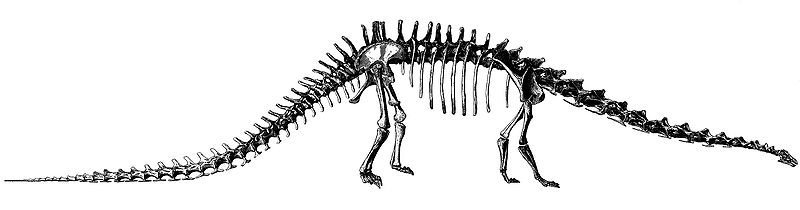
Dippy is, apparently, a common name for pet diplodocuses.  The statue of a diplodocus outside the Carnegie Museum in Pittsburgh is fondly known as “Dippy,” as is the fossilized remains of one such dinosaur from London’s Natural History Museum.  The London Dippy is on tour, or at least has been.  I learned about the fact that Dippy was in Norwich Cathedral just a day or so after the exhibit closed (I wouldn’t have been able to make it in any case; I mean I haven’t been able to get to the Pittsburgh Dippy and I live in the same state).  There are still plenty of photos on the cathedral’s website.  It’s a striking juxtaposition.  A massive stone building constructed to a medieval conception of God and one of the best examples of evolution, far older than the church on several orders of magnitude, peacefully coexisting.

John Bell Hatcher, public domain, via Wikimedia Commons

American evangelicalism has a much harder time accepting science.  I’ve been writing about change recently.  One of the changes in western thinking has been to move from the “I told you so” of clerics to the “I can show you evidence” of scientists.  Those who like others to tell them what to think have a difficult time letting go of medieval notions of the world—that it’s flat, and young, and about to end, as if God has a very limited imagination.  We now know that the world has been here far longer than one interpretation of the Bible posits, but that doesn’t make it any easier to have a conversation about it.  Many religions want to claim knowledge that can’t be questioned.  And yet, dinosaurs and cathedrals seem to mix well.

The assumption that those who think differently are evil, or are inspired by evil, is one of the most insidious children of monotheism.  With one God comes the idea of only one way to understand that deity and all other interpretations come from that divinity’s arch-enemy.  It’s a view of the world that struggles with change.  Historians, even those of us who focus on the history of religions, tend to take a long view. It’s possible to trace the development of ideas that have lead to the strange juxtapositions of our modern world.  Apologists so convinced of their interpretation of Genesis that they think the Bible wouldn’t have found dinosaurs worth remarking about, for example, and then cramming them on the ark.  Others, it seems, welcome dinosaurs into cathedrals.  Which is a better way to be humble before God?


Holiday Season

Halloween, in some ways, is the unofficial kick-off of the holiday season.  This was made clear to me when someone recently played the song “Soul Cake” in the context of Halloween.  I’d only ever heard the song in a Christmas context before, and a little research led to the discovery that asking for soul cakes originated as a Halloween custom (before it was called Halloween, even) but was considered appropriate anywhere from All Hallows through the twelve days of Christmas.  The common thread here is, of course, gift giving.  We tend to keep our holidays discrete for commercial reasons but there is a natural continuity from All Hallows Eve through what used to be known as Epiphany (now Insurrection Day).

Holidays help us prepare for things that we know are coming.  For the Celts, Samhain—which led to our Halloween—was the start of winter.  With no Daylight Saving Time to oppress them with the changing of their clocks and throwing everything off for weeks at a time, this was the dark part of the year.  Holidays are helpful in getting through times when natural light is lacking.  From Halloween you can almost see Thanksgiving.  At Thanksgiving we anticipate Christmas.  The winter solstice holidays see us through the shortest, darkest days of the year.  I’m no fan of capitalism, but as long as we’re stuck with it I wonder why we don’t advocate for Halloween as an official holiday.  The start of the holiday season.  In my local town the Christmas lights went up on November 1.

East and south Asian religions spend considerable energy teaching that change is the only permanent aspect of life.  Western cultures, on the other hand, focus on the status quo, the assumption that once something is established, it will, or should, remain as it is.  Time reminds us that change is constant.  We can allow entropy to win by sitting by and letting things fall apart, or we can try to build something useful to prevent a collapse.  Holidays change over time and over religions.  Halloween was a pre-Christian new year celebration.  From there it changed into a solemn holy day to remember saints and then the dead.  Incorporating aspects of Samhain and some customs such as soul cake begging and guising, it grew to a more fun celebration.  Now it’s a commercial occasion to rival Christmas.  The year is constantly changing.  Just when I start looking for my sweaters I see my light summer clothes haven’t yet been put away.  I look forward to Halloween as the start of the holiday season until we get past the longest night just before Yule.


Spirit of Halloween

So it’s Halloween.  It’s also Sunday.  I’ve been thinking quite a lot about the spirituality of this particular day.  Now it’s often treated as a trick, a consumerist holiday with too much candy and befitting spooky decorations.  Like all holidays Halloween has evolved from its origins to how we celebrate it today.  Other than Wiccans and Neo-pagans, however, not too many take it seriously.  At Nashotah House, and therefore likely at some parishes scattered around the world, All Saints Day—which is tomorrow—was a day of obligation.  What we call Halloween was the day before this major festival of praising the faithful.  There is some evidence that All Saints was moved to November 1 to counter the lively celebration of Samhain, or the Celtic fire festival marking the onset of winter.

The Celts included an intellectual class known as Druids.  Druids seem to have been the “theologians” (oh, that word!) of the Celts and they mandated that their teachings not be written down.  A great deal of information was passed on by intensive memorization and only became known to us outsiders because after Christianization it began to be written down.  Their idea of the afterlife seems to have been that it was being born into the other world.  In the otherworld life was different and apparently in some respects better.  When our time there drew to a close, our death led to our birth into this world.  The cycle continued on and on.  Samhain was the time when crossing between worlds could occur.  Death wasn’t a cause for sorrow since the otherworld awaited.  Birth into this world was more problematic.

Fear of death seems natural enough to us.  Even though it’s inevitable and this world’s graveyards are full, somehow we seem to think we can avoid it ourselves.  Our evolved survival instinct runs out of control since we’ve eliminated many of the causes of death that have plagued our species (and many other species) for millennia.  Eons.  As we’ve done so we’ve distanced ourselves from death—dying in hospitals, our corpses prepared in funeral homes, buried and eventually forgotten.  To me, the Celtic idea, from a world where death was likely much more close to hand, seems a more healthy outlook.  Instead of fear, why not consider it a day of wonder and celebration?  To many, I know, that is a spooky thought indeed.  It’s more than a day of masks and candy, however.  And we might learn from it if we stop and ponder.


Documenting Horror

Watching documentaries always seems to raise questions.  I recently found A History of Horror with Mark Gatiss on YouTube.  Produced by the BBC in 2010, the set of three episodes is a selective walk through the horror genre through the eyes of an insider in the film industry.  Divided over three segments, he covers early horror (primarily Frankenstein-related movies), British horror, and the American horror revival beginning in the late 1960s.  It occurred to me while watching this that horror is often—but not always—an intellectual genre.  Many of the plots and ideas are sophisticated and puzzling.  At one point Gatiss says it is nearly the perfect genre for movies.  I would tend to agree.  Many of the payoffs of horror are the reasons I go to see a movie.

Of course, documentaries involve interviews.  While discussing religion and horror—the two are closely related—in the third segment, he considers the impact of what I termed the “unholy trinity” in Holy Horror: Rosemary’s Baby, The Exorcist, and The Omen.  His primary interview for this set was with David Seltzer, the screenwriter for the last of these.  At this point my memory took me back to an interview on one of the extras for my DVD edition of The Omen.  In that interview Seltzer mentions that the antichrist is at that moment (clearly this was shot shortly after the movie came out) walking the earth.  In my mind I compartmentalized this to interpret his stance as that of a religious conservative.  The idea of the Antichrist, after all, is post-biblical, at least in the sense that end-time scenarios are developed.

The Gatiss interview was filmed many years later and he asked Seltzer if he believed in the Devil.  “No,” Seltzer laughed, stating that if he did he wouldn’t work on movies like The Omen.  People’s opinions change over time, of course.  And the Devil and the Antichrist are two separate characters as they develop after the Bible was completed.  Still, I had to wonder if his earlier interview included that comment about the Antichrist being alive now wasn’t intended as a bit of spooky propaganda for the movie.  It’s difficult to know what someone really believes.  Most people mouth what their ministers say, not really considering where said clergy get their information.  For these many years I’ve been thinking that The Omen was considered as some kind of documentary by the screenwriter.  Documentaries always seem to raise questions.


Podcast Live

Have you ever had one of those weeks where you forgot what day it was?  (Come on, now, it’s a pandemic—you can admit it!)  I spent yesterday unaware that it was Tuesday.  Tuesday is important because I knew that The Incarcerated Christian was going to be posting my interview on Holy Horror on their podcast.  It’s live now—give a listen!  I’ve been toying with rebooting my own podcasts, but like most other things in life I just can’t find the time to do it.  I still enjoy talking about my ideas and I thank Robin Mitchell Stroud and Debra Levy Martinelli for allowing me to yak their ears off for an hour.  There are many interesting podcasts on their site, so it you decide to listen the interview be sure to hang around a while and explore.

My hosts understand that Holy Horror was written for general readers, if not priced for them.  Being asked questions keeps you sharp, and sometimes it feels like my blade has been dulled from sitting in the drawer too long.  At the risk of sounding too biblical, iron sharpen iron, right?  Conversation is increasingly important in a polarized world where minds are already made up and the preferred solution is to hate others based on differences of opinion.  Why not talk about things?  Interviews also keep me sharp in asking about things I wrote years ago.  It may not seem like it, but the main body of Holy Horror was finished nearly five years ago.  Books take a long time to write and then a long time to publish.  It’s good to be asked about what one has written.

The questions asked on this interview were well thought out and reflective.  I can only hope that my responses were the same.  If you decide to listen and like what you hear, please share it with others.  The interview actually spilled over into a part two that will be posted in a couple weeks.  There’s a lot to say about religion and horror.  I’ve continued to watch movies since the interview and I notice further affirmations.  The Wicker Tree, for example, is a very biblical movie.  Or at least it quotes from the Bible quite a bit.  Holy Horror was very much an experiment on my part to find out if there was any room for a book like this.  After I wrote it I found others shared some interest in these topics, and two people cared enough to schedule an interview about it.  Please give it a listen.


B Film

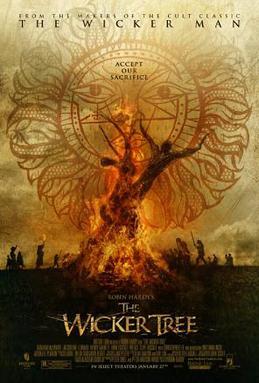
October brings horror films to mind.  As soon as the calendar clicks over, discussions of favorite scary movies begins.  As I’ve mentioned many times before, it is the one time of year when those of us who watch horror don’t feel so odd.  It is a little strange, however, to be watching movies related to The Wicker Man at this time of year.  As holiday horror that particular movie is set at the other end of the year, in May.  So I had to see The Wicker Tree, something I’ve avoided doing all these years.  Neither properly a sequel nor a remake, The Wicker Tree is Robin Hardy’s re-envisioning of the story with a larger budget.  There’s no way to prove it, but it seems likely that it was released in response to the unfortunate remake of The Wicker Man in 2006.

There are any number of things that could be said about The Wicker Tree, not least of which is that it’s clear Anthony Shaffer was a far better screenwriter than Robin Hardy.  (Shaffer had written a sequel, more properly conceived, which has not been filmed.)  Robin Hardy was, of course, the director of the original movie.  Plagued by low budget, rushed filming, and lack of production company support, The Wicker Man nevertheless soared.  The Wicker Tree is what is termed a “spiritual successor”—it doesn’t directly carry on the story of the original, but draws its inspiration from it.  It was based on a novel written by Hardy titled Cowboys for Christ.  Two evangelical missionaries are sent to Scotland to convert as many lapsed Christians as they can.  Of course, their invitation to Tressock is a trap so they can be sacrificed on May Day.

Despite the many unanswered questions the film leaves, to someone raised evangelical it seems that Robin Hardy really doesn’t understand what evangelicals are.  Beth and Steve, on their tour through the lowlands, do things evangelicals just wouldn’t do.  They drink, they dance, they swear, they play cards.  The only thing he seemed to get about evangelicals is they like to sing and talk about Jesus and hand out pamphlets.  This is something I often see is movies—those who try to portray evangelicals haven’t actually been evangelical themselves and don’t understand them.  I also find this in my interactions with British colleagues all the time—they don’t really comprehend what evangelicalism is.  That could be a topic for its own post.  In any case, The Wicker Tree has its moments, but it’s convoluted, cynical, and off-the-mark.  It may’ve been intended as a spiritual successor, but its prototype required no re-envisioning.


Banning Banning

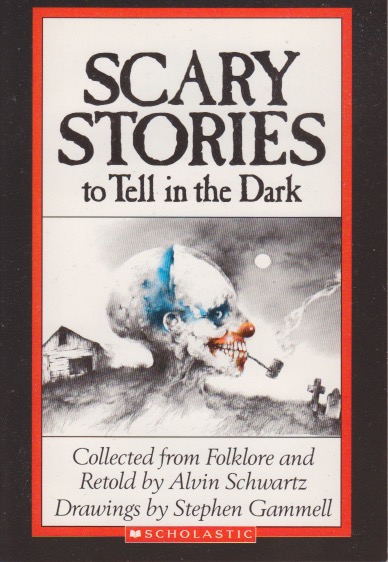
Banned Book Week gets me all aflutter.  There have been years at I’m so busy that it slips by before I notice it, but each year I try to incorporate it somehow into my reading challenges.  This year my book was Scary Stories to Tell in the Dark, by Alvin Schwartz and Stephen Gammell.  Yes, it’s a young readers’ book.  Most banned and challenged books are.  Why censorious adults feel the need to keep ideas out of print is pretty obvious in these Trumpian times.  (Please note, dear Republicans, many Democrats criticize Biden on a regular basis; we do not worship him.  American Marxist my donkey!)  Book censoring only serves fascist tendencies.  Ideas will find a way to be born, regardless.

Scary Stories, of course received a shot in the arm by Guillermo del Toro and his interest in making a movie based on it.  The stories themselves are drawn from folklore—they’re populist, you might say—and reflect what passes around from perhaps less insane times.  As an adult a reader tends not to find these stories frightening.  For one thing, many of them are stories we’ve heard before.  For another, life has already thrown many scary things at us.  Not only that, but we try to ban books to make adulthood even scarier.  You see, folklore doesn’t go away just because children are kept from the books.  These stories find the gaps just as water does.  They get told in the dark.  Instead of trying to censor them we should try to talk about them.

Adults’ own discomfort with ideas such as death and decay often stand behind our efforts to “protect” our children.  Then they reach maturity not prepared for the adult world of sex, exploitation, and dying.  Our modern comfort-based lifestyle tries to shut away the unpleasant aspects of existence.  Books, however, are the food of the imagination.  To ban them is to try to suppress the truths that authors have uncovered.  Growing up in a conservative household, we weren’t subjected to censorship.  I couldn’t afford many books, but my mother never said “No, you can’t read that.”  Some of my early reading faced uncomfortable facts.  I read both Jaws and The Godfather long before I ever saw the movies.  I read Scary Stories to Tell in the Dark as a form of solidarity with young minds.  There are benefits to learning to deal with fear early on in life.  And Scary Stories, even if not so frightening, has an appropriate place in it.


Psychology of Religion

It’s so human.  Mistaking form for substance, I mean.  A recent piece in Wired that my wife pointed out to me is titled “Psychologists Are Learning What Religion Has Known for Years,” by David DeSteno.  As the title intimates, religion benefits individuals in many ways.  Church attendance, however, has been declining for a long time.  While not the point of the article, I do wonder how much of it is because mainstream churches are stuck in a form that no longer works and people aren’t finding the substance there.  The basic church service is premised on a specific religious outlook that no longer seems to fit how the world works.  Potential ministers go to seminary where age-old ideas are tiredly replicated, based on an incipient literalism that simply doesn’t match what people see in the world.

Wired?

I’ve experienced this myself.  Depending on who the minister is, a church can go from dynamic to dull several times in the course of a member’s life.  People still crave the substance, even if the form stops working.  The form, however, is seminary approved and seminaries are accredited by the Association of Theological Schools.  The folks are academics and academics are well aware of the developments that suggest the form doesn’t work.  Speaking as a former seminary professor, sermons just don’t do the trick when you’ve done your own homework.  As DeSteno points out, once you remove the theology science and religion tend to find themselves in agreement with one another.  For years I’ve been suggesting that secular seminaries are needed.  Churches that aren’t bound by form or doctrine.  Instead we swim in a sea of retrenched evangelicalism.

Religion is an effective survival technique.  It evolved, even while denying it did so.  Some time after the Reformation a resurgent literalism led Catholicism to modernize, removing the mystery that was perhaps the last tenuous grasp that form had to provide substance.  Religion, beleaguered as it is, still has substance to offer.  DeSteno’s article is adapted from his new book How God Works.  I haven’t read it yet, but from the summary I can see that I should.  There are religious groups that attempt what this article suggests.  From my experience, however, I see they easily get sucked into mistaking the form they settle on for the substance of what they do.  I had recently been toying with the idea of attending seminary again.  I found, however, form after form.  What I need is substance.


Before Current Parameters

I recently had cause, for a work project, to survey which Episcopal seminaries are still around.  You see, I began my teaching career at Nashotah House.  (There were few teaching jobs in the early nineties, although we’d been promised a glut in the late eighties when I set out on that career track.)  In any case, I remembered marveling that the Episcopal Church had eleven seminaries.  For perspective, one of the largest Protestant denominations, the Methodists, only had thirteen.  Enrollments were high in those days.  Before the rise of the Nones, seminary teaching was a viable, if perhaps staid, option for a career.  Or in the case of some of us, it would be a holding pattern until something more suitable came along.  (I’ve always thought of myself as a small college professor.)

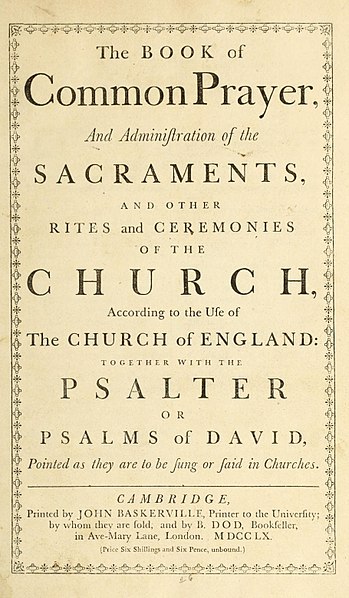
So the list of Episcopal seminaries is now down to ten, but those ten are much diminished from what they were back in the nineties.  Seabury, the nearest competitor to the south of Nashotah, has merged with Bexley Hall to make a very small federation.  Berkeley at Yale is a Jonah in the whale.  Episcopal Divinity School had to vacate campus and merge with Union in New York, leaving the tradition Episcopal stronghold of Boston.  The others seem to be clinging on.  In the midst of all this I learned that the Anglican Church in North America, a conservative break-away denomination, has reissued the Book of Common Prayer.  The BCP, as it’s fondly known, has a long and venerable history.  The 1979 edition has both a more conservative and a more modern liturgy, but even that doesn’t seem to be enough to prevent fracturing.

Photo credit: Church of England, via Wikimedia Commons

Fracturing.  Estimates for the number of denominations in North America set the figure at about 40,000.  No wonder Nones are among the fastest growing category!  If you’re going to place your eternal salvation on a bet, and there are that many options to choose from, the odds seem awfully long.  In some cases it’s a matter of being in the right state, or city, where the “one true church” exists.  If you miss it by thirty miles you could end up in Hell.  And all this with shrinking numbers.  The landscape has changed since I entered the seminary world.  Even as the numbers go down the fragmentation increases.  From a bird’s eye view this looks pretty odd.  Even if you look to the Prayer Book for solace you have to ask which one.  I just make the sign of the cross and move on.


All About Merch

Although I’d heard of it uncomprehendingly when I was in seminary, I first joined the Society of Biblical Literature in 1991, while a doctoral student.  I religiously *ahem* attended the annual meetings until I lost my job and my ability to afford it.  When I landed in publishing I started attending again, and over all these years I’ve started to notice a lot of swag creeping in.  Publishers sell bauble headed theologians (aren’t they all?), playful knick-knacks, and even socks bearing the cover design of established commentary series.  It’s as if we want to tell the world that studying the Bible is cool.  (Why not purchase some nice warm socks?)  So I wasn’t really surprised when the society itself, fondly known as SBL, started selling its own merch.

On most SBL electronic newsletters there’s a link to the vendor that produces shirts and mugs with jokes that only other biblical scholars will get.  (I never found this a very humor-laden community, being under duress, as it is, and as deeply conflicted as the country that hosts it.)  Eventually I grew curious and clicked on the link to the novelty tee-shirts and mugs.  It took me to a company called Redbubble.  SBL Press has its own page there with a strange header photo, apparently of a G. I. Joe and G. I. Jane reading some of SBL’s books.  Weird marketing is fine, of course.  Some of us have almost a connoisseur sensitivity to the bizarre.  As for the merch itself, it includes limited designs since, I suspect, most professors aren’t novelty tee-shirt fans.  What caught my attention was the button at the bottom that said “Mature content: hidden.”

Did the Society have some top shelf items?  The Bible certainly has quite a bit of mature content itself.  Questionable stuff as well as scenes that are, well, let’s just say scenes that are left out of children’s Bibles.  Of course I clicked the link.  It took me off the SBL Press page, naturally.  Redbubble has, I’m sure, many clients.  SBL’s demographics are slowly changing but the field is one still dominated, in numbers at least, by white men.  They’re the ones who benefit the most, I suspect, from a society that bases itself on the biblical outlook of the world.  At least as far as how it’s been applied in northern Europe and its colonial enterprises.  SBL tries to attract younger scholars, of course.  And everyone like knick-knacks and inside jokes. 


Screaming Season

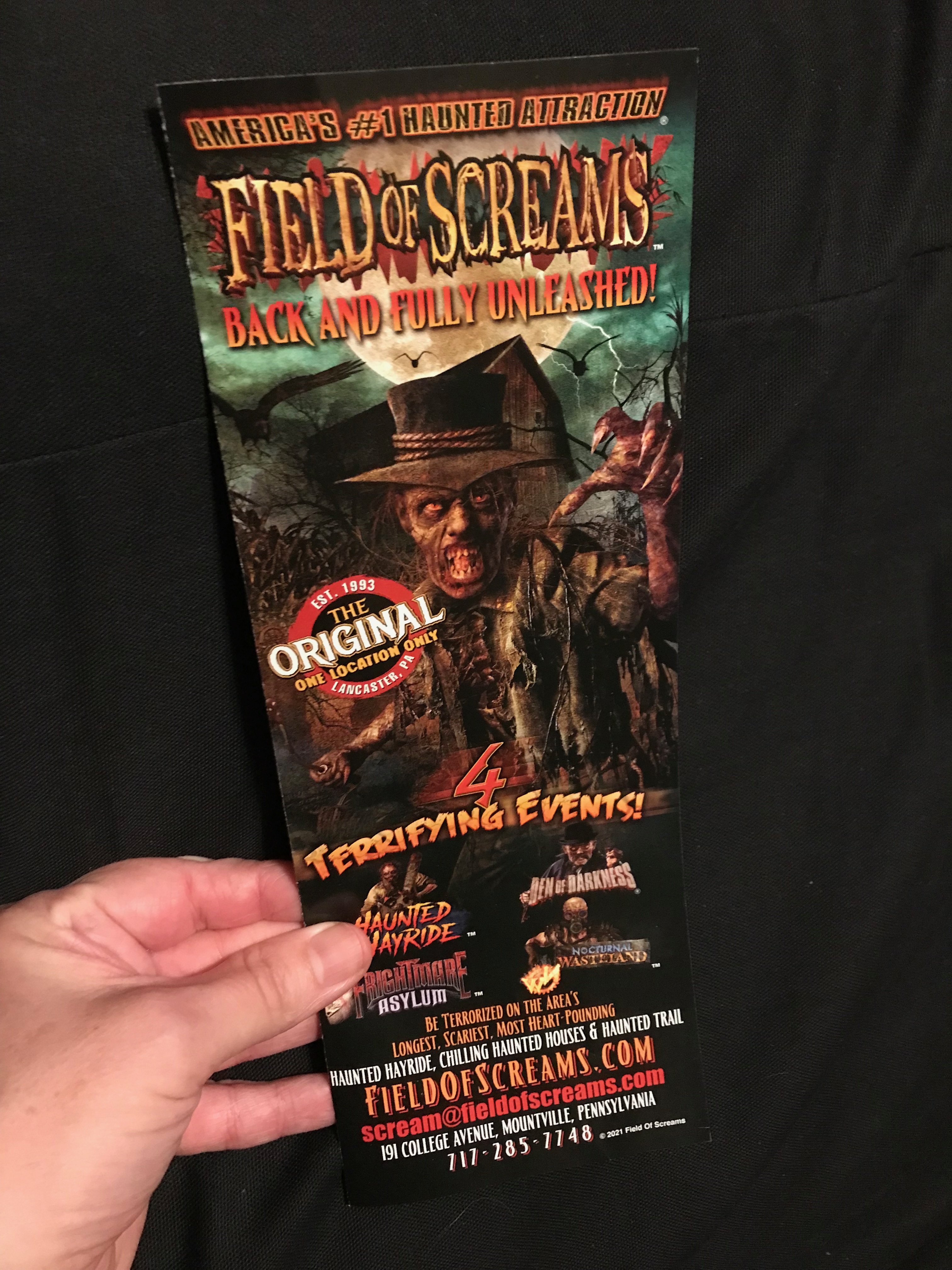
The signs are all around.  The orange and black Spirit Halloween signs are appearing where vacant storefronts stand.  Advertisements for autumnal activities are cropping up.  Brochures broadcasting local haunted festivities now adorn store counters, free for the taking.  I picked up a leaflet for the local Field of Screams the other day although I really don’t like to be in scary situations.  I do appreciate the spooky sense that they generate, however.  This local event runs from early September through early November—the two months enterprising farmers can draw urbanites to their land, cash in hand.  Halloween has been a major money-maker for many years now.  The less doleful minded wonder why, but I think that lots of us are really afraid.  Halloween says it’s okay to be so.

Perhaps it’s the realization that it’s all in good fun and nobody will really hurt you.  I’ve attended a few of these haunted events over the years, but it was more fun to participate in them.  Perhaps it goes back to Nashotah House.  I’m guessing that most of you’ve never been.  Nashotah is a gothic campus, at one time pretty isolated, out in the woods.  Halloween was, once upon a time, a real celebration there.  Our maintenance crew would offer a hayride through farm fields owned by the school, then through the cemetery on campus.  I used to dress in a grim reaper costume and carry a kerosene lamp through the graveyard, awaiting the tractor.  Nobody instructed me to do it, but we all knew it was in good fun.  And I wasn’t the only volunteer who’d pop out from behind headstones.  Students got into the spirit of it too.

These days remembering such shenanigans is more appealing than actually going out at night to have other people scare me.  The last time I went to a haunted maze it was really too unnerving for me to enjoy.  I volunteered instead for a local haunted house in New Jersey.  The run up to Halloween was usually an intensely creative time of designing and fabricating homemade costumes, and thinking of ways to make pumpkins look scary.  Now it’s become a season in its own right.  An important segment of the economy.  I won’t be going to our local Field of Screams, but I will understand those who do.  Changes are in the air.  It’s dark quite a bit earlier these days.  The air is chilly in the morning.  And the local fear fields open this weekend.