Finding Fakes

The Museum of the Bible has been a source of controversy since well before it even opened.  Many people don’t understand what biblical scholars actually do, and this leads to misunderstandings and not infrequent accusations.  Turning no basic critical thinking skills toward a museum intended to champion certain social causes (claimed to be “biblical”), those who support it can’t understand why a “biblical” scholar would object.  What do biblical scholars do all day, anyway?  We’ll come back to that in a moment.  The reason I’m writing about the Museum of the Bible in the middle of a pandemic is an article on National Geographic’s website, “‘Dead Sea Scrolls’ at the Museum of the Bible are all forgeries,” by Michael Greshko.  The Dead Sea Scrolls have captured the public imagination for decades now.  Having seen the collection at the Shrine of the Book in Jerusalem, I know it can be an awe-inducing experience.  One thing biblical scholars do is ask questions.

Artifacts are becoming increasingly easy to fake.  Some biblical scholars were fooled by these fake Dead Sea Scroll fragments.  Now, my own specialization was Ugaritic.  Ugaritic is a cuneiform language with clay tablets as the substrate.  One of the things that you learn from looking at a specialized body of material closely and for a long time is how they were written.  Some of the Ugaritic tablets have writing along the edges, like marginal scrawls.  Some are written with large characters in a clumsy hand, while others are clearly done by a professional.  With some practice you can learn to recognize handwriting even in cuneiform.  The Dead Sea Scrolls, mostly written on vellum or leather, are similar: specialists know just how they were written and close examination can reveal if they were made in antiquity or simply made to look antique.

Biblical scholars often get accused of taking the life out of things.  Would it be better to believe in something that is exposed as a fake?  Not exactly debunkers, scholars are those who ask pointed questions of unstated assumptions.  If some antiquities dealer claims to have access to material kept out of official hands, and is willing to charge you a lot for it, it’s best to call in the skeptics.  It works the same in most fields that keep our society going.  We need to trust those who’ve studied a subject in depth for many years.  Devoted their lives to it, in fact.  Many museum items around the world are forgeries and fakes.  It’s not too often, though, that someone specializing in really old stuff gets called in to make an evaluation.  There’s a risk involved—the risk of learning the truth.


Green Dilemma

It’s a dilemma.  I face it every year.  I don’t have green to wear and it’s St. Patrick’s Day.  For your average run-of-the-mill citizen, this might not be an issue—but I do have an Irish heritage (in part), and so it’s a heartfelt concern.  The reason I don’t have green has less to do with fashion (consider the source!) than with my clothing purchasing practices.  First of all, I like to make my clothes last.  Fabrics can be quite durable.  They aren’t mechanical and therefore don’t break down often.  I don’t live a rough-and-tumble life, so tears aren’t really a problem.  The end result is that I keep my clothes as long as they’re functional.  When they begin to wear out I go to the store and examine the clearance racks until I find something in my size.  That means color selection is often a matter of very limited options.

Once in a great while I have landed something green.  I still remember a green shirt I had in college.  It served me well for more than four St. Patrick’s Days.  It long ago succumbed to overuse, however, because I wore it on other days as well.  And let’s face it, when I make one of those infrequent trips to the clothiers’ shops, this particular holiday’s not on my mind.  Unless, of course, I go shopping in March.  Back when I lived in Boston it was easy to get your Irish on.  I bought a bright green silky (I don’t know if it was real silk) tie with white shamrocks on it.  It was probably down at Faneuil Hall.  It had been a bit outlandish to wear to work in New York City, though.  Indeed, at work staid dress was by far the most common code.  Consequently it hung unused in my closet for years.

When we moved a couple summers back, I noticed my green tie had faded to bronze.  I thought it went the other way around.  In any case, my last truly green clothing article was no longer green.  Yes, it still has shamrocks, but I’d feel even more ridiculous trying to rock a bronze tie and pass myself off as Irish.  It won’t even pass for gold.  Of course, I work from home.  I’ve practiced social distancing long before it was a trend or a government mandate, whichever it is.  The only people to see my lack of green would be my wife and daughter, and perhaps a Jehovah’s Witnesses that might stop by.  But still, even minor celebrations are anticipated at times such as this.  Although I won’t be going out today I’ll probably be spending some time in my closet and reflecting on the true heritage of my Irish forebears.

Perhaps St. Pat shops like I do?


Virtual Church

All the way back in seminary my friends and I used to joke about virtual church.  What made it so funny was that the idea seemed ridiculous.  The very raison d’être for church (which essentially means “gathering”) was, well, gathering.  We joshed about putting a communion card into an ATM and getting bread and wine.  Little did we know we’d live to see virtual church become a reality.  While I prefer not to tip my hand as to my affiliation (I began doing this when teaching at secular schools, for if a professor of religion is being academic about their specialization their affiliation should have no bearing on the class) I confess I am the member of a religious community.  That community has become virtual, as of today.

This isn’t a permanent thing.  Unless coronavirus is a permanent thing.  As I spoke with my clergy person about it, I wondered how many people would attend virtual services.  Sermons would need to be stellar.  Who would hear if I tried to sing hymns (this is not a pretty thing, take my word for it)?  My laptop doesn’t even have a disc slot into which I could insert my offering.  Churches, synagogues, mosques—they’re about community.  What does community feel like when you’re sitting there in your pajamas, at least on the part that the webcam doesn’t pick up?  Does the minister see you in virtual church?  Have I, like number 6, been reduced to a numeral?  I suspect the current crisis is going to be a real test for faith communities.  Meeting together would make us all feel like snake-handlers now.

The funny thing was, back in seminary it was a joke.  At Boston University School of Theology in the late 1980s we knew that churches weren’t really growing.  Some megas had started and we now see them following the mushroom cloud to its dissipation stage.  As little as we meant it, we could see devices creeping into the mix.  I did not use a computer until after seminary.  Funnily enough, thinking back to the pre-1990s, we survived without cell phones.  If you were going to church you were going. To. Church.  These days of pandemic in the pews will be a real test of the preacher’s power.  For Episcopalians the mediating of grace had to be done in person.  I remember watching worriedly as the priest, clearly with a sniffle, was the first one to take a sip from the community chalice before holding it out for others to drink.  We wondered about efficacy of ATMs dispensing consecrated hosts.  It was only a joke, then; really it was.


Die Besuch

It was both sweet and perhaps misguided.  I’ve not written much about the coronavirus because I’ve really had nothing to say on the pandemic.  Also I’m squeamish.  Being a remote worker I spend most of my time alone anyway.  So when the knock came to my door, I wasn’t sure I should answer.  Afraid that some vital bit of information was to be conveyed, I gave in.  Two young ladies stood there and at first I thought they were selling Girl Scout cookies, but one of them had some copies of The Watchtower in a folder and I knew that the Jehovah’s Witnesses had come calling.  I didn’t invite them in.  I don’t mean to be inhospitable, but those who go around knocking on doors might have been exposed to who knows what.  They were here, the older one said, to give good news.

Although she didn’t mention the coronavirus directly, she said people were feeling anxious.  But God—our creator—had promised everything would work out.  She read me Revelation 21.4, about God wiping every tear from our eyes, from an iPad.  I’ve read that verse many times on my own, and, tainted with decades of specialist knowledge, knew a good deal about the context in which it was written.  The Witnesses didn’t stay long.  As they walked away I couldn’t help but think how this current scare has been affecting us all.  We are afraid.  I don’t need any advice when it comes to social distancing (I am an introvert, after all), but there’s a kind of hopelessness afoot.  I don’t read the papers but every headline is about the virus.  The world seems awfully quiet.

This will go down in history, I suspect, as a strange episode.  I feel guilty for conducting normal business, as if there is anything I could do to prevent the disease beyond isolating myself even further.  It’s perhaps the waiting.  Those of us in circumstances where joy is more fleeting than a visit from the Jehovah’s Witnesses often invest huge amounts of time waiting for things to get better.  The news, for example, that a piece has been accepted for publication.  Or that a long wished for promotion has come.  Or that somebody has actually read your book.  Such news is rare indeed and outside a disease rages out of control.  What else beyond missionary zeal would send you to strangers’ doors at such a time as this?  They didn’t even leave any tracts.


Merch

I recall the time I first heard the word “merch” used as a verb.  I was with some wonderful ladies on the second annual Women’s March, in New York City.  We had to leave fairly early to get there from Jersey and as we made our way to the march route, we saw the goods.  Vendors had all kinds of things on sale, from the ubiquitous tee-shirt to refrigerator magnets.  One of the women in the group said, “I guess you can merch anything.”  And so you can.  People will buy all kinds of identifying marks.  It’s a craze I personally don’t get into.  I buy plain clothes, having more of an Amish aesthetic.  Still, I was a little surprised to notice that the Society of Biblical Literature is now merching itself.

Now, who can blame a non-profit for trying to score a little on the side?  We all know what that’s like.  What I find myself most curious about is who would want to advertise that they’re working on a degree that will, in all likelihood, find them on the breadline when it’s all over?  I’ve known many who’re proud to be nerds—they’ve got employment to give them creds.  Those of us tormented by the meaning of it all, not so much.  My decision to go to grad school was accompanied by the blessed assurance that there’d be plenty of opportunities, but there was no merch.  Indeed, I was two years into my doctorate before  I even found out what the SBL was—the great connector whence came jobs.  At least in theory.  I found my post at Nashotah House because a friend told me about it.  I still have some of their merch.

Knowing what I do now, would I have done it any differently?  It’s difficult to say.  Who can recall the frame of mind of his younger self with such clarity as to know his choices?  Having studied Bible I was curious whence it came—to turn back even further the pages of history.  As I sit here in the early morning I have on my last two remaining pieces of Edinburgh merch.  My moth-eaten woolen divinity scarf and my blue alma mater sweatshirt.  I try hard not to think how close to three decades ago it was.  I was so sure I’d find a job with that rare Scottish degree, imprint of John Knox’s breeches still fresh upon my head.  Instead the merch of my current employer—a coffee mug—stands before me, reminding me that work alone awaits.


CBD

They found me.  I used to call them CBD, but because of the popularity of a certain hemp-based product, Christian Book Distributors changed its name.  Now I knew about them long before they had me on their mailing list when I taught at Nashotah House.  When I was a seminary student in Boston I made occasional trips to CBD’s Peabody warehouse for sales—this was quite a boon to students who never have enough money (little did I know!).  Books you’d heard about in class were there, for a fraction of the price.  At Nashotah I always looked over their bargain page, because, well, professors like books.  I recognized their catalogue in my mailbox instantly.  The name is now Christianbooks.com.  Grab some munchies and sit down.

Not only the name has changed.  Back in my student days I could find academic resources here.  As religion in America has become more and more polarized, what used to be CBD (if I use their current incarnation my computer insists on putting links in) has become radically conservative.  Page after page of study Bibles reveal no hint of the mainstream bestsellers in the genre.  It’s as if they don’t exist.  More than that, if you leave them out maybe people will come to believe they don’t exist.  Even the bargain books are nothing an erstwhile professor would buy.  Instead of academic titles there are all kinds of Barnes & Noble-type gimmicks to get shoppers to spend their money.  Like junk food for the soul.  I look at the books on my shelf.  Some of them were purchased, cash in hand on the ground in Peabody.  Not any more.

There will be those who claim (fake news is the only news now) that what has changed is me, not them.  The fact is places like CBD used to be more open minded.  They admitted the possibility of doubt.  Now your choices are Scofield or Ryrie.  That should be enough for any appetite.  Not only that, but many of the titles now sound militaristic.  Battlefields and all.  Thumbing through, I wonder where Jesus has gone.  The evangelicalism of my youth was clearly Prince of Peace centered.  Now it’s politicized to the point that I’m not sure what it represents beyond GOP values of greed, opportunism, and power.  Anyone who thinks differently need not apply.  How CBD found me after all these years, I do not know.  I wish they’d consider saving the environment rather than printing catalogues to send me.  The climate, despite what they would claim, has changed.


Speaking of X

The project that ultimately led to Holy Horror and Nightmares with the Bible was an article.  Intrigued that the quasi-horror Fox series Sleepy Hollow was so solidly based on the “iconic Bible” in its first season, I wrote an article on how the Bible functioned in it.  After that was published I realized that there was plenty of material for a book on how the Good Book appears in horror films.  That book, of course, appeared late in 2018.  Nightmares with the Bible was a kind of sequel, but moving in a different direction.  It looks specifically at how ideas about biblical monsters (demons) are mediated through horror films.  This post isn’t all an introspective about past projects; in fact, it’s about present watching.

At one point in my research I noted that the X-Files wasn’t as biblically based as Sleepy Hollow.  I stand by that assertion, but my wife and I’ve been rewatching the X-Files on weekends for several months now.  Nearing the end of season two I’ve noticed just how often the Bible appears in it.  Unlike Sleepy Hollow, where the entire story was premised on (largely) the book of Revelation, the X-Files has multiple episodes that focus on religion.  What we might call New Religious Movements feature in some of the vignettes while others posit older, hidden religions.  The Good Book appears visually many times, or, and it’s often quoted, even if not shown.  Although some of the episodes are lighthearted, many of them are played as straight horror and address the question of the reality of evil.  I hadn’t been alerted by Sleepy Hollow the first time we made our way through the X-Files, but if I had more time, and if anyone were still interested, there’s a book in this.

Ironically, even in the light of a political party that takes its energy from a religious base, universities are no longer interested in the study of the subject.  I have no reason to believe that these two television series are isolated instances that I’ve just stumbled across.  American culture is biblically based, no matter how secular it may be.  To my way of thinking, when something like the Good Book has such a strong influence, the response of the rational should be to try to understand it.  I know what biblical scholars do all day; I used to be one.  Only in recent years have some of them begun to turn toward the concept of the iconic Bible and to consider how it influences American thinking.  I can only do this on a small scale, in my free time.  What I see, however, like a good X-File, defies explanation.


Icelandic Gods

There’s a lot to like about Iceland.  It has geothermal heat.  The people are literate and proud of it.  They don’t have an army.  Viking heritage and northern lights—what an interesting place!  A friend recently sent me a satirical piece on Patheos titled “Iceland Declares All Religions Are Mental Disorders,” by Andrew Hall.  I may not be as naive as I once was, but I have to admit I was nearly taken in on the fly.  Maybe because the idea seems so much better than what we have over here in our warmer, but less educated world.  Clearly, however, religion is extremely important to people, and if it is a mental disorder it’s an essential one.  Hall mades the astute point that Iceland didn’t want to become like the United States.  Who would, at this point?

Although this is a satirical piece, like most satire it works because it has chunks of truth in it.  Countries run by religions do seem to get into quite a lot of trouble.  I often think this is primarily a monotheistic problem.  If a nation accepts many gods, then adding those of other peoples is hardly an issue.  With a single deity, however, there is a single truth.  Anyone different is, by default, wrong.  When entire nations self-identify with a religion, it is only too easy to begin seeing those who believe differently just across the border as a threat.  Faith becomes fight.  As if a deity who always claims to value peace is only satisfied when we’re killing those who don’t share our same peaceful outlook.  Irony and satire have met together, it seems.

I’ve never been to Iceland.  It’s on my bucket list.  As a rockhound, the volcanic nature of the place calls to me.  I do wonder, however, how a vegan might fare on a far northern island.  My times in Orkney are among my mental treasures.  Those northern Scottish isles were places of wonder.  Not the most options regarding comestibles, however.  What they lacked in food they made up for in magic.  Iceland, despite the satire’s bite, has a considerable population that believes in the little people.  Anyone who’s too quick to dismiss such things ought to spend some time in the far north.  Driving to the ancient sites of Orkney certainly shifted my perspective a bit.  There’s great value in listening to the wisdom of those relatively isolated from the rest of the world.  You might, however, have to bring your own beans.


In the Cult

The word “cult” has fallen out of favor with religionists.  The reason for this is the problematic claim that any one religion makes to being the “only true” religion.  If that religion then sets about to study other religions there is a built-in bias that the study is being done from the perspective of those who know the truth looking somewhat bemusedly toward other religions.  A cult was defined as a relatively new religion with a fairly small number of adherents.  The more correct term is a “New Religious Movement.”  The idea of brainwashing is controversial, but it is clear that people can be made to follow the leader against their better judgment.  We’ve seen this time and time again and not just in places like Jonestown or Waco.  The word “cult” seems to fit.

Branch Davidian compound in Waco; photo credit: FBI, courtesy Wikimedia Commons

A friend recently pointed me to the work of the psychologist Jeremy E. Sherman.  Sherman has been studying the behavior of Trump followers and has illustrated quite well how it is a cult.  This is one place where the use of the term becomes essential.  I’ll lay aside my objections to the word to point out that a cult denotes a group that follows a leader without critical assessment of that leader.  You’ll have noticed that Democrats are quite critical of one another.  They think about and assess what each other say and do.  When someone like Trump, who is well known as a Pez-dispenser of lies, becomes a saintly paragon of his party, capable of no wrong, we’re in the land of cults.  What Sherman does that I can’t, is suggest how to deal with such thinking.

Most of us try to reason with our interlocutors.  If reason is turned off, as in blind following, it simply falls on deaf ears.  The public record of Trump’s doings speaks for itself.  Those who refuse to see it or engage it will never be reasoned out of it.  The parallels with Hitler’s Germany are extremely frightening.  Not even a decade after his death Hitler was understood to have been clearly unstable and driven by evil impulses.  Many of those alive today overlapped with the lifetime of this dictator.  There’s no doubt that Nazism behaved like a classic cult.  Presented with credible evidence of breaking the law while within office, Trump’s followers blithely acquitted him.  Those who study cults would expect no less.  We need to arm ourselves with knowledge of how religious thinking works.  To do otherwise is dangerous, despite what our economically driven bastions of higher education may say.  (See?  I’m critical of those on my side!)  Or we can lay down reason and simply follow.


Stickiness

As a concept, it’s what web designers call “sticky.”  Valentine’s Day, I mean.  And “sticky” has nothing to do with the expected chocolates or anything physical at all.  Stickiness, as I hear it used in these antiseptic clean-room days, refers to text, or an object, that stays in the same place as you change web pages.  Now, I’m no techie, in fact I’m probably a neo-Luddite, but this kind of stickiness is useful in thinking about St. Valentine’s Day.  We hardly need a reminder that humans are sexual beings.  Biology does quite well in that department, thank you.  Every year around this time, however, when the weather has been bleak for weeks on end, Valentine’s Day rolls in to give us hope.  I’ve noticed this as I’ve been out jogging.  The past couple of weeks the birds have been singing.  Me, I’ve mostly been shivering indoors as yet more cold rain falls.

Every year, I suspect (I haven’t stopped to look) I write about St. Valentine’s Day.  Valentine was an obscure saint associated, in the popular mind, with something saints shunned.  Such an embarrassment is this sexy saint that he was never mentioned in the liturgy of February 14th at Nashotah House in the days I was there.  (Given that most of the student body was male, there may have been a wisdom in that, but that’s a story for another time.)  Religions, as I used to tell my students in later settings, all have something to say about sex.  The two ideas, like monsters and religion, are tied closely together.  Scholars tend to blush rather than explore this.

There are so many things going on in the world that I could write about.  There are new scholarly developments every day.  Still, I keep coming back to this minor holiday.  Well, it’s not actually minor in the realm of economics.  Anything to get people to spend money in the middle of February!  Valentine’s Day is the embarrassing child of the celibate church.  Without somebody named Valentine, who may or may not have been martyred,  we wouldn’t have this uneasy reminder of winter’s impending end.  Instead of embracing him, however, many branches of Christianity second him to punch-out cards sold to school kids as teachers remind them that everyone gets a valentine.  What a sticky concept!  I’d been intending to write something about the state of the world.  I guess that can wait for another day.  Right now, as the sun begins to awake, I’ll sit hear and listen for the birds to start their sticky springtime song.


Human HU

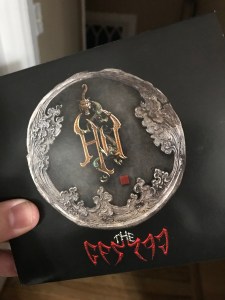
In these times of extreme xenophobia, we desperately need to understand those who are different.  When my brother recently shared his discovery of The HU’s album The Gereg, I was at first a little concerned.  That deep-seated childhood evangelicalism suggests anything that unfamiliar is bound to be satanic.  How unfamiliar?  Mongolian throat-singing unfamiliar.  Songs sung in Mongolian, unfamiliar.  Album art that could be heavy metal.  I’d never come across anything like it.  I suppose it’s a natural, knee-jerk reaction to say anything so unfamiliar is potentially demonic, and it shows just how paranoid a culture can be.  We think of 1950’s America as “the norm.”  I wasn’t alive then, but I’ve seen pictures.  Buzz cuts still give me the willies.  I trust Mongolians more.

I don’t know if The HU is a deliberate play on The Who or not, but the word roughly translates to “human.”  Like many ancient practices, nobody thought to write down the origins of throat singing.  Traditionally it was what Inuit women did when men were out on the hunt.  Like many aspects of hunter-gatherer society, it fascinates.  Some cultures reported that when Christian missionaries came, with their cultural imperialism in tow, they suppressed throat singing.  It looks like I wasn’t the only one raised to be suspicious of that which is different.  I learned, however, of my own cultural biases.  I learned that ones’ own assumptions must be interrogated.  If humanity is to survive, we must learn to try to understand one another.

Although the actual roots of throat singing are lost in unwritten times, I strongly suspect it has a religious, or if you prefer, spiritual, origin.  When women gather it isn’t the same as when men consolidate power and institutionalize violence.  I’ve read that when women rule there is a strong impulse to cooperate, to suppress aggression.  Men can learn this.  Indeed, as those white, male missionaries took up their positions in far-flung parts of the globe they spread the idea that men alone held the divine right of, if not kings, priests.  Conversion, you see, is seldom gentle.  Making the world in your own image, if you’re a man, runs into certain obvious problems right away.  HU means human.  When I feel the cold paranoia of my own government creeping up on me, I cue-up the soundtrack of my life.  I’m no longer a young man, and I don’t fear the different as much as I used to.  I need to hear something different, something human.


VFD

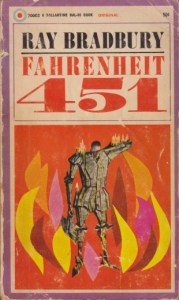
It’s been a few years since I read Fahrenheit 451, the classic novel by Ray Bradbury.  Like so many dystopias, it’s seen a resurgence of interest since 45 was elected.  (I can’t help but notice the shared digits.)  Bradbury was a writer of his time.  So much, I suppose, could be said of all of us who write—how can we be anything else?  Still, it’s difficult not to see that his fear was of television decimating reading.  And intelligence.  We’ve got the internet now, so the effect has been magnified a bit.  The tale, despited being dated, is poignant.  The more electronic we become the more of what used to be termed “real life” we miss.  At this reading it was clear that The Book of Eli was largely based on the last pages.

When Montag confesses to his wife that he’s been secreting books away, and she finds him insane for doing so, he takes the book in his hand to a former acquaintance, Faber.  It turns out that the book is the Bible, perhaps the last in existence (see what I mean?).  On the subway ride he tries to memorize the Good Book.  Now, I’ve been on the New York City subway, and I know the delays can be long, but there’s an error of scale here.  The Bible’s a big book.  Still, he gets pieces of it down.  Now, in the 1950s, when Fahrenheit 451 was published, the Bible was known for its liberating qualities rather than its darker side.  Also the atomic end of World War II was clearly still a painful living memory.  The two may not be unrelated.

Given the age of the story, I won’t worry about spoilers.  In case, however, it’s on your list proceed with caution.  The war that’s been building the entire story takes place the night of Montag’s escape.  Along with the intellectuals forced out of the cities, he becomes part of a human library.  Each person is, through a memory recovery technique, capable of recalling the books they’ve read.  Montag becomes, appropriately enough, Ecclesiastes.  Perhaps the least evangelical book in the Bible, along with Job (with which most evangelicals find themselves cheering on Job’s friends), Qohelet has long been one of my favorites.  It’s an honest book.  The same can be said for Bradbury’s novel.  Primarily a short story writer, Bradbury didn’t sustain the narrative to novel length very often.  But when he did he fashioned a book that, particularly now, needs to be read.


Religion, He Wrote

A friend recently sent me the New York Times obituary for Carol Serling, the wife of one of my heroes, Rod Serling.  Perhaps it’s a personal weakness, but I often wonder about the religion of my favorite writers.  More often than not I discover that they’re affiliated with tolerant faiths, sometimes unattached to any specific tradition.  Rod Serling grew up Jewish but became a Unitarian-Universalist by marriage, and—it doesn’t stretch the imagination—remained one by conviction.  I’ve read a bit about the UU tradition, and it is based primarily on values rather than beliefs.  In fact, the idea that religion is a matter of what you believe is only one way of defining it.  Historically one’s religion was a matter of what one did, not necessarily what she or he believed.

Authors that I read often deal with religious issues.  It’s important to confess that I don’t select fiction based on its having religious themes.  Anyone who’s read more than one or two of my posts will know my reading is eclectic and many of the books represented here have shown up because of wildly different circumstances.  Reading challenges, friends’ recommendations, and preparations for educational presentations are often driving forces.  In the fictional realm I’m drawn to the speculative, but also often to the catch-all category called “literary.”  Stories that feel authentic in either category have an element of religion in them.  Life portrayed without it doesn’t seem believable.  I’ve been re-reading some Ray Bradbury.  There’s often suggestive material there.

Raised a Baptist, Bradbury is often also claimed as a Unitarian-Universalist.  Apparently he didn’t like the label, but his behavior was more a selection of tenets that he found compelling from various religions.  All of this may sound strange in a context where “religion” is increasingly a dirty word.  (To be honest, it has been doing much to earn such a reputation.)  Still, it is a very deep part of being human.  Rod Serling’s stories advocated fair treatment of all people and often his sense of justice landed him in trouble with advertisers for The Twilight Zone.  Religions comfortable with maintaining prejudice, or turning a blind eye to lawbreaking in the name of false virtue would certainly not understand refusing to take money from questionable sources.  I suppose there’s a reason I enjoy the stories from the days when America still had a conscience.  The legacies of such writers, it is to be hoped, will outlast what passes for religion these days. 

Any other gods before me…


Fueling Fires

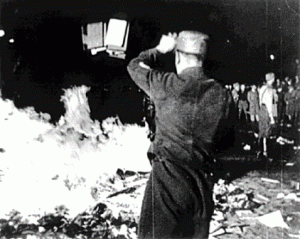
Paying attention to world affairs can take all your time.  In fact, for those who study foreign affairs, it practically does.  I’ve been struggling with the fact that you can’t be lazy in a democracy.  I know that’s true—we must constantly be vigilant of governments turning evil (with a wink)—and yet we each have our own lives to look after.  Trying to balance this teeter-totter, I noticed a Washington Post story lately about library officials in China burning books.  Said books challenge government ideology and are being destroyed.  We’ve seen this before.  Nazis burned books, and Republicans would certainly like to.  Even further back in history Medieval thinking led to the destruction of what would now likely be invaluable tomes.  There is biblical precedent, of course.  Read Acts 19 if you need a refresher.

Book burners now do their deed for its symbolic value.  We live in an age of Kindles and Nooks and books online.  Not as many are printed as there used to be, but the smell of burning plastic doesn’t convey the same pathos.  Besides, you can just whip out your synced phone and continue  reading.  Those of us who’ve committed our lives to reading find this symbolic gesture heinous.  Yes, there are books that offend us.  I’ve read more than one that I wish I hadn’t.  I have, however, no inkling to burn them.  Books represent our attempts to increase knowledge.  Fiction or non matters not.  Those who write have something to say, and surveys reveal that many adults really would like to write a book.  As a symbol, there’s nothing like it.  I suspect that’s why burning them makes such an impact.

The western world is struggling to understand China.  One of the largest investors in both Africa and South America, China is building foreign relations just as the Trump administration is jettisoning them.  Many well-informed Americans don’t realize just how long and how well China has been making connections through financial investment.  Sounds like a very capitalist thing to do.  That librarians should burn books seems an odd form of theater in such a scenario.  Governments that can’t take criticism are autocracies.  I know few donkeys that would state any one of their party is really a saint.  That’s GOP territory.  At least we haven’t started book burnings on the White House lawn.  As we turn our gaze to the east, or, depending on your perspective, to the west, we do have to wonder just how long it will be before we do.


Space Farce

Okay, so “Space Force” sounds like a gimmick that you’d see in a 1950’s ad geared to dungaree-wearing boys.  These boys, who’d be named “Dick” would show the girls, named “Jane,” just how it was done.  So as I read about the furor of dedicating a King James Bible from the Bible Museum as the official Bible for military branches aimed at the stars, I had to think how very small we actually are.  So 45 thinks, like Reagan thought, that we need outer-space defenses.  These guys need to read more science fiction.  Actually, some plain old science would help.  If there are most advanced civilizations out there—and such seems increasingly likely, given that our understanding of science is subject to change—we are nothing more than cosmic mosquitoes buzzing close to our own planet where we can wail on each other in the name of lucre.  And we call it “Space Force.”

An article on NPR points out the hypocrisy of swearing in the military on a Bible.  One guy in there, I’ve heard tell, was called “the prince of peace.”  He’s somewhere near the back.  The public loves a good warmonger, though.  We can send our tentative rockets into orbit where bug-eyed aliens laugh with bemusement, and say “Just you try something.”  Or we can make business deals with Russia with one hand while pointing our missiles in their direction with the other.  Is that a missile or am I misreading something, Dick?  I can’t ask Jane, because she just follows along.  Maybe we’re inheriting the consequences of those who grew up reading Dick and Jane.  Boys with their rockets, girls with their dolls.

Bringing religion into the military is nothing new.  German soldiers marched out into a couple of World Wars with “Gott mit uns” inscribed on their waists.  Millions died.  No lessons were learned.  So now we want to take conflict so far over our heads that we can’t even see.  Ancient people knew the gods were fighting far above.  That’s how they made sense of the world.  Some, like Erich von Däniken took those stories literally and thought our alien observers were the reason.  Now that we’ve got drones we have no need of UFOs anymore.  All that sci-fi I watched as a kid wasn’t wasted after all.  Only I grew up reading that Bible instead of swearing on it.  I was pretty sure that war wasn’t a good thing, as he rode on a red horse with his sword pointing upward.  Time to dust off William S. Gray and get back to watching Space Force. 

From NASA’s photo library