Contemporary Scripture

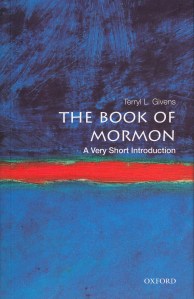
Being born into a religion makes all the difference. I say this as someone who was born into a family that would now be labeled Fundamentalist. That orientation stays firm unless a reason arises to question it. And that reason must be compelling. Many today wonder how, for example, Mormons can believe the narrative of golden plates told by Joseph Smith and that led to the Book of Mormon. Like many non-LDS members, I am curious. While this isn’t the main question in Terryl L. Givens’ The Book of Mormon: A Very Short Introduction, he does address it. The answer comes in the form of a community of belief. The idea is perhaps surprising in an age of individualism, but communal belief has been, historically, the mainstay of religion. A few individuals in any tradition dig deeply and ask questions. They rise into leadership roles, and steps along the way confirm their convictions. Most, however, are everyday believers.

The Book of Mormon is an interesting scripture. The idea of tribes from Israel colonizing the New World has its challenges. The Bible itself tends to go silent about what happened to the northern tribes (“Israel” proper) after the exile. This opens the door to all kinds of possibilities. Various cultures have claimed to be the remnant. Native Americans, of course, tend not to apply the idea to themselves. As Givens points out, the Book of Mormon states that the Israelites of the New World died out long ago. Probably when the Latter-Day Saints are few centuries older, it may happen that metaphorical views toward the Book of Mormon might become prevalent. It took over a millennium before “mainstream” Christians began to ask some pointed questions about their own Scriptures.

Scriptures are products of their own periods. No matter how sacred or inspired they are thought to be, they were written down in human time and human space. Hints are often left along the way regarding authorship, origin, bias, and perspective. The Book of Mormon is rare in having a known publication date, and that in the nineteenth century. Autographs—original texts—are available, even if the golden tablets are not. It’s a rare opportunity to watch a scripture come into being. We know who wrote the Book of Mormon, and when. Its printing history is known, as is its context in the Second Great Awakening. All that’s needed are a few more centuries for scholars to see how things develop. Those who study scriptures are inclined towards the long view anyway.

The Way, the Truth

It’s striking how similar world religions can be. Granted, the concept of “religion” as a separate sphere of life is a western one, but throughout the world thinkers have drawn similar conclusions. Until the World’s Congress of Religions of 1893 in Chicago, however, most Americans knew only of the monotheistic traditions. Jews and Muslims had been in this country almost as long as Christians. Nobody paid much mind to the indigenous religions of the original occupants. In any case, in 1893 other religions—those of eastern Asia—entered American consciousness. Buddhism and Hinduism were exotic, if pagan, belief systems. There wasn’t much of a conceptual foundation upon which to build, however, so early on people tended to focus on the differences between them rather than the commonalities.

For me, I first really learned about such traditions in a World Religions course in college. I’d never heard of Daoism (or Taoism) before. The Dao, or “way,” pervades ancient Chinese religious thought. There’s a sense of flow to it—one of the main ideas is not to resist the way, but to bring yourself in line with it. Doing so helps you to realize that you need not be rich to be happy. Sufficiency is, well, sufficient. Meanwhile in the west, Christianity mostly bought into greedy consumerism. Our happiness is measured by what we have. And having, we want more. I’ve been reading about Daoism recently, and it occurs to me perhaps there are some accidental Daoists here in the west. This reading made me think of my father.

I can’t speak much for who he was, since I barely knew him. I only saw him once as an adult, before he died. For a brief moment he took me into his apartment. He owned practically nothing. A television, a few things to sit on. A magazine or two. That was about it. Did he want to acquire more? I didn’t know him well enough to ask. He was raised as a Christian, and I do not know what his religious beliefs were, if any. Thinking back to that experience, however, was the result of reading about Daoism. Being content with little. Not all of us are cut out for monastic life, but my visits to such communities have always left me with the sense that having less is more than enough. I know I’m over-simplifying here. I’m not an expert on Daoism. I’m certainly not an expert on my father. I do believe, however, that things can weigh us down. And even Christianity, read in a certain light, agrees.


Church of Advent

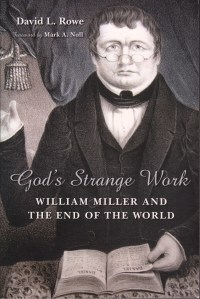
It’s a common name. You might know one yourself: William Miller. Indeed, for many years of my own life I borrowed that surname from my stepfather before returning to my birthright after seminary. But the ordinariness of the name alone doesn’t explain it. Joseph Smith, a fellow creator of a new religion, also bore an innocuous name, and he was a Junior. While many people might have trouble placing William Miller among religious founders, they would likely know of Seventh-Day Adventism, a religion that sprang from the root of his teaching. During his lifetime the preferred title was Millerite, but Adventist also worked. David L. Rowe presents a sympathetic, but not hagiographic account of this somewhat remarkable life in God’s Strange Work: William Miller and the End of the World. For Miller, you see, predicted the year Jesus would return.

A self-taught farmer, Miller became convinced that the Bible indicated 1843 would be the end. This idea was based on calculations derived from cryptic books such as Daniel and considering their days to be years. A touch of math and before you know it, it’s all gonna burn. During the intense period known as the Second Great Awakening upstate New York was perhaps the most religiously creative place on the planet. New ideas bumped into each other and, as if the bounds of Christianity were too constraining, flew out into new forms of belief. People grew convinced that the world might indeed end in 1843. When it didn’t, they called it the Great Disappointment and carried on. Adventism is still with us today.

Rowe also makes the point that for being such an obscure individual, Miller influenced the great religious movements that would give us modern day Fundamentalism as well as Jehovah’s Witnesses. These groups trace their spiritual ancestry to the convictions of a not-so-simple farmer who could fill an auditorium with his plain speaking and clear exposition of the scriptures. He devised his end times scenario with the use of only a Bible and concordance. No seminary or advanced theological reading was necessary. Millerites did not reach the numbers of Latter-Day Saints. They were disowned by the Baptist Church that gave them birth. They got the date of the end of the world wrong. Yet they persisted. It is a curious story with a long afterlife that still helps elect extremist presidents to this day. William Miller, ever unassuming, managed to change the very world that he was certain would end even before the midpoint of the nineteenth century.


Power in the Blood

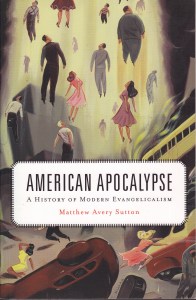
Converts, they say, are often the worst. It matters less what the conversion is to or from, since the zeal of the newly enlightened is impossible to match. The textbook example with religion, especially in America, is Evangelicalism. Those who’ve “found Jesus” are eager and too willing to tell others about it. You don’t often hear, however, of those who grew up Evangelical, but then had second thoughts. Often they disappear quietly. Evangelicalism is a potent force in American life. Intellectuals, embarrassed by it, tend to pretend it doesn’t exist. Or it’s on its way out. No need to approach, with nervous laughter, those who actually believe this stuff. Evangelicals, however, can get presidents elected and their zeal can take away any number of freedoms deemed “godless” by those who may have no more education than the local bartender. Matthew Avery Sutton’s American Apocalypse: A History of Modern Evangelicalism is masterful. Although not comprehensive (the movement is too large for that) this book does not shy from the unifying fact behind radical evangelicalism—the belief that the end is nigh.

Oh, I know. Those of us who are educated have no need to take such nonsense seriously, right? Sutton may change your mind on that. When you realize just how close to disaster after disaster this thinking has led (and continues to lead, under the current administration) us, you might want to take the Fundamentalists a bit more seriously. They constitute the largest religious bloc in the nation. One of the baffling things about them is their protean nature. What’s the difference between an Evangelical and a Fundamentalist? And what’s with the obvious differences between a Timothy LaHaye and a Billy Graham? And where do these people get all their money? (Fundamentalists have always been close to nearly endless, well, funding.) Republican presidents from far before Nixon realized that big business and conservative theology, although strange bedfellows, are remarkably compatible. (Each thinks the other side doesn’t realize it’s being used.)

American Apocalypse is an important book. Written before perhaps the strangest turn in US history last November, it might have helped to show that Trump was a serious threat from the beginning. If only the educated took it seriously. Evangelical antipathy to women’s rights, civil rights for minorities, and socialized medicine run very deep. It’s the Old Boys’ Club with a vengeance. Recent events have shown yet again how important it is to understand these ways of thinking. And those of us with insider knowledge have never been welcome in the academy. That’s okay, though. If I go back to my roots I’ll realize the world’s about to end any day now. Those who’re smart might think about taking equestrian training because I’m sure there will be white horses involved. If only I could get myself converted back.


Prophecy of Hezekiah

Maybe my recollection of the Gospel’s a bit hazy. I seem to remember one of the main characters of the New Testament saying something about doing unto others as you would have them do unto you. And turning the other cheek. I may be recalling incorrectly, since Robert Jeffress, one of Trump’s “evangelical advisors” (and since when do Presidents need evangelical advisors?) has said the Bible gives you permission to take out your enemies. Granted, it takes a twisted exegesis of Romans, and twisted exegesis works best in twisted minds, but this runs full frontal in the gospel ideal of love just two books earlier in the Good Book. Forcing the Bible to say what you want it to say is a tactic as old as preaching itself, but still, those of us with training in Scripture shudder.

Pulling verses out of context like the Bible’s a magic book is called “prooftexting.” Not related to the current plague of texting, prooftexting means you can make the Bible say whatever you want it to. The classic example is that the Bible says “there is no God.” Check it out. I’ll even give you the reference: Psalm 14:1. What’s that? I’ve left out the most important part? “The fool says in his heart, ‘there is no God.’”? You see what I mean. The danger here is that a feeble-minded, biblically illiterate world leader could easily be swayed. Nukes, after all, are great for your ego. Who wouldn’t want the Bible to say that it’s fine to take out all your enemies, and horde all the money you possibly can (not it’s not the root of all evil—Paul is dead, after all.) Except Paul wrote Romans. How are we ever to decide?

The Washington Post story by Sarah Pulliam Bailey may not suggest that we should pay attention to Bible scholars—hey let’s not get too radical here!—but the world would be a very different place if we did. The Bible is a complex and difficult holy book. (As most holy books are.) The idea used to be that you had to spend a lifetime in a monastery, or at least a few years in a seminary, to say something intelligent about it. And that training wasn’t reinforcement of literalism. But we live in a brave new world. A world that re-envisions Jesus as the loving God with his finger firmly on the button. And sycophant preachers saying, “Go ahead, make my day.” It’s all there in the book of Hezekiah.


Spice of Life

So it finally happened. Sean Spicer, I mean. Resigned. It must’ve been an impossible job, lying for a liar. The art of lying requires a knowledge of what’s true in order to be effectively done. Since truth is a commodity decidedly rare in Washington, DC, and imports aren’t reliable, to be a liar’s liar takes some considerable skill. Now, all people lie from time to time. Politicians more than most. If you’re too naive to believe that, well, I’m the president of the United States. Tweet. QED. I was in Washington the day of the inauguration from Hell. I was there for purposes of participating in the Women’s March the next day. A curious family member attended the inauguration and swore to what the cameras revealed—it was poorly attended. The next day the otherwise muddy mats—why they chose white I’ll never know—revealed the line where the crowds had stopped the day before. It wasn’t very far back, if I believe my own eyes.

The doleful night of nights, Sean Spicer made his first press appearance. It was the best attended inauguration ever, he lied. Those of us in DC at the time stared at the television screen in disbelief. Shortly after that we were informed that “alternative facts” revealed the way the president preferred to view reality. It has stayed that way pretty much ever since. The amazing thing is that Spicer lasted this long. Trump appointees come with a short shelf life. Behind-kissery will only get you so far. The funny thing was to watch the interweaving of untruths as Spicer spouted a falsehood only to have Trump trump him with yet a different post-truth answer.

The problem with dishonesty is that it quickly snowballs. In the case of the present administration it started well before January and the season for snow. Now it’s July and the melting is picking up speed. Past presidents, as bad as some may have been, seem to have had, at least to a reasonable degree, the greater good of the country in mind. Now we’ve got a commander-in-chief who takes everything personally and who can’t keep a press secretary even after he bans cameras from the room. And still his supporters think he’s doing a great job. Meanwhile, Spicer’s made a celebrity of himself. His resignation comes as no surprise since Trump staffers constantly find themselves living the lie. And for those Tea Partiers who still support 45, it would be a good idea to learn what it means to “bear false witness.” Oh, and the Bible says “thou shalt not” just before that.


Liberty and Justice

I confess to being a bit vexed. How are we supposed to celebrate Independence Day under the Trump administration? Since January our government has demonstrated over and over and over again that it’s dearest desire is to pick democracy apart, to its own advantage. Making voting more difficult for those who oppose the Republican Party, gerrymandering to ensure local election victories, cutting their healthcare so that they might, well, just die off. Repeated and loud public protests do not impact them at all. When their own party moderates protest, they claim they’re collaborating with the enemy. The American people have become the enemy of the wealthy and privileged who want this country to resemble a country club, not a nation of liberty and justice for all.

How do we celebrate a country like that? Back in high school, my senior year, I won a state-wide essay contest. I got my picture in the paper and everything. I don’t have a copy of the essay, but I do remember that the topic was Americanism. Yes, the “ism” was part of it. Although I didn’t know Shostakovich at the time, it was my attempt at what he did in his fifth symphony. Looking back, it seems strange that a Pennsylvania statewide committee would select an essay so full of irony from a working class boy who was only too well aware of his own inferiority. Yes, there was irony in that essay, and anger. Carefully hidden. It sounded patriotic. The hundred dollar prize didn’t make a dent in my fall tuition bill.

Nearly four decades have come and gone since then. I’ve watch my nation teeter-totter between humane treatment of those left out by the system and offering kick-backs to those who by no definition need or deserve them. Until November of last year I’d never seen a nation stoop to the absolute abyss of cynicism in the election of Trump. Although President Obama had the grace to say that many people were obviously happy with the results, it was as if my essay—now lost and forgotten by all but one—had come true. Make no mistake about it—I’m a poor boy who grew up among the working class. As a teenager I could see, hear, and taste the hypocrisy. I hoped and dreamed that as I grew up so would my nation. It’s the fourth of July. Normally I would be celebrating Independence Day. This year, however, I’m only wondering what went wrong along the road to liberty and justice for all.


Classical Education

Andrew Dickson White famously wanted Cornell University, unlike what would become known as the other Ivy League schools, to be non-sectarian. Most Ivy League universities were founded as seminaries or with the strong influence of churches. On farmland gifted by Ezra Cornell, in Ithaca, New York, the school became one of the first truly secular world-class universities. As I approached Ithaca over the weekend, my wife told me that the town had once been briefly known by the name of Sodom because the remote location’s reputed notoriety for sabbath breaking, horse racing, and profanity. It is now considered one of the most enlightened towns in the country. Famous for its waterfalls and gorges, one of the cascades is still rejects the biblical slur with the sobriquet “Lucifer Falls.”

Many place names—indeed, much of American culture in general—reflect(s) the Bible. Ours is a culture in denial of just how formative religion has been for who we are. Because of our willful blindness on this point we sometimes run the risk of being entrapped by our heritage. Despite how much we’ve educated ourselves we still see what we want to see. Our religious heritage is often considered an embarrassing family secret rather than the path by which we came to be a civil society. Religion is so frequently portrayed as an evil force that it’s easy to forget just how much we owe it for our evolution. Even education itself had a religious motivation since teaching students to read was often done with the intent that they should read the Bible.

Like nearby Binghamton, Ithaca has a statue dedicated to Martin Luther King, Jr. It bears a biblical quotation from Amos without embarrassment. Ithaca today is a livable, socially conscious community. Recycling is strongly encouraged while cars are not. Hardly a hotbed of immorality, it is one of the great examples of an American college town. Ideas are welcome here. Befitting its classical heritage of education, the city is named after the island ruled by Odysseus, according to Homer. Indeed, Ulysses lies just down the road. Homer (and yet another town in the area bears that name) presented Odysseus as among the smartest of the Greek kings. Like most classical Greeks, Odysseus was only too conscious of how the gods could interfere with one’s life. Instead of denying the obvious, however, religion was recognized as a necessary source of culture. Not that it always has to be taken too seriously. Maybe it shouldn’t be completely ignored either.


Good Newsists

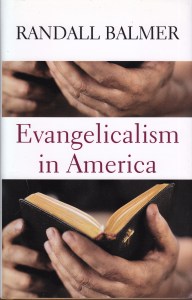
In the interest of avoiding conflict thereof, I cannot yet give a review of Randall Balmer’s Evangelicalism in America. Since I’m writing a review of it for Reading Religion, I’ll use it as a springboard into a topic that should concern all who believe in religious freedom. One of the resounding themes of Balmer’s treatment is that Evangelicalism, after it wedded to the Religious Right, lost its soul. Those are my words, not his, but the sentiment’s about right. For anyone who wasn’t politically aware in the 1980s, it may seem a surprise that religion didn’t enter into politics before that decade. With the exception of the fear of the Catholic in the case of John F. Kennedy, religion wasn’t used as a political wedge until the presidency of Jimmy Carter. The Religious Right, unhappy with the born again Southern Baptist in the White House, moved to solidify the Evangelical bloc.

Evangelicals had been an underground movement for half a century. Many had no idea what being “born again” meant when Carter first claimed the sobriquet. Balmer points out that it was the threat of the withdrawal of tax-exempt status to discriminating Christian schools that led to political action. Bob Jones University, fearful of racial intermarriage, didn’t admit African American students. Leaders of the Religious Right saw the loss of tax-exempt status as a move against their sacred segregated culture and a push that required a shove. Coopting the abortion issue (historically Evangelicals had supported women’s rights, including the right to abortion in many cases), they nailed together a platform for political activism which put women “back in their place,” kept racial “purity,” and romanced a total aberration in Christianity—the “prosperity gospel.” All of this is well documented. And well hidden.

Looking at Evangelical politics today, abortion—the control of women—has become THE issue. It’s hard to believe, as Balmer amply illustrates, that Evangelicalism used to be allied with the Social Gospel. It was a religious view with a conscience and it supported issues that are now polarized as “liberal” and leftist. This shift came about gradually, but not accidentally. There were political players—Balmer names names—who had one goal in mind, and that goal wasn’t Jesus or what he’d do. It was the sweet prize of political power. Evangelicals, you see, are born followers. A leader with a strong voice can lead them just about anywhere. Many Evangelicals today would deny their more liberal history, but it is right there for anyone who’s willing to learn something about who they once were.


Terms of Interment

In an early episode of The Simpsons Marge is commissioned to paint a portrait of Montgomery Burns. Angry with him because of his constant treatment of others as beneath him and his glib superiority granted by wealth, she paints him old and feeble, naked as he climbs from the shower. The crowd present for the unveiling is appropriately shocked. Marge explains her motivations for the painting and one of the voices in the crowd affirms, “He is evil, but he will die.” That scene was brought back to mind by an article a friend sent me on Archaeodeath. As someone who’s volunteered on an archaeological dig, I understand that the past is a history of death as well as of life. We read what historians choose to preserve. And, as Professor Howard M. R. Williams points out, the tomb often tells a tale that requires some subtlety in reading.

Never a great fan of the wealthy, some years ago I visited Sleepy Hollow. It was before the television series began, back in an October when the mind begins naturally to turn to death. I’d always liked the story by Washington Irving that had made this quiet town famous and it’s really not hard to get there from New Jersey. While in town we visited the famous cemetery, in search of Irving’s grave. Others are buried there, too. High on top of a hill stands a palatial tomb to some Rockefeller. As Prof. Williams makes clear, all must die and all tombs lie. Those who insist on the most opulent tombs are those who routinely overestimate their personal importance. So it is my mind turns from Montgomery Burns to Cyrus the Great.

There was a time when world conquerors possessed a dose of humility. It may seem strange in today’s world that an Iranian (in the days before there was an Iran, designed as it was by Europeans) would be considered a benevolent dictator. Cyrus reversed the deportation rules of the Babylonians and Assyrians. Subject peoples were permitted—encouraged even—to return to their lands. He even federally funded the building of temples and, to translate, centers for the arts. Cyrus understood that grateful people make good subjects. When Cyrus died, after being king of the world, he was interred in a decidedly understated tomb outside Pasargadae where, according to one account his inscription read, “I am Cyrus, who founded the Persian Empire. Grudge me not, therefore, this little earth that covers my body.” Archaeologists uncover the dead. Those who bill themselves grandly, as the diggers understand, seldom deserve the glory bestowed by their own minds. Marge Simpson, as usual, is a voice of wisdom.

Some president’s tomb


Seeing Belief

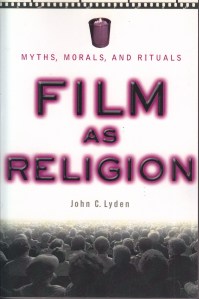
Although most of us can recognize it on sight, we have a difficult time defining religion. In the early parts of Film as Religion: Myths, Morals, and Rituals, John C. Lyden discusses this lack of definition and offers some broad categorizations since his thesis depends upon it. How can one assert that film may be understood as religion if religion isn’t identified? Lyden makes clear that this book won’t be about an ideological or theological interpretation of film. It’s more about popular culture and how elements of that culture, such as cinema, may be religion. This leads to the discussion of the topics of his subtitle: myths, rituals, and morals. These all share some conceptual territory with movies, therefore understanding them is important.

To me the most interesting part of the book is the consideration of genres (westerns, gangster movies, melodramas, romantic comedies, children’s movies, science fiction, thrillers and horror) as exemplars of various aspects of this religion. Each genre includes the discussion of a feature film, and some even have two. Of course, Lyden’s book is a few years old now and other studies have shed further light on both how religion and film interact and also on the interpretation of various genres of movie. The hope of the book—that it may be the start of a new kind of discussion about religion—has to some extent been realized, although the analysis has taken off in several directions at once. There can be no doubt that cinema taps deep spiritual needs in a way not unlike a religious ceremony.

It seems that society has come to distrust the usual purveyors of religion. Dishonesty almost as deep as that of the government has been found in it and the responses are remarkably similar—cover-ups and denials and many species of prevarication. Cinema seems downright credible in comparison. What you see is what you see. The big difference between movies and religion, however, is that we’re only too glad to acknowledge the human sources of celluloid. Many religions, especially in the monotheistic tradition, rely on direct divine revelation as their origin. Lyden isn’t suggesting that film substitutes for religion in that way, but on a more practical level it may. It meets our needs. We trust we’ll get what the poster and trailers promise us. We sit reverently in the dark awaiting illumination. And yes, there’s an exchange of money involved for any kind of worship involves an offering. No religion’s free of cost.


The Cargo of Cults

Among religious studies scholars “cult,” in the popular sense, is a swear word. Professionals in the field don’t use it because it implies that a belief system—usually modern—is somehow less important than an established religious tradition. Instead, we’ve been taught to call these “New Religious Movements,” or NRM for short. Looking around it seems that political correctness is now gone and open advocacy of white power is the new norm. After all, the minority of the American electorate voted for it so we can change the rules on that basis. Even before the election, however, Rebecca Nelson wrote an important article on GQ about the cult of Trump. As a person, what’s there not to dislike? A long history of shady business deals, lawsuits, and sexual harassment (we just couldn’t get beyond Bill Clinton and Monica Lewinsky just a couple of decades ago, but all that’s water over the dam) such a man couldn’t have been elected even in the W era. Well, cult thinking explains that.

Nelson cites the work of Rick Alan Ross, an expert (back from in the days when we still had those) on cults. The rise of Trump followed exactly the pattern of how cults work. A single man (nobody voted for Pence) who is able to fix this great broken machine called America. He can do it by referring to a black box that nobody may open to examine, but yes, believe me, the solution’s in there. Stir the muck and tell people things are awful when life expectancy is better than it’s ever been, everybody has health care, and the economy’s finally starting to stabilize, and you’ve got yourself a cult leader. As Nelson insinuates, the Kool-Aid is in the future.

We learned a sum of zero from Jim Jones, David Koresh, and Marshall Applewhite. We wrote them off as weirdos getting off on a power trip. Swept away by the mere fact of being followed. Mentally unstable with delusions of grandeur. Narcissistic to a fault. Wait, what? We ignored them so well that we’ve elected a candidate who took not just a page from their playbook, but an entire chapter. Back in the days of political correctness, when there was still such a thing as experts, I sensed that things were pretty good. As horror movies should’ve taught me, too good. Caligula insisted that his statue be set up in the Jerusalem temple next to where Yahweh resided. The temple may be gone, but the desire to be worshiped will always be with us.

Wait, that's not the Washington Monument is it?

Wait, that’s not the Washington Monument is it?


Ash Monday

I was traveling abroad with a friend. We’d just arrived back in the United States and were making our way through customs. Since he was from another country we were separated. The border agent told me I couldn’t come back into the country unless I demonstrated that I was a racist. Only racists were permitted. He began to pressure me, even offering to help. Should I comply? I awoke in a panic. As someone who suffered frequent childhood nightmares, this was something new. In the past it was merely a monster chasing me, or my alcoholic father. Now I’m having nightmares about the government of my own country. And here it is, Presidents’ Day. Like U2’s early “New Year’s Day” or Bruce Springsteen’s “Independence Day,” there’s a decidedly poignant tone to this holiday. Looking towards DC I see nothing to celebrate. I see a government putting the mock in democracy.

This Presidents’ Day, I have a modest suggestion. It could fix democracy. When an election (I’m thinking Brexit as well as 11/9) squeaks out a victory because people don’t vote or don’t understand the issues, a true democracy would then hold a follow-up, “what I really want” vote. If we insist on keeping such arcane tools as the Electoral College in place, this is the only way for democracy to actually work. It wouldn’t be necessary in the case of a candidate winning both the electoral and popular vote. When that happens it’s pretty clear someone won. When the two are divided, however, that’s also a clear signal. Only unthinking automatons would declare that a landslide defeat is actually a win, based purely on political casuistry. Is there an ethicist in the house?

dscn6820

This Presidents’ Day feels more like Ash Wednesday to me. Ash Wednesday is for public mourning. It is a realization and confession that we have sinned. We wear ashes to make it conspicuous. This year no ashes are required. Perhaps we should wear black bands on our arms. I would, only arm bands seem to have a way of becoming bright red and appropriating ancient religious symbols. We have sinned, and we have sinned boldly. The miasma of Foggy Bottom is as clear a condemnation as is devoutly to be wished. When I start waking up in a panic, in a body-sock of sweat, my childhood monsters have become real. It’s Presidents’ Day 2017.


Celestial Politics

Two things about my childhood: I grew up religious, and I grew up learning you didn’t talk about religion or politics. Now I see that that combination leads to tremendous potential for abuse. Many conservative Christians believe that their faith only ever endorses a Republican candidate, no matter how bad. This is a strange idea and it goes back to some strange people. If I can talk about it.

We live in a cult of celebrity. This is nothing new. People have always admired the individual who could get him or herself noticed. As early as the epic of Gilgamesh, the guy willing to show his bad self managed to capture the public imagination. We’re still reading his story some five millennia later. Of all places this tendency to treat a human being as authoritative should be considered strange is evangelical Christianity. This religion grew out of a largely Calvinistic backdrop where no individual could be assumed to be good. Indeed, total depravity was part of the theological environment. Mix in this stern outlook with the revivalism of the two “great awakenings” and an uncanny alchemy takes place. People, who used to be bad, now found enthusiasm in religion. The first real superstar in the United States was George Whitefield, a preacher. He had a massive following and was, in every sense of the word, a celebrity. This culture became the social substrata of the new nation. Open to all religions, yes, but mostly belonging to this one.

Once American religion became based on popularity, singular figures emerged as defenders of this faith. “Trusted” leaders and authors. Not all of them home-grown either. Names like C. S. Lewis, Dietrich Bonhoeffer, and Francis Schaeffer—not to mention Billy Graham—grew to a status they never had in their lifetimes. Well, Schaeffer and Graham came to be evangelical gurus in their own rights and Graham remains among the living, but Lewis and Bonhoeffer were really adopted by conservatives only after their deaths. The interesting point here is that Lewis and Bonhoeffer often wrote things that directly challenge the easy evangelicalism that accepts them as celebrities. The problem is, we don’t talk about religion any more. We use it for voting, and for feeling good about ourselves. Superior, even. It seems strange to think that Calvinism had some safeguards built in that have been knocked down for the sake of the polls. I can’t imagine John Calvin casting a vote for Donald Trump. But then again, Calvin became a celebrity in his own lifetime, so I might be wrong about that.

calvinjohn


What You Eat

The future of Sleepy Hollow is uncertain. The successful FOX television program has suffered the slings and arrows of outrageous scheduling over the past year and speculation abounds that the current fourth season may be its last. It has been, in my experience anyway, one of the most literate supernatural horror shows ever. Books and reading abound and an interracial team fights evil week after week. Having done some research on the first season of the program, I continue to be surprised just how detailed the homework of the writers is. My wife sent me a story from Atlas Obscura on the “sin eater.” This is a term, I readily confess, that I never heard before the introduction of Henry Parrish to Sleepy Hollow. Ichabod Crane, guilty over the death of a freed African American freedom fighter, ingests poison to kill himself and severe his connection to the Headless Horseman. Abbie Mills, believing there is another way, locates the sin eater.

The idea is fairly simple, if unorthodox. A sin eater can literally devour the sins of another. In Sleepy Hollow this comes at a considerable cost, but the article by Natalie Zarrelli demonstrates that this too reflects research on the subject. There were, it turns out, sin eaters in the early modern British Isles. Often a poor person with no other options, a sin eater would consume bread placed on the chest of the deceased, incorporating, in an almost Christ-like way, the sins of the recently passed. The dead could then be safely buried, forgiven, while for a pittance a poor soul could walk around with someone else’s sins in his or her body. Sounds like capitalism writ large, to me.

Watching Sleepy Hollow I had assumed this idea was invented for the show. Like so many details, however, it turns out that some digging had brought an obscure historical practice to the surface. Sin eating, as the article makes clear, was never sanctioned by the church. People have often worried that official religion might not deliver the salvation it so readily promised, bound up with rules and rites as it was. Here was a sacrament of the people. Bread could be visibly consumed and symbolically, or literally, sin with it. The sin eater was paid, making this a legal transaction. Although sin eating is thought to have died out, it seems that with the recent, high-level resurgence of evil-doing, perhaps it is a practice that should be recalled. In many ways Sleepy Hollow has been ahead of the times since the beginning.

IMG_1960_2