Animate Magnetism

The Magnetic Monster is listed as sci-fi and horror on industry websites.  It falls into that period when horror had shifted to Hammer Studios in the UK and the US had entered that white-shirt, button-down period known as the fifties.  There were still monsters out there but they generally had to do with radiation.  In this case, it’s magnetism and its relationship to electricity.  The movie came out in 1953 and introduces what may have been the forerunner of the X-Files, namely the Office of Scientific Investigation, the OSI.  This team of A-men (yes, this was the fifties) study anomalies in order to keep America safe.  There were a total of three OSI films, of which this is the first.  The eponymous magnetic monster is alive only in a philosophical sense—it’s actually an irradiated element gone wild.

An unrestrained scientist had subjected a radioactive isotope to alpha particles for several days and this started a chain reaction.  He takes the substance onto a commercial airline—in his carry-on, no less (it was the fifties)—but the plane is diverted so the A-men can intercept it.  Every eleven hours this isotope divides and doubles, eating all the energy around itself to do so.  This creates an immense magnetic field.  So immense, in fact, that in a mere matter of days it will throw off the earth’s core and our planet will spin helplessly off into space!  Don’t panic, dear reader, the A-men are on the job.  They find a scientific means of overfeeding this monster and destroying it, which is why we’re all still here.

Interestingly, this is one of the more highly rated movies of the era, perhaps because of its scientific optimism.  Scientists can solve all our problems.  And yet you’ll find them without fail in church on Sunday morning.  The fifties were developing a kind of split personality for this country that was trying to hold two conflicting impulses together in an attempted fusion.  The problem is, overthinking either (or both) of them would demonstrate that they really have separate paths to take.  They may well be compatible, but in ways that relegating religion to Sunday morning simply doesn’t work.  Even today many scientists—generally not the outspoken kind—still hold religion and science in tension.  There is something to this impulse we call religion, but it always seems to have to wait while we use science to destroy the monsters we create ourselves. 


Early Halloween

Call it seasonal disorientation syndrome, but I’ve been reading about Halloween.  I’m pretty sure I’m not the only one thinking about it.  Stores will begin Halloween displays next month, if the usual pattern recurs.  So why not do a little advanced study?  Although I’ve written about holidays myself, they’re unruly subjects to handle.  Lesley Pratt Bannatyne is a name familiar to many fans of Halloween.  Her 1990 book Halloween: An American Holiday, an American History kickstarted renewed interest in the holiday and has been followed by other studies, even occasionally with academic presses.  Still, holidays are difficult to pin down.  One of the most obvious reasons for this lies in the fact that before the world became über-connected, holidays were largely local celebrations.  Trends traveled slowly and not everybody agreed on which holidays to celebrate.

The early days of Halloween are the most difficult to piece together.  This is clear in Bannatyne’s book also; we simply don’t have the written sources we’d like.  The ancient Celts, although great strides have been made through archaeology and close examination of ancient writings of outsiders, remain poorly documented.  They didn’t leave archives like the classical writers of Greece and Rome did.  And clearly Halloween has its earliest known celebration as Samhain among the Celts.  Once Bannatyne gets to America, however, there’s a trove of information in her book.  Her chapter on the celebrations among the original thirteen colonies is quite good at demonstrating regional differences not only for religions, but for tolerance for something like Halloween.  Fall festivals predated Halloween as we know it (if we really do know it), and she does a good job of demonstrating how the melting pot effect made Halloween national.

One of the problems with any history is that one event can change everything.  This book was written three decades before Covid-19 and the pandemic was one of those events that did change everything.  It makes it seem as if we were much more carefree back in the eighties when Bannatyne’s book was written.  Halloween was just starting to become an adult holiday again back then.  In the ensuing years it has become even more so.  Communities are seldom what they used to be with the extreme mobility of much of our society, but many still find a way to agree to the terms of Halloween.  Historians of holidays have a difficult task, and we’re still learning about ancient cultures and their modern manifestations.  This is a good book to start that exploration—I know it taught me a thing or two.


The Ology

It’s good to refresh yourself once in a while.  I attended a Calvinist college and my doctoral program was in the context of an institution strongly influenced by Calvinism.  I took courses based on Calvinistic theology.  Jon Balserak’s Calvinism: A Very Short Introduction was really a refresher for me and I have to admit that it sparked a pretty strong reaction.  For one thing, many Calvinists unthinkingly accept the tradition in which they were raised.  (Call it indoctrination, literally.  This is true of most religions.)  Those I know seldom believe what Calvinism teaches, for it presents God as a monster. (This is me, not Balserak, and I mean this in the kindest possible way.)  You see, doctrinally Calvinists have to accept Scripture literally and if you do that you come up with all kinds of contradictions.  (The amount of special pleading is mind-boggling.)  The way the Calvinists landed on this was that God created us for his glory, which will be shown in predestining large numbers of people to Hell.  These people can do nothing to change that since God doesn’t really love them.  What would Jesus say?

I argued quite a lot with professors at Grove City College.  I was raised a Fundamentalist, but of the free will stripe.  The Methodist Church, which I eventually joined, was not Calvinistic in outlook.  (Neither are Lutherans or many others.)  Still, Calvinism has unduly influenced American culture—I wish the book would’ve focused more on this.  We are, culturally, heirs of Calvinism.  This little book points out one obvious way this is so, namely, the separation of church and state.  There are many other features that could be pointed out, but the book aims to be universal and this is therefore not a theme.

The book approaches Calvinism theologically.  There’s quite a lot of “shop talk” here that I imagine might put off those who don’t really care to know who said what about a particular point of doctrine.  Balserak points out that Calvinism is complex and there is no one way of looking at everything, but there are clearly some non-negotiables.  These non-negotiables are precisely what prevented me from ever trying Calvinism on for size.  I’ve moved through various religious outlooks on my journey that is geared toward finding the truth.  Calvinism never tempted me, nor did it ever seem to make sense.  It was as if the tradition accepted that Zwingli and Calvin and company had gotten the basics all correct and every act of theology since then involves a casuistry to prove the early teachings correct.  Why not question things?  Well, I guess they’re predestined not too.


Baptist to the Future

Setting aside their smartphones and MAGA hats for a moment, the Southern Baptist Convention voted to exclude women pastors this week.  The photos seem to show a rather dour delegate pool that seems ready to head to the apothecary for some leeches to take care of this headache.  The conservative mind is a curious place.  I can understand wanting to slow change down—it is moving at a scary pace, leaving many of us concerned and confused.  Yet the idea that nothing has changed in two millennia isn’t only demonstrably wrong, it’s something that history demonstrates is a relatively recent, and reactionary, idea.  The fundamentalist brand of religion that elevates the Bible to godhood has only been around for about a century.  It’s a reaction to a hundred-year-old modernism that, in spite of all the evidence, closes its eyes.

Fear is natural enough.  Some of us actually watch horror movies voluntarily, after all.  But when fear overtly drives your religion isn’t it time to stop and ask what you’re doing?  The Southern Baptist Convention ejected its largest church, Saddleback, which had achieved national influence under Rick Warren.  According to the New York Times, Warren himself addressed the Convention citing none other than Billy Graham in his defense of women pastors.  The convention overwhelmingly voted to excise its most successful church for fear of that dreaded slippery slope of liberalism.  We’re fixated at some sexual level, it seems, and afraid of what might happen if we admit that even as AI is taking over our world, things may have changed.  At least a little.

The Bible is a sacred document with a context.  That context was patriarchal and it held considerable sway for about two millennia.  Power is difficult to relinquish.  When you get to call all the shots you don’t want to be reminded that those shots are wounding and killing innocent people.  “It was just better that way,” people think, ignoring the very Bible they worship.  It’s a point of view I understand, having grown up in it.  I remember reading with the juvenile furrowed brow of some tender twenty years how C. S. Lewis simply couldn’t see how women could be priests.  And then noticed how Baptists and other Protestants embraced Lewis although they condemned his idolatrous Anglicanism.  Sometimes it’s difficult to believe we’re actually in the twenty-first century with AI knocking at the door.  And we still can’t get over women wanting to be in the pulpit.

What would Roger Williams say?

World’s End?

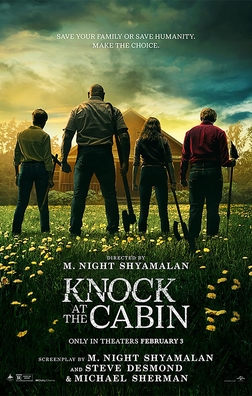
I’ve been writing on religion and horror for quite a few years now.  Sometimes you come across a horror movie, or novel, which addresses this directly.  Paul Tremblay’s The Cabin at the End of the World is one such novel.  A friend strongly recommended this, and indeed, the first half went impossibly fast.  This despite my dislike of home invasion stories.  It nevertheless kept me on the edge of my seat.  I should probably say there will be spoilers here (there will), in case you haven’t read this but intend to.  I’ll hold off on them until the next paragraph, though, so if you’re a faster reader than I am a writer you won’t accidentally run upon them.  So, a family consisting of two fathers and an adopted daughter find the cabin, where they’re vacationing, invaded by four people who believe the world is going to end.  Spoilers follow!

The world is going to end unless the family agree to sacrifice one of themselves to stop the apocalypse.  The strangers are armed while the vacationers are not.  And, as usually happens when those with weapons confront the innocent, the armed prevail.  But.  But the family refuses to sacrifice anyone.  Then the brainwashed four do something unexpected—they kill one of their own.  They continue to do this, attempting to convince the men that if the invaders all die, and neither of the men is sacrificed, the world will end.  Quite a bit of the novel then becomes a theological discussion regarding what kind of god would make such a demand.  Of course, if you read Genesis you’ll already know the answer, right Isaac?

Tremblay knows not to tip his authorial hand as to what’s really happening.  As the cabin becomes a mess of blood and gore, the television seems to be showing predicted apocalyptic events.  The invaders can’t reveal their source of secret knowledge because they receive visions telling them what to do.  The whole thing raises that most troubling of questions: who is really in charge?  Is there a bloodthirsty deity who requires a willing death or are the invaders simply good at acting out their paranoia and interpreting events to meet their expectations?  So it is that Cabin becomes a disturbing story—nearly a theodicy—asking age-old questions of what happens when religious belief conflicts with rational materialism.  There are enough hints of supernatural happenings to make the reader wonder.  And when it ends it affirms something many of us are exploring these days—religion and horror have much in common but neither is clearly understood.


Coming to History

Perhaps because I was a critical thinker at a young age, or maybe because I’ve always been insistent on fairness, I never took an interest in American history.  I cast my eyes back further, wondering how we got to where we are.  Such looking backward would lead to my doctorate.  Now, however, I’m interested.  I’d pay better attention to American history in school, were I now required to attend.  I’ve known about Kenneth C. DavisA Nation Rising since shortly after it was published.  My family listened to part of the recorded version when long car trips were more common.  Remembering what we’d heard, I eventually purchased the print book as well—I’m a fan of print and always will be, I’m afraid.  I only resort to ebooks when there’s no other option.

In any case, what drew me to these Untold Tales from America’s Hidden History was the information about early revivals.  Particularly those of George Whitefield.  Now, I’d learned about Whitefield in seminary (it was in United Methodist history, as it happens), but I hadn’t realized that he was America’s first superstar entertainer.  People flocked to hear him preach and he even caught the attention and friendship of Benjamin Franklin.  It’s estimated that Whitefield reached an audience of about 10 million hearers, and this was back in the eighteenth century.  He also preached in England and since the American population was just over 2 million in those days, it means he was enormously popular over here.  It was Davis’ book, not a seminary class, that made me aware of the fact.

Having grown up in one of the original thirteen colonies—Pennsylvania was a state by then; I’m not that old—you’d think I might’ve been more interested.  George Washington was in western Pennsylvania at least a time or two, and I even found a Civil War coat button poking out of the ground in our backyard once.  Nevertheless, it took adulthood, and perhaps the recognition of just how fragile our democracy is, to kickstart my interest.  Davis’ book is good for those who are interested in the lesser-known aspects of American heritage.  We aren’t always the good guys, though.  This isn’t the heavy-duty history that totters with facts and figures.  Really, it’s a set of fascinating vignettes of many people mostly forgotten these days.  And like most American histories, it shows that our political troubles today are nothing new.


The Idea of Scripture

Although the academic field of biblical studies is slowly dying—this is something I wrote about a long while back on this blog—the Bible and its kin nevertheless continue to shape and control society.  I was recently reading that Islam takes quite a different view of the Qur’an than Christianity does of the Bible.  It’s also clear that Judaism has yet another way of looking at Scripture.  What underlies these Abrahamic faiths is, however, the idea of sacred texts.  They don’t have to be understood, let alone read, in order to alter perceptions of reality.  The idea that God wrote a book, combined with the idea that God doesn’t show Godself or intervene in the world for good in any obvious way, has transferred a kind of godhood onto sacred scripture.

People desire the second coming because of a deep-seated need for God to part the clouds and demonstrate that their way of looking at things is the correct way.  It may be influenced by Scripture or politics or a favorite news channel, but the result is the same—they want divine intervention and since it’s not forthcoming, their sacred texts become the rallying point around which they gather.  Like many people I’m puzzled how a man like Trump, known for his proud womanizing and lack of care for anyone other than himself, came to be seen as a messiah.  Perhaps the key is that moment he gassed American citizens for a photo op holding up a Bible he never reads.  How this comes to be interpreted as a kind of divine moment only makes sense when we realize it’s the idea of Scripture that becomes the reality of many.

I’ve read through the Bible many times.  I have to confess that trying to get through the Qur’an is a struggle for me, but I suspect quite a lot of that is cultural.  I’ve read a few other sacred texts over the years, and have found some wisdom in all of them.  It’s when they become divinities in their own rights that society begins to pay the price.  If a non-interventionist God remains invisible, that identity will be transferred to the divine surrogate—Scripture.  People will coalesce around the idol they can see rather than the invisible one they can’t, right Elijah?  These sacred books have survived partially because they contain old wisdom, and old wisdom is often better than new knowledge.  But they also survive because they have become, in some sense, gods.


Denver Memories

It may be a strange thing to say (or write, as the case may be) but I was kind of hoping to spend some extra time at the Denver Airport.  When I traveled to Denver for a conference last year, I arrived to a workload (attending AAR/SBL as an editor is all work, not play).  I had no time to hang around the airport.  I knew, however, as a recent New York Times piece states, that the airport has a reputation for the paranormal.  While the Times article focuses on Luis Jimenez’s sculpture “Mustang” to start, it quickly moves on to “conspiracy theories.”  And the parts of the airport passengers never see.  The place has a reputation for being weird.  During construction in recent years, the usually anodyne partitions that block construction from the view of passengers, housed images of aliens, bolstering rumors that Denver, and its airport, have some connection with our extraterrestrial neighbors.

The Times story points out alien graffiti in parts of the Denver Airport where travelers can’t go.  And it also points out that although the fiery red eyes of “Mustang” are to represent Jimenez’s father’s start in the neon business, they give the giant horse a demonic aspect.  The artist died working on the sculpture.  A piece fell during construction, severing an artery.  But the conspiracy theories began earlier.  The southwest has a reputation of being the home of the shapeshifting reptilians that have made it onto mainstream television.  Is it any wonder that Trump stands a possibility of getting the nomination while yet more crimes are actively stacked on his record?

Of course, I was in Denver to work.  I claimed my bag and got a taxi on a snowy southwestern morning.  While there I worked, of course.  It was cold, in any case, back in November, so getting out to see the sights didn’t particularly appeal, especially since it was getting dark by the time the book stalls were closing and I was there alone.  I always want to be on time, and since I’m an early riser, and since Thanksgiving was just a couple days away, I went to the airport three hours before my flight home.  I was thinking I might have some time to do a bit of X-Filing while waiting.  Alas, it was not to be.  The helpful flight attendant put me on an earlier flight and I ended up with a three-hour layover in Chicago.  But I also knew that several “mothman” sightings had taken place at O’Hare over the preceding months.  When you’re a traveler, however, they keep you away from the interesting parts of the airport.


Young Reading

It was more the lede line than the story.  Melissa Kirsch’s “The books we read when we’re young help shape the adults we become in ways we don’t always grasp” caught my attention.  My own current rereading of Dark Shadows books certainly reflects that.  As my You Tube video on Dark Shadows considers, it was the books more than the television show that shaped my young mind.  Consciously, I know that’s probably the main reason I’ve always wanted to live in Maine.  It may seem strange to some to want to move where a vampire frequently visits, but there was more going on in those stories than I realized.  It would be enough to make me tremble were I a young persons’ fiction writer.  They have so much influence.  Spending my younger years searching for a father took me some strange places.

My other young reading was, naturally, the Bible.  I can’t remember how young I was when I began to try to read through the King James.  Eventually I did get through, and then I started all over again.  Clearly my entire life has been impacted by that early fear of Hell that drove me to the Scriptures.  Perhaps that combination of Bible and Dark Shadows novels led to Holy Horror and its aftermath.  In other words, my youthful reading led to what has become a vocation, of sorts.  That elusive university, or college job in Maine never came to fruition.  I tried many times to get a toehold there, Bible in hand.  I’ve ended up back in Pennsylvania, where I started.  And I’m still reading.

I’ve read a good number of good books, but it has been some time since one set my life off on a different trajectory.  Some books have lead me to write books, and books I read often suggest even more books.  Whether I die today or thirty years from now, books will have defined my life.  I grew up reading them and wanting to write them, with no real idea how to do the latter.  One of those childhood books convinced me that a career outside the church was one not worth having.  Indeed, were I clergy now my enjoyment of horror would certainly garner more attention than it does in my current role as “some guy.”  I am, however, that person who grew from a worried-looking kid who’d not yet figured out that my reading choices would lead to a life measured by books.

The ultimate adventure…

Spiritual Alterations

I’d been meaning to watch Altered States for quite a few years.  I suspect the reason (it’s been long enough that I can’t recall for sure) is that I knew it had a story line tied in with religion.  The tale follows Edward Jessup, a psychopathologist, who is attempting to understand schizophrenia.  He’s particularly taken by the religious nature of some schizophrenic delusions, and he uses sensory deprivation on himself to trigger something similar.  A trip among tribal Mexicans leads him to a psychoactive substance that he decides to combine with sensory deprivation to enhance the effects.  Along the way he explains to his girlfriend, and eventual wife, that his father was religious but died a horrible death.  He therefore became irreligious but his altered states of consciousness are often full of images from Revelation.

While the Bible theme eventually gives way to biological regression to pre-Homo sapiens, one of Jessup’s experiences has him coming to his dying father again and dropping a Bible on him which turns into the veil of St. Veronica on his face, which he then rips off and throws, flaming, to the floor.  Another instance of the Bible in horror, the film also uses crucifixes and hellish images to demonstrate the religious nature of these alternative states.  Jessup’s goal is to regress to the original thought, to encounter, as he puts it “God.”  This desire, combined with the potent Mexican drug, transforms him physically, and, in the end, emotionally.  Instead of being dissociated from his wife (whom he is planning to divorce), he realizes that love is the only thing that can save him from the terror of his experiences.

This is some profound stuff.  Paced like a movie from 1980, it has a quality not unlike 2001: A Space Odyssey.  The message seems to be sound—the need for encountering the “divine” ends up convincing Jessup (that may autocorrect keeps changing to “Jesus”) that love is really what it’s all about.  The transformation scenes, while not shown in the detail of An American Werewolf in London, are nevertheless convincing enough.  It’s a rare movie that treats religion respectfully.  Here Ivy-League scientists are motivated to understand it.  In real life, alternative states of consciousness are quite real, if poorly understood.  They’ve been part of religious practice from the beginning and are a far cry from sitting in the pew and singing anodyne hymns week after week.  The more movies I see, the more it seems that a sequel to Holy Horror will be necessary some day.  


Monsters of Mystery

Sunn Classic Pictures was responsible for much of my young movie viewing.  Or at least a reasonable portion of it.  As I predicted, I ended up watching The Mysterious Monsters in the wake of Boggy Creek, and that got me curious about this unusual production company.  As a film distributor, the company began in 1971.  One of its early films was the aforesaid Mysterious Monsters.  Unlike other film distributors, their practice was to rent out a theater (this was before multiplexes) and take all the profits for the run of their film.  This was no risk to a theater owner and apparently it worked for Sunn.  They sponsored documentaries on unusual topics, likely because of the tastes of one of the founders, Charles Edward Sellier Jr.  

In addition to cryptids, the company also made films of the Bermuda Triangle and Noah’s Ark.  They even had a hand in a television version of “The Legend of Sleepy Hollow.”  Ever since my college days, I’ve tried to figure out whether they had a religious motivation.  I suppose it was In Search of Noah’s Ark that made me wonder.  They even distributed work by Alan Landsburg, who would go on to initiate the series In Search of…, which claimed many of my childhood viewing hours.  Sunn lasted only a decade before being bought out by Taft International Pictures, but what a formative decade it was!  As I’ve noted in a couple of my books, the bestselling nonfiction book of the seventies was Hal Lindsey’s Late Great Planet Earth.  That level of interest firmly fixed the Apocalypse in the American imagination.  I even saw the 1978 film (not Sunn Pictures)  in the same theater that’d housed Mysterious Monsters.

Come to think of it, the Drake Theater in Oil City had an outsized influence on my thinking.  The Drake is now gone.  It served the Oil City area for many years.  I saw Star Wars there for the first time, as well as Clash of the Titans.  We didn’t have much money, which may be why the escapism of movies was so important to my young self.  Now that I’ve finished my third book about movies it seems that perhaps I missed my calling.  Life is all about finding something someone will pay you to do.  The most fortunate find meaning in it as well.  The rest of us generally have to wait for the weekend to have the time to watch movies.  But like the Drake, Sunn Classic Pictures is gone, leaving memories of formative ideas behind.


Miracles

“Expect a miracle,” Oral Roberts used to say, “and a miracle is yours today.”  The famed Evangelical probably didn’t have Catholic-variety miracles in mind, although a story on the Catholic News Agency does.  Miracles come in big and small varieties.  In case you’re feeling encrusted in materialism, there are plenty of things science hasn’t yet explained.  It helps to have a little wonder in your quotidian routine.  So what was this miracle?  It took place in Hartford, Connecticut.  Specifically, at St. Thomas in Thomaston.  In case you’re not Catholic, or high church Episcopalian, a brief explanation: after the consecration of the host (communion bread), ordained clergy pass communion wafers to those who come forward to receive them.  Believing in transubstantiation, this is done with a great deal of attention to detail.

Photo by Josh Applegate on Unsplash

The vessel that holds communion wafers is called a ciborium.  (My years at Nashotah House were good training for this.)   Since consecrated wafers should never be defiled, only a certain amount are consecrated at a time—enough to cover those present for the Eucharist, usually.  Any extras are locked in a tabernacle for future use.  In this miracle, a minister handing out the wafers noticed he was running out.  Believe me, this is something to which clergy pay close attention.  Then suddenly there were more wafers in the ciborium.  A multiplication of loaves, but in much smaller and pre-ordered form.  One child called them, I once heard, “tiny little quesadillas.”  Perhaps a small miracle, but we take what we can get.

A miracle is defined as “an extraordinary and welcome event that is not explicable by natural or scientific laws and is therefore attributed to a divine agency.”  Since we can’t observe all phenomena all the time, they do occur now and again.  What happened in Connecticut?  I don’t know.  No scientist was observing, and no vestment cams were in use.  We have the word of a clergyman with no cause to lie.  Maybe something unusual did happen.  Yet I can hear the evangelicals protesting that if God were to perform a miracle it would have something to do with Donald Trump rather than some popish fetish.  That’s the problem once religions get involved around miracles.  Too much is left to interpretation.  Sometimes I think of the miracle of the sun at Fatima, Portugal.  Or of people miraculously healed from late-stage fatal diseases without medical intervention.  These things happen and when people are pressed for an explanation they tend to turn to the divine.  Perhaps, however, things just aren’t what they appear to be.


Holiday Hopping

Weekends in spring are like touching base.  They’re the only places you can’t be tagged out and you run from one to the next, hoping not to get caught.  Our British colleagues, more secular than we, tend to have both Good Friday and Easter Monday off work.  Religious America grins that Easter’s always on a Sunday so nobody has to be given any time off.  This disparity has long played into my fascination with holidays.  After generously giving you off both Christmas and New Years—within a week of each other!—the typical US company will throw a long weekend or two into January and February, but then won’t let you out of sight until the end of May.  And this is just as the weather is warming up and we’re wanting to be outdoors a bit more.  On weekends only, of course.

Holidays are a religious idea.  We have the various world religions to thank for them.  The idea of sacred time was, once upon a time, taken seriously.  And nothing is more secular than business.  World religions gave us the concept of weekends and the little breaks that we take from doing the same stultifying thing day after blessed day.  The more enlightened of companies have decided, after senior-level employees have accumulated days off with years of service, that adding extra days for every decade of servitude isn’t really fair and stop the practice.  So we find ourselves in that strange day between Good Friday (a work day) and Easter (thankfully, a Sunday), and thinking, “you know I could really use a break about now.”  We cast a weather eye toward Memorial Day while dreaming Beltane dreams.

My personal fascination with holidays really kicked off when beginning 925 work.  I don’t mind long work hours if it’s a vocation rather than a job.  When the relationship’s purely economic, however, you begin to miss the time to regenerate.  We remember someone died yesterday, too—we’re told—liberate us.  Tomorrow amid lily scent we’re informed he came back.  The rest of us, however, look at the clock and know that despite world-changing events we’ll be back at our desks on Monday since, well, what do you think we’re paying you for?  Don’t try pointing across the Atlantic, either.  They’re burdened with holidays and we’ve been liberated to capitalism.  And what are you doing, reading this blog on a Saturday?  I am most honored and grateful.  And I hope you have some time to rest, since it’s still a long way to the last Monday in May.


Addenda

In retrospect, I suppose I wrote Holy Horror a bit prematurely.  Back when I started writing it, I had thought that the Bible in horror wasn’t as common as I’ve since found it to be.  I still stand by what I wrote, but I could’ve included a lot more movies that I’ve watched over the years since.  The Sacrament is one of them.  Based on the Jonestown massacre, the film sets the movie in the early twenty-tens.  A reporter for VICE is going to find his sister who’s joined a religious commune in some unspecified country.  In an effort to get him to join, she invited him to visit.  She was unaware, however, that he brought another journalist and cameraman with him.  The movie gives creepy vibes right away since they’re greeted at the helicopter landing site by men with guns.  Eventually they’re allowed to enter.

“Father,” the leader of the commune bears a resemblance to Jim Jones and soon it’s clear where this is going.  Along the way, however, Scripture gets quoted to justify their communal lifestyle.  There are many fictional aspects thrown in—the young women seduce the journalist whose sister invited him.  She makes no bones about saying they do it to convince him to stay.  The camera crew is almost convinced that this is the paradise it claims to be, but they start getting requests for help.  The writers clearly did their research on Jonestown since several details of the final weeks of the Peoples Temple are fictionalized here.  The mass suicide is shown in graphic detail.  The number of the dead, however, is only about a fifth of those who actually died in Guyana in 1978.

The movie clearly shows that the commune is problematic, but it also raises uneasy questions.  If it weren’t for the murder of Leo Ryan, would Jonestown ever have happened?  Probably, but the film shows “Father” making the point that nobody was being harmed.  That’s belied by the introduction of an abused girl and the number of people who want to leave.  It’s true of Jonestown that mind-control tactics were used and people weren’t permitted to leave, especially as Jones’ paranoia grew.  The movie leaves the viewer wondering whether utopian communes can ever work, people being what they are.  We crave our freedom, even when things look great.  The movie condemns the exercise, but not so much that it leaves lingering doubts about whether, had things been different, it might’ve worked.  And it would’ve worked, had I seen it earlier, for Holy Horror.


Another Exorcist

I learned from the wonderful Theofantastique that Russell Crowe’s new movie is The Pope’s Exorcist.  (I guess Crowe hadn’t read Nightmares with the Bible to think to send me a personal notice.)  I knew instantly, from the title, that it had to be about Fr. Gabriel Amorth.  Say what you will about him, he inspired William Friedkin to make a documentary titled The Devil and Father Amorth.  It’s pretty unnerving to watch, no matter what is really going on.  Catholic officials aren’t trilled about Crowe’s movie—I wasn’t impressed with his portrayal of Noah in Darren Aronofsky’s take on the flood story a few years back.  It takes a certain kind of director (like Friedkin) to be able to handle theologically dense material in a believable way.  I can’t say anything about Julius Avery’s The Pope’s Exorcist, of course, without having seen it.

I can say, however, that those who publish books at $100 miss many opportunities.  My book is one of very few written by a credentialed religious studies scholar on demons in movies.  A quick web search will reveal that it remains basically unknown and uncited.  (The only Amazon review is a two-star job by an evangelical who didn’t like what I was doing.)  Pay $100 for a book with a two-star review?  Most people, reasonably, have better things to do.  I once got around this in the past by posting a PDF of one of my book for free on Academia.edu, where, at recent count, it has been viewed over 6,000 times.  Academic publishers don’t realize the appeal of most of the books they publish.  Even demons can’t open a wallet to a Franklin level.

So while I’m waiting for enough royalties to afford seeing The Pope’s Exorcist, I’ll focus on my current book project.  Of course it’s on something completely different.  The Wicker Man should be coming out in September, but my mind will likely be elsewhere.  Those of restless intellect are condemned to wander, it seems.  Of course, I have Theofantastique to keep me busy.  There are other kindred spirits out there.  They don’t know the way to my website, I suspect, but I’m not alone in being excited about a new exorcist movie.  I’m not expecting anything to surpass The Exorcist, however.  Like The Wicker Man, The Exorcist turns fifty this year.  One guess which was the more popular film.  Given Crowe’s profile I’m surprised there hasn’t been more buzz about his new film.  Demons can be funny that way.