Burger Impossible

On the way home from Ithaca, we’ve learned the hard way to avoid I-80 through the Poconos on a holiday weekend.  Past experience indicates that about 80 percent of the population of New Jersey (to be fair, a percentage of that may be those from New York City) tries to squeeze through the Delaware Water Gap at just about dinner-time the day before work starts again.  There is a longer alternate route, I-476, the turnpike, which you catch north of Scranton and exit in Allentown.  The only issue with this plan is that, unless you want to exit the turnpike to try to find food in rural Pennsylvania, there’s only one travel plaza between our entrance and exit.  It’s a nice enough stopping point, but for a vegan on the road options are limited.  As we pulled in we noticed there was a Burger King.  Would they have the much touted “impossible burger”?

It turns out that they did.  Having last had a whopper well over two decades ago, mouth memory may have faded a bit, but I can honestly say this was like the whopper I remembered.  If you hold the cheese and mayo, you have a vegan version.  This discovery made me strangely happy.  For years at remote locations (and some urban) we’ve stopped when the only other options are meat based and had the BK veggie burger.  It’s not too bad most of the time, but if you want to think you’re eating meat while not contributing to the massive environmental degradation of industrial farming, the impossible burger seems like a reasonable option.  This is one area of technology that I’m glad seems to be catching up with ethics.

I often ponder how much our western point-of-view is based on the Bible.  Our reluctance to include animals in our ethics is another example of how the hard line between species has been applied.  Even scientists are susceptible to worldview bias.  When we realize we’re all part of a continuum of biological relatedness, it’s a lot more difficult to argue for our special place in the divine eye.  At the same time, insisting one’s ethics be applied to all is a form of fascism.  I’m just glad my conscience can be assuaged with some plant-based food options.  After all, I’ve been on the road for a few hours and I’m sitting here happy to be eating at Burger King.  It’s a matter of perspective.


Meatings

It was almost a little too real.  As I looked at the fake blood—this wasn’t a horror movie—I had a hard time accepting this wasn’t the real thing.  I mean Beyond Meat’s vegetable-based sausage.  My daughter recently sent me a captivating article about artificial meat.  Unlike many paeans to its virtues by fellow vegetarians and vegans, this was written by an omnivore who unabashedly stated that we’ve reached the point where synthetic meat has surpassed the real thing in flavor and the eating experience.  The piece on Outside made me glad.  Feedlots, apart from being the largest industrial polluters in this country, are a horror film based on a true story.  The way we treat “food animals” violates just about every ethical stance in the book, and it’s a big book.  We do it for profit, of course.  Now that artificial meat is turning a substantial profit, those who slaughter are starting to pay attention.

I recently ate at a local restaurant where our waiter recommended the cauliflower burger.  The thought wasn’t appealing.  Don’t get me wrong, I do like cauliflower.  I prefer it raw, however, since cooking brings out its more cruciferous qualities.  In any case, our server said, “It’s new on the menu.  We offered it once before and so many people requested it that we’ve made it a regular item.”  Now we don’t exactly live in a hippie haven here.  Still, enough people are asking for alternatives that we’re discovering it pretty easy to find plant-based protein in some pretty remarkable places.  It put me in mind of my most challenging course in college: biomedical ethics.

A class that asked, and then pressed on very sensitive questions, biomedical ethics required a term paper.  I wrote mine on animal testing.  This was back in the 1980s, and technology has moved on since then.  Even back in those dark ages of Reaganomics, artificial tissue was being lab grown, eliminating the need for animal testing on many products.  Now we’re reaching the point where the same may apply to comestibles.  I’ve long used vegetarian alternatives (now vegan ones) and they’ve increasingly improved.  When I had the most recent alternative, however, I couldn’t believe it wasn’t meat.  It was too real.  I’m not morally opposed to verisimilitude, I assure you.  The closer they get to the real thing, the better it is for the animals who’ll never need to be born to be killed by us.  It’s just I find the fake blood upsetting, and I’m happy to be reminded that this is only a simulacrum after all.


Funny Business

Do animals laugh?  The question sounds innocuous enough, and when my wife played me a RadioLab episode on that very question, the conclusion, although cautious, was that at least rats and chimpanzees do.  This is an instance in which the very question strikes me as terribly speciesist.  Despite the fact that evolution suggests otherwise, Homo sapiens are constantly seeking that fabled northwest passage that will separate us from animals once and for all.  One by one, over the decades, the defining traits have fallen aside.  Animals make and use tools, they build dwellings with ornaments, they solve puzzles, they communicate, and they laugh.  Were we not so obsessed with our own greatness (and consider whom we’ve elected over the past few years!) we might easily recognize that we have evolved to be what we are.

Perhaps it’s because we wish to retain our right to exploit animals.  After all, eating animals is big business and it’s harder to eat someone who’s not so very different from you.  In our culture certain animals are taboo for fodder: dogs, cats, and horses, for example.  This isn’t universally the case, and knowing that animals laugh might just make it a little worse.  We like to think animals “react” using “instinct” rather than respond with genuine emotion.  Until we fuss and fawn over Rover, and accept his affection as genuine.  Consciousness can be quite a burden to bear.  Funny, isn’t it?

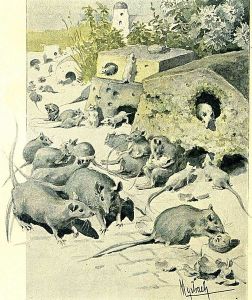
We accept evolution up to a point.  Is it any wonder then that creationists still are a force with which to contend?  Often we fail to recognize that science, as it has developed in the western hemisphere, gestated in a largely Christian context.  The reason for drawing a hard line between animals and humans is ultimately, in this setting, biblical.  We’ve moved beyond the idea of God creating each separate species one-by-one, but we haven’t gotten beyond the literal truth of Adam naming and dominating them.  If we don’t consider the biblical origins of these ideas they continue unchallenged, even into the laboratories and sterile rooms of today.  It makes us a bit uncomfortable to consider just how influenced we still are by the Good Book.  At the same time we consider its meta view on the biological world, even as the evidence continues to pile up that little, if anything, really separates us from our faunal kin.  Try explaining that to the rats.  That sound you can’t hear without special equipment, by the way, is their laughing.


A Decade

Please pardon my being sentimental, but today marks one decade of blogging on Sects and Violence in the Ancient World.  I realized, thinking this over, that I used to make some interesting, perhaps even quotable statements back then.  Why not, I thought, farm those older posts to celebrate what I was thinking when I was a tenth-of-a-century younger?  So for today’s post, I’m presenting some quotable quotes from July 2009, starting with one of the zingers from my very first post.  For convenience, I’ve even provided the links to the posts so you can see them in context, if your July has somehow not filled itself up already.

Sects and Violence in the Ancient World, by the way, was the name given when one of my nieces thrust a recorder in my face and asked me what I would call a blog, if I had one.  She subsequently set this site up for me.  One aspect of the title may not have been evident: it’s a quasi-anagram for my initials.  It has been, from the beginning, mostly metaphorical.  Without further ado, then, a few of my favorite lines from a decade long gone:

“He had a sidekick called Cypher (sold separately), and arch-enemies with such names as Primordious Drool and Wacky Protestor. I marveled at the missed opportunity here — they could have called them Text Critic and Doctor Mentary Hypothesis!” First post: Bible Guy, July 12, 2009. <https://steveawiggins.com/2009/07/12/bible-guy/>

“Technology has outstripped reality.” Asherah Begins, July 13, 2009 <https://steveawiggins.com/2009/07/13/asherah-begins/>

“Black and white are not in the palette of serious religious studies.”  God is Great (not)?, July 14, 2009 <https://steveawiggins.com/2009/07/14/god-is-great-not/>

“When he [Aqhat] refuses to release it to the goddess he is unfortunately pecked to death in a hitchcockian demise by a swarm of buzzards with attitudes.” Sects and Violence, July 15, 2009 <https://steveawiggins.com/2009/07/15/sects-and-violence/>

“Indeed, one may think of them [religion and monsters] as fellow ventricles in the anatomy of fear.” Vampires, Mummies and the Holy Ghost, July 16, 2009 <https://steveawiggins.com/2009/07/16/vampires-mummies-and-the-holy-ghost/>

“Better to consider it [weather] human than to face unfeeling nature.” Changing Faces of the Divine, July 18, 2009 <https://steveawiggins.com/2009/07/18/changing-faces-of-the-divine/>

“As the gods are drinking themselves senseless (how else can the latest Bush administration be explained?)…” Drunken Moonshine, July 20, 2009 <https://steveawiggins.com/2009/07/20/drunken-moonshine/>

“As usual, we kill off what we don’t comprehend.” Not Lion, July 22, 2009 <https://steveawiggins.com/2009/07/22/not-lion/>

“A bonobo was recently documented as uttering the word ‘yes’ to a keeper’s question, officially making her more articulate than some clergy I’ve known. Even today there are churches that still call their leaders Primates!” Religious Origins, July 23, 2009 <https://steveawiggins.com/2009/07/23/religious-origins/>

“I never used a computer regularly until I began my Ph.D., and then it was only a glorified typewriter, qwerty on steroids.” Who We Were, July 27, 2009 <https://steveawiggins.com/2009/07/27/who-we-were/>

“I grew up in a blue-collar household where paying ladies for favors was itself considered a sin.” Yes, Mammon, July 28, 2009 <https://steveawiggins.com/2009/07/28/yes-mammon/>

Where do you suppose we’ll be a decade from now?


Not for Men

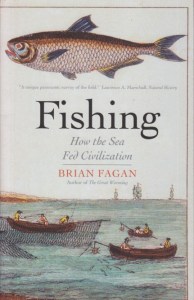
Does anyone else think that feeding fishmeal to herbivores so that they, in turn can be eaten, is weird?  Brian Fagan in his Fishing: How the Sea Fed Civilization describes the long history of eating seafood.  In evolutionary terms it makes sense, but so does veganism.  One thing that becomes clear from this study, however, is that human civilization simply could not have developed the way that it did without fishing.  Food for those performing massive public works came from the abundance of the ocean.  Theology played its part too.  Roman Catholicism established a habit that still exists of eating fish on Friday.  In Catholic areas of this country Friday fish fries, and the occasional fish boil, are cultural icons.  As Fagan points out, part of the reasoning behind this was the belief that God gave humans fish to exploit.

We find, interestingly enough, that religious thinking often stands behind tragic results.  Although I’m a vegan, I find it distressing that the oceans—so vast in extent—have been depleted by human activity.  The main problem, which we’re slow to learn, is that technology has made fishing too efficient.  This isn’t some kid with a rod and reel on the bank of a muddy river, but rather the industrial-scale trawling that begins by locating fish schools with sonar.  Not only that, but the land habitat to which we bring the fish is also being depleted.  I’m probably not the only one who gets the feeling that Fagan’s writing about more than just fish.  Where there is abundance, we take it as an invitation to exploit.  Tech makes it so easy!

In the early history of humankind, seafood was a necessity.  As Fagan shows, it was sometimes reserved for hard times.  Now we feed fishmeal to domesticated animals not because it’s what they naturally eat, but because—you guessed it—it’s cheap.  I’m still not allowed to give blood because of the Mad Cow Disease scare that rocked Britain when I lived there.  In part it was caused by feeding herbivores feed that consisted of meal made from other herbivores.  I no longer eat fish.  With the world population what it is, and global warming stressing agriculture, it seems we need to be thinking about what’s for dinner.  Quite apart from the fact that fish are, despite proclamations of ecclesiastical bodies, animals just like any others, we’ve managed to scour the ocean so thoroughly that recovery may be impossible in some locations.  The reason often given is that God gave us the oceans to use.  And that kind of thinking always leads to disaster. 


The Lagoon

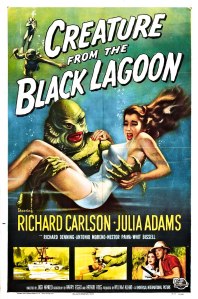
My current book project has me watching The Creature of the Black Lagoon again.  One of the Universal monsters—indeed, arguably the last of them—the Gill-man fascinated me as a child.  There was a strange contradiction here.  The creature had evolved in the Devonian Era and remained unchanged into the 1950s.  But the movie opens with a voiceover of Genesis 1.1.  There’s a mixed message here, appropriate for scriptural monsters.  Watching the film again brought back many of the innocent perceptions of youth, as well as the trajectory of my own life.  I don’t often get to the theater to see horror movies anymore, but at the same time the Universal monsters aren’t quite the same thing as modern horror.  As a genre it had to evolve.

Strangely, as a fundamentalist child, the evolution aspect didn’t bother me.  I was after the monster, you see.  The backstory was less important.  Growing up, at least in my experience, means that the backstory becomes more essential.  It has to hold together.  There are, of course, inaccuracies in the story—many of them, in fact.  Still, within the first three minutes Genesis and evolution are thrown together in a happy harmony that belied what I was being taught at church.  The Gill-man is a monster mainly for being a creature out of time.  When modern humans invade his lair, he defends his territory.  The story might’ve ended there, had he not spied Kay.  He doesn’t so much want to kill her as get to know her better.  For a movie posthumously rated G, it has a body count.  Five men die but the Gill-man apparently just wants to evolve.

There’s been a recent resurgence of interest in Creature from the Black Lagoon with both the publication of The Lady from the Black Lagoon and the death of Julie Adams this year.  The Gill-man seldom shows up in the same billing with Dracula or Frankenstein’s monster, or the Wolf-man.  He’s a bit more inaccessible in his watery abode.  Both cold and hot-blooded, he represents how science and Scripture might get along, at least on the silver screen.  The film holds up remarkably well, if a modern viewer can handle the pacing.  Underwater filming was pretty new back in the day, and watching humans swim in many ways suggests the truth of evolution in its own right.  These aren’t the childhood observations of the movie, but rather the reflections of a guy wondering if there might not be some hidden wisdom in the monsters of yesteryear.


Not from Nazareth

The world just doesn’t feel safe any more.  I’d better give a little context as to why.  You see, I just learned that what I thought was the work of carpenter ants is actually that of carpenter bees.  I never knew such things existed!  This still might not give you the thrills you were hoping for, so here goes a true story: when I was maybe six or seven my mother took my older and younger brother and me to a place in the woods where we could run around and holler and not bother anybody.  We had our dog there too, as well as our grandmother.  After a while my brothers started a game—throwing a stick to see who could get to it first, me or our dog.  I was running along, stepped on a stump, closely followed by the dog, when a swarm of angry yellowjackets flew out.  I was wearing shorts at the time and received multiple stings on my bare legs.  We didn’t think our dog would survive; he was completely covered.  So I have a thing about bees.

My phobia isn’t as bad as it used to be.  I’ve been stung many times since, and it always feels like an insult as well as a bad memory.  (I still don’t wear shorts, except on very rare occasions, when the bee quotient is zero.)  Believing in turning the other cheek, I’ve even captured and released bees from the house rather than killing them.  Still, to this day, when I get a haircut if the woman pulls out a set of clippers you have to pry my fingers from the naugahyde when she’s done.  Anything that sounds like buzzing near my ears sends me into spasms of terror.  Please pardon the graphic fear.  It’s heartfelt.

I used to have nightmares about killer bees.  I still worry about them a lot, and wonder that if, instead of a wall, we might put up a massive, small-weave net this side of Texas.  I don’t know how high they fly, but we should try to do something, don’t you agree?  Now I’ve learned that bees can eat you out of house and home, literally.  The carpenter bee, to the untrained eye, looks like a bumblebee.  They’re big, heavy-bodied insects that can crawl through three-eighth-inch holes, perfectly round the insect guy tells me.  They’ll eat and mate, and release their larva, ready to grow stingers, into the world of my back porch.  They appear to enjoy the global warming, judging by their numbers.  Maybe it’s a good thing we settled not far from Nazareth because a friendly carpenter might soon come in handy.


Thoughts While Flying

Uh-oh!  I seem to be airborne.  All that’s in front of me is concrete.  If I don’t do something, my exposed hands will hit first.  Tuck, and try not to hit your head.  Still, on impact the first thing I do is look around to see if anyone saw that.  It’s embarrassing to trip and fall, especially when you’re old enough to be avoiding that sort of thing.  I jog before it’s fully light out, however, and the sidewalks can be uneven.  Just in case anyone’s watching my Superman impression, I immediately climb to my feet and resume my pace.  I’ll be sore tomorrow.  As a jogger since high school you’d think I’d have this worked out by now, but you’re never too old to learn, I guess.

The amazing thing to me is just how much you can think in those fleet seconds that you’re actually in the air, about to hit the ground like a sack of old man.  That’s exactly what happened, though, from the split second I felt my toe catch in an unseen crack and felt my balance give way.  Taking additional steps while trying to straighten back up sometimes works, but my top-heavy head was too far out of sync and my feet were sure to follow.  Your memory of such things goes out of body and you watch yourself comically flying, without the grace of a bird, toward an unforgiving substrate.  Such is the fate of the early morning runner.  I don’t have time to do it during the day.  What if someone emails and I don’t answer?  They’ll think I’m slacking off.  Remote workers!

Despite the occasional spills, I’ve always enjoyed this form of exercise.  In the post-Nashotah House days while still in Wisconsin I’d sometimes do nine miles at a time.  Whenever I’ve moved to a new place I’ve gotten to know the neighborhood by jogging around.  Even if it’s not fully light you can see plenty.  (Although the cracks in the sidewalk aren’t always obvious.)  I tend to think about these things as life lessons.  Parables, if you will.  One of the deep-seated human dreams is that of flying.  Birds make it look so easy, and fun.  A human body feels so heavy when it impacts the ground.  I suspect that’s why we find gymnasts so fascinating to watch.  As for me, I’m just a middle-aged guy in sweats and wearing glasses.  And even as I head home I’m already thinking how remarkable the number of thoughts are in the few seconds while in flight, somewhere over the concrete.


No Animals Harmed

Out for a walk after work the other day, I spied a black cat.  Not the superstitious sort, I didn’t let this deter me from continuing on.  Then I noticed that it was a mere three or four feet from a ground hog that was just as large as, if not larger than, the cat was.  They were staring at each other, weighing their options.  The ground hog didn’t appear too concerned.  Then a rabbit hopped up, on the other side of the cat.  A perfect syzygy of fauna that remained still for a moment in a tableau of nature.  About the same time as the cat noticed  the rabbit, the rabbit noticed it back and quickly hopped away.  The cat crouched and slunk after the bunny and the woodchuck ambled off at its own pace.

Not only was this conjunction an odd combination of three species of mammal—four if you count me—but it was such a conscious interaction that I had to think of it as almost human.  Three very different individuals, probably all with eating on their minds, had to assess how to interact, wordlessly.  As far as I could tell the drama ended amicably.  The cat looked well fed, in any case, and the rabbit far outdistanced it from the start.  Chuck was unconcerned.  Although the hard line still exists in science, drawn between ourselves and our fellow animals, I’m convinced that they have a share of consciousness.  We’re told that they’re mere “machines” following instinct.  These three “machines” along the trail were sure acting like they were thinking.

What are they thinking?

As the situation played out, no violence ensued.  Three individuals out enjoying the spring happened to find themselves in a scenario that called for negotiation.  The cat, like Republicans, felt compelled toward aggression, I should imagine.  It had a choice: take on a larger, more worthy foe, or turn its attention to the weaker, more vulnerable prey.  Naturally, it turned toward the weaker of the two.  There were differing agendas at play here, and with a dose of consciousness added in, these critters behaved so like human beings that I felt compelled to share it.   The ground hog and rabbit looked on the situation with some wariness.  They thought about it, and each took the prudent route to safety, for the time being.  Nature, it seems, will find its balance if we let it.  And we, if we would acknowledge it, still have something to learn from nature.


Nature’s Bible

When you’re writing a book, many strands in your mind are weaving their way into what you hope will be whole cloth.  Well, at least if you write books the way that I do.  In writing Weathering the Psalms, for instance, one of the threads was the question of science and religion.  I was teaching at Nashotah House at the time, and I read a lot of science.  As I told colleagues at the time, if science is how we know things, shouldn’t what we know of the natural world apply to the Bible?  I don’t claim to be the first to ask that question—back in the days of exploration there were many people (mostly the genus “white men” of the “clergy” species) who went to what is now and had used to be Israel, to find out what the world of the Bible was actually like.  Their books still make interesting reading.

Quite unexpectedly a colleague, Dalit Rom-Shiloni of Tel Aviv University, told me she’d just ordered my book.  She’s leading up a project called the Dictionary of Nature Imagery of the Bible (DNI).  Over a decade after my teaching career ended, someone had deemed my work relevant.  Dr. Rom-Shiloni recently sent me the link to the project website where there is a video of her interviewing three Israeli scientists about the possibility of lions, leopards, and bears living in Israel.  They’re all mentioned in the Bible and no longer exist in the area.  The video is on this link and won’t take half an hour of your time.  It’s quite interesting.

One of the surprising facts to emerge is that leopards, in small numbers, may still exist in Israel.  This assertion is based on lay observation.  I contrasted this with the United States where, no matter how often a cougar (aka mountain lion, puma) is spotted in a state where it’s “known” to be extinct, it is claimed to be mistaken observation.  A departed friend and mentor of mine once saw a mountain lion in West Virginia.  I’d grown up in neighboring Pennsylvania where they are officially extinct, so I wondered if said beasts knew to observe the Mason-Dixon line.  The fact is, despite all our best efforts to destroy our environment, animals often find a way to survive.  Growing up, one of my cousins in Pennsylvania (now also unfortunately deceased) showed me a puma print in the snow behind his rural house.  Now Pennsylvania is a long way from Israel, and this topic is a long way from the DNI, but remember what I just said about how my books are written.  Tapestries only make sense from a distance.


Ground, Candle, and February

The world’s hairiest prophet?

Relying on the prophetic ability of a rodent may seem like a fool’s errand, but to understand Groundhog Day you have to go back to Candlemas.  Apart from when I lived at Nashotah House, I’ve never been anywhere that people knew what Candlemas was.  It’s also known as the Feast of the Presentation, and it in itself is built on an archaic ritual based on a creative understanding of biology.  In ancient Israel, a woman was considered impure for seven days.  The eighth day, if the child was a boy, he was circumcised.  Thirty-three days later the woman, finally considered pure enough to approach the temple precincts, was to take a sacrifice for her purification.  And oh, if she bore a girl the impurity lasted sixty-six days.  It’s all there in Leviticus.

What does any of this have to do with Groundhog Day?  Well, according to the much later tradition that Jesus was born of a virgin on December 25, if you do the math you’ll find Mary’s purification falls on February 2.  And if Jesus had been a girl Candlemas would be a moveable feat since February sometimes has 29 days.  Since it’s still dark out for most of the time in February a couple of traditions developed: one was a way of finding out when winter would be over and the other was the blessing of candles since you’d still be needing them for awhile.  That gave the feast its common name.  The tradition grew that clear weather on Candlemas meant that winter was to last for a good long time yet.  Since Germanic peoples love their Christmas traditions, a badger was used for the long-range forecast part of the celebration.

In Pennsylvania Dutch territory, badgers are rare.  Woodchucks, or groundhogs, are just about everywhere and they live in burrows like badgers do.  In a carryover from Candlemas’s clear weather foretelling the future,  the belief was that a badger or groundhog seeing its shadow—because it’s clear, get it?—meant six more weeks of winter.  Of course nobody knew about global warming in those days.  Candlemas, it turns out, was one of the earliest Christian celebrations and it was part of the Christmas complex of holidays.  It’s still winter out there.  It’s also Saturday which means I already have a list of chores as long as a badger’s shadow.  Now I’ve got to remember to get my candles blessed as well.   Winter, it seems, never ends.


For the Love of Dog

All I have to do is say “Old Yellar,” and everyone will know the feeling.  Everyone of a certain age, I should add, who’s owned a canine.  The love of dog.  From where I pass my days I can see out the window into the neighbors’ back yards for four houses over.  They all have dogs.  Big dogs, mostly.  They also have fenced in backyards.  One of the things I haven’t seen too much in our neighborhood is dog walking.  People let their dogs out to frolic, and do their, ahem, other outdoor activities in the yard.  Once a day some member of the family, either with the basic plastic bag or with the specialized, long-handled brush and scooper, slowly surveys the yard to remove any offensive matter so the space may be used for human activities.  It’s a level of care that most would shudder to provide for their own species.

Wolves were the earliest domesticated animals.  In those hunter-gatherer days either they or humans—the jury’s out on which—realized the advantages of working together.  Kind of like we were fated to be partners.  Besides, unless the dog turns on us, there’s no question of who’s the master here, and everyone likes to be the boss.  When I catch a glimpse of one of the neighborhood pets being scolded, or praised, it’s clear they share emotions with us.  The bond is deep.  I often wonder about this—they recognize the tone of voice, something that takes humans a while to learn.  I grew up with dogs and I found out that even if you insult them in a friendly, encouraging tone of voice they’ll love you for it.  Dogs are just that way.

Our first real dog—the one that ended up staying with us his whole life, was a beagle pup we got at a farm.  Dogs like to be with others.  Unlike humans, they don’t have to pretend.  (Although they can do that too, as when they growl at you during a game of tug-o-war.)  Then we leave home and go to our places of business, where capitalism reigns.  We treat other humans coldly, clinically.  “It’s only business,” we’ll parrot, especially if we feel bad about doing what the boss tells us.  That’s the way we treat our own species when money’s involved.  And we’ll sit at our desks, daydreaming of our dog at home that will be so glad to see us when we walk through that door.  And we’ll gladly clean up after our pets what we find obscene even to write in human language.  It kind of makes me wonder when I glance out the window while at work.


Not about Pigs

Pseudepigrapha always struck me as a great name for a pet guinea pig.  Neither members of the porcine family nor from Guinea, these rodents are remarkably companionable.  But like the word pseudepigrapha, this post isn’t about guinea pigs.  I’ve been reading various documents among this sprawling category of texts, and I can see the fascination they hold for scholars of Second Temple Judaism.  My own specialization was on the earlier end of the spectrum—Ugarit had ceased to exist even before a first temple was built and provided clues to how this whole religion got started in the first place, but that’s a story for another time.  The account of the pseudepigrapha  cannot be summarized easily.  Some of the documents have been known to scholars for a very long time.  Others have been (and continue to be) discovered, some quite recently.

Not a pig.

The documents classified as pseudepigrapha generally bear the name of someone who couldn’t have been their “author.”  We now know that ancients didn’t think of writing the same way we do.  They didn’t publish books like modern writers do, and scholars have been exploring how the category of “book” distorts even the Bible, let alone books that didn’t make the cut.  None of this diminishes the intrigue of these ancient texts.  The world into which Jesus of Nazareth was born contained many texts and traditions.  There was no Bible as we know it today—it was still being written (or compiled)—and no canon, literally a measuring stick, existed to determine what was holy and what was not.  

As discoveries in Mesopotamia have made clear, although few could read or write, writing itself was prolific, at least given the technological limitations.  Today if one wishes to specialize the literature of one subsection of one time period, and probably even some subdivision of that, has to be selected.  Universities don’t see the point, and much of this ancient material is understudied because there remains money to be made in looking at economically viable topics.  The pseudepigrapha have nevertheless come into their own.  Perhaps because some of the stories these documents contain have made their way into pop culture.  Even as I make my way through many of these texts that are young in my eyes, I realize the proliferation of writing made such growth almost inevitable.  There remains, however, a high-pitched squealing that demands attention, regardless of what the exact genus and species of the creature may be.


Mastering Ravens

One of the most difficult things in modern life is to keep up with all the new jobs available.  That’s not to suggest that unemployment isn’t a real problem—it is—but that the game has changed since the days I went to the guidance counselors’ office and thumbed through the box of microfiche to learn about potential colleges.  (And what strange people the guidance counselors were!)  Since 1981, when I graduated from Oil City High School, the Internet has been invented and has changed employment forever.  I understand that making YouTube videos can now be a full-time job, with benefits.  Who knew?  So when I was kindly presented with a copy of Christopher Skaife’s The Ravenmaster: My Life with the Ravens at the Tower of London I wasn’t too surprised to learn that there is such a job.

Delightfully written, The Ravenmaster goes into the ins and outs of life in what is a ceremonial job.  That the Brits are fond of tradition is no secret, and this little book is so full of them that it becomes a delightful gallimaufry that includes, I kid you not, dog biscuits marinated in blood.  Although Skaife takes you on a few detours through his own life, the book is mainly about ravens.  We’re so used to materialists telling us that everything is simply cause and effect of neurons firing that I wonder how they might react to the obvious intelligence and personalities of ravens.  Reading about their antics as well as their wisdom it’s difficult not to surmise that consciousness isn’t a purely human preserve.  With the ravens and the wolves we are a piece.

Intelligence is more common in the animal world than in the White House these days, and this book may help to show why.  Ravens can plot, plan, and be cruel.  They can also be kind, compassionate, and friends.  I’ve long had a fascination with corvids, and I tried to befriend some before moving out of New Jersey.  It was a bit tricky with the strictures of my own Tower of London—the commute, the bus, the job—and so my friendship with the local crows in the back yard of our apartment remained strictly casual.  We lose so much by not paying attention to the natural world of which we are, increasingly, so unnatural a part.  When humanity disappoints and the ridiculousness of human behavior haunts, I recommend reaching for The Ravenmaster.  It’s comforting to know that real minds exist out there in the wild.


Web Design

As those who read this blog on the actual site will have noticed, I’ve been playing around a bit with my “look.”  Neither famous nor influential, I’m just a regular guy with a doctorate who wants to make some use of it.  This blog is a way of doing that.  In any case, as I was changing templates and background images, I noticed my rather lengthy blogroll.  Apart from sounding like a particularly tasteless eastern appetizer, blogrolls are pretty much outdated these days.  Back when I started this, there was a community of like-minded bloggers who linked to each others’ pages and helped stir some stats.  In those days doing something like posting on the winner of the Super Bowl could garner you a thousand hits in a day.  The web’s become a bit more crowded since then, I suspect.

So I went to edit my blogroll.  As I did so I found no other blogs linked to mine—no offense taken!—and many that had become defunct.  Many, many.  And there were many blogs that hadn’t been updated in years.  Now, I understand that it is possible to make a living as a blogger these days.  According to my stats, this will be my 3,447th post.  When I consider the time it takes each day to write one of these things, I realize it’s a considerable piece of my life.  Seeing the blogs that have become inactive was like walking through a technological graveyard where many virtual comrades are buried.  For me, the exercise of writing (and I don’t mean the physical typing) is an essential part of each day.  I’d miss it if I stopped.

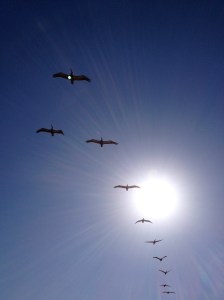
My redesign focuses on a couple of things: books and pelicans.  Since the books part should be obvious, the pelicans might need explaining.  The background image is one I took while visiting the University of California, Santa Barbara for Routledge.  On my lunch break I went down to the beach and this flock of pelicans flew right over my head.  The iPhone was new in those days, so I pulled it out and snapped a picture.  It won a company photo of the month prize (no monetary value).  There’s quite a bit of symbolism in this image of birds against the California sun.   This blog tends to be metaphorical and those who’ve complained on it over the years don’t really get that.  That’s because things are not what they seem.  There’s something valuable about having to dig for meaning, even if it means looking up.