Thy Will Bee Done

Today I had to do battle against the bees. That’s the way I must steel myself for the task of mass specieocide. Watching those little tiny creatures struggling, kicking their six legs and antennae into the air, trying to get the poison off is heartrending to me. They are, after all, only trying to do whatever it is that yellow-jackets do. But it is a heat wave right now, and without central air we need to open windows as much as possible, and today they tried to invade people air space. I had to do something. So standing over the carnage of an Ezekielian valley of damp exoskeletons, I recalled the bees of the Bible. (May their entomological souls rest in peace.)

Bees are one of the more innovative weapons in the divine arsenal. They are used to chase people away, like God’s little army of armored stinger missiles. And as in any arms race, it is numbers that count. Hundreds of them to the one human being holding a putrid can of chemicals trying to defend home against their incursions. In the book of Judges, the one prominent female judge is Deborah. Her name translates to “bee.” She is the bane of the Canaanites. So much so that general Barak (“lightning”) refuses to go to war without her. Bees were a potent curse in ancient times as well, strong enough to drive a family from their home.

Bee careful around this one, because love hurts!

Bee careful around this one, because love hurts!

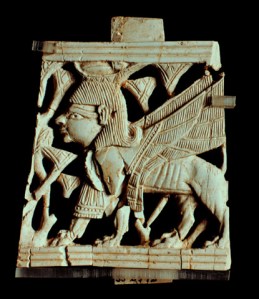
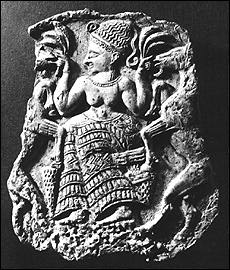
A Sumerian cylinder seal depicts what appears to be a divine scene with a killer bee goddess (not an Africanized killer bee, but a slang killer bee). One wonders what the worshippers must be thinking. Perhaps they too had watched Phase IV when they were kids! Bees could also be benevolent. Honeybees provided a rare treat before sugarcane had been discovered, and even Israel’s “promised land” flowed with milk and honey. So like most of life, bees were ambiguous. They bore all the markings of the divine: a wonderful sweet residue, nice trendy color scheme, but a painful sting that could even be fatal. Gifts of the gods are like that. So no matter how humane my temporary solution may be, I still feel like I’m taking on the gods.


More Biblical Cats

In the Bible there are no cats. This silence is odd since cats have been associated with humans for over 9,000 years. Large felines, of course, appear in the Bible; lions and leopards prowl sacred writ, but nary a housecat. In a world of subsistence farmers, the concept of a “pet” is also absent — an animal as part of the household is yet another mouth to feed. The closest we get to biblical pets is in Nathan’s parable to David about Bathsheba. Here the “pet” is a lamb — a potential source of wool and almost certainly a funeral involving roasting and possibly mint sauce.

The Israelite view on animals is difficult to assess fully. Clean and unclean classifications seem to relate to predatory behavior and “fitness” for an environment. As a notorious but useful predator, cats could have been somewhat of a religious embarrassment. Having tamed feral cats, I know that the key is to make repeated offerings to a cat (by the way, this is the advice of Old Deuteronomy in Cats). Being quite self-sufficient, cats can find what they need without human, or divine intervention, thank you. Perhaps feline behavior resembles that of the gods a little too much for people inclined towards henotheism?

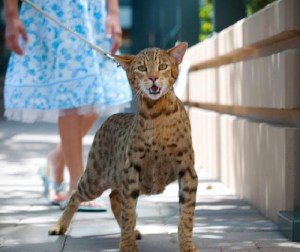
In the beginning was the cat

In the beginning was the cat


The problem with predators is no one knows what they’ve been eating. Predation involves bloodshed and blood pollutes. Look at what the cat dragged in! Biblical cats are victims of argumentum ex silentio — we can never know why they don’t merit a mention. As carnivores they are necessarily unclean. By the Middle Ages, for reasons still unclear, the church and superstition rendered cats as the familiars of witches. Ironically the associated killing of cats likely helped to spread the Black Death because of the removal of the flea-bearing rodents natural predators. In most ancient cultures cats are credited with supernatural powers. Since the Bible strictly guards this privilege, perhaps cats stepped just a little too close to divine prerogatives to merit a mention in the Good Book.


Everlasting Cats

“The mystical divinity of unashamed felinity, round the cathedral rang ‘Vivat!’ Life to the Everlasting Cat!” I’m not sure if this is T. S. Eliot, Andrew Lloyd Webber, or a chimeric mix of the two, but it is an interesting bit of mythology. My daughter is the consummate Cats fan and has been asking me to write a post on Cats and religion. When I read (or hear) the above lines of poetry, I must confess, my mind wanders to Xenophanes who stated that if horses could draw they would draw their gods like horses. Ditto for cats.

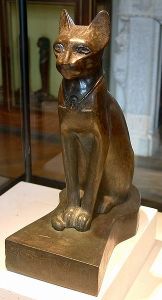
Everlasting cats, however, have their roots deep in religions of the ancient world. Although the word “cat” never occurs in the Bible (“dog” is there plenty of times, with even a “bitch” or two) cats are certainly within the biblical culture. Eternal Egypt knew of an everlasting cat — Bastet, the “cat goddess.”

Bast to see this as an everlasting cat

Bast to see this as an everlasting cat

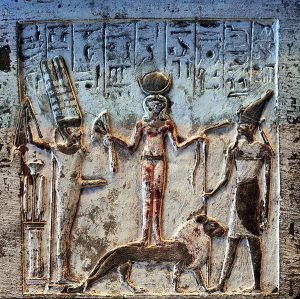
Hailing from Bubastis, Bastet (I just can’t call her Bast, since it sounds like slathering meat with some kind of ambiguous liquid, something I can’t stomach as a vegetarian) seems likely to have some connection with the sun. Regarding yesterday’s post, the ancient Egyptians had a plethora, a veritable superabundance even, of solar deities. Bastet was called the Eye of Ra. She was also associated with war, appropriate enough to anyone who’s read Erin Hunter’s Warrior series. As a goddess, Bastet qualifies as an everlasting cat.
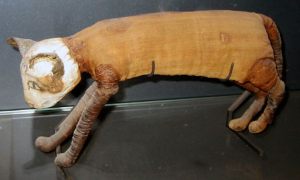
Little Bastie doesn't seem so playful any more

Little Bastie doesn't seem so playful any more


So do the numerous cat mummies from ancient Egypt. Preservation of the body was an aspect of realizing life beyond life for the Egyptians. It would also obviously help to keep the mice out of heaven. T. S. Eliot was C. of E. (Church of England, not Copt of Egypt) and had a savvy sense of wit. Ignoring the biblical snubbing of cats, he named the wisest and most respected of Old Possum’s Practical Cats with a biblical name — Old Deuteronomy. Although I am not a cat owner (is anybody really a cat owner?), I do have great respect for felines, mystical or not. And I am not alone as long as the ancient Egyptians kept a mummy or two around and an Eye of Ra to keep that solar barque on its course.


Religious Origins

There’s no question that religion is a distinctly human phenomenon. Although the concept of “religion” is used to lump together all kinds of belief and praxis systems around the world, it is now an aspect of every culture ever studied. When on an interview recently for a religion teaching post, I pondered whether to be entirely frank or to play it safe: should I discuss the origins of religion or a more conventional topic? (I went the safe route and did not get the job, if anyone wonders if there might be a moral to all this…)

For several years now I have been exploring whether it is possible to trace religion back to the animal coinhabitants of our planet. While my musings have taken me from singing Neanderthals to mourning penguins, it has become quite clear that at least the most basic levels of religion also exist in what is often termed “lower” life forms. My epiphany began while watching David Attenborough discussing the purpose of birdsong. Religion and music have been nearly inseparable in human experience (if one can overlook some extremist reformers). My thoughts turned to elephants who “bury” their dead with branches and penguins who clearly mourn the loss of their young — watch March of the Penguins if you doubt it! Death and religion have walked the long and disjointed journey of humankind hand in bony hand. By the time we get to primates we find baboons stopping to watch the rising sun (an act the ancient Egyptians supposed to be solar worship) and chimpanzees raging against thunderstorms as if they despise Baal even more than Hosea. A bonobo was recently documented as uttering the word “yes” to a keeper’s question, officially making her more articulate than some clergy I’ve known. Even today there are churches that still call their leaders Primates! For those who doubt that animals are capable of worship I would suggest the true acid test — purchase a dog.

The C of E's newest primate?

The C of E\’s newest primate?

We guard far too jealously that which makes us better than our animal companions. As observation and research progress and that line in the speciological sand grows ever more effaced, I wonder why religion might not have its roots in our very animal nature. While reading a book on biblical flora recently, I pondered if a even larger step back might be taken. Consider the heliotropes, for indeed they do toil and spin.


Not Lion

Being raised without much of a paternal presence, I frequently wondered at how church services were always presided over by men but populated by women. When I grew up (well, part-way at least) I became interested in feminist interpretations of the patriarchal Bible. The idea that just half of the human population seemed to have all the interpretive privileges simply struck me as unfair. Being a man myself, however, I wasn’t sure where to go with feminist interpretation, or even if I was qualified! This penchant no doubt vexed many an official in my Nashotah House days, but the conviction only grew stronger there.

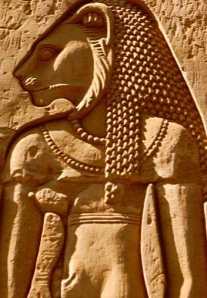
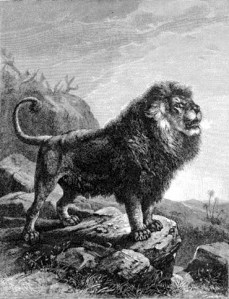
While preparing class materials on the prophet Amos, I recalled how fond the prophet was of leonine imagery for Yahweh. Amos characterizes Yahweh as roaring, hunting for prey. Curious about lions in Israel, my research revealed that the great felines are extinct in that part of the world. The Barbary lion, extinct in the wild, was the biblical lion. As usual, we kill off what we don’t comprehend.

Further research revealed that lions like to sleep even more than most teenagers. It is not unusual for a lion to sleep 20 hours a day! When they have to wake up, however, they are hungry. And here was the interesting tidbit — when lions hunt it is usually the females that do the work! Once a kill is made, the male struts in and takes the proverbial lion’s share, but the lionesses are the hunters. In the ancient world, before television, ipods, or even mindless Ann Coulter drivel, people were keenly aware of their environment. Ancient writers often made astute observations of nature. Would Amos, the shepherd, have known that it is the lioness who makes the kill? Was Amos the first feminist in the Judeo-Christian tradition?

Compare the lions.

Compare the lions.


Which is scarier?

Which is scarier?