Uncut

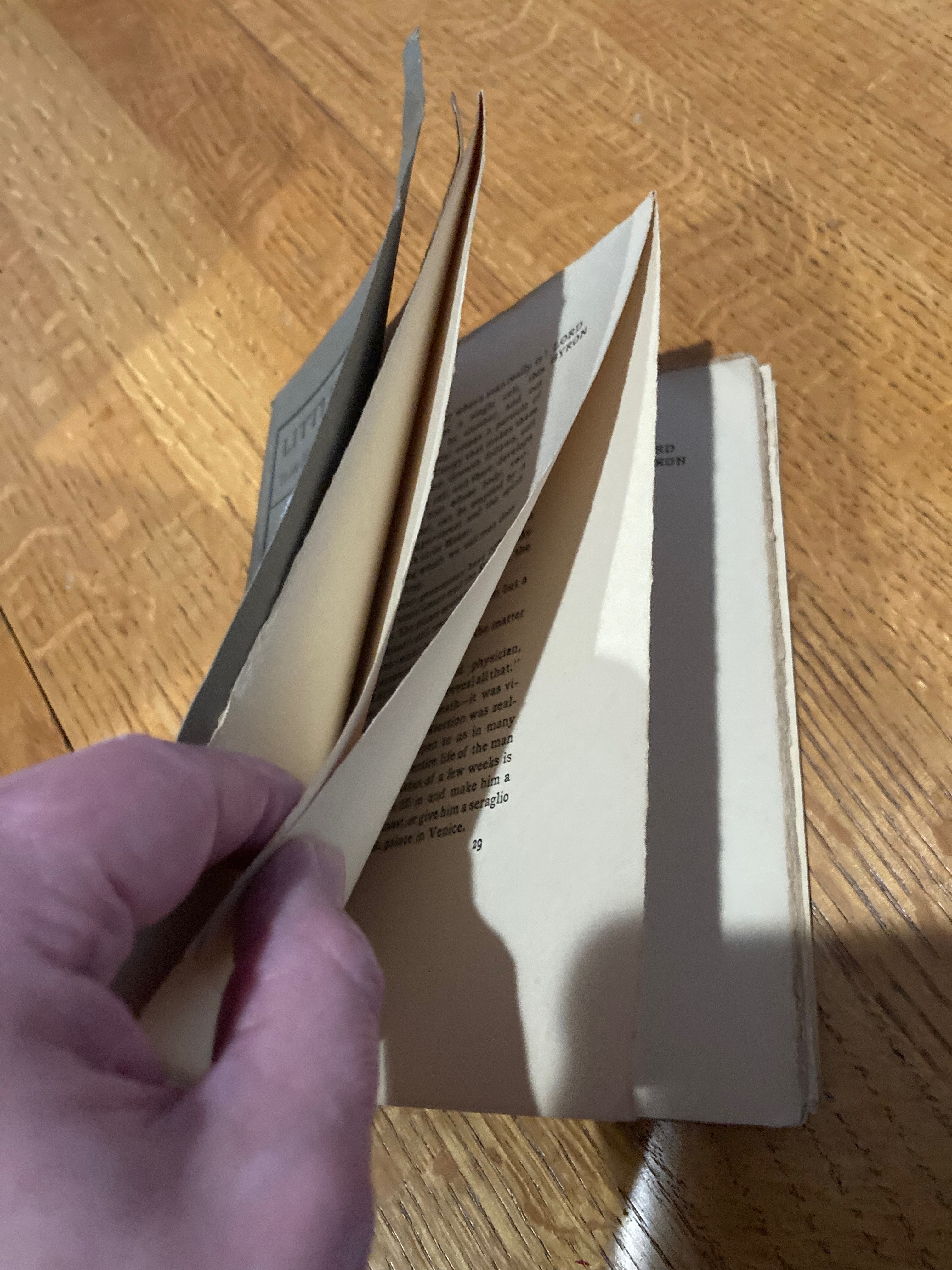
I remember well the first time I encountered a book with uncut pages.  It was in Edinburgh and the book was mine on inter-library loan.  This presented a dilemma: should I, a mere post-graduate student, cut the pages of a book older than me?  The librarian told me it was fine to do so.  I wasn’t sure how to go about it.  I’ve never trusted myself with scissors and this seemed like such a permanent act I was about to commit.  I settled on a butter knife, figuring a sharp knife might cut into the meat of the page.  It worked fairly well.  I later bought a book with uncut pages.  I didn’t do so well on it, but I need to read what was inside (and it wasn’t a cheap book).  

This is more common in Europe than it is in the United States.  I recently bought an out of print book for my research.  The pages were uncut.  Now we have the internet which can be useful from time to time.  The proper technique, it turns out, is to use an index card with a saw-like motion.  It works extremely well.  Fighting paper with paper.  And I love these old books.  The heavy paper.  The actual, clear imprint of where the type hit the page.  This was an object being crafted, not electrons cycling around a screen.  When it was done you were left with something that felt permanent.  Something that wouldn’t disappear when an online vendor went out of business.  These old books also give you an idea of how they were made.  Offset books (those made on a traditional printing press) are printed on paper that is then folded and bound together.  Most modern presses also trim the edges, but you can, on rare occasions, still see where metal met paper.

Substantial.  These books feel substantial.  Don’t get me wrong—I enjoy the trim, clean look of the modern book, but part of me misses the solidity of old fashioned books.  As much as I enjoy visiting new bookstores, I also like used bookstores.  There used to be several around here, but I think the pandemic killed them off.  You can browse their inventory online, but it’s not the same experience as that dusty, musty smell of books aging well.  Now that mass-market paperbacks are being discontinued, they have their own place of pride as being the books that brought reading to the masses.  Now people stare at screens and call it reading.  I, for one, will be keeping my index cards handy for the next book with uncut pages that comes my way.


Recipe for Childhood

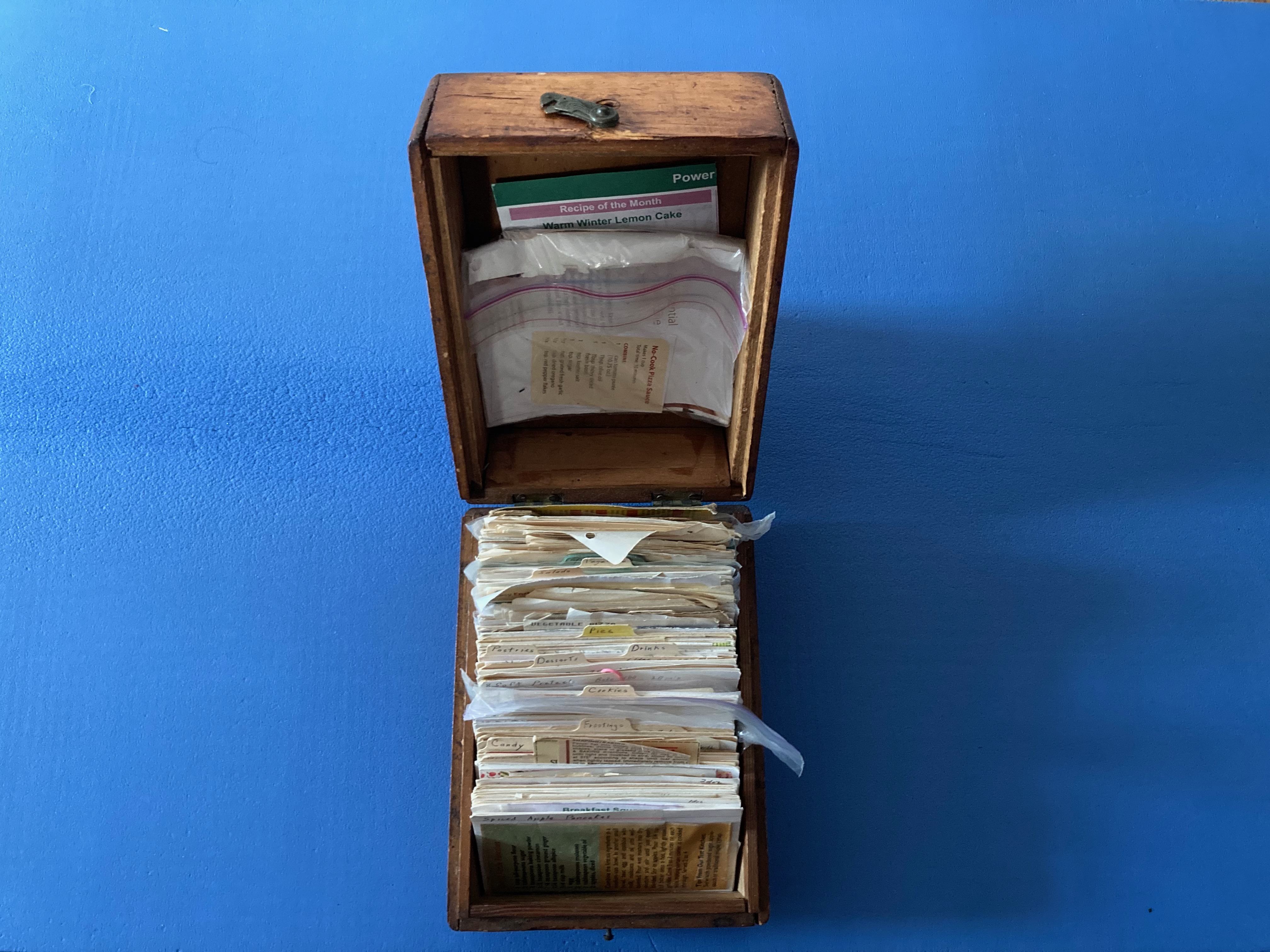
I once read that over the course of an average lifespan, an American will eat 73,646 pounds of food.  Think about that.  That’s over 36 tons of food.  Apiece.  No wonder recipe books sell so well!  This came to mind recently as I was thumbing through one of my mother’s mementos.  When she died I inherited her recipe box.  In liquidity terms it’s worthless, but inside is a great deal of my childhood.  I still find it poignant to look through her things although she died two-and-a-half years ago.  The memories are thick and tangible.  I only now had the courage to look through the foods she tried, liked, and sometimes didn’t.  (Some have notes, for example, saying what a friend didn’t like.)  We eat every day.  And variety is important for health.  So, recipes.

But not all cards are for things we eat.  The one that really jarred me was the recipe for play dough.  I grew up in a family of humble means, but not destitute.  I know, and still recognize instantly that Play-Doh smell.  It, along with Crayola, encapsulates childhood.  But I remember Mom making play dough for us.  The recipe is very simple: flour, water, salt, and a little oil (yes, it is edible) with food coloring.  I remember trying to mix the coloring in by hand and ending up with stained skin until the dye wore off.  And Play-Doh always makes me think of Silly Putty.  I think as a kid I kind of supposed the two were married.  Similar, but different in significant ways.  Kind of like cats and dogs, in my juvenile mind.

Childhood is strange.  We tend to cast a kind of rosy glow on it, even if it wasn’t very pleasant.  In my case, Mom was my protector.  I grew up without a father present and one of my greatest fears on becoming a father was that I didn’t know how to be one.  My role models were television figures and men I’d met and admired in my own life.  My father was a stranger but Mom made play dough for us at home when we couldn’t afford to buy it at the store.  After my daughter was born, and was old enough for them, the smells of Crayola and Play-Doh took me back to that pleasant version of childhood where things were fine and I had nothing better to do than to play.  Mom would prepare part of the many tons of food I would eventually consume.  And it all came from a simple wooden recipe box.


Little Gems

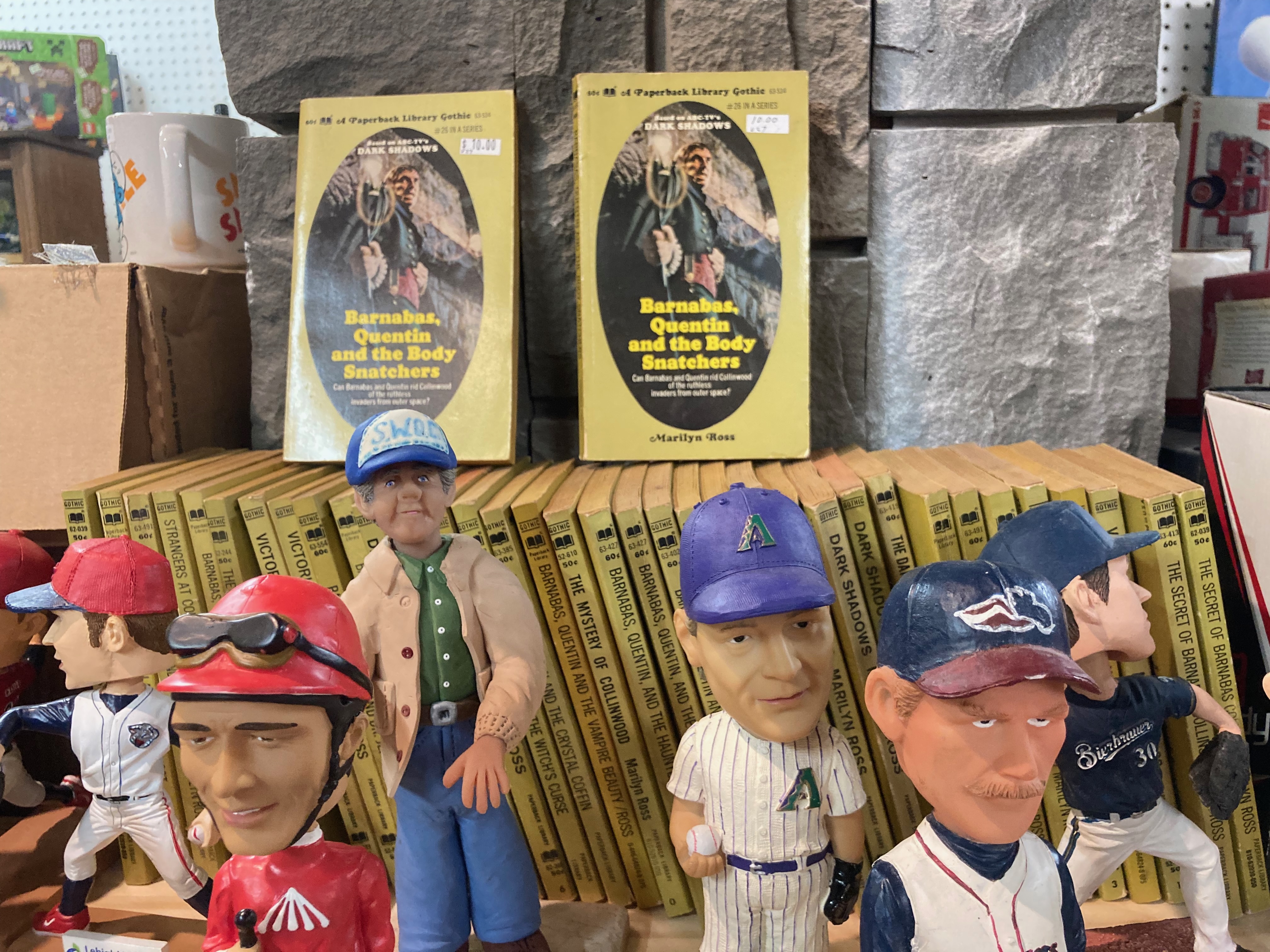
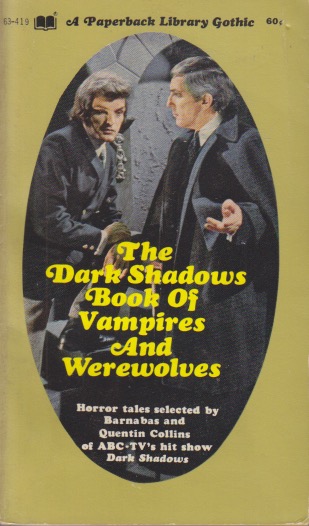
On a recent diversion to a curio shop we like, I found that one of the “Dark Shadows” paperbacks they had was one I hadn’t read.  Dark Shadows had, of course, spurred a pretty amazing franchise for its day.  It’d sunk its fangs into many young people who would not have otherwise been inclined towards soap operas.  I’ve written several times about the spin-off books by Marilyn Ross.  That series encompasses much of my childhood.  This particular book was a knock-off with the same branding titled The Dark Shadows Book of Vampires and Werewolves.  Now, to be fair, the asking price was about the same as a trade paperback price today—a little less, even—and the collection included, I saw at a glance, Polidori’s “The Vampyre.”  So now it sits on my shelf next to the other Dark Shadows books.  Apart from the gimmick of listing the book as edited by Barnabas and Quentin Collins, it is actually a nice period piece.

In addition to Polidori, eight stories I’d never read.  Two of them make the claim of being non-fiction, and a third maybe.  The tales, which favor vampires over werewolves, also include what are some little gems.  One is a story by M. R. James (“Count Magnus”).  Other noteworthy members are “Wolves Don’t Cry” by Bruce Elliott and “The Vampire Nemesis” by “Dolly.”  “For the Blood is the Life,” by F. Marion Crawford, is also good.  In other words, the collection was better than I suspected it would be.  I’d not read any of these before, so they were all new to me.  I was particularly intrigued by “Dolly.”  Apparently the author of The Vampire Nemesis and Other Weird Tales of the China Coast has remained anonymous since its 1905 publication.  The book has been rediscovered in modern times, and I’m now curious about it.

Although I like to think myself immune, I am sometimes susceptible to branding.  For whatever reason, that olive-green oval-cutout cover design, when spotted in the wild, makes me ecstatic.  My childhood wasn’t ideal, and I remember when I started to find these books used.  It was a very challenging phase in my younger years.  I knew even then that these cheap paperbacks would take me away from my troubles for a while.  And they would transport me back to an even more troubling period of my childhood when I would watch the show after school with my brothers.  A visit to the curio shop from time to time may be just what the doctor prescribes.


Loss and Beauty

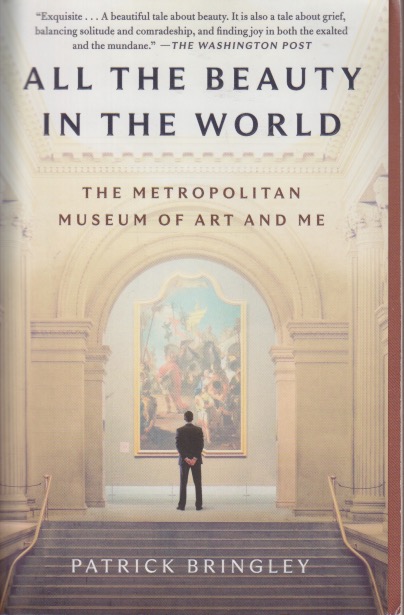
Losing someone close to you is never easy.  We of our species are closely interconnected, but family is where we feel the safest and, hopefully, most accepted.  There are many ways to deal with grief, but one of the more unusual is to take a job at the Met.  The Metropolitan Museum of Art is world famous, of course.  And Patrick Bringley, giving up a rat race job at the New Yorker (where he got to meet Stephen King, I might add), to become a guard at the Met, is the kind of thing to write a book about.  He frames it as a way of dealing with the loss of his older brother prematurely to cancer.  All the Beauty in the World gives you insight into a job open to just about anybody, but that has long hours and pay hardly comparable to the costs of living in New York City.  Giving up the rat race to spend your days looking at, and keeping people from physically interacting with, art doesn’t sound like a bad thing.

This memoir delves a little bit into spirituality, but not in any kind of religious way.  Then Bringley starts a family and after ten years decides to take his career in another direction.  I’m familiar with career pivots.  In my case, the choice was made for me and anybody who reads much of my writing (either fiction or non) knows that I’m trying to cope with it still.  In any case, museum work—I’ve applied for many such jobs, on the curator side, over the years—isn’t easy to find unless you’re willing to be a guard.  I know security guards.  It’s not a job that will make you rich, but it does give you access to riches.  Art is something we seldom take time to admire since, for most of us, museums are a weekend activity, and even then, only once in a while.

Museums begin with collectors.  Generally rich ones.  Those who can afford what the rest of us can only dream about.  They’re also altruistic places, for, as well as showing off, they give the rank and file access to what we tend to value even more than money.  The creative work of those we deem geniuses.  Bringley doesn’t just focus on the “Old Masters”—they are in here, but not alone—demonstrating that art can, and should, include the creative work of African-American quilters and woodworkers ivory carvers from Benin.  Museums are places that bring us together instead of separating us (that’s the job of politics, I guess).  And this book is a thoughtful way of dealing with loss.


Nostalgic Shadows

Nostalgia is a funny thing.  Although it can strike at any age, somehow after the half-century mark it’s particularly easy to get swept into it.  As I written about many, many times, I was drawn into the Marilyn Ross Dark Shadows novels as a tween.  In my mid-to-late forties, when the internet made it possible, I started to collect all the volumes from 1 through 32.  It took several years.  I had to find them via BookFinder.com and our level of income didn’t support buying more than one every few months.  Then in 2022, having difficulty locating the last of the original series, I found a seller on eBay offering up the whole set.  The price for that set was less than the least expensive final volume I could find.  I did what any nostalgic guy would do.

We don’t really buy antiques, but I’d been looking for an office desk (this was before the scam).  I’d been using a craft table for a desk for years and it seemed that I really needed something with a better organizational range.  This led me to stop into a local antique shop.  They ended up not having much furniture, but they did have aisles of nostalgia.  A few weeks later when it was too hot and humid to be outdoors, I revisited the shop.  This time, relieved of the burden of seeking a desk, I was able to browse at leisure.  It’s like going to a museum but not having to pay admission.  I turned a corner and I saw something I’d never seen before.  A collection of Marilyn Ross Dark Shadows books.

It wasn’t a full set, but I had, prior to finishing my own collection, never seen more than one or two together in any single place.  As a child I’d buy them at Goodwill.  As an adult, on BookFinder.  All those years in-between, I always looked for them when visiting used bookstores.  I visit said shops whenever possible.  In decades of looking I’d only found one in the wild once or twice, and always by its lonesome.  This was a completely new experience for me.  It was also quite odd to be seeing them and not having any need to buy them.  I have a full set.  The nostalgia was almost overpowering.  I couldn’t help but think of how even a few years ago I’d been pawing through to see if there were any I hadn’t yet found.  All for reliving a bit of my childhood.