Ancient Near Ideas

Looking backwards has its issues.  I still think about the Ancient Near East.  My reputation on Academia.edu is based entirely on it.  (From the user stats, nobody’s really interested in my horror writing there.)  Let’s face the facts, though.  If you an expert in a field (mine is Ugaritic mythology, a form of history of religions), you can’t just write things off the cuff for publication.  I need to be very precise and accurate.  I like to think that’s why my articles on Academia get attention.  To do that kind of writing you need time—when I was a professor most of my “free time” was spent reading in that field—and either research funding or an incredible library.  Professional researchers (i.e., professors) get paid to do that kind of thing.  I don’t do it anymore but that doesn’t mean I don’t think about it.

The other day I saw an article about Mehrdad Sadigh.  Although this antiquities dealer operated mere blocks away from where I worked when I commuted to Manhattan, I’d never heard of him.  It turns out that he had (has) a full-scale forging operation right in the city that never sleeps.  He has made a living, allegedly, for years by selling fake antiquities as genuine.  The story is tragic, but it underscores the point with which I began—people are interested in antiquity.  We want to be in touch with the past.  I can attest that there’s nothing quite like the thrill of being the person who unearths something on an archaeological dig.  Touching an artifact than no human hand has touched for two or three thousand years.  Looking back.

Looking back makes it easy to get distracted.  As much as I enjoy and appreciate my friends who still get to do Ancient Near Eastern studies for a living, I sometimes think how it’s good to move on.  Who knows, maybe I have another Ph.D. left in me yet.  Moving on increases the breadth of your knowledge.  Since university jobs are as mythical as the texts I used to study, doing a doctorate for a job is a fool’s errand.  Doing it to learn, however, is something I still heartily recommend.  There’s nothing like immersing yourself into a single topic for three-to-five years so that you come out with more knowledge than is practical about it.  I still think about the Ancient Near East.  I’m still tempted to buy new books that come out on the topic.  Instead, I watch horror and think it might be fun to earn a doctorate in monsters.

Durable Goods

So you bought something that worked.  It was a simple thing, but you bought it many years ago.  Then something happened and the thing got broke.  (This could be just about anything here, so please bear with me.)  You go to replace said item that worked so perfectly for your needs, only to find fashions have changed and your item is no longer in style.  In fact, not even Amazon has anything like it.  Or eBay.  What is one to do?  This recently happened to me again—it doesn’t matter what the item is—and I once again reflected on how changing styles make it difficult to live a life not encumbered by having to keep up with change.  Some things need not change styles to be functional, but they do nevertheless.  And trying to replace them with exact duplicates can be difficult.  Perhaps the solution is to buy two of everything.

The speed of change is amazing.  Head-spinning, in fact.  Having studied ancient history, I often ponder how civilization got along with minimal change for well beyond a lifespan of an individual.  Or generations, even.  Take pottery, for example.  Innovation was so slow with pottery that—along with its extreme durability—it can be used as a means of dating events in antiquity.  There was very little improving an ancient bowl.  Its shape was functional and served its purpose well.  Why change it?  When it was discovered that, say, a rim, made spillage a little less common, that innovation spread and stayed in place for centuries.  Until perhaps someone discovered a spout would make for easier pouring.  Again, no other “improvements” for centuries.

Today things change, it seems, just for the sake of change.  I tend not to replace things unless they really aren’t functional any longer.  (That’s how I can afford to buy books, I guess.)  My car is old.  So is our furniture.  To me it seems more eco-friendly to keep things than to be constantly throwing them away to upgrade them.  Then something breaks.  If that particular item was an impulse purchase in some forgotten store in another state decades ago, good luck trying to replace it.  It may be out there somewhere on eBay, I suppose, but hours spend searching for that purchase that was almost an afterthought shouldn’t take hours and hours, and it likely will be even more expensive than anticipated if actually found.  Such is the nature of fashion.  Some durable goods are just fine the way they were.


Contains Cookies

In the early days of this blog I used to get regular reactions from other bloggers.  This was back before I started the long commute to New York City and when I actually had a little spare time on my hands.  I always enjoyed the interactions, but followers eventually dropped away and I now often get no responses to my posts at all.  That’s why I was thrilled when two recent posts came together with a response one of my faithful readers sent.  I’d written about keeping books neat, along with a piece related to ancient food, when a friend pointed me to the story of a cookie found in a 1529 Cambridge copy of Augustine.  According to the piece on Delish, the cookie was left in the book about half a century ago and had only now just been discovered.

Photo by Mae Mu on Unsplash

Now, like most readers of religious studies, I have opinions about Augustine that aren’t pristine.  Still, I respect books.  I suspect all the bakery jokes necessary have been made about this particular bookmark, but what strikes me as odd is that nobody discovered a cookie placed in a book when I was less than ten years old, until now.  Let that say what you will—Augustine still sells wildly in translation, of course.  Not too many individuals go back to the source, however, at least not reading as far as the cookie.  I don’t know about Cambridge, but Edinburgh used to have books from the seventeenth century on the open stacks in the New College library.  I’m sure the older volumes weren’t frequently consulted.  And I’m not the one to point a finger; I have no catalogue of my own books so I have to remember what I already have.

Books aren’t a great investment, financially.  I remember back when Antiques Roadshow was all the rage.  Every episode I saw where someone brought a really old book led to certain disappointment.  No matter how rare, the value was measured in hundreds of dollars rather than thousands.  Those of us who invest in books do so for different reasons.  Our money is being exchanged for knowledge, learning, and thinking.  Back when Amazon used to give out bookmarks with each purchase one had a quote from Erasmus, “When I have a little money, I buy books; and if I have any left, I buy food and clothes.”  We are kindred spirits it seems.  Buy books and you’ll grow in wisdom, but you may go hungry.  That’s the way the cookie crumbles.


Taste of Gilgamesh

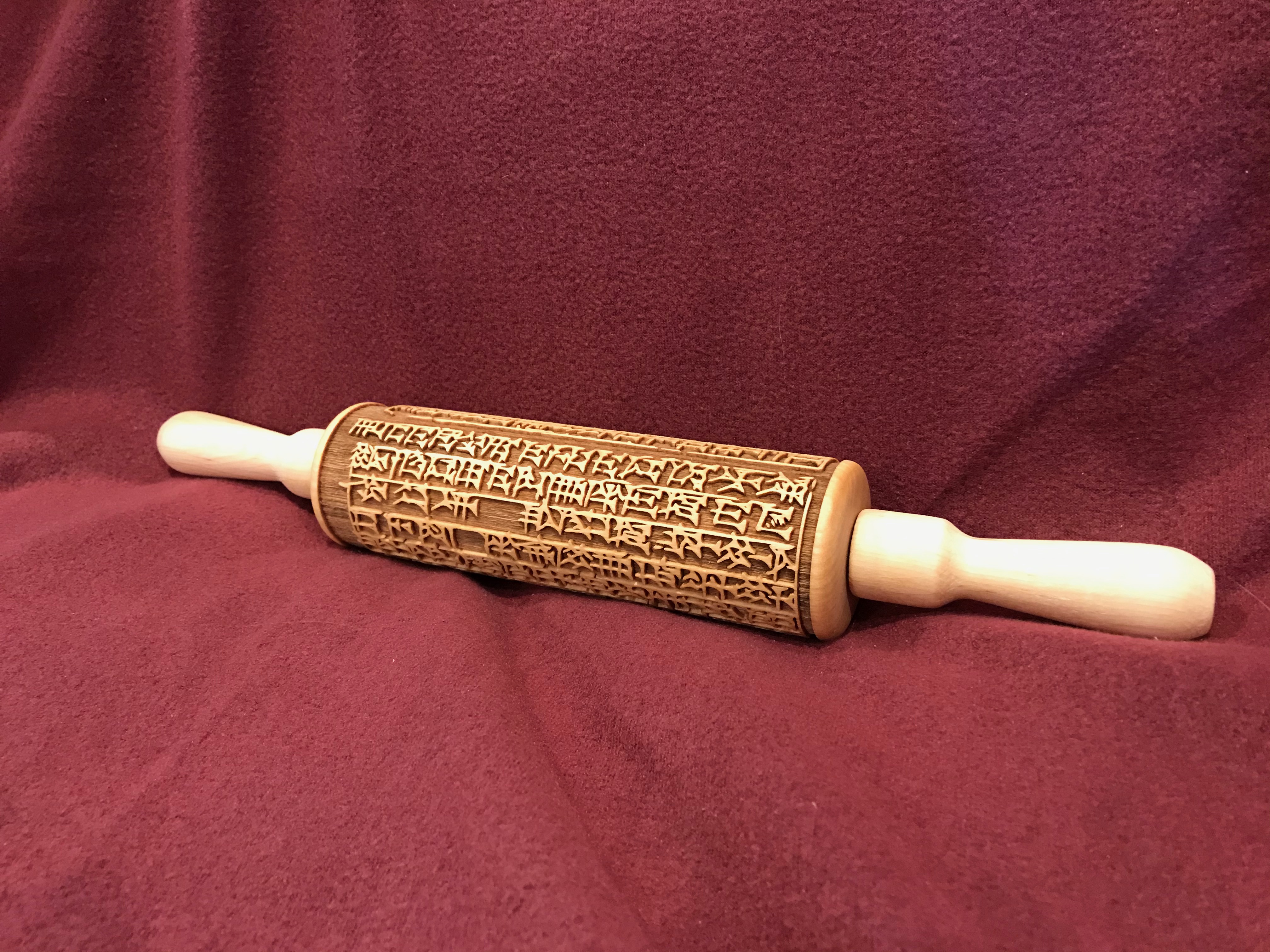
The Epic of Gilgamesh is considered a world classic.  Some would designate it the first novel written and others an example of how basic human concerns haven’t changed for thousands of years.  The ancient scribes and story-tellers, I suspect, anticipated none of this for their tale.  It was a religious story, perhaps taken as literally as some now take the Bible.  However you understand it, the Epic is part of the foundation of civilization itself.  I have to admit my Akkadian is rusty—I never had the opportunity to teach anywhere that I could regularly exercise it.  Still, I’m pretty certain that no one involved in one of the many versions of the tale that have survived would’ve expected it might end up on a rolling pin.

Back in December I wrote about Farrell Monaco’s Gilgamesh Epic column 5 rolling pin.  Her blog, Tavola Mediterranea features culinary archaeology—a good fit for these foodie times.  Having somehow found my blog, she kindly sent me a Gilgamesh rolling pin.  It was, in fact, one of the packages I wrote about a few days ago that was tracked as delivered but never arrived.  There’s no telling how long it will take to sort the Post Office out after Trump tried to destroy it so he could start the steal.  I was told it had been delivered in early January—not in time for Christmas itself, but still in the gingerbread season.  I called our local PO with the tracking number and was told it had been delivered.  If sent to the wrong house I’d have to rely on the kindness of strangers.

Last week, after I’d completely given up hope, it arrived.  Since, like many overfed Americans, I’m trying to wean myself off holiday excess back to my usual austere diet, it may be the next Christmas season before I get a chance to use it.  Still, the thoughtfulness of the gesture is deeply appreciated.  Anything that connects us so palpably to our ancient forebears is truly a gift.  If my career (if that’s what you call it) had gone a slightly different way, I might’ve ended up spending it with Gilgamesh.  As it is, I still turn to the Epic for inspiration now and again.  I wrote a couple of articles in the last couple of years where Gilgamesh makes part of the argument.  Now I’ve got something tangible to prove it!  Take a trip over to Tavola Mediterranea and see what wonders edible history holds.


At Sea?

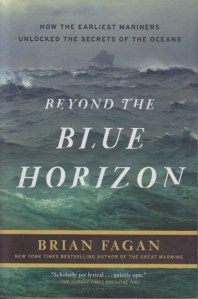
Brian Fagan is a name I’ve long known.  Not exactly the consummate stylist, he is a very prolific archaeologist and anthropologist.  I’ve read a few of his books.  Recently my wife and I read his Beyond the Blue Horizon: How the Earliest Mariners Unlocked the Secrets of the Oceans (you see what I mean about style?).  Divided into different regions of the world, the book explores early boat-craft, sketching how people without our technology navigated oceans, often reaching remote locations.  What interests me is when anthropologists make statements about ancient religions, often before the advent of writing among the peoples studied.  No doubt such peoples realized the dangers of open water—open water is still dangerous with all our tech.  It is reasonable to assume their response was religious.  What exactly it was, we don’t know.

The one that really caught my attention was on the Maya.  Coastal Mayans valued the spondylus, or spiny oyster.  This particular mollusk is seasonally toxic—itself an interesting phenomenon—that becomes a hallucinogen.  Hallucinogens have frequently been associated with religion for indigenous peoples.  If archaeology is to be believed, even temples in ancient Israel burned cannabis, so who’s to judge?  Fagan writes that this practice led to shamanistic trances, and this seems likely.  He goes on to suggest that the spondylus was thus a gateway to the supernatural world.  Of course, in the biblical world shellfish were a forbidden food.

While Fagan likes to reminisce about his own past sailing, and likes to describe boats in detail, and show off his nautical language skills, I think about the religious aspect of the great waters.  We still have only a small understanding of the oceans that cover most of our planet.  We can fly over them these days, and miss the intensity of being where no land is in sight.  It can be a transcendent experience, I’m sure.  I’ve seldom been that far from land.  On a ship bound for the Orkney Islands from John O’Groats we were on the North Sea beyond the sight of shore, if I remember correctly.  Although I can’t recall how long the voyage took, I can imagine the feeling of nerves aching for a sight of coastline.  Even with minke whales off the starboard bow, I knew my feet belonged on terra firma.  It’s more comfortable to read about the gods of the ocean in books like Beyond the Blue Horizon.  And when I’m out to sea, I always pray the mariners know what they’re doing.  


Mummy’s Daddy

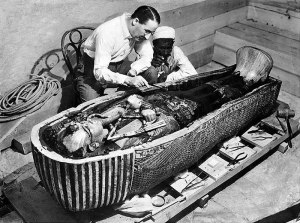
Now that I’ve broached the subject of the Agade listserv, I’m bound to find some interesting stories therein.  The title of this blog “Sects and Violence in the Ancient World” is an artifact that demonstrates eleven years ago I was still keeping up with Ancient Near Eastern studies.  I was calling it “Ancient West Asian studies” then, but I’ve been in publishing long enough to know that shifts in terminology are frowned upon by those in an industry that moves at a glacial pace.  (Just remember that the tortoise wins in the end.)  In any case, one of the recent articles on Agade had to do with the “curse” of Tutankhamen’s tomb.  This is an idea that goes back to the 1920s and was in some respects expressed in the Universal monster film The Mummy.  In pop culture the idea lives on.

Photo credit: The New York Times (public domain)

It seems that some, but not all, of those involved in opening Tut’s tomb died in unusual ways shortly thereafter.  The deaths were not concentrated within a day, let alone a week or a month, and some of them were natural but premature.  The ideas of curses, however, fit the spiritual economy of the human psyche so well that they suggest themselves in such circumstances.  A run of bad luck may last for years, causing the sufferer to think they might be living under a curse.  It is, in many ways, the pinnacle of magical thinking.  No matter how scientific we become the idea never goes completely away.  Just when Mr. Spock seems in control of the Enterprise Harry Potter beams aboard.  Our minds are funny that way.

The particular article I saw was one that had clearly followed on an earlier piece that I had missed.  It mentions “the documentary” but doesn’t say which one.  I suppose there are many such filmed attempts to make sense of memes such as the Pharaoh’s curse.  From my teaching days I have documentaries about a number of weird things that the History or Discovery channel, and maybe A&E, spun out back in the Dark Ages.  I’m not convinced that scientific thinking is really under any threat from such journeys down the paths of speculation.  I’m also not sure that there really is any connection to the various deaths surrounding the Carter expedition in 1922.  In just two years’ time we’ll be at the centenary of the discovery of the tomb and I’m sure there will be plenty of information on offer then.  As long as the curse doesn’t get us all first.


Agade

The word “listserv” feels abrupt to me, as if someone couldn’t be bothered to type one more “e” to give the reader a sense of satisfied completion.  Technology terms are often like that—not really descriptive of what they are and leaving us older folks wondering about the words and not quite comprehending what they’re supposed to signify.  Back in the early 1990s I joined a listserv that eventually came to be known as “Agade,” since it carried news of the Ancient Near Eastern variety.  Since I seldom have the opportunity to work in that field any longer, I long ago ceased to be on the Agade listserv and consequently have lost track of what’s happening in real time.  Or at least close to it.  An author with whom I was working recently asked me to post about his book on Agade so I had to resubscribe.  It’s nice to see the listserv, whatever that is, still alive and kicking.

One of the articles posted recently had the intriguing title “Burnt remains from 586 BCE Jerusalem may hold key to protecting planet.”  I’m not sure, beyond evangelicals chomping for Armageddon, who doesn’t want to protect the planet, so I read on.  Archaeologists, I know, sometimes feel put upon to defend their work.  Yes, it’s sexy and cool, but it’s also expensive and not as well funded as it needs to be.  It does occasionally lead to real scientific breakthroughs.  This particular story is about Earth’s magnetic field.  It is vital for life as we know it, and we know that it is constantly shifting.  In fact, some pundits are fearing a flip in magnetic poles which, for a guy who can’t even understand listserv, sounds really catastrophic.  The article, however, is about the fact that the destruction of the temple in Jerusalem by fire that led to a trapped picture of the magnetic field at the time, and we know the date.  Magnetic materials under high heat preserve indicators of the Earth’s magnetic field, whether it had been discovered or not.

Image credit: NASA/ISS Expedition 28, public domain from Wikimedia Commons

The book of Genesis says nothing about the creation of the magnetic field that makes life on our planet possible.  Knowing that we understand so little about something that makes our existence possible, I suspect, indicates that there are many factors of life we haven’t even begun to comprehend.  There are further discoveries to be made.  We’re not even sure if our definition of “life” is entirely accurate.  One thing our history has taught us, however, is that if we build great structures there will be those eager to burn them.  As we sift through the rubble we might discover something about the direction in which we’re going.  And a listserv will be there to share the news.


Page Count

Research has taken on a different flavor now that I don’t have a teaching post.  I’ve started work on my next book after Nightmares with the Bible, and I’ll reveal more about it eventually, but the topic does require research.  Much of the reading required for both Holy Horror and Nightmares with the Bible was done on the bus.  Those long commuting years weren’t exactly conducive to getting a lot of writing done, but there were hours of built-in reading time each weekday.  My research often involves reading big books and I’m a slow reader.  It’s a valid question why a slow reader would go into editing for a career.  A bit of research on this blog would reveal the answer to that, but the fact remains that big books take a huge amount of time to get through.

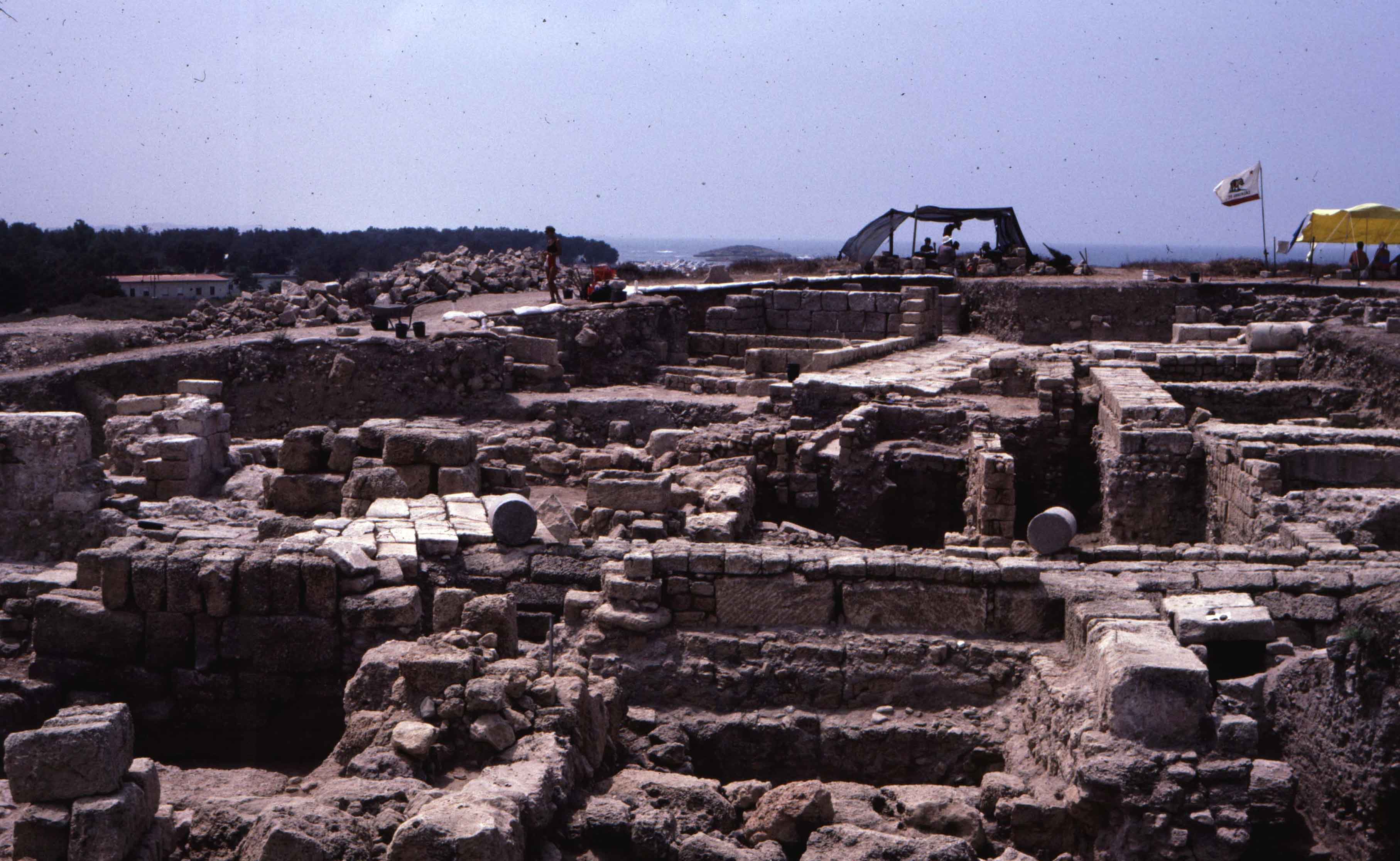
Back before any of this was a concern, back when I was a mere seminarian, I had plenty of time for reading.  One summer I volunteered for an archaeological dig at Tel Dor in Israel.  This involved meetings ahead of time and a lot of advanced planning.  One of the questions that naturally got raised was how many books to take.  It was a long flight from Boston to Tel Aviv, and I didn’t have much cash for sightseeing.  Most people, I was told, take James Michener’s The Source.  This is his archaeologist book.  In addition to that, it is a long work, just like most Michener novels, which meant you only had to take one book for the entire trip.  I decided to buy a paperback of Tolstoy’s War and Peace instead.  What a luxury it seemed in those long Israeli days to read such a tale.

In fact, I didn’t finish the book during the flight over, the six weeks at Pardes Hanna, and the return flight.  It took me at least until winter back in Boston.  These days when I take on a big book I generally read smaller ones alongside it.  You see, I have to see some progress as I’m going.  I tend to read nonfiction before work in the morning and fiction after work is done.  My days are literary work sandwiches, I guess.  And the stuff that I need to do around the house doesn’t pause while I indulge in my favorite vice of reading.  Yes, my research has definitely taken on a different flavor since being paid to do it.  What hasn’t changed is the desire to push knowledge forward, one page at a time.


Temple Mysteries

Maybe you’ve noticed it too.  If you read the Bible, rather than just pose with it, you’ll wonder what went on in the temple when you’re done.  Yes, it’s obvious there would be the bleeting of sheep followed by an eerie silence, and that “that Burger King smell” would be pervasive, but what of the interior of the temple itself?  The Good Book says next to nothing about what happened inside.  We do know that going to temple wasn’t the same as going to synagogue or church.  The laity, for one thing, weren’t allowed inside.  Although the temple in Jerusalem can’t be excavated, many ancient temples have been found and archaeologists have the ability to analyze residues found on altars and that tells us something at least.  A story on Artnet News publicizes an archaeological report that rests behind a paywall, so I’ll use Artnet’s headline: “Did Ancient Hebrews Get High During Temple? A New Archaeological Discovery Suggests They Did.”

The story explains that chemical analysis of the famous Arad temple from ancient Judah shows that one of the altars was used to burn cannabis.  I guess that could help explain all the animal sacrifices.  Like most religions, that of ancient Israel kept much in the dark (literally).  Read the biblical account again.  The temple had no windows.  The holy place was illuminated by the menorah, so there was light.  The holy of holies was completely dark.  Other than the rituals of the Day of Atonement, we’re not given much information on what the priests and levites did for the rest of the year.  They may or may not have burnt cannabis.  It might be that what happened in Arad stayed in Arad.  What hath Arad to do with Jerusalem?  We simply don’t know.

Another altar in Arad, according to the story by Sarah Cascone, burned frankincense.  That sounds much more biblical.  I’ve never been a smoker and I’ve never smoked anything in my life.  I did, however, attend many services at Nashotah House where the small space of St. Mary’s Chapel was filled with so much incense that I wondered about its health affects.  I’m not sure if others felt they were getting lightheaded from all the fumes or not.  Incense, to be used effectively should be handled sparingly.  Its purpose was, theologically, to cloud the air in case God decided to show up.  You weren’t allowed to see him.  If he did show up, though, maybe it was party time.  And there’s bread and wine just out in the vestibule.  Some mysteries will never be fully explained.


Cave Monsters

A story in Discover back in December discusses cave drawings from Indonesia.  Dating back almost 40,000 years before the creation of the world, these cave paintings represent the oldest yet discovered.  The interesting thing about such cave art is the representation of figures—both human and animal—that are instantly recognizable.  Scientists studying the art are able to identify likely species, but, as John Morehead pointed out on his Theofantastique Facebook post, there are also fantastical beasts.  We might call them monsters.  It’s interesting to see how scientific writers shift from their awe at life-like illustration to a nearly palpable embarrassment when the creatures become mythical.  Indeed, the article itself suggests such figures point to a very early sense of either fiction or spirituality.  The monstrous and religion have long trod parallel paths and we are only now beginning to explore the implications.

Monsters are beings over which we have no control.  They don’t abide by human rules and often the only recourse against them is religious.  When monsters come knocking, it’s often wise to drop to your knees.  Or at least reach for your crucifix.  Many rationalists like to claim that human civilization developed without religion.  The discoveries at sites such as Göbekli Tepe gainsay that assessment, indicating that humans first gathered for religious reasons and agriculture and all the rest followed from that.  Perhaps they came together for fear of monsters?  That’s only a guess, but I recall the defensive tower of Jericho.  The archaeologist lecturing us as we stood by this neolithic structure asked “What were they afraid of?”  He never answered that question.

Bringing monsters into the discussion isn’t an attempt to make light of these significant discoveries.  Rather, we need to learn to appreciate the fact that monsters are serious business.  Religion, whether or not literally true, is important.  Civilization has been running the opposite direction for some time now.  When surveys emerge demonstrating that the vast majority of the world’s population is still religious, analysts frown.  It does make me wonder, however, if nature itself programs us this way.  To other sentient creatures who experience us as predators, humans must look monstrous.  We come in a variety of colors and textures (clothing), we smell of deodorant, shampoo, soap, aftershave, or none of the above.  We emit strange sounds (our music).  Are we not the monsters of the natural world?  And should animals develop religion, would we not be one of the causes?  It’s just a guess, but I need to sit in my cave and think about it for a while.


The Place of Temples

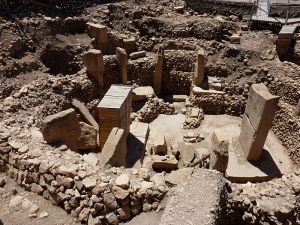
Gobeklitepe, or more properly, Göbekli Tepe, stunned the archaeological world a few years back.  This site in what is now Turkey contained what is apparently a sanctuary—purposefully buried—and advanced architecture for its age.  It was that age that was so shocking.  Gobeklitepe dated from around 11,000 years ago.  Now, in case ancient history’s not your thing—this will be painless—agriculture began, according to the standard chronology, about 10,000 years ago.  This led to surplus production that in turn led to the first cities, indeed, what we recognize as civilization itself.  While Gobeklitepe wasn’t permanently occupied, it was an example of a temple before agriculture, and according to the standard thinking, this should not be.  Consequently not too much has been published on the site because nobody likes a smart aleck, even if said aleck is an archaeological site.

Just within the last weeks, Anadolu Agency announced that an even older site was found in Turkey, near the city of Mardin.  Reports coming out of Boncuklu Tarla suggest that it is a millennium yet again older, dating from 12,000 years ago.  The article doesn’t include many photos, but suggests the site is similar to Gobeklitepe.  If this holds up, a new paradigm for human history will need to unfold.  What drew people together at first was not tilling the soil and reaping a surplus, but religion.  Even in the still standard paradigm, kings could only emerge with the backing of gods, so early cities had impressive temples.  What the evidence now suggests is that the temples came first and ancient people came together at sacred sites before they had a surplus to bring.  You can’t pick a sacrificial animal without having a heard or flock from which to take said victim.

We live in a technological era in which intelligent people are scratching their heads with their smart devices because religion just won’t go away.  I have suggested before that the reason it won’t is that it is deeply engrained in our biology.  We can try to reason the gods away, or abstract them to the point that we can call them laws or principles, but we can’t escape the fact that we’re held down by forces beyond our control.  Ancient people in Turkey, hunter-gatherers in our current paradigm, were gathering together and putting massive energy into building what look like temples before they had a secure and steady source of food.  Before, indeed, they had smart phones or even dial-up.  Millennia later we would rediscover them and wonder about things even as religion would be the deciding factor in elections in the most technically advanced cultures on the planet.

Photo credit Zhengan, via Wikimedia Commons.


Scrolls Not Living

Of the many ancient finds in Western Asia, none captured the imagination like the Dead Sea Scrolls.  The timing and romance of the find itself, the scandals that almost immediately broke out, and the subsequent “secrecy” over the contents made the secular news.  I’m convinced that a large part of the mystique has to do with the somewhat spooky name—Qumran scrolls never caught on, even though it is more accurate for many of the documents.  Their discovery came after the Second World War when people were wanting good news, and, perhaps, an indication that all of this stuff was somehow predicted.  Enter the scrolls.  No doubt, these documents gave us quite a lot of information on the Second Temple Period—the time from the rebuilding of the Jerusalem temple in the sixth century BCE until its destruction under the Romans in the first century CE.  Now the scrolls are back in the news.

A story by Nicola Davis in The Guardian announces that the origin of the scrolls is once again open to interpretation.  The reason is somewhat technical—scrolls that were written on vellum (animal skins) had to be prepared for writing.  One of the steps involved chemically treating the writing surface with a fine powder (the details are beyond me) so that it could be written upon.  We’ve reached the point where the salts left behind can be tested for place of origin.  The Guardian story notes that the Temple Scroll—one of the important non-biblical texts—was not prepared at Qumran (the site where most of the scrolls were found).  That means that the scroll itself came from elsewhere, depending upon with whom you speak.  The scrolls gather controversy like the Ugaritic tablets gather dust.  

Part of the charm here is that there are many unanswered questions about these ancient texts.  Who exactly wrote them is debated.  Their find-spot suggests they were hidden away by the quasi-monastics who lived in nearby Qumran, but this doesn’t mean they necessarily wrote them.  It’s still debated whether the Qumran community was made up of Essenes or not.  One thing we do know about them is that they were able librarians.  The scrolls themselves are symbolic of the strife in the region, having been discovered just as Israel was declared a nation.  The scrolls were quickly politicized.  They were kept under the auspices of a small group of academics and priests for many decades.  And they still have a way of catching headlines.  Even when its a matter of who powdered their faces.


Tumblin’ Down

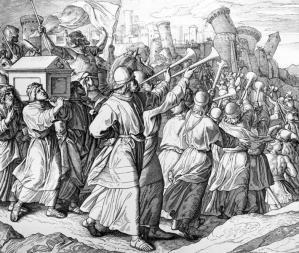
RadioLab (not to be confused with Radiohead) is an NPR program to which my wife likes to listen.  She’s introduced me to a few episodes since, as a person who does a lot of writing, I don’t normally gravitate toward programs with a lot of talk.  It’s part of the writer’s curse.  In any case, she recently played a segment on acoustic warfare.  I’ve known for some time that acoustic warfare is a thing, and that militaries use sound to disrupt enemies’ machinery and human operators.  I didn’t really know how it worked.  The interesting thing about this RadioLab spot was that they took the story of the walls of Jericho as a starting-off point.  Also of interest is that one of the hosts had never heard the story—something that would have been somewhat impossible for many growing up in my generation.  In case that’s you, however, the story goes like this—

God commanded Joshua to take on Jericho, a major, walled city, with a ritual procession and the blowing of trumpets.  After marching around the city several times, the priests blew their trumpets and the walls collapsed.  The story’s told in the book of Joshua.  The question discussed on RadioLab was whether it was possible to knock down walls with noise.  It is, they concluded, but at a noise level beyond the abilities of shofars.  This very discussion, however, raised any number of issues.  One is that the collapse of Jericho’s walls isn’t attributed to the rams’ horn sound, but rather a miracle.  Another is that biblical scholars and archaeologists have long known that Jericho wasn’t even occupied at the time of Joshua, and so the story isn’t historical.

Those who produce educational materials on various media generally don’t consider scholars of religion as interesting or noteworthy speakers.  TED talks don’t feature a category for religion, and, as this RadioLab episode demonstrated, those who understand acoustics have more interesting things to say than biblical scholars.  It’s not so much a rude awakening as it is a confirmation that what has long seemed obvious is indeed true—biblical scholarship isn’t really of general interest.  The Bible, however, retains a certain mystique.  I struggle with this disconnect constantly.  While the Good Book remains an iconic symbol—divine, even—those who know it well have less to say than others who have scientific methods to apply.  Not once was it mentioned on RadioLab that pretty much no biblical scholar would argue that the story is historical, but then, what fun would that be to pick apart?


Digging Bad?

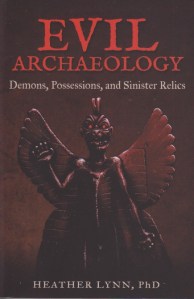
Academics, as a rule, focus on books by other academics.  Theirs is a specialized vocabulary with specific goals (tenure, then an Ivy League position).  It’s easy to see, sometimes, why they distrust books by those of us outside the academy.  We aren’t as constrained, and can say some speculative stuff.  I just finished Evil Archaeology: Demons, Possessions, and Sinister Relics, by Heather Lynn.  Now, most academics I know won’t take seriously a book where the author is cited by “Ph.D.” on the cover.  That’s a sure sign of trying to impress a lay readership.  This book is clearly heartfelt, and personal, but it does raise a host of questions regarding sources and details. I found myself wondering where the author found out so much about Pazuzu when I, who hold a doctorate in ancient West Asian studies, had such trouble locating sources.  Then I checked the bibliography.

Even academics have been known to cut a corner or two, now and then.  For my last book I didn’t have access to a university library so I had to make do with what I could get my hands on.  (JSTOR is not cheap for individuals, in case you’re wondering.  If you teach and you get free access from your library, you don’t know how lucky you are!)  So it is with my present research.  I muddle along, often buying used copies of the books I need, sometimes from eBay.  Researchers can be driven that way.  Lynn’s book covers a lot of territory, and not all of it seems related to demons.  Little of it covers archaeology in any detail.  But then, it’s not intended for academic readers.  I learned a thing or two.  I also distrust a thing or two she claim (having once been in the academy), but there’s no doubt she’s trying to do a service in this book.

Demons cut a wide swath.  Lynn discusses bits and pieces from here and there, and at times her treatment is rather a gallimaufry of anecdotes.  There are interviews, personal experiences, and urban legends.  It does seem hard to believe that scientists worldwide are studying demons in order to explain illnesses, though.  For me, finding a new book on demons just when I was finishing my draft on the same topic, it was imperative to read what she had to say.  It’s clear she’s seen some of the same movies I have.  I like to think that, as an inbetweener I can still read academese as well as regular writing.  You always find interesting things there in the middle.


Servants and Such

At Nashotah House I met my first real-life servant.  This was a student—a candidate for the priesthood—who’d formally been a “domestic.”  Now, being Episcopalian one doesn’t bat an eyelash at that sort of thing but I was secretly in shock that servants still existed.  I’m woefully uninformed about aristocracy.  Having grown up poor I resent the idea of a person being placed in the role of fulfilling the whims of someone just because they have money.  My wife has more of a fascination about this than I do, and she was recently reading a book about servants.  This post isn’t about domestics, however.  It’s about foreign gods.  In the book she was reading my wife noticed one of the servants writing that old-fashioned stoves were like Moloch.  Were it not for Sleepy Hollow, I suspect, many modern people wouldn’t know the name at all.  Who was Moloch?

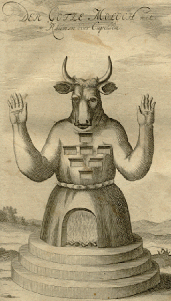
Moloch, according to the Bible, was a “Canaanite” deity.  Specifically, he was a god that demanded child sacrifice.  The phrase the Good Book uses is that his worshippers made their children “pass through the fire” for Moloch.  Very little is known about this deity, and the question of human sacrifice is endlessly debated.  Theologically it makes sense, but practically it doesn’t.  Deities want servants and living bodies do that better than dead ones.  Although it’s been suggested that “passing through” could be a symbolic offering, by far the majority of scholars have taken this act as an actual sacrifice.  The ultimate servant is a dead servant.  Moloch, you see, comes from the same root as the word “king.”  And kings are fond of having many servants.

Image credit: Johann Lund, Wikimedia Commons

So how is a stove like Moloch?  The classic image of the god, which looks like a scene from The Wicker Man, holds the answer.  Well circulated since the early eighteenth century, this engraving has captured the imagination of modern people.  A massive, multi-chambered statue intended to consume by the raging fire in its belly.  This is the way in which a stove might resemble a Canaanite deity.  The servant who described cookware thus knew whereof she spoke.  Archaeological evidence for the “cult of Moloch” is slim.  It is almost certain that nothing like this fanciful image ever existed.  Moloch, in other words, lives in the imagination.  One aspect, however, rings true.  Like most tyrannical rulers the deity wants unquestioning obedience on the part of servants.  And this is a viewpoint not limited to deities.