Trailing Art

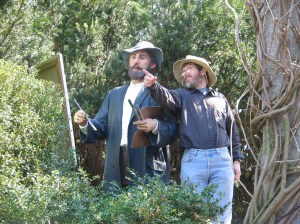
One of the many trails that wend their way through Ithaca is the Art Trail.  (The town finds waypoints on the wine and beer trails of the southern tier as well, but we were looking for visual art.)  In early October several artists open their studios—these are personal places—to the tourists passing through.  Those of us on the trail are seeking inspiration in human expression.  I’ve neglected my own art for many years.  While other guys my age are retiring and expressing their boredom, I struggle to find enough time to write, dreaming of the day when I can again take up my pencils and brushes.  Being in so many studios over the weekend jump-started something in me.  Humans are at their most god-like when they create.

Seeing artists in context is revealing.  They don’t worry too much about convention.  I found myself hanging toward the back of our little group.  There was so much of others’ souls on display here.  While some were young, a fair number were older than me.  Perhaps retired from a novocaine job that dulled many days until enough years had passed and the need to let the art out escaped.  If felt like visiting a small farm where the true independent, liberal spirit of this country once resided.  These were farmers with paint brushes rather than shotguns and Trump bumperstickers.  Free thinkers, not Fox thinkers.  Under a sky October blue after two days of rain and gray, this was a mosaic of autumn.  Art is a muse.  I think of my neglected brushes and dried out paints, tucked away in the attic.

Modern art sometimes feels like someone slapped a frame around something random, but in talking with the creator something different emerges.  Something that doesn’t feel like plastic.  Something that defies words.  Like poems sometimes break conventional lines, art refuses to be confined.  Some of these studios used to be living rooms.  Houses converted and dedicated to creativity.  Why is this so difficult to accomplish in my own life?  How has the time come to be consumed with work, even when the commute has been effaced?  I suppose I’ve been using words to express myself—this blog is certainly an example of that.  It is, however, a mere fraction of visual ideas awaiting release.  I don’t know if I could ever open my studio to strangers.  Art trails are labyrinths, and once you’ve entered that maze, it will take some time to reemerge.  And when I do I know I will have been transformed.


The Sound of Musik

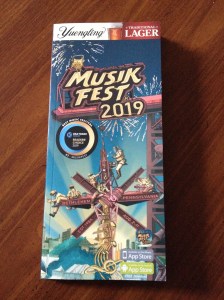
“Why is there so much people here?”  The words aren’t mine, but those of a random stranger I heard in Herald Square.  Not only was it grammatically offensive, I always find “much people” in Manhattan, but this was the occasion of the Pope’s visit a few years ago, so more of us were crowded into that area than normal.  It was a feeling that returned last night as my wife and I wandered around Musikfest.  If you’re not from around here, Musikfest is the largest free music festival in the United States, and it takes place in Bethlehem each summer.  Ten days of free, live music and tents hawking wares and all kinds of comestibles, as well as that strangely satisfying feeling of being lost in a crowd.  We ended up there more or less accidentally.

I was an experimental subject.  Those of you who know me will probably not find this odd, and you may well come up with many reasons to find me in the psychology department, some involving locked doors.  This was, however, a voluntary research project that required participants and it had been literally decades since I’d volunteered to be one of the “much people” who was not not part of the university crowd.  It felt good to be on a campus again.  The Lehigh Valley hosts several colleges and universities, and that draw is perhaps related to why Musikfest is held here.  When we got to town my wife realized we might have trouble parking.  Sections of downtown Bethlehem are closed to traffic and there are people everywhere.  I finished my experiment and we became part of the crowd again.

Music and religion, I’ve noted before, hang out in the same crowd.  They both have the ability to be transcendent and people seek out such experiences.  Since we hadn’t planned on attending—accidental musicologists we—we had no groups as targeted hearing while we wandered.  Mostly we marveled at the size of the event.  The city of steel transformed to the city of music.  And the religious feelings music brings.  As I walked from the college back to downtown, a couple strangers accosted me.  “Hi, brother,” they said.  “Heading to Musikfest?”  This, I realized was a congregation.  I was an unknown brother.  Music brings peace.  Dona nobis pacem, sisters and brothers.  Like those crowds a few years back hoping for a glimpse of the pontiff, an entire city had kicked off its shoes for a Friday night of potential transcendence.  Why is there so much people here?  Simply listen and you’ll have your answer.


McChristianity

Christianity isn’t known for its sense of humor.  The same can be said of other religions as well, of course.  What else should we expect concerning belief systems that claim eternal consequences?  A story by Colin Dwyer on NPR explains that the Haifa Museum of Art had to remove a sculpture titled “McJesus” due to public violence.  The sculpture depicts a crucified Ronald McDonald, and a number of althoughs follow: although Haifa is in Israel a large number of Christians protested.  Although the practice of crucifixion was uncomfortably common in ancient days it has come to be associated with one particular case.  Although the message might be interpreted as a condemnation of commercialism, protestors took it to be aimed at their faith.  Perhaps it was.  Artists can be notoriously ambiguous in that way.

Ronald McDonald is a liminal, if ubiquitous figure.  Instantly recognizable, he has been challenged before as a threat to christendom.  I once heard a priest lament that children recognized the golden arches more than the cross.  Well, that’s not surprising—we don’t go around telling our kids about crucifixion daily.  (Or shouldn’t.)  A massive Ronnie, on the other hand, floats down Manhattan every Thanksgiving Day.  He’s on posters, commercials, and 42nd Street.  He’s the patron saint of branding.  With his garish clashing color palette, his red and yellow never mix to orange and they linger in our minds to ensure us that no matter where we might be there’s always cheap, if unhealthy, food nearby.  Mr. McDonald has become a religious symbol of capitalism.

Even as a child I noticed the great deal of excitement that accompanied the opening of the local McDonald’s.  In a small, corroded corner of the rust belt, families piled into cars to drive to Oil City to see this wonder.  It was like an epiphany.  Eating out that the poor could afford.  Just about everything in downtown Oil City is now closed, but the last time I was there that McDonald’s still stood.  Back in Haifa an ironic depiction led to real violence.  Angry Christians carrying stones couldn’t see the statue as a condemnation of consumer culture.  Their beleaguered religion was at risk.  Blood flowed and the art piece was removed and packed off to Finland.  Although the point of the display was to question religious appropriation in the support of consumerism, and although that message could ultimately support the teachings of the religion it evokes, the branding came across all wrong.  Church is your kind of place…


Beyond the Facade

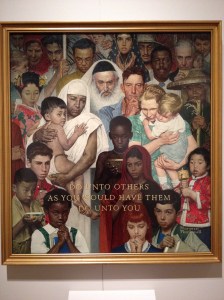
Over the summer the New York Historical Society had an exhibit, now over, on Norman Rockwell, Franklin Roosevelt, and the Four Freedoms.  I think we may be down to one or two freedoms by now, but nevertheless.  One weekend my wife and I went to the exhibition.  She’d just read a biography of Rockwell, and although his Americana is my America, I suppose, his pluck is sometimes unnerving.  You see, an artist has to show emotions on people’s faces and in their gestures.  Long ago I learned that if you show what you’re feeling in real life, people will quickly take advantage of you.  I learned, even as a teen, to be subtle.  If you think you’ve got me figured out, here’s a hint—that subtlety continues even into my writing.  It’s often not what it appears to be.

Some months back I wrote a funny piece on this blog.  Some people who actually know me—or the part that I let be known—thought I was depressed.  Or angry.  Or both.  That’s a side effect of subtlety.  Episcopalians have it down to a science.  At least they used to.  The only place they showed emotion was in high mass, and that, if done right, packs a wallop.  One of my brothers comments that I seldom smile.  I might say too much about myself if I did.  What would you do with that knowledge?  In my earliest experience, you might use it to hurt me.  Walking through Manhattan to the exhibit, I noticed the stone facades.  Some buildings have solemn stonework, almost gothic is aspect.  Behind the windows, however, I can sense emotion left unshown.  It’s not very Rockwell.

I admire Rockwell’s outlook.  Indeed, I might share more of it than I want to reveal.  Rockwell, according to the exhibit, believed in America for all races and all creeds.  Strong women dominate his paintings and illustrations.  Equality was what America used to stand for.  And although I’m reluctant to admit it, when my writing’s most serious an element of humor enters in.  Like a Rockwell painting.  He wished to be taken for a serious artist, but had a difficult time suppressing the irony of life itself.  I get that.  It’s just that if other people see what’s beneath the surface—what goes on behind that stone facade?—they will find a means of extorting it.  Best to be subtle.  Words can mean the opposite of what they say or can be literally true.  The shades between the extremes are endless.


Riveting

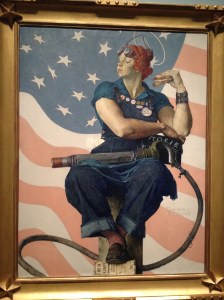
The days of angry white men backlash are hopefully numbered.  One thing this strange phenomenon of privileged males feeling under threat has brought to the surface is the long struggle of women for the basic acknowledgment of human equality.  Ironically, it took a horrible war to move the cause forward.  Rosie the Riveter became a fixture during World War Two, blazing the message that women could do the tough jobs men had always done, now that males were off trying to kill one another overseas.  These images of Rosie have found new life in the era of Trumpism that has objectified women in the crudest possible ways, because it’s, well, monkey-see monkey-do in the world of politics.  Just consider Brett Kavanaugh and try to challenge the point.

One of the more famous portraits of Rosie, back when Fascism was an evil thing, is that painted by Norman Rockwell.  A pugnacious Rosie eats her lunch with her feet on Main Kampf and her riveting gun in her lap.  (These days she would need to have her feet on an elephant rampant.)  Something about this painting always bothered me.  I could never put my finger on it.  It certainly wasn’t the confident look on Rosie’s face—she’d earned that and deserved it long before it became a reality.  Even the patriotism at that time was tasteful.  No, it was her posture.  There was something uncanny about it.  Then I learned that Rockwell had consciously copied Michelangelo’s Isaiah from the Sistine Chapel ceiling.

Isaiah, according to that famous rendition (Isaiah has never been a popular subject for paintings, for some reason), has his head turned at that peculiar angle because an angel is whispering in his ear.  Instead of a riveting gun, he’s packing a nascent Good Book, but he is receiving a direct message from on high.  I like to think it might be “The Spirit of the Lord is upon me, because he hath anointed me to preach the gospel to the poor; he hath sent me to heal the brokenhearted, to preach deliverance to the captives, and recovering of sight to the blind, to set at liberty them that are bruised, to preach the acceptable year of the Lord,” but then I’ve always been a dreamer.  Rosie, in Rockwell’s rendition, is prophetic.  She is proclaiming an equality which, inexplicably, coming up on a century later, is still unrealized.  Why?  The angry white man only recognizes God made in his own image.


Museum Haven

At various points of my career I’ve applied for museum curator positions.  Since those who actually land those jobs have degrees in museum studies, I’ve never gotten as far as an interview.  Still, I like to think I’d be good at it.  I spend time in museums and I’ve been told I have an okay eye for design.  And I recently read that museums are educational institutions.  That makes sense since people tend to be visual learners.  (This is something I took into account in my classes as well, illustrating lectures to make a point.  The traditional academic feels that pictures are somehow “soft” learning as opposed to the harsh realities of text and word-based instruction, but I beg to differ.)  We see things and they stick with us.

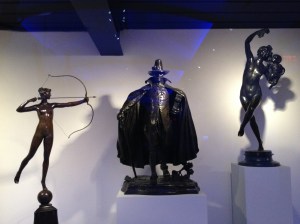
On a visit to the New York Historical Society museum I once looked at their somewhat abbreviated sculpture collection.  This isn’t the Met, after all.  One of the tricks I’ve learned about museum displays is that some curators place subtle humor in their framing of objects.  For example, my gaze was drawn to a figure of a pilgrim.  A stern-looking fellow, he’s captured in full stride, massive Bible tucked under his arm, determined frown on his face.  This is a man trying to create Heaven on earth, dour though it may be.  Taking a step back, my camera found a smile in this image.  On either side of this angry Christian were two naked women: one was apparently Artemis with her bow, the other perhaps a Muse.  The lines of the display draw attention to this juxtaposition.  There’s some humor here, intentional or not.

This also takes me back to yesterday’s post about Heaven.  Perceptions of what it is differ.  There’s a mindset like the pilgrim that sees a life of suffering being rewarded in the hereafter with endless bliss.  I do have to wonder whether too much hardship down here might not make one forget how to enjoy oneself.   It’s difficult to picture a Puritan in rapture.  It’s as if the journey—the hard road—is the real source of enjoyment here.  Each of us, I suppose, has her or his own view of Heaven.  Mine’s kind of like a library with all the time in the world without end to read.  Others, I suspect, would find paradise as a garden.  Yet others would see Heaven as a kind of museum, but it would be one where laughing out loud was okay, for the Curator definitely has a sense of humor.


Cthulhu You Knew

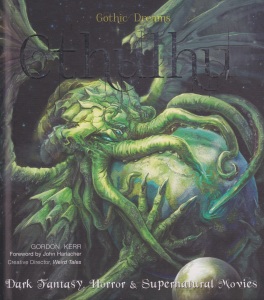
Humans tend to be visually oriented.  Arresting images stop us cold, causing us to focus on what we’re seeing.  As a tween I could be transported by large, lavishly illustrated, full-color books of other worlds.  While these went the way of Bradbury, I still sometimes recollect scenes that stopped me in my young tracks, making my juvenile mind wonder, what if…?  As an adult I realize “coffee table” books are heavy and a pain when you’re moving.  Printed on specialized paper, they have more heft than your mass-market paperback, or even most academic tomes.  Nevertheless, Gothic Dreams Cthulhu was a book that carried me, like a time-machine, back to my younger years.  Unlike in those days, however, I read the text as well as lingered over the images.  And I wondered about Cthulhu.

You see, I didn’t know about Lovecraft as a child.  The only reading regularly done in my family was Bible-oriented.  I discovered science fiction and gothic literature as a tween and, living in a small town, had no one to guide me in my choices.  Rouseville (the town pictured in the background on this website) had no public library.  My reading was left to my own, uninformed devices.  I discovered Cthulhu through my long fascination with Dagon.  I’d pitched Dagon as my dissertation topic, but settled on Asherah instead.  While teaching religion at the University of Wisconsin Oshkosh, I discovered Lovecraft, and Cthulhu, through Dagon.

Gordon Kerr, the author of Gothic Dreams Cthulhu, might be forgiven his hyperbole about H. P. Lovecraft.  Lovecraft was not a great writer—that’s not intended as any kind of slight, I hasten to add.  Classically, however, he didn’t have the level of literary finesse of Edgar Allan Poe, for example.  Still, Lovecraft created credible worlds.  His was a life of imagination—one might almost say divinity.  He was a creator.  Cthulhu has become a cultural icon.  With the magic of the internet bringing a writer still obscure to international attention, many people who never read horror fantasy nevertheless know who Cthulhu is.  Or they think they do.  As Kerr explains, the descriptions by Lovecraft himself are spare, thus the variety of ideas represented in the delicious artwork on every page of this book.  As Lovecraft earns more academic attention, surely others will notice the religious potential of the Great Old Ones that were, in their time, gods.  A guilty pleasure read, to be sure, Gothic Dreams Cthulhu fits well into this serious world of chaos we’ve created for ourselves.


Upstate Goddesses

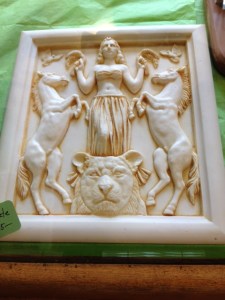
Goddesses give you connections. Here in Ithaca, all kinds of specialty shops abound. University towns are like that. This one had lots of goddesses. Ever since writing my dissertation on Asherah I’ve been interested in female divinities. Part of the reason for this is that I fail to understand how many men don’t see the power of women in their lives and insist that men should rule. Goddesses remind us that women have as much to contribute as do men, and they should be honored and respected just the same. Deities, after all, are projections of humanity. In any case, I found myself in a shop with many goddesses. The proprietor noticed my interest and struck up a conversation. This was ironic because where I live no one asks about my academic background; I have to travel to find interested takers, I guess.

She told me of an upcoming conference that would like to hear my thoughts on the topic of Asherah. Since my book on the goddess has been plagued with high prices, it remains hidden down three or four pages on Amazon, while lower priced dissertations easily float above it. My conversation with this stranger brought out that I had planned to write on other goddesses. A friend had done his dissertation on Anat, so I began working on book on Shapshu, the Ugaritic goddess associated with the sun. Some cultures made the sun male, the people of Ugarit, however, knew the true nature of brightness. I was going to make an academic career of goddesses.

Every great once in a while an academic will ask me about Asherah. Chances are their book or article will fail to cite my work, but they do seem to know to make queries. In my hopes to get a job beyond Nashotah House I followed the advice of colleagues to write a biblical book before finishing another book on “pagan” deities. In the career vicissitudes that followed, goddesses had to fall by the wayside. Although there can be money in deities, as this shop in which I stood proved, they aren’t really a marketable commodity in the realm of making an academic living. Now that I’ve found my way back to writing books again, perhaps I’ll return to my goddesses. That brief encounter in an Ithaca store resurrected some of the fascination of learning about the inner lives of divine women. The need to remind the world, it appears, has only become greater since I first wrote about Asherah decades ago.


Addicted to Heaven

I once wrote a scene—please don’t look for it; it’s never been published—in which a character awakes after attending a concert the night before. In my own life this kind of thing is very, very rare. Even when I had a full-time job in the relatively inexpensive Midwest, shows in Milwaukee were a bit out of our range for regular consumption. Here on the East Coast you have to scrimp and save to pull it off once in an every great while. In the scene I wrote, the character awoke wondering why the world looked so different the morning after. I’ve been pondering that because of my own recent Broadway experience, and a realization came to me. Such events involve an altered state of consciousness.

For all of science’s dowdy physicalism, there are very few practitioners who’d deny that altered states of consciousness exist. Nearly everyone experiences them. Perhaps the most common form is the dream. We know it’s not real, but most of us have had one or two that we just can’t shake. Upon awaking, going to work, dealing with the drudgery of everyday, we come home still feeling as if the preceding daylight hours were somehow less than real. Shows, some movies, and meaningful music can all induce alternate states of consciousness. Perhaps rare these days, but so can religious services. Such states continue after the event ends, and cushion our harsh reentry to “reality” with pleasant reminders that there’s something better somewhere else. Historically these moments have been highly valued. More so than even money. They’re addictive.

Attempts to induce such alternate brain chemistry through drugs are now a national crisis. One draw of opioids is their ability to bring on such altered states of consciousness. Our experience informs us that such things must exist, and they are likely behind the very idea of Heaven itself. The cost for altered states of consciousness is, of course, daily life. As physical beings we could not and cannot survive in a perpetual state of bliss. What is truly sad is that physicalism has convinced many that such alternative states are “not real.” Materialism leads, so often, to misery. The tendrils of altered states, however, interweave themselves among the synapses of our gray matter, sparking just often enough to make us realize that yes, those transcendent moments were just as real—if not more real—than this illusory world we daily inhabit. My character, awaking the morning after, was learning something she already knew to be true. Even if it was only fiction.


Let the Memory

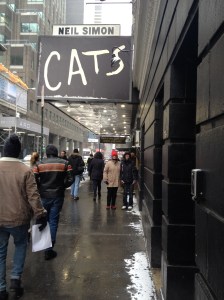
One of the rare and long-anticipated treats of being near New York City is the prospect of a live show. For practical reasons we don’t go to shows very often—years separate the occurrences—but once in a great while we manage to afford such a boon. Yesterday we attended the penultimate performance of the Cats revival on Broadway. The experience was transcendent. I’ve seen the movie version a number of times, and over the years I’ve caught a few live performances here and there. For whatever reason, this musical speaks to me. Although it doesn’t really have much of a plot—it’s more a series of vignettes—it is about redemption and being comfortable in one’s own skin. T. S. Eliot was a poet who knew spirituality intimately. Andrew Lloyd Webber, no one needs me to say, writes stirring music.

Cats, unlike many shows I’ve seen, requires athleticism as well as vocal ability. The performers are in nearly constant motion as they play out their roles, often with acrobatic flourishes. Most of the parts are for the young, while those dwelling on the experience of older characters—Gus, Grizabella, and Old Deuteronomy—tend to be recollections of youth as a commodity that slips away leaving as residue the wisdom that comes with age. It’s quite biblical in that respect. Even the old can appreciate back flips and double cartwheels and the grace of ballet. For this particular production the lighting stood out as an integral part of the story. Illumination, I might add, is a powerful metaphor.

In our family discussions afterwards, comparison with other versions dominated. Although my wife and I saw a community theater production long ago (placing us, I reluctantly suppose, in the ranks of the older characters), our main introduction was through the filmed adaptation. Again, like the Bible, we tend to think of canonical versions. This is how it should go. Because of both its running time and its demands on the players, not all vignettes are included in each production. The character who narrates the story may change. Choreography is adjusted. Each show, as is the case with live theater, is a little different. Standing in the snow on a cold, New York City December afternoon awaiting the opening of the doors, we wondered what would be changed. The original Broadway run had ended while we lived in the Midwest, so this was both our first exposure but also our fourth rendition over the decades. None, it turns out, could be called canonical. That, however, took nothing away from the inspiration of the event unfolding before our very eyes.


The Art of Commuting

You can tell when the holiday season settles on the city. The commute home takes longer because developers simply can’t ignore a highway and the potential it has for shipping in the lucre. Highway 22 is built up in several spots—it’s kind of like a 20-mile long roadside mall between where the bus enters it and my exit. Holiday shoppers right after work clog this artery faster than fried eggs for breakfast every day. We crawl, penitent, wanting only to reach home. You get to know the regulars on the bus. You may not know their names, but their faces and personalities become clear enough. The man sitting across the row from me was someone I couldn’t recall having seen before. Lots of people, of course, go into New York occasionally. A stranger on the bus isn’t exactly rare.

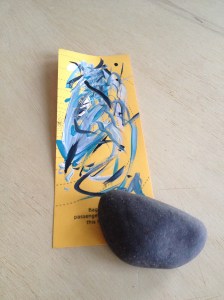
Near my stop I slip into the empty seat next to the aisle to get ready to disembark. He looks over at me and asks if he can give me a bookmark he’s made. Worse than talking to strangers is taking candy from one. He encourages me by telling me he does it to promote his work, since he writes haikus and does paintings. I accept one and learn of the website unfoldingmind.com. He then asks what I’ve been reading. If you read my posts in order, you can see my last book was The Exorcism of Anneliese Michel. There’s a reason I don’t tell my fellow passengers about my literary choices. I say it is a book about an exorcism and he takes it in stride, asking if it was an actual case.

I had my own unfolding moment then. Not only was it the case that I could mention exorcism in casual conversation, but a man considerably younger than me knew what it was. Stop and think about that: prior to the movie and novel, The Exorcist, very few modern people even knew about the rite. Strangers on a bus, both artists in their own way, I like to think, knew what this was. I look at my bookmark, some original art with a haiku on it, and think of the many interesting people that make this bus their temporary domicile. Occasionally, amid the snoring phone-movie watchers, is another passenger using the long ride home to open his or her mind. The bookmark is now amid the artifacts of my personal museum. And my words, hardly poetry, are a tribute to those who practice the arts that make us human.


Spiritual Education

The water was hot. Notoriously hot. Our Junior High School had been built in the days of the prison esthetic, with heavy, cinderblock walls painted in penitent colors. And the water was famously hot. One of our gym teachers, nameless here forevermore, challenged us to be men. It takes a kind of courage mostly illegal these days to lecture a room full of naked boys, but he once came in during mandatory shower time to tell us that anyone who could hold their hand under the hot tap for a full minute would get an A in gym. Since he was an ex-Marine nobody was foolish enough to take him up on this challenge. At least not in my class. It’s difficult to be courageous when you’re unclothed.

The incident I recall, however, occurred at the opposite end of the spectrum, in art class. You may remember those days when you wove reed baskets to take home to your mom. The thing about reeds is that they’re brittle unless soaked in hot water. That was the key to working with them. Make them supple with hot water and then when they dried, they’d be remarkably sturdy, if somewhat lopsided. We had been weaving reed baskets when someone, unbeknownst to the teacher, had filled the sink with water as hot as our old school could deliver. Thinking it funny, since even in those days educational budgets were under threat, somebody dropped one of the very limited number of heavy reed-cutters into the sink, now at the very bottom of a basin of very hot water. I was not the guilty party; I don’t know who was. The drain was plugged from the bottom. Very funny, no?

At the end of class. the teacher was not amused. “No one leaves this room until that cutter is out of the water,” she flatly said. The first bell rang. She stood in front of the door. We would be late for the next period. Perhaps it is the weakness of character my religion instilled in me, but I’ve always had a great fear of not doing what I was told. It lingers to this day, that Fundamental unworthiness. This body of mere flesh is weak and prone to sinfulness. The clock was ticking. Teacher wanted the guilty party to suffer the price of their prank. I pulled up my sleeve, plunged my hand into the scalding water, pulled out the reed-cutter, slapped it on the counter, and walked out the door. We were released to class and the searing pain didn’t last long physically, but spiritually it has never gone away.


Creative Religion

If you ignore common sense and read this blog, you know that I try to be creative in my approach to the world. It’s bold, in my way of thinking, to claim the mantle of creativity since there are so many people out there that the world has already decided are creative enough, thank you. Who has time to visit all the world’s museums, read all the world’s novels, or watch all the world’s films? Why contribute to the clutter? The answer—in as far as there is an answer—is that creativity is a way of being. My wife sent me a piece by Maria Popova from Brain Pickings. It is about the creative life. I’m reluctant to claim the title for myself, but the essay does match the description of what I’d like life to be.

Writing about religion daily requires a certain amount of creativity. If you think about it, it does make sense. Religion deals with intangibles. “Things not seen.” It also delves into that deep place called meaning and wrestles with issues we all have to face in our lives. It’s really a shame when religion becomes ossified into a system with no creativity or humor. One might make the case that it ceases to be religion then. The other day I was recalling just how powerful a high mass can be. Even now, if the mood is right, the memory of my first experience of it can bring tears to my eyes. It is a pageant of mystery and power. And creativity. The colors, the sounds, the scent of incense, the pressure of the kneeler on your knees, the sharp bite of flame tokay. It may not be the worship the way the disciples did it, but it sure has a creative genius.

When, however, worship became a daily requirement—when the majesty became mandatory—something was lost. Creativity means being willing to try something different. As much as we creative types cherish our friends, we need time alone with our Muses. And when we come back together with those friends, it is all the more pleasant for having been away. Creative people do not control their creativity. It clearly works the other way around. We can’t stop being creative, even if—and I can’t imagine why—we’d ever want not to be. Religion, on the other hand, tends to get stuck in some awkward places. If only it could be brought together with an open creativity without becoming trite it might find a place in a world too busy to take time simply to be.


Sweet Tooth

I don’t have a sweet tooth. I count that as a personal flaw, but the fact is I don’t seek out sugary snacks. Still, who doesn’t enjoy a nice chocolate once in a while? My wife and I attended a local chocolate tasting event recently. This was a new experience for me. Being of working class vintage, I tend to look at comestibles in a purely pragmatic way—food is for eating. It shouldn’t taste too bad, and ideally it should be healthy. Between meals I seldom think about eating unless the time stretches too long and hunger kicks in. I’ve read a couple books about chocolate, however, and I was curious what I might learn.

Apart from learning the disturbing fact that much American chocolate isn’t really technically chocolate, it was an enjoyable evening. The proprietors of Carol’s Creative Chocolatez know their stuff. The event began with a history of cacao beans. Native to the Americas in the equatorial regions, it was only after Columbus’s fourth voyage that Europeans discovered chocolate. Indigenous peoples used cacao beans as currency, and chocolate was the food of the gods. Its technical name, Theobroma, means just that. When Columbus appeared, a white man with European garb, and horses (as well as exotic diseases), he was ironically thought to be the returning god of chocolate. Instead, he took the previously unknown delicacy to Europe where various means of preparing it began. Eventually we ended up with the sweet, sugary variety that is considered standard today.

Theobroma plants contain a compound that creates feelings of euphoria. Chocolate, in other words, rewards you for eating it. It’s easy to see why indigenous peoples assigned chocolate its own deity. It’s also perhaps not surprising that what was mistaken for a god became a deadly plague. While Europeans were mostly interested in gold during the early period of exploration, they eventually realized that exotic foods and spices could be almost as good as gold. Chocolate, the food of the gods, could be mass produced and degraded and sold as an addictive treat to children. Such we do with our divinities. If only obesity were the same as obeisance! Instead, we are presented with a treat that tastes good and makes us feel happy. Like most gifts of the gods, it’s best enjoyed in small quantities. Even a little gold will go a long way. And after this evening, I think theology may help to explain the fascination with Theobroma.


Photographic Evidence

All photographs are lies. That moment preserved, formerly on celluloid but now with electrons, is gone for good as soon as the shutter is snapped. The camera doesn’t see as the eye sees. I was reminded of this during a mountain thunderstorm. I awoke early, coated with jet lag and the residue of my regular early morning schedule. It was still dark, but the reddish sunlight soon wrestled through a valley fed by a creek across the lake. The color was impressive, but my camera washed it out to a diluted Creamsicle orange. In reality the clouds were roiling overhead and lightning was streaking through a thunderhead like synapses firing violently in a massive brain. Thunder in the mountains can’t be photographed. Nor can it be forgot.

My work used to require quite a bit of travel. Before I would visit a campus I would spend some time on faculty pages, trying to put faces together with names. Impressed with how young these professors were, I’d knock on doors armed with foreknowledge of who might greet me. I wondered who these older people were when the door actually opened. It’s disconcerting to see someone age before your eyes. I would think back to the photographs online that had assured me this person would be much younger. The picture was a fossil. A moment frozen in time. The very next second after the photo capture that smiling face had changed. The best that we can hope for is a gross approximation.

Perceptions of reality, as all religions teach us, contain a healthy dose of illusion. While it contains ethereal beauty, this vision I’ve captured in my lens is only part of the picture. There is something deeper, more meaningful behind it. Photographs enhance memory. In the days before Photoshop they could be submitted as proof of an occurrence. They are a form of art. Whatever else they may be, they are also lies. Lies need not be of evil intent. Religions try to explain what some privileged individual realized was the truth. These who found a way of looking behind the photograph. The streaking lightning outside evades the slowness of my finger on the button. The thunder rolling and re-echoing through these valleys will remain in my head long after the sound waves cease to reverberate. Reality is more than it seems. Even my experience of this mountain thunderstorm is that of a single individual seeking enlightenment. Elsewhere others are up early, observing it too. What they experience may be something very different from me indeed. I have a photograph to prove it.