A Sigh for Cybele

As we fall out of the holiday season into that distinctly chilly and sometimes cheerless February, Cybele comes to mind. Over the past several weeks I have added posts focused on the holidays associated with December and January. In the course of my research for a children’s book on American holidays (not published), I was astonished at how frequently Cybele appeared among the origins of current holiday practices. Having researched ancient Near Eastern mythology long enough to complete a doctorate in the field, and to write a book on an ancient goddess (Asherah), the lack of reference to Cybele in my sources was unexpected. I pushed this question mark to the back of my mind, but as I was reading H. P. Lovecraft’s story “The Rats in the Walls,” I found Cybele once again.

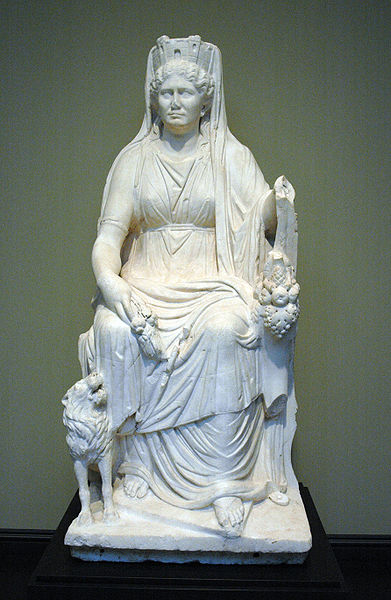
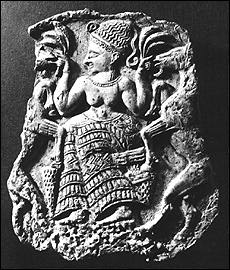
Cybele eventually became a major Roman goddess, although she was never among the Greek Olympians. Her importance shows in her connections with several Roman festivals and practices of antiquity, some of which have survived even to the present. Greco-Roman adherents to Cybele worship considered her to have been of Phrygian origin. Many scholars, however, see in her name and character echoes of a Semitic goddess named after Gebal, or the native name for Byblos in Phoenicia. If so, she is one further piece of the puzzle connecting the classical world with that of the fertile crescent.

Wikipedia Commons Cybele

A standard title for Cybele was Magna Mater, or “great mother.” As such, she was frequently associated with the earth itself, widely considered to have been a primordial female deity in the ancient Near East. In many respects she resembles Asherah, although the two are never explicitly identified. In myths where she is associated with Atys (later Attis), she becomes the spouse of a “dying and rising god.” She is prominent in festivals around mid-March, at the time of the renewal of fertility in the Mediterranean basin. Matronly, stolid, and powerful, Cybele lurks in the background of religious sensibilities. Her association with spring offers something to look forward to as the overly long, yet short, month of February starts to become visible.


Our Mother Who Aren’t in Heaven

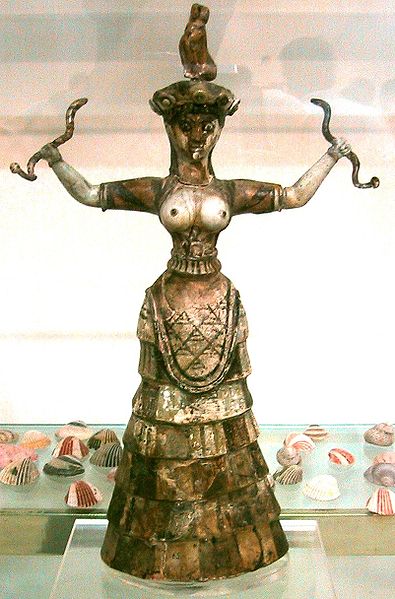
In the course of preparing to teach a course on Classical Mythology, I have been reading up on the Minoan culture of ancient Crete. This fascinating civilization is obviously related to many others in the Ancient Near East, but it has such a distinctive ethos that it always gives me pause. The Minoans had a religion that was apparently dominated by a great mother-goddess. Decades ago astute archaeologists and historians demonstrated that the amorphous “mother goddess” of antiquity was a modern construct rather than an ancient reality, but the evidence still stands that at least the Minoans revered the sacred feminine.

The work of Marija Gimbutas had overstated the case for a matriarchal society in antiquity, but she had touched on a truth sometimes obscured by the patriarchal world of yesteryear — some cultures did venerate the divine mother. Among the cruel ironies of history the name of this goddess has been lost, but images of a secure island with its chthonian female divinities remain. Among the artifacts discovered among the various Philistine sites in the Levant was an inscription, apparently dedicated to Asherah. Asherah is a thoroughly Semitic deity, first appearing in Mesopotamian contexts further to the east. The Philistines, however, likely settled their region after migrating from Crete a few centuries after the collapse of the Minoan culture. Could they have brought with them a remembrance of the divine mother?

I am not convinced by arguments that suggest a polymorphous “mother goddess” reigned in antiquity, as much as I might wish it had been so. What a different world might have emerged if monotheism had been based on a divine mother! Minoan culture appears to have been strong but relatively peaceful. In one of the androcentric twists of history “Cretan” and “Philistine” have come into modern usage as derogatory slurs against good taste and refinement. History demonstrates, however, that apart from foreign biases those hailing from ancient Crete may have developed the superior civilization of antiquity.


Asherah Overcomes

In the constant struggle of humankind against nature, we often find things out of place to our refined sensibilities. With the advent of autumn we frantically rake the fallen leaves into Brobdingnagian piles and anxiously await the colossal vacuum truck to come by and suck them all away. Leaf litter just doesn’t fit the suburban image. Or perhaps there is a dead tree that threatens to fall on our artificial habitat. We call the tree removal experts to have it taken out. All animals reshape their environment. We humans recreate it.

Long ago I argued that divinized trees in the ancient world do not necessarily represent Asherah. I stand by that assessment — asherahs were apparently constructed of wood, but it does not follow that all wooden cultic objects are asherahs — this does not meet the logical requirement of sufficient condition. Nevertheless, the book of Deuteronomy suggests that in times of necessity any tree might serve as an asherah (16.21), although this is soundly condemned. Perhaps the power of the tree represents the feminine vitality of the goddess. Like a tree, Asherah often outlives humans.

Photo credit to Christopher Chung

This picture appeared in today’s paper. A crew trying to remove an out-of-place tree near an expensive home had a little trouble as the tree pulled over the crane, and not vice-versa. Seeing the all too masculine crane truck dangling helplessly in the air while the tree holds its ground, I thought again of Asherah. I do sympathize the homeowners, but my sense of wonder is temporarily restored. Perhaps nature still has the means to prevent humans setting things in their own preferred order. Perhaps Asherah still lurks at the edge of the forest. Let’s hear it for the trees!


Neo-Canaanites

The world of religious studies is full of surprises. Since people are forever seeking new forms of fulfillment, the endless variety of religions itself comes as no surprise, but the results of religious experimentation sometimes lead into uncharted waters. One of my students at Rutgers recently pointed me to a new religion called Natib Qadish, “the sacred path” in potentially vocalized Ugaritic. (Ugaritic, like most ancient Semitic languages, was written without vowels. Some modern scholars, basing their reconstructions on likely vocalizations known from other Semitic tongues, have tried to give voice to this dead language.) I have no idea how large a following this religion has, but it does maintain a substantial website explaining its core beliefs — the modern worship of the Ugaritic/Canaanite gods.

Unsatisfied with the tradition monotheism that eventually drowned out polytheistic voices in western religions, followers of these reconstructed religions are looking back to something more ancient, more primal, and perhaps, more human. What strikes me as odd concerning all of this is that religions such as Natib Qadish are based on extremely fragmentary understandings of ancient religions. We have perhaps a 101-level understanding of Ugaritic religion; some parts are very well attested, but there are huge lacunae that confuse the overall aspect. As I tell my students, ancient religion was based less on belief than it was on practice. Belief-centered religion is a relative newcomer on the historic scene. Ancients inherited their “religions” without question, based on where they were born. Tess Dawson, the founder of Natib Qadish, writes: “I have yet to find any word that means ‘religion’ in any of the ancient texts.” I would argue that it is because the concept of religion itself is a modern one.

Humans seem to have believed in gods from very early times. If gods are there, they must be placated. This is not religion; it is commonsense. Not to placate gods is to invite disaster. In Ugarit these gods included Hadad (Baal), El, Asherah, and Anat, among a host of others. These were the gods people “discovered” as they tried to fumble their way through a difficult existence. And gods like to eat meat, they learned. Sacrifice was born. What is a feast without ceremony? Ritual must emerge. I know this is overly simplistic, but belief doesn’t really enter into this scenario until late in the game. Heterodox belief was normative until Christianity assigned eternal consequences to correct belief, and now we are free to believe whatever we will.

As far as I can tell, Natib Qadish does not actually involve animal sacrifice to the gods (although it is based in Chicago, long known for its slaughterhouses). Like many modern Christians, the followers of this religion wish to reach back to a more pure form of ancient belief. It is an exercise in futility, however, in many respects. The framework has changed beyond recognition and we have no way of knowing what any ancient god would require of us in an internet age.

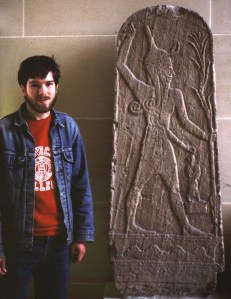
SAWHadad

A young Dr. Wiggins meets Hadad in Paris


God’s Wife

Podcast 13 follows up on the previous two posts concerning Asherah. Here a little more background is provided on the discussion/debate concerning the goddess. I trace the origins of Asherah, best attested at Ugarit, and explain why this should be our primary source of information about the character of the goddess. I consider the 40 biblical passages briefly before moving on to the Mesopotamian, Hittite, and Epigraphic South Arabian material. Clearly the most important evidence for the debate on whether Yahweh was wed or not is the set of inscriptions from Kuntillet Ajrud and Khirbet el-Qom. I examine these bits of evidence as well, explaining why I doubt that they intend to portray a divine couple. The podcasts closes with what I believe to be the way forward — a clear understanding of Asherah based on Ugarit and read without a scholarly agenda (yes, they do exist!).


Who’s Your Daddy?

Is there an epigrapher in the house?

Is there an epigrapher in the house?

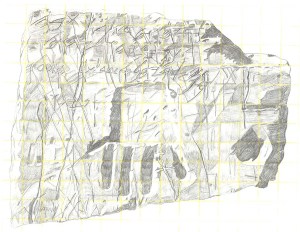
As long as I’ve broached the issue of Yahweh and his Asherah, it would be fitting to consider the supporting evidence of Khirbet el-Qom. The attention of William Dever was drawn to this burial site as long ago as 1969 by a badly striated inscription purchased from an antiquities dealer that had been traced to the location. Indeed, the exact spot of the excised inscription was discovered where it had been removed from a pillar near a tomb. Dever originally translated the inscription with no reference to Asherah and with an admission of its poor state of preservation. It was only after Kuntillet Ajrud was discovered (see yesterday’s post) that scholars began reading Asherah back into this extremely difficult epigraphic puzzle.

Since that time, Kuntillet Ajrud and Khirbet el-Qom have become the requisite two witnesses to seal the case: Yahweh had a wife named Asherah. Now slow down a bit! What does the second witness say? The Khirbet el-Qom inscription is extremely problematic; those who’ve examined it closely do not all agree that “asherah” occurs in it at all. If asherah appears here it is grammatically unwieldy: “blessed be Uriyahu by Yahweh for from his enemies by his asherah he has saved him,” and that’s only if the word really is “asherah.” Although Dever has gone on to write a book about God’s wife, he has never changed his original translation sans asherah. I followed his publications on the topic to see his revised translation, but surprisingly, he defers to others, some of whom have never seen the original. Am I the only one who sees something odd here? Only after “Asherah” appears in a grammatically awkward way from Kuntillet Ajrud does she get back-read into Khirbet el-Qom, in an even more awkward syntactic construction, and voila! Yahweh is happily wed!

My scholarship suffers from no conservative agenda, and I cannot be accurately classified as conservative by any stretch of the imagination, but I simply cannot
abide sloppy scholarship (and I’m the one without a full-time job!). It seems to me that if Yahweh was married, even if so considered by a tittering band of heterodox Israelites who liked to hang out in tombs and scrawl graffiti on public property, we would find some solid indication. So far all we have is ambiguous references to Yahweh of Samaria (and Tema) and “his asherah” at Kuntillet Ajrud and a badly defaced inscription from Khirbet el-Qom that may or may not even mention “asherah.” I cannot see this as strong evidence for a case of divinely wedded bliss.


Here Comes the Bride – Maybe

Kuntillet

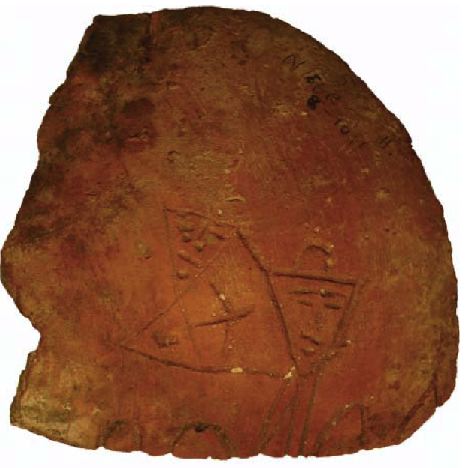
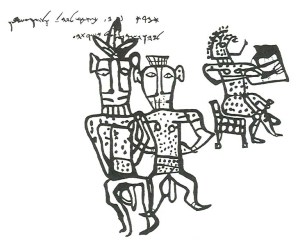
This is one of my favorite doodles from the ancient world. Its rich ambiguity lends to its appeal — some see it as salacious, while others see it as sacred. For those of you unfamiliar with the graphic details of the Asherah debate, this image is an ancient graffito from a desert way-station called Kuntillet Ajrud, a one-period site from the eighth century BCE. Like any number of other ancient drawings, this one would have probably remained in the obscure curios-portfolio of ancient scholars if it hadn’t overlapped an inscription that mentions “Yahweh of Samaria and his asherah.” Discovered in 1975–1976, this inscription, along with a couple others, revolutionized many scholarly assessments of ancient Israel’s religion. Yahweh had a soft side after all, a wife no less, the old god!

I’ve taken some flak in my circumscribed academic career for suggesting that this inscription, and a perhaps somewhat similar one from Khirbet el-Qom, are ambiguous. Sure, I’d like to see Yahweh happily married as much as the next guy, but is that what is going on here? Yahweh and Asherah, sittin’ in a tree? My doubts don’t stem from a squeamish conservatism (come on!) but from a concern of over-interpreting ambiguous evidence. Asherah, as a goddess, was rediscovered with the excavation of Ugarit. Forgotten by time with only cryptic references in the Hebrew Bible to some kind of cultic item called an “asherah,” scholars were excited to learn that she had a body and a personality. Many aspects of that personality fit, circumstantially, with a lovely pairing with Yahweh; wherever Asherah appears she is the consort of the high god, she is royal, matronly, and never showy.

The image above, however, has nothing to do with the inscription it overlaps. The two larger figures in the foreground are clearly Bes, the minor Egyptian protective deity. The characteristics are so clichéd that only the will to see Yahweh and Asherah arm-in-arm suggests anything different. Scholars like a happy ending just as much as anybody else, but I am obligated to state that, taken objectively, Asherah simply isn’t in the picture here.


Of Cats and Goddesses

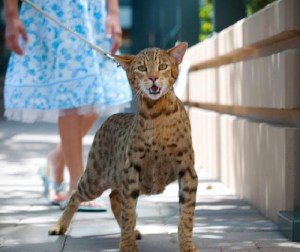
During one of my periodic forays into current Asherah lore on the web, I discovered a new breed of cat. Well, actually, I didn’t discover it, I just became aware of it. Because of a misspelling on a website I learned that the Ashera (trademarked name!) is the most expensive cat in the world, retailing for $22,000. A blend of three species (the mind boggles), the African Serval, Asian Leopard, and domestic cat, this feline comes in at least three varieties, including the especially appropriate Royal Ashera. If you’ve come into an inheritance and want to waste a few grand, take a look at Lifestyle Pets to see the wonder.

According to Kirta she has a temper!

According to Kirta she has a temper!

Curious, I searched to find if anyone would tip a hand as to where the name of the cat was derived. Choosing the name of the queen of the Ugaritic divine world seemed a little too much coincidence for me, but then again, homophones happen. When the Prince of Egypt, Dreamworks’ answer to The Ten Commandments, was released, I had several people ask me why the Israelites were singing about “Asherah” after they crossed the Red Sea. I had to watch the movie very closely, but I figured out that they were singing “I will sing,” which, in Hebrew, sounds suspiciously like “Asherah.” I never did discover Ashera’s origins.

Cats, however often maligned as associated with witches and vampires and other creatures of the night, are certainly among the most divine of domesticated pets. If I were free to purchase an animal companion the Ashera would be in the ranking (after I’d won the lottery, of course). Whether intentional or not, who would not want to own a cat named after the only goddess to be mentioned in connubial relations both to El and perhaps even to Yahweh? (The latter association, like the naming of the cat, is entirely open to question!)


The Lady or the Lion

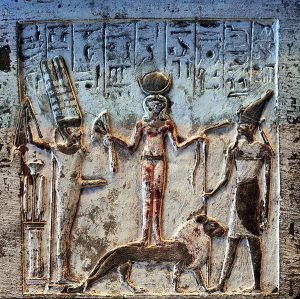
Ancient West Asian society utilizes a striking image that causes no end of confusion — the lady and the lion. Although not always identified, the lady generally appears to have been a goddess. Pairing a female figure with the most ferocious predator known in that society ripples with significance; there can be no question that the cultures involved were patriarchal, a fact of life in that part of the world at that time. If it was a man’s world, why depict the glorious lion with the feminine? Because we fear what we cannot control?

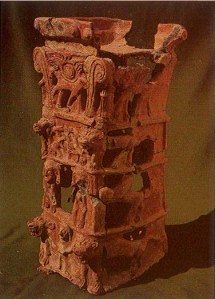
The infamous cult stand from Taanach

The infamous cult stand from Taanach

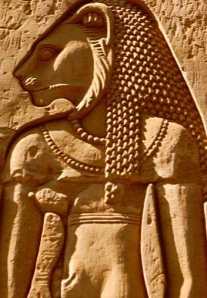
Ostensibly the rationale for this correlation may be traced back to Ishtar, the goddess sine pari of ancient Mesopotamia. The exact reason for her leonine associations is unknown yet she is among the fiercest females connected to warfare and strife in the ancient world. Her lion companions ranged over the realms of the Levant where other goddesses also assimilated her imagery. Curiously, one goddess who has no specifically leonine attributes is Asherah, the consort of the god most high, El. In Egypt the fierce goddess associated with war was Sekmet, often portrayed with a curiously male lion head.

Min, Qedeshet, and Resheph — a ménage à trios?

Min, Qedeshet, and Resheph — a ménage à trios?

In an earlier post I suggested that the biblical prophet Amos may have known that lionesses generally make the kill. Could it not be that although most women were locked out of public power structures in the ancient world they still may have retained the utmost respect and reverence of the populace? Long before male monarchs claimed titles such as “Lionheart” even gods would tremble before an enraged goddess. Morphed through time and continued patriarchal culture, the connection once again recurs in Frank Stockton’s The Lady or the Tiger where the metaphor has lost its teeth and the lady is no longer the source of destruction, but of male desire. Has the male prerogative once again usurped feminine independence? If only Ishtar or Sekmet could have been behind door number three!

Behind door number 3

Behind door number 3


Shades of Asherah

When my book on Asherah was first published in 1993, some reviewers criticized my humble effort to sort out the identity of this goddess without resorting to iconography. As I had anticipated this, in the text itself I provided what I thought was a reasonable rationale for my decision. It is a sad fact that ancient polytheists seldom captioned their imagery. Some images so clearly resemble the character of deities described in the myths that correlations are almost certain. Asherah, alas, lacks that privilege.

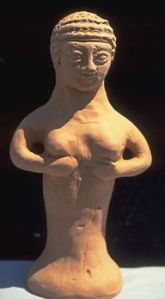
Could be anybody's mommy

Could be anybody's mommy

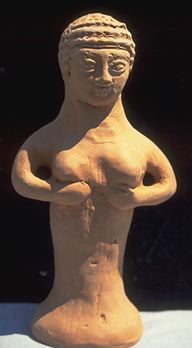
No item from ancient West Asia has yet been recovered that bears an inscription identifying the portrait as Asherah. We simply do not know what the ancients believed she looked like. This hasn’t prevented modern scholars from assigning an Aserah value to certain favored artifacts with a great deal of certainty. So much certainty, in fact, that we don’t know which certainties to trust. If iconic emblems for Asherah existed, that might provide a way of connecting images to the goddess. Unfortunately, snakes, lions, and “twigs” — the usual suspects — could fit just about any goddess with a little twisting. So we are forever left with iconic ambivalence.

May be Asherah, but what's with the goats?

May be Asherah, but what's with the goats?

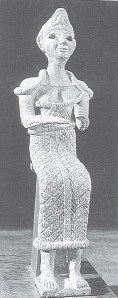
Of all the artifacts recovered from the Levant, where Asherah was actively worshipped, only one, it seems to me, is a potentially clear match. Not as alluring as the Asherahs of popular imagination, she is actually described as a matronly figure, the consort of patrician El. The El images that seem beyond question illustrated him comfortably seated on his throne of state, hand raised in a sign of blessing (or waving good-bye). One image found at Ugarit presents a feminine counterpart in posture and pose. This is likely the image of Asherah. Younger, sexier goddesses need not apply. This one instance reminds us of just how little we know of the immense divine world of Ugarit. If we are careful in our explorations, however, there is much to be learned.

Like hubby like wifie

Like hubby like wifie


Yes, Mammon

In the continuing coverage of the most recent New Jersey scandal the Star-Ledger, on Monday’s front page, posted a picture of San Giacomo Apostolo in Hoboken. San Giacomo is traditionally the brother of the equally mythical St. Ann. The statue, which stands outdoors in a public street, has monetary donations tacked to it. The image flashed me back to my Nashotah House days when students became visibly excited nearing the date for the procession of Our Lady of Walsingham at the proto-shrine in Fond du Lac, Wisconsin. Seminarians would beg for an opportunity to hoist the holy statue, or at least be a lowly acolyte. (These were grown men, mind you — many of them seeking the priesthood as a second career.) I never attended Walsingham, but it was my understanding that pilgrims and penitents at the festival also adorned their lady with money in hopes of some gift of grace. I grew up in a blue-collar household where paying ladies for favors was itself considered a sin.

Looks like Our Lady has put on some weight

Looks like Our Lady has put on some weight

While on a recent trip home, I saw a church for sale. As I started to break out my checkbook, I recalled how closely money and religion are tied together. The more I pondered this, the clearer their ancient, entangled roots became. The religiously observant bringing gifts to the temples of their gods was a standard act of piety and civic duty in the ancient world. Temples were expensive and the staff could only be supported by continuous donations. In the Ugaritic tale of Kirta, our protagonist seeks a son and makes a vow to Lady Asherah that if he successfully procures a wife he will make a statue of her in silver and gold. The favors of gods may be purchased. Today credit cards are accepted, but we are still caught in the web of those who claim God has asked them for your money.

For sale, God not included

For sale, God not included

When I was a teenager a friend invited me to attend a public presentation by some visiting Rev. Harrington, a popular evangelist. Several times during his high-energy sermon he sent the collection baskets around. The first time it was for your standard church offering. The second time was for any change you had in your pockets. The third time was for a special blessing. For those who had checkbooks ready, a thousand-dollar donation would get your name on a personalized plaque in his private jet. Years later I saw Harrington on television during an interview on his private estate. He puttered around it in a customized golf cart with wheels designed not to scuff up the gold-plated bricks that constituted the drive before his opulent mansion. “If we’re going to walk on streets of gold in heaven, I want to get used to it here,” he casually explained.

So, as an (unofficial) agent of Asherah, if you are seeking to make a divine investment, get out your checkbooks and I’ll tell you where to send the donations (checks made to “cash” please!).


Asherah Begins

Back in the Dark Ages when I was working on my dissertation on Asherah, web research had not been born, or even conceived. Its parents might not have even met yet at that stage! When Gorgias Press decided to print a second edition of my book on the goddess a couple of years back, I utilized the opportunity to peruse the web to find out where the old girl is these days.

It seems that Asherah worship is alive and well, according to the internet. I suspect that the ancients would be scratching their heads — and not just because of the omnipresent lice — at the ways she is portrayed these days. The matronly bearer of the gods of Ugarit is a lithe and whimsical girl, walking on the water just like so many other ancient divine figures. She has become a patroness of witches and is identified with any number of pet causes. She is chic, sexy, and alluring.

Unfortunately, what we know of the actual goddess is quite a bit less exciting than all that. Asherah is best attested at Ugarit, a city on the northern coast of Syria that has been extinct for 3000 years. Here she is matronly, passive, and interested in doing the laundry. Her role in the mythology is small, despite being the mother of the gods. She does become notorious in the Hebrew Bible and still has the power to inspire the “bad girl” dreams of many a rebellious youth. She is a fascinating figure — some pundits even think she might have been the main squeeze of someone very high on the spiritual food chain!

Perhaps this is one of those “disconnects” that pop-up like toadstools during a wet and rainy summer. Technology has outstripped reality. A goddess once feared and revered as the ancestor of the gods has become a pin-up girl in a digital era. If a mirror could be held up to time itself, I’m not sure that Asherah would recognize herself even if she long gazed into it.