The Movie Maker

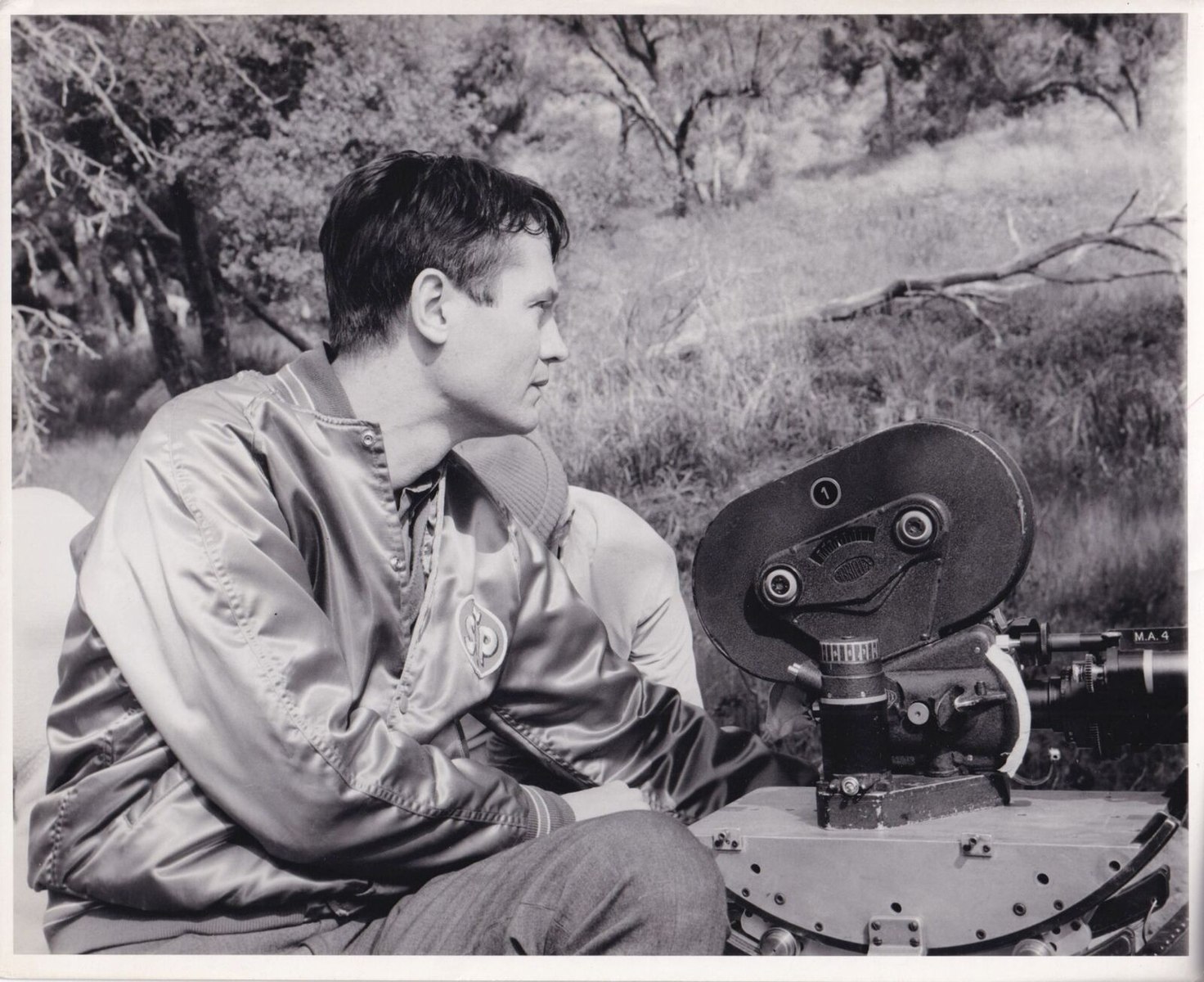
Roger Corman has died.  So passes an era.  I’ve always had an appreciation for the speculative films of the fifties and sixties.  Many of these involved low budgets and content intended to shock.  Or at least excite youngsters.  And Roger Corman was a huge name among directors, producers, and promoters of such schlock.  He entered the realm of horror in 1955 with Day the World Ended.   Attack of the Crab Monsters a couple years later put the focus firmly on monsters.  Producing and directing three or more movies a year, he built a reputation for being cheap and quick, but that didn’t prevent him from creating some good movies.  A film’s producer is the one responsible for overseeing the production.  Often they come up with the ideas of what to film.

Roger Corman, publicity still; public domain via Wikimedia Commons

As the sixties were dawning, Corman produced several films “based on” work by Edgar Allan Poe.  I remember seeing some as a young person and wondering what they had to do with the Poe I’d been reading.  Still, he managed to grace cinema with House of Usher and The Masque of the Red Death.  These are good films, despite limitations.  At the same time, Corman was still producing creature features as well, wracking up an impressive list of nearly 400 produced films.  As an established player in cinema he also took on the role of distributor from time to time.  When The Wicker Man was being ignored in Britain, Corman undertook the role of US distributor, likely saving the movie from total obscurity.

Circling back to Day the World Ended, we’ve become accustomed to believe that some kind of divine or human ending is in the offing.  These ideas get embellished over time, as I suggested in my new piece on Horror Homeroom.  Corman knew that this putative end would get the attention, whether or not there was any truth to it.  Perhaps that was the genius of his work—he knew how to attract attention.  And he wasn’t afraid to do so.  The business of cinema is one of attracting viewers.  Telling stories we want to hear.  We remember reading Poe, and even if the movies differ from the stories he penned, they are nevertheless reminders, reminiscent of what we’ve read.  If there are monsters they are somehow perhaps even more effective for not really being believable.  In short, Corman was a showman.  He made a living doing what he loved.  And he influenced many lives along the way.


Movie Prophet

Is there such a thing as a movie so bad that it can distort reality itself?  If so, I nominate A Haunting in Salem.  A little explanation.  I am trying to develop an aesthetic for bad movies.  I’m finding it not too difficult for movies that are so bad they’re good.  Usually such movies are fun—whether intentionally or not.  But there is a class of movie that is poorly written, poorly acted, poorly lighted, poorly set, poorly premised, poorly directed, poorly paced, and all without a hint of humor.  That’s this movie.  I watch bad movies because of my expensive habit.  I stream movies.  Since I work 9-2-5 and I’m tired by 5, I do this on weekends.  I’m not paid enough to afford renting movies every single weekend, so I look for what I can find on the services I can access—Hulu, Netflix, and, mostly, Amazon Prime.  I try to find something that grabs me.

I watched A Haunting in Connecticut and A Haunting in Georgia, as well as their remakes.  The Salem in the title made me think this might have something to say about the Witch Trials.  Perhaps it did but I was so busy groaning that I couldn’t hear it.  Although set in Salem it was filmed in Pasadena (who would notice?).  They used a 200-year-old house as a 400-year-old house, as if there’s no difference.  There’s a scene where the daughter asks her mother about her father’s PTSD.  She says something like, “He shot that man in the war.  He thought he was a bad guy, but he was a good guy.”  It’s difficult to write this badly, even if intentional.  Sorry, I’m getting away from Salem.  Well, it turns out that the witches were buried on the property of Judge Corwin’s house and they kill every sheriff and all their families, when they move in.  This has been going on for four centuries but nobody has caught on?  Even a scene where the mayor is shown raising the flag outside his office had me scratching myself bald.  Is that one of the mayor’s duties?

Most of the time the actors act like there was no direction—showing the wrong emotions and not even remembering what was said just a minute ago.  And you can’t really feel for anyone other than the deputy who seems to be trying to be a nice guy.  Maybe this is my calling in life—to serve as a prophet warning my small band of readers what movies not to watch.  I can’t recall the last time I couldn’t wait for a movie to end so that I could wash my eyes out with soap.  Avoid A Haunting in Salem.  Don’t even consider it.


They Come in Batches

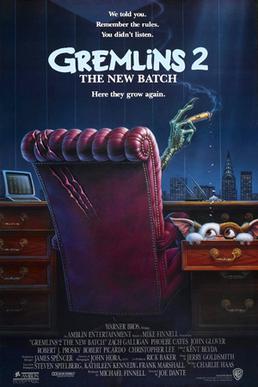
There’s horror and there’s comedy horror.  And then there’s just plain silly.  Gremlins 2: The New Batch falls into that last category but with the strange factor that it’s silly without being funny.  There are a few smirk moments, and sometimes the self-parody approaches clever, nevertheless it’s bad.  It’s a big budget bad movie.  The idea that the gremlins try to take over New York City is funny, at first, but other than Phoebe Cates and Christopher Lee, they don’t seem to know this is a satire of Gremlins.  I guess not knowing about the plot—I tend not to read reviews about movies before I see them—I was expecting something more like the first one, which I thought was pretty good.  The only reason I knew the movie existed at all was that the Blu-Ray version of Gremlins comes with The New Batch.  The late eighties and early nineties I was spending holed up in Edinburgh working on a Ph.D.  We didn’t have much money and didn’t see many movies.  We had no television (there is, or was, a television tax in the UK), so I never heard of the sequel.  

I presume we all know the three rules of mogwai, and needless to say, they immediately get broken.  The eponymous new batch takes over the Manhattan tower of Daniel Clamp.  His high-tech building needs no gremlins because the technology already doesn’t work well.  The high rise houses, among other things, a genetics lab where Christopher Lee camps it up, but which means the gremlins have access to formulas that allow them to grow wings, tolerate sunlight, and become spiders.  Sound silly?  You betcha.  One of the gremlins is even able to talk.  I watched with increasing stupefaction. 

Bad movies and cult followings are the peanut butter and jelly of cinematography.  Some bad movies never attain cultdom, but I can see why this one has.  The big budget ensured glitz and special effects.  Even the self-awareness to have Hulk Hogan being able to control the gremlins in the theater with a threat almost gives the movie an art film feel.  The horror, mostly based on the fact that there are monsters, is tightly constrained.  Although I felt increasingly like I was wasting my time as the movie went on, upon reflection I can see why some people have glommed onto it.  It may just have edged over into the so bad it’s good category.  I’ll need to think about it.  And avoid eating after midnight.


Which Witch Where?

I like to think of myself as a kind critic.  I’ve been on the pointy end enough to know how it feels when those who don’t like my work are unkind.  I’ll try to find a nice way of saying Witches of Amityville, or Witches of Amityville Academy, must’ve been shot on a very modest budget.  It must’ve been written by someone who’s still working hard to master the craft.  And the actors are continuing to improve as the director gets better at that role.  Why did I watch it?  Amazon Prime gives it four stars.  The incongruity of Amityville and witches suggested it might be a bad movie, and in that regard it did not disappoint.  So what’s going on here?

There’s a witch academy in Amityville.  Although all the cars have steering wheels on the right, everyone speaks with American accents, apart from a couple of characters.  The interior shots, however, are also pretty British for the most part.  There does seem to be some awareness that Amityville is in the new world.  In any case, said academy is run by an evil coven that is seeking to release the demon Botis.  To do so they have to sacrifice college-age women (and no, it’s not that kind of movie).  One of their intended sacrifices escapes and is found by three white witch sisters who also live in Amityville.  They decide to train this young woman who, as it turns out, is a very powerful witch.  Problem is, the director of the academy can’t release the demon without sacrificing this particular victim.  So she kidnaps her back.  The three good witches burst on the scene, actually more like just walk on, and prevent the sacrifice.  The bad witch kills herself and releases the demon, but the young witch is so powerful that she destroys him.  In the end the witches must go to Salem.

What’s not to like?  Some of us, day by day, year by year, work to improve our writing skills.  We write stories that incorporate whatever ability we’ve managed to scrape together.  And we struggle to find publishers.  I like bad movies because they are a great place to find hope.  The world’s a big place.  Even the entertainment industry is large enough to absorb movies produced by Amazon, Hulu, and Netflix, among others, including the big studios.  They’ve got to be looking for content, right?  Those of us who channel our creativity towards writing, and who keep trying to get it published, have a chance, don’t we?  What’s the harm in believing in the power of magic?


The Third

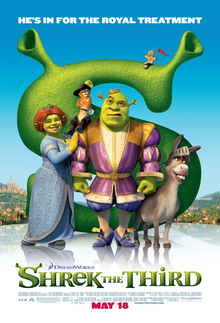
I don’t know what possessed me—and I use that verb intentionally—to suggest Shrek the Third for weekend viewing.  Apart from a Rosemary’s Baby and Exorcist mashup scene, it is a bad movie.  I’ve been watching bad movies over the past few months, and developing an aesthetic for them, but I just can’t warm to Shrek the Third.  The first two movies were quite good, and sequels frequently struggle.  I’m trying to put my finger on why this one leaves such a bad taste in a viewer’s mouth.  For one thing, it’s the writing.  Not as snappy or crisp as the first two, it drags with politically correct emotional adjustment as Arthur tries to learn to be king and Shrek reconciles with being a father.  What happened to the histrionics of Lord Farquad?  Or the cluelessness of the fairy tale creatures with no leader?  Instead there are hugs and reassurances.

Not that hugs and reassurances are bad, but they’re not Shrek material.  Sudden character shifts don’t help either.  The real thing, however, seems to me, to be the music.  Many movies patch in contemporary songs to set the mood.  The first two Shreks did this remarkably well, with one narrowly edging out two in several places.  The Third lacks this artistry.   The pop songs chosen just don’t fit.  They tank the mood time and again.  Music is important.  It can make or break a film.  In this case it’s only one problem.  To me even the animation seems rushed.

There is an aesthetic to bad movies.  I guess I was hoping to find it here (I’d seen it before, years ago).  Maybe badness in movies is harder to make good when they’re animated.  There’s an intentionality about everything when you know everything on screen was planned to appear exactly as it does.  Good bad movies entertain.  There’s a reason we come back to them, even knowing they’re not great.  As someone who’s written for his entire literate life, I tend to think that good writing can redeem most movies.  We can put up with low budget effects if the writing is strong.  There’s a reason Casablanca is a classic, despite the low budget.  The Third has the tag line, “The best Shrek yet.”  Considering the bar set by the first two, that was a boast not likely based on anything like facts.  Or taste.  I’ve got to wonder, however, when big budget animations start going off the rails, when is it decided to simply let them go and hope that a classic will emerge?


Not The Sting

Why do we make the decisions we do?  Watch the movies we do?  I have to confess that for me a number of strange factors combine to make for some weird choices.  For example, Invasion of the Bee Girls is difficult to explain apart from compounding oddities.  One is that Amazon Prime auto-suggested it too me (for free).  Yes, I have a history of watching bad movies and this definitely fits that bill.  Fuzzy-headedness during my weekend afternoon slump time probably played into it.  Along with the fact that I’d been researching bees and that brought the movie The Wasp Woman back to mind.  Wasp woman, bee girls?  It’s free and I’m not going to be able to stay awake otherwise.  The movie is about what you’d expect from a low-budget 1970s sci-fi horror film.  It did make me think I should read about movies before I watch them rather than after.

Nevertheless, I’m trying to develop an aesthetic for bad movies.  If you’re a regular reader you’ll know that I have a fascination with Ed Wood and his films.  I even read a book about him and also read a book on why it’s okay to like movies that we tend to label as bad.  No matter how you parse Invasion of the Bee Girls, it’s bad.  The acting, the writing, the plot.  Still, some of us have a taste for films from the seventies—it’s kind of a nostalgia trip since I was really only becoming aware of the odd world of science fiction about then.  Nicholas Meyer, who wrote the initial screenplay wanted his name removed after he saw the changes that’d been made.  That should be telling you something.

Meyer, while not a household name writer, did pen some good detective stories about Sherlock Holmes, and wrote, uncredited, both Star Trek II: The Wrath of Khan and Fatal AttractionInvasion of the Bee Girls has a somewhat salacious plot that fits the Zeitgeist of the seventies of which I was unaware, growing up.  The seventies were my sci-fi high point, it was good escapist material for someone living in a situation less than ideal for day-to-day living.  I watched, for example, Killdozer about that time and thought it was great.  Now that streaming is how we watch, the amorphous internet has a record of what we’ve seen and then recommends products for us based on our record.  I really thought we outgrew being tracked all the time.  Little did any of us know that it was only getting started in high school.  And as long as you have a penny to spend, those who track us will try to figure out how to take it.  You could get stung.


One Demonic Night

I only discovered after watching Night of the Demons (2009) that it was a remake.  Eventually curiosity got the best of me and I had a spare moment to watch the 1988 original.  It’s still kind of a bad movie, but it is scarier than the remake.  It’s also a horror comedy, but the emphasis is a bit more on the horror here.  A group of ten high schoolers go to Hull House, which used to be a funeral home, for a Halloween party.  When the power goes out they decide to have a séance.  Unbeknownst to them, however, there is a real resident demon.  This demon gets passed on through kissing, and it animates the kids who’ve been killed along the way.  Although the final girl is pretty clear from the beginning, in a usual twist the only surviving guy is African-American, the son of a preacher.

The concept of demons here is explained as entities that were never human.  This is the explanation Ed and Lorraine Warren used, often without making reference to fallen angels.  Since the demons are using the physical bodies of the kids, they can be stopped by locked doors, but killing them doesn’t really help, since they keep coming back.  It seems that there’s really just one actual demon, a dragon-headed entity that lives in the crematorium.  Rodger, the Black man, brings the element of religion to the story.  He objects to the séance in the first place, and suggests that they pray as he and Judy, the final girl, are attempting to escape.

In-between all this is sandwiched the gore and violence that make it pretty typical horror.  The humor involved, however, makes it less intense than a typical slasher.  Although I didn’t walk away thinking this would be a favorite movie, I could see why it’s garnered a cult following.  As is often the case, the original is better than the remake.  For one thing, it understands that religion seasons horror quite well.  Demons are, by definition, religious monsters, at least traditionally.  And the two “good kids” who survive are uncomfortable with messing with spiritual forces to begin with.  Judy just wants to go to the dance, after all.  The movie went on into sequels as its cult fandom grew.  If I ever do a sequel to Nightmares with the Bible I’ll need to include this franchise, I guess.  For a sleepy weekend afternoon, there are worse bad movies to watch.


Out There

While Amazon Prime includes a few A-list horror movies, those that it does I’ve already watched.  Since I can’t afford to pay for this habit, I watch what’s free.  That brought me to the horror comedy There’s Nothing out There.  Written and directed by a twenty-year-old guy, it’s kind of what you might expect.  Its main claim to fame, apart from being a low-budget monster flick, is that it anticipates Wes Craven’s classic Scream.   The latter is famous for being so self-aware.  One of the characters keeps telling the others what happens in horror films and, of course, those things happen.  Although There’s Nothing out There is silly, one of the characters does exactly that.  In the funniest moment in the movie he looks directly at the camera and says “It’s a distinct possibility” in response to one of the girls asking “So you’re saying we’re in a movie?”  Craven didn’t borrow that, but then, Scream is a landmark.

So what’s it about?  There are seven young people who head to a cabin in the woods.  Actually, it’s a regular house, and quite a nice one at that.  The three couples are there for sex but the single guy (Mike) is the horror expert and gets on everyone’s nerves.  He’s right, of course, that there is a monster on the loose.  A slimy green thing with a huge mouth full of pointy teeth, has fallen from space into the neighborhood and it slimes the guys, digesting them, and tries to mate with thee girls.  And if it shoots lasers into your eyes you become its servant, helping out with its mission.  The kids are picked off, of course, with Mike surviving along with one of the couples.  Before they can stop the monster a plumber also gets eaten.

Horror comedy is a strange genre.  It tends to work because there are elements of humor in much of horror.  It’s not all blood and gore—the best examples use that sparingly, in any case.  And horror comedy doesn’t really frighten since it’s pretty clear that it’s being played for laughs.  Sometimes such movies venture into the bad realm—there’s a reason some movies are free on Amazon Prime—but at times they actually have quite a bit to offer.  There’s nothing scary about There’s Nothing out There.  It’s the kind of movie that tends to grow into a cult classic over the years, however.  And while it’s not A-list material, it’s still worth watching for free.


Through the Woods

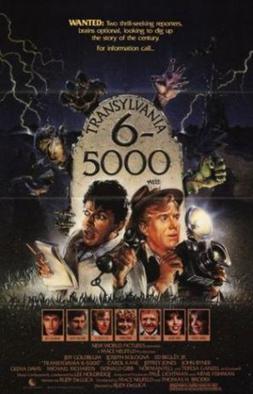
The thing about appreciating bad movies is that it’s difficult to be disappointed.  On a recent weekend I’d watched a horror film that didn’t sit well with me (or maybe it was the last night’s supper), and I decided I needed to see something else.  Something that was free on my streaming service.  I’d read about Transylvania 6-5000 someplace, but I couldn’t remember where.  The list of stars won me over: Jeff Goldblum, Ed Begley Jr., Jeffrey Jones, Geena Davis, Michael Richards—why don’t more people talk about it?  Because even for a comedy it has trouble working.  Well, a horror comedy, to be precise.  Emphasis on the comedy, which tries too hard.  I couldn’t get over the fact that this was a tall guy movie—Goldblum, Begley, Jones, and Richards are all over six feet tall.  Usually other actors literally have to look up to them.

Even though it’s a groaner, it’s not without worth.  It was filmed in what used to be Yugoslavia when it was rare for anything to come from behind the Iron Curtain.  Set in Transylvania, it wasn’t too far off.  (Transylvania is located in Romania, of course.)  Some of the performances aren’t bad, Davis’ vampire nods to Frank-N-Furter in Rocky Horror, and Carol Kane is fun to watch as Lupi.  The male roles are generally the problem.  In case you’re wondering, the plot is that two reporters—Goldblum and Begley—are sent to Transylvania to find a story.  The locals laugh at them, insisting Transylvania’s a modern country with no monsters.

When the classic monsters do appear, they all have rational explanations.  There are riffs off vampires, werewolves, Frankenstein’s monster, swamp monsters, and the mummy.  There’s even a mad scientist.  The problem is the movie really doesn’t give itself over to either comedy or horror.  There are ways to make that combination work.  And, as with C.H.U.D., the title put me off.  I didn’t know until reading about it later that it was also a riff, but from the Glenn Miller song “Pennsylvania 6-5000.”  I’d never heard the song before and was unfamiliar with its title.  Rudy De Luca, the director, had worked with Mel Brooks and perhaps if they’d collaborated on this one the results might’ve been better.  So, it’s a bad movie.  That doesn’t mean it isn’t worth watching.  Movies like this sometimes serve as an homage to the monsters with whom we grew up, and who even met Abbott and Costello in their own lifetimes.  Just be prepared not to take it too seriously and not to laugh too much.


Black Bird

Although we prefer typecasting—it’s so much easier!—Edgar Allan Poe had both depth and width as a writer.  He penned funny as well as scary, love poems and detective stories, even something like a scientific treatise.  One thing I’m sure he didn’t anticipate was his name being suborned for cheap horror movies.  Roger Corman is a Hollywood legend—a good example of a guy making it in the film industry on his own terms.  He paired Vincent Price with a number of Poe titles that had little to do with the actual works of the writer.  One that oddly stayed with me since childhood is The Raven.  This was well before I’d read the poem.  It’s funny how very specific things will stick in your mind.  I remembered the strange hat Price wore.  And I remembered—misremembered, actually—Price using a spinning magical device with sparklers.  Misremembered because that was Peter Lorre’s character, not Price.

That was it.  I didn’t remember that Boris Karloff was also in the film.  I was too young (as was he) to recognize Jack Nicholson as well.  Although I watched The Twilight Zone, I didn’t realize the script was by Richard Matheson.  This film was loaded with talent, but it really was goofy.  I recollected Price was a magician, but I didn’t know this was a rather silly battle to become chief magician.  Lorre’s ad libbed lines were surprisingly funny, even after all these years (I was about one when the film came out).  Surprisingly, the movie did well at the box office, despite its taking a sophomoric approach to perhaps Poe’s most serious poem.  

I’d avoided watching it again for all these years because of that sparkler scene.  I’m not sure why that particular moment wedged itself so firmly in my young brain.  It seemed so not Poe that I couldn’t get back to the movie, apparently.  With Price and Lorre camping it up—Karloff was, by all accounts, most professional as an actor—and Nicholson uncharacteristically timid, the cheap special effects, it’s obvious that viewers enjoyed a good laugh at this one.  It’s not true to Poe, of course.  It’s true to Roger Corman, however, a filmmaker who knew how to deliver cheaply and quickly and still earn some money at it.  I’d last seen The Raven about half a century ago.  I may be tempted to watch it again, after having seen it as an adult, but if I wait too long I’ll need to leave that duty to someone who’s read this and who isn’t afraid of sparklers. 


Gateway Horror

I’m in two minds about The Gate.  Part of me says “bad movie” while another part says, “Yeah, I’d watch it again.”  A third part of me knows I probably will.  It came out in 1987 as family-friendly horror.  There’s far too much going on for the run-time and the acting is lackluster (child actors who can really pull horror off are rare; perhaps those with more life experience make it believable).  It does have some Poltergeist vibes, though.  So, Glen (12) and his sister Al (15) are allowed to stay home without a babysitter for three days.  A couple nights before, a storm blew over a tree in the backyard, and Glen, with his friend Terry, accidentally open the eponymous gate at the hole by breaking open a geode, allowing demons to come into the world.  And, of course, the parents are gone.

Glen fears he is losing his sister to, well, growing up.  They used to do model rockets, but now she’s interested in boys.  Terry listens to heavy metal and discovers in an insert to an album of a European band, Sacrifyx, that they’ve opened the gate.  As night falls, the stop-motion demons attack.  They’re little and can be blocked by doors.  Al, Glen, and Terry have to figure out how to stop the demons and seal the gate without the Dark Book insert from the Sacrifyx album.  What to do?  They grab a Bible and try reading a bit.  When it doesn’t seem to be working, Terry utters an expletive and throws the Bible into the hole.  It works!  But, ah, this is only the false resolution.  The really big demon bursts through a hole in the living room floor after Terry and Al are both taken.  Glen, left to his own devices, launches a model rocket at the demon, destroying it.

Okay, sounds bad, right?  The reason, it seems to me, is that it doesn’t put religion to work for itself.  The instincts seem good—use the Bible—but the demons are too corporeal and too physical.  There’s no possession here.  In fact, the demons are the old gods (we’re in Lovecraft territory now) who want to take over the world once again.  There’s some good material to work with in The Gate, and if I ever get around to a sequel to Holy Horror I’ll have to include this one.  Overall, the message seems to be that if the Bible doesn’t work, use a rocket.  Oh, and don’t give up on your sister.


Not Handel’s Messiah

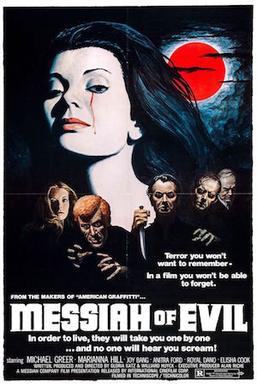
It’s polarizing.  Even now, nearing fifty, Messiah of Evil is either adored or excoriated.  So it was at its release.  I was pointed to the movie by an adorer—a somewhat unexpected New York Times seasonal article.  Suggesting that there’s nothing else like it, the article recommended it for autumnal viewing.  So, what’s it all about?  I’m not really sure, but that won’t stop me from trying.  Arletty is a young woman who wants to find her father (with you so far).  He’s moved to New Bethlehem, California, now known as Port Dome.  She finds his house abandoned, and the locals decidedly unfriendly.  Her father’s diary explains that he’s transforming into something inhuman.  The locals are cannibals, it turns out, awaiting the return of, well, the messiah of evil.  (The title is never used in the movie.)

Although I learn more towards the excoriating opinion of things, this is a great horror and religion film.  The original messiah of evil was a preacher stranded with the Donner party.  He started a new religion and, wanting to spread it, went to California.  Now, whenever a blood moon comes, he arises from the sea and his followers become aggressive.  The movie is set a century following this first appearance, and the dark master is due to return.  His followers await him on the beach, and Arletty is their intended sacrifice.  Elements of Lovecraft are clearly evident—people transforming, old gods, evil emerging from the ocean.  Yet, there are many things unexplained.  Or maybe I’m just naive.

The male lead, Thom, travels with a mini-harem.  He’s in Port Dume because he likes to gather folktales—like the blood moon—and he likes Arletty’s father’s art and came to buy some locally.  The movie features a blind art dealer, cops who apparently know nothing about the infestation of ghouls in their town, and a guy who could drive away from the attacking hordes who decides to run instead.  The directors (Willard Huyck and Gloria Katz) were a talented couple, but this wasn’t their best collaboration.  Still, many recommend this as an overlooked horror gem from decades ago.  Others not so much.  I’m glad to have seen it, although I fall into the latter camp.  Mainly because it continues a theme that I’ve tried to pick up at several points on this blog—that horror and religion have a great deal in common.  Even if one (or both) shows its age and fails to impress.


Not Making Decisions

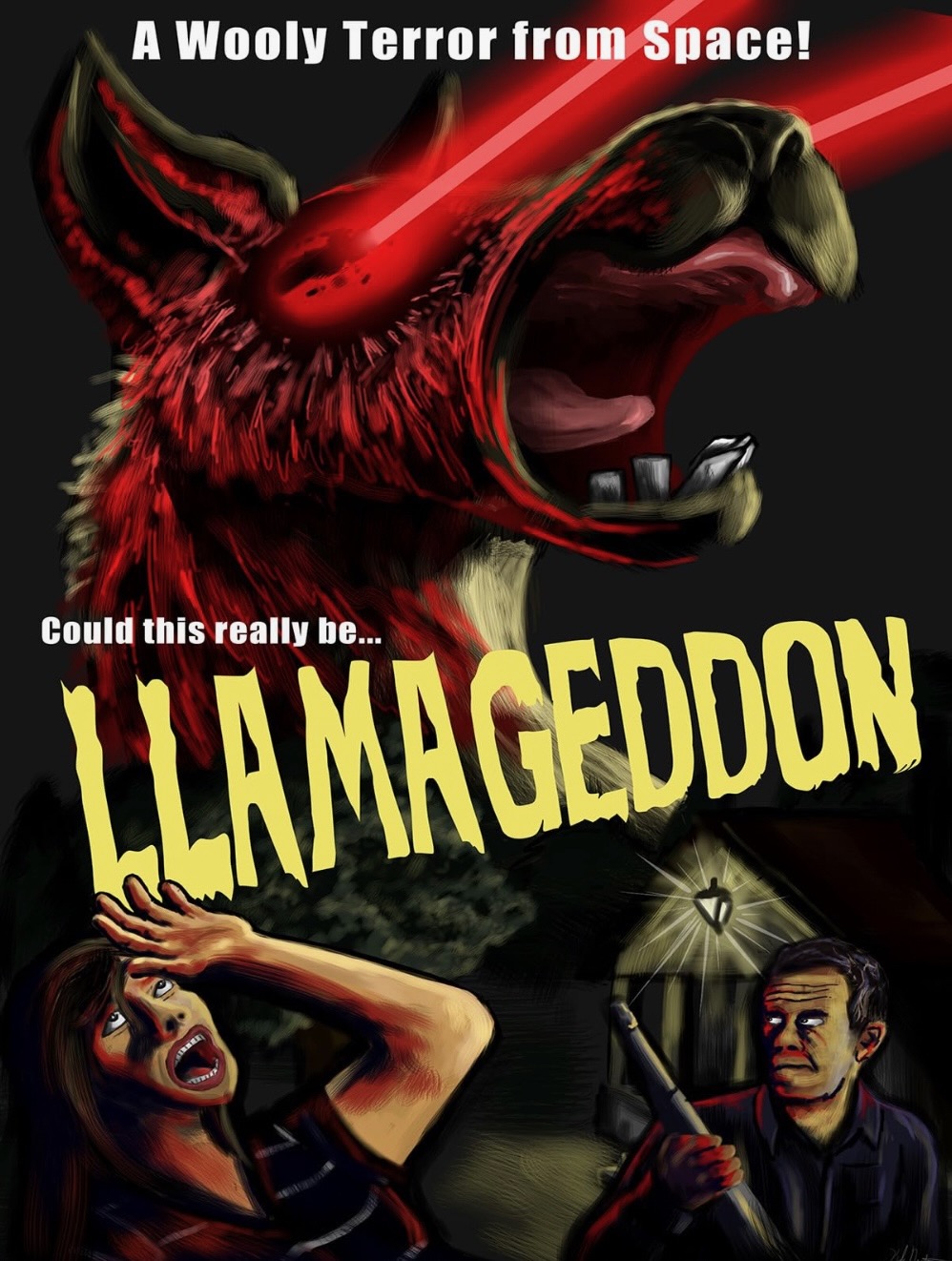
After anesthesia they tell you, “Don’t make any important decisions.”  That’s the excuse I’m using for having watched Llamageddon recently.  That, and it’s free on one of the streaming services to which I have access.  I only found out about it because of such services and I wasn’t in any shape to decide important things like how to spend the rest of the groggy day.  I’m of mixed minds regarding comedy horror.  Or is it horror comedy?  Decisions.  The fact is, quite a few horror movies do involve some amount of fun.  My favorite ones tend to be more serious, but once in a while you find yourself watching movies you know are (or you know are going to be) bad.  I knew this one was.  It’s so bad that it’s got a cult following.  It was, I’m pretty sure, made to be bad.

So a killer llama from another planet is forced to land on earth.  It kills an older couple in Ohio and after the funeral two of their teenage grandchildren, Mel and Floyd, are left to stay in the house.  Mel, who is older and more experienced, contacts all her friends so they can party that night.  Of course, the llama’s still on the loose.  It has laser-beam eyes and it bites and punches people to death and the partiers are picked off, not exactly one-by-one since many of them are electrocuted in the hot tub.  Generally they’re so drunk and/or high that they don’t believe any of this is happening.  Eventually Mel and Floyd’s father arrives and tries to save his kids.  Before dying of llama bite, he kills the quadruped by running it through a combine.

It’s worse than it sounds, but it’s played strictly for laughs.  And, I suspect, it’s one of those movies that’s meant to be watched under the influence.  Since anesthesia is about as close as I’ll ever get to that, I suppose this counts.  Some of the early horror movies have become funny with the passage of time as early special effects age and we become used to better, more convincing fare.     As it is, it’s difficult to find much about Llamageddon apart from IMDb, and the director’s name, Howie Dewin, is a red herring.  I’m fascinated by such films being able to gather a following.  Of course, I confess to enjoying Attack of the Killer Tomatoes when the mood is right.  And a day when decisions are contraindicated, anything can happen.


The Good Lurid

It takes a lifetime to make a reputation.  In high school my teachers and classmates knew mine well: religious and full of integrity.  Going on to do three degrees in religious studies confirmed all that (at least the former).  Something that nobody seemed to pick up on was that I liked watching monster movies.  I did less of it in college, but still watched some heavy-duty fare (including David Cronenberg) when I was in seminary.  Once I married life looked more optimistic and I really didn’t feel the need to watch what is called “horror” any more.  Sure, we occasionally saw films everyone was talking about, but in general I moved away from the genre.  It took Nashotah House and its aftermath to bring me back.  In any case, my reputation seems to be such that now when people who know me see religion and horror together they think of me.  I’m touched.

A regular reader of my blog sent me an article from The Guardian titled, “Schlock horror! Meet the family who made lurid movies for the Lord.”  It should be pretty clear, if my integrity is intact, that what I’m trying to do is figure out how these things fit together, religion and horror.  That they do is obvious, but how?  In any case, this article plugs a book by journalist Jimmy McDonough, The Exotic Ones.  The book explores the Ormond family and their odd filmmaking.  The father, mother, and son triad, made a living producing cheap, questionable films.  After a plane crash, which they survived, they became religious only to find their minister wanted them to keep making their bad movies for evangelistic purposes.  The films they produced for the church had religious themes, but used well recognized horror tropes, anticipating, if you will, Left Behind and its ilk.  Like a Thief in the Night scarred many of my generation.

I’m probably not alone in not recognizing any of the movies the article discusses.  If I’m reading correctly, Tim Ormond, the son and sole surviving family member, stopped making these films after the death of his parents.  In any case, I have been developing a fascination with bad movies.  The fact that they’re even made and released is incredible to me (mostly the released part).  Many of us end up reacting to life rather than following the plans we had for it.  Fate—call it what you will—has a way to stepping in.  For one family, however, fate led them to a church that paid them for what they wanted to do.  Many of the rest of us find just the opposite and we end up watching horror to try to understand.


Not Grant

Grant Wood’s painting, “American Gothic,” is undoubtedly his most famous work.  The image is so evocative and suggestive that countless interpretations have been offered for it.  The idea of debilitating isolation suggests itself.  An unhappy self-reliance that has taken its toll on an aging couple (some say the woman is his daughter) often comes to mind.  For some it suggests a movie.  Normally I like horror films from the seventies and eighties.  There’s almost an innocence to them that gets lost in the new millennium.  On a rainy weekend afternoon when I couldn’t be mowing the lawn I found American Gothic on Amazon Prime and it had received four stars and even IMDb showed it as better than average.  The longer I watched the more I was inching toward “bad movie” territory, but I had to see how it ended.

Six young people, four of whom are distinctly unlikeable, have plane trouble and get stranded on a lonely island in the Pacific northwest.  They discover a house furnished from the twenties and it turns out there’s an older couple there who don’t really cotton onto strangers.  As the plot unfolds it turns out they have three adult children who think they’re still adolescents.  And—this is the good part—they are a very religious family (in part.  Again, as often happens in such films, the writers really don’t understand religion).  In any case, the predictable killing off of the kids starts to happen when they continue to be rude and insult the family.  Since we’re in slasher territory here, there’s a final girl—one of the two sympathetic women—who ultimately takes over the house.

Part of the problem with the film is the utter paranoia with which it treats mental illness.  The family clearly has problems and, in a way typical for the genre, they turn toward killing.  Ironically, Pa, when he finds his family has been killed by the one mentally ill visitor (everyone with psychological problems in this movie turns to murder), renounces God and sells himself to Satan.  Interestingly, he doesn’t survive long enough to do anything about it.  Reading about this movie after watching it I came across a new word: hixploitation.  Exploitation movies are familiar to anyone who watches much in this genre, but I’d never considered that Deliverance and company exploit “hicks.”  It’s all about how others look at you.  And, as a movie made in Canada and the UK, it shows us what others see when they look at us.  There’s some ground to explore here in a sequel to Holy Horror