Black Bird

Although we prefer typecasting—it’s so much easier!—Edgar Allan Poe had both depth and width as a writer.  He penned funny as well as scary, love poems and detective stories, even something like a scientific treatise.  One thing I’m sure he didn’t anticipate was his name being suborned for cheap horror movies.  Roger Corman is a Hollywood legend—a good example of a guy making it in the film industry on his own terms.  He paired Vincent Price with a number of Poe titles that had little to do with the actual works of the writer.  One that oddly stayed with me since childhood is The Raven.  This was well before I’d read the poem.  It’s funny how very specific things will stick in your mind.  I remembered the strange hat Price wore.  And I remembered—misremembered, actually—Price using a spinning magical device with sparklers.  Misremembered because that was Peter Lorre’s character, not Price.

That was it.  I didn’t remember that Boris Karloff was also in the film.  I was too young (as was he) to recognize Jack Nicholson as well.  Although I watched The Twilight Zone, I didn’t realize the script was by Richard Matheson.  This film was loaded with talent, but it really was goofy.  I recollected Price was a magician, but I didn’t know this was a rather silly battle to become chief magician.  Lorre’s ad libbed lines were surprisingly funny, even after all these years (I was about one when the film came out).  Surprisingly, the movie did well at the box office, despite its taking a sophomoric approach to perhaps Poe’s most serious poem.  

I’d avoided watching it again for all these years because of that sparkler scene.  I’m not sure why that particular moment wedged itself so firmly in my young brain.  It seemed so not Poe that I couldn’t get back to the movie, apparently.  With Price and Lorre camping it up—Karloff was, by all accounts, most professional as an actor—and Nicholson uncharacteristically timid, the cheap special effects, it’s obvious that viewers enjoyed a good laugh at this one.  It’s not true to Poe, of course.  It’s true to Roger Corman, however, a filmmaker who knew how to deliver cheaply and quickly and still earn some money at it.  I’d last seen The Raven about half a century ago.  I may be tempted to watch it again, after having seen it as an adult, but if I wait too long I’ll need to leave that duty to someone who’s read this and who isn’t afraid of sparklers. 


Gateway Horror

I’m in two minds about The Gate.  Part of me says “bad movie” while another part says, “Yeah, I’d watch it again.”  A third part of me knows I probably will.  It came out in 1987 as family-friendly horror.  There’s far too much going on for the run-time and the acting is lackluster (child actors who can really pull horror off are rare; perhaps those with more life experience make it believable).  It does have some Poltergeist vibes, though.  So, Glen (12) and his sister Al (15) are allowed to stay home without a babysitter for three days.  A couple nights before, a storm blew over a tree in the backyard, and Glen, with his friend Terry, accidentally open the eponymous gate at the hole by breaking open a geode, allowing demons to come into the world.  And, of course, the parents are gone.

Glen fears he is losing his sister to, well, growing up.  They used to do model rockets, but now she’s interested in boys.  Terry listens to heavy metal and discovers in an insert to an album of a European band, Sacrifyx, that they’ve opened the gate.  As night falls, the stop-motion demons attack.  They’re little and can be blocked by doors.  Al, Glen, and Terry have to figure out how to stop the demons and seal the gate without the Dark Book insert from the Sacrifyx album.  What to do?  They grab a Bible and try reading a bit.  When it doesn’t seem to be working, Terry utters an expletive and throws the Bible into the hole.  It works!  But, ah, this is only the false resolution.  The really big demon bursts through a hole in the living room floor after Terry and Al are both taken.  Glen, left to his own devices, launches a model rocket at the demon, destroying it.

Okay, sounds bad, right?  The reason, it seems to me, is that it doesn’t put religion to work for itself.  The instincts seem good—use the Bible—but the demons are too corporeal and too physical.  There’s no possession here.  In fact, the demons are the old gods (we’re in Lovecraft territory now) who want to take over the world once again.  There’s some good material to work with in The Gate, and if I ever get around to a sequel to Holy Horror I’ll have to include this one.  Overall, the message seems to be that if the Bible doesn’t work, use a rocket.  Oh, and don’t give up on your sister.


Not Handel’s Messiah

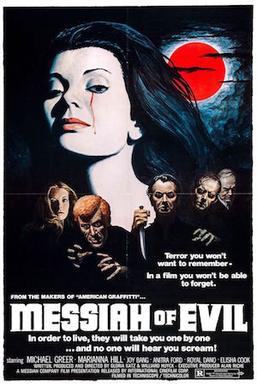
It’s polarizing.  Even now, nearing fifty, Messiah of Evil is either adored or excoriated.  So it was at its release.  I was pointed to the movie by an adorer—a somewhat unexpected New York Times seasonal article.  Suggesting that there’s nothing else like it, the article recommended it for autumnal viewing.  So, what’s it all about?  I’m not really sure, but that won’t stop me from trying.  Arletty is a young woman who wants to find her father (with you so far).  He’s moved to New Bethlehem, California, now known as Port Dome.  She finds his house abandoned, and the locals decidedly unfriendly.  Her father’s diary explains that he’s transforming into something inhuman.  The locals are cannibals, it turns out, awaiting the return of, well, the messiah of evil.  (The title is never used in the movie.)

Although I learn more towards the excoriating opinion of things, this is a great horror and religion film.  The original messiah of evil was a preacher stranded with the Donner party.  He started a new religion and, wanting to spread it, went to California.  Now, whenever a blood moon comes, he arises from the sea and his followers become aggressive.  The movie is set a century following this first appearance, and the dark master is due to return.  His followers await him on the beach, and Arletty is their intended sacrifice.  Elements of Lovecraft are clearly evident—people transforming, old gods, evil emerging from the ocean.  Yet, there are many things unexplained.  Or maybe I’m just naive.

The male lead, Thom, travels with a mini-harem.  He’s in Port Dume because he likes to gather folktales—like the blood moon—and he likes Arletty’s father’s art and came to buy some locally.  The movie features a blind art dealer, cops who apparently know nothing about the infestation of ghouls in their town, and a guy who could drive away from the attacking hordes who decides to run instead.  The directors (Willard Huyck and Gloria Katz) were a talented couple, but this wasn’t their best collaboration.  Still, many recommend this as an overlooked horror gem from decades ago.  Others not so much.  I’m glad to have seen it, although I fall into the latter camp.  Mainly because it continues a theme that I’ve tried to pick up at several points on this blog—that horror and religion have a great deal in common.  Even if one (or both) shows its age and fails to impress.


Not Making Decisions

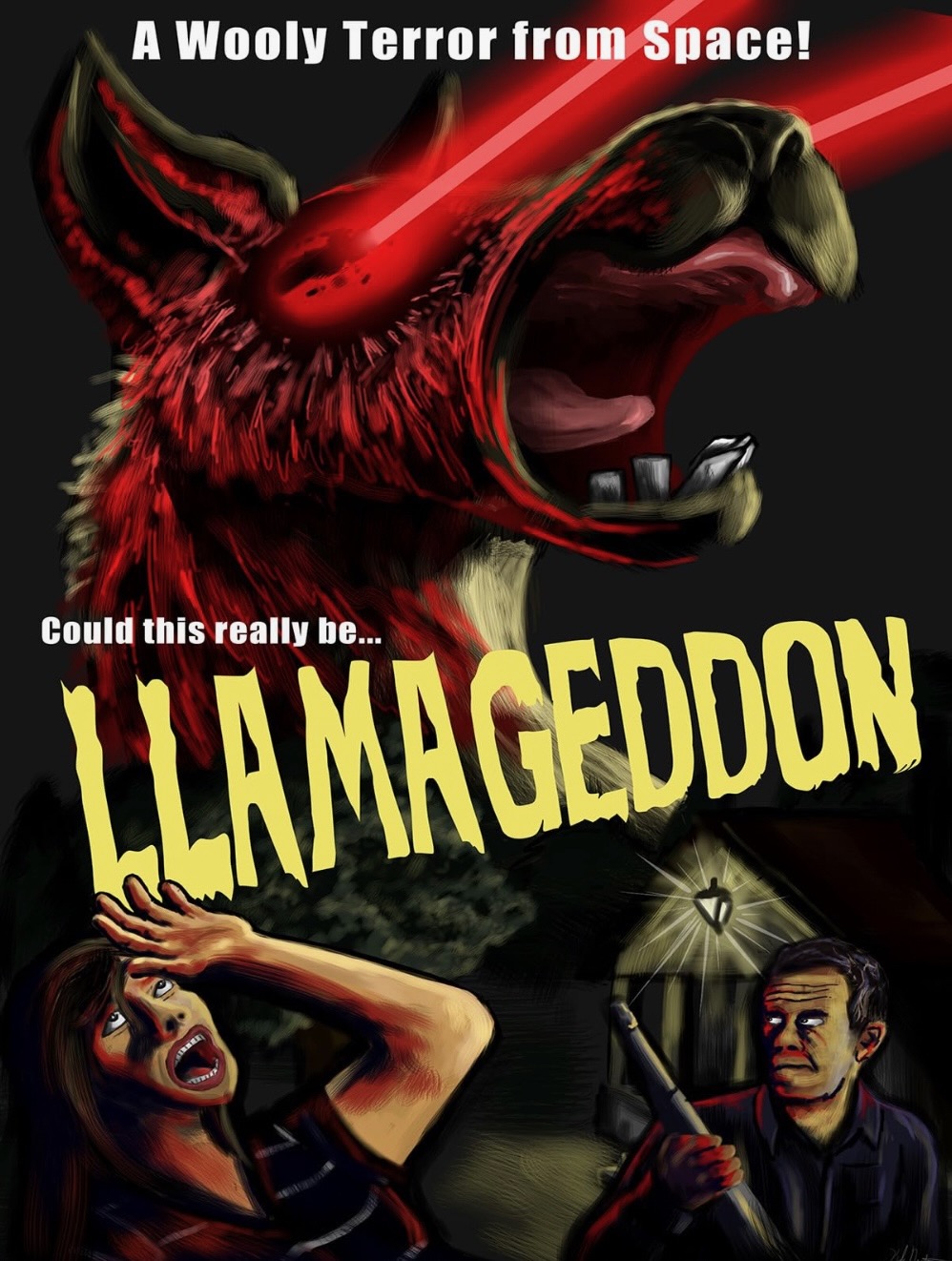
After anesthesia they tell you, “Don’t make any important decisions.”  That’s the excuse I’m using for having watched Llamageddon recently.  That, and it’s free on one of the streaming services to which I have access.  I only found out about it because of such services and I wasn’t in any shape to decide important things like how to spend the rest of the groggy day.  I’m of mixed minds regarding comedy horror.  Or is it horror comedy?  Decisions.  The fact is, quite a few horror movies do involve some amount of fun.  My favorite ones tend to be more serious, but once in a while you find yourself watching movies you know are (or you know are going to be) bad.  I knew this one was.  It’s so bad that it’s got a cult following.  It was, I’m pretty sure, made to be bad.

So a killer llama from another planet is forced to land on earth.  It kills an older couple in Ohio and after the funeral two of their teenage grandchildren, Mel and Floyd, are left to stay in the house.  Mel, who is older and more experienced, contacts all her friends so they can party that night.  Of course, the llama’s still on the loose.  It has laser-beam eyes and it bites and punches people to death and the partiers are picked off, not exactly one-by-one since many of them are electrocuted in the hot tub.  Generally they’re so drunk and/or high that they don’t believe any of this is happening.  Eventually Mel and Floyd’s father arrives and tries to save his kids.  Before dying of llama bite, he kills the quadruped by running it through a combine.

It’s worse than it sounds, but it’s played strictly for laughs.  And, I suspect, it’s one of those movies that’s meant to be watched under the influence.  Since anesthesia is about as close as I’ll ever get to that, I suppose this counts.  Some of the early horror movies have become funny with the passage of time as early special effects age and we become used to better, more convincing fare.     As it is, it’s difficult to find much about Llamageddon apart from IMDb, and the director’s name, Howie Dewin, is a red herring.  I’m fascinated by such films being able to gather a following.  Of course, I confess to enjoying Attack of the Killer Tomatoes when the mood is right.  And a day when decisions are contraindicated, anything can happen.


The Good Lurid

It takes a lifetime to make a reputation.  In high school my teachers and classmates knew mine well: religious and full of integrity.  Going on to do three degrees in religious studies confirmed all that (at least the former).  Something that nobody seemed to pick up on was that I liked watching monster movies.  I did less of it in college, but still watched some heavy-duty fare (including David Cronenberg) when I was in seminary.  Once I married life looked more optimistic and I really didn’t feel the need to watch what is called “horror” any more.  Sure, we occasionally saw films everyone was talking about, but in general I moved away from the genre.  It took Nashotah House and its aftermath to bring me back.  In any case, my reputation seems to be such that now when people who know me see religion and horror together they think of me.  I’m touched.

A regular reader of my blog sent me an article from The Guardian titled, “Schlock horror! Meet the family who made lurid movies for the Lord.”  It should be pretty clear, if my integrity is intact, that what I’m trying to do is figure out how these things fit together, religion and horror.  That they do is obvious, but how?  In any case, this article plugs a book by journalist Jimmy McDonough, The Exotic Ones.  The book explores the Ormond family and their odd filmmaking.  The father, mother, and son triad, made a living producing cheap, questionable films.  After a plane crash, which they survived, they became religious only to find their minister wanted them to keep making their bad movies for evangelistic purposes.  The films they produced for the church had religious themes, but used well recognized horror tropes, anticipating, if you will, Left Behind and its ilk.  Like a Thief in the Night scarred many of my generation.

I’m probably not alone in not recognizing any of the movies the article discusses.  If I’m reading correctly, Tim Ormond, the son and sole surviving family member, stopped making these films after the death of his parents.  In any case, I have been developing a fascination with bad movies.  The fact that they’re even made and released is incredible to me (mostly the released part).  Many of us end up reacting to life rather than following the plans we had for it.  Fate—call it what you will—has a way to stepping in.  For one family, however, fate led them to a church that paid them for what they wanted to do.  Many of the rest of us find just the opposite and we end up watching horror to try to understand.


Not Grant

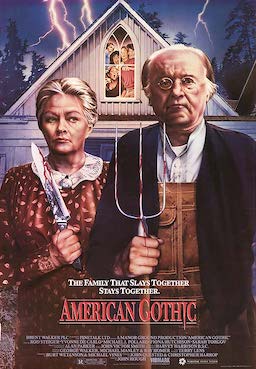
Grant Wood’s painting, “American Gothic,” is undoubtedly his most famous work.  The image is so evocative and suggestive that countless interpretations have been offered for it.  The idea of debilitating isolation suggests itself.  An unhappy self-reliance that has taken its toll on an aging couple (some say the woman is his daughter) often comes to mind.  For some it suggests a movie.  Normally I like horror films from the seventies and eighties.  There’s almost an innocence to them that gets lost in the new millennium.  On a rainy weekend afternoon when I couldn’t be mowing the lawn I found American Gothic on Amazon Prime and it had received four stars and even IMDb showed it as better than average.  The longer I watched the more I was inching toward “bad movie” territory, but I had to see how it ended.

Six young people, four of whom are distinctly unlikeable, have plane trouble and get stranded on a lonely island in the Pacific northwest.  They discover a house furnished from the twenties and it turns out there’s an older couple there who don’t really cotton onto strangers.  As the plot unfolds it turns out they have three adult children who think they’re still adolescents.  And—this is the good part—they are a very religious family (in part.  Again, as often happens in such films, the writers really don’t understand religion).  In any case, the predictable killing off of the kids starts to happen when they continue to be rude and insult the family.  Since we’re in slasher territory here, there’s a final girl—one of the two sympathetic women—who ultimately takes over the house.

Part of the problem with the film is the utter paranoia with which it treats mental illness.  The family clearly has problems and, in a way typical for the genre, they turn toward killing.  Ironically, Pa, when he finds his family has been killed by the one mentally ill visitor (everyone with psychological problems in this movie turns to murder), renounces God and sells himself to Satan.  Interestingly, he doesn’t survive long enough to do anything about it.  Reading about this movie after watching it I came across a new word: hixploitation.  Exploitation movies are familiar to anyone who watches much in this genre, but I’d never considered that Deliverance and company exploit “hicks.”  It’s all about how others look at you.  And, as a movie made in Canada and the UK, it shows us what others see when they look at us.  There’s some ground to explore here in a sequel to Holy Horror


Keeping Sentinel

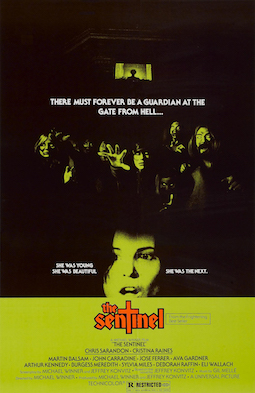
Not among the trinity of holy horrors from the late sixties and early seventies, The Sentinel takes its cues from religious horror but manages to fall into bad movie territory anyway.  While still cited from time to time, it’s largely forgotten among the films of the era.  It had a lot of competition in the seventies with The Exorcist, The Omen, and The Amityville Horror.  One of the reasons it seems to have fallen at the threshold is that it doesn’t understand the religion it tries to portray.  That religion is some form of Catholicism that involves a number of clerics who run around northern Italy wearing various liturgical vestments to oversee an apartment in Brooklyn Heights that’s actually the gateway to Hell.  They do this by way of an eponymous sentinel who lives in the apartment building that’s Hell’s portal.  The rest they, reasonably enough, rent out.

Alison Parker, a model, ends up renting the place while her boyfriend lawyer decides to have her killed—no particular motivation is given, although he had his first wife murdered too.  At the apartment Alison is disturbed by the other tenants, who are very strange.  And a mysterious priest lives in the apartment at the very top and never comes out.  (In case you haven’t gathered, the plot is pretty convoluted.)  It turns out that people who’ve formerly attempted suicide (like Parker) are targeted by the church to take over as sentinels to make up for their sin.  They have to “go missing” and reappear as a priest or nun and live in a particular apartment.  The strange neighbors, as you may have guessed, are demons trying to escape the watchful gaze of the sentinel.  Naturally, they stay in the same building.

The problem—or one of them, anyway—is that the Catholicism displayed doesn’t resemble Catholicism very much.  In the famous scene where the demonic entities are swarming on Alison and the dying sentinel she’s to replace, said sentinel carries a distinctly Protestant cross rather than a crucifix.  The mythology the film tries to construct is simply bizarre.  The classics of the period at least got the religion correct.  Catholicism in The Exorcist, Protestantism in The Omen, and, although fabricated, Satanism in Rosemary’s Baby.  Many filmmakers, it seems, think it’s easy to fake it when it comes to religion.  Looking at the movies that succeed on that front, however, and comparing them to those that become bad movies, it seems clear that doing your homework, or at least going to Sunday school, pays off.


Ghoulish Night

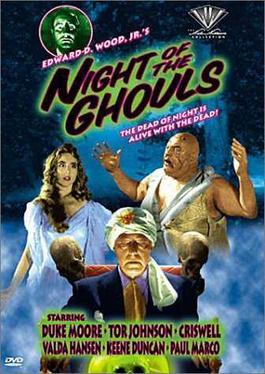
Night of the Ghouls, I like to think that even as a child I would have opined, is a bit silly.  It does show improvement over some of Ed Wood’s other films and the plot is really no more harebrained than some movies I did watch as a kid.  I’ve been trying to figure Wood out.  He was apparently incompetent, but he had no formal training and that could explain things a bit.  He was also creative.  This film is broadly a sequel to the worse Bride of the Monster.  Although only a couple of characters appear in both films, there is quite a bit of reference to the earlier story.  There was a mad scientist who made monsters.  The house burned down (actually an atomic explosion in the former), but someone—no-one knows who—rebuilt on the same location.

In a typically convoluted Wood plot (he wrote as well as directed the film), a bogus necromancer (who is actually, without knowing it, a really powerful necromancer) bilks clients out of their money by raising their dead loved ones for a few minutes.  He keeps the police and others away by having his young female assistant pretend to be a ghost outside the house.  But then she runs into an actual vampiric ghost who’s killing people who wander onto the property.  The police eventually decide to investigate and prove themselves as incompetent as the writing for the film.  They do manage to put an end to the fraudulent seances but it’s up to the real raised dead to put an end to Dr. Acula and his assistant.  At least there’s no atomic explosion at the finish.

The film, in Wood style, is black-and-white and the props are cheap and not really convincing.  A bit of the movie seems to have been intentional comic relief.  It doesn’t really work as a horror film because there’s nothing really scary about it.  Wood was a lifelong fan of horror movies, but fandom doesn’t always equal the ability to replicate the object of desire.  There are several possible horror atmospheres—Poe horror is quite different from Lovecraft horror, for example.  Wood seems to have been unable to strike a vein, however, that was close to an authentic horror feel.  The Scooby-Dooesque role of the necromancer doesn’t really help, I’m afraid.  Still, for fans this is vintage Ed Wood work.  I can’t claim to have figured him out, but if you’ve a hankering for a bad movie, this isn’t a horrible choice.


Earth Colors

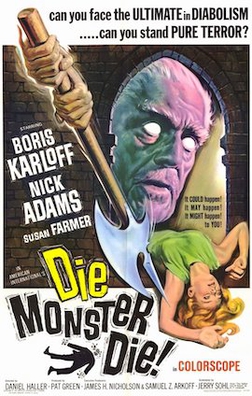
Bad movies can be therapeutic.  While trying to find hope it sometimes helps to see that others are even worse off.  This isn’t exactly Schadenfreude, but rather an awareness that your own efforts  at self-righting aren’t so bad.  Then there’s the hopeful monster theory, but that’s something different.  Already the title of Die, Monster, Die! warns the viewer that this won’t be Oscar-worthy material.  And despite his fame by 1965 Boris Karloff was still landing sub-par roles in such movies as this.  Both the directing and editing are noticeably lacking, evident even to an amateur.  A step backward may help; this movie is based one of my favorite H. P. Lovecraft stories, “The Colour out of Space.”  This is, to me, his most Poe-like tale and could well serve as the basis for a film.  Too much is changed here, however, to make it work.

Arkham is transplanted from its native New England to the old one.  The love theme manages to interrupt the mood of dread Lovecraft used in his story.  Nahum Witley’s use of the meteorite runs counter to the family’s reaction in the original.  The screenwriting doesn’t build much confidence either.  On the positive side, it feels like a fine little haunted house film from time to time, when the plodding plot doesn’t get in the way.  For a scientifically aware visitor, Stephen Reinhart has no concerns about lingering, unprotected, around a major source of radiation.  Although a few of the jump-startles work, the whole ends up feeling just a bit silly.  Of course, I was watching to escape, for a moment, what life throws at you.

Like reading poorly written books, watching bad movies can teach you mistakes not to make.  Movies can be an education rather than simply entertainment.  Cinema is one of the great myth-making vehicles for modern culture and, unfortunately, big budgets are often (but not always) necessary to make them believable.  Here is the hidden element of optimism, perhaps.  H. P. Lovecraft stories can sell films.  They also attach those who may be excluded from studio A-lists because, let’s face it, Lovecraft appeals only to a specific demographic.  The title of this particular film buries the lede, however.  No Lovecraft keywords (Dagon, Dunwich, Arkham, Cthulhu, or any of a host of others) clue readers in to what they might expect.  Learning the film business from Roger Corman might’ve steered director Daniel Haller is this direction, I suppose.  Whether he intended to or not, he produced a therapeutic result.


Hidden Wood

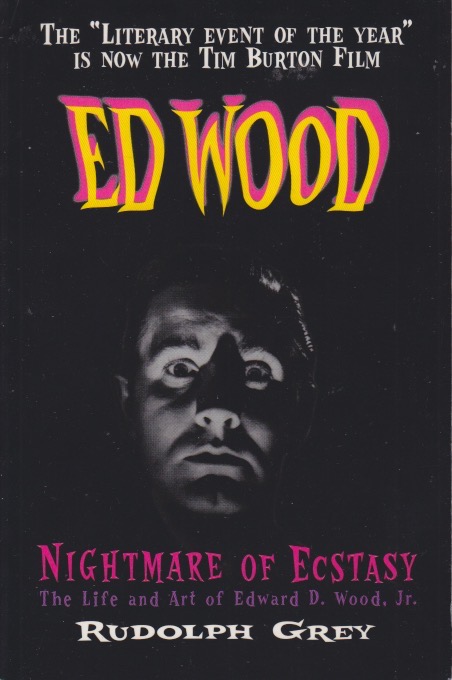
Fandom can lead to fame, even if it’s just cult fandom.  The nature of Ed Wood’s films is such that he could’ve been among those forgotten had he not posthumously developed a following.  Unfortunately it didn’t arise in time to ameliorate the tragic final years of his life when he died pretty much penniless, drinking away the pain.  Rudolph Grey’s Nightmare of Ecstasy: The Life and Work of Edward D. Wood, Jr. may have helped rescue him from obscurity.  Of course, Wood had gained a following earlier than the book, but nobody had really thought to document his life.  What I find so compelling is that Wood was like so many of us—trying hard to gain some recognition only to be shut out of what we love by a huge industry that calls the shots.  It’s difficult to get notice as an independent filmmaker, or even as a writer publishing with smaller presses.

Wood lived a most unusual life.  A straight transvestite, he fought as a Marine in World War Two.  He moved to California to try to break into filmmaking and wrote and directed several movies.  When this failed to make enough money to support him, he turned to writing pornographic novels and film scripts.  Wood had, interestingly, befriended a lonely and washed up Bela Lugosi.  His last two movies were Wood’s work.  Wood found camaraderie with other outsiders in Hollywood and he cast them in his low-budget productions.  He would try to shoot his films in less than a week.  Considering the constraints under which he operated, his movies really aren’t that bad.  They aren’t good by conventional standards, but they’re better than many other people could’ve made them in his circumstances.

This book isn’t a conventional biography.  There’s no narrative apart from the recollections culled from interviews of those who knew him and occasional letters and writings of Wood himself.  As with any biography there are gaps and lacunae.  From a writer’s point of view perhaps the saddest part of the story is how Wood and his wife were evicted from their final apartment and he had to leave his papers and manuscripts behind.  These were reportedly thrown into a dumpster and lost forever.  Although his movies may have been bad, Wood was a capable writer.  And like any writer he felt the loss of his work keenly.  He only lived about three more days after that.  His friends had largely abandoned him, alienated by his drinking and its effects on him.  Next year will mark the fiftieth anniversary of his death and, I hope, the commemorative watching of some bad movies that deserve to be remembered.


Movies about Movies

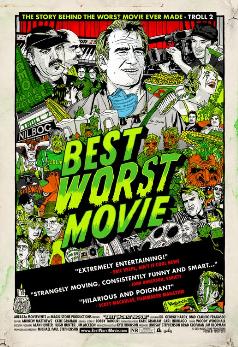
The category of movies so bad that they’re good sometimes spawns the phenomenon of a movie about the bad movie.  The Room, generally on the list of worst movies of all time, was followed by The Disaster Artist.  Not exactly a documentary, it was a movie about the making of the movie.  There’s a macabre fascination with films that dare to be so very bad.  They’re released nevertheless, and if they’re the right kind of bad they grow a following.  Ed Wood’s movies inspired Tim Burton’s movie Ed Wood—dramatized, but apparently not far from the truth.  Troll 2 was followed up by Best Worst Movie, directed by the child star of the original, Michael Stephenson.  Such movies are irresistible in their own right.  So when I finally saw Troll 2 I turned around and immediately watched Best Worst Movie.

A few things stood out in this documentary.  One is that being part of something larger, it’s not always clear what this larger thing will be.  Most of the people in the movie (which was released directly to video) found out about the release by accident.  Many of them never acted again but one thing they all knew: when they did see it, it was clear that it was a bad movie.  The one person in the documentary who doesn’t accept this is Claudio Fragasso, the director.  Fragasso is Italian and he still maintains that this is a great movie and everybody else is wrong about it.  He skulks around the tributes made to the movie and insists to both actors and viewers, that the movie isn’t bad.  They are wrong, he is right.

There’s nothing wrong with pride in achievement, of course.  Sometimes, however, it’s more graceful to admit that you simply got it wrong.  Best Worst Movie follows some of the actors to conferences where they expected huge lines and great attention, only to find a handful of disinterested spectators wondering what all the fuss was about.  At the same time, there are screenings of Troll 2 in major US cities that draw sell-out crowds.  Bad movies don’t appeal to everyone, of course.  They can, however, serve some good and might even add some enjoyment to life.  Best Worst Movie underscores that not all film fans have the same taste.  It also shows that those who enjoy traditionally bad movies aren’t alone.  There’s an aesthetic to being bad enough to be good, and even that can spin off sequels of its own.  And please, Mr. Fragasso, don’t make the sequel you’re touting—this kind of magic only comes once, unless you’re a genius like Ed Wood.


Bad Movie Therapy

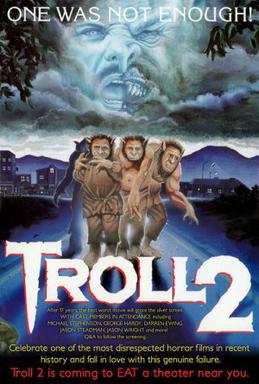
I haven’t see Troll, but it doesn’t matter.  Troll 2 has nothing to do with it.  As a frequent contender for worst movie of all time, Troll 2 is an anti-vegetarian screed and campy horror film that’s impossible to take seriously.  It’s part of my bad movie therapy.  And it’s also an example of religion and horror.  But first, let’s set the scene.  The Waits family (Michael and Diana, and their kids Holly and Joshua) is doing a house exchange for a vacation.  Before they leave, however, Joshua’s dead grandfather appears to him to warn him about the goblins.  The goblins, who are vegetarians, make people eat/drink a special substance that turns them into plants so that they can eat them.  (Yes, it’s that bad.)  Ignoring Joshua’s concerns, the Waitses head for Nilbog (goblin backwards) and go ahead with the house exchange.

The locals (there are only 26 of them) can make themselves appear human and they try in vain to get the visitors to eat.  Joshua prevents his family from eating the plant food by peeing on it.  They go to bed hungry as the queen of the goblins plans her next move to get them floradated.  About midway through the film, we’re shown a church scene in which the minister preaches of the evil of the flesh.  Ironically, this is not far off from the teaching of some Christian denominations.   He tells the trolls what they already know—they have to get the visitors to eat so that they can eat them.  If nothing else, it will make you forget your troubles for ninety minutes, unless your trouble is that you’re being turned into a plant.

Any number of reasons have been offered for why the film is so bad.  While filmed in Utah, the crew was Italian, and most of them spoke no English.  The movie was low budget.  The acting is just plain bad.  All together, however, these features work symbiotically to grow a wonderfully therapeutic end result.  Some of the crew claimed that it was the intention all along to make this a funny film.  Comedy horror or horror comedy is a recognized genre, after all.  The only problem I have now, however, is where to go from here.  So how does the Waits family escape their peril?  I’ll need to offer a bit of a spoiler here.  The goblins are frightened away long enough by a double-decker bologna sandwich that the family can touch the magic stone and destroy the conspiracy.  What are you still doing here? Why aren’t you watching this already?


Hoppy Fourth

Today is the one of the relatively rare summer holidays.  Modern industrialized nations tend to take a more relaxed view toward summers without having to give out too many prescribed company holidays.  This seems to follow on from school schedules because the kids are out in summer and adults need some flexibility when work demands collide with family needs.  The internet has made work-life balance a little tricker to achieve since work is always just a click away.  Some more generous employers gave yesterday as part of an extended four-day weekend, which is rejuvenating in a way that’s easily forgotten until you start to feel it.  The sense of obligation takes a couple of days to wind down, and then on Monday you realize “I’ve still got another day off!”  It’s a sublime feeling.  Why not watch holiday horror on it?

The Wicker Man is a holiday horror movie.  One of my arguments in the book is that holiday horror has to derive its energy from the holiday, and not just be set on it.  For example, I Know What You Did Last Summer and Return of the Living Dead are both set on or near Independence Day but the movies don’t really draw their horror from the holiday itself.  It falls into the same category.  Frogs?  Well, maybe.  Perhaps holiday horror, it’s definitely in bad movie territory.  A rich southern family is dominated by a Trump-like grandfather who controls the money and measures everyone by loyalty to him personally.  On his birthday, the fourth of July, nature revolts and his adult children and grandchildren (apart from one granddaughter), are killed by animals in this eco-revenge groaner.  But is it holiday horror?

One scene may suggest that perhaps it fits the category, but the real significance of that day is that grandpa won’t let it be celebrated any way other than by his prescribed plan.  Even as the estate is overrun by frogs (mostly), snakes, lizards, alligators,  tarantulas, and even some birds (thank you, Mr. Hitchcock), he insists that everyone do what they always do on the fourth of July/his birthday.  The only scene that suggests holiday horror is where the eponymous frogs hop onto a cake decorated like an American flag.  I normally like nature-revenge films, and this one starts out well but quickly goes downhill.  The environmental message is there, but underplayed.  There are some firecrackers and a number of dead rich folks, but otherwise the film seems to have no message at all.  It’s a bad movie.  Holiday horror?  Not really.  Something to watch for a day off work?  Definitely.


Good-Bad

If anybody bothers to follow my movie viewing history, they’ll know that it includes a perhaps disproportionate number of “bad movies.”  In fact, I recently added that as a category for my blog posts.  In need of some reassurance, I read Matthew Strohl’s Why It’s OK To Love Bad Movies.  (As far as I can tell the Why It’s OK series was started by my old boss at Routledge—an inspired idea!)  Strohl is a philosopher, but one who admits to, and even advocates for, loving bad movies.  This book is fun but it does have a serious philosophical underpinning.  I can’t summarize it all here (you need to read the book anyway) but my main takeaways are that ridicule isn’t making the world a better place.  Movies that are so bad that they’re good are definitely a reality.  There’s a community built around it, but I haven’t had many visits from it in my lonely little corner of the internet here.

Strohl points out that not all bad movies are what he terms “good-bad.”  There are certain qualities—aesthetic qualities—that make a bad movie good.  And it doesn’t involve watching the movies to make fun of them.  One of the films that often tops the list is The Room.  When I first saw it I really couldn’t think of anything to write about it on this blog.  It was just another bad movie.  Now I want to see it again.  I do have to say that on my first viewing I didn’t feel like ridiculing.  I was more stunned than that.  And when I watched Plan 9 from Outer Space—another on the list—I felt inspired to learn more about Ed Wood, its famous director.  I’ve since watched a couple more of his movies and I appreciated them.  Now I have a better idea of why.

In addition to discussing the biggies, Strohl also takes forays into some collectives: the Twilight series, for example, and the movies of Nicholas Cage.  These are both often singled out for ridicule, but this book demonstrates that there’s an artistry to such things.  And Bad Movies underscores that not everyone likes the same bad movies.  Strohl also makes the salient point that if we only ever watch great movies we’d have no basis for comparison.  There’s a lot to like in this little book.  One thing it convinced me of (in addition to making me feel a bit better about myself) is that there’s a community out there that I’m missing out on.  Good books bring people together instead of dividing into factions.  This is a good book.


Not Dagon

There’s an aesthetic to bad movies.  And when your production company is Crappy World Films you’ve got to wonder if it’s intentional.  Chad Ferrin’s H. P. Lovecraft’s The Deep Ones, which was released in 2020, isn’t a great movie.  It is kinda fun, though.  I’ve had a weakness for explicit Lovecraft films ever since Stuart Gordon’s very moody Dagon.  That film was clearly the inspiration for this one.  With the “low” budget of only a million dollars (it feels strange to write that), it nevertheless has a clean cinematography that shows some artistry.  The story just isn’t that good.  A young couple is seeking a getaway at an oceanfront AirBNB only to discover it’s part of a “gated” community.  Their hosts, who are living in the boat down at the marina, keep on stopping in, not leaving them much privacy.

The set-up is very much a Rosemary’s Baby scenario.  The community, as the title suggests, worship the Old Ones.  They introduce Cthulhu early on, but the young man of the couple has never heard of him (he obviously doesn’t spend much time on the internet).  Speaking of the internet, the film makes the point that everyone spends too much time on it, and there’s perhaps some truth to that, but, if you’re streaming the movie you’re also participating.  In any case, the community wants women to offer to Dagon—and the monster here is clearly low-budget—so they can bear more children for the Deep Ones.  Well, not so much bear children for them as to be pregnant with tentacles that can somehow convert newcomers.  Once you’ve been tentacled, it seems, you’re a member of the community.

There is a kind of Lovecraft vibe to the film despite the often wooden acting and throwaway dialogue.  One thing Lovecraft had learned from Poe was the consistency of mood.  It’s here that the movie runs into some trouble.  At times it’s a little scary, at times dramatic, but too much of it just feels silly.  The case could be made that Lovecraft’s writing tends toward the puerile and there’s some truth to that.  It is never silly, however.  Sometimes when translated to the screen the outlandishness of Lovecraft’s view of the world comes across as so weird as to be funny.  It takes an able director, and a strong writer, to adapt him to cinema successfully.  It’s no accident, then, that the movie is dedicated to Stuart Gordon, whose Dagon is still difficult for me to watch, so full of Lovecraft as it is.