Seasonal Viewing

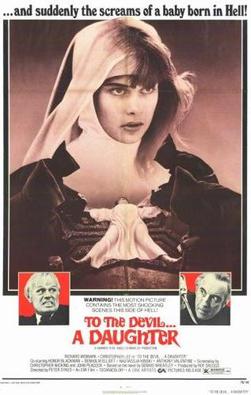
Any movie that begins with an excommunication ought to be good.  Especially with its list of stars you’d think To the Devil a Daughter might’ve turned out better.  Still, it is a good example of religion and horror mingling together.  I’ve never read any Dennis Wheatley novels, but reputedly he didn’t like this film adaptation of his book.  It certainly has a convoluted plot.  So an excommunicated priest has started a new religion that worships Ashtaroth.  He has to baptize a child, now 18 (three-times-six, don’t you see), with the blood of the demon so that she can become his (Ashtaroth’s) avatar.  This is apparently the eponymous daughter to the Devil.  She was baptized initially by her mother’s blood at her birth.

The girl’s father, who survived her birth—unlike his wife—has decided at the last moment to save his daughter.  He appears to be independently wealthy yet he talks an author of occult books into doing the saving for him.  The girl, it turns out, is a nun in this satanic religious order and is only too willing to do what she can to serve “our Lord.”  The way that all of this plays out is confusing and Byzantine, but it does raise a serious question: what if a child is reared in a bad religion?  (And there are some.)  Who has the right to decide if a religion is good or bad?  Children are easily indoctrinated and not too many question the faith in which they were raised.  Yes, we all think the religion we believe is the right one.  The problem is everyone else thinks the same thing.

One of the things this movie got right is that the “heretics” are portrayed as sincerely believing that their religion is for the improvement of the world.  Calling themselves Children of the Lord, they believe Ashtaroth is good.  And a good lord wants what is best for the world, right?  This is the dilemma of exclusive religions that teach only their own outlook can possibly be the correct one.  Otherwise you have to give adherents a choice and another religion may be more appealing.  Or worse, they may reason out that if you’re given a choice that means your own religion is also merely one of many.  Historically religions have gotten around this by valorizing true believers who never question anything.  To the Devil a Daughter isn’t a great movie.  It’s not even a very good one.  Nevertheless, it raises some questions that lie, of course, in the details.


Flavor of Childhood

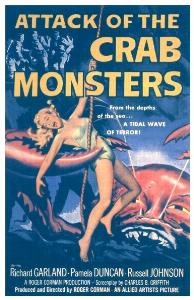
Giant, telepathic crabs whose molecular structure make them impervious to bullets, explosives, and fire, and that know how to use dynamite and who plan to take over the human world?  A group of scientists trapped on an irradiated Pacific island that is slowly sinking into the ocean?  This must be Attack of the Crab Monsters!  I was born during what is generally considered the dearth  period of the American horror industry.  Roger Corman, however, was working hard outside of the studio system to cater to that new demographic—teens with spending money.  Drive-in theaters were big and for about $100,000 you could shoot a double-feature and bring in ten times that much.  If you shoot quickly enough you can produce several of these in a year and not have to worry about the big studios.

It’s been fashionable to laugh Corman off, but he knows how to live the teenage dream.  Monster movies were part of the childhood of many of us during this “dearth.”  Yes, sophisticated frights were yet to come, but these creature features were full of creativity and escapism.  And so many unanswered questions.  How did those giant crabs chop all the radio wires to bits with those indelicate giant claws?  If they could smash through the outside wall of a house, why couldn’t they break through a light-weight door once inside?  And why, knowing that bullets and grenades can’t possibly hurt them, do scientists keep firing away?  What was that oil subplot all about anyway?  And how do you end a film with the lines “He gave his life,” followed up by “I know”?  This is stuff, like Strawberry Quik, I couldn’t get enough of as a kid.

No, this wasn’t intelligent horror—it was often laughable—but it made an impression.  As an adult I can’t recall which of these movies I’ve seen before and I suspect it would take a lifetime to watch all the films Corman directed or produced.  Along with his contemporary indie director/producer William Castle, Corman may be inordinately responsible for my tastes as an adult.  I’ve grown more sophisticated (I hope) in some ways, but I’m at a pay grade where free on Amazon Prime often decides a weekend’s entertainment.  Besides, these movies struggle to top out an hour’s running time.  You can still get a lot done in a day and still have time for a monster crab, giant leech, or wasp woman.  With enough radiation, and imagination, anything can happen.


Stinging Days

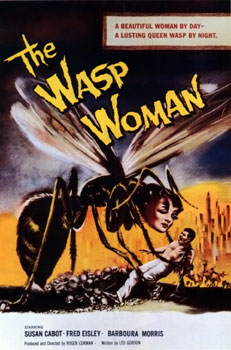
It doesn’t take much to encourage wasps.  Even after a few unseasonably cold weeks in autumn, one warm day will bring them back, poking along the siding looking for a nesting place.  My most recent stinging incident occurred in October.  It’s fitting, then, I suppose, that to try to keep awake late one October weekend afternoon that I watched The Wasp Woman.  These creature features were what I grew up with, and this was a Roger Corman brief film from 1959.  In fact, it was so brief that eleven minutes had to be added to make it a stand-alone television release.  It was originally part of a theatrical double feature.  Finding out about added time explained why Dr. Zinthrop’s accent changed from the first eleven minutes to the rest of the film.

Women have the same right as men to be made into monsters, of course, but there’s a poignancy to this storyline.  Janice Starlin is the owner of a cosmetics company but profits have been declining since she’s showing signs of aging.  Her customers want a younger looking woman providing their beauty products.  As is to be expected for a movie from the fifties, it’s a pretty sexist storyline.  Still, through the plodding plot the viewer can’t help but to feel for Ms. Starlin.  So when Zinthrop shows up with an extract made from wasp royal jelly (a secretion that actually comes from honey bees) that reverses aging who can blame her for trying it?  Of course it turns her into a giant wasp woman.

These kinds of mad scientist movies with their inevitable results perhaps injected a sense of caution into those of us who grew up watching them.  They weren’t great works of art, but that doesn’t mean they didn’t have something to say.  What I heard, watching this one, was that women exploited for beauty products suffer from natural aging processes.  And any formula that reverses aging come with its own set of problems.  The only other scary part of the film was when employees have to get to the upper floors to prevent Starlin from killing people, they have to wait for the elevator.  Their sense of frustration, although funny, is nevertheless a reality of working in a high-rise.  These movies from the late fifties seem to me to be a cry for help.  The sexist, button-down, white shirt world isn’t all it’s advertised as being.  Mad scientists are needed to help us cope.  Or at least stay awake on a sleepy October weekend afternoon.


More Excuses

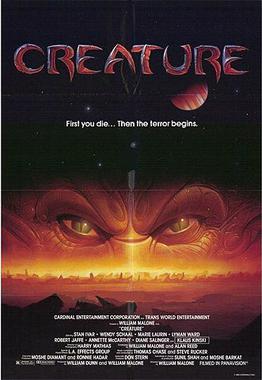
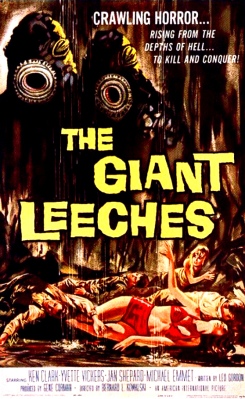
Perhaps it was my Shingrix-addled brain—but we all know that’s an excuse—I decided to watch Creature (1985) and Attack of the Giant Leeches (timeless) over the past couple of days.  The former was a decision made when not having the energy to read, I could still search Amazon Prime for “free to me.”  I was all set to start Attack of the Giant Leeches when I scrolled over Creature only to learn it would be free for only eight hours more.  I recalled, somewhere in the haze, that a movie called Creature was on my watch list, and since time was running out, I clicked play.  Clearly a knock-off of Alien, with even a Sigourney Weaver stand-in, it was one of the most badly written films I’d seen in a long time.  I was surprised to learn it’d had a theatrical release.

A crew stranded on Titan, one of Saturn’s moons, finds a creature—one that looks like a down market version of Ridley Scott’s nightmare—that feeds on unsuspecting astronauts.  Still, the surprises kept coming.  The impossibly pretty women and rugged men of the crew seemed unlikely.  And was that Klaus Kinski trying a move on the security officer that he wouldn’t have survived if he’d tried it on Sigourney?  And how was it even possible that this was nominated for the Best Horror Film of 1985 at the Saturn Awards?  Okay, granted 1985 wasn’t a banner year for horror, but Creature really doesn’t seem to hit the bill for “best of” category—but it was over 25 years after a classic.

Attack of the Giant Leeches is obviously the lesser of the two movies, but it falls into the category of “so bad it’s good.”  The leeches are clearly people in rubber suits, and the caricatures of the hooch-swillin’ swamp-dwellin’ lazy ole homeboys is just too good to pass up.  And the fact that it’s just over an hour long is a bonus when you’re having trouble keeping your eyes open.  Those black-and-white sci-fi horror films of the fifties sure take me back to more innocent times (not the fifties, and the film isn’t all that innocent).  Given that both movies were free on Prime, and given that my head was fuzzy from my vaccine, I counted this as a worthwhile effort at staying awake.  We seem to have come to a more sophisticated era, in many regards.  Such films can’t compete with their modern-day counterparts and even streaming companies are producing their own these days.  There’s something to those older films, however, and maybe it’s helped along by a shot in the arm.


Double Feature

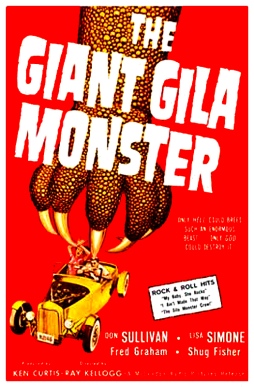
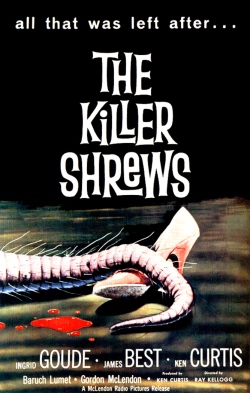
Creature features were a regular part of my youth, and, I suspect, where my appreciation of horror films began.  Nobody was really afraid of Godzilla or other monsters that were clearly people in rubber suits.  The use of forced perspective to make regular-sized animals into giants was obvious even to a child, but that didn’t make such movies any less fun to watch.  The Giant Gila Monster and The Killer Shrews both involve gigantic versions of rather small animals and both of them were produced outside of the studio system by Gordon McLendon, the owner of a chain of drive-in theaters.  Looking for B-movies for double features, he decided to make a couple of his own.  These two didn’t cost that much, but the special effects artist, Ray Kellogg, agreed to do them if he could be the director.  Together they make quite a double-feature of their own.

The Giant Gila Monster is never explained beyond the effectively shot beginning stating the who knows how big some things grow in the unexplored west.  Not even using a real gila monster, the lizard (unlike Komodo dragons, which one expects, were too expensive and untamable) isn’t aggressive and seems, from my perspective, to be just barely putting up with the fake trees and models it has to crawl over and around.  And everyone, apart from Mr. Wheeler, is nice.  The local Texas teens want to drag race but Chase Winstead, the gold-hearted mechanic, keeps them in line.  It’s a perfect world, in a Republican kind of vision, except for that darned giant lizard.  Winstead even figures out a way of getting rid of it so the authorities don’t have to.

The Killer Shrews, in reality puppets and dogs dressed up as shrews, is more adult-themed.  Four scientists on an island—contradicting the voiceover at the opening—have bred giant shrews.  The supply-boat captain and his Black mate are trapped on the island by a hurricane, where the mate predictably gets eaten by the escaped shrews.  McLendon himself appears as an over-the-top nerdy scientist while the producer, Ken Curtis, appears as another, more action-oriented man of science.  In a move a little unexpected for the fifties, Dr. Craigis’ bombshell blonde daughter is also a scientist.  But she’d be willing to be a sea-captain’s housewife if only she could get away from these awful shrews!  There’s a bit more tension in this one as one of the scientists is already engaged to Miss Craigis, but he’s a drunk and she wants out.  So might some audience members, but both films found international distribution and made money.  Now widely available for free, they are a slice of childhood served up in giant proportions.


Things that Appear

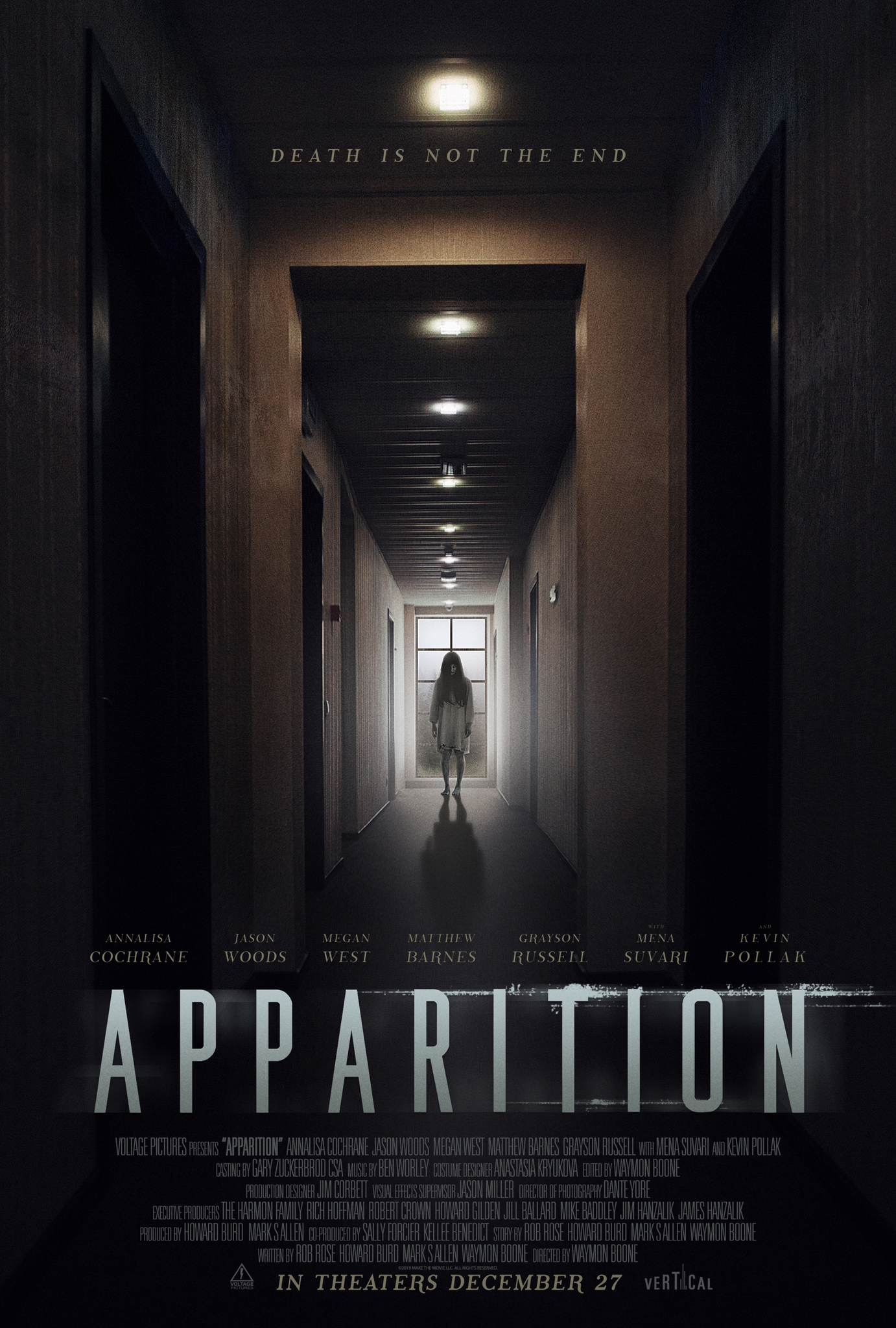
As a movie, Apparition fails on many levels.  One way that it passes is being free on Amazon Prime, which is how I found it.  The trick with Prime, of course, is that really good movies tend to be available for a limited time, keeping you on the website.  Time is money, after all.  I was drawn into Apparition from the “based on real events” tagline, even though I should know better.  It was a hot, sleepy weekend afternoon, and I’m not a good napper.  I’m not going to worry too much about spoilers here, so if you’re into penance, you might want to wait until after you’ve seen it.  Set at the real life Preston School of Industry—a boy’s correctional institution in California—the boys are tortured and sometimes murdered by the warden and guards.  This is one of the few real-life parts: a housekeeper at the facility was murdered in an unsolved crime at the site.

Fast-forward two decades.  The former warden (the place has been closed), is hosting the lavish rehearsal dinner for his son’s wedding.  The son is unloved (his father is a sociopath, after all), and doesn’t treat his fiancée very well.  Meanwhile a younger son is a nerd who’s developed an app called Apparition.  Through some unexplained technological wizardry, it allows the user to connect to the dead.  Another couple, son and daughter of two of the former prison guards, decide to try it and discover that it works.  When the bride gives it a try it leads the five young people to the Preston School.  There various ghost-hunter startles are used as the ghosts of the murdered boys take their revenge on the offspring of the warden and guards.  The bride discovers her father was a “good cop” and that’s why she wasn’t killed.  The younger son is actually the son of the murdered housekeeper, another of his father’s dark secrets.  The parents come and get what’s due to them.

What makes this unremarkable film (and very little comment has been given on it) worth discussing here is that during the opening credits a Bible is shown open to Exodus.  The verse called out is 20.5: “Thou shalt not bow down thyself to them, nor serve them: for I the Lord thy God am a jealous God, visiting the iniquity of the fathers upon the children unto the third and fourth generation of them that hate me.”  This isn’t referenced per se in the film, but the warden does suggest the school is a righteous place.  That’s a fairly brief reward for watching, but I hate to waste even a lazy weekend afternoon when it’s too hot to work outdoors.


Some High School

I have a soft spot for bad horror.  And Sleepy Hollow High isn’t exactly good horror.  It’s not horrible horror either.  It follows the story of five teenage delinquents at Sleepy Hollow High School.  Threatened with expulsion, their only choice is to do community service.  In this case that means picking up trash in the eerily secluded town park.  I won’t give away the one big spoiler, but it’s fair to say not is all that it seems.  It’s very low budget (paid for by credit cards and estimated to be $16,500) shows in several places, but it does keep you watching.  And wondering, to an extent.  It claims that the legend of Sleepy Hollow is true, but not exactly in the way you might think.  (Sorry for being cryptic—I don’t want to give too much away.)

One of the reasons I appreciate efforts like this is that I know what it’s like to be possessed by a story you want to tell but being unable to find a publisher—or in this case, a distributor/studio—who’s willing to take a chance on you.  The movie is largely the effort of Kevin Summerfield and Chris Arth.  They are listed as co-directors and co-producers, and each has credited roles beyond that.  Neither one is famous, and yet they made the film anyway.  It’s the same impetus behind self-publishing, I suspect.  The problem with the latter is that anyone can do it, and it often shows.  Most of us don’t have access to proper movie equipment, props, and actors willing to work for free.  Heck, I don’t even know most of my neighbors.

Movies like this stand a chance of becoming cult favorites.  I have no idea how that happens or who makes the call on it.  Low budget (often), cult films catch the imagination of a certain kind of fan and eventually generates some buzz of its own.  Wikipedia articles will appear about some of the people involved because those who watch grow curious.  Our highly developed publicity systems make decisions on who or what gets exposure.  That doesn’t mean the rest of us can’t get a small dose of attention now and again, but those who’ve made it have had some help.  Sleepy Hollow High was perhaps able to cash in a bit on the previous year’s Tim Burton effort, Sleepy Hollow.  But there are horror movies—and stories—out there that nobody knows about.  And which might, if discovered, have their fifteen minutes.


Terror Able

Saturday afternoons were made for B movies. After a hectic week, nothing soothes like grainy picture quality and poor dialogue. This weekend offered a chance to view The Terror. This 1963 Roger Corman film won its bad marks the honest way – by earning them. Nevertheless with Jack Nicholson playing against Boris Karloff and a plot so convoluted that I had to draw a chart to figure out what I’d just watched, the movie lived up to its grade. Throw in Francis Ford Coppola as an associate producer and it’s party time. Corman’s legendary cheapness and fondness for disproportionate claims of scares that never materialize only add to the charm. After watching the opening sequence one gets the distinct impression that Franklin J. Schaffner had watched this film before setting up the climatic scene of Planet of the Apes.

In keeping with a recent trend on this blog, the plot involved a witch. An old woman from Poland resettles in France to avenge her murdered son. The crone casts a spell transforming a bird into a beautiful young woman. The first words of the spells sent me fumbling for the “rewind” button. “Tetragrammaton, tetragrammaton,” the old woman intones to begin her spell. In a movie fraught with dialogue problems, this might be considered simply a choice of foreign-sounding, mysterious syllables to be uttered for an audience not expected to know that tetragrammaton is the title of the sacred four-letter name of Yahweh. By this point the plot was so convoluted that making God the agent behind a pagan curse seemed almost natural.

The analog with the Bible soon became clear. The Bible holds its sway over many because of its often beautiful rhetoric. Sparing the time to study what the rhetoric might have meant in its original context is an exercise few believers can afford to undertake. Our world has become so full of things that taking time to explore the implications of one’s religion must compete with ever increasing Internet options, thousands of channels of television, and plain, old-fashioned figuring out how to get along. Religion is a luxury item and, as experience tells us, it is best not to look too closely at luxuries – their flaws too readily appear upon detailed inspection. Allowing religion its exotic sounding mumbo-jumbo preserves its mystery and power. And if a witch says a theologically freighted word we can just chalk it up to entertainment. We are too busy to examine what our religions really say. Roger Corman may have unintentionally discovered a real terror in a movie that will keep no one awake at night.