Daylight Saving Time Zone

One or two of you out there—you know who you are—put yourselves through reading my musings on a daily basis.  I haven’t missed a post in nearly a decade, but travel always complicates things.  Yes, it’s that time of year again—I’m on my way to AAR/SBL.  The American Academy of Religion and Society of Biblical Literature Annual Meeting is the trade show of the guild.  This year we’re meeting in San Diego, California.  The hope of many of us is that it’ll be sunny and warm.  Last year, of course, I missed the conference for the first time, exchanging the Denver Hilton for a night on the floor of Newark’s Liberty Airport.  This year I’m flying out of a different venue—one where egress is possible in the case of snow.

I always like to post a reminder to the faithful few that normal service on this blog may be interrupted.  One never knows what might happen when away from the regular routine.  And three time zones will surely wreak havoc with circadian rhythms that haven’t yet caught up with the end of Daylight Saving Time.  Or is it the beginning of Daylight Saving Time?  It makes no difference, because it lead to lack of normal sleep, no matter what we call it.  In any case, San Diego may make usual posting unusual.  At the very least it’ll be a few hours off.  I’ve become a creature of habit, posting my thoughts between six and seven on weekdays.  On weekends I’m up just as early, but I give the web a chance to sleep in.

These annual meetings are exhausting when you go on behalf of a publisher.  Unlike the leisurely experience of a paying customer, you don’t get to go back to your room for a nap, or even to sleep in.  Every year colleagues ask me to receptions but I decline because every day is a school day.  And I have appointments from 8:30 until 6:30 daily.  Sometimes even later.  You, my gentle reader, have been given advance notice.  I’ll try to continue my daily chronicle of life inside this particular head as thousands of scholars of religion mill about, wondering about the answers to the big questions.  Right now the big question is whether I’ve packed everything I’ll need.  I’ll gain three hours on the way out, but I have to leave them at the desk when I get back.  Along the way I’ll scatter posts like breadcrumbs to help me find my way home.


Grasses and Bans

It’s been so busy that I didn’t realize it was Banned Books Week until yesterday, when there was but one day left (today).  I usually make a point of reading a banned book during this week, but I suppose I read so many of them normally that the observance might lose its edge.  But that’s just an excuse—in this world of uber-corrupt governments, preventing censorship is a sacrament.  We’ve seen just this week how dictators try to silence those who expose them.  Banned books, whether we like what they say or not, should be available for reading.  This is an amazingly bipartisan holiday.  Some places have banned the Bible, to which true believers in the principles of Banned Books Week would respond “Even books we might disagree with should be made available.”  Censorship seeks to cut off discussion.

Although I won’t finish in time, after work yesterday I quickly grabbed my unread copy of Walt Whitman’s Leaves of Grass to begin to make up for my oversight.  Leaves of Grass has been called America’s homegrown Bible and it has an almost religious following, as it has for decades now.  Poetry has a way of moving people that frightens autocrats.  It taps into something that skirts around our conscious mind at times, opening up possibilities that censors would rather keep closed.  Over the past couple of years books of poetry have again begun to appear on the New York Times Bestseller list.  People read to be moved.

One element banned books tend to have in common is that they’re honest, even when they’re fiction.  Honesty is a source of great anxiety for many.  We don’t like to let our true selves be seen because, truth be told, we feel vulnerable.  Banned books take us into uncomfortable places.  And sublime places.  Not all books are great literature, of course.  Even I have been known to part with a book after reading it because it simply didn’t speak to me in the way I like to be spoken to.  Still, I’m loath to give such a book a negative review.  It didn’t speak to me, but it spoke to the author and the publisher, obviously.  It is a voice that deserves to be heard.  That’s what Banned Books Week is all about—defending the right of human expression.  I may not finish my banned book by the end of today since weekends tend to be busier than many work days.  Still, I’m looking forward to my encounter with America’s other Bible.


Fearing Hubris

I’m afraid of hubris.  You see, my academic career was not exactly distinguished, and as an editor you’re encouraged to keep to the background.  Still, when you write a book you need to promote it a little, which is one of the things I learned as an editor.  I was equally parts embarrassed and pleased to see the bookstore display for my upcoming book signing in Bethlehem.  I mean, although I wrote Holy Horror for a general readership, the publisher tends more toward academic books and their pricing, so this is not an inexpensive purchase.  Those who write are nothing, however, without readers.  Those chosen for interviews are writers who’ve made a sales impact or who have a university behind them.  When it’s just me, it feels like maybe I’m trying to ascend Olympus on my own initiative.

I was in the Moravian Book Shop to purchase Neal Stephenson’s Fall; or, Dodge in Hell.  I’ve fallen a bit behind on Neal’s work, largely because Goodreads challenges are measured in numbers of tomes read.  I was pondering this, book in hand, when I noticed—there I was with my own display.  You see, Holy Horror was meant as a guilty pleasure read for those of us who like the scary time of year.  The book price is the scariest part about it, however.  I feel a profound gratitude when anyone actually buys it.  Since there are now copies available on sites such as eBay, I’m guessing some who’ve read it want to recoup a little of the cash outlaid.  While all of this is happening, however, I know that I have to learn the art of book promoting.  Still, it feels like that self-promoting I was warned against as a kid, an unseemly thing.

Writing is a form of conversation.  When I’m in a room with a bunch of other people unless I’m the teacher I have trouble making myself heard.  I’m soft-spoken by nature.  I suppose it’s obvious, then, why a book signing feels hubristic.  Perhaps it’s appropriate for a book about fear to engender this sense of discomfort.  Entering the conversation has always been difficult for me.  At the same time, as the beneficiary of so many books, I feel compelled to give something back.  My insights, if such there be, won’t rock the world.  As I think of myself signing books, I wonder what I could possibly say to someone who’s willing to pay that price for something I produced.  If you’re going to try to climb that mountain, you’d better think about what you’ll say when you meet the gods at the summit.


Scrolls Not Living

Of the many ancient finds in Western Asia, none captured the imagination like the Dead Sea Scrolls.  The timing and romance of the find itself, the scandals that almost immediately broke out, and the subsequent “secrecy” over the contents made the secular news.  I’m convinced that a large part of the mystique has to do with the somewhat spooky name—Qumran scrolls never caught on, even though it is more accurate for many of the documents.  Their discovery came after the Second World War when people were wanting good news, and, perhaps, an indication that all of this stuff was somehow predicted.  Enter the scrolls.  No doubt, these documents gave us quite a lot of information on the Second Temple Period—the time from the rebuilding of the Jerusalem temple in the sixth century BCE until its destruction under the Romans in the first century CE.  Now the scrolls are back in the news.

A story by Nicola Davis in The Guardian announces that the origin of the scrolls is once again open to interpretation.  The reason is somewhat technical—scrolls that were written on vellum (animal skins) had to be prepared for writing.  One of the steps involved chemically treating the writing surface with a fine powder (the details are beyond me) so that it could be written upon.  We’ve reached the point where the salts left behind can be tested for place of origin.  The Guardian story notes that the Temple Scroll—one of the important non-biblical texts—was not prepared at Qumran (the site where most of the scrolls were found).  That means that the scroll itself came from elsewhere, depending upon with whom you speak.  The scrolls gather controversy like the Ugaritic tablets gather dust.  

Part of the charm here is that there are many unanswered questions about these ancient texts.  Who exactly wrote them is debated.  Their find-spot suggests they were hidden away by the quasi-monastics who lived in nearby Qumran, but this doesn’t mean they necessarily wrote them.  It’s still debated whether the Qumran community was made up of Essenes or not.  One thing we do know about them is that they were able librarians.  The scrolls themselves are symbolic of the strife in the region, having been discovered just as Israel was declared a nation.  The scrolls were quickly politicized.  They were kept under the auspices of a small group of academics and priests for many decades.  And they still have a way of catching headlines.  Even when its a matter of who powdered their faces.


Pointing to the Moon

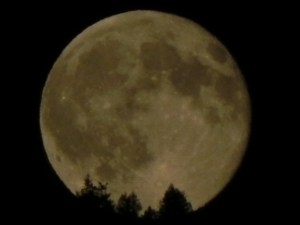
The failure of India’s  Chandrayaan 2 to maintain contact, intended to make India the fourth nation to successfully conduct a lunar landing, sent me reading about the moon.  I remember the first manned landing, which happened when I was six, so the idea that we could make it that far seemed less impressive than it really is, I suppose.  I was fascinated by early space travel, and part of this may have been because of the moment of silence announced in school the day Apollo 13 safely returned to earth after the oxygen tank explosion that made its landing impossible.  As I was reading about the many moon missions that took place before I was born, I was surprised to learn how many nations are still attempting to reach our nearest neighbor.  This year alone China, Israel, and India have all attempted to land up there.

Israel’s mission called its lunar lander Beresheet.  It was the first attempt to land the Bible on the moon.  Beresheet is the Hebrew title of Genesis.  The US missions were named Pioneer, Ranger, Surveyor, and Apollo.  Ironically for the persistently religious nation, our only supernatural title was the name of a Greek deity.  Israel was true to its roots with its naming convention, but there is kind of a paradox involved.  In the world of the Bible the earth is the center of the universe and the moon is a quasi-living being circling about our stationary fix in this fictional view of the cosmos.  That’s not to say our own views may not some day be regarded as fictional as well, but simply that we now know the view in Genesis is incorrect.

Of course, the word “genesis” can mean a purely secular beginning as well.  It is a compound word that is often translated as “in the beginning.”  As such, it is appropriate for the first attempt at a moon landing, or any other great venture.  Still, it is instantly recognizable as the first word in the Bible, indicating a kind of strange juxtaposition where the biblical moon—which is not the same as the astronomical moon—are brought together.  Unlike the book of Genesis, the moon has been reached many times by others before.  The old and the new meet in this attempt to reach into space.  Meanwhile our problems continue down here.  Maybe that’s why we continue to attempt to reach the heavens.  And in that sense, no better title applies than that of the book that somehow defies rational explanation.


Burger Impossible

On the way home from Ithaca, we’ve learned the hard way to avoid I-80 through the Poconos on a holiday weekend.  Past experience indicates that about 80 percent of the population of New Jersey (to be fair, a percentage of that may be those from New York City) tries to squeeze through the Delaware Water Gap at just about dinner-time the day before work starts again.  There is a longer alternate route, I-476, the turnpike, which you catch north of Scranton and exit in Allentown.  The only issue with this plan is that, unless you want to exit the turnpike to try to find food in rural Pennsylvania, there’s only one travel plaza between our entrance and exit.  It’s a nice enough stopping point, but for a vegan on the road options are limited.  As we pulled in we noticed there was a Burger King.  Would they have the much touted “impossible burger”?

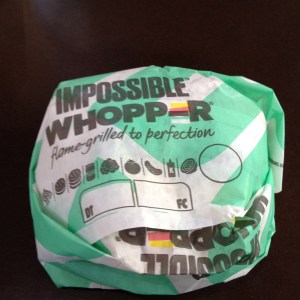
It turns out that they did.  Having last had a whopper well over two decades ago, mouth memory may have faded a bit, but I can honestly say this was like the whopper I remembered.  If you hold the cheese and mayo, you have a vegan version.  This discovery made me strangely happy.  For years at remote locations (and some urban) we’ve stopped when the only other options are meat based and had the BK veggie burger.  It’s not too bad most of the time, but if you want to think you’re eating meat while not contributing to the massive environmental degradation of industrial farming, the impossible burger seems like a reasonable option.  This is one area of technology that I’m glad seems to be catching up with ethics.

I often ponder how much our western point-of-view is based on the Bible.  Our reluctance to include animals in our ethics is another example of how the hard line between species has been applied.  Even scientists are susceptible to worldview bias.  When we realize we’re all part of a continuum of biological relatedness, it’s a lot more difficult to argue for our special place in the divine eye.  At the same time, insisting one’s ethics be applied to all is a form of fascism.  I’m just glad my conscience can be assuaged with some plant-based food options.  After all, I’ve been on the road for a few hours and I’m sitting here happy to be eating at Burger King.  It’s a matter of perspective.


Linking

So I’m active on LinkedIn.  I try to keep social media down to the essentials, but you never know when opportunity might rap its knuckles next to your shingle.  When LinkedIn began they ran the warning that you should only connect with people you actually knew, since people can say bad things about you and hurt your job prospects.  Since that kept me down to about a dozen connections (many academics, being secure with tenure, don’t bother with LinkedIn), I eventually followed the advice of a wise friend and accepted invitations from people I didn’t know because, as he pointed out, they might be the ones with jobs to offer.  That made sense.  There is a flip-side to it, however, and that is people think I have work to offer.  I don’t.  At my job I have no hiring capacity whatsoever.  (I can feel the links being broken even as I write this.)

The vast majority of people who contact me on LinkedIn want something from me.  They obviously don’t read this blog.  (See paragraph above.)  Many people send me messages wanting me to publish their books.  Editors, my dear and gentle readers, work in specific disciplines.  No one contacting me on LinkedIn has written a book about the Bible, although my profile indicates that’s my gig.  And besides, many companies, including mine, have policies against doing business over social media.  I often think of this because the book business is easily researched.  There’s a ton of information both online and on shelf about how to get published.  Messaging someone on LinkedIn is not recommended.

Writing a book takes a lot of effort.  I know, because I’ve done it a number of times.  If you’re going to put years into doing something, it pays to spend at least a few minutes learning about how the publishing industry works.  I made rookie mistakes in my younger days, of course.  But that led me to learn about publishing even before I had a job in the industry.  Quite apart from my job, I freely admit to being a book nerd.  And publishing, despite its many problems, is an inherently fascinating industry.  Although I’ve had academic books accepted for publication, I still struggle getting my fiction to press (I have had short stories published, but my novels remain unread).  I won’t contact other publishers I know through LinkedIn, though.  I’d rather have it be a personal experience whether it’s acceptance or rejection.  And that’s something social media just can’t replicate.


Detective Daniel

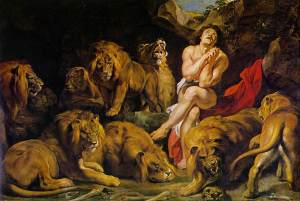
In a recent article, which will hopefully be published, I explore the origins of the horror tradition in the Bible.  That should come as no surprise since the Good Book is really the beginning of the western literary canon.  Yes, there are earlier works—the Epic of Gilgamesh may be considered part of that canon as well, for the canon has no official curator—but because of Scripture’s status literature in the western world takes off from there.  In any case, the other day I was considering the additions to the book of Daniel in the Apocrypha.  The Apocrypha is, of course, part of the Catholic biblical canon, but not the Protestant.  The additions to Daniel roughly fall into three stories, or two stories and a poem.  The two stories—Bel and the Dragon, and Susanna—involve Daniel as an early kind of detective.

Traditionally the inventor of the detective story is Edgar Allan Poe, and certainly in the modern literary canon that may be so.  One wonders, however, if Poe might have drawn his inspiration from these apocryphal stories.  Susanna goes like this: two nasty elders fall in lust with Susanna, the beautiful wife of a local prominent judge.  They stalk her, learning her habits, and when they know she’ll be alone they confront her demanding sex.  If she won’t, they’ll claim they caught her with another man and since the law requires two witnesses, well, she was screwed.  Since she won’t comply they accuse her and she is condemned until a young Daniel in turn condemns the court for not questioning the men separately.  When Daniel does so the details of their story don’t match and Susanna is vindicated.  Part courtroom drama and part ratiocination, this is an early detective tale.

Bel and the Dragon involves a couple stories together, but the story of Bel is the one involving detective work.  The priests of the god Bel take food into their temple every night to offer as a sacrifice.  Since it’s gone in the morning, they offer this as proof that Bel is real.  Daniel, however, knows Bel is just a statue and so he sprinkles a fine layer of ash on the floor around the food one night.  The next day as Bel’s followers announce the food is gone and the temple was sealed for the duration, Daniel takes them back and shows the footprints in the ash—the priests have been entering from a secret access and eating the offering.  There may not be a direct line from these stories to Poe, but they nevertheless reinforce the idea that the western canon begins with Holy Writ.  If we explore this with our own ratiocination we’ll discover, I believe, much more.


Glossophobia

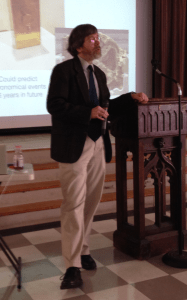
For a guy so full of phobias that there’s no elbow room at Hotel Fear in my head, people are sometimes curious as to why I don’t suffer one of the most common sources of terror: speaking in front of crowds.  Glossophobia is extremely normal.  I suspect it’s one of evolutions tricks for keeping metaphorical cooks out of the allegorical kitchen.  If we’re all talking at once, who can be heard?  The internet will prove to be some kind of experiment in that regard, I expect.  Thing is, I’m not what most public speakers appear to be: confident.  I’m not.  Beneath the surface all kinds of phobias are vying for the next private room to become available.  Over the weekend I had a public speaking engagement, and that made me consider this again—why doesn’t it bother me?

Although the answer to “why” questions will always remain provisional, I have an idea.  It’s kind of creepy, but true.  In my fundamentalist upbringing, I was taught that my life was being taped.  You see, it goes like this: since the book of Hebrews says “And as it is appointed unto men once to die, but after this the judgment,” some Fundies like Jack Chick illustrated this as an outdoor cinema in Heaven.  Or rather, in the clouds just outside Heaven.  Here you’d be summoned, buck naked, as soon as you died.  Other nude souls would gather round the big screen and your entire life would be projected for all to see.  Since everyone’s dead there are apparently no time constraints.  As a kid I realized that I was being watched.  All the time.  Now, I’m not conscious of this constantly, but I did translate it to public appearances.  We’re all, it seems, actors.

With a lifetime of performing experience, by the time I was a teen I wasn’t afraid of public speaking.  Introspection was a big part of my psyche, and when I had a speaking engagement, I knew that I had to be conscious of what I did and said, because people would be watching me.  I learned to play the part.  I did take a college course in public speaking, and even a preaching course offered by the Western Pennsylvania Conference of the United Methodist Church, but both of these were long after I’d begun taking public speaking roles.  I make mistakes, of course, and early on I learned to laugh at them before the audience did.  We were all being taped, after all, and there’s no outtake reel before the pearly gates.  Strange, but true.  If you’re afraid to speak in public just remember—you’re being watched, all the time.


Sighs

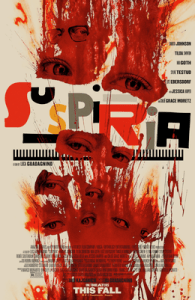
Suspiria is a movie intentionally difficult to follow.  The original 1977 version was an Italian film about witches posing as dance instructors.  After watching it, I felt I didn’t have enough backstory to understand the action.  Then a remake was released last year and I felt I needed, like a dancer, to try again.  I have to confess I’m not a dancer.  Luca Guadagnino’s remake left me scratching my head again, although it underscored a point I make in Holy Horror: in horror films with remakes the role of the Bible changes.  Now, it’s been years since I’ve seen the first Suspiria, but I don’t recall the Bible appearing.  It does, however, in the 2018 remake.  The protagonist, Susie Bannion, is an American enrolled at a German dance school.  She is, in the remake, a Mennonite from Ohio.

Not only does this situation allow religion to take once again an important role in a horror film, it is also the opportunity to show the Bible visually.  Susie’s mother, who objects to her daughter engaging in such a showy profession as dancing (and given the performance of Volk in the film, the nature of this objection can be easily guessed), is dying as the film begins.  Her Mennonite community watches and prays over her, sitting with Bibles clutched in their hands.  To take a page from Holy Horror, this suggests that the Good Book is powerless to save.  While the movie itself is a little confusing on this point, it seems that Susie’s mother dies as her daughter becomes the head witch of the dance academy.  Since Holy Writ famously contains verses condemning witches, the impotence of Scripture is underscored.

Italian folklore about witches appears to be remarkably robust.  From Strega Nona to Suspiria, the wizened women of society have power against which men are powerless.  Some of the bleakest moments in the film (from the point of view of the male gaze) are when the witches taunt powerless, naked men who cannot in any way defend themselves.  Turnabout, of course, is fair play—at least if folk sayings have any validity.  Here it’s worth considering that if male religions hold females down—the Mennonite women are shown in bonnets and uncomfortable clothes—then being a witch is remarkably freeing.  Indeed, there is the energy of a life-force evident in the dancing of the young women and the academy is closed to men, apart from public performances.  I’m still scratching my head over Suspiria, but it seems that the direct engagement with religion and the power of women makes this a movie worthy of rewatching and attempting to understand.


Funny Business

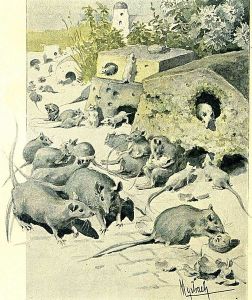
Do animals laugh?  The question sounds innocuous enough, and when my wife played me a RadioLab episode on that very question, the conclusion, although cautious, was that at least rats and chimpanzees do.  This is an instance in which the very question strikes me as terribly speciesist.  Despite the fact that evolution suggests otherwise, Homo sapiens are constantly seeking that fabled northwest passage that will separate us from animals once and for all.  One by one, over the decades, the defining traits have fallen aside.  Animals make and use tools, they build dwellings with ornaments, they solve puzzles, they communicate, and they laugh.  Were we not so obsessed with our own greatness (and consider whom we’ve elected over the past few years!) we might easily recognize that we have evolved to be what we are.

Perhaps it’s because we wish to retain our right to exploit animals.  After all, eating animals is big business and it’s harder to eat someone who’s not so very different from you.  In our culture certain animals are taboo for fodder: dogs, cats, and horses, for example.  This isn’t universally the case, and knowing that animals laugh might just make it a little worse.  We like to think animals “react” using “instinct” rather than respond with genuine emotion.  Until we fuss and fawn over Rover, and accept his affection as genuine.  Consciousness can be quite a burden to bear.  Funny, isn’t it?

We accept evolution up to a point.  Is it any wonder then that creationists still are a force with which to contend?  Often we fail to recognize that science, as it has developed in the western hemisphere, gestated in a largely Christian context.  The reason for drawing a hard line between animals and humans is ultimately, in this setting, biblical.  We’ve moved beyond the idea of God creating each separate species one-by-one, but we haven’t gotten beyond the literal truth of Adam naming and dominating them.  If we don’t consider the biblical origins of these ideas they continue unchallenged, even into the laboratories and sterile rooms of today.  It makes us a bit uncomfortable to consider just how influenced we still are by the Good Book.  At the same time we consider its meta view on the biological world, even as the evidence continues to pile up that little, if anything, really separates us from our faunal kin.  Try explaining that to the rats.  That sound you can’t hear without special equipment, by the way, is their laughing.


Tumblin’ Down

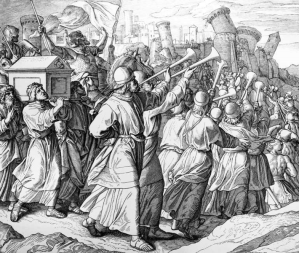
RadioLab (not to be confused with Radiohead) is an NPR program to which my wife likes to listen.  She’s introduced me to a few episodes since, as a person who does a lot of writing, I don’t normally gravitate toward programs with a lot of talk.  It’s part of the writer’s curse.  In any case, she recently played a segment on acoustic warfare.  I’ve known for some time that acoustic warfare is a thing, and that militaries use sound to disrupt enemies’ machinery and human operators.  I didn’t really know how it worked.  The interesting thing about this RadioLab spot was that they took the story of the walls of Jericho as a starting-off point.  Also of interest is that one of the hosts had never heard the story—something that would have been somewhat impossible for many growing up in my generation.  In case that’s you, however, the story goes like this—

God commanded Joshua to take on Jericho, a major, walled city, with a ritual procession and the blowing of trumpets.  After marching around the city several times, the priests blew their trumpets and the walls collapsed.  The story’s told in the book of Joshua.  The question discussed on RadioLab was whether it was possible to knock down walls with noise.  It is, they concluded, but at a noise level beyond the abilities of shofars.  This very discussion, however, raised any number of issues.  One is that the collapse of Jericho’s walls isn’t attributed to the rams’ horn sound, but rather a miracle.  Another is that biblical scholars and archaeologists have long known that Jericho wasn’t even occupied at the time of Joshua, and so the story isn’t historical.

Those who produce educational materials on various media generally don’t consider scholars of religion as interesting or noteworthy speakers.  TED talks don’t feature a category for religion, and, as this RadioLab episode demonstrated, those who understand acoustics have more interesting things to say than biblical scholars.  It’s not so much a rude awakening as it is a confirmation that what has long seemed obvious is indeed true—biblical scholarship isn’t really of general interest.  The Bible, however, retains a certain mystique.  I struggle with this disconnect constantly.  While the Good Book remains an iconic symbol—divine, even—those who know it well have less to say than others who have scientific methods to apply.  Not once was it mentioned on RadioLab that pretty much no biblical scholar would argue that the story is historical, but then, what fun would that be to pick apart?


Born Once More

Every once in a while a reader, either here or on other social media, asks me what my religious beliefs are.  The expected answer to such a question is the standard label of a denomination of some sort.  My response, however, is that knowing the group I belong to (and I do) should not effect the way my thoughts are viewed.  With the exception of some groups suspected of mind control, standard religions are generally trusted as being motivated by pure intentions.  Having both attended and taught in seminary settings, and knowing a great number of clergy, however, it becomes clear that denomination is less important than one might think.  In short, I answer this question in the public forum of neither classroom nor blog as I truly believe there’s nothing to be gained by readers/students knowing where I personally seek meaning, denominationally.

It’s no secret that it was once the Episcopal Church.  (I could not have taught at Nashotah House otherwise.)  It was made pretty clear after being at said seminary for many years that the Episcopalians had no official place for me.  Even when I worked a few blocks from the church’s headquarters in New York City I could find no one willing to listen or consider my credentials.  Its Church Publishing branch wouldn’t consider me in their book wing.  Were it not for some former students who still minister to me, it was clear they did not miss me.  So it was with some surprise that I found myself in Nativity Cathedral in Bethlehem on Saturday for their Celtic Mass.  The Cathedral itself is lovely with a négligée of wrought iron tracery for a reredos, appropriate for a city built by steel.  Eight angels with outspread wings stood atop it.  Like most sanctuaries, it was a place of refuge from the busy, noisy street outside.

The reading from Amos 7 stood out to me.  Lectionaries, by definition, take pericopes (selections) out of context.  Amos’ vision of the plumb line is actually part of a series of visions, but here stands alone with the episode of Amaziah trying to send Amos back to Judah.  The prophet responds by saying he’s not a prophet, but just a guy who’s received a message from God.  In ancient times there were prophets paid for their services.  They supported the government positions and governments made sure they were cared for.  The situation hasn’t much changed, at least among conservative religious groups under a Republican administration.  There were other parallels here, but saying too much on them might end up giving too much away.


Bible Misunderstood

Okay, so I wrote a post a couple days ago about evangelicals challenging Trump’s China tariffs because it will raise the price of Bibles.  Little did I know that Miriam Adelson wants a “Book of Trump” added to that very Bible.  Now, heroes are a personal business; to each their own.  Adding someone to the Bible, however, especially when that person has no idea of what Jesus said, is problematic.  Biblical and ecclesiastical scholars know that even if most Christians agreed books simply can’t be added to Scripture.  Many think the Gospel of Thomas should qualify—it may actually be closer to the words of Jesus than some of the canonical gospels and was putatively written by a disciple.  Thomas, however, will never make the cut.  Early bishops and elders in the church set pretty firm limits to the New Testament.  

Some religious traditions, such as Mormonism, have gotten around this impasse by writing entirely new sacred texts.  Loyal Trump followers might indeed fit the description of what used to be called a cult.  Thing is, George W., and George H. W., and even Ronald Reagan were more religious than the incumbent and nobody suggested adding them to the Good Book.  Our world has somehow flipped upside down in the last three years.  All I know is that in the photos of Trump with the most Jesus-like Pope in modern memory the Holy Father wasn’t smiling.  Then again, the Pontiff would likely not autograph Bibles if asked to do so.  Has anyone suggested a book of George Washington?  There’s such a thing as getting carried away.  

The Bible, apart from being the sole recognized authoritative text of the world’s largest organized religion, is an iconic text.  This means that the Bible is recognized as an important book—perhaps even a stand-in for God—without considering what it actually says.  This was a major point behind Holy Horror and it’s essential to understanding American political behavior.  Manipulating Scripture for political ends is generally the most cynical of approaches to the Good Book.  In America you can drive down highways and see the Bible advertised on billboards.  Large segments of an increasingly secular society are still motivated by it.  There was a time when it was believed that such cavalier suggestions as that of Ms. Adelson would constitute blasphemy, or would at least profane the founding book of Christianity.  In the minds of some Trump has clearly become a god.  So it was in Rome before the fall.


Good Ground

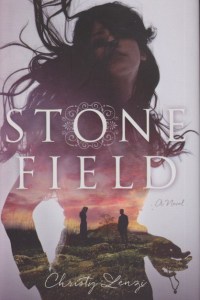
Young adult literature gives me hope.  The quality, speaking for a guy who grew up in a small town with limited choices, has improved astronomically over the past several years.  One of my favorite (adult) novels is Wuthering Heights, and so it’s no surprise that I found Christy Lenzi’s debut novel Stone Field quite engaging.  Set in a different time and place, and with a younger readership in mind, it retells the story of forbidden love based on xenophobia.  The message has never been more relevant.  Although it avoids explicit language, it does include adult situations and features a strong female protagonist in an age of explicit gender inequality.  During the chaos leading up to the Civil War, star-crossed lovers are set against one another because prejudice is a most effective poison.

While not a religious story, the iconic Bible plays a large role in it.  One of the main characters is a preacher, but even without him Catrina Dickinson’s family and friends are ready to quote the Good Book as unquestioningly as a Republican (with my apologies to fiscally conservative friends untainted by this aberration).  This is beyond a realistic portrayal of American life of the 1860s, it reflects the way that many people continue to think of Scripture.  Nevertheless, in one crucial episode of the story set in the church at Roubidoux, Missouri, the iconic role of the Bible becomes clear.  It is deftly woven throughout the story in a way that might serve as a lesson for modern writers seeking verisimilitude.  Many authors fear to address religion, but the Good Book is alive and well in these post-frontier days.

Often the desire to avoid religious motivations leads to stories that lack a key element of the social fabric.  In my own attempts at fiction religion is seldom absent.  It is the way average people live.  Lenzi presents Cat as being aware of but unwilling to be cowed by the Bible.  Indeed, as the story unfolds with several tragic events (remember, Wuthering Heights) she demonstrates that Catrina knows but doesn’t accept the strictures of Scripture.  The issue of theodicy hangs heavily in the atmosphere of the novel.  To me, this makes stories appear more life-like than tales that simply suppose religion doesn’t impact people.  When tragedy strikes, many people question what God, or their stand-in for the divine, is doing.  Anyone who’s asked “why me?” has directed that question into the world of theodicy, whether intentionally or not.  Reading this story while going through a family illness may have drawn this to the surface, but it underscores just how effective it may be for a realism that is otherwise lacking, whether in fact or young adult fiction.