Lunar New Years

Celebrating the New Year in the middle of winter is a strange idea, at first glance. As I have discussed before, January 1 is “Circumcision-style New Year,” based on the projected date of Jesus’ circumcision after the church had settled on December 25 as his birthday. In actuality, a winter New Year date is due to its proximity to the winter solstice, and the other popular contenders for the honor of the head of the year, historically, have been the spring and autumnal equinoxes. The matter gets more complicated when a culture has a lunar calendar since the sun and moon don’t see eye-to-eye when it comes to their timing. That accounts, obviously, for a shortened February, but also for why a full moon doesn’t occur on the same day of each month. Now, I know little of Chinese culture, but I do know that Chinese New Year fell on January 28 this year, initiating the year of the rooster. Considering what had happened only eight days prior, this feels incredibly apt to me.
800px-hahn_im_huhnerhof_flamisch_17jh

Cultural diversity is a wonderful thing, and this nation is rich in it. You can, to pick a trite example, sample cuisines from around the world in a moderately sized town. Here in New Jersey getting onto a public transit bus will almost guarantee that you’ll hear at least one non-English conversation going on. Nevertheless I do have to confess that I don’t know what the year of the rooster represents in a Chinese context. As concepts cross borders they take on new associations and those who assign those new associations don’t represent those from the original land. So let it be here. Not knowing what the rooster symbolizes in China, I turn to its American expression—the cock. This is its year. The newspaper headlines read like a fortune cookie, in this distorted view of things.

To shift this metaphor to yet another cultural context—originally Jewish, but now appropriated by Christians around the world—think of Passover. For Jesus a night of betrayal. Peter, arguably Jesus’ best friend, denied three times in one night that he even knew his BFF. Cursing and swearing, according to the Gospels, he said, “I don’t know that man.” The cock crowed. It was around the spring equinox. A new year had begun. Within 24 hours, according to the story, Jesus was dead. We have much to learn from other cultures. The concepts change, however, when they’re stopped at the border.
Come Forth

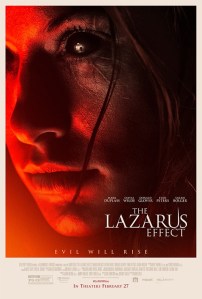
the_lazarus_effect_2015_film_posterHorror movies provide a strange consolation at times such as this. When evil has overtaken democracy, it’s almost like strategy, watching how fictional characters deal with things that are wrong, things that are too close to real life. The Lazarus Effect has been on my watch list since the last sane presidential administration, but need finally dictated that I watch it. The premise is clear from the title—Lazarus is universally known as the dead man who came back to life. A group of medical researchers at a university in California find a way, through direct stimulation of the brain, to bring dead animals back to life. The idea is that they will give surgeons more time to resuscitate critical patients if they can get the formula right so that it works on people. An evil corporation steals their discovery and they have just a few hours to replicate the experiment to prove they are the ones who perfected it. Predictably one of them (Zoe) dies and her fiancé brings her back to life. Mayhem ensues.

Those who’ve seen Pet Sematary will find many similar ideas covered here. Those who come back from the dead are somehow distorted versions of their former selves. Those who do the resurrecting end up dead at the hands of the modern-day Lazaruses. There’s not much unexpected here except that Zoe, a Catholic, ends up in Hell. There’s quite a bit of talk about religion versus science—what really happens when you die. Zoe, despite being a practicing Catholic, has never been forgiven for her childhood sin of setting a fire that killed some neighbors in the apartment building. Religion and horror sharing the screen is something fairly common, but it is seldom as forthright as it is here.

Resurrection—necessarily a religious concept—is a frightening prospect. Horror films have shown many times that this is a miracle that just shouldn’t happen. At least not on this plane. (Those who’ve watched Re-animator know how bad the consequences could be.) Scientists, generally unbelievers in the cinematic world, just can’t accept either an afterlife or death. Using technology to challenge a godless fate, they inevitably end up losing. So it is in The Lazarus Effect. Some biblical scholars have suggested John’s rendition of the story is a kind of biblical horror tale. I mean, Lazarus had been dead four days in the warm climes of the Holy Land. His resurrection seems to have ended up well, however. Then again, there is an inherent difference between science and religion. Neither one, however, is now really in charge.


Theoretically Speaking

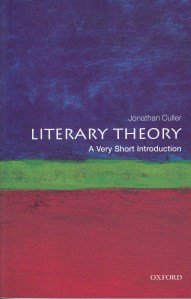
lit-theory-vsiI’ve been brushing up on my literary theory. All writing tends to get classified as fact or fiction, and we don’t stop to think, generally, about what “literature” is. Those of us who write fiction and non know that a well-placed hyperbole might throw us from one camp into the other. Such is the power of rhetoric. So it was that I found myself reading Jonathan Culler’s Literary Theory: A Very Short Introduction. Witty and insightful, Culler acknowledges the elephant in the room for many of us—theory, in a literary context, is often impenetrable. I’ve often wondered what one had to do to be considered a theorist, and this little book actually addresses that. Nobody has time to read all the theorists, though, and come up with their own creative things to say. Chose your poison.

The Bible, of course, is literature. That’s one reason I was reading Culler. I found one of his assertions immediately applicable: people in nineteenth-century England saw literature as a unifying principle. The British Empire encompassed the world, and to make diverse peoples a part of it, literature might be used, they thought, to do the trick. Culler suggests that it might have been a substitute for religion, which, he notes, was no longer holding society together. This gave me pause. Religion—at least official religion—began as social glue. The earliest recorded religions were state sponsored and served to cast the monarch in the role of the special appointee of the gods. There’s no arguing with that, right? Elaborate, expensive temples were erected. Financed by tax-payers’ dollars. This worked fine since priests declared the rule of the king as sanctioned by the gods. Nations warring against each other were thought of as rival gods fighting.

When science began to take the universe literally, religion lost its stickiness. How do you hold a society together when the gods no longer exist? You see, scientists didn’t think out the whole picture in advance. Scientists, like most academics, work in silos (that’s a metaphor). The discovery of a scientific truth can dissolve a social epoxy quite efficiently. Recognizing the slippage in the British Empire, theorists (I suppose that’s who noted such things) considered literature the great uniting force of a diverse people. We’re kind of facing that same dilemma today as literature is becoming, for many, as irrelevant as religion was a century-and-a-half ago. At the same time, people don’t understand science well enough to assess it for themselves. What are we supposed to do? Is there a theorist in the house?


In Poor Taste

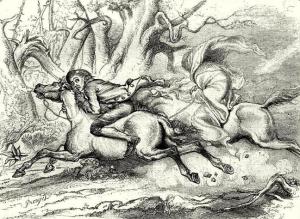
I remember seeing a television commercial once (not during the Super Bowl) where an older guy, a lawyer, complained at the camera, “It used to be that lawyers didn’t advertise.” He went on to say that he felt uncomfortable promoting himself since it was in poor taste, but since the legal profession had swung that way he was entering the game. I know how that guy felt. I grew up with the firm notion that self-promotion was in bad taste. If my career has taught me anything, it’s that unless you’re born well connected, if you don’t promote yourself nobody else will. Still, it rankles. With that hearty introduction, I would, in poor taste, point out that my latest article has been published. Those of you who keep an eye on this blog will know that I gave a paper about the Bible in Sleepy Hollow to a learned society a couple years back. That paper is now available in the Journal of Religion and Popular Culture.

ichabods_chase_crop

Doing research is difficult when you don’t have institutional support to carry it out, but doing such things as an independent scholar can be kind of liberating. I used to research, write, and get published an article a year, back in my teaching days. Nashotah House didn’t have the greatest library, but they did have interlibrary loan and, towards the end of my time there, internet access. More than that, life wasn’t measured in increments of nine-to-five. Living on campus, commuting could be measured in seconds rather than hours. Although publication didn’t bear the weight there that often pressures academics elsewhere, like that lawyer whose name I can’t remember, I wanted to be in the game. I guess I still do.

In these days of uneducated government, if you don’t do it yourself nobody’s going to do it for you. It’s what I once called “the educational imperative.” We are duty-bound, as conscious beings, to move knowledge forward. How many apocalyptic scenarios are there where, when the powers that be devolve into inanity, the monks in their cloisters have to keep knowledge alive? (The question’s rhetorical.) I’m reminded of Station Eleven by Emily St. John Mandel since there women do a good bit of keeping the culture alive when society collapses. Or, to put it another way, like Sleepy Hollow. When the forces of evil break into the world, it’s an African American woman who saves it. If your school has access to JSTOR, you’ll be able to find out more in my paper.


Cheap Faith

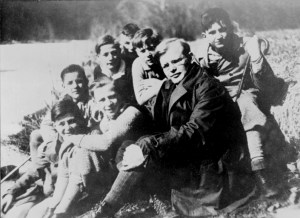
“If I see a madman driving a car into a group of innocent bystanders, then I can’t, as a Christian, simply wait for the catastrophe and then comfort the wounded and bury the dead. I must try to wrestle the steering wheel out of the hands of the driver.” Many of my conservative Christian friends may be surprised to learn that these are the words of Dietrich Bonhoeffer. Evangelical hero and firm believer in costly discipleship, Bonhoeffer lived, and died, during the Nazi takeover of Germany. A promising young theologian, he escaped Germany to come teach at Union Seminary in New York City. Increasingly disturbed by what was taking place back home, he forsook safety and returned to Germany to try to wrench the hands of Hitler from the steering wheel. Bonhoeffer didn’t write empty words.

The above quote comes from a letter he wrote to his sister-in-law Emmi. Bonhoeffer’s book, The Cost of Discipleship, well deserves its status as a classic. In it Bonhoeffer declares that a cheap faith is not a faith worth believing in. The Prosperity Gospel would have made him ill. You see, Bonhoeffer believed that the religion preached by Jesus didn’t allow for shirkers. Those who get rich and claim God helped them to it. There’s a reason some people say Mammon is a demon. This was in the days when Christianity still had a conscience. When leaders of religious movements weren’t afraid to speak out against accommodating with evil when that was the more comfortable course to take. And his wasn’t empty rhetoric.

Bonhoeffer was arrested back in his native land. Sent to Buchenwald and then to Flossenbürg, he was hanged on April 9, 1945. He was 39 years old. Two weeks later the Allies liberated the camp. Bonhoeffer knew evil when he saw it. Now, some seventy years later our vision has become blurred. We live in a country that declares itself “Christian” but, unlike any religion Jesus taught, declares itself to be first. “America first,” we’re told. Flipping through the pages of the Gospels my eyes fall on a forgotten verse. “The first shall be last,” it reads, “and the last shall be first.” Scholars argue over the authentic words of Jesus, to be sure. What we do know is that he too was executed by his government before he reached 40. And they killed him for the radical message that what God requires is loving your neighbor as yourself.

Photo source: Bundesarchiv, Bild 183-R0211-316 / CC-BY-SA 3.0, Wikimedia Commons

Photo source: Bundesarchiv, Bild 183-R0211-316 / CC-BY-SA 3.0, Wikimedia Commons


Reformation Blues

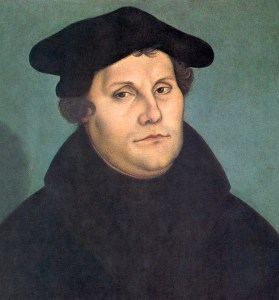
Welcome to Reformation Year! Well, not actually. It’s more like an anniversary. Five centuries ago this Halloween, Martin Luther grabbed his silver hammer and history forever changed. In 1517 nobody could guess that that obscure strip of land across the Atlantic (nobody knew how far west it went except maybe those who already had lived here for millennia) would one day identify itself so strongly as Protestant that other religions would be merely tolerated. Even when it established itself as a land of religious freedom, it mainly would have Protestants in mind. Indeed, Martin Luther unlikely ever met a Hindu or Buddhist. His concern was the Catholic Church which, in all fairness, had already split into two major branches a few centuries before he was born.

lossy-page1-558px-Martin_Luther_by_Cranach-restoration

Thinking about the Reformation makes me uncomfortable. As my regular readers know, I’m concerned about ultimates. In a universe where “you only live once,” and eternity is so very long, you need to make the right choices when selecting a means of salvation. Really, an eternity in constant torment makes a Trump administration look like a day in the kiddie zoo. This is a very important choice. Heaven and Hell are a non-zero-sum game. You pick the wrong one and you suffer for ever and ever and ever. And ever. With one united church at least you could know that everyone else believed the same. Now you have to shop around for salvation. Which brand really does whiten best? Which is the most flame retardant? Things got pretty complicated as soon as that nail entered that Wittenberg wood.

The truly sad thing is that all this splintering represents those of the same “religion.” It’s bad enough that Christian versus “infidel” was already a thing, but from 1517 onward it was Christ versus Christie, as it were. You may have been lucky enough to have been born into the right family, but if you descended from the wrong scion you were still going to end up in Hell. Catholicism may have been corrupt—selling indulgences is pretty shady business when you can get them for free—but once that break is made we can’t all be right. Somebody’s going to end up eternally in torment and it’s not even going to be the heathens. Reformation suggests something’s wrong in Rome. You can’t hide behind being born Baptist, Methodist, Presbyterian, or Lutheran. No, you’ve got to do your homework and learn which is actually correct. Where is Pascal when you need to make a bet?


Samaritans, Good and Otherwise

It’s the coldest day of the winter so far. I’m noticing this because I’m standing on the shoulder of the New Jersey Turnpike counting the NJ Transit buses that are flying by at highway speed. It’s been a morning of irony so far, which explains why I’m standing out here instead of sitting inside the broken down, but still warm bus right next to me. I felt the cold while waiting at quarter to six for my bus to show up. Thankfully on time. It’s very empty this morning; I’m maybe the fourth passenger. Somewhere along Route 22, miles later, the bus gives a distress cry. Ironically, the engine is hot. The temperature outside is in the single digits. Also ironically, the radio on our bus isn’t working, so the driver has to call dispatch on his smart phone. Meanwhile, the engine cools down enough for him to try it again. We’re fine until we pass exit 15 on the Turnpike.

While I try to think of others before myself, I sit near the front of the bus—the first or second row. That way when it’s time to get off I don’t have to wait for dozens of people to wake up, stretch, and slowly shamble into the aisle. (If you think that’s an exaggeration, you don’t commute by NJ Transit.) “The first shall be last,” the Good Book says, and I believe it. I lost count of how many of the company’s buses have zoomed past, but when one finally stops, I’m person number 8 off the bus. The Good Samaritan driver stops me outside his bus. “Sorry, no more seats. No more standing room.” No room in the inn. My driver urges the long line behind me to get back on the bus, where it’s warm, to wait. I was first, now I’m last. That’s why I’m standing out here in the cold. As I approach the bus I see all the first several rows are filled by those first back on the disabled bus. They will be the first to be offered a ride by the next driver along this road to Jericho.

winter

The guy behind me, now in front of me, comes to the same conclusion and waits outside too. At least we both have beards. I’m thinking of Jesus’ words about the end of the world. “Pray it won’t come in winter.” Out here, all prayers are frozen. At least thirty NJ Transit buses buzz by creating their own wind chill before another stops. I want to be first because I paid more for my ticket than those who sat further back on my bus. In fact, I could rent a small apartment in many places in the country for what I pay a year for a bus pass. I wonder if that’s what it means that the first shall be last. Or maybe my brain’s just frozen, since it’s the coldest day of the winter so far.


Capital Carol

The idea of exchanging presents on a holiday emerges from the impenetrable veil of time. We don’t know when the practice began—the idea of copying the Zoroastrian wise men in Matthew is a bit of a stretch and the date of Christmas wasn’t settled until much later in time. However and whenever it started, giving gifts at this time of year has become one of the defining features of late capitalism—it’s almost as if Jesus of Nazareth was born for this. An economy that measures self-worth in terms of money is just the place to have God-incarnate celebrated by giving lavish gifts. Those of us who make no money off the holidays can’t deny that it feels good to give someone something. People like, in general, to make each other happy.

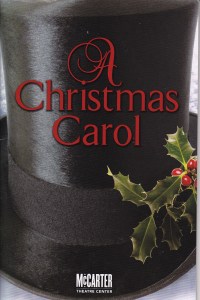
This year my wife asked for a non-material gift. We made our way to the McCarter Theater in Princeton to see their acclaimed performance of Charles Dickens’ A Christmas Carol. A gift of a memorable family time and a truly spectacular play. Seeing this story in 2016 felt especially important. Dickens was a famous advocate for the poor and was well aware of how they suffered at the hands of the wealthy. Indeed, those with too much money lose their humanity almost completely. The story is focused around Christmas, but the message is needed for every day, especially in over-long years such as this. Capitalism is a form of social evil. Anything that lowers humans to mere ciphers on a page is the very definition of sin.

christmas-carol

We all know how the story goes, but to see accomplished actors undergoing conversion is nevertheless a strangely hopeful experience. As the story makes abundantly clear, it requires so very little to make others happy. The point of having money, after all, is to use it for the good of others. Seeing one man facing his own mortality only to realize that he has isolated himself from the care of others is a powerful experience. As we move forward into the long and dark days ahead, there is a reminder here that we need to keep close to our hearts. There may be fewer presents under the tree this year, but we are all the richer for it. This is the kind of gift that we need to share with the entire world.


Bible Riots

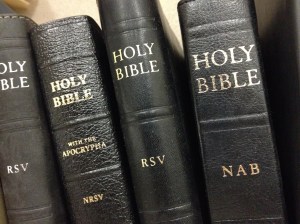
One of the more embarrassing questions I get asked is “What do you do?” This has been true throughout my career (if what I do can be called that). I should clarify—I don’t mind saying “I’m a professor,” or “I’m an editor”—it’s the follow-up question that’s difficult. “What do you teach/edit?” Mentioning the Bible is a conversation-stopper. In the silence that inevitably follows you can almost hear the electronic buzzing in the interlocutor’s brain as s/he tries to come up with something nice to say while backing away. In actual fact my degrees have been more in the history of religions rather than Bible per se, but those who’ve done the hiring haven’t tended to see it that way. This is not a nostalgic post, asking to go back to yesteryear (that’s happening politically without my help), but it is a reflection of what James Wallace Harris says on BookRiot—the Bible is a good book to read.

It’s easy to get swept away in the criticism of religion, and particularly Christianity. Those who profess it, historically, have a lot to answer for. What we’ve allowed religion to do to others is inexcusable. What we sometimes miss is that the motivation is one in which all people participate—learning the truth. This is more difficult than it might seem. If someone had discovered “the truth” we’d all know by now. The fact is we’re deeply divided about what that truth is and that alone proves no one has found it. We’ll recognize it when we see it. We just haven’t seen it yet. What sometimes gets forgotten along the way is that the Bible was, and is, a great milestone of humanity’s search. As I keep having to remind myself, there’s some really good stuff in there.

IMG_2634

Harris isn’t alone in suggesting that atheists should study the Bible. Some very prominent non-believers have declared the same thing from time to time. The Good Book is densely interwoven with western culture—even secular western culture. I’m currently at work on a book that explores one thread of that complex fabric, and it’s amazing to me how much we miss when we ignore holy writ. We shouldn’t throw out the baby with the bathwater, as the old saying goes. That’s not biblical, but it does hint at the truth, I think. Or maybe it’s just that I want to be able to answer that most basic of questions without having to make excuses for what otherwise looks like a series of poor life choices.


Mark of the Beast

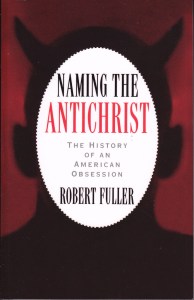
namingantichristI grew up believing in “the Antichrist.” As I came to realize that much of the New Testament pointed to contemporary problems (for them) with the Roman Empire and that what appeared to be predictions were actually safe ways to discuss forbidden topics, I began to worry less. It was about the past, not the future. Recent political events have ratcheted up my anxiety level again—maybe there is such an evil after all. Robert Fuller’s Naming the Antichrist: The History of an American Obsession is an important book in this regard. Although end-time worries have diminished among some now that we’re safely into a new millennium, for the true believer none of that matters. The Antichrist is a great motivator. I hadn’t realized until reading this book just how much of contemporary culture has grown from this fabricated fear.

Let’s get this straight from the beginning. In the Bible there is no figure known as “the Antichrist.” The generalized word antichrist is used only twice and in neither instance is the book in question Revelation. Early Christians speculated that the beast of Revelation might be “the Antichrist” but that identification wasn’t solidified until the beginnings of the Fundamentalist movement in the late 1800s. By the time Fundamentalism was a fully developed system, by about the 1920s, believing in the Antichrist and trying to identify him had become a cottage industry. I grew up in the shadow of Hal Lindsey and the pressing concern that “the Antichrist” was alive in the world today. Face it, The Omen loses something if he isn’t. This strange, non-biblical belief has come to define a large number of true believers.

Fuller’s book is important for the insight he brings into why some “Christians” are avowed enemies of peace, toleration, and the improvement of human conditions. Those who believe their tribe is the only correct one hold the double standard of ethical treatment of those inside and scorn and hatred of those without. This view believes that the world is to be condemned, natural resources used up, wars started, and civil rights suppressed, in the name of Christ. Perhaps you may begin to see why a chill ran down my spine as I was reading this book. We need to try to understand this perverted way of looking at the world in order to understand the forces that would rather see a dictatorial billionaire run the country than an eminently qualified woman. Reason’s got nothing to do with it. It’s all about conviction. Failure to understand that is perhaps the surest way to bring about the end of the world. We ignore religious thought to our own peril.


Hollow Bible

Sleepy_Hollow_-_Title_Card

The proofs for my article on the Bible in Sleepy Hollow are now here. It will be appearing shortly in the Journal of Religion and Popular Culture. For those who know my previous academic work—hi, both of you!—this represents a departure from the familiar for me. Some years back, floundering for a teaching position like a fish that’d flipped out of the acadarium, I talked to a colleague who confirmed what I’d long suspected: study of the biblical text is dying. Face it, nobody cares about J, E, D, and P, or even Q, anymore. We’ve made our point. The Bible is a composite document with many sources that people can still tuck under their arms on the way to the polls. It’s so easy to forget that this text is the basis for so many lives and eternal plans. While we scholars have been arguing with one another, culture has moved on. That’s why I looked at the Bible in “Sleepy Hollow.”

If the Bible isn’t relevant, why bother studying it? If the main character—dare we call him protagonist?—of the New Testament says to turn the other cheek and his “followers” advocate for gun ownership it’s time to ask what went wrong. Scholars know the Bible, but do we know the Bible? Long ago meaning slipped away from academics. Consider science. We can question global warming because the science has become a topic of conversation among specialists that the rest of us can’t hope to understand. Instead of trusting that they know what they’re talking about, we politicize it. Scientific research, even in major universities, is funded by interested third parties. You know, some scholars don’t think there really was even an E after all.

The Bible no longer means what the specialists say it does. I may have spent years of my life and thousands of dollars to speak as an expert, but I soon learned nobody was listening. Meanwhile, culture marches on, somehow supposing if two Corinthians walk into a bar the rich man in his tower makes the best sense, according to the Good Book. Indeed, if you want to find out what the Bible says, all you need to do is head up the Hudson Valley for a season. Or listen to those who hand out tracts and purchase firearms. What could possibly go wrong there? My article will be out in a few weeks. If you’re one of the two who read it keep in mind that there’s more to it than meets the eye.


Remember the Alamo

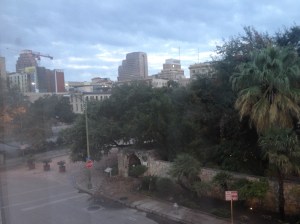
I’ve never started a fight. I’m actually a very conciliatory type, willing to be wronged in order to avoid an unnecessary confrontation. This election has made me feel a little pugilistic, however. The sheer size of Trump’s loss based on the popular vote makes me hope I’m not alone in this. I find myself in San Antonio at the moment. The American Academy of Religion and Society of Biblical Literature annual meeting, which rolls around the weekend before Thanksgiving, has been a regular aspect of my career since 1991. My hotel room overlooks the Alamo, and the implications—indeed, the irony—are not lost on me. I don’t know a great deal of Texas history, but what kid grows up without hearing about Davy Crockett, who died a few yards from where I lay down my head?

img_3034

I’ve known many Texans in my life. Many of them have been, and continue to be, perfectly reasonable people. Good and loyal friends. Lots of people like to live here. Indeed, the population of the state has swelled over the past quarter century. I’ve also encountered Texans (particularly at Nashotah House) who acted like the enemy at the Alamo wasn’t Mexico, but the other states. In the light of last week’s election I’m reminded of the words of one of the Mexican officers, after Santa Anna declare the battle a light one. Reportedly another officer quipped, “with another such victory as this, we’ll go to the devil.” Voices from the other side of the wall. Maybe it’s the lack of sleep from getting in so late, but I’m looking at the Alamo and Pink Floyd’s The Wall is going through my head. The lesson of the Alamo is that although you may lose the battle you can still win the war.

This is my second visit to San Antonio. Last time I was here, for the same conference, one of my doctoral advisors was over from Edinburgh, and we walked through the Alamo together. Today we are lamenting Brexit and Trump together. By slim margins the alt-right has learned to game the system. The problem seems to be apathy. It’s clear that we’re going to have to fight from now on just to get a little social justice around here. Strange words coming from the fingers of a lifelong pacifist, but you’d think that the work of Martin Luther King, Jr. and Susan B. Anthony might have had more lasting effects. Perhaps it truly is time to remember the Alamo.


Daily Bread Plus

I have a confession to make. I’m not a foodie. These days such an admission is tantamount to a venial sin, but the fact is I’m one of those who eats to live, not lives to eat. Still, like many people I’m concerned about whence my food comes. I can’t grow my own and just about all of it comes wrapped in plastic. Thus I found a BBC article my wife sent me to be of great interest: “An uncanny mixture: God, alcohol and even cannabis” by Kait Bolongaro. Focusing on monasteries and their brewing and distilling traditions, Bolongaro uses the foodie angle well. People want to know where their grub comes from, and the current interest in knowing the location of the source plays well into this. European monasteries have long been known for their production of alcohol. Even Jesus drank wine.

I’m no connoisseur of spiritous liquors, but the story is quite interesting. Many people don’t realize that monastic orders, in addition to praying and not having sex, also support themselves through industry. Many make goods to sell. Those in this article make booze. As Bolongaro points out, the fermentation and distillation process is an exacting one. In fact, it is a science. In the case of Chartreuse only three monks know the secret formula. They control the temperatures and conditions remotely, by computer. And I thought Bible Gateway was the only place the religious spent their time.

IMG_2642

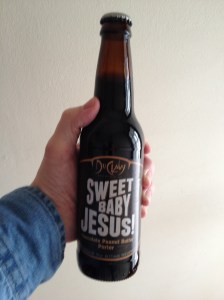
Science and religion actually have a very long history of cooperation. Gregor Mendel, whose work gave Darwin’s theory of evolution by natural selection its actual mechanism, was a monk. Other religious have been close observers of nature and processes. There is no commandment against good beer, as many Teutonic brothers would no doubt point out. But to get it right you have to know your chemistry. As the article says, some things can’t be rushed and monastic life lends itself to such slow processes. The rest of us in our secular pursuits rush through life far too fast for religion or science. Contemplation requires “down time.” Time off the clock. The kind of time, we’re told, that simply doesn’t exist any more. The story, after all, appears in BBC Business. I’m no foodie, but I have to confess that the cheese and pretzels purchased from the Amish in Lancaster do tend to taste better than those that come wrapped in plastic. There may be a religion to science after all.


Signed, Sealed, Forgotten

the_seventh_sign

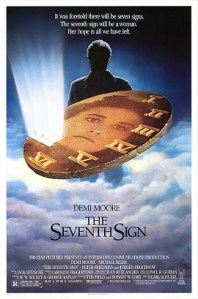
I’m a little ashamed to admit it. With such a long list of moody horror movies out there, I gave in to watching The Seventh Sign again. 1988 was a momentous year. I had graduated from Boston University School of Theology the year before and had been functionally unemployed, as befits a future adjunct professor. I had joined the Episcopal Church, cutting off my chances of ordination in my previous United Methodist sect. I’d been accepted into doctoral programs at Oxford, St Andrews, Aberdeen, and Edinburgh but couldn’t afford any of them. I proposed to my future wife and by the end of the year had married her. In the midst of it all a friend convinced me to go see The Seventh Sign, then in theaters. A typical end of the world movie, The Seventh Sign was a “see once” movie to me, but I guess I’m weaker than I thought.

The movie got me to thinking about the end of the world. Not literally, but rather how we came to have such a strange idea. As creatures conscious of our own deaths, I suppose it’s natural that we think everything comes to an end. The mythical scenario of “the end of days,” however, is cobbled together from various pieces of the Bible, like some distorted, religious picture puzzle. The Book of Revelation doesn’t give a coherent story of the future. In seminary I learned that it was because Revelation is actually about what was happening in the Roman Empire in the first century, not about what would happen in the days when I happened to find myself conscious and eating Kraft macaroni and cheese, mixed with water instead of milk and working for Ritz Camera. I was sleeping on the floor of a friend’s apartment. That was my own kind of personal apocalypse, I guess.

The Seventh Sign is unusual in that a Jewish boy, Avi, and a lapsed Christian woman, Abby (who rents a room to the new incarnation of Jesus who lives, apparently, quite a lot like I did at the time) have to figure this out together. Tying in several other mythological motifs, the number of seals broken is, if I count correctly, only five. The world is saved by self-sacrifice, as is generally expected, and everyone ends up feeling let down. It is a downer of a movie, and not very scary for a horror film. What struck me was how many scenes I remembered so precisely. So I guess it did manage to impress me on some level, back in 1988. I selected Edinburgh University and now once again, find myself outside the institution I covet. I’m still waiting to see what happens with those two last seals.


Tell It Straight

Apparently there is a burgeoning interest in swearing. Not necessarily in doing it, but in studying it. Over the past couple of years I’ve easily found a book every twelve months that devotes itself to the topic. After I finished reading the most recent one, my wife pointed me to a story on The Guardian that deals with the same topic. The story by Benjamin Bergen, “Well, I’ll be… There’s a real science to cussing and blaspheming but beware,” springs from his book on the subject, which I’ve not yet read. Interestingly, Bergen points out that there are four main classes of “bad words:” those that misuse religious concepts and names, those dealing with sex, words that denote various bodily effluvia, and finally, slurs. Today the final category, particularly when it comes to prejudicial slurs, is often considered the most offensive. Religious swears aren’t what they used to be.

800px-rembrandt_harmensz-_van_rijn_079

Why concern ourselves with such things? For me, I suspect, it is because of laws. Yes, laws. The religion in which I was raised was all about what you could or couldn’t do. One of those species of forbidden activities was swearing. Problem was, I didn’t know what all the words were. How could I not say them if I didn’t know them? And how could I know them if somebody didn’t say them? This vexed my young mind. I thought perhaps I should keep a written list, but this would be hard to explain if anyone ever found it. To make matters worse, some of the words were not swears sometimes and other times they were. “Hell,” referring to the fiery place, was not swearing unless you instructed someone to go there. Other uses beyond the literal were swearing. An ass was fine if it was an animal, but not if it was on an animal. And if you added one consonant that you couldn’t even hear onto a structure built to hold back water you were in hot water. Who made up these rules? The Bible didn’t say much about it.

In high school I heard there were seven words that you couldn’t say on television. Since we didn’t watch George Carlin I didn’t know what they were, but by this point I had collected more than seven. When I finally did hear his shtick (quite recently, at that) it contained some words I didn’t expect which, while rude, were never considered “swearing” on my canonical list. So it is we find ourselves with no definitive rules about what not to say. Professors are writing books about such things and even after having read some I’m no closer to my definitive list than when I started. It’s all a matter of laws, I suppose. Only the rules keep shifting. Best just to keep my mouth shut.