To Whom It May Concern

Everything we do is an investment in the future. Some times it’s intentional, and other times it’s purely accidental. My wife sent me a CNN story about what might be the oldest message in a bottle ever found. It’s difficult to conceive an idea more romantic than the lonely castaway throwing a message in a bottle into the sea, hoping for rescue. The size of the oceans make any such chance qualitatively smaller than the smallest possible needle in the largest possible haystack. The sheer volume of the oceans is among the most mind-boggling quantities on earth. The chances of finding a single bottle in the blue is practically nil. Still, the message in the bottle is an investment in the future. We hope it will be found, despite the odds.

This particular bottle, although of some scientific value, is the least of the romantic kind. George Parker Bidder III, a third-generation scientist, dropped about a thousand bottles into the sea to study deep ocean currents. This was more than a century ago. Those finding the bottles were instructed to send the message back to Bidder, now long dead, so that he might enter the data in his notes. Bidder died in 1954, and one of his bottles was just recently found in Germany. Here is a case of a man writing to himself beyond the grave. Could he ever have imagined that six decades after his death a sample of his work would be found? For those who’ve labored only to be forgotten in their own lifetimes, this is like finding a genie in a bottle. We want to believe our lives have made a difference. For most of us, we go through our daily chores never really sure that any more than a handful of people care, and most of them only care if it is earning something for the company. Others stand on the shore and throw bottles into the sea.

The Bible has positive words to say about casting your bread upon the waters. Indeed, it will come back to you, we’re told, in a time of need. This is a metaphor, of course. It is all about investing in the future. When it comes to money, this doesn’t often work. Some people are fortunate in their investments, but many are not. Bidder wanted to know about deep water currents. This bottle would have told him something about them, but he isn’t here to receive the news. Instead he is being heralded as someone who deserves to be in the Guinness Book of World Records. Maybe not a scientist’s first choice of memorials, but an investment is an investment. More people will read about world records than will ever find a message in a bottle, no matter how metaphorical.

Casting bread on the water, New York style

Casting bread on the water, New York style

Buying the Kingdom

Who doesn’t admire the presidential wannabe who can take a personal hit without flinching? We are, after all, a nation of tough-minded individualists who think they know quite a lot about God and the way the universe works. So Donald Trump has been, according to Steve Benen on MSNBC, been saying the Bible is his favorite book. As Benen notes, when asked to point to some specifics, the ultra-rich contender prevaricates, recently saying that of the Testaments, he liked both equally. I wonder which verses are really his favorites? I’m guessing Proverbs 11.28 must be among them: “He that trusteth in his riches shall fall; but the righteous shall flourish as a branch.” Or 28.22, “He that hasteth to be rich hath an evil eye, and considereth not that poverty shall come upon him.” Or maybe Ecclesiastes 10.6, “Folly is set in great dignity, and the rich sit in low place.” It could be that the New Testament has a slight edge over the Old. “Then said Jesus unto his disciples, Verily I say unto you, That a rich man shall hardly enter into the kingdom of heaven,” (Matthew 19.23) must be right up there. Or Luke 6.24, “But woe unto you that are rich! for ye have received your consolation.” Maybe James 5.1, “Go to now, ye rich men, weep and howl for your miseries that shall come upon you.”

Actually, a near constant vexation to those who try to take the Bible seriously is it’s refusal to take one position on wealth. Written by many people over hundreds of years, it is clear no single viewpoint emerges. Wealth is considered both a blessing and a curse. One thing, however, that the Bible refuses to countenance is the presence of great wealth while poverty still exists. Those who have riches are expected to make sure everyone has enough before enjoying their surplus. Who among the one percent, no matter how much they claim to give away, can ever honestly claim the Bible as their favorite book? There are places where the rich are let off easy, but they are few. Wealth corrupts, and those who have riches in great abundance don’t come off looking good. Still, you can’t be a presidential candidate without the Bible. And money.

I can think of no better use of the Bible as an iconic book than Trump’s claims to valuing it as his favorite, if private, book. This is a Bible containing no words. It is a hollow leather shell that can be used to buy votes—spiritual currency of the highest market value. When is the last time someone could be a non-religious candidate for the highest office in the land? If you can buy your way into the White House, you can surely buy it into Heaven as well. Every god has his price. If I were a rich man running for the presidency, I’d put my money in needles. If I were a literalist, I’d have one cast so large that I could easily walk through. This would be my best chance to inherit every possible kingdom through the use of money.

IMG_0322


Dog in a Manger

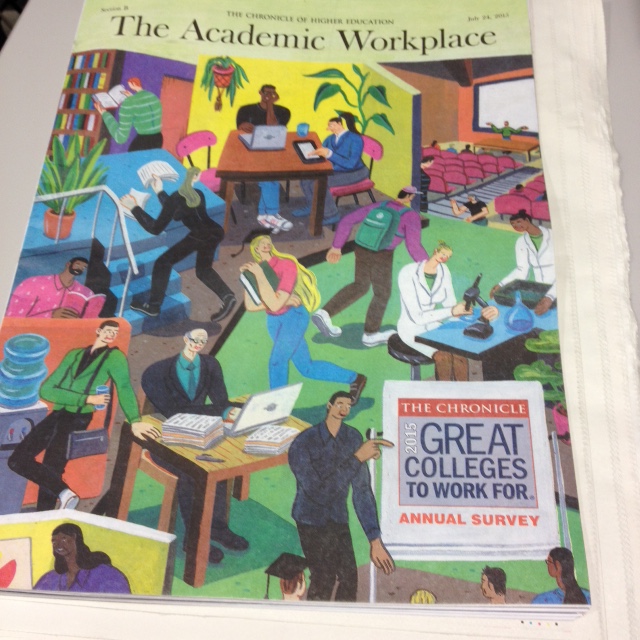
I’m easily amused. I suppose I never outgrew that sophomoric fascination with the little things that seem like big jokes. The other day, for instance, I was given a copy of the Chronicle of Higher Education to read. The supplement featured Great Colleges to Work For; what are we supposed to do with that? None of them have jobs, so why advertise? It’s so funny when those who have a great thing going advertise it, even though there’s nothing to it beyond bragging rights. Those of us who’ve tried repeatedly to get into higher education (and I even succeeded for nearly two decades, in some measure) would love to take a job at even the worst college to work for, but they’re not hiring either. Nobody is. So why does the Chronicle want to remind us that the fruit will always be just out of reach, and that the water will be just too low to sip—even if we’re bathing in it?

IMG_2417

The frustration that settles in when the laughter dies off is because everyone I know agrees that I should be teaching. Colleagues, tenured and not, former students, friends. “Why aren’t you a professor?” they say. Many of my best friends are. Full professors. Sabbaticals. Grants. Time that’s not spent on the bus or in the office. Perks of every sort. Ask them. Or ask the Chronicle. I can’t reach the grapes, but they’re probably sour anyway. I mean, I can’t help it that I spend hours on faculty webpages and see those who made the cut not writing the books I have like jets in a holding pattern over Newark. How can the get written when time is he one thing I haven’t got? (Oh, and money too, but you don’t need so much of that to write.) Any one of those Great Colleges to Work For appear on the advertisement pages? Anyone hiring a warmed over religion professor who reads a hundred books a year? Nah!

Just joshin’ ya. I poke fun at higher education like you can only tease a lover. I’m into exercises of nihilism as much as the next prof. Didn’t old Ecclesiastes say it centuries ago: learning is a zero-sum game? So the academic vehicle that doesn’t boost the number of jobs offered will continue to tell us where we should work, if there were any jobs. Perhaps professors of privilege demand more than I think. Just give me a classroom and a syllabus to teach her by. I’ve done so in very primitive conditions at a college that make no marks on the “Best of” scale. Real world experience, however, doesn’t count. We’re only telling you what you can’t have anyway. Isn’t that better than where you work now?


Monumental Time

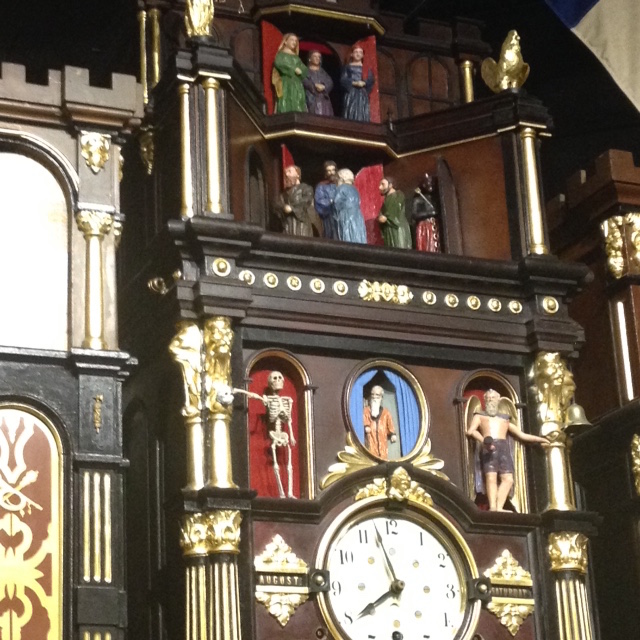
One of my nieces works on the 10,000-year clock (aka Clock of the Long Now). I’ve written about the project before—the object is to build a clock that will run a myriad of years. For comparison, 10,000 years ago we were only beginning to tamper with this concept we call civilization. Clocks have been my muse this week. Monumental clocks have long fascinated people. The Engle Clock, in the National Watch and Clock Museum, was completed about 1878. In those days, these large clocks (it literally weighs half a ton) toured the country as technological marvels—something that fails to impress, I suppose, in an iWatch age. Nevertheless, this is a clock with all the whistles and bells—literally. Figures come marching out at various fractions of the hour, culminating with a skeletal death chiming the end of each sixty minutes. The figures are both secular and sacred, a mix that the people of the days just after the Civil War no doubt appreciated.

IMG_2464

At the top of the clock, at quarter to the hour, Jesus appears. Doors above him open and the “three Marys,” including, of course, his mother, come out. Meanwhile the twelve disciples process in front of their Lord, each respectfully turning toward him. The devil appears, shifting from window to window, and one disciple does not turn to greet Jesus. This is Peter who instead turns his back, and immediately, to borrow a Gospel trope, the cock above their heads crows. Finally, as the apostolic procession winds down, the Devil appears last in line. It is all quite elaborate. The clock took Stephen Engle two decades to build—time he would never recover. The religious message, I suspect, was taken much more seriously then than it is now. After all, the clock is a museum piece.

Throughout the museum, references to Christianity abound. Not only Galileo, but many Medieval time-watchers saw God literally in the face of time. Clocks were embossed with religious figures. Hours were kept to remind the faithful to pray. The time, as the New Testament insists, was short. Ironically, we still build monumental clocks. Some are based on the 9-billionth of a second vibration period of cesium, while others are made to last ten millennia. We have secularized time. Now its purpose is mainly to tell us when to go to work. When to wake up to go to work. And when we might eventually leave work. I might enjoy building clocks myself. The fact is, however, I don’t have that kind of time.


Clerk and Dagger

Photo credit: Luis García (Zaqarbal),, Wikimedia Commons

Photo credit: Luis García (Zaqarbal),, Wikimedia Commons

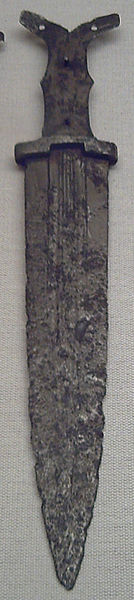
Recently I had the sad duty to list a contributor to a volume as deceased. The standard means of doing so in typography is with a symbol called a dagger (†). When I was young, I thought this was intended to be a cross, but it became clear, as I looked more closely, it wasn’t that at all. The origins of typographic marks go back to the classical Greeks. Used to mark dubious places in manuscripts, the asterisk was to show places where something had to be added to the text while the dagger was used to show deletion. Well, it wasn’t a dagger then. The earliest form was called an obelus and it could be a plain line, but was often shown with the symbol we now painfully associate with long division: ÷. This odd sign was said to represent a dart, a spit, or the sharp end of a javelin. Since things were to be cut out of the manuscript, a sharp instrument would be ideal. Early textual criticism, then, gave us symbols that have now been commandeered by math.

These signed evolved with time. By the Middle Ages the asterisk and the dagger could be used to indicate a pause when reciting Psalms. (Those of us at Nashotah House in the 1990s know all about pauses when reciting Psalms.) Medieval scribes marked up manuscripts religiously. Eventually the asterisk came to be associated with footnotes—a function that it still has, mostly in non-academic texts. The dagger was used for a footnote if an asterisk had already been used on that page. Beyond that, the double-dagger came into play. The function and the form of the obelus had now evolved solidly into the dagger form. The obelus continued on in math, at one time to mean subtraction, but finally settling down to represent division. Appropriate, given its graphic origins.

The dagger and asterisk were the earliest signs of textual criticism. Literalists today still don’t understand the concept, since all ancient documents of the Bible are copies of copies of copies. Nevertheless, how did a sign indicating a spit upon which an animal was roasted come to represent the dearly departed? Since asterisk and dagger often work as a pair, the most obvious way that this worked out was in representing the birth and death years of a person. An asterisk before the name meant “born in,” while a dagger in the same position meant “died in.” As a kind of typographical shorthand, then, a dagger after a name meant the person had died. Although it sounds dramatic and not a little violent, it is really only death by textual criticism. That, I suspect, is something most biblical scholars especially will be able to comprehend.


When under Rome

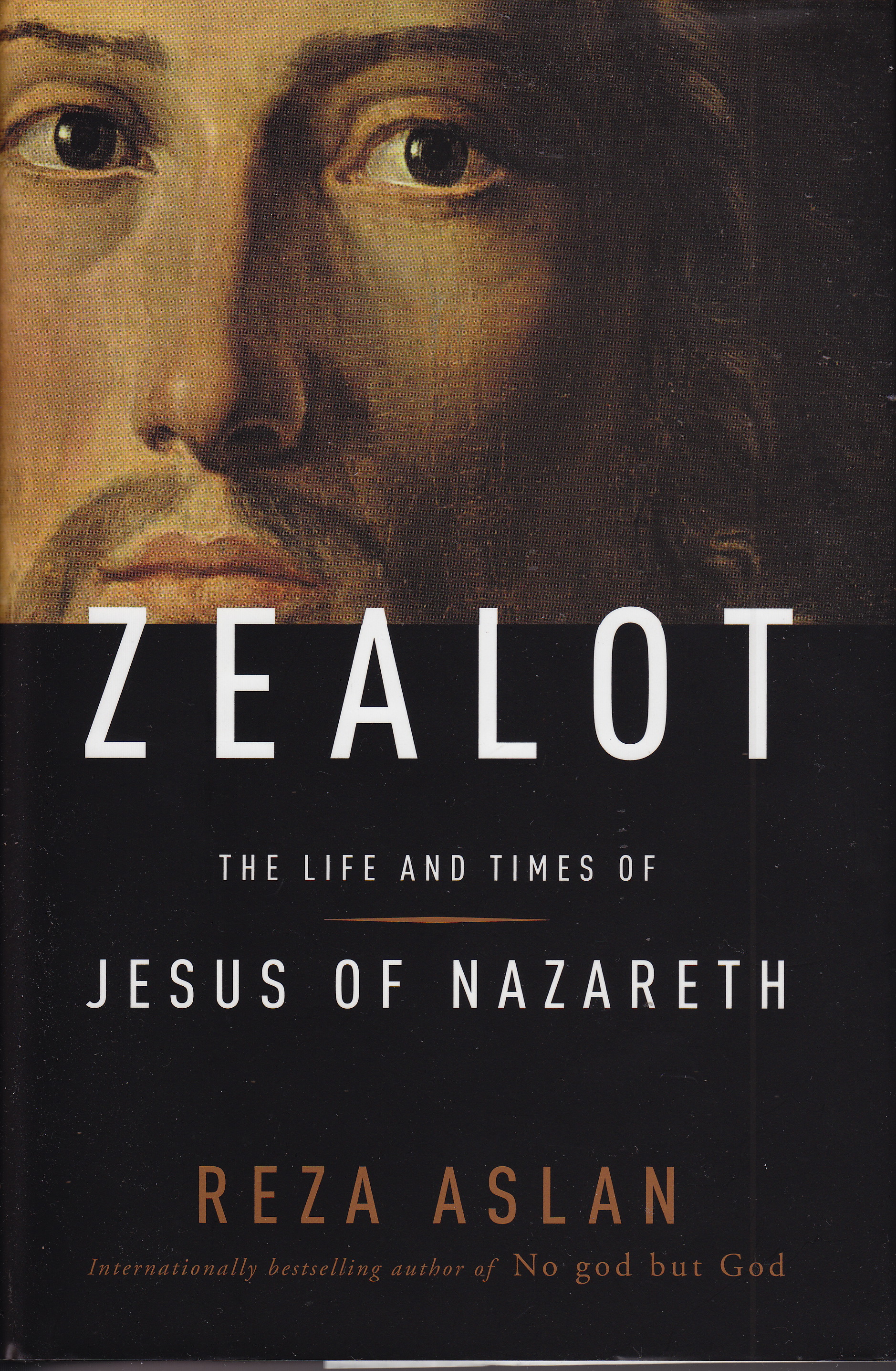
ZealotA question that has no answer: who was Jesus of Nazareth? Well, no single answer, anyway. When Reza Aslan’s Zealot: The Life and Times of Jesus of Nazareth came out, there was uproar. (Something, by the way, that publishers love.) How could someone suggest that not only do the Gospels disagree, but that they’re not even literal when they do? For those of us who’ve studied the Bible academically, there’s nothing too surprising here. Aslan’s perspective is often refreshing, even if he makes some basic errors (those of us who study the Hebrew Bible are pretty forgiving). For me, having the social circumstances of the New Testament spelled out in terms of the intense unrest of the first century explained a lot. It was a period of unremitting violence and frustration on the part of those coming to grips with life under Rome. Jesus was born and came of age when any outré idea could easily get you crucified. When it happened in his case, it was, as the Gospels point out, fully expected.

What might bother many readers is that Aslan doesn’t accept the story at face value. Jesus wasn’t unique as a healer, revolutionary, or messiah in first-century Palestine. In fact, Rome’s appointed rulers grew tired of such sons of gods that thousands of people were nailed up to warn others of the costs. Still, unlike the others, Jesus remained in contention even after his death. The belief in the resurrection didn’t hurt. Since Aslan is writing history, he can’t judge whether the resurrection or the healings actually took place. The traditions, he notes, are strong. He is surely correct that the Gospels aren’t attempting history. Written well after Christianity was already established, the writers had theological templates at their disposal. Not only that, they also had Paul.

Something I’d never considered was the dispute between Paul and the Jerusalem church. Yes, I’d noticed the stark contradictions between the letters of Paul and the one of James, but seeing the underlying conflict of those who knew Jesus personally (James, Peter, John) and Paul just never occurred to me. Paul doesn’t dote over the historical Jesus. His Jesus is divine from the start, and those who try to preserve Jesus’ words get in the way of the theology he’s developing. His letters express anger at those who teach what Jesus said over who he was, spiritually, anyway. Only with the destruction of Jerusalem was the way cleared for Paul’s gentile Christianity that eventually won out over Jesus’ teachings. It’s all very interesting, but I can’t buy it all. There are too many convenient connections here, and history abhors neatness. Nevertheless, Zealot is well worth reading. It tells an old story from a new perspective. And even if your Jesus is different from Aslan’s you’ll find something profound here that will only make your image stronger.


Somewhere, Out There

With Pope Francis’s impending visit, the New York-Philadelphia corridor is abuzz with discussions of traffic and commuting disruptions. From a little further away, Irish Central is reporting that the Vatican chief astronomer has gone onto record stating that he believes in extraterrestrial life. (Despite the headline, the article doesn’t say anything about UFOs, and the astronomer, Fr. Funes, is noted as saying that he doesn’t believe extraterrestrials are flying here.) The real issue, however, is metaphysical, rather than physical. How would life elsewhere impact theology? Long ago the Vatican expressed some comfort with the idea of evolution. As early as Augustine of Hippo, thinkers have noted that reason cannot contradict truth and still be convincing. The evidence for evolution, overwhelming as it is, falls under that rubric. Life in space, at least according to orthodox science, is more a matter of mathematical certainty rather than experiential. And like any scientific idea, not all scientists agree with the astronomical odds in favor of life in space.

Funes, according to the article by Frances Mulraney, believes that aliens are not fallen races in need of salvation. The grand master plan laid out in the Bible was unique to this world only. Human beings sinned, we required divine intervention, and, as you’d expect from a Christian source, the incarnation, death, and resurrection of God’s only son. It does raise interesting questions about what the aliens might think of a chosen race. How could you not think yourself superior if you had no need of God’s special attention? One can only hope that ET isn’t the jealous sort.

Photo credit: John Fowler, Wikimedia Commons

Photo credit: John Fowler, Wikimedia Commons

For years those who speculate about non-earth-based life have argued over how religions would handle the news that humanity isn’t alone. Would religious observance increase or decrease? It might depend on what our fellow universalists have to tell us. This, in a nutshell, is the dilemma of ancient religions. Founded when worldviews were pre-scientific, back when the earth was the center of everything, they didn’t add an infinite universe into the equation. And infinity always complicates things. Fr. Funes says the Bible isn’t a science book, and indeed, biblical scholars have long known that to be the case. It’s the contingencies outside the ordinary of two millennia ago that are most worrying to literalists. Even with all we have learned of science, we have a great deal yet to comprehend. Religion is a uniquely human response to an uncertain universe. And since ours is apparently infinite and expanding, religion may very well be something we’ll need to take with us to the stars.


Being Sheepish

Being among the animals at the fair, you begin to notice things that are foreign to those of us with exposure only to the house-pet variety of fellow creatures. Up close, for example, sheep are bigger than you might think they are. Since they’re domesticated and wooly, I tend to think of them as little—maybe knee-high—and in need of constant attention. The truth gives the lie to such false constructs. It was in the course of seeing sheep that I found out about Shrek. Shrek the sheep, now unfortunately deceased, has his own Wikipedia page. This was a single-minded ungulate who decided that the ’70’s lifestyle wasn’t truly over. The New Zealander took off from his heard, to avoid shearing, so the story goes, and hid in a cave for six years. With echoes of Odysseus, the ruminant survived just fine without human help and grew a serious coat of wool. When finally discovered and, of course, sheared, he gave enough wool to make suits for twenty men. Shrek had to be euthanized four years ago.

The story might have ended there. Shrek, however, fueled the imagination of several Christian writers who saw all kinds of parables in the lifestyle of this prodigal sheep. After all, in the pastoral culture of first-century Palestine, sheep suggested themselves as the fodder for the original set of Christian parables. Sheep wander, get lost, and get saved. They need someone to look after them. A good shepherd, preferably. In fact, sheep tales go further back in time, even to the Hebrew Bible. Perceptive prophets noticed how similar we are to our distant, quadruped cousins. It would be very odd, in hindsight, if nobody had picked up on the story. The mental picture is simply too appropriate.

394px-Flock_of_sheep

Metaphors, some have argued, are what make us human. We can see ourselves projected into just about any part of nature, and looking at nature, we can spy ourselves. Parables, by their definition, are never literal. We have to peer into them and find truths that gainsay the obvious. If we’re honest, we’d have to admit to being very much like Shrek. Who doesn’t want to run away and hide from what “the man” instructs us to do, against our own will? Yes, sheep have wills. Like any sentient creature, they have a sense of what they want and the best way to survive. With our fancy neocortex, we’ve domesticated sheep and bred many of their natural tendencies out of them forever. Still, I’m heartened to learn of Shrek the sheep. The lesson I draw from his story may not be the same as many Christian websites, but it will be no less true, I should think, for being such.


Go Down, Moses

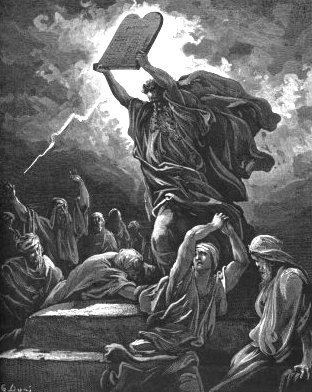
For a time, I tried to write down family tradition. My family was somewhat unusual in that regard. Family saying came generally from my maternal grandparents—my father wasn’t around for my childhood years—and since my grandparents died when I was relatively young, I didn’t hear much of their wisdom firsthand. Still, my mother told me various things her parents used to say and I tried to keep a record. Kind of like I wanted to be an anthropologist for raw folk sayings among the, non-elites. One thing my grandmother used to say, so I was told, was “Where was Moses when the lights went out?” I was always intrigued by this since I supposed it had something to do with Moses the miracle-worker. I guess I imagined Moses waving his rod and the lights coming back on. That single question is all I ever heard of this particular family treasure. I forgot about it until recently, though the miracle of the world-wide web, I learned that the query comes from a song.

Moses gets down

Moses gets down

The song, it turns out, exists in multiple versions. The Library of Congress has a recording dating to 1901 available on the web. According to this version, written by Harry von Tilzer, Moses was not “the” Moses, but a preacher condemning gambling. Also, “lights” is rendered in the singular. So much for the canonicity of family tradition. Duke University library has an undated, but clearly old, version of another song by the same title. This one does reference the biblical Moses, also the name of the song’s narrator. A child afraid in bed at night falls in love with and marries his nurse girl who used to ask him the question “Where was Moses when the light went out?” as he was falling asleep.

Yet another version, dating from 1965, has the question “Where was Moses when the lights (plural) went out?” followed by the answer, “He’s in the dark.” With all of this instant information from the internet, I’m still not certain what was being conveyed by my grandmother with this cryptic question. My mother said she used to say it when someone walked into the room too late to help with something, a kind of sarcastic “Where were you when I needed you?” What is clear is that the song was about as old as my grandmother and she found it somehow appropriate in an unconventional situation. I have to wonder how much of sacred tradition, including the Bible, might have come from misunderstood original instruction. We will, of course, never know. I don’t know what the original lyrics were, but I have learned that even family wisdom has a backstory, like any Scripture, for those who look hard enough.


Biblically Business

Bibles are business. I recently read that the first book of which Oxford University Press sold a million copies was the Scofield Bible. The Scofield is incredibly resilient to the advancement of scientific thought, and, although large print editions seem to be gaining, it is nevertheless an icon. Conservative Bibles still make good business sense. Still, the Bible originated in a rather more Catholic context. As Christianity was being born, and growing up, there were many sources of information on what it mean to be a member. Initially, being Jewish was a prerequisite. When that was dropped, you would have needed to be able to find an enclave. This wasn’t always the easiest thing to do since Roman emperors sometimes made a quasi-Olympic sport out of killing Christians. Once a church was found and joined, you just participated in the fellowship and listened to the leader. Reading from “Scripture” was likely part of worship services, but the Bible we recognize didn’t exist.

Well, parts of it did. Torah and Prophets were around. The Writings were written. Paul’s letters—several of which are still missing—were still circulating. The Gospels and Revelation would come somewhat later. About the fourth century there was general agreement about which books we meant when the word “Bible” was used. There was some fuzziness around the edges, though. Books like Tobit and Maccabees were accepted by the church, but had never been part of the Jewish canon. Judaism never officially closed its canon, so putting a limit around what would become the “Old Testament” was not as easy as saying it was just the “Jewish Bible.” No books have been added, of course, but nobody bothered to set the list in stone. Now Catholic Bibles, largely because of the counter-Reformation, included the Deutero-Canonical, or Apocryphal books. Protestants soundly rejected them. And Protestants were the champions of personal Bible reading.

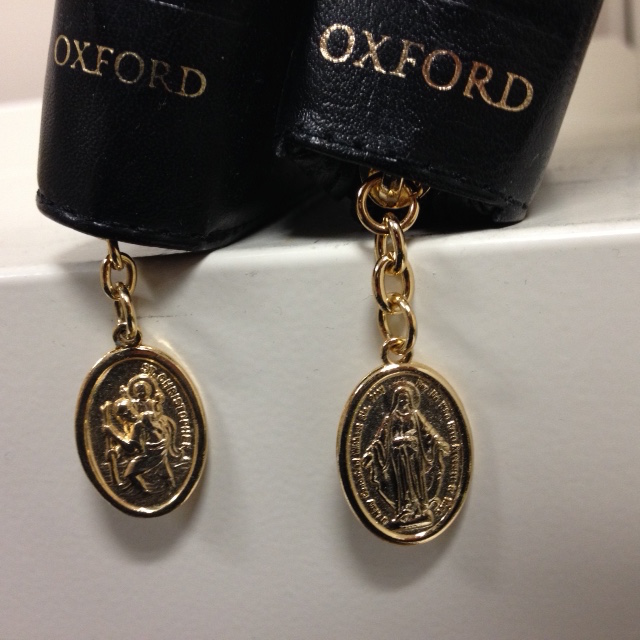
About the midpoint of last century, both Roman Catholicism and Judaism began to show a renewed interest in what had largely been a Protestant (and somewhat Teutonic) endeavor: critical study of the Bible. Bibles specifically directed toward these new readerships began to be produced. With metaphorical bells and whistles. The zipper Bible has always intrigued me. I never owned a zipper Bible. Once I had a zipper case, but never a zipper Bible. What was the message here: the word of the Almighty had to be protected? The other day I came across two zipper Bibles with saints’ medals as fobs. One was St. Christopher (who protects travelers) the other was for St. Mary (generally overall saint). These symbols of tradition interact with the more textual tradition that has come to be known as Bible. Religion is seldom monolithic, and even saints can watch over what is hidden by a zipper and regarded as the ultimate truth among those for whom Bibles are business.

IMG_2404


Sickness unto Death

It’s like Nightmare on Elm Street, as my daughter suggested: if my laptop falls asleep, it dies. Actually, that only happens if it turns off. As much as I rail against technology, I have to admit that I get a little choked up thinking about it—my laptop has had its final reboot. Finally back home from a trip where my MacBook died in transit, the local Genius Bar genius told me the frank truth. The on-off switch has stopped working. He was able to take it in the back and get it started with a “hard reboot” and I can’t help but imagine that it involved tiny little defibrillator paddles and a techie with a trendy haircut shouting “Clear!” before jolting the little guy back to life. If it turns off again, though, they can’t guarantee that they’ll be able to bring it back to life. At five years it’s suffering the effects of old age. Planned obsolescence means that you shouldn’t get too close to your machine. Still, with all this talk of artificial intelligence, I wonder if we haven’t given this laptop life. It sits right on my lap every day. It has for five years. It keeps me warm in winter and too warm in summer. It knows my deepest thoughts.

Like Logan, however, it was only planned to live for a few years. Its crystal is flashing, and I’m getting kind of emotional. Yes, it’s been running slower and slower. Sometimes it doesn’t hear my commands. It takes its time waking up in the morning. Still, it has become like a friend. So when the disciples came to Jesus in a panic saying Lazarus was dying, he replied that the sickness was not unto death. Lazarus died nevertheless. And Jesus wept. I wonder if he would’ve felt the same about an old laptop. This machine has been with me through several jobs—it was purchased to help with my teaching at Rutgers, but it has kept me company on many long flights and lonely nights traveling for publishers and trying to remain sane when there was only a whiff of a wifi scent to latch onto. We’ve done a great deal together.

IMG_2398

It can be fixed, the genius said. I have to send it to the iHospital where a new switch will be installed. It will cost a lot of money and if it goes bad again, Apple won’t be able to replace the parts because they don’t keep them on hand all that long. The best solution—buy a new laptop. Spoken like a young man without a child in college. I’m dithering here. I can keep this computer running for a long time without shutting it down. Still, it’s borrowed time. The genius helping the next customer over said, “It’s not a matter of if a hard drive goes, it’s a matter of when.” We’re living on borrowed time. Our devices are meant to be tossed, but my gray matter understands things differently. I like my old laptop, and when Freddie Krueger comes for its soul, I know I’ll be wide awake.


Ancient Tech

I feel like scraping Roman numerals on the wall of my cave with a sharp rock. One for each day I have to spend without my laptop. I’ve been working on this blog, born in this very cabin in which I sit, for six years now. With some exceptions, I’ve posted something new (and, I hope, thoughtful) every day. Even holidays and weekends. Most of those posts have been written on the deceased laptop that’s sitting in my carryon, electronic carrion. This has caused me to stop and consider that the most lasting words—the ones we all quote or at least recognize—tend to come from a far older form of communication technology: the pen and paper. Of course, there are older technologies yet. The Sumerians figured out that clay of the right consistency keeps marks made by a pointed reed pressed into it while it was still damp. Cuneiform writing lasted for millennia as the most advanced technology humanity had devised. The results, however, were bulky, heavy, and fragile. Few could learn the technique. It was an elite skill.

Nobody quotes the Sumerians anymore. Well, maybe the occasional quip from Gilgamesh will work its way to memory, but not much else readily does. The Bible, perhaps the most quoted book of all time, at least in western culture, wasn’t written on clay. By the time the earliest books of the Bible came along, scrolls had been developed. Probably suggesting itself from the way that papyrus naturally rolled up, this early form of paper—indeed, the word “papyrus” gives us our word “paper”—could be marked up with styluses or brushes and ink. Prepared animal skills, or parchment, sometimes called vellum, could also be used, but they were expensive. Pens at this period were sharpened objects dipped into ink, but the most famous words, well, penned by humankind were passed down in that medium. Copied, recopied, memorized. Electricity hadn’t even been discovered yet.


Printing presses and their children—typewriters and the consequent qwerty—have led the way since they were invented. Until, however, the 1980s at least, professors would accept only the old fashioned manuscript for papers. Indeed, the medium had given its name to the end result. We still write academic papers, although they are more often published and read electronically. So here I find myself in a cabin on a beautiful lake, surrounded by nature, worried about a communication device that can speak with the stars. There may not be workable clay here—the soil is far too sandy and I don’t have the patience to look up how to make clay on my phone—but there is paper. Pens are scattered everywhere. I am at home in the matrix that has given us the great ideas of humankind.


Monster Impulse

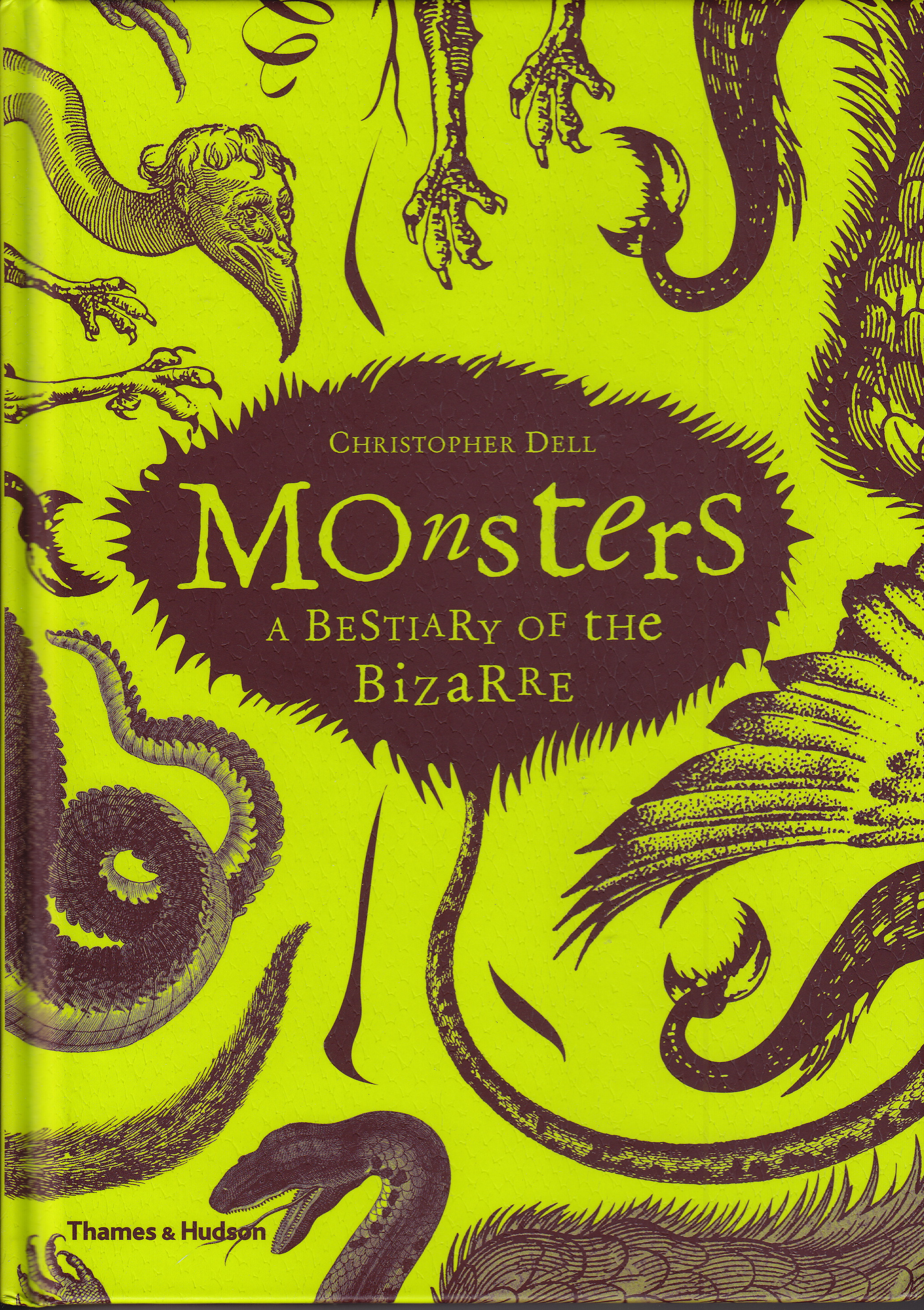
MonstersSome people are impulse buyers. In fact, retailers count on it. All those last-minute items next to the cash register while you wait your turn to consume—they beckon the unwary. I have to admit to being an impulse book buyer. I have to keep it under control, of course, since books are “durable goods” and last more than a single lifetime, with any luck at all. A few years ago I was in the shop of the National Museum of Scotland in Edinburgh. It was my last day in the city where I’d spent my post-graduate years and I didn’t know when I’d ever be back. What could help me remember this visit? A book, of course. Why I chose Monsters, by Christopher Dell, to mark this particular occasion, I don’t know. I love monsters, yes, but why here? Why now? Why in the last hours I had in my favorite European city? It was a heavy book, hardcover and unyielding in my luggage. I had to have it.

More of an extended essay than a narrative book, Dell’s Monsters begins with a premise that I never tire of contemplating: religions give us our monsters. At least historically, they have. There is an element of the divine as well as the diabolical in the world of monsters. As a student of art, what Dell has put together in this book is a full-color unlikely bestiary. These are the creatures that have haunted our imaginations since people began to draw, and probably before. One exception I would take to Dell’s narrative is that the Bible does have its share of monsters. He mentions Leviathan, Behemoth, and the beast of Revelation, but the Bible is populated with the bizarre and weird. Nebuchadnezzar becomes a monster. Demons caper through the New Testament. The Bible opens with a talking serpent. These may not be the monsters of a robust Medieval imagination, but they are strange creatures in their own rights. We have ghosts as well, and people rising from the dead. Monsters and religion are, it seems, very well acquainted.

The illustrations, of course, are what bring Dell’s book to market. Many classic and, in some cases, relatively unknown creatures populate his pages. They won’t keep you awake at night, for we have grown accustomed to a scientific world where monsters have been banished forever. And yet, we turn to books like Monsters to meet a need that persists into this technological age. About to get on a plane for vacation, I know I will be groped and prodded by a government that wants to know every detail of my body. Sometimes I’ll be forced into the private screening room for more intimate encounters. And for all this I know that William Shatner was on a plane at 20,000 feet when he saw a gremlin on the wing. Like our religions, our monsters never leave us. No matter how bright technology may make our lights.


Preacher’s Best Friend

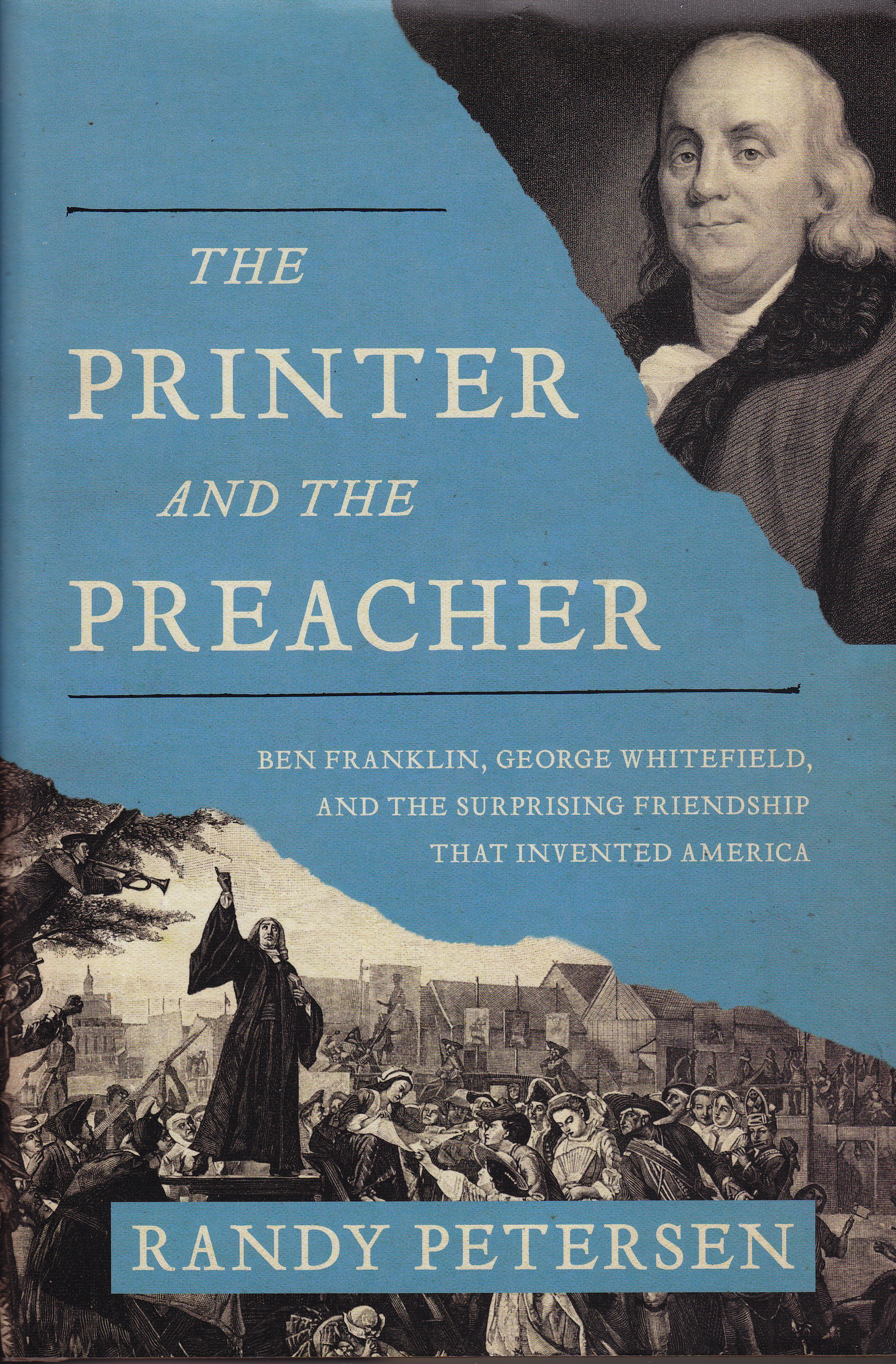
PreacherPrinterPerhaps it’s because I was born in Franklin, Pennsylvania, or perhaps it’s because everything I’ve ever read about him suggests he was delightfully unorthodox, but whatever the reason, Benjamin Franklin has always held my admiration.  Probably we all like to hear echoes of ourselves in the great.  It is difficult to believe that during his early rise to fame, Franklin was eclipsed by an unlikely superstar who was, of all things, an evangelist.  George Whitefield, an early English Methodist, wowed the colonies with his born again message, perhaps being responsible for its appeal even today.  Randy Petersen’s The Printer and the Preacher explores the unlikely friendship that sprang up between Franklin and the younger Whitefield.  While cataloguing early founders’ religious lives is always problematic, Franklin was a self-described Deist, and certainly not an Evangelical.  Whitefield was very into the personal relationship with Jesus idea that Franklin found, at best, simplistic.

Petersen’s book is a kind of wishful history.  He wants to see Franklin and Whitefield together, often suggesting that they might have met here or there, or that they might have discussed this or that.  The fact is, we have little to go on beyond the reality that the two knew and respected one another.  Whitefield stayed in Franklin’s house in Philadelphia.  Franklin printed and sold Whitefield’s best-seller sermons.  Certainly there was a good business opportunity here.  Even today the evangelical Bible market is a strong one.  Savvy businessmen and women know that a good living may be had from the Good Book.  You can’t read a book like The Printer and the Preacher without thinking that Whitefield and Franklin were a kind of odd couple.  Franklin is remembered as a man of wit and science.  Whitefield is barely remembered at all.  One of the first preachers to hire a publicity manager, Whitefield was the Joel Osteen of his day, raking in the accolades for being emotional in front of salt-of-the-earth colonials.  His oratory skills were legendary.  Even though he is honored as one of the founders of the University of Pennsylvania, he was no scholar and has largely been relegated to an historical footnote.

Petersen’s book is a quick read.  His writing is winsome in an evangelical way.  He assumes the truth, or so it appears, of the evangelical position.  Nevertheless, there is material to stop and ponder here.  Many of the questions can never be answered: why, particularly, did Franklin and Whitefield hit it off, for example.  On a more approachable level is the why of Whitefield’s faded flower verses Franklin’s perennial bloom.  The message of Whitefield simply doesn’t stand up to the experience of history.  Human beings—many of them born again—experience constant turmoil in their lives.  Franklin, on the other hand, was the consumate pragmatist.  His aphorisms are regularly mistaken for verses of the Bible.  Although others would have gotten there, we largely have him to thank for our harnessing of electricity, and even the birth of a new nation.  Whitefield’s spiritual descendants now rally to prevent stem cell research and the teaching of evolution.  Franklin’s children, illegitimate or not, reap the benefits of the lightning rod.


For the Sake of Fighting

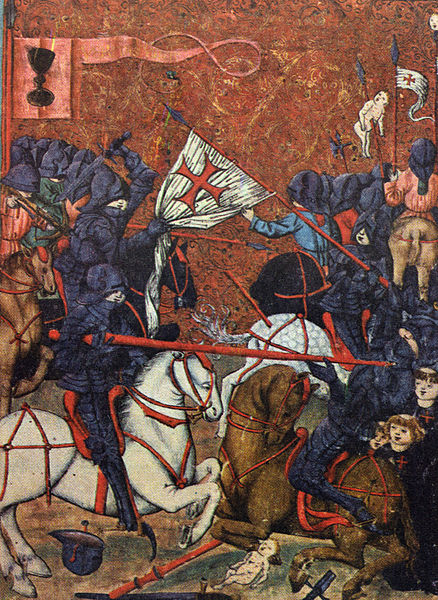
Different opinions can be used for discussion or destruction. In the formal context of government, the declaration of war is—or should be—an option of last resort. Increasingly language of belligerence is status quo ante when religion is the topic. “Culture Wars” is a thinly veiled reference to the profound disagreement between social conservatism, associated with Evangelical Christianity, and progressive policies, often affiliated with nones and mainline Christian traditions that don’t wish to be left behind. For years, decades, no one side can declare victory, for example, in the debate over whether America was founded as a Christian nation. Two news stories I saw this past week addressed just that question. Fox News ran a story about a Baptist Church in Shelby, North Carolina, that has decided to fly the Christian flag over the stars and bars until, well, I guess the Second Coming. Protesting the legalization of gay marriage, the congregation wants the message, aided by Fox News, to spread that in at least this corner of the country, God comes first.

The other story, on CNN, asks the question directly: “Was American Founded as a Christian Nation?” With five professors answering the question there’s bound to be differing opinions but all agree that this isn’t a simple yes or no answer. The even larger question, it seems, is how can the founders’ religious orientations help us to avoid cultural wars? Isn’t the fact that we’re still searching historical documentation over two centuries later an answer in itself? Maybe they didn’t tell us directly because it was none of our business. Washington, Franklin, and Jefferson are quoted on both sides of the debate. Their cultural context was Christian, but as all the five scholars agree, the question didn’t become a live one until the nineteenth century. Seems that we got along a century without knowing.

The “Culture Wars” may have been there, of course, but the need for a term only arose in the late 1980’s and early ’90’s. The divide had been simmering since the end of the ’50’s, however. Leave it to Beaver versus Star Trek: the Next Generation. The media has never been shy about telling us what to think. Difference of opinion is as natural as a pre-frontal cortex. Peaceful coexistence, however, doesn’t sell newspaper or commercial airtime or space. We want the thrill of danger, the chance to declare that, unlike the adversary, we are clearly in the right. Maybe if we changed the metaphor the rhetoric might catch up. In the meanwhile, battle comes to mind. Ironically, the Bible is a place that suggests peaceful solutions to many disagreements, but neither side thinks to look there for guidance.

438px-Husité_-_Jenský_kodex