Who the Devil?

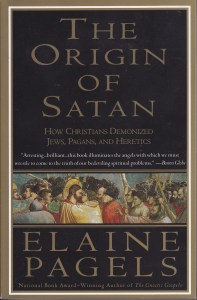
OriginSatanThose who’ve studied the history of ancient West Asian religions know that the concept of a devil, as a character, derives from Zoroastrian origins. In Zarathustra’s dualistic worldview, the forces of evil were concentrated in an “anti-God,” who, upon contact with the emerging monotheism of ancient Israel, became the satan. While scholars still argue about exactly what the role of the satan was, it is clear that it was a role, and not a name. The job of the satan was in some way to bring to accounting wicked deeds. By the time of the New Testament, “the Devil” had developed into an embodiment of evil more along classic Zoroastrian lines. What Elaine Pagels explores in The Origin of Satan is encapsulated in her subtitle: How Christians Demonized Jews, Pagans, and Heretics.

This is not a book about the historical development of the figure of Satan, but rather a study of how early Christians (and to an extent, Jews) viewed “the other.” Naturally she does discuss Satan, who developed along the lines suggested above, but more specifically she addresses how the accusation of being “of Satan” was used. Interestingly, it was generally utilized by those of ancient times to describe those of their own religion, but who held different viewpoints. Sects of Christianity and Judaism generally accused other sects in their own religious tradition of being “satanic.” Foreigners and pagans, well, what would you expect of them anyway? Those closest, ironically, are those most despised. Even early converts to Christianity from Roman polytheism tended to view their former religion as satanic. Satan, in other words, is “the other.” But not the far other. The near other.

While the book is full of Pagels’ usual erudition, it is also disappointing. Not as a book, but as a fact. Religions that claim God only wants us to love one another and treat each other well rely too readily on the figure of personified evil to castigate their enemies. As Pagels demonstrates, even as early as Augustine of Hippo there were those who realized Satan was not a “physical” being, but a symbol for evil. Yet on through the Middle Ages Satan would continue to be evoked to murder women and men thought to be witches or heretics. Satan, it seems, is simply a word for our darkest urges to harm those different from ourselves. We know that religions often have noble intentions. Perhaps the most noble could be to rid the world of Satan, and I don’t mean the mythological figure we all recognize without a hint.


Factor Fiction

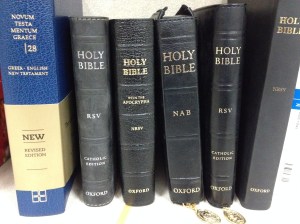
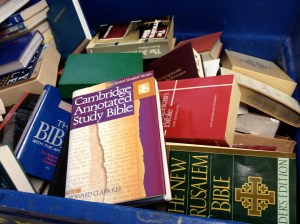
An article on CBS that my wife sent me tells how Costco mistakenly labelled a shipment of Bibles as fiction, setting off a tweet-storm. Some offended, some applauding, a 140-character barrage ensued as Costco apologized. What was the fuss about? As a person who has experience with both fact and fiction, it has become clear to me over the years that these categories are not nearly as sharply defined as they might appear. We make labels to help us categorize a confusing reality. Our brains, nevertheless, easily accept fiction as fact, at least for purposes of getting along in the world. The earth is spinning, right now, at over 1,000 miles per hour. We don’t perceive it, and in fact, it took not a few deaths and apologetic clerics before it was admitted that evidence we don’t feel proved the case. Each day we choose to believe the fiction that we are holding still and the sun goes overhead. Is anybody tweeting about that?

One of the angry bird calls pointed out that Costco (which apparently now has an imprimatur) doesn’t label their Qurans as fiction. How many Christians have read the Rig Veda and not wondered whether its proper label fell on that side of the pricing gun? The matter of fact or fiction is one of opinion. Even those books bearing the label of non-fiction are interpretations of evidence. When it comes down to ultimate truth, where it lies is always a matter of faith. Who buys a Bible at Costco anyway?

IMG_2634

When I was a child and Amazon did not exist, buying a Bible was itself a kind of sacred act. You wouldn’t think of going to Wal-Mart to do such a thing. You went to the Christian bookstore (or, I suppose, if you grew up in a city, a secular bookstore might do). You talked to clerks who knew the differences between versions. The place smelled of leather and velvet. It was a place dedicated to the truth. Costco is a big box store. Buying in bulk implies something. Ironically, those who angrily tweet about the Bible’s label don’t seem to realize that Bible selling is big business. You won’t find much in the way of small publishers’ literature in such a store. Next to your giant cartons of cereal and immense packages of diapers, why not tuck in a Bible as well? When you get home you can tweet about how much money you saved buying eternal salvation in bulk.


Reptile Fantasy

LizardPrincessThe generous folks at Exterminating Angel Press graciously sent me a copy of Tod Davies’ The Lizard Princess to review. A fantasy novel that includes a conflict between a world that admits of the supernatural and skeptics who deny anything beyond the material, it is a tale for our time. Indeed, the antagonism is real enough. We live in a world where fantasy can bring in untold wealth while we are taught that not an atom of it is true. Clearly material explanations fit the physical world we inhabit. It’s the world inside our heads that often rejects such materialism being taken to its “logical” conclusion. Davies clearly feels the angst of this discord. The Lizard Princess is a fantasy in the face of harsh reality. And we still need fantasy—perhaps we need it more than ever.

Throughout The Lizard Princess, whether intentional or not, biblical imagery pervades. The Bible offers classical stories that, no matter how we might receive them, continue to influence our ideas and ideals. Here, in a world created especially for the reader, the battle between good and evil is an everyday reality. The turns taken along this path are unconventional, and at times even uncomfortable. The awareness that there is a larger story in the background, however, offers some consolation. Angels, the Devil, and even a subtly veiled God are all players in this fantasy world of Arcadia. Mythical creatures abound, and transformations lead to new perspectives along the way.

In my conversations with other scholars I’m reminded that academics don’t often turn to novels for escape. Some do, of course, but the academy recommends a steady diet of technical non-fiction for those who wish to make an impact upon the world of knowledge. I have always been grateful for literature, however. During my years in graduate school and early in my teaching career I neglected the kinds of books that were my constant companions growing up. In a rural setting far removed from any institutions of higher learning, novels were often the only reading readily available. I never considered the time between their covers wasted. I found in The Lizard Princess a vivid world strangely like our own, but different enough to be more a parable than a simple piece of fiction.


Seeing Red

Not being commercially minded, it took many years for me to understand why it is called Black Friday. To many people “black” indicates negativity, sort of the opposite of Good Friday which, when you think about it, doesn’t seem so good. After I was forced into jobs in the money-making business, I came to realize that budgets were written in black and deficits were written in red. Since my lifetime, with a few exceptions, has been a series of economic disasters following one another (the implications should be obvious) and businesses operate in the red while projecting budgets ever higher the next year. This model is, in a world of limited resources, the very definition of unsustainable, and yet we keep raising our sights and getting disappointed. Nobody knows for sure where the term Black Friday originated, but it is a modern term. A holiday for those who measure celebration in terms of dollars and cents. (Mostly dollars.)

As I was pondering this phenomenon, my thoughts turned to red letter days. Red here is a positive thing—special days on the calendar that let us step outside the usual routine of pushing ourselves to make this year’s budget and allow us to relax with family and friends. The black and the red have switched places here. In fact, red letters, apart from the dismal science, have historically been considered good. Think of the red letter editions of the Bible. These Bibles had the putative words of Jesus printed in red so that they would stand out. The concept dates back to the change of the twentieth century. Red letter Bibles caught on among Evangelical readers. Red letters, however, go back even further in history.

Who said what now?

The book that Catholic priests used to set on the altar was a missal. Missals contained the instructions for saying mass, and during certain parts of the ceremony priests were supposed to make specific gestures. The places at which these actions were to be made were printed in red to draw the priests’ attention. They were called “rubrics” since they were written in red. Missals date back to the Medieval Period and they give us perhaps the first positive use of red writing that we know. Even further back in history when inks were organic, red writing was found. Epigraphers of antiquity know of red inscriptions but the meaning at that time remains speculative. We call this Black Friday because the one percent hope to get a bit richer. Those of us further down are supposed to enjoy the trickle. For me, in principle I don’t go shopping on Black Friday. I see it as a red letter day.


Birth of a Legend

I was sitting in the restaurant attached to W, a boutique hotel cum chain, with my brother-in-law Neal Stephenson. He was on a book tour and kindly treated me to breakfast. Above his head I noticed a slightly salacious painting portraying a nude lady in bed saying “Of course I think you’re adequate. I love you!” In the doorway stood a headless man in a red coat, clearly intended to be the headless horseman. I pointed it out and Neal, being an author, made some inquiries about it. Nobody in the hotel seemed to know anything about the image’s relevance, so I did some internet sleuthing. I knew Washington Irving was born in New York City. I don’t know where precisely, and I’m not really sure how to find out. New York, in those days, didn’t reach so far up Manhattan Island, and we were near downtown, at Union Square. Probably this was the outskirts back in Irving’s day. I had already started my research for my paper on Sleepy Hollow, so I was attuned to the clues. W is now a chain, but I think the first W was the very one where we met. The restaurant where we had breakfast was the Irvington. The website said nothing about the origin of the name. Had we been eating where Irving had spent his youth?

This was a slight synchronicity. I had been researching Irving and had ended up meeting someone at a hotel which, it may turn out, had been named after him. Which Washington was the Squire really named after anyway? Washington Irving had been named after George Washington, so perhaps the point was moot. Months passed, and I wrote and honed my paper for public delivery. I’d almost forgotten the existential pleasures of following a lead and drawing some conclusions, whether or not history might bear them out. My brain was fully active.

759px-John_Quidor_-_The_Headless_Horseman_Pursuing_Ichabod_Crane_-_Google_Art_Project

My flight to Atlanta yesterday for the Society of Biblical Literature annual meeting took off from Newark Airport on time. I thought I had a row to myself, but a couple of guys came in, talking, just before the cabin door was closed. They obviously knew one another, but not terribly well. One asked if the other was from Valatie, “where Ichabod Crane is buried.” These were not professorial types, which you often see at the airport this time of year. Just regular guys. “Yeah, there’s an Ichabod Crane High School,” the other replied. Their conversation moved on to other topics, but I sat there thinking about the synchronicities my paper seemed to be generating in my life. Of course, many people do watch Sleepy Hollow, not many, I suspect, are academics looking for connections to American religious thought. It seems that research never really ends.


Atlanta Bound

IMG_2600

Every year as the latter half of November rolls around, the mind of religion scholars goes toward the American Academy of Religion and Society of Biblical Literature Annual Meeting. This morning I’m off to Atlanta to join a myriad of others who still think the academic study of religion is a good and noble thing. For those who read this blog regularly, it will be no surprise that I’m giving a paper this year. Honestly, I’m a little nervous. I haven’t delivered a paper in years—it is nearly impossible to do research when you are cut off from academic libraries and, more importantly, the time it takes to do the work. Having only weekends to pull ideas together is not conducive to pushing the frontiers of knowledge forward. Sleepy Hollow came to my rescue this time around. That, and reception history.

Reception history is the hermeneutic that looks at the Bible from the point of view of later interpreters. For the Hebrew Bible that reception might be that of the New Testament, or even later books within the Tanak itself. Of course, the Bible has been studied and interpreted for nearly two millennia now, and not all those reading the Good Book have official training. Increasingly, with religious extremists making headlines from decrying the color of Starbucks cups to an all-out attack on Paris, understanding the reception of religious texts is important. The Fox network hit Sleepy Hollow is an excellent example. The show begins with the Bible and although the end has yet to be determined, Scriptures have played a role throughout. And a viewership of pitiful biblical literacy drinks it all in. It is important to understand how the Bible has been, and is being, perceived.

It may be, over the next few days, that my posts will be disrupted from their usual schedule. It is always a little hard to predict how things might play out when you’re away from home. I’m not sure what wonders Atlanta might bring. My own book should be on display in the book stalls for the first, and likely only, time. I will be meeting with people from dawn to dusk, discussing their book ideas. And I will, of course, be listening. Listening for the gallop of horse hooves in the background. Yes, the meeting is always a stimulating event, and with apocalypses in the news, I think I have selected a very timely topic this year indeed. If the frogs croak my name, I will know it is only my imagination.


Burden of Democracy

Speaking of revisionist history, I see that I’m negligent on updating my Egyptology. In a year when you need an Excel spreadsheet to keep track of the sheer number of GOP presidential wannabes, I had to ask my wife who Ben Carson was. She sent me a story explaining how the league of presidential dreamers believes that the pyramids were ancient Egyptian grain silos. His reason for believing this has nothing to do with archaeology or with history and everything to do with the Bible. Now, other presidents of too recent memory have had strange biblical beliefs as well. And that raises the intractable question of how you run a democracy with religious freedom. Some people like to claim religious belief is a matter of choice, but that is rarely true. At a young age we are programmed to accept what our parents or guardians tell us is true. Studies of the brain suggest that once wired for concepts of how God works, the circuitry is difficult to displace. In a country where most people can’t tell a Seventh-Day Adventist from an eight-hour clock, they may be surprised that a brain scientist might believe the pyramids were built to biblical specifications.

From WikiCommons

From WikiCommons

The Adventists are a literalist sect. And they are not the only ones who believe the pyramids have something to do with Joseph and the biblical famine that set the stage for the exodus. It is an idea I encountered as a child, and I didn’t even have a denomination to call my own. Religious belief can be, and often is, completely separate from rationality. Some very intelligent people are biblical literalists. The real problem is that the Bible doesn’t mention the pyramids at all, but then most Americans know as much about the Bible as they know about Seventh-Day Adventists. If people actually knew how much incentive George W. Bush had to start Armageddon, the turn of the millennium would have been far more tense than it was. And that’s saying something.

In our democracy, we want freedom of religion, but we don’t want to be bothered with the details of what a religion teaches. Like many, I was shocked by the headlines of a potential president grossly misunderstanding history, but as soon as I learned Carson is an Adventist everything clicked into place. I would suggest that it is a moral responsibility in a democracy to learn something about religion. We like to think we can fudge on that part of the homework. If we want the freedom of having anyone capable of becoming president, we need to learn something about a human being’s deepest motivations. No matter how much reporters and skeptics want to laugh and scorn, religion makes many decisions for by far the largest majority of people on the planet. The thought that a democracy can thrive without learning what truly motivates its leaders, I would suggest, is the most naive position of all.


Revisionist History

I recently came across a website with academic papers available on it.  Although the internet has yet to achieve its promise as a locus of solid academic material, such sites are becoming more common.  I’ve been uploading my own papers onto Academia.edu since they seem to be old enough not to impact anyone’s sales aspirations.  In any case, this particular website I found noted that a paper had been updated at such-and-such a time, and that anyone who had downloaded the previous version should delete it and use the new one instead.  This is a dilemma.  I know of publishers who make corrections without issuing new editions.  When I buy a book, what it actually says will depend on the printing rather than on the edition.  I wonder if such retractions are really fair.  How does one know when she’s reading something outdated?
 
Picture this: a young kid, perhaps an unknowing fundamentalist, reading his Bible.  Then he gets a newer copy of the same translation.  But soon he notices that there are differences.  Although the example may sound overly Talmudic, it is factual.  Bibles, being printed in large quantities, are especially susceptible to error.  When did the printed word become something that’s negotiable?  I’ve been pondering clay tablets and their apparent immutability.  Contrary to popular belief, most clay tablets weren’t fired—it was a lot of effort for something that had limited value.  Some tablets show signs of erasure or additional words being added.  In the case of clay, this is often very clear.  Besides, the readers were few and specialists.  They knew what they had.  But for a modern person staking the salvation of her soul on a document, is it not problematic to change a jot or tittle (of which not the least shall pass away)?  Has technology made us immune to fixed texts?
 
Back to the website I found.  What if I downloaded the faulty paper and wrote my own paper based on it?  How would I know to go back and check to see if a new version had been uploaded?  Am I to spend all my time revisiting web pages to see what has changed?  Knowledge itself seems now to have become whimsical.  What is true depends on the date and time you accessed it.  Perhaps I’m just a dreamer, but there was a time, it seems to me, before post-modernism, when you might purchase a book and be fairly certain of what you had.  Errata sheets (or the more fancy addenda et corrigenda) didn’t intrude into the typeset page.  You could still read correctly, assured that someone had spotted and acknowledged the mistake.  We have, I fear, outlived the need for sic.  And it is only a small step from siclessness to truth that changes second by second. Is this the siclessness unto death?

IMG_1363


An Apple a Day

Corporate logos are among the most instantly recognizable symbols in the world. Even in “developing” countries, kids know what the golden arches represent. Not a real fan of large corporations, I still buy things not knowing who the manufacturer is, if it is something I need. I find the frenetic need of non-profit organizations—even colleges and universities—to “brand” themselves vulgar and distasteful. Why do those who truly have something to offer feel like they have to snuggle up to Wall Street and its resident demons? Still, the corporate logo has a way of drawing attention to products. And sometimes we look for more significance in them than they actually have. Keep in mind corporations’ goals are merely to separate you from your money. Often it doesn’t take much thought.

IMG_2585

When I was a child I thought the golden arches were supposed to be french fries. And when I started to use computers—always Apple—I wondered if their logo might not be the most infamous bitten apple of all, the apple of Eden. Forbidden knowledge. It seemed to fit perfectly. Too bad it’s incorrect. Interviews with Steve Jobs, Steve Wozniak, and various marketing designers have revealed that the Bible had nothing to do with it. The original Apple logo was Isaac Newton under an apple tree with the apocryphal fruit falling toward his head. It was felt that this detailed and complex logo didn’t have the instant recognition that a trademark requires, and so a marketing firm came up with the apple we all recognize. Initially it was a rainbow apple, but now the mere outline tells us what we need to know.

But what’s with the bite mark? Surely that must be a throwback to Eden? No, apparently not. We don’t know that Newton ate his apple, but a stylized apple looks a lot like a stylized cherry. The bite mark was added to the logo for scale. You don’t want to confuse the buyer. Corporate logos are markers that say, “place your money here.” Non-profit organizations used to exist to provide valuable services—services that couldn’t be rendered in matters of dollars and cents. Now there is no other way to show value. We have followed the false idol of corporate thinking and the only way we can imagine to draw attention to what we offer is to brand ourselves. So it has always been with cattle, where branding was much more obvious. Yes, those who follow corporations should remember that the brand began with red-hot iron and it left an indelible scar. Of course, I’m writing this on an Apple computer.


Babylonian Boogle

220px-SinisterMoviePoster2012

I confess. I’ve fallen behind on my horror movies. My work schedule doesn’t allow for much down time, and on weekends when I spend time with family, well, horror films aren’t their favorites. So on a weekend afternoon when I was alone, I finally saw Sinister. I remembered seeing ads for it a few years back, but far enough back that I didn’t know what to expect. As I’ve often asserted on this blog, horror frequently draws its spookiest material from the deep well of religion, and Sinister once again emphasizes this point. With clear connections to The Shining and Ringu, Sinister does keep you in its web. Of course, ritualized murders are by their nature scary, since those who perpetrate them have taken leave of reason. I don’t read true crime because I have to sleep, and I’d rather not know what some psychopath has eating his brain as he plans his sacrifices. So it comes out in fiction.

The protagonist, crime-writer Ellison Oswalt, consults with a Professor Jonas, whose name those acquainted with the Bible can’t separate from Jonah, to find out about ritual crimes. Jonas informs Oswalt that the occult symbols found at a couple of the murder sites are unconventional. He eventually traces them to Bughuul, a Babylonian deity that eats children. The religious element couldn’t be clearer. Bughuul, who is a god fabricated for the movie, is effectively frightening in the film. But for the ritual element to the murders, the story might have passed as just another gruesome offering to audiences who want a little fright in their October. Religion makes it scarier.

The second appearance of Professor Jonas reveals that, like Ringu, watching the films that tell the story is dangerous. He delves into iconography. Icons, according to orthodox tradition, take part in the reality they represent. Bughuul knows that, and merely by watching the films, or looking at pictures (icons) you open a portal between his world and that of the viewer. By the time Oswalt learns this it is, of course, too late. Again, the element of terror is introduced through religious thought. Bughuul (Mr. Boogle) is a morbid iconographer. The reality of the evil is represented in the “artwork” itself. Once you’ve seen an image, you can’t unsee it. So it is that Sinister draws on religion to plumb the depths of fear. It is surprisingly effective, even on a sunny afternoon when I’ve had too much time alone.


Fundamental Fear

Something truly scary landed on my desk. Working for an organization that has many different departments, there’s no way to know everyone. So when something bible-ish arrives in the mail, it gets directed to me. Now, I don’t follow the afterlife of creepy religious people through prison, so it took a few minutes to remember who Warren Jeffs is. I knew I’d read about him but I couldn’t remember where. Then I remembered the Fundamentalist Church of Jesus Christ of Latter-Day Saints. Jeffs was once the head of this church before being put into prison for child sexual assault crimes. So why had he sent a copy of Jesus Christ Message to All Nations to my publishing house? It is already published, and it is rather modeled on the Bible, at least at a surface level. No letter, no instructions. Just a book that I felt I needed to wash my hands after touching.

IMG_2571

I’d not heard of this book before. The author is boldly listed as Jesus Christ. “President Warren S. Jeffs, Mouthpiece of God” it says, given credit for, I suppose, putting pen to paper. What’s to prevent me, I wondered, from claiming God wrote what I framed into words? It is far too easy a claim to make and the credulous follow where the bold lead. That’s the way human authority, unfortunately, often works. Someone with a surfeit of testosterone declares that he speaks with absolute authority—I think of angry atheists as well as televangelists here. Such sense of irrational conviction must feel god-like. I can only guess from the sidelines. And I wonder about those who wrote what are recognized as scriptures in other religions.

Did those who wrote the books of the Bible, for instance, ever feel that they were writing unquestioned truth? Might they not have been a bit more circumspect? Maybe they were writing in the heat of inspiration, but not with the confidence of claiming divinity. Somehow I doubt even that. Writing is a human activity. The creator of an entire universe shouldn’t need to use it. Still, religions are often built around written texts. Parts of the New Testament claim to come from Jesus of Nazareth, although he’s not the actual writer. I guess he must have been working on later works of which I’ve never heard. And I do wonder how the doctrine of the faulty vessel applies in cases like this. I know better than to ask a Fundamentalist of any stripe, because I already know the answer they would give.


The Bald Truth

The book of Judges is one of the most fascinating in the Bible. The “judges” are colorful characters, often rule-breakers, who ultimately seem to deliver the early Israelites from their enemies. Many of their names are familiar: Samson, Gideon, and Jephthah. Well, Jephthah may be a stretch for those who haven’t read the book lately. Anyway, among the most interesting facets of the book is the fact that there are female judges. The most prominent is Deborah. Although she doesn’t seem actually to fight in battle, she leads Barak and he is able to defeat the Canaanites, through the agency of God, of course. The story is told in great detail of how the Canaanite general Sisera gets his chariot bogged down in the mud, flees the field, and finds the tent of Jael, who invites him in. After she lulls him to sleep she drives a tent peg through his skull, killing him. Jael is celebrated for her part in the deliverance.

Gory images aside, I’ve been thinking of Sisera. I wonder what he looked like. I realize that he may not have been an historical person, but still. The Bible is generally shy about describing the outward appearance of people. We get a few people with details revealed, but Sisera is not one of them. The reason I’m wondering is that I’ve got an image lodged in my head. A childhood story that we were read about Deborah showed Sisera as a bald man with a beard. Totally bald. I know that complete baldness can and does occur, but the little iconography of Canaanites we have doesn’t show them as being particularly bald as a fashion statement. As I was reading about Sisera the other day I tried to picture him as a man with a headful of hair, and I just couldn’t do it. The image was too mentally jarring. Sisera was bald.

The images that we’re shown as children, especially for powerful stories, have a way of becoming canonical. It’s like learning to tie your shoes. The first way that leads to success is the right way. We never need to learn another. How many images of Sisera does one person need to have in his or her head anyway? So my Sisera is bald. Religions often provide us with images that impact us for the remainder of our lives. The impressions laid on young gray matter are not easily erased. Now that I know many of the stories in the Bible have no historical veracity, I still can’t help but think of the early images I learned. These are the canonical images and anything else is too difficult to contemplate. My Sisera will always be bald.

Palma got it wrong.

Palma got it wrong.


What’s a Bible?

LegaspiWhat is the Bible? This might seem a strange question coming from someone who holds a doctorate in what has sometimes been characterized as biblical studies. Still, it is a valid question. The fact is, very different things are referenced by the word “Bible.” This is made abundantly clear in Michael C. Legaspi’s The Death of Scripture and the Rise of Biblical Studies. Legaspi points out that the Bible hasn’t always been the central force of Christian identification that it seems to have become. Martin Luther was largely (but not solely) responsible for the view that the Bible alone is sufficient for eternal well-being. Historically it had been much more complicated than that. The church had traditions and sacraments, Judaism had Talmud and rabbinic interpretation. The idea that the Bible alone was necessary was more radical than it might seem in today’s secular world. The problem was, the Bible isn’t an easy book to understand.

It has long been recognized that the Enlightenment and the Reformation went more or less together. The mysticism and mystery of “superstition” were bound to fade in the brilliance of pure reason. The Bible, however, still held a revered place, and it had to be studied. The sea change of the scriptural Bible to the academic Bible took place largely in Germany. No surprises there. What Legaspi demonstrates is that this study was closely bound with the university as an organ of the state. Germany didn’t boast the oldest universities in the eighteenth century, but it could claim the most intellectually rigorous. Among its biblical scholars, indeed, perhaps the one who led to the creation of the academic Bible, was Johann David Michaelis. The book is mostly about Michaelis and his influence and background in biblical studies. Clearly, applying university treatment to an ancient text was not going to be Sunday School.

By the time people like me began advanced study of the Bible, the “academic Bible” was about all there was. Many of us with serious training in the field watch in wonder as some (many) theologians take the Bible literally. They use ideas and concepts that biblical scholars have long recognized as artifacts of antique understanding. The problem is once you’ve gone down this path, there’s no going back. You can’t unlearn the academic Bible. So, what is the Bible? Obviously, it’s going to depend on who you ask, but it is clear that no one answer will satisfy all takers, even if they all claim to share a single faith. And should you venture to those hallowed halls of higher education, you’ll find the Bible is studied here, as are dinosaurs and an earth that is a few billion years old.


Eleventh Commandment

Those who know me are sometimes surprised to learn that one of my favorite quick meals is grits and black-eyed peas. For a northerner that’s a bit strange, perhaps, but my father was from South Carolina and my mother often cooked “soul food” at home. Over the years I’ve experimented with ways of preparing this simple lunch, and I’ve found that with a little cheese and a bit of hot sauce, this makes a filling and tasty dish. A few weeks back I posted on Burning Bush hot sauce. I saw it on a tourist trip to Whole Foods. I was very pleased and quite surprised when the president and chief sauceror of Burning Bush emailed me, thanking me for my post. He even kindly sent me a bottle of Burning Bush hot sauce to try. Well, this was a chilly weekend up here in Jersey, so I splashed some Burning Bush on my grits and had my own kind of down-home religious experience. It sure beats the usual tabasco that, like my father, I usually shake over my grits.

I’m sharing this personal religious experience with you to encourage you to have a religious experience. Try some Burning Bush for yourself. If you look back at my post Mind Your Manna, you’ll find a comment from said president and chief sauceror giving readers of this blog an exclusive discount on web orders. Check out that post for the discount code. Also take a little time to browse around www.burningbushhotsauce.com. Burning Bush is kosher and it doesn’t just spice up grits. My favorite part about it is that it isn’t the product of a large corporation. Being one of the little guys, I prefer to help out others like myself. The one percent already have far more than enough.

Burning Bush

As I’ve confessed before, I’m not really a foodie. Still, sometimes something simple like a new flavor can improve your life. As a matter of fact, when the Burning Bush came to my door on Friday, I planned the coming week’s meals around the fact that I now had something new to try in the kitchen. I suspect I shall be very holy by the end of the week. Just like the Bible, the story of Burning Bush starts in a garden. The best things in life generally do. I’d rather support David than Goliath. Why skimping on the flavor end of things? Why not have a religious experience while you eat? Let Nestle, Unilever, General Mills, and Kellogg hobnob with each other. Remember, when it comes to hot sauce, every drop counts. Why not give Burning Bush a try? And just for reading this blog you get an exclusive discount.


Soaring Prophets

EzekielSpaceshipOkay, so I pulled the book off the shelf, and I feel now like I need to read it. Call it an occupational hazard. Josef F. Blumrich’s The Spaceships of Ezekiel, despite its von Däniken-like sales, has never been taken seriously by biblical scholars. Blumrich, no doubt a brilliant engineer, simply had no street cred among biblicists. His handling of biblical passages is awkward and he leaves out anything that really can’t be explained by his theories. Not exactly professional exegesis. He suggests, of course, that the “chariot” vision of Ezekiel was, in fact, a spaceship. The figure Ezekiel assumes is God is actually a commander of the ship and the message (which accounts for the vast majority of the book) really doesn’t matter in this context. In my earlier post, having not read the book then, I made the error of supposing that the helicopters were impractical in space. Reading it, I instantly saw my error. This was engineered as a landing craft from the mothership circling the earth above our heads. Boy, do I feel stupid now.

The overall mistake Blumrich makes is the “unforgivable sin” of eisegesis. Suspecting that he has a well-engineered spacecraft on his hands, he draws out the implications—such as the propellers—which would not be necessary, but must be there because of a “literal” interpretation of Ezekiel. Once the eisegesis is done, it can be used to explain further episodes throughout the prophetic book. The message of Jerusalem’s destruction and the hopeful prospect of a return from exile get lost in the space dust raised by these propellers. Blumrich was quite right, however, that technical people and humanities people need to be willing to learn from one another. Ezekiel may have seen something unexplained, but his function was that of a prophet, and prophets say the strangest things.

Even more odd, from my unprofessional reading, was the sense that Blumrich saw capitalism as the default economic system of the galaxy. Time and again he mentions how expensive such interplanetary travel must have been. How do we know, I wonder, that aliens like to exploit each other as capitalists do? If they are a more advanced species, surely they must have an imagination that reaches beyond one percent controlling 99 percent of the wealth to aggrandize themselves. I can imagine a society without money. A society with fair trade where everyone is cared for by medical individuals who don’t charge an arm and a leg to treat an arm and a leg. A world where doctors don’t worry about being sued by lawyers. A world where dreamers are free to dream and society values it. Ah, I’d better be careful since, it seems, I may be beginning to sound like a prophet.