Author! Author!

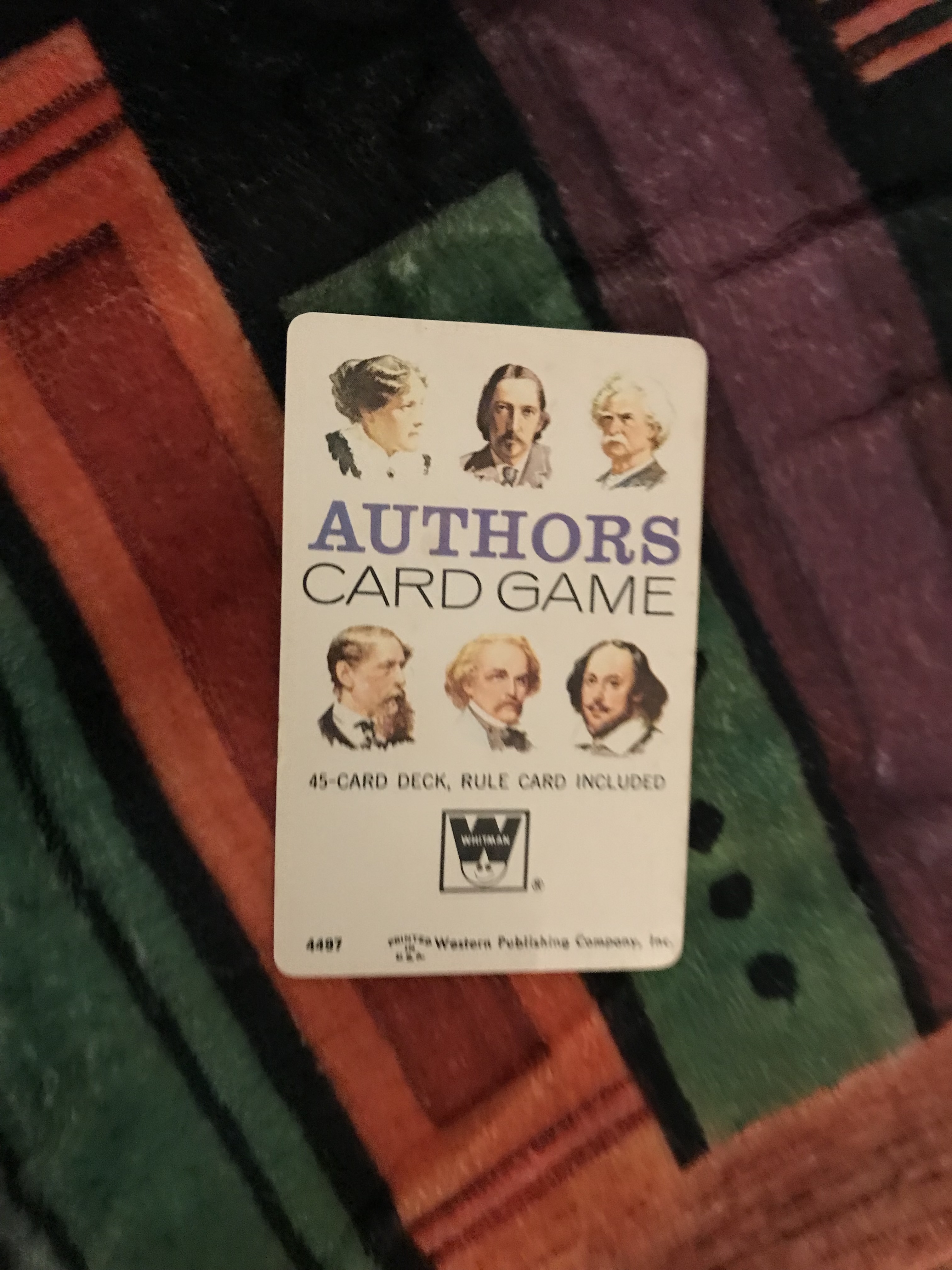
It happened in Salem.  In 1861.  The classic American card game, Authors, was published.  G. M. Whipple and A. A. Smith devised the game, which has remained available ever since then.  It’s one of the few games I remember having as a kid.  We, of course, had the Bible Authors game as well, which I’m kind of nostalgic for, but not enough to see if it’s on eBay.  The object of Authors, an early form of “Go Fish,” is to collect sets of four cards for each author.  Each card lists a different work.  Poets are represented by poems, of course, but prose authors mostly by books.  I have to confess to having eBayed this some time back and having beetlebrowed my family into playing it with me.  I noticed, however, a few curious omissions.

Edgar Allan Poe isn’t among their number.  Neither is Herman Melville.  Rather strangely, they included Shakespeare—centuries earlier than the others—and Alfred, Lord Tennyson.  The only female is Louisa May Alcott when there were perfectly acceptable Brontës in the room, as well as Jane Austin.  The game reflects its time.  A couple years back I was in Michaels—you know, the arts and crafts supplies store.  In fact, Michaels is one of those places for family outings, for families like mine.  (We tend to be creative types.)  While I’ve never been into scrapbooking, I walked down that aisle and found a set of stickers labeled “Literature.”  Two authors were represented: Shakespeare and Poe.  People smarter than me have argued that worldwide Poe is probably the best recognized American author.  I think it’s safe to say Shakespeare occupies a similar role in Britain.

Poe had fallen afoul of many in America because of an intentionally damning obituary by Rufus Wilmot Griswold, whom Poe had named his literary executor.  If it weren’t for Poe nobody would likely know Griswold’s name today.  In 1861, when Whipple and Smith were inventing their game, Poe wasn’t really considered worthy of emulation, largely because of Griswold.  He wasn’t the kind of guy you’d want your kids to be too curious about as you tried to teach them about literature.  Authors has gone through over 300 editions over the years.  I’ve never seen any of them (apart from Bible Authors) other than the Whitman edition from my childhood.  Each time I pick it up, smell the cards (go ahead—try smelling your Kindle), and thumb through the authors I feel like I’m missing something.  Go fish.

Nuts and Bolts

It all began with an innocent laugh at the local hardware store.  It was Saturday morning, around 8:30 and I had to get some nuts and bolts.  Literally.  From those neat little trays that separate out individual pieces that may be the last place on the planet you can spend just a dime.  These local stores have an honor system with little bags on which you write down how many of which piece you took and the price.  Also a dying breed, these bags are made of paper.  One other guy was there doing something similar and when I picked up my bag, another clung to it and slipped to the floor.  He laughed.  Then apologized.  He explained that he seldom made it through the day without some aspect of Murphy’s Law taking place.  I let him know I didn’t take his laugh wrongly and that I knew Murphy’s Law, perhaps too well.

He then told me that he thought he’d write a book about it.  A novel, he said, like the book of Job.  My ears perked up.  Only this time, he suggested, God had to treat Job so that only bad things happened and used Murphy’s Law so that they would turn out good.  Every good thing God wanted to do would have to appear evil at first.  I encouraged this stranger to write this book.  I meanwhile couldn’t believe that I was having a conversation about Job with someone I didn’t know in a town where I’m still a bit of a newbie.  Do I have “former Bible professor” written on my forehead?  Even when I’m wearing a mask they seem to be able to tell.

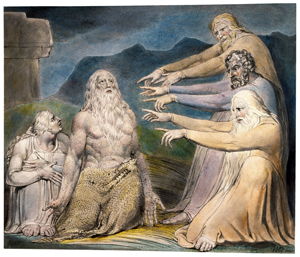
Job, according to William Blake

But seriously, although I don’t get out much any more throughout my life I’ve had strangers approach me with religious issues for conversation.  Often at the strangest times.  I wonder if this happens to other people.  You can’t assume someone will know the book of Job, or what it’s about.  You can’t know that a stranger won’t take such a story idea the wrong way.  Me, I was counting out nuts and bolts.  Perhaps I was there to build my own Frankenstein’s monster.  Or some evil device to end the world.  Would Job calm me down or rile me up?  As it was, I was glad for the diversion.  8:30 on a Saturday morning is well into the day for me, having been awake for over five hours already.  And I’m glad to have an innocent laugh from a stranger.


Gateway Horror

I’m in two minds about The Gate.  Part of me says “bad movie” while another part says, “Yeah, I’d watch it again.”  A third part of me knows I probably will.  It came out in 1987 as family-friendly horror.  There’s far too much going on for the run-time and the acting is lackluster (child actors who can really pull horror off are rare; perhaps those with more life experience make it believable).  It does have some Poltergeist vibes, though.  So, Glen (12) and his sister Al (15) are allowed to stay home without a babysitter for three days.  A couple nights before, a storm blew over a tree in the backyard, and Glen, with his friend Terry, accidentally open the eponymous gate at the hole by breaking open a geode, allowing demons to come into the world.  And, of course, the parents are gone.

Glen fears he is losing his sister to, well, growing up.  They used to do model rockets, but now she’s interested in boys.  Terry listens to heavy metal and discovers in an insert to an album of a European band, Sacrifyx, that they’ve opened the gate.  As night falls, the stop-motion demons attack.  They’re little and can be blocked by doors.  Al, Glen, and Terry have to figure out how to stop the demons and seal the gate without the Dark Book insert from the Sacrifyx album.  What to do?  They grab a Bible and try reading a bit.  When it doesn’t seem to be working, Terry utters an expletive and throws the Bible into the hole.  It works!  But, ah, this is only the false resolution.  The really big demon bursts through a hole in the living room floor after Terry and Al are both taken.  Glen, left to his own devices, launches a model rocket at the demon, destroying it.

Okay, sounds bad, right?  The reason, it seems to me, is that it doesn’t put religion to work for itself.  The instincts seem good—use the Bible—but the demons are too corporeal and too physical.  There’s no possession here.  In fact, the demons are the old gods (we’re in Lovecraft territory now) who want to take over the world once again.  There’s some good material to work with in The Gate, and if I ever get around to a sequel to Holy Horror I’ll have to include this one.  Overall, the message seems to be that if the Bible doesn’t work, use a rocket.  Oh, and don’t give up on your sister.


Feeling Elephants

There’s an old story about an elephant (the noble kind).  It involves visually impaired men—they always seem to be male—feeling said pachyderm and coming up with different ideas of what it is they’re touching.  I’m sure you’ve heard this before—it’s repeated constantly.  The other day I was reading yet another author using this analogy and he specified that there were three blind men.  I stopped.  Scratched my head.  Where did he come up with three?  An elephant has lots of parts and you need someone to touch at least the trunk, the tusks, the legs, and the tail.  At least.  So I decided to find out where this story came from.  This particular author said it was from India, which seemed likely enough.  And so I went looking.

Image credit: From The Heath readers by grades, D.C. Heath and Company (Boston), p. 69, public domain via Wikimedia Commons.

It turns out that the earliest rendition of this story is a Buddhist text from the sixth century BCE.  In case you’re biblically oriented, the sixth century is the era of Jeremiah and Ezekiel, as well as Deutero-Isaiah.  Things were happening, that is, religiously.  While the prophets were busy dealing with the fall of Jerusalem, someone during the lifetime of the Buddha was writing this story into the Tittha Sutta (the story spread to Hinduism and Jainism as well).  Now I’m quick to admit that I’m no specialist on Buddhism.  I know a few Buddhists, but they don’t talk to me much about the tenets of their religion.  Still, I marvel at how much our culture has been influenced by the religions of India, including Buddhism.  So how many men are there? I hear you ask.  Well, the most usual answer is “a group.”

A typical early version had men feeling the trunk, ear, leg, side, tail, and tusk—double the three I’d just read about.  But you see, literalism is the problem here, as it generally is.  Nobody has suggested, at least in my limited research on the topic, that an actual group of visually impaired males found an actual elephant to feel up.  And that these men weren’t curious enough to reach beyond the trunk to the head, or feel along its side.  The story is told to make a point, not to establish history.  And like all stories, it changes over time.  So much so that when innocently reading about something else, I discovered that somebody had heard that there were three men.  Rather like wise men, I expect, who are numbered by their gifts rather than Scripture.  Instead, wouldn’t it be best to feel the whole elephant and find out what it really is?


Biggest Book

As a bibliophile it’s kind of embarrassing to admit that I’ve only just learned about the world’s largest book.  If you’re like me you’re probably imagining an enormous tome that required acres of trees and fifty-five-gallon drums of ink to print.  But that’s not it at all.  This particular book is located in Mandalay in Myanmar.  If I say it’s a religious text you might be clued in that it represents the Tripitaka, or Pali Canon.  These are Buddhist scriptures.  They are extensive, as scriptures tend to be.  I’m certainly no expert on religions in that part of the world, but it’s clear that the world’s largest book, as a monument, required a massive amount of effort to put together.  Housed at the Kuthodaw Pagoda, the texts were inscribed on stone housed in 729 stupas that are stunningly beautiful.  (Take a look for other photos online—it’s impressive!)

Photo credit: Wagaung at English Wikipedia, published under GNU Free Documentation License

The monument was completed in 1868.  When the British invaded southern Asia, however, there was much looting and damage was inflicted on the shrine.  It was eventually repaired and still stands as the largest book in the world.  It’s no real surprise that this honor would be relegated to a religious text.  Bibles of all sorts become symbols and their symbolic nature often supersedes what’s written inside.  The idea of the sacred book has an unyielding grip on the human psyche, whether we think the book comes from God or an enlightened human being.  Indeed, the sacred itself is an integral part of being human.  When one group wants to dominate another, it often goes for its sacred artifacts.  Cathedrals as bombing targets in the Second World War demonstrate that well enough.  Ironically, we’ve ceased paying much attention to the sacred but we still revere it.

Books represent the best of our civilizing nature.  They’re ways of coming to see the point of view of others.  It really is a privilege to read.  Banning books is, in its own form, a crime against humanity.  Those who ban almost inevitably end up promoting yet more sales of the offending book.  I often see books that make me angry or upset.  My knee-jerk reaction is to want to deface them—this is a human enough response.  But taking time to reflect, I realize that these writers are entitled to their opinions, benighted though they may be.  A civil exchange of ideas is essential to getting along in a world with billions of different opinions.  Every nation should have a monument that shows its love for books.


The Jonah Treatment

A kayak on the ocean might’ve seemed to be a safe place during a pandemic.  In November of 2020, however, two women ended up getting the Jonah treatment.  While it happened some time ago, the story appeared in Slate just in August, so the world is learning about it after a few years.  At least those of us who hadn’t seen the viral videos before.  Julie McSorley tells how she and a friend were paddling out to see some humpback whales along the California coast.  Then, like a scene from Finding Nemo, bubbles started to well up around them and they found themselves briefly in the whale’s mouth.  They escaped unharmed since humpbacks don’t eat mammals, being baleen whales.  Apart from the natural fascination of the story, what caught my attention was the reference to Jonah in the log line.  As Heather Schwedel notes, few people “outside of storybooks and the Bible” have actually been inside a whale.

Image credit: Gustave Doré, Illustrations of Baron von Münchhausen, public domain via Wikimedia Commons

The typical biblical scholar response is generally somewhere along the lines of, “the Bible says ‘great fish,’ not whale.”  This may be true but we don’t possess a biblical glossary for the animals, real and imaginary, in the Good Book.  Ancient Israelites were neither great seafarers nor precise describers of nature.  There are many strange references to animals in the Bible with no certain referents in the world we know.  Not being oceanographically inclined, biblical authors wrote “great fish,” a term that was still used to describe whales up to Melville’s time.  But we now know there are other big fish as well.  Whale sharks, for example, and if you’ve ever watched River Monsters you’ve likely seen catfish large enough to send shivers down your spine. 

The funny thing about the book of Jonah is that the point of the story is often overlooked for the splashy action.  There’s a moral to the story.  It’s all about not judging others because they don’t belong to your group.  Jonah has already condemned the Ninevites as godless idolaters.  The book teaches that such judgment isn’t a human prerogative.  But we simply can’t get past that image of a whale, or great fish, swallowing a guy and digesting him for three days.  Like Jonah, Julie was spit back out by the whale.  It took only a matter of seconds since, despite what Pinocchio shows, the interior anatomy of most whales won’t allow living space for a long weekend away from home.  Julie McSorley and her friend emerged relatively unharmed.  McSorley even says it was a transformative experience.  One might even suggest it could be a spiritual one.


Personal Psalms

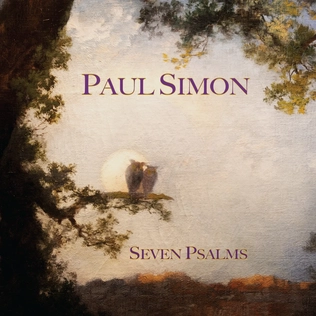
I haven’t heard it yet, but a New York Times article encourages me to.  Paul Simon has joined the ranks of those aging music stars to record albums presaging their deaths.  The article was about Simon’s latest album, Seven Psalms.  And, yes, the religious reference is pretty hard to miss.  Like most kids from the sixties, I grew up hearing Simon and Garfunkel on the radio.  We didn’t have money for albums, but I always liked their songs when I heard them.  After their breakup I really didn’t pay much attention to Simon until Graceland, and since then I’ve listened with half an ear.  You see, I’m wired in such a way that I can’t listen to music while I write.  Or read.  My mind grips one thing at a time.  That means I don’t listen to background music much.

That doesn’t mean I don’t appreciate music.  I do.  Almost religiously so.  On occasion I come back to Simon, with or without Garfunkel.  I posted about his song “Werewolf” some years back.  I eventually listened to that album, and I’m not sure I got it.  Artists are that way.  Some pieces you like, others are just okay.  I am curious about Seven Psalms, though.  I’ve posted about David Bowie’s Blackstar, Leonard Cohen’s You Want It Darker (both discussed in the Times article), and Bruce Springsteen’s Letter to You.  No longer young myself—these guys were young when I was a kid—hearing them reflect on death is powerful, and, if the mood is right, peaceful.  We fear death because it’s unknown.  And also, we all know, deep down, that we’re flawed.

Psalms aren’t necessarily biblical, of course.  Sinead O’Connor’s “Take Me to Church” is a psalm.  So is “Sounds of Silence.”  Artists have been writing psalms for as long as they’ve been writing songs.  The biblical psalms are among the most quoted bits of literature in the western world.  They were likely originally sung as well, but we can only guess what they may have sounded like.  We know that across the world people turn to song to express strong emotion.  I’m not sure what Paul Simon’s Seven Psalms might be, but it seems that thoughts of mortality go naturally enough with emotion.  I don’t write much about music because it’s so deeply personal.  I try to be intellectually honest on this blog, but if you want to talk music you really have to get to know me first.  Then I’ll reveal my psalms.


Mom

Mom

I just became an orphan.  I tend not to write about other people without their permission, but I have a few words to say about Doris Ruth Miller.  First of all, she was a saint.  I’m often accused of putting the needs of others before my own, and this is something I learned from Mom.  She set me on my lifelong course of reading the Bible, determining, in some inexplicable way, what I call a career.  Mom was born April 7, 1935 in New Jersey.  She was the youngest, and last surviving, of five siblings, and the only girl.  When I reached that age when children (as adults) get curious about their parents, I asked what town she was born in.  By that stage she couldn’t recall, but at one point she told me Cherry Hill, and at another, Asbury Park.  She never finished high school and never had any job training.  But she always believed.  She was faith personified.

She married to get away from a difficult relationship with her own mother.  My father, who died twenty years ago, was an alcoholic.  They had three sons together.  Mom, very aware of Dad’s condition, didn’t believe in divorce and stayed with him until she no longer felt safe doing so.  Not for herself, but for her sons.  Her life revolved around her children.  She eventually remarried and her final son was born.  This marriage involved a move to Rouseville, Pennsylvania—I’ve written about it before—my last childhood home.  Neither of her marriages were happy ones, but she was determined about two things: maintaining her faith, and caring for her children.  She believed unquestioningly and the only book I ever saw her read for herself was the Bible.

I only found out over the weekend that she was in rapid decline.  Circumstances (medical and financial) had kept us away for far longer than I would’ve liked or hoped.  I talked to her on the phone nearly every other day and told her with joy just about a month ago that we had finally got a car that would enable a visit.  We were planning on spending Thanksgiving with her.  The universe, which operates on its own timetable, had different plans.  Mom was a remarkable woman.  She was not afraid of death and she embodied these famous words from Paul of Tarsus: “O death, where is thy sting? O grave, where is thy victory?”  Mom lived eighty-eight difficult years.  She dedicated her life to others and lived the Gospel by example.  I miss her terribly, but I have no doubts about her being among the saints.  Thanks for life, Mom, and for showing how to love unconditionally.


Loco Locusts

It really used to bother me.  Other kids in kindergarten or first grade called them “crabs.”  The picture, however, clearly showed a lobster.  Quiet and introverted, at least I knew how to tell apart basic body plans.  It’s a weakness I’ve always had—the need to correctly identify.  This didn’t come from my family, who really seem not to be bothered about such things.  It came from somewhere deep inside.  A lobster is not a crab.  The same applied to toads and frogs, or any number of other fine distinctions.  Now I confess that I try to stay away from Nextdoor.com.  It seems that no matter what anyone writes the comments immediately turn political and belligerent.  Such is our world.  But when someone can’t identify an animal, that’s clickbait to me.  I just have to take a peek.

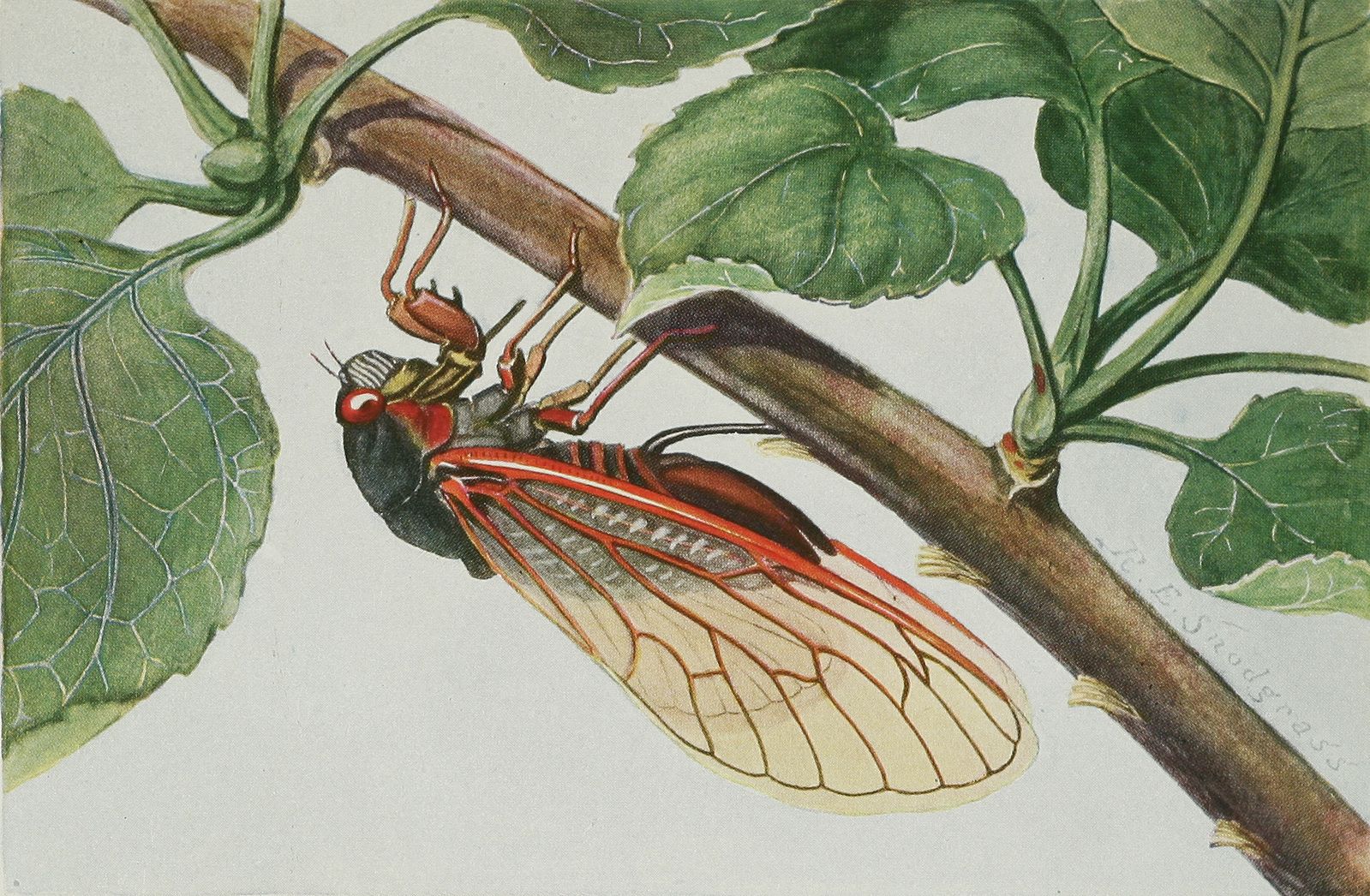
A couple of months back a woman posted a photo of a cicada.  I didn’t chime in because at least thirty other people already had.  The thing was, several locals said it was a locust.  Even after previous commenters had sent helpful links showing the difference between a cicada and a locust.  Probably it comes from many years of teaching biblical studies, but I couldn’t believe anyone would misidentify a locust.  Mind you, when I taught the book of Joel we talked quite a bit about locusts—they are amazing creatures.  In a pre-market economy, they were also deadly.  They don’t attack people like they do in horror films, but they will eat every green leaf for as far as the eye can see.  They travel in huge swarms, capable of blocking out the sun when they fly overhead.  Cicadas are harmless.  Noisy but harmless.

Cicada. Image credit: R. E. Snodgrass, public domain, vía Wikimedia Commons

How someone can live in the world and not care to know the other things that surround them I cannot fathom.  I can understand mistaking similar creatures—some animal mimics can be incredibly effective.  A locust, however, looks nothing like a cicada.  They’re both insects, yes, and they both have wings.  The similarity stops there.  Life is complicated, I know.  There’s a lot to learn.  As a writer one of the things constantly using up my time is trying to find the right name for a thing I know by sight but have never heard called by its noun.  With the internet, identification of critters has become somewhat easier.  But only somewhat.  You have to know where to start.  I still have the well-thumbed animal identification books from my childhood.  Outdated, yes.  Coming apart at the spine?  Definitely.  Full of childhood memories of learning what things are?  Of course.


Calculating Christians

I know some calculating Christians.  I use “Christian” as religion scholars do—it is the way people identify themselves, not necessarily what they are.  For example, I grew up learning that Christianity was God’s excuse for throwing a bunch of unknowing people into Hell.  Laughter all around!  Then I did something radical.  I started reading the Bible.  Spoiler alert: as you start to get near the end, you learn that Jesus and his early followers (except maybe Paul) promoted the idea that God is love and the only correct response to that is to love other people.  Of course, a religious founder, deity or not, can’t control what his/her followers will do.  Christianity quickly became judgmental.  “I’m going to Heaven and you’re not!”  Laughter all around!  In my life I’ve been the recipient of calculating Christians more than once.

Calculating Christians are those who, like ein U-boat Kapitän, try to figure out the best way to do the most damage to those they don’t like.  They will destroy your career—torpedoes away!—and then get on their knees to thank their vengeful god for sinking a satanic vessel.  And all the lives of Christians onboard are counted as collateral damage.  God’s good at sorting things out.  Laughter all around!  I’ve also known “Christians” who will target a family member when he’s down, and stressed out to the max, only to tell him he’s going to Hell and they’re just fine with it.  Laughter all around!  They do this without ever asking about the two seriously ill people in a family of three, or how you’re doing with that therapy you’ve had to start.  Jesus would do no less than kick a confessing sinner when he’s down.

There’s a reason Christianity is developing a bad name.  With the first compassionate Pope in centuries we find doctrinaire Catholics condemning his compassion.  Among the Fundamentalist camp we find those who would gladly die for the most hate-filled politician ever elected on these shores.  Calculating the end of the world is, after all, a tiring activity.  No matter that you’re wrong (you never consider the possibility and you never, ever try to weigh the facts), you calculate how to blow it up for everybody.  Laughter all around!  The only thing that keeps me sane, I believe, is knowing that many actual Christians out there know that such actions are taking God’s name in vain.  And that, they know, is against the commandments so prominently placed on courthouse lawns.

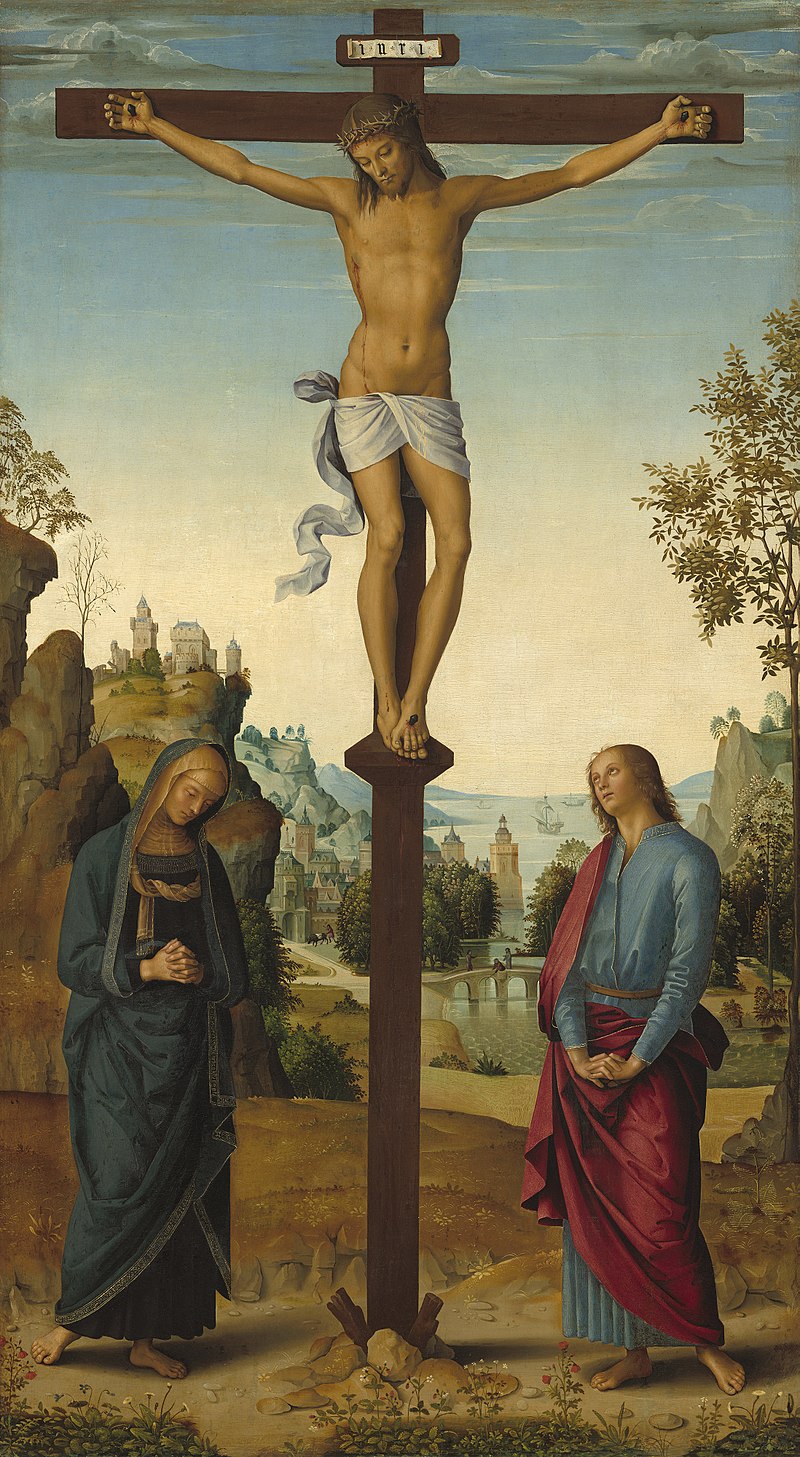
Pietro Perugino, The Crucifixion with the Virgin, Saint John, Saint Jerome, and Saint Mary Magdalene [middle panel], public domain, via Wikimedia Commons

Dental Dawn

Someone knowing my interest in religion and horror recommended Teeth.  A comedy horror film based on the concept of vagina dentata—an idea I first encountered in Neal Stephenson’s Snow Crash—it begins with a purity event.  Dawn, a teen leader in the abstinence movement, addresses other adolescents about the importance of maintaining, well, purity.  They all wear purity rings and vow themselves to chastity until marriage.  As might be expected, not all of them are able to uphold their pledges.  Being inexperienced, when Dawn finds herself in a compromised position with her boyfriend she learns she has, um, teeth.  Other guys, even when warned, can’t resist an opportunity and they too pay the price.  The point of the film seems to be female empowerment, but it’s also pretty funny.

After boyfriend number one has disappeared, Dawn again addresses the purity group only to have them quote Genesis 3 at her, clearly intimating that sin is the fault of women.  The Bible is there by implication and the sermonizing of the adult leader after Dawn has to leave the stage again takes up the religious outlook.  The underlying concept of purity movements is distinctly Christian.  While all religions have something to say about sex, generally the most negative about it is Christianity.  That’s not because other religions lack for spirituality, but Christianity tends to denigrate the body, and in the process tends to make natural things sinful.  This gives plenty of fuel to a movie like this where a woman has to make her own way in a man’s world.

What’s really interesting here is that no punches are pulled when it comes to the origins of patriarchy.  The Bible clearly views males as the standard of humanity and females as an adjunct.  That idea has had a death-grip on western society, particularly in America, from the beginning.  Teeth was written and directed by a man.  I suspect that the presumably well-intentioned use of an old mythical idea that makes females into monsters may not appeal to women writers or directors, empowering as it may be.  Nevertheless, if taken with the fun obviously intended from the opening playful music to the comically terrified responses of Dawn’s adolescent victims, the movie can still convey a positive message to women who might watch it.  Horror is often a repository of social commentary.  Not taken seriously by the mainstream, it nevertheless puts good messages out there.  And sometimes it bares its teeth.


Early Ghosts

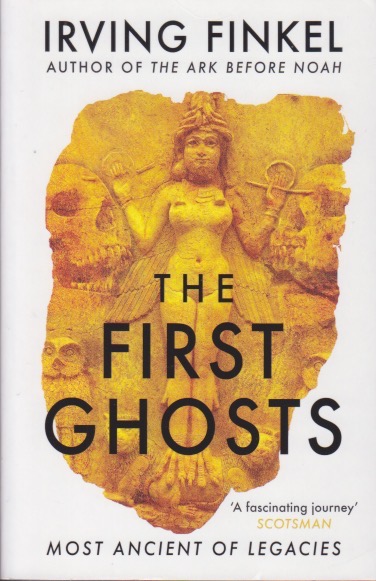
I’m not the most impulsive person in the world, but certain books I know, as soon as I see them, I will read.  Irving Finkel’s The First Ghosts was one of those books.  This wasn’t an easy book to get.  I’m guessing it was some minutiae about transAtlantic rights or some such nonsense, but it was announced a couple of years before it became available in America.  Then, of course, it had to wait its turn on my reading pile.  For those of you who don’t recognize his name, Finkel is a well-regarded Assyriologist who works at the British Museum.  Assyriology (which encompasses Babylonian and Sumerian studies as well) is, perhaps unavoidably, a highly technical field.  The languages are complex and a lot of that has to be explained before a reader can figure out what’s going on.  Some parts of this wonderful book are, unfortunately, technical.

The idea, however, is brilliant.  Ghosts have always been with us.  Finkel is well-placed to open the cuneiform world and he presents the earliest recorded ghost stories in history.  They’re not exactly modern horror, be warned.  Nevertheless, they demonstrate that from as soon as people figured out how to write, ghosts were one of their favorite topics.  Or at least, ghosts were assumed to exist and were written into many myths and legends.  Non-judgmental books like this are rare from academics; indeed, it’s difficult to imagine anyone else having written this particular book.  Even in the small world of academia not too many people read these languages and those who do are busy trying to impress tenure committees and businessmen deans.  (The reboot of Ghostbusters demonstrates this in a comical but too serious way.)

There are plenty of takeaways from this book.  A good general point in that myths do not reflect the everyday beliefs of individuals.  It’s easy to forget that.  Another striking idea occurred in his one chapter on the Bible where Finkel notes that the Good Book tends not to dwell on things considered “detestable,” such as foreign gods or demons.  That makes it an outlier concerning everyday information from antiquity.  After looking through that one window for so long, I suppose that’s why I focused by doctoral work on a “foreign” goddess.  If you can handle the technical bits and try to keep in mind multiple multi-syllabic names from forgotten languages, you’ll find a lot of really surprising and fascinating information here.  I’ve known for years that I’d be reading this book, and as autumn approached the time felt right to seek ancient ghosts.


Look it up

Does anybody else find the internet too limiting?  I regularly find that what I’m searching for flummoxes even Google when it comes to trying to find things.  The internet doesn’t encompass all of reality, I guess.  For example, the other day I encountered the word “evemerized.”  Even Google vociferously insisted that I meant to search for “euhemerized,” which is a different thing.  It did, however, reluctantly give me a couple of websites that use, and even define the word.  What is it that the search engines are not showing us?  Oftentimes in my searching I admit to being at fault.  I don’t know the correct string of words to use to get algorithms to understand me.  I guess I’ll be one of those up against the wall when AI takes over.  “Does not compute,” it will say in its sci-fi robot voice.

Some of us still like to unplug and pick up a real book.  Or take a walk in the woods.  I do have to admit, however, I wouldn’t complain if the internet could find a way to mow my lawn.  (I don’t mean giving me a list of those companies that haul around inverted-helicopter mowers that make every summer morning sound like Apocalypse Now.  “I love the smell of cut grass in the morning.”)  I am, and hope I always will be, a seeker.  I’m aware that our brains did not evolve to find “the Truth,” but I’m compelled to keep looking in any case.  There’s so much in this world and we’ve tried to distill it to what you can accomplish with a keyboard and a screen.  And even with those I can’t find what I’m looking for in this virtual collective unconscious that we call the web.  There are others better than me at web searching, I’m certain of it.

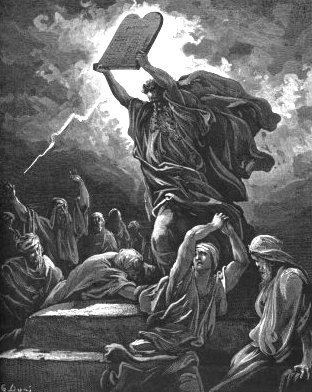
Despite our current understanding of the virtue of curiosity, there have been periods of history (and pockets of it still exist now) when religions have presented curiosity as evil.  This is generally the case with revealed religions that invest a great deal in having the truth delivered to them tied up with a bow.  I can’t believe in a deity that created curiosity as a sin.  Early explorers of religion exhibited curiosity—if Moses hadn’t wondered what that burning bush was no Bible would ever have been written.  Of course, the internet didn’t exist in those days and seeking was, perhaps, a little bit simpler.  Even if Moses was evemerized.

Moses gets curious

Cabin Stories

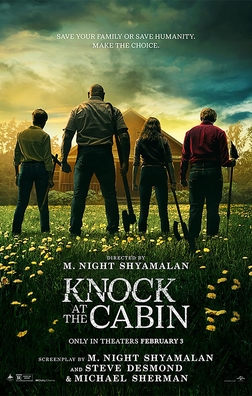
Almost always I come out on the same side of the debate.  The book is better than the movie.  The book allows things to be explained more fully and is the way the story is “supposed to go.”  Maybe it’s because I found the novel open-ended and I like closure, but M. Night Shyamalan’s Knock at the Cabin, in my humble opinion, is better than The Cabin at the End of the World by Paul Tremblay.  Now, the author’s title is better, but Shyamalan’s explanation is clearer.  In short, I think the movie works better.  If you’re not familiar with the story, four apocalypticists, responding to visions they’ve had, break into an isolated cabin occupied by a vacationing family of two daddies and an adopted daughter.  Shyamalan characteristically shifts the cabin’s location to Pennsylvania and, yes, before you think it’s all Philadelphia, there are some very isolated places in my home state.

These weaponized apocalypticists subdue the family and inform them that unless they decide which one will be sacrificed, and then carry out the deed, the world will end the next day.  The adult couple tries to explain rationally how crazy this all is.  How could four people be given this hidden knowledge and be tasked with saving the entire world?  It seems more likely that they’ve targeted a gay couple and are trying to break up their family.  One of the things the movie makes explicit that the book doesn’t is that the intruders are correct.  This is the end of the world.  In order to achieve this, Shyamalan had to rewrite the ending to remove the ambiguity.  For some of us, that really helps.

The movie, in a way that a brief blog post can’t replicate, includes quite a bit of dialogue about religion.  Religion and horror are often bedfellows, and this is one of those movies that relies on religion to fuel the fear.  Interestingly, the cabin invaders aren’t stereotypical conservative Christians.  In fact, they appear to be mostly secular everyday people who have come together around a vision that they all had in common.  In the novel there’s always some question whether this is an elaborate hoax whereas the movie makes it clear that the death of each individual apocalypticist unleashes a plague.  Indeed, they are, as the couple finally realizes, the four horsemen of the apocalypse.  Since I’m still here to tell you about it, the end of the world has obviously been avoided.  This movie is worth seeing, even if the novel has a better title.


Consider the Ant

Ants, the Bible suggests, are worth both watching and learning from. I was reminded of this while at the Easton VegFest a couple weeks back. The VegFest is an annual event promoting vegan food in a riverside park. I’d given someone a ride and ended up finishing earlier. I could either walk all the way back to the car or spend the time outdoors. It was a pleasant enough day and there were places to sit (with no back support, however). One such sitting venue is a concrete retaining wall about 12-feet high, that borders a walking trail along the river. Since there’s a lively inner tubing business along the Delaware and Lehigh Rivers, you could watch groups float by, looking very relaxed in the way that only being on the water can make you. It was while sitting along the top of this wall that I realized I was on an ant highway.

Image credit: Fir0002/Flagstaffotos, under CC BY-NC license, via Wikimedia Commons

While individual ants don’t live very long, colonies (and their lives are very interconnected) can last several years. Some queens even make it to 30, which is impressive for an insect. As I was sitting (more like leaning, since the wall has a rounded top and I have a fear of falling) I’d notice some larger ants approaching with great determination. I would stand to let them pass. They weren’t in a close line or anything, so if I didn’t notice one in time, I became part of the trail. Looking confused—if an ant can look confused—at missing the chemical trail, they’d nevertheless continue in the same general direction unless some microscopic bit of a dropped piece of lunch on my lap caught their attention. Their determination was a lesson. They simply don’t give up.

Although the wall predates any of their individual lives, it has become their highway just as any interstate becomes ours. They didn’t build it, but it has become their recognized and known pathway. This was clear because in the course of my hour there, several members of what I presume was the same hive came by. I suspect the writer of Proverbs wanted readers to notice their busyness, but what I saw was their marked will power. Not even a giant wearily resting on their road deterred them. There was an utter conviction about what they were doing. Obstacles were simply climbed or gone around in the assurance that the trail would resume on the other side. Their sense of hope was admirable and, in its way, contagious.