What’s Wrong with Eve?

Reading a newspaper film analysis by critic Stephen Witty on film noir, I was intrigued by how he represents the role of the femme fatale. Most produced and directed by men, the classic noir features a dangerous woman. Noting that there are “nice girls” in such movies, Witty states, “they’re not the ones who matter, the ones as essential to the plot as that serpent is to Genesis.” Naturally, this statement evokes the image of Eve, the seductress.

Eve has been much maligned by patriarchal religions. She is a convenient scapegoat for men’s uncontrollable urges, and by making her the gateway to sin itself the male spiritual psyche is unburdened; it is all her fault. It often comes as a surprise that Genesis does not use the word “sin” in the episode in Eden. Interpretations of the tree of knowledge are not universally negative, nor is Eve alone to blame. Scapegoats, however, are much more comfortable than admitting culpability. Religions have stropped this to a high art; the masculine religious establishment can repress the feminine threat with scriptural justification.

Eve is a misunderstood heroine. She is the mother of knowledge. Genesis does not forbid the tree of life; ignorant humanity was free to live forever. Without knowledge. Eve, while perhaps under the duress of temptation, nevertheless took the initiative to find wisdom. And she has been paying the price ever since. Film noir is a reflection of life, as is most art. In a world where men like to think they have the right to rule, the woman who sees a little farther is considered dangerous. All feeble theological attempts to forbid religious leadership to women have Eve to thank for their revisionist hermeneutics.


Climb Every Mountain

In Ancient Near Eastern religions class, we’ve been discussing where the gods live. At least beginning with the Sumerians (perhaps earlier, but since writing hadn’t been invented, we can’t know) the gods typically dwelt on a high mountain. Older writings on Sumerian religion call this the mountain of “Heaven-Earth,” a name that conveys the point, but also misleads. The concept of “Heaven” is much later than the Sumerians, and in western religions, later than the Hebrew Bible. “Heaven” in this sense is nothing more than sanctified sky. The gods live up there, beyond all the trouble we encounter down here. The idea proved remarkably resilient, stretching through the concepts of Mount Sinai, and Mount Zion in the Bible, and Mount Zaphon among the Ugaritians. Even the Greeks found their gods on Mount Olympus.

The logic of the day was simple: no one has been up the mountain to prove otherwise, so the assertion has never been falsified. Mountain climbing is a leisure activity – in ancient times leisure was not a general expectation. Mountains were obstacles, not opportunities. In their remote and rugged heights, where humans could not reach, the gods dwelled. And, perchance someone did climb a mountain and find the wrong gods? There were plenty of extra deities to go around, so no worries there.

An element of the divine on the mountains still exists. Various tourist companies offer Noah’s Ark climbs of Mount Ararat in Turkey. Even without such support, misguided but determined groups still head to this mountain to prove the veracity of the Bible. In their own way they too are seeking god on the mountain. The problem is that we’ve climbed every mountain and not found the gods. In our cosmology the divine has been shoved out further into space. When space becomes infinite, God moves beyond infinity, always one step ahead of our ability to find him. The ancients bequeathed an undying, if evolving concept upon us when they fabricated the mountain of Heaven-Earth.

Andrew Behesnilian's photo of Ararat from Wikipedia Commons


Sharks and Apostles

There are sharks in the water. For the third day in a week, some New Jersey beaches have restricted access to the ocean because of sharks. As a particularly hot July trundles along, this is not really welcome news. Also yesterday, the Vatican codified revisions to its clergy sexual abuse crisis. According to an Associated Press article in the New Jersey Star-Ledger, women’s ordination groups are angry because sexual abuse and the ordination of women are classed together as crimes against the church.

Venus of Willendorf

Even before civilization began, it seems, religion and sexual dimorphism were tied together. Beginning back 35,000 years ago Paleolithic humans carved female figurines. In a hunter-gatherer society where struggle for survival was the best paying job available, the execution of such objets d’art in a brutish, hostile environment reveals religious sensitivities. Stone Age humans knew something that organized Christianity forgot within its first century: sexuality is never far from religion. The Bible itself, particularly the Christian Scriptures, emphasize that celibacy is a putative gift, not something that can be learned or forced on someone. In typical Roman fashion, however, the church quickly mandated celibacy as the norm and ruled that women were the source of evil.

Nothing could be further from the indications of both Paleolithic remains and scientific thinking. Women, long the source of spirituality, were now cast aside in an arrogant aberration of earlier practice. Largely based on the angry writings of one man, the church decided that men alone should determine the eternal fates of others. Masculine men who knew self-control and who could turn off millennia of evolutionary pressures by a sheer act of will. Centuries later, and the Vatican with its own Pontifical Academy of Sciences, the church still can’t get beyond basic reproduction and sexuality issues. I would go to the beach to try to think this one out, but there are sharks in the water.


When Dinosaurs Will Rule

Just about all of us begin life as budding paleontologists. What kid doesn’t adore dinosaurs and their paradigmatic story of planetary rule followed by inexplicable decline? The mystery and drama only add to the fantastical nature of the beasts themselves – creatures towering over houses and trees, predators the size of school buses. When my daughter hit dinosaur age, my latent paleontologist experienced a profound resurrection. Sure that she’d become the next great dinosaur hunter, I relearned all the old species names and added dozen more from creatures discovered since my interest went underground. While my career was spiraling downward at Nashotah House, I contacted the paleontology program at the University of Wisconsin to see about retraining. I even started to teach myself calculus.

Life delights in playing funny tricks on people. Once again my career in religious studies spirals downward and the specter of the dinosaurs rises. Literally. A former student of mine pointed out an article on Helium.com that spells out some possible implications of the Deepwater Horizon fiasco. The first sentence reads: “Ominous reports are leaking past the BP Gulf salvage operation news blackout that the disaster unfolding in the Gulf of Mexico may be about to reach biblical proportions.” The Bible is our standard measure for disaster; no crisis can not be made worse by throwing in the adjective “biblical.” If Terrence Aym is correct, however, even the Bible won’t save us now.

Apocalypse now?

Basing his analysis on Gregory Ryskin’s thesis that immense methane bubbles from under the ocean led to several past mass extinctions on our planet, Aym suggests that all the signs are present that a true doomsday scenario is unfolding in the Gulf of Mexico. I have seldom been impacted by doomsday predictions, but Aym’s article is perhaps the scariest thing I’ve read in years. I’m not enough of a scientist to assess the danger, and the media blockade only makes the speculation worse. Could it be that the decay from all those dead dinosaurs, their cohorts and predecessors, their flora – the very source of fossil fuels – is rising to deal yet another mass extinction on our planet? The reader will need to decide. For me, I regret that I didn’t stay with the dinosaurs, for they still rule the planet.


Green Bible


One of the most heinous theologies to emerge from Christendom is the idea that exploitation of our planet is good for the soul. The idea, apart from having been foundational to Bush II’s administration, is based on the idea that if we mess up our world badly enough we will force the divine hand into sending Jesus back to clear up our detritus. The Second Coming apparently will be in a garbage heap rather than a garden. Christian businessmen rest secure knowing that their exploitation of our natural resources is all part of God’s master-plan. This “theology” is alive and well among many Neo-Cons and it insists that the fact of global warming is a myth and the myth of creationism is a fact.

One of the unexpected perpetrators in the war on our planet has been the Bible. Accurate records of the number of Bibles actually printed were not kept in the early days of Gutenberg’s dream machine, but current estimates place the number of Bibles printed at over 8 billion. That’s more than enough for one per person. Some of us would have to confess to owning multiple copies, making us perhaps guiltier than the rest. It was in an effort to stem the dendrite slaughter of this industry that I shifted to the Green Bible for my classes last year.

Some people treat the Bible as an object of veneration, never laying it on the floor or putting other objects atop it. Some people object to making Bibles out of “inferior” products – the Green Bible is printed on recycled paper and is biodegradable – but to me this seems to be the most responsible way to produce a book with the enormous environmental impact that the Bible has. I could live without the “green letter” sections intended to prooftext the Bible’s environmental concerns, but care for our planet trumps good taste at times. If anyone from Oxford University Press is reading this, the eco-friendly aspects of this Bible are what reluctantly switched me from 15 years of requiring students to purchase the New Oxford Annotated Bible! It is time that the Bible owned up to its part in our planetary plight.


Probation in Hades

Yesterday I received an email in my Rutgers account with the title above. It was difficult to determine if the message was directed at me or was a piece of spam that had gracefully navigated around the powerful university filters. In either case, the sender had mapped out to an impressive degree the goings on in the afterlife. I am not qualified to comment on the correctness of the assertions, having never been to the Underworld myself, but I was hooked by the preference for the name Hades over Hell. This particularity took me back to revivalist sermons I heard as a youth when preachers, apparently fearing the swear-like quality to the word “Hell” – which the church gave us – deferred to the use of “Hades.”

As I have described in one of my podcasts, Hell is a Christian construct derived from Judaism’s confrontation with Zoroastrianism. The idea is distinctly Christian in its formulation: Hell is the afterlife for those who side with Satan and his angels and therefore are blocked from Heaven (also based on Zoroastrianism). Nobody wishes to go there, but those who choose the powers of darkness will be sentenced to an eternity of burning and torment for their choice. The idea is so odious that eventually its very name came to stand for a curse-word in many Christian contexts. In the pietism of the Evangelical tradition, the word itself is to be avoided. Thus I heard sermons warning of the somehow softer sounding Hades.

Hades is not Hell. I tell my mythology students that the classical Greek conception of the afterlife is not necessarily a punishment. It may be for some notorious sinners, but generally it is the fate of all the dead, like Sheol in the Bible. The choice of Hades as a stand-in for Hell is not in keeping with standard Christian teaching. Hell is Hell. Hades is somewhere else. Both lie underground, but they inhabit completely divergent conceptual worlds. I wish to thank my sender for this carefully crafted Underworldly roadmap, but in the interest of full disclosure, I must insist that a Hell be called a Hell. Hades is best left to Pluto and his retainers, so Satan needs a realm of his own.

Hades, slightly influenced by ideas of Hell


Misappropriated Prophets

There seems to be a can of worms lying open on my desk, released by the comments yesterday’s post engendered. I thank all my readers and commentators. The issue most pointedly thrust among the worms appears to be that of prophecy. Teaching about prophecy constitutes a large part of my meager income. And since prophecy plays a large role in many Evangelical associations not only with the Deepwater Horizon disaster, but also Hurricane Katrina, 9/11 and just about any other major catastrophe, it is worth exposing. In the Bible prophecy is not about predicting the future.

Prophecy was a widespread phenomenon long before Israel appeared on the scene. One of the roles prophets shared in ancient times was the declaration of outcomes to momentous events. Unfortunately that aspect of their duty easily became equated with predicting the future. Its actual milieu, however, was that ancient people believed prophets to be “effective speakers.” When a prediction came true it was not because a prophet could “see the future,” but because the spoken word of the prophet participated in the reality of the world. The belief was that the effective word came from God/a god, and therefore would be true by definition.

Apocalyptic, the familiar literary form of Daniel and Revelation, is not prophecy. Zoroastrianism, the religion of ancient Persia, had influenced many ancient religions, including Judaism. Apocalyptic, like prophecy, has a predictive element. Like prophecy, however, apocalyptic has a different purpose. The books most heavily farmed for future predictions by Evangelicals, Daniel and Revelation, are both thinly veiled accounts of contemporary events of the authors’ own days. Daniel consoles Jews persecuted by Antiochus IV Epiphanes and Revelation consoles Christians persecuted by one of the early Roman emperors (the jury is still out on precisely which one). Neither book predicts the end of the world. Both, however, declare the comeuppance of the arrogant oppressor. It is here, perhaps, that the true relevance of the Bible speaks to the scars human beings inflict on their own planet and on each other.

sic semper tyrannis


Wasting our Breath

The internet is alive with the sounds of musings about the appropriateness of various types of scholars doing biblical research. The discussion revolves around a recent article by Ronald Hendel in Biblical Archaeological Review, a useful, if sometimes overeager, magazine. In it Hendel laments the policy of the Society of Biblical Literature, a professional group to which I have belonged for nearly two decades, of accepting overtures from evangelical groups in return for money they are able to bring in. The Society’s web page has a rebuttal and has invited discussion. I prefer to give my views on my blog – a place that I consider neutral territory.

I am not privy to the inner workings of the SBL. I have served as a chair of one of the program units in the annual meeting for several years, but I do not pretend to know the politics behind the scenes. I joined the society, like most young scholars, to find a job. Since that has never happened I have not become more deeply involved since I have no institutional base. It is clear, however, that over the past years conservatively motivated groups have felt an assonance with the Society, given that it is the gateway to academic respectability. The problem is that conservative/evangelical groups approach the Bible with doctrinal shackles firmly locked in place. Fearful of angering their image of God, there are questions they simply can’t ask. Secular or unaffiliated scholars are free to go wherever they believe the evidence leads. In the job market, the evangelicals are better placed to find work. In the wider academic world, however, their work is suspect.

Little did I realize as I laboriously worked away on my dissertation that many evangelical scholars flock to the field of ancient Near Eastern studies, providing, as it does, a way to avoid critical interaction with the Bible. They may thus become “Bible scholars” while leaving the confessional virgin Holy Writ intact. I entered ancient Near Eastern studies to get to the bottom of it all – to explore the origins of the Bible itself. All of us end up interviewing for the same jobs.

At the end of the day what it comes down to is an issue I’ve addressed before: who has the right to interpret the Bible? The answer often distresses scholars. It does not require a Ph.D. to read and interpret the Bible. Most times an advanced degree is a decided liability. A friend has recently pointed out that scholars write for scholars, intent on demonstrating their erudition while losing all public credibility. I’m not sure where the debate will end, but when it’s over not a ripple will be felt among the general public. The Bible will continue its reign in American society unchallenged.


Sol Invictus

Perhaps for abject fear of paganism, western civilization has avoided holidays associated with the summer solstice. Being the lightest day of the year in a frequently dark northern hemisphere, it was naturally a time to celebrate the victory of light over darkness. While the winter solstice insinuated itself into the complex of Christmas holidays and Easter became intricately intertwined with the vernal equinox, the summer and autumn holidays were rejected.

This neglect of the powers of light coincides to some extent with the orthodox Christian rejection of Gnosticism. The Gnostics, able dualists like their Zoroastrian predecessors, celebrated the victory of light over darkness. Remnants of their theological outlook survived in the canonical Gospel of John and the always questionable Revelation. Ancient societies throughout the world recognized the summer solstice because, regardless of its name, the sun was acknowledged as a powerful deity. On this day the sun is at its height of strength, banishing darkness for longer than any other day of the year. It is a day not to waste.

Christianity has preserved some minor holidays for the summer season, but with the advent of a leisure-based society where summer is a time to take it easy, if not cease work altogether, the solstice lost its grip. Perhaps because light is so abundant already in the longer days as winter wends its way into spring and summer and lingers pleasantly until the vernal equinox, summer itself is simply holiday enough. Those adhering to the ancient religions nevertheless gather at sites like Stonehenge and Maeshowe, or even Egypt’s famous pyramids to consider the unending influence that our special star holds for its most imaginative planet.

The stones of summer


Nebuchadrezzar’s Dream

One of history’s great ironies is that, despite being visually oriented creatures, we often do not know what famous people looked like. The further back in time we go the more difficult the reconstruction is. Ancient people practiced portraiture, although their efforts may have been hampered by stylistic conventions. Egyptian artwork is recognizable at a glance, and Mesopotamian art, with its weightier, angst-laden form is easily distinguished. Their stylized images generally do not allow for direct correlations to Renaissance portraits. When searching for specific individuals, even famous ones, however, the likeness may be completely absent.

Among the most notorious (from a biblical viewpoint) ancient emperors was Nebuchadrezzar. Demonized for his role in the destruction of the sacred temple in Jerusalem, Nebuchadrezzar becomes the hypostasis of Antiochus IV Epiphanes in Daniel and even worse in Christian apocalypticism. For all that, Nebuchadrezzar seems to have been a jolly good fellow. An able emperor, he was noted for his building an empire and the loveliest gardens in Iraq. Yet no images of him survive. They may be out there, buried, waiting to be found, but we do not know what this emperor looked like.

A recent web search nevertheless turned up the clearly Greek version of that famous, if forgotten, face on an onyx cameo. It even appears on Wikipedia’s page for Nebuchadnezzar II as an actual image of the man, the legend; this despite the fact that William Hayes Ward, in the American Journal of Archaeology in 1887, explained how the cameo was an early forgery. Originally an “eye of Nabu,” the proto-cameo was the eye of a statue, the pupil of which was carved by a reconstructionist Greek artisan into what he supposed Nebuchadrezzar looked like – a Greek warrior – centuries after the fact.

From Ball's Light from the East

This might be a simple historical curiosity were it not for the fact that evangelical websites and wikis are quick to claim that this clean-shaven, Olympian-profiled vision of masculinity is an actual image of Nebuchadnezzar. Why? He occurs in the Bible and therefore must be “proved” to have been historical. Not only for the real Chaldean Empire, but also for the fictional one concocted by Daniel. Seeing is believing. While history did not see fit to leave a lasting image of Nebuchadrezzar, evangelical websites will use the tried and true god-of-the-gaps methodology to show us what he actually looked like (not).


Aye, Robot

Being a “biblical scholar,” having an interest in robots might seem counter-intuitive. I was intrigued by the topic as a youngster, but convinced that if what the Bible said was true it deserved nothing less than full attention, I let my formal study of science lapse (although I kept an active reading life on it). Now, through the interest of my daughter, I have found myself mentoring budding young engineers, mostly by helping put things away and correcting grammar. Yesterday we took our robots outside for the local street fair. Almost always the response we get from local people is “Robots? Our school has robots?” Well, partly correct. The schools house the robots, but our robotics club is largely self-funded, so the robots might be said to belong to the team rather than the school. In any case, yesterday the robots played soccer in the street for the amusement of festive fair-goers.

People often fear “soulless machines.” They run by predetermined rules, set down explicitly in computer code, and do only what they are programmed to do. Some fear artificial intelligence for this very reason: what if robots or computers are programmed to think? Does this make them something more than physical machines? The standard, religiously biased, answer is that the soul, or even mind, is a uniquely human possession. Animals may act on instinct, some may qualify as having a limited mind, but definitely not souls. That would simply cross too many boundaries. When asked to produce a human soul for scientific scrutiny all religions come up blank. We don’t actually know what a soul might be – an everliving component that God might throw into Hell or spoil in Heaven seems to be the general gist. And it makes our moral choices for us.

In the Bible if any animal (say a bull) gores a person to death, and that bull had a prior reputation, not only beast but master could be put to death. It seems that the bull has a bad moral intention. If robots hurt people, in violation of Asimov’s first law of robotics, they are treated as acting with moral intention. We project souls onto them for the convenience of condemnation. If an animal, such as a zoo gorilla, saves a human child, that animal receives the treatment of a souled being for a while, until the act is forgotten. It seems that souls are immaterial components of a closed system used to reward or punish an individual. How much of themselves do humans have to put into their robots before they can have souls as well?

Robots among the people


Cryptid Be Thy Name

While poking around the internet last night to take my mind off the heat and humidity surrounding me, I stumbled across an article entitled “The Religious Struggle over Cryptozoology” on a site called Science and Religion Today. The piece was written by Joe Laycock, a doctoral candidate at one of my alma maters, Boston University. Having just finished Bruce Hood’s Supersense, there was a pleasing euphony in the coincidence. Cryptozoology is the study of unknown animals, and is not necessarily based on the supernatural (although it may fall within Hood’s definition of it). Laycock notes that two religious elements in society have latched onto this study: New Agers and Creationists. Creationists, it seems, see in certain cryptids, such as the Loch Ness Monster, hold-overs from the Mesolithic Era that prove the Mesolithic Era never existed. God can still make dinosaurs today, therefore the Bible (which doesn’t mention dinosaurs at all) must be true.

The draw of the unknown

One of the most welcome parts of Hood’s thesis was its consonance with Stephen Asma’s On Monsters, a book I’ve posted on before. Both authors explore how the human psyche reacts against what it perceives to be “strange mixes,” beings that cross-over between readily defined categories. Hood addresses this by tackling the concept of “essence” while Asma notes a dread accompanied by a sense of wonder. Hood demonstrates that from a scientific point of view, there is no such thing as the “essence” of a person, object, or living thing. Such ideas are the cling-ons from the era of souls and radically distinct species and genders. Closer observation has taught us that many such things are more of a continuum than a series of sharply defined types. Religions prefer to have fixed categories. Religious ethics often depend on them.

Laycock suggests that both New Ageism and Creationism “can be read as a religious response to the cultural authority of science.” Religions fear that which can be empirically demonstrated since it throws the god-of-the-gaps into the dryer and he comes out smaller each time. This is so, despite the fact that Creationists crave scientific respectability. While teaching my course on Myth and Mystery at the University of Wisconsin Oshkosh, I dwelt on cryptids for a few sessions. They are indeed often surrounded with a religious mystique. I wouldn’t necessarily dismiss the possibility of undiscovered species, many new ones are described by science every year. Nor would I say that they are supernatural. Nature has ways of surprising us still, and as Asma clearly demonstrates, we still have a need for monsters.


Bible Experts All

I seldom write follow-ups to my own blog posts – I’ve always found self-referential academics somewhat distasteful, and besides, what is creativity without some variety? Nevertheless, it seems that yesterday’s post has garnered a bit of interest in the disaffected outlook of a self-professed biblical scholar. (Actually, I have three “higher education” diplomas rolled up neatly in tubes in some untidy closet that show that some universities also accuse me with this charge.) Perhaps I need to clarify.

When reading a blog post, it is very difficult to determine the position of a writer’s tongue in relative proximity to his/her cheek. (Those with eyes to see, let them hear!) The subject might be funny if it weren’t so deadly serious. Despite my reservations with Christopher Hitchens, Sam Harris, and Bill Maher, they have all underscored a vital point – biblical literalism is very dangerous. This is even more so the case when, in their own minds, all people are Bible experts. We attend school and learn to read. Some learn to read more deeply than others, yet all “know what the book says.” There is no way to dispute that belief. Belief is belief, requiescant in pacem. Some commenters wondered why the opinion of “Bible experts” should matter at all.

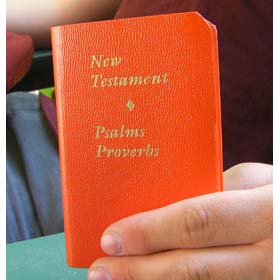
When I’m feeling ill, I would prefer to ascertain the opinion of someone who has actually earned a proficiency in human physiology. When the car breaks down (again), I prefer to have someone who understands machines well as the repairer. When many, many people want to know what God doth require of thee, they turn to individuals who have not been thoroughly trained in Bible. I taught in a seminary for many years, and as an administrator, became quite familiar with the accrediting requirements of the Association of Theological Schools, the nation’s main seminary accrediting agency. I may unequivocally state that few seminarians emerge as full-fledged Bible scholars. Some “denominations” do not require any seminary training at all. So when your spiritual life breaks down, most folks head to an “expert” ill-equipped to handle the Bible, a homeopathic (no slur intended) literary diviner.

Purely from my own perspective, I would prefer to know what the Bible, in its own context, language, and words, is more likely to have meant. Delusions and all. Can’t buy that at your local church, with rare exceptions. That is the role of the humble Bible expert. As with any field of study, it is obvious when you have found a true expert. Such a one will readily admit that she or he has more questions than answers.


Pulp Bible

Everyone is an expert on the Bible. This is one of the factors that provides professional biblical scholars with generous ulcers. Everyone is an expert because they know what they believe about the Bible. The difficulty is very few people actually know much about the Bible. Belief and knowledge are very different features of the human psyche. In my introductory course on the Hebrew Bible last night, I showed the clip from Pulp Fiction where Jules exegetes Ezekiel 25.17 (which is a fictional verse concocted for the movie). This offers a springboard to discuss how the Bible is perceived in society at large. Many people believe that Ezekiel 25.17 actually reads as Jules quotes it. The writer/director of any movie may freely manipulate the Bible since they are as expert as anyone else on the subject. (Of course, Ezekiel is a safe bet for a false citation since few people have actually read the book.)

As an officially trained “expert” on the Bible who has learned the original languages and who has read far more books on the Bible than health or common sense would dictate, I often wonder about this. When the Jehovah’s Witnesses stop by, knowing that I have these credentials, they plow straight ahead and tell me what the Bible really means. They are experts as well. When my wife was pregnant and we visited the obstetrician for an initial interview, as soon as he discovered my vocation, the physician quoted Scripture for this nervous young couple before him. Would you not rather have a Bible expert deliver your first child? Where is there room for the bone fide Bible specialist?

Having read Hector Avalos’ The End of Biblical Studies some months ago, I found myself largely in agreement. In many quarters the Bible receives a privileged treatment that only creates problems. Politicians, rap artists, physicians, movie directors, and janitors are all experts on the Bible; why do we need those of us who’ve made it a life’s work? The answer, I believe, is that knowledge of the Bible is at an all-time low. Many venerate the Bible without understanding what it is. Until society gets a grasp on what it means to have so many experts on the Bible, everyone should ponder the meaning of the passage that reads, “The path of the righteous man is beset on all sides by the iniquities of the selfish and the tyranny of evil men. Blessed is he, who in the name of charity and good will, shepherds the weak through the valley of darkness, for he is truly his brother’s keeper and the finder of lost children. And I will strike down upon thee with great vengeance and furious anger those who would attempt to poison and destroy my brothers. And you will know my name is the Lord when I lay my vengeance upon thee.”


Converting Triffids

“Stupendous as this disaster is, there is, however, still a margin of survival. It may be worth remembering just now that we are not unique in looking upon vast calamity. Whatever the myths that have grown up about it, there can be no doubt that somewhere far back in our history there was a Great Flood. Those who survived that must have looked upon a disaster comparable in scale with this and, in some ways, more formidable. But they cannot have despaired; they must have begun again – as we can begin again.” This quote from John Wyndham’s Day of the Triffids brings into focus a number of themes from this blog. Initially, it is another example of the intersection of science fiction and religion, specifically the Bible. In his apocalyptic 1951 novel, Wyndham can find no better example of disaster than the Flood Myth. The Bible and science fiction have kissed each other once again.

Another recurring theme reflects on disaster and how religions deal with it. As the Gulf of Mexico oil spill begins taking on apocalyptic dimensions religion is brought into the discussion in a variety of ways: God will take care of it; it is a sign of the end times; God is punishing us for something; corporate greed must stop. Take your choice. When people feel threatened, religion is quickly brought off the shelf, dusted off, and thrust out as the harbinger of deep solutions. Those of us who deal with religion every day must be forgiven for being a bit more circumspect.

The Flood Myth is a regular theme as well. It crops up in unlikely as well as predictable locations. As mentioned yesterday, it was evident in the Mystic Aquarium (unexpected), and it constantly resurfaces in Fundamentalist rhetoric (predictable). On a previous travelogue entry I mentioned Noah’s Ark being rebuilt in Maryland (unexpected). Seeing the Flood as the benchmark of worldwide disasters in a science fiction novel may be predictable, but the troubling ethical concomitants drawn out by Wyndham are profoundly disturbing. The Flood is not longer the worst disaster imaginable, but the Bible will continue as the measure of catastrophe long after the triffids have vanished.