Sticky Labels

Who gets to decide on their own label? We all generally know how we’d like people to think of us, but labels are limiting and divisive. An article by Tom Gjelten on NPR describes why “2017 Has Been A Rough Year For Evangelicals.” The label “Evangelical” is so protean that most people outside the specialist camp really have no idea what it means. A colleague of mine at Nashotah House used to defensively declare himself an Evangelical while holding somewhat progressive social views. I know Evangelicals who find the whole Trump charade distasteful and, quite frankly, wrong. They are, however, pasted with a label that has passed its expiration date. This label doesn’t come off easily.

The real issue is not Evangelicalism, but politics. In the version of Evangelicalism in which I was raised was non-weaponized. Yes, we believed that others should convert to “true Christianity” but whether they did so or not was their decision. In college, fellow Evangelicals in a very conservative setting declared that legislative morality was no morality at all. This was in the Reagan Era, when the GOP “discovered” the huge “bloc” of untapped voters—the Evangelicals. They discovered that this particular bloc could be rather easily swayed from voting in its own best interests, socially and financially, but emphasizing certain hot button issues. It was a political game that many Evangelicals simply didn’t recognize. You love Jesus, you vote Republican. Now these Jesus lovers must love Trump.

This discord is what Gjelten is addressing. Some Evangelicals are discussing changing their label. This can happen, of course, over time. The Moral Majority became the Religious Right became the Christian Right. Powered by televangelists when television was king, they now have to try to control the internet so the mediating influence of secular thought can be dammed. Among the casualties along the way is Jesus. The modern Evangelical movement no longer adheres to the teachings of the carpenter from Nazareth. The issues on which he spoke plainly and repeatedly have been relabeled as “liberal” and therefore evil. If you can keep the Jesus brand, eviscerated of its core beliefs, you can gather a bloc of dupes who’ll flush their own healthcare and financial wellbeing simply because sheep will follow any shepherd. Ironically, the Bible itself warns of the dangers of following false shepherds. None of that matters anymore. And those who joined the group because of that Bible wonder now who they really are.


Ancient Perspectives

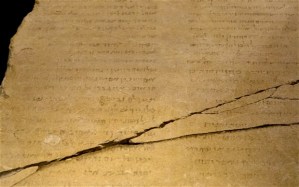
Around the holiday season, on social media, stories relating to the Bible tend to pop up. When my wife mentioned a New York Times story about “Gabriel’s Revelation” on the second day of Christmas, I was suspicious. The story, which was nearly a decade old—the internet keeps things in circulation far longer than those old library tomes consisting of physical newspapers bound together—describes the unprovenanced inscription as predicting a messiah will rise after being dead for three days. I assumed this meant evangelicals would be overjoyed, but it turns out that the artifact, if authentic, predates the New Testament. That means that it can’t be traditionally ascribed as a prophecy, since it’s not in the Bible, and therefore it becomes a threat because it suggests Jesus’ story isn’t unique.

Image credit: The Telegraph, from Wikimedia Commons

This is an interesting dynamic. A potentially important ancient artifact can only have value if it’s in the Bible or proves the Bible “true.” When that happens the faithful crow about how the evangelical position was right all along. If such a document implies that the gospels were borrowing from widespread cultural assumptions, however, it becomes just another unimportant bit of junk from days gone by. Confirmation bias, of course, is something in which we all indulge. Nobody likes being wrong. The difference is that the scholar is obliged to admit when the evidence overthrows his or her position. New options have to be considered.

Since I was between jobs in 2008 when the inscription was announced, it escaped my notice. Now that nine years have settled the dust a bit, there seems to be no sustained case for declaring Gabriel’s Revelation a forgery. Neither does it appear to have changed Christianity at all. The period known as that of Second Temple Judaism has shown itself to have been rich in messianic expectations. We know little, historically speaking, of Jesus of Nazareth. We know from the Dead Sea Scrolls that some were expecting a messiah along the lines of what Jesus was said to have been. But those documents aren’t part of the magical book that contains the truth, the whole truth, and nothing but the truth. In as far as they back the Bible up, they are celebrated. When they call the Good Book into question, they are rejected. I have no idea whether Gabriel’s Revelation is authentic or not. It seems pretty clear, however, that a faith that’s based on one unquestioned source might be more fragile than even other artifacts that have managed to survive, somehow, from ancient times.


Honest Doubt

Kurt Vonnegut was never required reading in my high school English classes. I read Slaughterhouse-Five when I was in seminary, and picked up a few of his other titles in the dearly departed Boston Book Annex. A couple of these used books have been waiting patiently over the decades, and so I selected Cat’s Cradle to be perhaps the last book I finish this year. As far as I can recollect, the Vonnegut books I purchased while in seminary had no particular order or reason. A friend had recommended The Sirens of Titan, but Cat’s Cradle was what would now be called an “impulse buy.” Reading it, I rediscovered why I like Vonnegut so much. I also found out the book revolves around religion.

Regular readers know that I tend to find religious themes in secular books. It’s partially human radar and partially an unfortunate occupational hazard. Occasionally I’m pretty certain the author had no intention of including or developing the themes I discover. Cat’s Cradle, however, places religion front and center. The story involves a journalist on the trail of one of the developers of the atomic bomb. He unintentionally coverts to Bokononism, a religion made up by a castaway on the island of San Lorenzo. The religion, based on the teachings of a still-living sage, revolves around the idea that all its sacred writings are lies. Think about that a moment.

Lies, in which we’ve all had a crash course since January, are among the most insidious of human accomplishments. We value and crave the truth. We all believe that we believe it, but there are differing opinions as to what it is. Some opinions are backed with evidence, and others with flimsy fabrications. To declare a religion based on lies is, of course, to undermine the whole enterprise. Vonnegut was a noted iconoclast, but there’s a brilliance in declaring a religion to be knowingly based on falsehood. In fact, we’re seeing it happen before our very eyes. The religion formerly known as Christianity, once upon a time, took into account the teachings of Jesus of Nazareth, as recorded in the gospels. Modern Christianity—Evangelicalism—has completely thrown Jesus out of the equation in all but name. Branding, after all, is everything. This modern faux religion suggests hating your fellow creature, taking advantage of the poor, and believing falsehoods to be the most sincere of truths. It’s alive and released on the earth even now. And it is far more scary than even ice-nine.


Nothing Better

While it may seem that the largest challenge on a blog like this is writing all these words every day, that’s often not the case. Early on in my blogging life, I learned that images draw readers in. That may no longer be the case, but I do try to ensure that my posts have apt illustrations. Due to the fact that I can’t keep up with technology, I no longer know where these images are even stored, so when I was seeking a picture—amid thousands—that I had saved on my backup drive, I came across a series of photos taken in central Pennsylvania. These showed some road-cuts with obvious and impressive folding of geological layers characteristic of orogenous zones. Geologists only discovered the earth was ancient in the nineteenth century, and evangelicals have been disputing it ever since.

Genesis, so the spotless thinking goes, says the world was created in six days. So, by God, in six days it was created! When Darwin simply put the pieces of the puzzle together, evangelicals objected loudly. They started electing US presidents in the next century—a blink of the eye in geologic terms. They don’t dispute non-biblical dinosaurs, however. Their kids would object. The impressive sedimentary layers (or for that matter, igneous or metamorphic) were, they claim, made by God to look old. To fool us. That’s the kind of deity he is. So I got to thinking of a “to do list” for a God with nothing better to do than to oversee intricate and complicated layers of rock that make sense in geological time, but which, apparently, are only planted here to test the faith of brand-spanking new Homo sapiens.

One thing such a deity might do is take care of social injustice. Since he is a father, I suspect we ought to listen to his son, my evangelical friends. Jesus of Nazareth seemed pretty set on helping other people and everyone loving one another. This was, of course, between stints of helping make the planet look older than it actually is so that sinful scientists could trick their compatriots into going to Hell by believing false evidence. There are so many things you could do if you had the time to make such intricate traps. Why not write another book, for example? The Bible could use a good sequel. But no, it is far better to spend divine time making a world look older than it is. And if I had been able to save the time looking for that image that took over half an hour to find, a post such as this would’ve never been created at all.


Who Can You Call?

They’re scratching their heads. The media, I mean. In this distorted world of Trumpism, newspapers have rediscovered religion. Some say Trump is the altar boy of the evangelical right with people like Franklin Graham wetting himself over the president. Others say evangelicals want to change their name to distance themselves from Trump. Everybody seems to want to know who evangelicals are, but they’re afraid to ask. The weird, or perhaps expected, thing is universities decline to help. For years now they’ve been cutting positions in religion, a topic no longer relevant or of any interest. Academics aren’t always good at seeing what’s right in front of them, of course. So it is that the media’s scratching its collective head. Is he or isn’t he? What can you say about a man who’s so clearly heathen and yet a sparkling example of Christ-like compassion and values?

It’s doubtful whether any university administrator or televangelist could finger Jesus of Nazareth in a police line-up. They have no idea of who he was or what he taught. All that matters is he was God and he protects unborn babies so that he can arm them with automatic rifles when they’re of age. Oh, and he’s definitely not a woman. Or gay. Is that about it? Just in the past week major media outlets have run stories about the evangelical relationship to the commander-in-thief who’s told more lies in his first year than all other presidents combined. Who said Jesus of Nazareth was honest? He just stood for the right causes.

Having grown up evangelical, studied religion with evangelicals, and having been fired by evangelicals, I know them well. They have a mental capacity for biblicism that’s nearly incomprehensible. The Bible is so sacred that no other book should be placed atop it. It should never be set on the floor. Memorizing chapter and verse is more important than knowing what they might mean or how to live by them. This is old-school blind faith. And proudly so. Trump doesn’t know the Bible but he says he does. His actions resemble the carpenter from Nazareth’s about as much as Joseph Stalin’s. He was a good Christian, too, wasn’t he? After all, the Bible says Russia is our ally. Reagan—another evangelical—may’ve said they were our worst enemy, but one thing we know for sure about the Good Book: it never lies. For that it takes evangelicals and politicians.


Wise Women

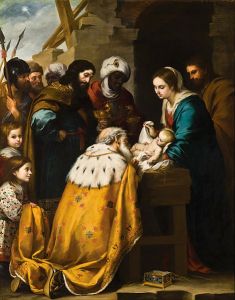
At a neighborhood holiday gathering the topic of a local living nativity came up. This year they need some wise men (don’t we all!) and some of the women mentioned that wise men should have beards. As the wearer of an old growth facial forest, I became the subject of a couple of queries—could you be a wise man? I replied that I wasn’t smart enough, but in the back of my mind I was attending the last church nativity play I’d been in. It was at the Church of the Advent, Boston’s high Episcopal establishment. I was cast as a centurion and was directed to deliver my lines woodenly. Being who I am, I did as I was told. I was invited to the cast party on Beacon Hill anyway. It was one of my few brushes with society folk in Boston.

Like many boys raised in church, I’d been cast in such plays before. One of three boys each born just one year apart, I was assigned the role of wise man along with my brothers. Far too young to grow a beard, I wore a costume made by my mother and carried a jar from a science experiment as a gift for baby Jesus. Being poor, we had no gold—or even frankincense or myrrh—lying around. In school we’d done this science project where a solution grew crystals up the inside of an ordinary coffee jar and out over the top. Stain it with food coloring and you have a gift fit for a king. So the illusion went.

The Christmas we celebrate today isn’t based too much on fact, but it is a prime occasion for plays. It’s a dramatic story, although the New Testament has to be bent and twisted to make it all fit into the comprehensive narrative of proselytizing playwrights. The king nobody recognizes being born in a barn. The creator of the universe being rejected by the very world for which he (the baby was always a boy) was responsible. The story is as timeless as Dickens’ Christmas Carol, and it’s enacted thousands of times each year in churches large and small across the country. Is there any reason that, as long as we’re straying into realms of imagination, the wise visitors shouldn’t be female? The ability to grow facial hair has little to do with any kind of intelligence. In fact, we’d be much better off right now with a woman in charge.


Museum Piece

So the Museum of the Bible is now open in Washington, DC. It actually opened while a quorum or more of biblical scholars were busy making their way to Boston for the annual meeting of the Society of Biblical Literature. Many of the guild realize that the museum’s a conservative, evangelical venture, but it brings some attention to the beleaguered field and so it’s strangely welcome. This shows itself in the rather surprising names on museum publications. Renowned scholars don’t seem to think through the implications of supporting such places with the star appeal of their names. Indeed, many in the professorate are starved for attention—I’m not judging; I implicate myself even by making such a suggestion. When such an institution opens, it validates those it implicitly condemns.

A Bible museum?

Scholars can be woefully naive. Visiting places such as the Museum of the Bible, or the Creation Museum, or the Ark Encounter, pumps money into the already very well-funded Christian right. Such believers are extremely political and seek to get candidates like Trump elected. By slaking our puerile curiosity, we’re funding those who’d have us stripped of our very freedom to believe as we do. The paper trail’s there for any who wish to follow it. Supporting such ventures in any way will lead to headaches in the future. Sure, I’d love to see dioramas of dinosaurs on the ark so that I could feel superior for a little while. There’s a price for such vanity, however, and that price is the loss of freedom itself. We see it at work in our government at this very moment.

Museums are places for artifacts that are outdated. This is an ironic statement to make concerning the Bible. Especially by those who believe it is the final word. Why put that word into a museum? The irony’s worth it if enough paying customers arrive. Scholars meanwhile try to find ways to analyze this. Articles and books are appearing, stating what we already essentially know. The Green family, motivated to repressive political action because of their Bible belief, have spent money to build an elaborate museum, money that could’ve been used to help the poor. The book that appears in that museum suggests that the poor should be our concern. And although it actually does say that idols shouldn’t be worshiped, it has the great potential to become one itself. All you have to do is pay the admission price to find out.


Devolving Apes

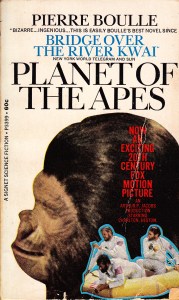
It would be difficult to overestimate the effect the movie Planet of the Apes had on me as a child. Raised a biblical literalist, evolution was, naturally enough, anathema to me. And yet here was a movie based on the idea that evolution had taken a different course. It was a transgressive film, but the screenplay had been written by Rod Serling, so well known for his trusted work on The Twilight Zone. I was utterly fascinated by it. Until the most recent iteration, I’d seen every sequel, spinoff, and reboot ever made. So important was this story line that as a child I found a copy of the book, in English, of course. Pierre Boulle told the story somewhat differently. Spying the book on my shelf after some four decades of my own evolution, I decided to read it again.

We all evolve. I noticed the improbabilities more this time through. The fact that, unlike the movie, humans wore no clothes at all must’ve scandalized my young eyes. I would’ve agreed, however, with Ulysse Mérou’s sentiments that humans were created in the image of God, not apes. In fact, there is an undercurrent of a somewhat conservative theological outlook here. Humans may experiment on animals, but when it’s reversed, it’s evil. In many ways, the cinematic version improves the story, but Boulle’s telling grows in intensity as the novel unfolds. Mérou develops a moral sense that includes the apes as well as human beings. The story, of course, is largely about prejudice and its evils. In that respect, it’s timeless.

As a child I realized that we lose something if we accept the fact of evolution. We lose that special feeling of having been intentionally created by a deity that made us God-shaped. Ironically, I also came to realize that those who rejected evolution often treated their fellow humans like animals. They held onto prejudices against other “races.” They castigated the poor for being lazy. They wish to remove healthcare from those made in the image of God. The contradictions and cruelties simply don’t comport with the Good Book they adore and ignore. Evolution, with the realities of nature impinging on our security, is far less dangerous than what biblical literalism has evolved to be. I can’t say why this book and its cinematic renditions became so deeply embedded in my young mind. But having read the book again, it’s pretty clear that the ideas have remained there, even as they have modified, with descent, over time.


Predestined?

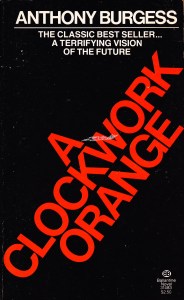
This particular doctrine struck me as evil. It violated every experience and thought I’d ever had, even raised as an unquestioning Christian as I was. Then, at Grove City College I was faced with it for the first time—predestination. If free will is an illusion, what crueler God can be conceived? I couldn’t avoid such thoughts upon re-reading Anthony Burgess’ A Clockwork Orange. A non-conforming non-conformist at the college assigned it in a science fiction class, so it has been decades since I’d read it. Now I found it perhaps more profound than before. Much has happened since my initial reading of the book, o my brothers. (And sisters.)

The framework of the story is well known. Alex and his friends are teenage punks who love ultra-violence. Alex is betrayed and imprisoned. Considered incorrigible, he’s reprogrammed to the point that he can’t even defend himself in a society that’s grown even worse during his time in jail. In the hospital after a suicide attempt, he awakes to find his old self restored, whether this is a good thing or not. The main point that’s behind this, it seems, is that without free will, repentance means nothing. In fact, in my edition of the book, an afterword by Stanley Edgar Hyman makes the point that some interpret A Clockwork Orange as a fictional defense of Christianity. Certainly the comparisons are there, from Judas through Jesus, healing, sin, and suffering. How much it actually meets that idyllic vision of God in Heaven directing the lives of individuals is, of course, an open question.

The idea that human beings are born as Hell-fodder posits a cruel and sadistic deity. Not only are the majority of human beings going to face eternal punishment for matters beyond their control, there is a divinity who planned it that way. We are all, literally, puppets in a universal morality play written by a being whose moral compass is horribly skewed. Indeed, even at Grove City some of the faculty would state that philosophically there could be no contest—free will was right. But, they would add, tapping the Bible, it’s not true because the Word of God says so. When I protested, it was declared, without irony, that even my protest had been predestined. In other words, in this clockwork universe I was clearly an Alex. Upon closer inspection, however, the truer analogy would be that we are all the victims of Alex and his droogs. But only if we have the freedom to make such an observation.


Persecution Myth

The myth of persecution is a great cover. Christians, we are accustomed to think, are timid and loving individuals eager to turn the other cheek. In this sophisticated world of science and technology, they might appear a little naive, but they’re not really out to hurt anyone. Or at least some of them aren’t. I grew up among what would now be called Fundamentalists. Harsh to their own sins, they’d not imagine harming others. The story went that in the Roman Empire days it was open season on Christians and the oppressors liked nothing better than killing off a dozen before breakfast. That myth has largely been debunked by historians. Yes, there were some brief periods of intensive persecution, but for the most part the early Christians were left alone.

Many of the more zealous among the literalist sects today feel the loss of that mythology keenly. What can you do when you learn that your primitive ancestry wasn’t as heroic as you thought it was? For some, that myth must be kept alive today. When it is acknowledged that our world has become a smaller place because of technology, we get exposed to those who give the lie to our prejudices. Moral Muslims (despite the media portrayals), Hindus, Buddhists, and even secular humanists, abound. News, however, thrives on negativity. After all, it too is a capitalistic enterprise. We see the violence, the hatred, the bigotry. The myth lives on. Christian Dominionists have simply given up on the rest of the race. The Bible, after all, says few will be saved. And they have thrived for decades based on the simple fact that nobody takes them seriously.

I have seen the lack of compassion in evangelical eyes firsthand. A coldness that declares education to be evil since the only truth was revealed long ago in unchanging form. The word of God stands forever. It says so itself. And among the most despised of all human beings are those who study that word instead of “just reading” it. Those outside this camp know there is no such thing as “just reading.” They also know that we have no original biblical manuscripts at all and that translations are merely approximations. It’s difficult to build absolute laws on approximations. Among themselves these groups claim that legislation to treat others equally is a direct affront and insult to them. In fact, they claim they are persecuted because of the fair treatment of others. The thing about democracy is that any system can be gamed. Even Putin can be your friend, for this is the world of myth.


Bible Practice

In a strange kind of oneupmanship, the horrendous murders in Sutherland Springs overshadowed the story of Scott Ostrem’s multiple shooting at a Walmart in Colorado. Ostrem apparently shot at random and killed three people. No motive is known, but when his apartment was searched a stack of Bibles was found. Plenty of people have Bible stacks in their houses—I know I do—but the odd element here is guns. The “reasoning” behind the NRA’s convoluted logic is that guns are for self defense. Everyone ought to have them, along with their Bible stacks. When those voices in your head begin to speak, which you grab—gun or Bible—may make all the difference. Fact is, you don’t have to be mentally stable to buy guns. And no matter how much the NRA says you should shoot back, guns in the hands of madmen obey no rules.

Trump promised to make America great again. One of the statistics at which we excel—indeed we’re a world leader—is gun deaths. We also do pretty well at opioid overdosing. Politicians can’t seem to figure out that the underlying causes here are related to the society they’ve built where you can’t ever get ahead and no matter what you do the 1 percenters will get richer while you spend your days struggling to get to the point when you can climb back into bed and sleep it off until it all starts over again. Watch them in congress. See them trying to thrust more money upon the wealthy. See them pocket the funds the NRA so generously offers. And then read the statistics. Some inexplicable disconnect exists that no amount of drugs will bridge. We are a hurting nation. And stacks of Bibles aren’t the answer.

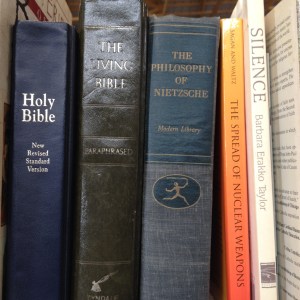
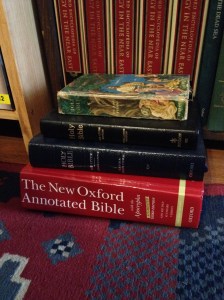
A Bible stack in its natural habitat

In antiquity there was an ideal. Not that it ever existed in practice, but at least they had the idea. The ideal was that there was nothing wrong with wealth as long as the wealthy first ensured that everyone had enough. Then they could go on an accumulate as much as they wanted. The problem of course is that nobody knows what enough is. When do you know that you have enough? Today there’s no ceiling cap. Take your pick: money, guns, drugs, Bibles. You can have as much or as many as you wish. In just about any combination. Any combination that doesn’t involve money. Only the 1 percenters should be entitled to that. And the rest of us here below and fight it out over the remaining three.


Christian Story

The problem with the Bible is anybody can “interpret” it. As a book of unrivaled status in the American imagination, it can be tapped for anything from advertising to justifying pedophilia. So when stories of Roy Moore’s sexual dalliances with minors emerged, Alabama’s state auditor, Jim Zeigler drew the comparison with Mary and Joseph from his half-hearted knowledge of the Bible. There is no auditor for Bible interpretations. It’s the ultimate free market. Many, including evangelical clergy, were quick to jump on the inappropriateness of the analogy. What they didn’t see is that the Bible can justify just about anything. Despite what it says. That’s the problem with worshipping a holy book.

What the Good Book says about Mary and Joseph is very, very little. We do not know their ages—they are never mentioned in the Bible. The tradition about Joseph being older seems to go back to having to explain his continence to preserve Mary’s perpetual virginity—also not in the Bible. The church, in the early days, had issues with ideas such as “original sin.” When Augustine suggested it passed, along with bodily fluids, during sex, it became clear that Mary could have none of that. Even if she was a virgin by misquoting Isaiah, then she still had original sin from her parents. So Mary had to have been immaculately conceived. The Bible, of course, knows of none of this. Anybody can interpret it. And what senator-to-be wants to be bothered with consulting a Bible scholar? They’re hard to find. And besides, they might not interpret it the way you want it.

GOPolitics have sunk so low as to pressgang the Bible into justifying pedophilia. What’s more, the faithful don’t seem to mind. The Bible’s big enough that you can find just about anything in there. Except morality, apparently. You’d think that anyone running for public office would examine his—and it’s usually a guy problem—life pretty closely for possible scandals. We’ve lived to see the radical right, diligently groomed and oh-so-righteous, go after anyone who can spout insanity and be counted on to vote against women’s rights. You can be sure Roy Moore will be forgiven—already has been by many—because the Bible swings that way. We’ve already seen what happens when people like Moore take public office. They make America grope again. For the Bible tells them so.


Joshua Fit

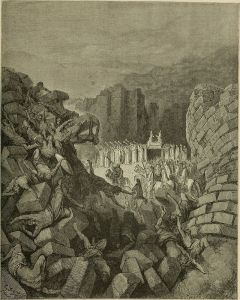
“Horrible things are going to happen!” shouts Grandpa Simpson. He ends his epiphany in church with the strange words “Epa, epa!” The Simpson’s Movie, among many other popular outlets, has had some fun at the expense of the Environmental Protection Agency. Over the years many people have concluded that it is ineffectual and that the heart of the government isn’t really behind it. One of the Dominionist creeds is that the government as we know it must be disbanded. Trump has been working hard at that, on his breaks from the back nine, since January. Appointing heads of agencies tasked with dismantling them, the underlying plan (not Trump’s, for he has no plan) is to take the current government apart while self-important Republicans simply can’t understand that they’re being used as pawns to be sacrificed as soon as a knight or rook comes along. Bishops don’t seem to be of much use anymore.

So when the head of the EPA cites the book of Joshua as science, some were surprised. Scott Pruitt, according to a story on BuzzFeed my wife sent me, has decided that the Old Testament is the new frontier. You have to choose who you’re going to follow. As for Pruitt and his house, it will be the Lord. And by “Lord” I mean money. Those who stand to gain by deconstructing the EPA are big businesses. Those who stand to loose? Only Homo sapiens and every other species on the planet. Although, in all fairness, rats and cockroaches have a way of thriving in our wastelands. In fact they seem to be thriving in Washington DC. I almost tripped over a rat on my way to work just the other day. They’re not just for the subway tracks anymore.

The Bible is the most abused book in history. This is what idolatry looks like. You take an object and make it a god. Nobody would be more surprised to find their words worshipped than those who wrote the Bible. Not one of them realized that their words would be taken the way that they are today. It’s pretty obvious that Paul of Tarsus would’ve taken a little more time in his letter writing had he known they’d be one day mistaken for God’s words instead of his own. And Joshua—well, we don’t even know who wrote that material. Whoever it was believed the earth was flat and that to stop a day from progressing all God had to do was hold the sun still for a day. No hot mitts needed either. This is, after all, the most powerful government in the world.


Turn the Other What?

The man next to me on the bus is reading his Bible. At one point in my life that would’ve made me feel safe. I would’ve known that the person next to me was committed to the same value system as mine—love for all, peace, equality, and acceptance. Now, however, I see that Bible and I’m afraid. You see, I’m reading Chris Hedges’ American Fascists: The Christian Right and the War on America. I can’t remember the last time I’ve been so scared. Hedges’ book was published a decade ago. What he wrote about then is coming true now and it’s because the elites of society—university folk and all—don’t take the radical religious seriously. In their delusional ways, they assume all will be well. If you think like that, read this book.

Dominionism is fascism dressed in Christian garb. It has no room for tolerance. It teaches that those outside its circle are to be ignored at best, and murdered without compunction at worst. This is not exaggeration. It is their teaching. It’s like that computer game that used to come with Macs where a time-traveling dinosaur collected the eggs of other species to save them from the coming asteroid. You could kill other dinosaurs without guilt because you knew they were going to die in 20 minutes anyway. That is very much the way Dominionists feel about you and me. We aren’t saved—their word is “Christian”—God has rejected us, and therefore we deserve to die. Many of them stockpile weapons just for this reason. Their goal, not at all hidden, is to take over the United States and make it a Christian nation. Already many in the houses of Congress are their candidates. They have a president who shares their values. We should be very afraid.

Hedges does a very good job providing the statistics that back his assertions. There is no question that this is real. Those who blithely vote Republican out of fiscal conservatism have risen to the bait. Trump has proved that once and for all. These “Bible believers” do not value or treasure love. They treasure treasure (many of them are very wealthy) and what they desire is power. Tolerance, in their view, is evil and compromising with the literal Satan in which they believe. Their Jesus does not love. He fights. And he fights for white, straight, privileged men. If you’re willing to forsake sleep, read this book. And if you think it’s exaggerating read the headlines.


Learning to Evolve

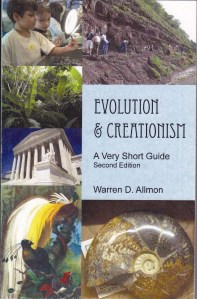
Not to beat a dead hadrosaurus, but creationism is in danger of driving us extinct. On a visit to the Paleontological Research Institution’s Museum of the Earth in Ithaca, I picked up a copy of Warren D. Allmon’s Evolution and Creationism: A Very Short Guide. Although I’ve read plenty of books on the subject, a refresher is never a bad idea. When it came to statistics, though, it grew scary. The majority of Americans do not accept evolution, despite all the evidence for it. What’s even scarier is that a large percentage of physicians—particularly Protestant ones—do not accept it either. Allmon is writing for a local readership, but these issues are quite large. World-wide, in fact. One thing most scientists don’t understand is that “religion” isn’t to blame. Literally reading of texts is.

Were it not for the creation myth in Genesis 1 there would be no conflict over evolution in Christianity or Islam. The question comes down to how one understands a sacred text. Many religious believers can’t get beyond the basic issue of if it took more than six days to create the world then that house of cards called biblical truth collapses. There’s a panic involved here. A very real and visceral fear that heaven itself is on the falling end of the balance. No amount of scientific reasoning will help with that. Hell is just too scary. And reason tells us that reason can’t solve this dilemma. Those raised religious by caring parents can’t believe that Mom and Dad would teach them wrong. Emotion plays a stronger role here than reason. More Kirk, less Spock. When even a majority of high school science teachers feel that “teaching the controversy” is okay, we’re in trouble.

Allmon’s book is well-intentioned. Of course, it was written before the post-fact world evolved. The stakes for not accepting reason (think Trump) are extraordinarily high. Having a figurehead that doesn’t accept rational explanations for what the educated can see plainly encourages widespread copycat ignorance. In the rational world there is no doubt about evolution. Most mainstream biblical scholars and clergy accept it. Don’t try to convince others with an argument, however. This is a matter of belief. Allmon does point out that science can’t speak to non-physical processes. It can say nothing about God. But a certain book can and does. Had it been written in modern times none of this might have become an issue. Until we realize the power of that book, we’re going to continue to struggle to come to grips with simple facts.