Camping Season

Summer is the time for camp. I’m not into extreme sports, like sleeping outdoors in the snow, so in my mind, summer is the time for camp. While in college I spent two summers as a counselor for the Western Pennsylvania United Methodist Conference camps: Wesley Woods, Camp Allegheny, and Jumonville. These were formative experiences for me since I’d never camped as a kid (beyond sleeping on the front porch and an ill-fated attempt at Boy Scout camp one winter), and certainly not in a Christian context. My wife recently sent me a story in The Guardian about Jesus Camp. The documentary is a decade old now, and people are wondering if the religious indoctrination of children is child abuse or what. As always in such situations I tell myself the real issue is that you can’t understand Fundamentalism unless you’ve believed it. Really believed it.

IMG_2856 copy

Some psychologists claim children can’t conceptualize God. Many adults can’t either, but for those who try, what they believe is true. The Fundamentalist parent doesn’t attempt to deceive his or her child. The thought of having your own children suffer eternally in Hell is a wrenching, and very real one. A convinced adult is morally, viscerally, and utterly compelled to teach her or his child the truth. Anything less would be monstrous, hideous, and inhumane. Critics from the outside say that such nonsense damages children psychologically. I have to admit that watching Jesus Camp made left me feeling enraged and, in some measure, victimized. The untold reality, however, is that apart from some cases of deep insincerity, most Fundamentalists truly believe what they teach their children. They’re not trying to abuse any more than a parent who teaches their progeny that the stove is hot. They want the best for their kids and life is full of uncomfortable truths.

Richard Dawkins, notably, has argued that teaching children religion is a form of child abuse. The fact is nobody knows the truth about religion. All we can do, scientists included, is believe. Believe for or against or somewhere in the middle. God, by definition, stands outside the reach of empirical evidence. Perhaps it’s just a trick of consciousness, but we have to leave the possibility open. We don’t even understand consciousness yet. Rare aberrations apart, people love and care for their children. They try to give them the best that they can, and that includes their religion or lack thereof. I saw some strange stuff at church camp. It wasn’t in any sense “Jesus Camp,” but it’s safe to say it changed my life. On the brink of fully legal adulthood I was coming to learn that certainty was impossible, and the only honest way to be in the world was to admit that we all, in some form, believe.


The Lure of the Dark Side

I have to confess that the easy self-publishing of ebooks is a real temptation sometimes. Perhaps it’s one of those inexplicable side-effects of earning a Ph.D., but sometimes you have the impression you have something to say and traditional publishers just don’t agree. In my work life I see many clever ideas that, well, let’s be frank, just won’t sell. Publishers do have to keep an eye on whether a book can earn back the money put into it, and sometimes a good idea leads to no cash payout. So when you can easily sign up online—you don’t even have to talk to anyone—and post your unedited words right on Amazon and call it a book, well, anyone can be an author. So I was looking up books with the terms “Bible” and “America” on Amazon when I came up with Donald Trump in the Bible Code. I found the self-designed cover frightening, and the sentiments expressed in the description grounds for terror. Then I noticed it was only 15 pages long. I’ve written student evaluations that were longer than that.

Trump

At three bucks, that’s—wait while I get my calculator—twenty cents a page. Now anyone who’s been able to read the original Bible Code and not cover a snicker or two will possibly find such a jeremiad palatable. After all, it’s a book! Somebody published it. Well, actually, all you need for self-publishing is an internet connection and at least one finger to type and click. Or a toe. You too can become an expert! No education required. Publishing fiction in such a format is one thing, but when people can’t tell a prestige publisher from a vanity press when it comes to factual material, we’re all in trouble.

There’s an old saying: “those who can’t do, teach.” I think I first came across this wisdom in a Peanuts cartoon, with all the gravitas that such implies. Editors, it seems, are not required for publishing. In fact, some of us who live by the word seem destined to die by the word. Even with connections I have trouble getting my ideas published. More than once I’ve lingered on Amazon’s CreateSpace page with my finger hovering over the mouse. Publication is one click away and some people make six digits a year publishing only on Amazon. Since I produce about 145,000 words a year on this blog alone (apart from my other writing), the urge is very strong at times. Then I look at that cover and I stay my finger as it hovers. I’ll wait a little longer. At least until November.


The Devil Made Me

TheWitchesWitch-hunts, I suspect, will become all the rage again if a certain presidential candidate is elected. The fear of witches is not easily explained in a world driven by materialism, but certainly misogyny plays an unholy role in much of it. Stacy Schiff’s The Witches: Salem, 1692 has been selling well. Since my wife is one of the many descendants of the Towne family that suffered three witch accusations resulting in two executions (Rebecca Nurse, Mary Esty, and Sarah Cloyce) we read this book together. It is a detailed account of the year we went mad. A year when being different, especially not being Puritan, and not being male, was dangerous. Religious tolerance was not a gleam in the colonists’ eyes since religious freedom translated into not being forced into the government church, not allowing others the same privilege. Indeed, as Schiff points out, religious tolerance was considered by many to be a satanic idea. If ministers starved due to such freedom, it would be easy for Satan to take over. As it was, the Dark Prince seems to have done a pretty good job among the Puritans without such tolerance.

The idea of the Devil has been (and still is) the ultimate scapegoat. People in a capitalist society are naturally frustrated—surprisingly few see this—and frustration always seeks a reason for its own existence. That is patently clear at Salem: blame the Indians, blame the French, blame the Quakers, blame the women. Any and all may be agents of the Devil. Even the descriptions of the Lord of Darkness varied so much that, were he a human, no one could be quite sure who it was they saw. The Devil always takes the form of your enemy. All it takes is an influential clergy willing to push tense believers over the edge. Soon we begin building walls. Then we build gallows.

Religious tolerance has always been a frightening thought. Protestantism challenged a somewhat uniform Catholicism and the mite of a doubt burrowed deeply into peoples minds: is my religion the wrong one? Tolerating other religions means admitting that yours might be wrong. The logic that plays itself out is a terrifying one to some. Belief is never easily changed. States can’t stand dissenters. The only capital crime for which the federal government still executes citizens is treason. Treason sits uncomfortably on the other side of the coin whose obverse reads “tolerance.” You’d think that three centuries would be long enough to learn something. Unfortunately some lessons—often tragic ones for the powerless—have to be played out over and over before we start to comprehend that Satan can be anyone we want him to be.


Mythisotry

Positivism takes no captives. I’m not talking about the philosophical system—not necessarily—but about the phenomenon of assuming absolutes are available for human consumption. Some physicists, for example, assume that because our five senses can detect reality only the perceptions of those senses can be considered real. Material. Nothing more. Nothing less. A similar view plagues those who believe history is the telling of “what actually happened.” No historical event has ever been fully explained. All stories are told from a perspective. This is particularly dangerous when religions get involved. Many mistake historical veracity for “truth.” If it didn’t occur just as “the Bible says” then we should throw out the whole shebang. No point in believing in half truths. This is a myth.

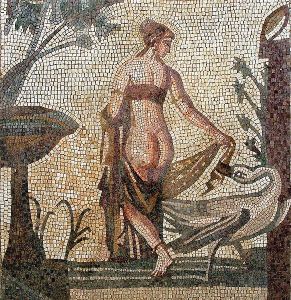
This point was reinforced when a friend send me an article about the production of “The Hollow Crown” on the BBC. Apparently a local politician tweeted that having a Nigerian of Jewish descent (Sophie Okonedo) play Margaret of Anjou, a French queen, didn’t match history. As proof he provided a downy white Medieval illustration of the queen. In a rare moment of academic cool, an historian quickly pointed out that the illustration came from a manuscript that claimed Margaret descended, Leda-like, from a swan. Her whiteness, thus, belonged to her avian DNA. As the story makes clear, history is the modern mythology. We assume we know what happened, but we will only ever have part of the picture.

582px-Leda_mosaic_crop

Prejudice seldom worries about historical accuracy, unless, of course, it helps to uphold the bias. I used to caution my students about taking history as a statement of fact. Certainly there are events with factual elements, but when everything is interconnected we can never untangle precisely what happened. When we “believe” history, we are choosing to accept a certain viewpoint of things. One person’s manifest destiny is another person’s genocide. Peculiar institutions are very peculiar indeed. History, as we’ve come to know, reflects the point of view of the historian. It must be read and evaluated as the opinion of the writer and not as the absolute truth. For me, I rather like the idea that some people are descended from birds. It certainly helps to make more sense of what I see in the behavior of those who claim to be making history today.


Religious Melancholy

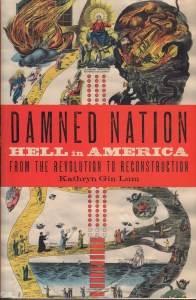
DamnedNationI’d never come across the term “religious melancholics” before, but somehow it seemed to suit me. Perhaps that goes without saying as I’m reading Damned Nation, by Kathryn Gin Lum. While sitting on a bus. We’re sitting in traffic and the guy sitting next to me has obviously just finished a cigarette before climbing aboard. Having grown up as the victim of second-hand smoke for my first two decades in life, I’m thinking about Hell as well as reading about it. You see, Gin Lum’s descriptive subtitle is Hell in America from the Revolution to Reconstruction. The fact that Hell’s alive and well, despite some evangelicals’ attempts at annihilating it, suggests that it’s best to keep informed on the topic. This book’s mostly historical, however, reporting how Americans interpreted Hell in the eighteenth and nineteenth centuries.

As with most histories, I find the earliest material the most interesting. Gin Lum tends to focus, naturally, on preachers at this period since they are the ones most likely to talk about eternity. The thing that struck me the most was the number of people she describes who, after contemplating (a primarily Calvinist vision of) Hell, attempted suicide. I tend to think of suicide as a contemporary problem, but obviously it has been a steady human practice since our species first learned that you don’t have to wait for someone else to help you slough off this mortal coil. It is troubling, however, that it was a “doctrine” barely found in the Bible that led people—most of whom later became preachers—to try to kill themselves. It also seemed a touch odd that evangelicals in those earlier days of our nation didn’t find it troubling that those leading the flock had almost sent themselves to perdition. These early days of literal Hell believing were most interesting indeed.

The phrase “religious melancholics” comes from the resistance. There were those—generally skeptics, doctors, psychologists, and the like—who felt that the preaching of hellfire and brimstone took a toll on the healthy psyche, particularly of the young. As one of those who grew up attending revivals where Hell was a featured guest, I know that my life has been a prolonged attempt to avoid said eternal lake of fire. Even when I rationally learned that there is no three-tiered universe in which it still fit, and that the idea was cobbled together from a variety of religions into the ultimate scary place, Hell still manages to haunt me. Does it keep me moral? I don’t suppose that to be the case, since I have tended to believe people are basically good. Don’t bother trying to convince me logically that Hell doesn’t physically exist. I know that already. It’s the mental one that I’m trying to avoid. And that can be a full-time job for a religious melancholic brought up on a diet of overcooked theology.


Freezes Over

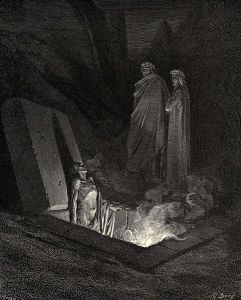
A good metaphor gone bad can do a lot of damage. Like a loose cannon. Hell is a bad neighborhood for metaphors. Taken literally Hell can be hell. So it is that many evangelical Christians are abandoning the concept. Jumping ship on the Manichean outlook that has policed bad behavior for two millennia now. A recent article on National Geographic by Mark Strauss discusses why many leading conservatives are now casting Hell into the pit and looking for ways to make God look better. Like many metaphors, Hell best resides in a world of black and white. A dualistic world where there are no shades of gray (certainly less than fifty of them). A world where any behavior can be understood as good or bad, forward or retrograde, never neutral. You’re either for us or against us. There’s no Switzerland in this geography. That’s precisely why so many people want to keep Hell on a leash.

Dore_woodcut_Divine_Comedy_01

Hell probably never would’ve become such a motivator for good had Jesus not mentioned it. Prior to its encounter with Zoroastrian beliefs, Judaism held that the dead quietly resided in Sheol, a dreary place, true, but hardly fiery real estate. You worked out justice here on earth because that was the only chance you had. The dead were sleepier than early morning commuters and they received neither rewards or punishments. It was a much more egalitarian view of things. The dualistic Zoroastrians saw paradise and torment as a great image to explain evil in the world. The sorting takes place after this life is over. Jesus used such language as well, and the image became canonical.

Evangelicals are now starting to think through the implications of all this. A God with the kinds of anger issues that condemn people literally forever might be problematic. Sure, we may get angry at our enemies, but only the most truly heartless person has no pity on their suffering. What does it say about God if his anger lasts for eternity? Some, therefore, are trying to put the metaphor back into Hell without losing the strict divisions for which the good news crowd is famous. Instead of full-time Hell, perhaps there’s part-time Hell with time for repentance. Or simple annihilation. Metaphors lose their power when they come to be taken literally. Hell is such a loose canon. Doctrine among the doctrinaire is often non-negotiable. Although some may try, as a whole, the fires of Hell can never be extinguished. At least to those who understand figures of speech as statements of fact.


Map to Eternity

One of the most remarkable things about Christianity is its fascination with the end of the world. Far from being the obsession of nineteenth-century dispensationalists alone (the other Mr. Darby), the earnestly anticipated end goes back to Paul of Tarsus, the first known Christian writer. Before even a Gospel was penned, this sect was expecting the end to come any day now. It still is, at least among many sub-sects. My wife, however, recently sent me a story on National Geographic about a map collection from the 1480s that depicts a geography of the apocalypse. If you were wondering where to make that left-hand turn, this book may be for you. One wouldn’t want to drive a German mile into Hell without an indicator signal on.

The story by Greg Miller describes this late Medieval manuscript and its assurance that the world will end in 1651—talk about your great disappointment! The unknown author of the codex feared Islam almost as much as Donald Trump but instead of running for the GOP nomination he wrote a book showing just how the end would take place. Illustrated, of course. Map is territory after all. I grew up reading fundamentalist tracts that did essentially the same thing. The more progressive bits of the propaganda left out the actual dates because an earlier Miller seems to have missed the doomsday boat, along with various and sundry telltale timekeepers. There in front of me I could nevertheless unfold the future and once the European Common Market gets its tenth member—wait, what? Has yet another head of the beast been lopped off?

Maps give more than directions.

Maps give more than directions.

Ironically, early Christianities were anti-materialistic. Money was considered the root of all evil and communism was the ideal. If you doubt me ask Ananias and Sapphira. They thought long-term investment was a bit of a foolish notion—something that I have somewhat naively, if unintentionally, followed my whole professional life. You can’t be vested without three years of servitude after all, and I was expecting the Second Coming after one year. Two, tops. If only I’d had a roadmap. It’s only 1777 German miles from Lübeck to paradise, so maybe I can catch the next doomsday boat and still get there in time.


Noah Way

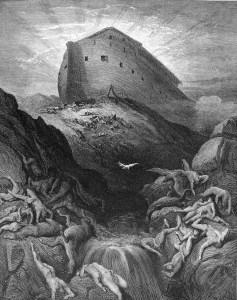
As a fleet of Noah’s Arks near completion, some critics would like to stop these Titanics from their mythical crossing. The Ark Encounter, despite announcements of its demise, is set to open soon in Kentucky. This Noah’s Ark replica, unlike its seaworthy compatriots, is land-locked in bluegrass country. According to a story originating in the Lexington Herald-Leader, Tri-State Freethinkers tried to take out billboard ads suggesting the ark advocates genocide and incest. Well, marrying first cousins has been done before (think about it). And if you go back ten generations things get even a bit dicier with Cain’s wife and that of Seth. All in the Family wouldn’t even air for 6000 years. As for genocide, well, this was more like genomicide. Not a race, but an entire species, apart from kissing cousins, was about to learn the hard lesson of being born not of chosen stock.

According to the article billboard companies have rejected the Freethinkers’ proposal. It might cause accidents, they suggest, which, although not technically genocide, do take the lives of the innocent, even in dry weather. The flood divides people. Thus it always has.

Dore_arch_noah

The culture wars, curiously, pick strange targets. I’m not in favor of teaching children to read myths literally, but then, I’m not in favor of bringing them up as materialists either. There used to be a concept called the “via media”—the middle of the road. Now such a stance appears decidedly wishy-washy. Milquetoast anyone? It is much better to be combative. “Oh George, you’re always so forceful,” sighs Winifred. So we teach our children. Boys, push your way to the front.

Implications can be tricky things. Allowing opponents, no matter how naive, their say has always been a mucking out of the Augean stables. Nobody likes to accommodate other points of view. Watching the parade of politicians we must be assured that we alone are right. Still, the stillborn billboard has a point. Building arks is the sign of the ultimate intolerance. Not only do you condemn those who differ to the outside, you are giving them a self-righteous death sentence. Maybe the billboard should stand. Or maybe it should not. What would Charlie Brown do?


Omen, O Man!

Omen_ver4

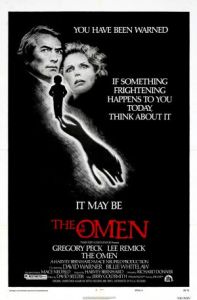
Of the unholy trinity of late-60s to mid-70s horror movies Rosemary’s Baby (1968), The Exorcist (1973) and The Omen (1976), the last always seemed the least effective to me. Having recently read about the Devil in American popular culture, and having a rainy Friday evening alone, I decided to give it a try again. Based as heavily on Hal Lindsey as it is, once one outgrows dispensationalism it is hard to be frightened by the idea of biblical end times. Everything from making up verses in “Revelations” to utterly bogus Holy Land geography (Megiddo is north of Jerusalem, not south—did the writers not even own a map?) contributes to a set of untenable tenets, even among the bibliterati. The film relies mostly on shocks and startles to earn its horror stripes, and after you’ve seen the movie once, these lose their power in subsequent viewings. Nevertheless, on this rainy May night, so close to June 6, I noticed new ways in which the movie undermines its own message.

The premise, of course, is that Damien, the son of the Devil (who apparently has a thing for bestiality), is plotting to take over the world through the means of politics. Having been watching the events of the past few months I have to wonder how the Devil could improve on progress through such channels. But I digress. His step-father Robert Thorn, US ambassador to London, discovers his “son”‘s identity and tries to kill him. With a strong anti-Catholic bias (the Antichrist is born in Rome, the seat of the church, and is protected by Roman clergy) the film nevertheless spawns sympathy for the Devil. As a child, Harvey Stephens hardly appears diabolical. Maybe it’s just because my brothers and I also spilled goldfish from their bowl once, but it seems to me he acts just like most little boys do. Who really wants to go to church at that age? As the movie approaches its climax, he’s represented as the biblical good-guy.

Thorn has to confirm Damien’s satanic identity. Like Delilah, he creeps up on the sleeping boy and cuts his hair. Convinced by a man who introduces himself “I am Bugenhagen” that he has to stab the boy, Thorn in a white car outraces police (so there might be a bit of prophecy here after all) to sacrifice the child on the altar. The movie casts Damien as both Samson and Isaac within a few short minutes. Apart from the film’s use of violence against women’s bodies (Thorn won’t allow an abortion, Kathy seems to have a penchant from falling from high places in slow motion, Baylock gets a fork in the neck) it actually seems ambivalent about the evil of the boy. An unfortunate birthmark does not a devil make. We’ve made it through the change of the millennium and many other hazards, yet dispensationalism is still with us, as is its anticlimactic Antichrist, Damien. He’s less scary than the real politics of an entirely secular age.


Narrative Ark

Complete with an artificial giraffe perched on its prow—or aft, I can never tell the difference—a modern-day Noah’s ark is about to set sail. Or set float. The Bible doesn’t describe any kind of steering or propulsion for the ark since its main job was not to sink. According to a story on Huffington Post by Nina Golgowski, the life-size “replica” of Noah’s ark from the Netherlands (that I’ve posted about before) is about to go to sea. Spreading the good news as it goes, it is headed for South America, according to the story. Then the itinerary heads north, where the most rapid true believers can be found. Perhaps intentionally the ark is headed toward the godless left coast rather than hitting the Bible Belt. The fact that an imaginative reconstruction of a mythical ship can float may save many from Hell. A few questions, however, remain.

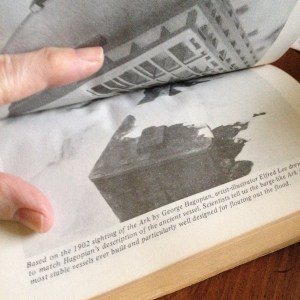
I’m a visual guy. I study pictures rather than just look at them. As a kid I was amazed at the sheer variety of arks that claimed to follow Noah’s blueprint. Reading the account in Genesis, it is clear that all that’s given are measurements—in cubits, no less—and instructions to make three decks and a window. The Dutch ark follows the design made popular by the 1977 Sun Pictures’ In Search of Noah’s Ark movie. The design, I recall thinking as a teen, looked slick and scientific. Engineered to withstand a fake storm in a bathtub, this has to prove something. When rock outcroppings on Mount Ararat were photographed from satellites and military jets, they suggested this was, in fact, correct, some of the time. Close-up photos were inevitably lost as sherpa after sherpa fell into hidden crevasses with the camera still in hand. Now they won’t let you climb the mountain, just in case.

The drawing that launched a thousand, or at least one, ark(s).

The drawing that launched a thousand, or at least one, ark(s).

Apart from the ark design is the more important question—the question about leg room. With all our technology, and a world that has been pretty thoroughly, if disappointingly, explored, we still haven’t catalogued all the species on the planet. The ark had to hold all the species since evolution is a diabolical lie. Pugs had to be there as well as their non-ancestral wolves. Both African and Indian elephants. Black and white rhinos. Hippopotami, pygmy and economy-sized. It had to have been pretty crowded, and Answers in Genesis claims there had to be room for dinosaurs too. For me the question has always been those left off the ark—the fish. If the oceans are salt water and the whole world was flooded, whence the fresh-water fish? They couldn’t have evolved, since nobody does. That’s a head-scratcher. Good thing too, because there had to have been more than just two fleas on that ark.


Taking God to Bed

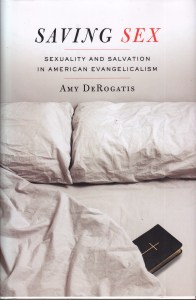
SavingSexThere are varieties of evangelical experience. It is so convenient to put people into neatly labeled boxes that we tend to forget religious experience can be very different, even to conservatives. This point is made very clearly in Amy DeRogatis’ Saving Sex: Sexuality and Salvation in American Evangelicalism. The title of the book requires some further disclosure. DeRogatis is offering an academic study of evangelical sex manuals and teachings about sexuality. If you’re anything like me, the very concept sounds strange. I grew up in an evangelical household and we would’ve been scandalized to learn that such things as godly sex manuals existed. In fact they did, but we didn’t know about them. Although evangelicals share a common idea that there are appropriate and inappropriate varieties of sexual experience, they disagree, according to the evidence, over what some of those boundaries are.

DeRogatis’ book offers some fascinating insights even within this circumscribed field of study. For example, some writers of such manuals give rather permissive instructions as to what might happen in a heterosexual, Christian boudoir, while others keep to the basics. Some suggest that the very practice of sexuality opens its participants to demonic infestation, so much so that they consider STD to be Sexually Transmitted Demons. This is an intriguing and frightening world to enter. Many of the writers of such books suggest that women should indeed be under the authority of their husbands in all things. No room for Lilith there! Others, however, are surprisingly broad minded. More so than some Episcopalians I’ve known.

This brings me, as a former evangelical, to my concern about academic studies of such groups. It seems to me that to truly understand what are undoubtedly irrational beliefs, you must have had the experience of truly believing. If I might be excused of the pun, are you experienced? As much as we wish it were, evangelicalism isn’t a neat packet of propositions that people simply accept. It is a complex, emotional, and, in its own universe, logical response to the belief that the Bible is the owners manual. Sola scriptura gone wild. How individuals deal with this impossible truth is widely divergent. We’re taught not to discuss sex in polite company, but we just can’t help ourselves. For some that’s good news indeed. For others it is the very definition of wickedness. As Saving Sex shows, there is more than one position to be taken.


Fossilized Views

Not all Fundamentalists are the same. I grew up believing the Bible was literally true, but in my family we recognized that fossils indicated the earth was older than just a few thousand years. Keep in mind that I never tested this with any preachers—we didn’t need to. We knew that evolution was wrong, but that didn’t mean there had never been dinosaurs. Kids are as sure of dinosaurs as they are of angels. Besides, we lived beside a tributary to the Allegheny River that was rich in fossils. We’d spend summer days wading in the water looking for rocks with impressions of various bivalve shells in them. They weren’t hard to find. And being collectors of just about anything inexpensive (or free, as in the case of fossils) we brought them home. We really didn’t see any great disconnect between the black book on the table and the rocks in our hands. There was room for both.

It must’ve been a slow news day at Huffington Post recently when a story titled “This Guy Is Pretty Sure He Found Fossils From Noah’s Flood” ran. The guy in question is from Texas, and, finding fossils probably not unlike those we used to, supposed that they were laid down during Noah’s flood. This was an idea that I only encountered after I’d left home. We couldn’t afford many books when I was growing up, but we did have conventional dinosaur material. Nothing strange enough to suggest that the flood created all the landforms and fossils on the planet. That would’ve sounded just a bit strange. Today, however, it is common to suppose all Fundamentalists are naive and enemies of science. Not all are. Some, I hope, are like I was, trying to find a way to fit their faith into a world that science has come to help define a bit more clearly. Positions have, however, polarized a bit since my tender years. We now fight over things we used to wonder about.

IMG_2734

The fossils I found as a kid found their way back into nature before I grew up. If I ever have the time when visiting home these days, I still try to get an hour or two to spend down by the river to look for the rocks that filled me with such awe as a child. That was a world where belief was fairly easy. I loved science. I loved my religion. I loved the fossils that told me the story was a complicated one. Only I wouldn’t have believed that decades later I’d still be trying to suggest to others that the world is big enough for both facts and faith. I haven’t been a Fundamentalist for decades, and given a few million years, who knows how even the nature of the debate might evolve.


Unlearning Prejudice

With the terrorist attacks in Belgium on our minds, people are asking once again, “What’s up with Fundamentalists?” My jeremiad that the only solution to religious violence is to study religion reaches few eyes, I realize, but the internet has the capability of spreading memes far and fast. It is merely the hope of a closet optimist. One thing that Fundamentalists believe—I know from personal experience—is that the stakes are based in eternity. In Christian fundamentalism, for example, Hell or Heaven will be forever and any parent would be depraved indeed not to teach their children this belief from their earliest days. That parent-child bond is strong to the point of being unbreakable. That’s why what children learn about religion tends to stay with them all of their life.

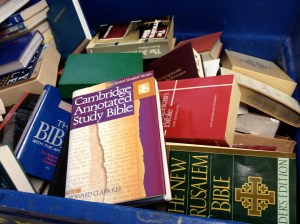
IMG_0922A story on the Freedom from Religion Foundation website describes how it is fighting the distribution of Gideon Bibles in public schools in Delta County, Colorado. I was under the impression that Gideons contented themselves with hotel rooms and county fairs. I had no idea that they were active in public schools. In response, the Freedom from Religion Foundation has provided counterbalances to be available to students, including materials calling the Bible into question, and, somewhat more surprising, atheist and Satanist literature. It is clearly a political move to prevent the district from allowing Gideons to distribute Bibles, but it feels an awful lot like a battleground to me. We want the best for our children, but is it best to put our adult biases out where they can be so plainly seen? In a pluralistic society, religion will always raise extreme responses where children are concerned.

The question here is not whether children should receive religious teaching or not, but where such teaching should occur. We are a nation founded on the principles of religious freedom, and although the concepts have changed since the founding days, the ideal is still valid. No matter how one wants to argue the point, people will be religious beings. They may express it in enormously different ways, but express it they will. Children trust us to act like adults. We want what’s best for them but the risk is very high. What should be done? Educate adults. But then, that’s a screed you’ve heard from me before.


Bible Use

In the current presidential race, it seems, the Bible hasn’t been as large an issue as it has been in the past. Bluff, bravado, and bullying seem more the order of the day. Goliath rather than David. This makes me think of the varied uses that the Bible has had in American life. It has been used as a spiritual guide, a textbook, a set of moral principals, a grimoire, and a science primer, as well as a political playbook. It is versatile, the Good Book. It has been prominent in American society from the very beginning, but clearly its prominence is starting to fade. Not likely to disappear any time soon, the interesting question is how people use the Bible, often without reading it. This is what scholars call the “iconic book” aspect of the Bible. It is performative—it acts in a way that has an outcome, no matter what the intent of the user. As I’ve argued in academic venues, it has become a magical book.

An iconic book (photo by David Ball)

An iconic book (photo by David Ball)

Wondering whether this is a new situation or not (I deeply suspect it’s not) I’ve been reading about the Bible in early America. Almost all the reference material points to the “official” uses of the Bible—that by statesmen and clergymen (both classes of “men” in the early days) with almost nothing of how it was used in private. This question involves some exercise of the imagination since there are few data. Would not a family, struggling to survive, see in the Bible a powerful book? And would not a powerful book be capable of subverting the laws of nature? Reading about the witch trials in Salem, we see that thunderstorms and other “prodigies” were considered magical. Surely one could use the Bible for unorthodox purposes? There’s little to be said in the absence of evidence. The use of magic in the colonial period, apart from the trails of witches, was not unusual.

How do we measure the ways the Bible was used when nobody beyond interested parties, such as clergy, wrote about it? Mr. Trump even tries to quote it from time to time, but since his citation that sounds like a joke opener, “Two Corinthians [go into a bar],” he seems to have let that hot potatoe drop. The Bible, seldom read, remains a powerful book. The source of its power, I suspect, is in its use by the common people. Many people are familiar with it, and believe in it. Some have even read it. It remains, however, one of the great mysteries among the early European settlers. We know they had their Bibles with them. How exactly they read them, when not under the eye of the preacher, we apparently have no way of knowing.


Bible Search

The Bible is, in many ways, not suited to internet study.  Let me explain: this artificial world of the internet is based on searchability.  To search for something, you need to have a distinctive word, a keyword, or catchphrase.  As perhaps the most successful book of all time, the Bible has undermined its own uniqueness.  How many books are titled The Gun Bible or the Dog Bible or substitute your favorite noun Bible?  Web searches for “the Bible” bring up a large number of relevant hits, but then quickly devolve into other Bibles.  Too many Bibles. Not only has the noun “Bible” been appropriated, so have many aspects of its story.  Particularly the Good Book’s penchant for using short, common words for titles of individual books.

Search for Mark, or John, for example.  Don’t bother adding the word “Gospel” since it too has become widely utilized to give any popular subject an air of authenticity.  Not only did the four evangelists write such books—the Gospel according to Biff, Trump, the Simpsons, or Bruce Springsteen will likely pop up ahead of the original fab four.  Or consider the books whose names became common nouns: genesis, exodus, numbers, judges, kings.  Then there are the ambiguous titles: Job, Proverbs, Song of Songs, Acts.  Sure, you can lengthen them out a bit: Acts of the Apostles, Song of Solomon, the Proverbs of Solomon, but the results you get tend to skew evangelical that way.  Job is just a non-starter. Do you mean employment or enlightenment? Do I need to get a job or to get Job? At least it’s not a popular name for kids.

The other area where the Bible’s success works against it in the computer age is its success at giving names to people.  In a culture so biblically based, the Bible has been treated as a name-list for newborns for centuries.  Even though the Anabaptist penchant for using prophetic names has faded from popular culture, there are plenty of Isaiahs, Jeremiahs, and  Ezekiels out there.  Even some minor prophets, too.  Amos, Micah, Zechariah.  (Habakkuk, Zephaniah, and Haggai haven’t particularly caught on.)  Daniel, David, Joseph, Abraham, Isaac, Jacob.  We live in a world of biblical nomenclature.  There’s even more than one Jesus running around.  (Jesus, is, of course, Greek for Joshua, so there may be even more than one might suspect.)  I spend a good bit of the day searching various biblical material online.  I wonder if anyone ever imagined, over two millennia ago, that a three-letter name was bound to cause problems in a world of billions? Were it submitted for publication today, the editor would’ve sent the Bible back to the author for a rewrite, along with a list of suitable keywords.

IMG_1364