From Palin to Phelps

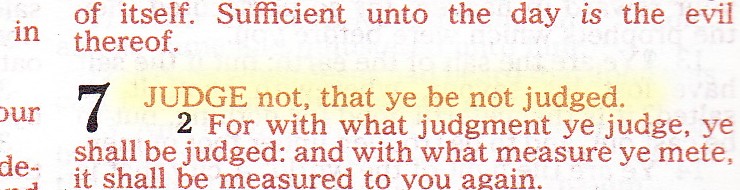
People get shot every day, but that does not take the sting from the January 8 shootings in Tucson, Arizona. We live in a nation filled with angry, violent people. Most of them hold their rage in check, but others act out their frustrations aided by the obscene ease of firearm ownership. Into this volatile brew, mix in the warped rhetoric of a politics of fear and who knows what might happen. Sarah Palin and other outspoken conservative ideologues hold up their pristine hands to demonstrate they have nothing to do with the hate-mongering that haunts our streets. She calls the jabs at conservatives “blood libel.” I say if you propagate the politics of fear you’re liable to get blood on those hands. Often in the bookstore I see titles like How to Talk to Liberals: If You Have to. The liberals I hear talking are only asking for dialogue and coexistence. One side wants a chance for everyone to be heard, the other wants to throw stones at those who are different.


Students do presentations in my classes. The assignment is to choose a social issue where the Bible is brought to bear on the topic and present to the class what you learn about the subject. Two groups last night presented on the Westboro Baptist Church and its outspoken pastor and founder, Fred Phelps. Both presentation groups showed videos of members of the Westboro Baptist Church speaking out about various and sundry liberal groups/causes/nations they hate. Plucking verses from the Bible like a chicken pecking at the ground, they cite only those passages that justify hating those who are different. They seem to have overlooked the part that says, “by their fruits you shall know them.”

On today’s schedule? According to the Westboro website: “WBC to picket the funeral of Christina Greene, the 9-year-old girl cut off in her youth for the rebellion of the parents, preachers, and leaders of this nation.” They’ll have a hard time finding any place in the Bible that condemns children, shy of sly old Elisha calling out she-bears to kill 42 of them. Having read the Bible for practically my whole life, I have a very difficult time reconciling those who use the Bible for conservative causes with their own sourcebook. What will it take for them to realize that “what I want” is only part of the picture? Whether presidential hopefuls or crazed curmudgeons, we would all sleep better if we took to heart that inequality is very easily transformed into iniquity.
Jehovah’s Eden

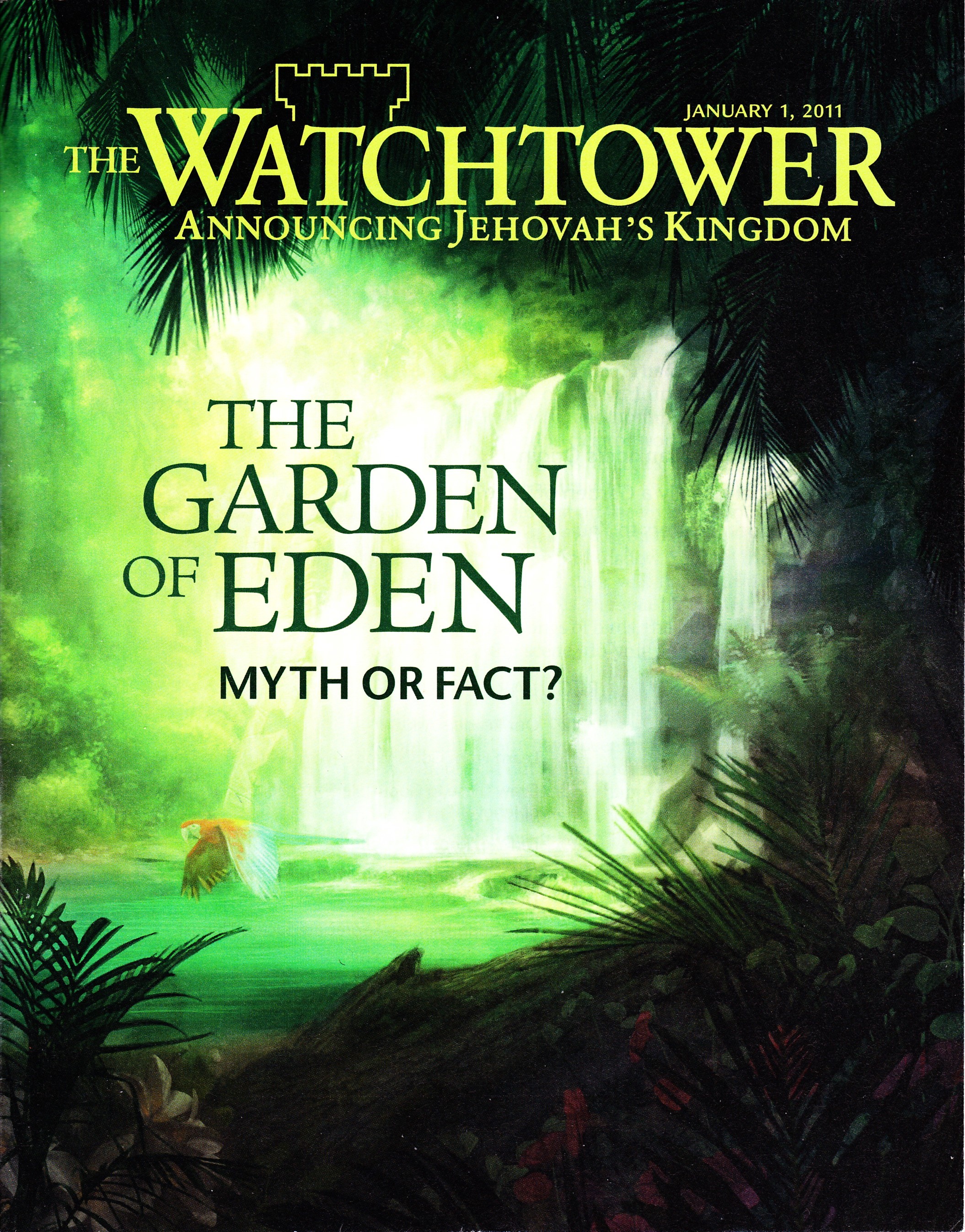
As a religious studies specialist, I inhabit a world where definitive answers are comparatively rare. It is clear that my assigned Jehovah’s Witnesses case-workers are not similarly constrained. While I was out earlier this week, they left a copy of the newest edition of the Watchtower for my edification. The cover shows an Edenic garden and bears the legend, “The Garden of Eden: Myth or Fact?” Now, I thought I knew the answer to that one. So I started to read. I learned that it was because of philosophers and their nonsense that people ceased to believe in Eden. Most people in world believe there was a paradisiacal garden, way back when, so it must be fact. I also learned that the reason we can’t find Eden today is that the Flood wiped it away. Seems a shame; with proper drainage it could be as dry as Aden and as rich as Dilmun.

The story in the magazine is set up as a series of objections raised as to why the Garden of Eden is rejected by skeptics. Literalist biblical answers to the objections are then offered. Ironically, one of the most obviously missing objections is that of geology. The article states that, prior to being destroyed by the flood, Eden would likely have suffered from the devastation of earthquakes. The area, it seems, is in the earthquake belt. Still, the garden was created “some 6,000 years ago,” despite what all those earthquake-toting geologists tell us. Somebody has forgotten to set their calendar back by a few billion years.

A more serious objection missing from the critique is that of mythology itself. Those who’ve studied the background to the story of Eden realize that most of the elements in the story are recycled myths known among the Mesopotamians. Special trees, crafty snakes, people being created from clay – all these are standard elements in Mesopotamian mythology that predates the Genesis creation accounts. If modern people understood that the point of mythology is to convey truths that are beyond the factual, perhaps we wouldn’t have such insistence that Eden is fact, despite the facts of science. The Garden of Eden: Myth or Fact? Clearly myth. And that rescues the story from the burden of bearing facts it was never intended to convey.


Dating Daniel

Last semester one of my students had an encounter with a literalist. This is not uncommon, but the issue raised ran counter to what we were covering in class, namely, the book of Daniel. Apocalyptically minded literalists use Daniel and Revelation as a two-tiered roadmap to the future, supposing that these books are predictions of the end of time. Scholars who’ve studied apocalyptic literature, however, know that such interpretations misrepresent a fascinating genre of ancient writing that says more about its own time than some unforeseen future (our time). Nevertheless, the myth of Daniel’s foresight persists.

Long ago biblical scholars noted that although set in the period of the Babylonian Empire, the book of Daniel makes several basic errors about that time period. On the other hand, Daniel knows the period of the Seleucid Empire (when it was actually written) in relatively precise detail. We think nothing of it when an author today sets a story in the past, but somehow this is dirty pool in the composition of an evangelical Bible. Apocalyptic was intended to provide encouragement to those under persecution, not to give them a Google-mapped future. It is in the nature of apocalyptic to present the author as a seer, but the future age is a Zoroastrian contribution that gives books like Daniel and Revelation their edge.

Misunderstanding genre is a large concern among literary scholars. A document like the Bible, which contains several distinct genres, must be handled carefully if it isn’t to be misrepresented. I used to point out that if the passages intended to be read ironically were understood literally many Bible-quoters would be in trouble. After all, doesn’t Amos declare, “Go to Bethel and sin; go to Gilgal and sin yet more” (4.4)? Learning to place biblical genres within their proper context makes a world of difference. Instead of Daniel telling us to hold tight because the end is near, he is found to be encouraging those who were suffering in his own day. We have no biblical roadmaps for the end times because the end of the story has not yet been written.

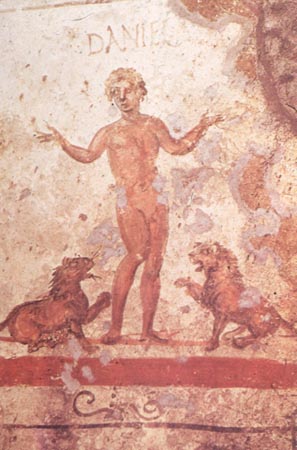
Daniel tells the lions a story about the future


Build-A-Bible

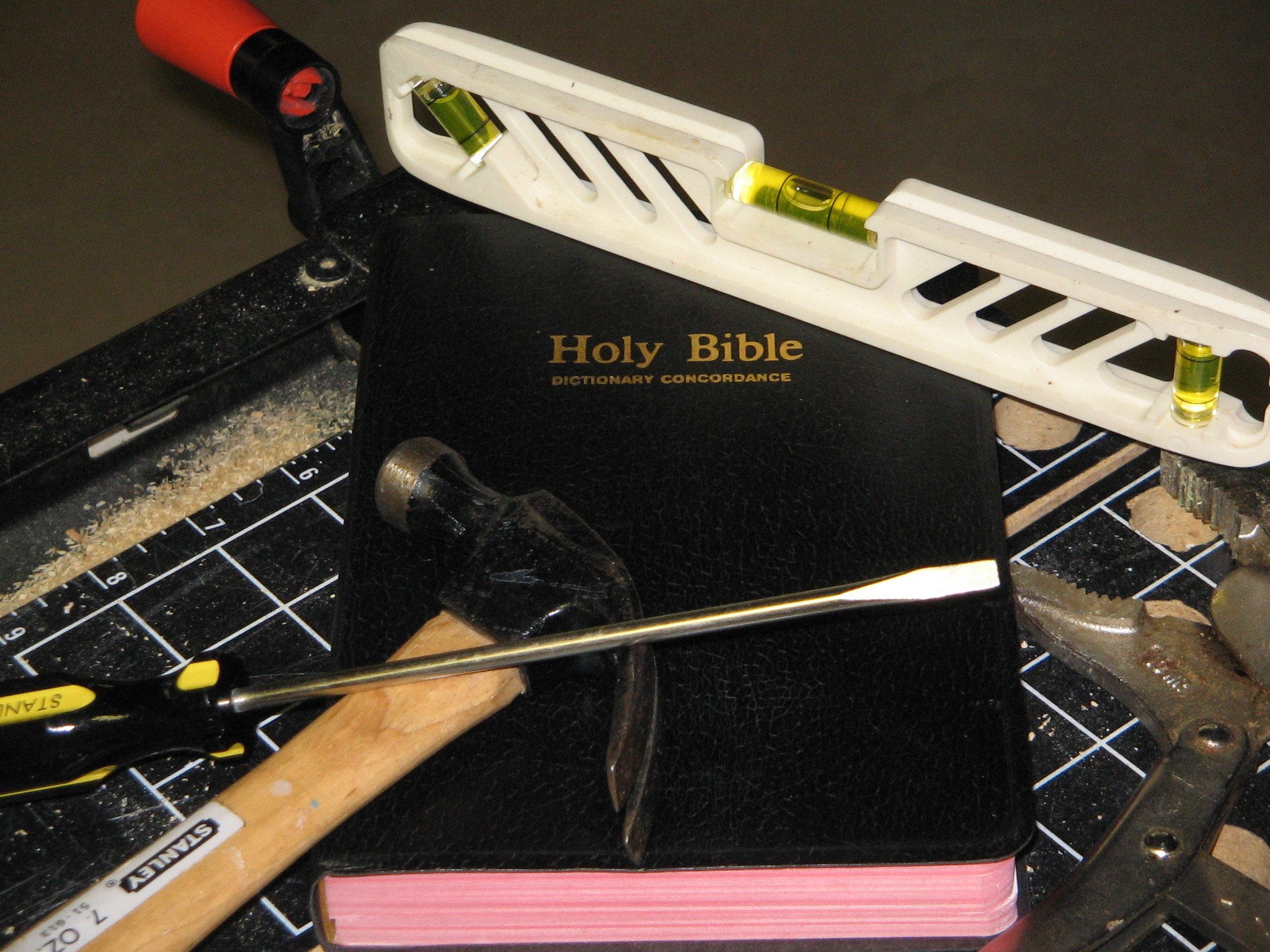
Winter Term is underway, and one of the first aspects of the Bible I discuss with students is the fact that the Bible was a book that was compiled instead of written. In our society we are used to the concept of the Bible as a document that is unified by divine authorship, often forgetting (or ignoring) that none of the authors was intending to write a book with the tremendous authority the Bible now enjoys. Students ask how the Bible came to be; it was a process of gathering material widely utilized in Judaism. No one knows the actual composition history of the Torah, but after the Pentateuch got the process rolling, scrolls were gathered in collections and added to the Bible en masse. By the end of the first century of the Common Era, we had a Hebrew Bible.

Sometimes this historical reconstruction is a hard-sell to members of a society where a divinely written book is accepted alongside sub-atomic particles and super novas. Despite the technological sophistication that accompanies growing up in our engineered world, students are often ill-equipped to accept the Bible as a product of human exploration. The writers, whoever they were, traveled this same path of discovery that we continue to tread. They wrote down their hypotheses, based on their experience, just like modern people continue to do. The difference is they did this a very long time ago.

Those books that were selected for inclusion in the Bible became the defining documents of western civilization. Even though there is now an international space station orbiting out of sight above our heads, and even though quarks, leptons, and bosons fly out of cyclotrons large enough to encircle most small towns, God still holds a quill pen. The fixation just after the age of cuneiform is a curious one. If only God had held out for the invention of the Internet, the compilation of the Bible would have taken a very different course, I suspect. Instead of beginning its title with the word “Holy” it would more likely have commenced with “Wiki.”


The Bible Tells Me So

As part of my regular Hebrew Bible class, students prepare classroom presentations for the end of the semester. This gives them a break from constant lecturing and also serves the function of initiating discussion. I assign social issues for them to discuss vis-à-vis the Bible; they can discuss these with each other in group-sessions throughout the semester. Since no one knows “the answer” when it comes to the Bible, I figure we can all learn from each other. I’ve been using this exercise for four years now, and at a school the size of Rutgers, you’d expect a wide variety of perspectives. This occurs, to be sure, as does more predictable stances. After fourteen weeks of instruction, most of them can only find the Bible a trove of prooftexts.

Learning to integrate biblical study into a rational worldview is difficult in our cultural climate. From nearly every medium from which religion wafts – Internet, television, newspaper, personal sermonizing – it comes out literal. The Bible/Quran says… (fill in the blank). What occurred to me during the student presentations is that scriptures of all descriptions become dangerous when their context is lost. Politicians, often among the arguably least educated members of society, argue about what the Bible says. Problem is, the Bible was written from a pre-Enlightenment viewpoint, a perspective that is out of reach to all but the most utterly naïve. Even to understand worldviews from the pre-Enlightenment you need to spend years of serious historical study.

So here’s our dilemma: we live in a society enamored of a book it doesn’t understand. Bible verses are used like Band-aids, pasted over every perceived rupture of continuity, but never quite reaching to the ends of the wound. Even after a semester of bald instruction – in the case of Nashotah House three semesters – students generally revert to what they know. To learn what the Bible instructs, take a pair of mental scissors, snip around the pericope, and tape the verse over the issue. There is, however, always a backside to the page. And most students never learn even to turn the page over to see if both sides agree. They could be ready for a life of politics.


Lead Us Not

The media love the story of the fallen. Sometimes even those in religious institutions secretly delight in seeing the foibles of their infallible leaders. Part of the problem is that many clergy (but by no means all) place themselves on a moral precipice impossible to reach by mere mortal standards. So the Associated Press carries the story of a Neptune, New Jersey pastor who’s taking a sabbatical. What makes this leave noteworthy is that Pastor Miller railed against his flock using Facebook, arguing that it leads to adultery. So far, so good. This is standard pastor-babble. The problem is a decade ago the good reverend was involved in a ménage à trois, thereby predating even Facebook and still finding access to adultery. The response of Living Word Christian Fellowship Church: take some time off.

The real problem, the Republican symbol in the room, is that human nature likes to place the blame elsewhere. “The Devil made me do it,” was the 1970’s version (thanks, Flip!). Many religions, uncomfortable with the implications of humanity’s evolution, have devised means of shifting the blame. Augustine gave us “original sin,” suggesting that the true blame went back to our first biblical ancestors and forever made sex dirty. Somebody else must take the fall, as the Neptune preacher has discovered. The words of another famous New Jerseyan capture the sense exactly: “Now he walks these empty rooms looking for something to blame, if you inherit the sins you inherit the flames. Adam raised a Cain.”

Coming to grips with being human may be the greatest challenge bestowed by consciousness. There are primate survival strategies inherent in shifting the blame. Where evolution is disallowed, supernatural agency – even Facebook – is placed in the dock. Facebook may encourage the wasting of time on trite sentiments endlessly repeated across this universe we call the Internet, but it can hardly be blamed for adultery. For that, the beast is within. And those who place themselves on pedestals have a great distance to fall.

Lead us not into Facebook...


What Would Noah Do?

Unfortunately, religion and politics do mix. A story on POLITICO.com announced on Wednesday that the House Energy and Commerce Committee chair hopeful, Rep. John Shimkus has declared Genesis on the side of conservatives. Stating that the Noah myth (not his exact words) promises God won’t flood the earth again, Shimkus claims we have nothing to fear from global warming. In a twist that makes some of his fellow conservatives squirm, Shimkus admits global warming is a reality but suggests that we really don’t need to worry about it because “the Bible tells me so.” Time for Shimkus to go back to Sunday School.

Part of the problem lies in the concept of Bible itself. The Hebrew Bible isn’t too much of a self-referential work, claiming to be pure words of divine gold. Paul, on the other hand, found the Hebrew Bible useful to cite against enemies, and his admirer who wrote letters to Timothy in his name took the idea even further. For all that, the Bible wasn’t finally settled on for a couple more centuries. Once the concept took hold, however, the world could never be the same. A book written by humans had become direct revelation from the word of God himself. The Bible makes few such lofty boasts about itself, but its less conscientious followers are not nearly so shy. As I demonstrate repeatedly in my classes, the Bible has become a magic book.

Politicians now feel comfortable claiming God as their ally because “he said so.” Without having ever critically engaged Scripture, or even having read it in its original languages, those in positions of public trust know enough to flaunt it. And it always scores points with Americans. Liberals fear the ramifications of using the Bible while Neo-Cons charge bravely ahead to places Noah himself would fear to go. Maybe it’s time to put the Bible back in the schools. Only this time it should be taught by people who realize that the Enlightenment has taken place and that we can’t rely on magic to save us from dangerous situations we ourselves have created.

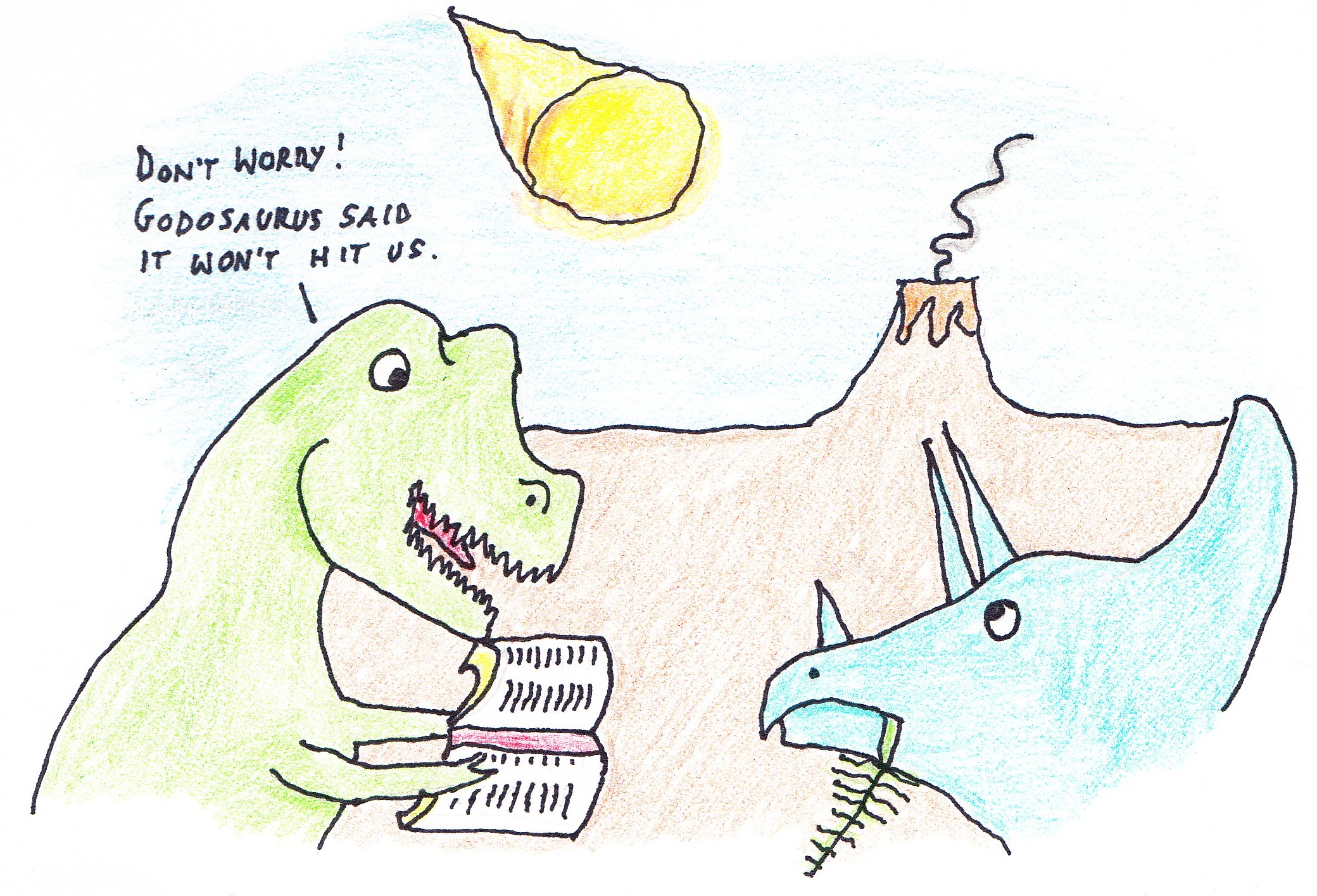
The lesson from the Cretaceous Period


Lions, and Politicians, and Bears


A man was eaten by a lion in Zimbabwe yesterday. A boy on his way to school in Alaska was attacked but relatively unharmed by a brown bear. Predation. Much of the way humans act is based on our long history as both predators and prey. Evolution (may not apply in Kansas or Texas) has designed us to cope with these constant stresses of finding enough food and avoiding becoming food. A great deal of religious behavior can be traced back to avoidance of predation and success in the hunt. We like to think that we are somehow not animals, but animals are smart enough to disagree. Just ask that cheeky squirrel that finds ingenious ways to circumvent all the deterrents you put in place to assure that those seeds go to needy birds, not fat rodents. We are part of the mix. Our opposable thumbs help immensely; we build our own ecosystems to keep lions and bears out.

Yesterday was a day of predation. Even within the human sphere we find that killing others is permissible, as long as it is done slowly by those in fine clothes and fancy automobiles. Depriving the less deserving is a time-honored human behavior, after all, survival of the fittest only applies to animals, not us. Right? By backing policies that protect the wealthy in their lofty sanctuaries while others shiver in November’s Tuesday chill we show human nature. Humans are predators as well as prey.

Intriguingly, many politicians who support laissez faire economics deny evolution exists. Instituting policies that ensure survival of the wealthiest, they deny up and down that evolution has anything to do with the way that we are. It’s all in the nature of the evidence. And nature itself is evidence. We may be the smartest, most well adapted of the mammal class, and yet we can be eaten. What does the evidence suggest? From the point-of-view of a lifelong observer of religion, it suggests we are still the prey. When religion stealthily crawls into bed with politics, it is evident that even religion itself may be a deadly predator.


La Puerta

A musician who has always deserved more acclaim than he has received in his solo career is John Cale. A founding member of the Velvet Underground, a band whose lyrics and insistent – if at times atonal – music capture their era far more effectively than most, Cale has gone on to produce some songs provocative enough to rival those of Lou Reed himself. On his Paris 1919 album, the song “Hanky Panky Nohow” contains these thoughtful lyrics: “nothing frightens me more than religion at my door.” These words are, ironically, prophetic. Religion at the door, in public office, behind major media corporations, has become an insidious threat to the founding principles of this nation. Right, Ms. O’Donnell?

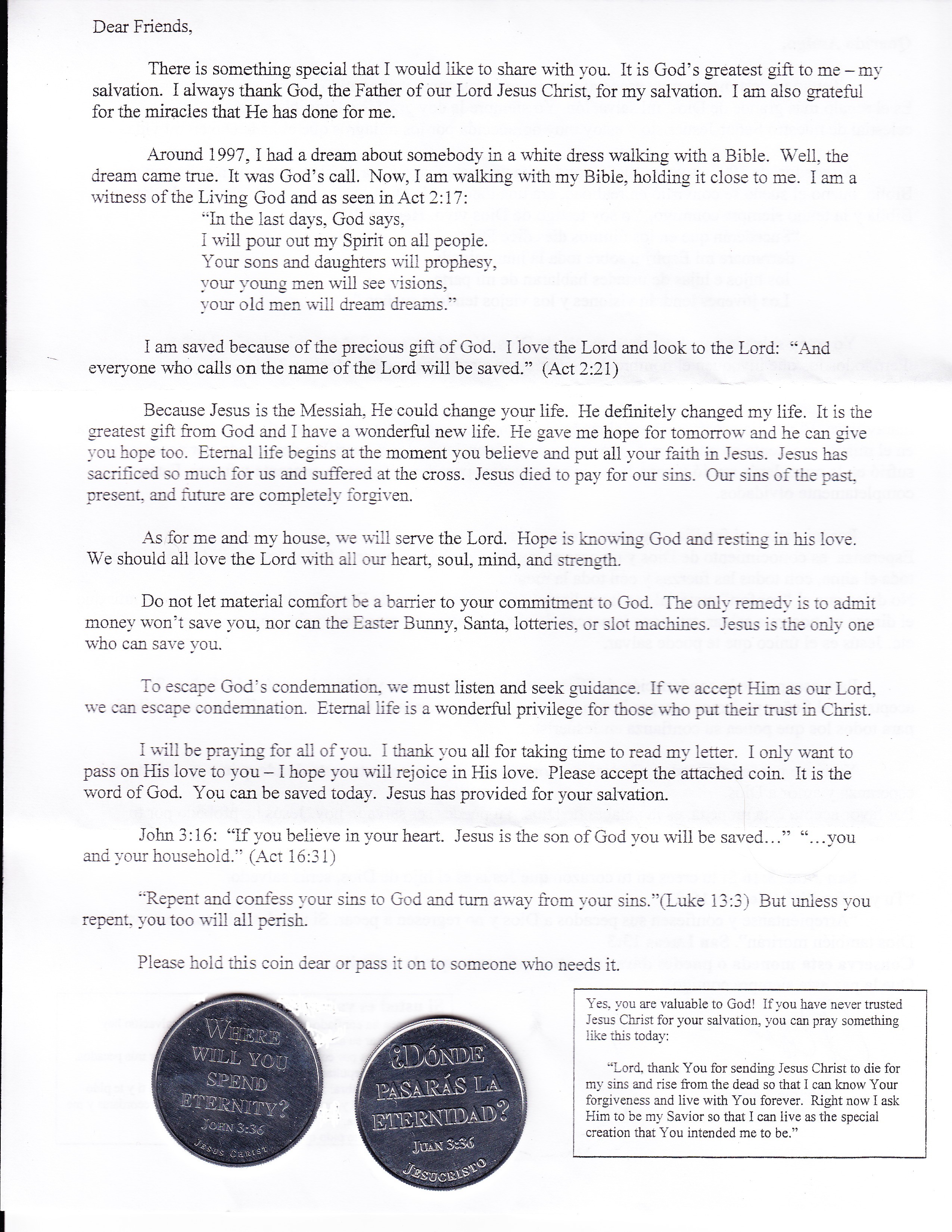
Yesterday morning I went out to get the newspaper. Although I live in a relatively safe town, we are classified as the “Greater New York City” area, and I’m always suspicious of anything unexpectedly left on the doorstep. There was an unaddressed, blank, sealed white envelope there that jingled when I nudged it with my foot. At first I thought it might be a set of keys left at the wrong house, but when I did finally open it I discovered a bilingual set of aluminum faith coins. An accompanying letter assured me that God wants to save me and shared with me a dream of somebody in a white dress carrying a Bible. The letter, amazingly, misquotes John 3.16.

I am the frequent victim of Jehovah’s Witness visits. I have students handing me booklets that will save my soul. I receive offers of golden miracle crosses in the mail – I still carry mine around, but prosperity has continued to elude me – with the assurance that God wants only the very best for me. I open the paper and see the suffering of the people of Indonesia. I see a column about teen suicides resulting from bullying with victims as young as twelve hanging themselves. I see overweight politicians feathering their already overstuffed nests. I turn back to the anonymous letter. “Please hold this coin or pass it on to someone who needs it,” it instructs. I think I’m going to need a truckload of coins. Nothing frightens me more.


Empty Pews

An insightful op-ed piece by Robert D. Putnam and David E. Campbell in yesterday’s paper asked the question “why youths are losing their religion.” The authors, professors at Harvard and Notre Dame, respectively, answer with the suggestion that religion and politics just don’t mix. The truism that religion and politics are taboo subjects of polite conversation was widely accepted in my younger years. During the Reagan campaigning era, however, it became clear that some unprincipled louts were drawing religion into the political mix to garner votes. Those who actually research Reagan’s religious convictions are often surprised to find that they are not as “George W. Bush” as everyone thought. It was a ploy, and a vastly successful one at that. A new avenue had been paved, however, for hotly contested elections: use the Bible. The fawning attitudes of many Americans toward the Bible they seldom read is a powerful political tool.

Putnam and Campbell note that adults coming of age in the 1990s and later have been alienated by this paring of religion and politics. The results have tended to be the rejection of organized religion that is seen as hypocritical and intolerant. The interesting factor is that it is the political agenda that is hypocritical and intolerant, but organized religion is paying the price for going along with the Ralph Reeds, Jerry Falwells, and Pat Robertsons of the early religious right. One guy from an old book once said something like “what you sow you also shall reap.” The political use (abuse) of religion has only and always been about power.

The authors are able to provide statistics to back up their models, but their reasoning is clear enough on its own. Some of us have experienced first hand the ugly, hideous agenda behind the angelically smiling evangelistic face. Those who hold to it may be naïve enough to believe that it is actually religion that they are serving, but the sad truth is their positions are cravings for power. There are those who actually relish the days of imperial Christianity when, despite its Roman Catholicism, the church made Europe tremble. They forget that pilgrims and colonists moved to this land to flee such tyranny. Americans, reluctant to elect Roman Catholics to the presidency because of the latent fear of a hierarchical religion — so close to kingship — now bow down before political rulers in religious garb. Decidedly Protestant. And the Tea Party continues to crank out candidates who do not even realize that the separation of church and state is a founding principle of this nation. If there is a backlash coming, it is a well deserved one indeed.


The Power of Hope

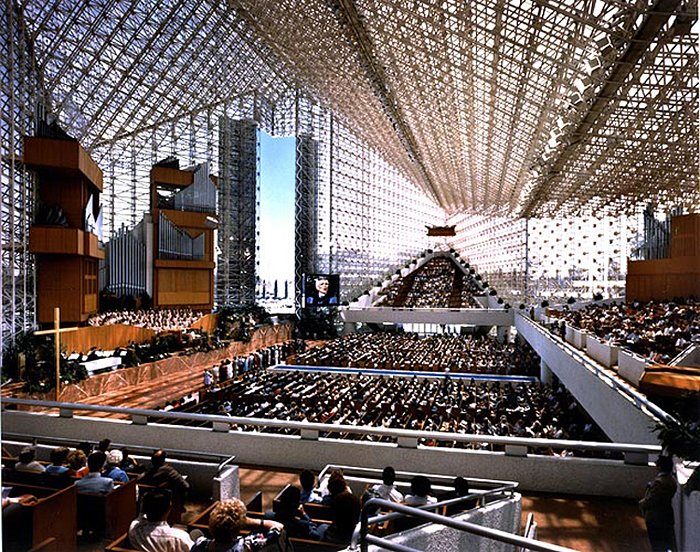
My wife pointed out at article on MSNBC yesterday that stated Robert H. Schuller’s Crystal Cathedral is filing for bankruptcy. Internet reaction has been predictably hostile, clawing at the craven, money-driven industry of television ministry. There is no question that many television ministries quickly grow corrupt under the lure of immense wealth. The average American citizen is glad to part with some money if it can buy favor with the man upstairs. When a minister is able to construct such edifices as the Crystal Cathedral with the good-will offerings of the faithful, well, s/he’s an entrepreneur, the kind of people God likes, according to the Tea Party. Schuller was famous for his positive thinking and insistence that God will do great things for you. When recession hits, however, not even God remains solvent.

According to the article, various corporate sponsors of the Cathedral are having difficulty holding up their end of the contract. Positive thinking extends only as far as the goodwill of the banks. Is there any question who the real god is here? Americans love the non-biblical concept that God helps those who help themselves. Making more money than a humble clergy-person ought to make may improve the sense of optimism, but it loses touch with where the average citizen lives. It is easy to be optimistic when you have a heavenly bankroll on your side.

Yes, but can it keep birds from flying over your head?

Over the weekend my family looked at slides from our years in Europe. The great cathedrals, even if in ruins, convey a sense of stoic strength, genuine commitment. Built with the hard-won resources, if not the actual physical labor of the local populace, these cathedrals were made of stone. I recall standing in the nave of Salisbury Cathedral while the tour guide pointed out that the very stone pillars supporting its huge steeple were bowed under the weight of all that stone above. Some day it may collapse under its own pressure, but it will have always survived longer than the Crystal Cathedral. Religion, if I may use a metaphor, is more authentic when it deals with stone rather than glass. The religion that struggles with the intractable realities of daily life will inevitably last longer than the feel-good, glass-plated, Tea Party serving “religion” of feel-good Christianity. It is too bad about the Crystal Cathedral, but maybe the entrepreneurs should be asking serious questions right now about which god they truly serve.


From Bragg to Phelps

Religious freedom is proving to be a two-way street. The news is rife with stories of religious groups pushing the limits beyond their right to state an opinion into arguably unconstitutional behaviors. At Fort Bragg, the Army is sponsoring Rock the Fort, a Christian rock concert promoted by the Billy Graham Evangelical Association. Although Christian bands are spiritually minded, they do not perform for free, raising the question whether military (government) money is being spent to promote a particular religion, a particular strain of Evangelical Christianity. In offering this concert, is the government endorsing this one religion? Statements that other religions are free to send their rock groups to Army bases rings hollow when, with rare exceptions, such groups simply do not exist.

Meanwhile, Time magazine brings the curious Westboro Baptist Church of Topeka, Kansas back to the headlines now that Supreme Court has been called in to argue whether their outspoken condemnation of the military is constitutional. Fred Phelps, the founder of the church, has led divine hate campaigns across the country. It is his protests at the funerals of soldiers killed in action that has forced the question of whether his group has the right to condemn indiscriminately. The question of good taste need not even be asked.

What these Evangelical groups are pointing out is that God apparently suffers from schizophrenia. Simultaneously the great general upstairs loves soldiers and wishes to convert them and also hates them and condemns them to hell. The jury, it seems, should be the taxpayers. We are the ones footing the bill for Christian concerts and paying the not-insubstantial salaries for Supreme Court justices to argue about the legality of religious hatemongering. In these days when many feel that Islam is a threat (as Christian clergy threaten to burn the Quran), it might be worth asking where the real threat to religious freedom comes from. Religious zealots often make excellent soldiers, no matter what the religion.

These guys love God, but is the feeling mutual?


I’ll Take Coffee, Thank You

Yesterday’s victory of Christine O’Donnell in Delaware’s senate primaries seems to have shocked a lot of people. Have these people not been paying attention? Did they sleep through Beckpalooza? Have they failed to see that Sarah Palin’s lackluster life story has become a best-seller? Are Americans in denial that we are facing a major Religious Right comeback? The problem, yes, problem, is that Americans are not taught to think about religion for themselves. Raised with the idea that their political and religious leaders have some special channel open to the divine, they are sheep led to the, well, you know…

Society pays for its sins. One of the most fatal of the deadly sins is the refusal to take ownership of religious education. Unreflective religion in the hands of politicians is a fully armed atomic warhead. Many Americans like to think this is only a problem in nations with Islamic infrastructures, nations unduly influenced by shahs, ayatollahs and imams. Nations influenced by Tea Parties, Neo-Cons and biblical amateurs are much safer, much more friendly.

Problem is, the Bible’s a mixed bag. Some of the loftiest spiritual sentiments nestle down uncritically next to calls for genocide and harsh repression. As long as it is the magic finger from above that’s written it, that’s good enough for tea-tipplers. There are few opportunities to call Americans together for a religious town meeting. We’re all too busy off doing it our own individual way. In such a climate, isn’t it best to let those without any formal religious training tell us what the Bible says we should do? Do you want one lump with that, or two?

O'Donnell takes Castle to school


Mere Typography

Juxtapositions are important. The way that words are laid out on a page can say as much as the words themselves, as any poet knows. In the light of the ongoing media frenzy over Rev. Terry Jones’ misguided attempt to set everything right with the world – through fire – and a natural attempt to keep related stories together, the New Jersey Star-Ledger ran two stories on page three yesterday that display the deep ambivalence many Americans feel about Islamic culture. At the top of the page the headline reads, “In Florida pastor’s eyes, burning of Quran is an act of war against evil.” At the bottom of the same page runs an article headlined, “Iran: Stoning sentence for adultery under review.” Two or more faces of Islamophobia on the same page.

As remarks made on my previous post on the subject attest, many westerners simply do not understand Islam. This is perhaps to be blamed on the all-too-prevalent attitude that “history is boring.” Have people been asleep for the past thirteen centuries? Islam is much closer in time to the origin of Christianity than it is to us. With concerns of supersessionism and the covert desire to capitalize on one’s religion, Christianity has been content to ignore Islam as long as those in charge have been able to maintain capitalist quo. When forced to face the fact that two major monotheistic religions have designs on the same world, some members of each camp are only too ready to declare those in the other “evil.” An attempt to understand other religions would go a long way toward ending the carnage.

Perhaps the phobia should more properly be labeled religious xenophobia. We dislike those different from us. Rare is the person who, when confronted with a contrarian, will attempt to understand rather than destroy. Students may readily qualify for higher education degrees without ever having to face the question of how to handle different religious outlooks. We would rather pretend that they are not there. The ambivalence shown towards the issues of Islam in the Star-Ledger could just as easily be turned on Christianity, or even Judaism, Hinduism, Buddhism, or Sikhism. Religions are conflicted because people are conflicted. Instead of recriminating, we should all take a long, serious pause in front of a mirror before we start accusing other religions of being evil.

Who said what now?


Quran 451?

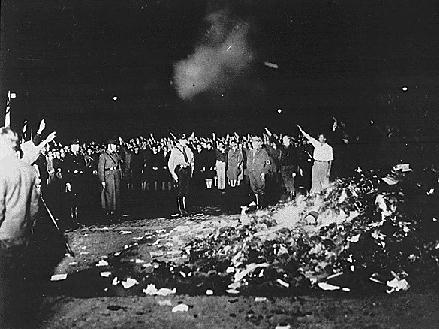
One of the saddest books I remember is Ray Bradbury’s Fahrenheit 451. Any society that burns books has whip-lashed far beyond Fascism into the enemyhood of humanity. Much of ancient culture has been lost through the natural or premeditated destruction of misunderstood “inflammatory” writings and we are much the poorer for it today.

According to an Associated Press story, the ironically named Rev. Terry Jones of the even more ironically named Dove World Outreach Center in Gainesville, Florida, is agitating for a “burn the Quran” day on September 11. Other than momentary, self-righteous catharsis, nothing is to be gained by burning books. The contradictory impulses here lie thick and deep: a Christian clergyman feels insulted by an extremist attack that killed indiscriminately (Muslims and well as Christians, Jews, and Atheists died in the September 11 attacks), bearing the symbol of peace he wishes to declare his personal war, and the follower of the willing victim of Nazareth wears a gun.

Burning books does not solve any problems. Surely Rev. Jones knows that plenty of copies of the Quran abound throughout the world. His action is calculated as a poignant symbol. Is such a symbol anything more than a base expression of outright hatred? When, apart from medieval Christendom, has Christianity insisted that violence is the way forward? All you need is hate? For although the burning of books may not physically harm anyone, the violence in this hatefully symbolic act is the very antithesis of tolerance and understanding that the religious world so desperately needs. Islam has given much to world culture, and we reap the benefits of Muslim scholars and thinkers each day, without any conscious consideration. Rev. Jones needs to read more than just Fahrenheit 451. He must learn truly to read and, like Montag, weep.

Jones' theological comrades