Being Human

Within the first three pages, if you’re not mortally offended or inexplicably happy, you’re probably not an American.

Growing up with pets, I had a hard time understanding the hard and fast line drawn between animals and people. The failsafe fact used back then is that only people used tools. When we looked closer at animals we found that wasn’t quite true. Well then, only people have language. A large question mark has grown from that assertion too. The final fallback, the sine qua non was souls: only people have souls. It is also the safest of assertions, since it can be tested for neither people nor animals.

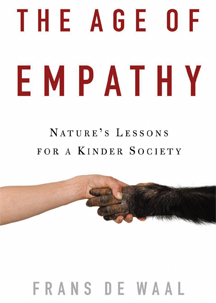
This way of thinking, according to Frans de Waal’s The Age of Empathy, arises from the western religious tradition—a religious tradition that grew up in relative isolation from other primates. Many world religions do not feel the necessity of making people absolutely different from our animal cousins. In Christianity at least, heaven itself rides on it. What are we so afraid of?

I posted, a couple years back, on Frans de Waal’s Our Inner Ape. Having just finished The Age of Empathy, I have reaffirmed my earlier accolades—he is one of the most sensible and important writers alive. Step by slow, evolutionary, cautious step, de Waal illustrates that one of the taboos of science—that animals don’t have emotion—is patently wrong. Not only do they experience emotion, but apes, cetaceans, and dogs at least, know empathy. Even scientists don’t like to admit this because science grew up in the shadow of the Judeo-Christian-Muslim worldview of human superiority.

But there’s even more at stake. As de Waal makes perfectly clear, the unbridled capitalism of the United States goes against nature. The unlimited acquisition of the vast majority of the resources by the few sets our primate sensibilities on end. Empathy, the ability to feel for another and take their perspective, is not only part of animals’ experience of the world, it is also a mandate of our religions. In order for society to survive, we must come to know this truth. Falsely applying Social Darwinism as factual, biological Darwinism, the few have taken more than either biology or religion permits.

The Age of Empathy should be on every school’s mandatory reading list and corporate climbers should learn that even selfishness has a very steep price tag. Not only for themselves, but for all of us.


Adrift

We all have the gift of critical thinking to thank for the world of relative comfort in which we live. That doesn’t mean we always appreciate the source of the gift; in fact, America has had a long history of anti-intellectualism, a distrust of those educated “European style.” Nevertheless, universities in the United States far outnumber those in most nations. Overall they represent a tiny fraction of our culture and workforce, however, and when any institution become elite trouble will follow. I just read a review of Richard Arum and Josipa Roksa’s Academically Adrift in the Chronicle of Higher Education. Arum and Roksa, sociologists, have done a study of university outcomes in the United States and the results are failing. More specifically, a large proportion of students emerge from college having learned little and heavily in debt for their effort. Having just learned of the book, I haven’t had the chance to read it yet, but Kevin Carey, in his review, notes that the disparity breaks along the lines of privilege.

Those students who enter college from well-to-do backgrounds, having attended fine schools, learn a great deal and are very unlikely to end up unemployed. The other group, by far the larger of the two, is comprised of students from schools mediocre or worse, hails from somewhat humble financial circumstances, and will like find unemployment at the end of four years with little true education. There can be no excuse of ignorance, for universities have known of this for many years. In the words of Carey, “Academe was so slow to produce this research because it told the world things that those in academe would rather the world didn’t know.” Some of us emerged from higher education in profound debt, but even with good study skills, lack of connection equals great uncertainty. Classism is alive and well in America, but unfortunately universities have been quietly playing a supporting role.

The truly sad part is that many people already assume the worst about higher education. We like to claim education to be a great equalizer, but that will never change the fact of who your daddy is. The upper crust looks out for its own, and when it comes to the tremendous costs involved to maintain universities, the bulk of the tuition comes from those who benefit least. How long before university presidents with their pseudo-corporate salaries start asking for a federal bail-out? How many times can those who have too much cry that they can barely make ends meet? It can cost a lot to ensure your kids get the jobs they deserve. Universities have increasingly modeled themselves on corporate America, and the product has become shoddy and cheap. Perhaps those who distrust intellectualism have been right all along. Perhaps the logo outside campus should read “buyer beware.”

A rare view.


Witch Crazy

The self-destructive tendencies of human societies should be of major interest to those who study the mind. Why a highly evolved species would forego reason—or create an entire false logic—to give itself an excuse to mass-murder its own is among the greatest trials of theodicy. Can God be justified in such circumstances? With or without divine approval, God is nevertheless implicated. One of those homicidal events, the European witch craze of early modern history is a prime example. Anne Llewellyn Barstow’s Witchcraze: A New History of the European Witch Hunts is a disturbing book on many levels. For a human being with any level of empathy, reading about the torturous destruction of at least 100,000 people—generally women—is hard going. We don’t want to be reminded that we were ever so naïve as to believe that women slept with the devil, flew through the air to meet with other witches, and were trying to bring down society. The “upright,” as Barstow makes very clear, feared for the church. Concern for the ways of God excused—demanded even—the death of the innocent. Many of the victims confessed, under torture, that the godly men had got it right.

Barstow contends that economic stresses and fear for the sanctity of the church, along with a generous dose of native misogyny, fueled this holocaust. She notes that it happened in the same society that would initiate another holocaust a mere three centuries later. But why women? Coming out of the medieval period, societies were strengthening centralized governments. Roles of power that belonged to women were highly individualized, and therefore considered threats. The healer, in absence of a medical profession, was often female, frequently a midwife. In days of high infant mortality, they were sometimes blamed for performing abortions, something men in power simply couldn’t accept. Barstow points out that population increases were stressing the economic production of the period. The newly minted Reformation advocated a very active devil in the world. Since the devil, like God, was a guy, well, women satisfied his lust.

The most disturbing aspect of reading this book for me, however, is the fact that our society has come to resemble that one once again. Strong centralized governments control what citizens do through fear—what else would compel us to allow Patriot Acts to pass? They target women as scapegoats—otherwise the issue of abortion would not command such male attention. Fear for the sanctity of God is repeatedly invoked. Sometimes these modern witches are persecuted on the basis of ethnic background as well as gender. And in both the witch hunter society and that of today an elite class has collected the wealth and sits back to let the remainder incinerate itself in the name of God. Witches don’t fly through the night to meet a fictional devil. The real threat to society is right here among us, but its not who the powerful want us to think it is. And it is very human.


Wired for God

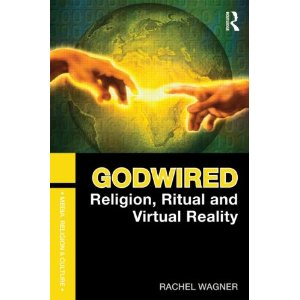
I am not now, nor have I ever been, a techie. When my fascination with the newest technological marvel borders on the rhapsodic, I suddenly realize it’s all electrons and immediately the fascination dissipates. It feels like an illusion. I am a guy who likes the sensation of a paper book in his hands and prefers conversation accompanied by all the subtle biological clues of being in the same room with somebody. Maybe it is lack of imagination on my part, but I will often get bored on the Internet and pick up a book instead. One book I recently picked up, and one that challenged my perception of reality, was Rachel Wagner’s Godwired: Religion, Ritual and Virtual Reality (Routledge, 2011). Wagner is one of that generation of younger scholars who is asking what the implications of electronic culture are for religion. If concepts such as online prayer walls, chat-bot salvation, and storing sacred texts on the same device as secular ones intrigue you, do yourself a favor and read this book.

As Wagner ably points out, religious individuals are tapping into the vast communications’ potential of the Internet to spread their faith abroad. There are apps to help you pray online, there are electronic games to prepare you for the fictitious rapture, and there are virtual churches. We have indeed sealed God in an Xbox, and we have beamed the divine across wireless networks and learned to confess our sins in cyberspace. And physicists are starting to confirm that, at our most basic level, we are energy rather than matter after all. Maybe we are tapping into ultimate reality here. Wagner explores how the level of engagement with virtual worlds constructed by software engineers (the new gods) becomes so intense as to provide an alternate reality. It all depends on how you define what is real. And it is clear that for many people, life without the Internet is now unimaginable. Those of us born before the supercomputer scratch our physical heads with amazement. How did Nebuchadrezzar or Alexander ever conquer the known world without GPS technology? Does my iPhone have a secret life about which I know nothing?

Within our culture live many older people who have never touched a computer. They exist alongside grandchildren practically born with some iDevice in their grasp (may be a choking hazard for children under three). I have lived long enough already to have witnessed keyboarding being replaced by thumbing, and research having shifted from long treks to the library in the snow to a few taps on a glass screen that can feel the electricity from my chilly fingers. From the comfort of my lonely room sings my soul, how great thou art! Perhaps Terminator didn’t go far enough, perhaps Skynet really is god. Maybe this matrix of blood, muscle, bone, fat, and spit is really just an illusion and the Internet is true revelation. Wagner pries open some very important questions in her book. And none of us should be surprised if, when we approach the pearly gates, we find a touchpad next to the electronic lock inscribed with this legend: “Welcome to Heaven. Please enter username and password. Type in the letters you see in the box below.”


A Long Way to Go

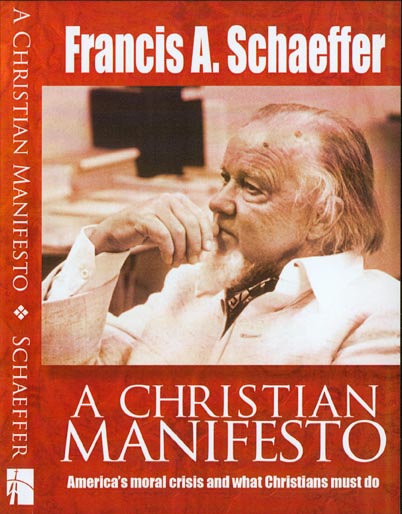
“One of the greatest injustices we do to young people is ask them to be conservative.” The words are those of Francis Schaeffer. The Francis Schaeffer. Among evangelical circuits, Schaeffer has a status right up there with James Dobson, Ronald Reagan, and Saint Paul. At Grove City College he was viewed with such veneration that hagiography would be an understatement. Few realize that Schaeffer was a mover and shaker in the hippie movement until Roe v. Wade caused what might have been akin to a breakdown. Schaeffer transformed into what he once despised, the ultra-conservative trying to protect the unborn. While Catholic groups had been unsuccessful at capturing Jerry Falwell’s sympathy for fetuses, Schaeffer would win. His book, A Christian Manifesto, published the year I started college, was required reading for religion majors. Abortion had now been taken on as an “evangelical” issue.

Fast forward a few decades. Karen Handel, erstwhile Georgia gubernatorial hopeful, becomes senior vice-president for Susan G. Komen’s The Cure. Handel ran for governor on a pro-life platform. The Cure (temporarily) withdraws funding from Planned Parenthood—the idea that every child should be loved and esteemed is less important than every child should be born. With those little tiny feet. And as it turns out, hopefully with little tiny penises as well. Divide and conquer. Women against women. The Margaret Thatcher syndrome. Call it what you will, but abortion as a religio-political issue revolves around women’s rights. Anti-female legislation has had a long and sordid affair with Christian theology, reaching back to medieval witch-hunts and Catholic sacerdotal declarations. What is sometimes excused as ignorance in less developed societies where women are routinely brutalized is given a Gospel air brush job and called “anti-abortion” in the United States. The real issue, the literal elephant in the room, is women’s rights.

The evidence on this is incontrovertible for anyone who is willing to open their eyes. In order for our culture—men hurling themselves at each other during the Superbowl while women are preparing food in the kitchen—to survive, outmoded gender expectations must be kept firmly in place. Even if you want to cure breast cancer—largely a plague against females—you do it so they can live to produce more males. Being raised with an absentee father, I learned very early that women had every right to equal treatment with men, but I also learned that it did not happen. The trick has been to get women on board to vote against their own best interests. Raise them up to think their religion, their God, demands them to be subservient. And if a man wants sex, it is a woman’s duty to comply. And abortion undoes all a man’s hard work in the bedroom, or backseat, or dark alleyway. Yes, these issues are complex and myriad aspects play into them. I say we call a quorum on the debate until one-half of the human race is truly given a chance to find its voice.

What does he have that half the human race doesn't?


Virtually Divine

So I decided to try virtual reality for a while. I have been reading about the influence technology has on religion, so I thought a trip to Wikitude would be instructive. Now I don’t want to sling lingo like I’m some sort of real techie, but Wikitude is an app that shows the artificial worlds of virtual reality in your immediate environment. Many of us live our day-to-day lives without realizing that we are surrounded by powerful, invisible beings who can only be seen through electronic eyes. We have given our physical world an imaginary overlay that may turn out to be more real than reality itself. So I clicked on Wikitude and took a peek around my office on Third Avenue. Wikitude shows those things that I would have called “dialogue boxes” as a kid, but that now stand in for overlays against any mapped reality. In Manhattan there are many, many of them. I clicked on the one nearest my finger. It read, “A monster is destroying the city.” Like it read my mind.

In some ways I never got over the naïve realism I grew up believing. I first read about avatars in Neal Stephenson’s Snow Crash. Back then the idea of virtual worlds was still pretty new, and although Norman Spinrad and William Gibson had played with the idea earlier, the Snow Crash version is what stayed in my head. Avatars, I knew from my research on ancient religions, came from very early Indian belief. In what we now casually call “Hinduism,” some believed that gods came down and walked among us as avatars. Christians would later call this “incarnation.” In virtual reality, we are the gods and we descend into the world of human making as embodied electronic versions of ourselves. The idea, however, goes back to one of the most ancient religions in the world.

I’m not sure I feel safe in this virtual world I’ve discovered. I was relieved when I clicked on Wikitude the next day to find the menacing monster nowhere in sight. But is it really gone? The physical world has no shortage of ways to frighten the very sensibilities out of us. Many of them go by the name of religion. In this world, I can’t just click off the screen and be safe. It used to be that our simple, domed world had a divine bowl above it with a loving, if often very stern, parent watching over us. Now we have become that god, creating monsters and worlds to house them. Maybe that is the best answer to theodicy yet. When we create virtual worlds, we always include evil in the picture. Perhaps it has always been thus with the gods.

Reality or not?


Tweeting the Bible

I have an underused Twitter account. My life isn’t so interesting that I need to give my few followers (fewer even than those who read this blog) updates throughout the day. In fact, I mainly use it to let my Tweethearts know what I’m blogging about on any given day. While reading a book on the influence of technology on religion (more anon) it struck me that one of the more interesting aspects of biblical studies is the fact that the well never goes dry. For those who read sacred texts, there is no end of interpretation. I’ve addressed this before on this blog—religion is as individual as each believer. The more I read biblical interpretations, however, the more I see the subtle textures and layers that readers find in the text, despite what most religious leaders desire. And I don’t restrict this to the Bible—any sacred text can be read in multiple ways. The Bible, however, has been foundational for this person that I’ve become, and so I’ve decided to do some close reading.

I’m going to tweet the Bible. (If you are one of my rare followers, don’t worry—read on.) I’m going to tweet the maximum 140 characters per message once a day. For this task I will be using the King James Version, arguably the most influential book ever written in the western world. Doubt me? Watch a presidential candidate debate. Or google Girl Scout cookies. Why am I doing this? Well, I wonder what the Bible says when it is broken down into byte-sized nuggets. At character 140 I will stop, and the next day I will begin where I left off the day before. This exercise will be a way of looking at the Bible from a fresh angle. Besides, it’s been a few years since I’ve read the entire KJV. I don’t pretend that nobody else has thought of this—I’m sure there are many Bible tweets out there. I’m curious, however, at 140 characters a day how long it will take, and what will emerge. Yes, I know that there are mathematical whizzes out there who could calculate the answer in a matter of seconds, but I just have to see for myself. The doubting tweeter.

A new look at an old book.

There may be occasions when I fail—isn’t the Bible about forgiveness anyway? In my job I travel quite a bit, and sometimes Internet access is dicey. Most hotels, however, still sport a Gideon Bible, so resources should be no problem. It will be an adventure, and the Bible could stand some adventure these days. Besides, interesting pericopes will give me something to blog about occasionally. For those who haven’t been subjected to years of higher education on the Bible (or other texts), a pericope is a passage cut out from its surroundings. It is the favorite of televangelists and other proof-texters who prefer to not to face the larger implications of reading the whole Bible in its context. I like to think of this exercise as Internet hermeneutics. So let the adventure begin. If you are really bored and want to follow a glacially paced Bible reading, my Twitter name is stawiggins. When interesting observations emerge, however, I will let my blog readers know as well. In the technical age, life is tweet.


Grapes of Mirth

Growing up in a teetotaling family, when I first encountered Greek mythology I paid scant attention to Dionysus. Assuming him to be “just the god of wine,” I had no interest in the wares he was peddling. Of mythology itself there was no end of fascination, and many of the great classics have been toned down to Disney, or even more insipid, for the entertainment of children. What we often fail to appreciate is that this is religion. Mythology that does not address the very real human concerns of sex, intoxication, and false dealing is really of no help at all. If in doubt, read your Bible. (Not the children’s version.) When I came back to Greek mythology as an adult, it became clear that Dionysus differed from other gods in considerable ways. While teaching my mythology classes, I decided to read more about this intriguing god. Well, it was just like the Fates that I would get a new job before reading Walter Otto’s book, Dionysus, but the urge was still strong and I was glad I’d read it.

Otto wrote in the days of Frazer’s technique of comparing sometimes questionable sources, and yet he produced a masterful, and poetic study of Dionysus. What quickly becomes clear is that the popular association of Bacchus with wine is a gross oversimplification. Dionysus is the god of madness, of blurring distinctions, and of losing control. He is the most frequently represented god in Greek art because, like us, he sometimes loses it. Greek society is famed for its rationality and order. It is sometimes overlooked by the reasoning mind that creativity, emotion, wildness are part of the complexity of humanity. Dionysus is the god who understands the need to let go once in a while. This is not hedonism, nor is it debased. Bacchus represents the human in full form. He is the god who comes to humanity, the god of appearing. Dionysus, the friendly god.

In the early days of Christianity in the Greek world, many Greeks supposed that the Jesus preached to them was Dionysus (to the chagrin of many missionaries). The connections, however, are remarkable. Like Jesus Dionysus has a god for a father and a human for a mother. He lives a carefree life and is the god who actually comes down to live with people. He is a god who dies and who is resurrected. Like Jesus, he enjoyed a glass of Bordeaux every now and again. And his followers were fanatical. As Otto makes clear in his dated, but insightful, book, Dionysus left a deep imprint on culture itself that continues to affect us even today. Even if we’re teetotalers, we can appreciate the depth of character and the complex nature of a god like Bacchus. And if we’re honest we’ll admit that there are times when we just have to let it go.


Religious Capital

Eric Weiner’s book, Man Seeks God, surely received a boost with an article in Sunday papers (originally written for the Los Angeles Times). In this piece, Weiner comments on the American fluidity of religion, how people pick and choose the spirituality that works for them. His observations are based on the results of a Pew Trust study that indicates about a third of Americans change their religion during their lifetimes. This is a departure from the age-old tradition of being born into a religion, something that still seems to apply to two-thirds of the American population. In his article Weiner suggests this is not entirely a bad thing, since people are consciously deciding on that to which they will commit themselves. I haven’t yet read Weiner’s book, but the situation described here has a potent underlying implication.

Religions tend to make claims based on certitudes and assertions of absolute truth. When religion becomes merely a matter of choice, has it not lost its very foundation? This may not be a bad thing, but it does change completely the essence of religion. No longer can religion be considered an inviolable truth handed down from on high if the truth is a matter of choice. Or, more troubling, perhaps we no longer seek truth. In a population based on personal satisfaction, religion becomes an extension of personal comfort. In a society where non-faith is suspect (most atheists still complain of being considered “evil” for their non-belief), people need to believe something—anything. We can’t test the truth in any empirical way, so we all have to admit to some guessing. When born into a religion, questioning is a sign of doubt. When shopping for a religion, questioning is a smart economics. Does this religion work for me? Is there one that suits me better? Is it worth the extra costs?

The center of focus has shifted from seeking the one, unwavering truth that is beyond us to seeking a belief that we can stomach. Religion is a commodity. Perhaps this development is inevitable in any society so dedicated to the free market that even common decency is labeled socialism. Is it possible for people who constantly think in terms of supply and demand to understand an absolute in one tiny sector of their lives? Choice becomes an all-or-nothing proposition. Its pragmatism indicates its origins. When people can choose a religion without consequences, it should be obvious that this is a human construct. Instead, we want to believe that our religion is the right one because that’s the way we like it. Perhaps the question we should be asking is whether our lifestyle is authentic or simply a fabrication made to suit our wishes. Our treatment of religion as a product to purchase and use reveals more about what we believe than does any creed.


Let the Left One In

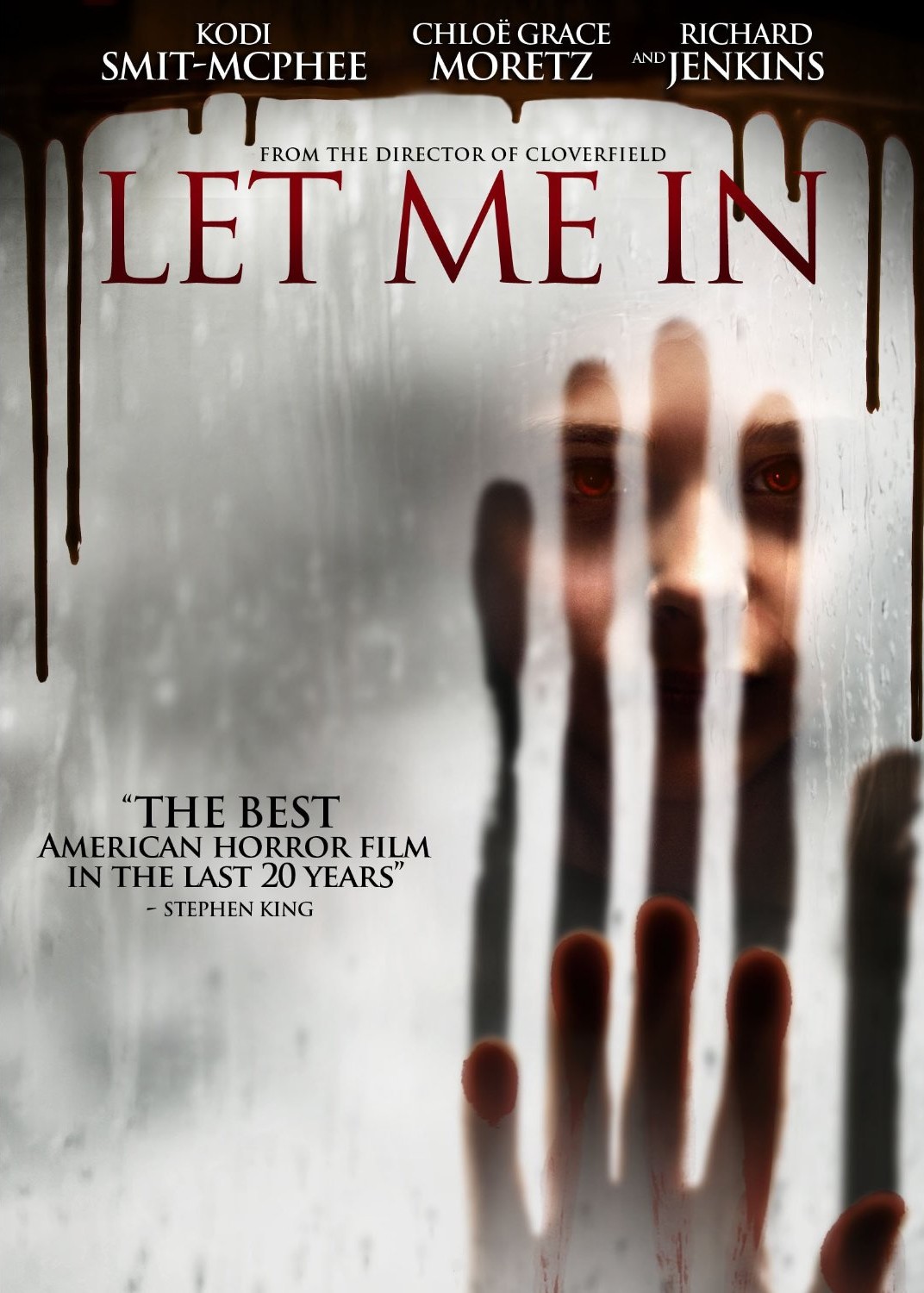
When you’ve got a good thing going, why stop? Reading Timothy Beal’s Religion and its Monsters put me in the mood for a vampire flick over the holiday weekend. I had watched with longing as Matt Reeves’ Let Me In flew into and out of theatres back in 2010. Advertised as a thoughtful vampire story based on John Ajvide Lindqvist’s novel, Let the Right One In, and having a real moral struggle unlike the Twilight saga’s dulled fangs, it had been on my “to see” list for quite some time. This movie doesn’t disappoint. The specific aspect to which I refer, of course, is the religious. Vampires may be the most religious monsters ever invented, and like all good, subversive movies Let Me In casts the religious aspect in an unexpected role. Religion and the vampire interact through the character of Owen’s mother. Her face never seen on the screen, she shuffles outside the range of view and tells her son of the need for prayer and belief. Her life is a shambles and 12-year-old Owen knows it.

Abby, the vampire next door, is a monster capable and desirous of love. Her vampiric self is not exposed to crucifixes or blessed communion wafers, but to the torment of outliving those she loves. Eternal life is her curse, and religion can do nothing to solve it. When Owen slips twenty dollars from his Mom’s purse to buy Abby some candy, Jesus is watching from the mirror. When the bullies torment Owen, Jesus is nowhere to be found. The symbolism, whether intentional or not, is apt social commentary. Our religion is there to punish us, not to help us. If in doubt, listen to the politicians and televangelists; God is intensely angry—Jonathan Edwards wasn’t even halfway there. Their surfeit of rectitude puts the rest of us to shame. Until they’re elected.

Vampires have their origin in creatures that steal the life-essence of the living. Whether blood, semen, or psychic energy, the vampire feasts while the victim withers. Let Me In, by telling the story of a pre-pubescent vampire, shifts the focus of culpability. A 12-year-old is beneath the age of responsibility according to the Judeo-Christian tradition. Unable to determine right from wrong, the child simply seeks what all living creatures do—the possibility of existence. When Owen discovers that his new friend, his only friend, is a vampire, he tries to find answers from his religious mother. She is asleep. He calls his absent father who blames the religion of his mother. The moral guidance here comes from the monster. The bullies would win if it weren’t for what the authorities call evil. Sometimes I think Jonathan Edwards got it all backwards, for when power determines who is righteous it is the bullies who dangle spiders over the fire.


Hic Sunt Dracones

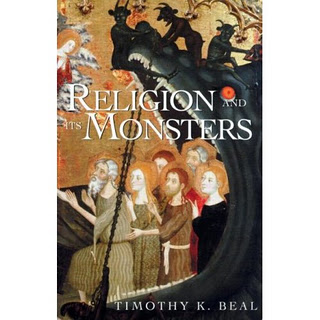
Even a visionary like Thomas Edison can’t know the directions in which an invention might be taken. The idea of the moving picture has immersed human beings in an alternate reality that is sometimes difficult to separate from the physical world we daily inhabit. As soon as movies were invented, producers and directors began to explore the depths of fear with the monster movie. What they were really exploring was the mystery of religion. I frequently write of the nexus of religion and the monstrous, and Timothy K. Beal wrote a book on that subject a decade ago in which I found another affirmation of my suspicion. Forthrightly titled Religion and its Monsters (Routledge, 2002), Beal’s playful yet serious exploration of the scary traces the origins of monsters to Genesis, and even earlier. Taking on Leviathan, the biblical sea serpent, Beal demonstrates the pre-biblical pedigree of this fierce monster and shows that, like most truly frightening entities, it began as a god. Indeed, what we call religion today grew up around fear of those forces beyond our control, a nature so harsh it could be none other than divine. The writers of the Bible clearly knew this story as Beal traces it from Genesis to Job, from Psalms to Jonah, from Leviathan to Devil.

In a shot/reverse shot formation, Beal takes us to modern-day monsters and shows their religious origins. Those things that frighten us on the big screen crawl there from their origins in the temples, shrines, and chapels of religions that don’t manage to subdue evil completely. The claims are made that the gods are stronger than the chaos that surrounds us, but they are still fighting nevertheless. From Dracula to Godzilla, the monsters have the gods on the run. And when the human protagonists finally get their monster pinned down, they discover that it is often God wearing a mask. Our monsters are gods gone bad. How else could they revive from the dead at the end of the reel? They never truly disappear. And if they do, there’s always more where they came from. The reason, Beal concludes, is that we are, in fact, the monsters.

According to the analysis of W. Scott Poole, Timothy Beal, like myself, falls into the “monster kid” generation. As I grew up, I quickly learned that to confess my interest in monsters was to risk the labels of juvenile, naïve, and immature. Grown ups are interested in money and sex and power. Only kids have any interest in dinosaurs, mythology, and monsters. An epiphany of sorts, however, seems to be unfolding. Scholars of religion in my generation are peeling back the rubber masks of our movie monsters and are discovering the face of the divine. Perhaps we are all adolescents at heart, fixated on the weird and bizarre because the paths to money, power, and temptations of the flesh are blocked to us. Or perhaps we are the Magellans charting a course for regions off the map. It is those regions, as Beal reminds us, that are illustrated with sea serpents and inscribed hic sunt dracones, “here be dragons.” Doubt it? Read your Bible and find out for yourself.


Trouble with Triffids

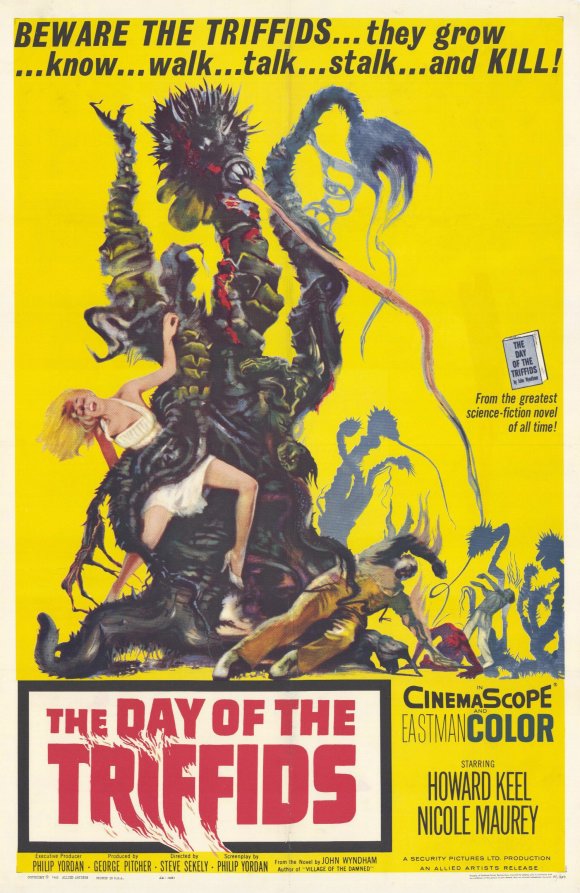
Some time ago, I posted about the John Wyndham novel, The Day of the Triffids. In playing on the loss of humanity’s primary sense of sight, the story creates a truly eerie scenario in which people are harvested by plants. Not just any plants, but alien plants! Of course, such an idea demanded a movie rendition. The film was released the year I was born, but I only just got around to watching it. Compared to the psychologically thrilling novel, the movie doesn’t ever reach the intended level of terror. Nevertheless, religion, as usual, plays a role in the movie. As Bill Masen, the protagonist, makes his way from London to Paris, attempting to find other people who retain their sight after a devastating meteor shower blinded most of the world, he comes upon a mansion where the wealthy owners are caring for the disabled. (Hard to imagine that these days, but it was the 60’s, and idealism was kicking in.) While discussing their rather hopeless options, Bill suggests there is little reason for optimism. His new-found love interest, Christine, says “We must keep faith,” to which Bill replies, “It’s going to take more than that to get through this.”

Indeed, God is no help against the triffids. These intelligent, moving plants are soon everywhere, consuming humans and intent on taking over the planet. Bill and Christine, along with their adopted daughter Susan, make their way to Spain in hope of finding a military solution. They stop at a mission, topped with a cross and inhabited with a helplessly blind, and expecting, couple. The message is clear—there is no god to help those left to their own devices. Even those who live in god’s real estate have been abandoned. Those who survive are those who help themselves. Eventually our hapless heroes are rescued by the navy and a submarine moves them safely away from triffid-infested Europe. Then, in the final scene, our blended family is seen walking into a church while a voiceover declares that the triffids did not defeat humanity after all, and “Mankind survived and once again have reason to give thanks.”

Exegeting this film, however, leads to some uncomfortable conclusions. Those who had no divine aid give thanks to an impotent deity after it is all over. The solution for destroying triffids—salt water (you might want to store that away for future use)—is discovered by scientists and is applied at their personal peril. Even the heavenly-based origin of the menace has divine overtones: colorful portents in the sky are the provenance of God. In 1962 science had not yet even reached the moon. The default fallback, based on decades of evangelical sculpting of culture, is to give thanks to the Lord, despite the devastation. Indeed, a new Garden of Eden might be said to have resulted from the triffid assault. In this garden parasitic plants teach humans to give thanks, but the vast majority of humanity remains blind.


Political Insantorum

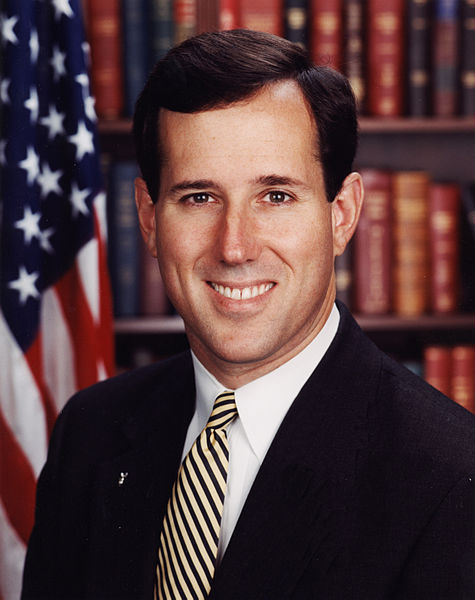
Some weeks it is Thursday before I get a look at Tuesday’s newspaper. It has been one of those weeks. On the op-ed page of the New Jersey Star-Ledger is a piece by Harvard professor Noah Feldman on the somewhat surprising rise of Rick Santorum in the melee otherwise known as the GOP nomination process. The intolerant Catholic (Santorum, not Feldman) has surprised many with his appeal to the Evangelical Protestant camp, the traditional enemies of anything popish. As Feldman points out, if you add up Santorum, Bachmann and Perry, you get the equivalent of a 2008 Iowa Huckabee with Romney staying about where he was back then. This calculus of political doublespeak points to a very basic, fundamental lie at the heart of it all: none of the candidates is a theologian, but they act one on TV. Santorum’s Catholicism is blurring with Huckabee’s Baptist sensibilities in a way that should make even the most profane Reformer shudder. Baptists supporting a Catholic? This marriage can’t end happily.

I am no politician. I’m not even a political science student. As someone who has kept a weather eye on religion for over forty years, however, it is clear that “Christianity” in America is a house built on shifting sands. For a nation founded on the notion of religious freedom, an awfully large number of citizens sure want to limit the options. Freedom of religion is the choice whether to sit on the right hand side of the aisle, or the left (with the former being strongly urged). Freedom of religion can be frightening because no one has all the answers. And politicians, who regularly distance themselves from the rest of us, send their children to private schools to underscore the fact. Is it not so, Mr. Santorum?

Those who want to take their dogma to the White House should make sure it’s at least paper-trained first. Feldman notes that Roe v Wade gave the initial push of Evangelical toward Catholic. I am reminded of the excellent book Republican Gomorrah by Max Blumenthal—those who are interested in the real roots of the overly emotional secret lives of blastoplasts should read this book. Suffice it to say that some very interested parties really didn’t care much until a particular quasi-celebrity decided to make a cause célèbre of the issue. Now the way to the seat of power is paved with unwanted pregnancies. It is high time politicians got their hands out of their pockets and off their Bibles and started using them to help the average person again. In fact, it might not hurt if they had to be an average person before running to represent them. But then, they wouldn’t be able to afford private school for their kids, would they? Mixing with hoi polloi takes more fortitude than a congress full of representatives can muster after all their pampered rearings.


Doubting Peter

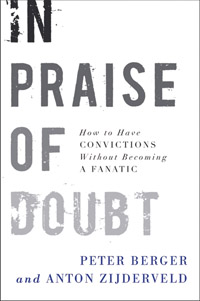
As a student at that university across the river from Harvard, it was clearly a matter of institutional pride that Boston University could claim Peter Berger. He was one that Harvard didn’t manage to get. Of course, I never took any courses with Professor Berger, but his work on sociology of religion is still considered the standard in the field. When his recent book, In Praise of Doubt, appeared a couple of years back, I knew that I had to read it. Originally published by an academic press, it was unnecessarily expensive (well, as the minion of an academic publisher I now realize the rationale for the prices, but I still get spasms in my wallet every time). When it appeared in paperback I finally located a copy that I could justify buying. I was not disappointed.

This little book begins innocuously enough, but by the end you find yourself realizing that you’ve just downed a potent draught. We are all familiar with doubt, but what many of us do not stop to consider is its role in different religious perspectives. Moving us through absolutism and relativism, In Praise of Doubt demonstrates how either position may lead to a “fundamentalism” of sorts, and for the same basic reason: neither position professes enough doubt. Having been raised in a fundamentalist environment, I knew that doubt was the great enemy. Certainty was the only true sign of faithfulness. The problem, for me, is that I’ve always harbored doubts. The more I learned, the less certain I became. Doubt had acquired the stench of sin, and I tried to avoid the very element that constituted my personality. Berger has finally given doubt its due.

In a world of extremists—extreme religionists and extreme atheists—the still, small voice of doubt is frequently drowned out. Doubt, however, has a noble pedigree and even more remarkable progeny: tolerance. Those who are certain tend to have little tolerance for those who differ, or worse, those who challenge their views. The doubter, as Berger (and co-author Anton Zijderveld) asserts, is less spineless than s/he appears, being open to the fact that no one has all the answers. No matter how eloquently Hitchens, Harris, or Dawkins may grow, they do not have all the answers any more than (god help us) Pat Robertson, Rick Warren or Tim Tebow. Probability and logic tend to suggest the former are closer (much closer) to the evidence than the latter, but who knows? It might even be possible that the Evangelical camp may one day learn the virtue of a little uncertainty by reading this book. But frankly, I doubt it.


Close Commandments

Okay, so I’ll admit that Jeffrey Kripal’s Authors of the Impossible put me in the mood for Close Encounters of the Third Kind. Watching this movie always calls for an investment of time and some emotional energy since it does drag a bit and there are some ponderously majestic scenes that simply make me want to scream. As I powered up the old DVD player this weekend, however, I received an epiphany while watching the movie for the first time in years. Early on during Richard Dreyfuss’s breakdown, the kids (incongruously) gather around the television with excitement to watch the Ten Commandments. The reason, clearly, is that they want to stay up late, and even having to watch Cecil B. DeMille’s warhorse is an adequate excuse. I’ll admit that it was one of my motivations for watching the lush, but equally dull, Ten Commandments as a child. Yes, I took it to be a pious attempt to render God’s literally true memoirs into celluloid, but its 4-hour running time did promise to keep me out of bed until after ten.

Young Moses experiences a theophany.

As my wife and I watched Close Encounters over the weekend, I realized for the first time that much of the cinematography is based on the Ten Commandments. Dreyfuss is a visionary, a prophet, if you will. He is drawn to a sacred mountain (Devil’s Tower) where, like Moses, he makes his way up and down, unable to decide whether to enter the divine presence or not. One of the pacing problems in the book of Exodus is the mental image of an 80 year-old Moses laboriously making his way up and down Sinai as God sends him on various errands. I imagine the children of Israel having time to cast a whole herd of golden cattle. As the UFOs make their grand appearance somewhat near the end of Close Encounters Roy Neary (Dreyfuss) and Jillian Guiler climb the mountain, see the theophanic display, and start back down. Only to go up again. On their way to Devil’s Tower they drive by several dead animals, like those struck down in the fifth plague of Exodus. The army forcing the people out of the area is itself an exodus. The return of those kidnapped by the aliens is a kind of letting go of those held captive. Apparently the Egyptians and aliens have a long history anyway.

I have no idea if Steven Spielberg was intentionally modeling Close Encounters on the Ten Commandments, but corollaries are clearly there. 1977 had not yet witnessed the decline of Erich von Däniken’s star, catapulted into orbit by Chariots of the Gods? where once again we find God driving spaceships and giving the Egyptians a hand with those pesky pyramids. Even the surnames of the characters seem to be a play on their biblical roles. Roy Neary, the one who draws near to God, the only one selected to literally ascend to heaven at the end, and Jillian Guiler, whose suspicion keeps her earthbound with her son Barry, who bears an eerie resemblance to the childlike aliens whom he befriends. Berry is the movie’s Joshua, the one who will keep the faith alive for the next generation. The story came to Spielberg, according to the media, when he saw a meteor shower in New Jersey as a youth. I missed last week’s meteor shower in New Jersey, and my baby ark on the Nile never sailed.