Rocks and Philosophs

Porphyry is, apart from being a cool word, a kind of purplish stone that was prized for statue-making in antiquity.  It is also the name a Syrian philosopher gave himself in the third century of the Common Era.  Now, if you read widely about antiquity, as some of us have done, you’ll encounter the name Porphyry from time to time, but those of us who focused on older materials don’t pay him much mind.  I was reading about Porphyry recently, however, and did a little poking around to discover that he’d written a book called, in translation, Against the Christians.  Some historians speculate that Porphyry may have once been a Christian himself, but whether or not that’s true, he developed an antipathy to the sect.  I was curious about what his beef may have been only to discover that this book is lost.

Now lost works in antiquity are the rule rather than the exception.  Literacy may not have been widespread, but those who could write did write, and often prolifically.  Human history was very well documented.  But tonnes of it went missing.  Wars have been part of that history and wars are notorious for destroying written records.  Also, much writing was on perishable materials that, well, perished.  That wasn’t the case with Against the Christians, however.  Porphyry’s work was purposefully destroyed.  By this point Christianity had taken over the Roman Empire.  Rather than accepting the challenge of a philosopher, officials censored and destroyed his work.  Ironically, all that survives are quotes from books of theologians who were trying to refute him.

This made me reflect on the book bans that are currently all the rage among some “Christian” politicians.  Such rearguard actions belie the confidence that imperial religions showcase.  A religion that’s afraid others might see the holes raises many questions, does it not?  It seems to come down to the idea that nothing has changed in two millennia, even though Jesus didn’t have a cellphone—not even one of those old flip-open kind—and much of what we know of nature was still many centuries in the future.  The fact is that we only try to silence those who disagree when we fear them.  Book bans pretend that they can hold the hands of the clock still and that all will remain as it was decades ago.  Learning, however, is a genie let out of the bottle.  Back in Porphyry’s day powerful bishops and emperors ordered his book banned and destroyed.  And we are all the poorer for it.


Cabin Stories

Almost always I come out on the same side of the debate.  The book is better than the movie.  The book allows things to be explained more fully and is the way the story is “supposed to go.”  Maybe it’s because I found the novel open-ended and I like closure, but M. Night Shyamalan’s Knock at the Cabin, in my humble opinion, is better than The Cabin at the End of the World by Paul Tremblay.  Now, the author’s title is better, but Shyamalan’s explanation is clearer.  In short, I think the movie works better.  If you’re not familiar with the story, four apocalypticists, responding to visions they’ve had, break into an isolated cabin occupied by a vacationing family of two daddies and an adopted daughter.  Shyamalan characteristically shifts the cabin’s location to Pennsylvania and, yes, before you think it’s all Philadelphia, there are some very isolated places in my home state.

These weaponized apocalypticists subdue the family and inform them that unless they decide which one will be sacrificed, and then carry out the deed, the world will end the next day.  The adult couple tries to explain rationally how crazy this all is.  How could four people be given this hidden knowledge and be tasked with saving the entire world?  It seems more likely that they’ve targeted a gay couple and are trying to break up their family.  One of the things the movie makes explicit that the book doesn’t is that the intruders are correct.  This is the end of the world.  In order to achieve this, Shyamalan had to rewrite the ending to remove the ambiguity.  For some of us, that really helps.

The movie, in a way that a brief blog post can’t replicate, includes quite a bit of dialogue about religion.  Religion and horror are often bedfellows, and this is one of those movies that relies on religion to fuel the fear.  Interestingly, the cabin invaders aren’t stereotypical conservative Christians.  In fact, they appear to be mostly secular everyday people who have come together around a vision that they all had in common.  In the novel there’s always some question whether this is an elaborate hoax whereas the movie makes it clear that the death of each individual apocalypticist unleashes a plague.  Indeed, they are, as the couple finally realizes, the four horsemen of the apocalypse.  Since I’m still here to tell you about it, the end of the world has obviously been avoided.  This movie is worth seeing, even if the novel has a better title.


Closure of a Trilogy

So the final part of Jessica Verday’s Hollow trilogy really moves into supernatural explanations of life after death.  At least for those destined to become shades.  Since we’re at the end here, I won’t worry about spoilers.  Also, the series has been out for over a decade now, so we’re fairly safe, I think.  (Young adults aren’t my demographic, I don’t imagine.)  To recap, Abbey is in love with Caspian, who is a shade.  Caspian isn’t seen by many people, but he does appear to Abbey.  Throughout the story she mourns the death of her best friend Kristen.  As the action builds, Revenants begin to appear in Sleepy Hollow.  Revenants are beings that assist people who are to become shades as they die.  This indicates to Abbey that she won’t live to graduate from high school.  She will, however, get to be with Caspian—“complete him”—in a form of life where few will see them but they will live on in a limited sense.

The universe here isn’t particularly Christian in background.  Revenants operate in pairs, one tending toward good, the other evil.  They are sent to do a specific job and when it’s over they move on.  As in the movie Dogma, however, one Revenant doesn’t want to move on.  He figures that if he fails to do his assigned task he’ll continue on as an immortal on earth.  At the end he reveals that he killed Kristen in Abbey’s place so a difficult decision’s in order.  To straighten out the mess that’s been made on some cosmic scale, Abbey can die, history will be altered, and Kristen will be the one who survived.  This will involve self-sacrifice, which kinda does bring us back into Christian territory.

This trilogy emerged following the obvious success of Stephanie Meyer’s Twilight saga.  Teen paranormal romances were in, and publishers hearkened to the demand.  It does reflect our times that writing for young readers has taken on an impressive quality.  This trilogy is a great example of how someone who recollects well what it was like to be a teen is able to transport many of us back to that stage of life.  The awkwardness.  The constantly making wrong decisions.  The bewilderment of falling in love.  And of course, if you throw in some ghosts and some light violence, you’ve got a winning combination.  I enjoyed getting to know these characters.  I knew, once I put volume one down that I would have to see how the rest of this story unfolded.  I’m glad I did.  I have a sense of closure, for this series at least.


Reframing

Theory can be tough to stomach, but once you get through it you can often find all kinds of valuables in an academic book.  I learned quite a lot from Cecilia Sayad’s The Ghost in the Image.  It’s a brief but powerful book.  One of the under-explored areas of life is how our inventions affect reality.  We invent things and they change us.  Photography is one of those inventions and it seems like we should step back for a decade or two and try to figure out just how it’s remade reality.  Sayad explores that specifically in the realm of horror.  Not just movies, but other technology associated with images (and even other senses).  She makes the case that the frame that separates an image from the “reality” outside the frame—think of going to an art museum and how the frame sets a painting off from the “real” wall behind it—has become permeable.  Thus the theoretical part.

Applying that principle to horror, she has fascinating chapters on Amityville and Enfield, the found-footage fictions of Paranormal Activity, and the Slender Man meme.  She also discusses spirit photography, which is really the precursor to the horror film, and what used to be called video games.  I’m not a gamer, I’m afraid, and I’m sure I’m missing out on some culture because of it, but researching and writing books beyond work takes up quite a bit of time.  In any case, the amazing thing is that Sayad does all this without judging.  She doesn’t say that ghosts are “real” but she doesn’t say that they’re not.  Part of the reason for this is that reality is part of the quest here.  We define reality partially (largely) through our technology.  Would politicians become “celebrities” without photographic media?  They’re hardly the cream of the crop anymore (let’s be honest here).

So this book left me thinking.  Imaging technology invents, instigates a new reality for creatures as visually oriented as our species tends to be.  Sayad also explores how other senses are brought into this—sound, most obviously, for movies—and help to confirm that reality.  Theaters have toyed with touch and smells to widen the diegesis of the movie (taste is a bit trickier), each layer brings the image further outside the frame.  The internet has, of course, only accelerated all of this.  The fact that horror is the genre that perhaps best lends itself to this kind of impact on society is, in itself, a telling point.  I need to step back for some time and ponder how this all fits together in what I perceive of as reality.


More Young Fear

Okay, so the second one has a cliff-hanger ending.  I should’ve seen that coming.  This installment of Jessica Verday’s The Hollow Trilogy moves the story pretty directly into the realm of the dead pervading the everyday world of Sleepy Hollow.  For young adult literature from the era of Twilight, it does raise issues that, although they were around when I was young, have become more prominent in the thinking of teens.  Overdoses, college choices, attempted rape (or at least threatened), seem like things our society might’ve either overcome or matured about.  Instead, we start putting these pressures on our young and wonder why society has a hard time coping.  Sometimes I wonder if we’ve made society too complex.  As an adult it’s become so complex that I’m never quite sure if I’m getting things done correctly, or if they might come back to haunt me later.

In any case, in the first novel of the set, The Hollow, the protagonist/narrator, Abbey, discovers that her boyfriend has been dead all along.  The Haunted, volume two, is about how she copes with that.  I read many years ago that certain narratives are something like preloaded in human brains.  Given even the most basic pieces, our minds fill in the blanks.  When girl meets boy and likes him, our thoughts go toward getting them together.  Of course, a story is all about the difficulties that threaten to prevent that from happening.  For most of us, we start to experience these things as teens and even as adults we remember it well.  These are intense emotions and society complicates them because just when we think we know what we want at high school age, college separates us and we start over again.  Thus college visits.  It’s even more complicated when your boyfriend is a shade/ghost.

How the material and spiritual relate is an unresolved issue.   Materialists have already decided by cutting the spiritual out altogether, but the rest of us, perhaps trusting our feelings more, wonder.  Although these books are more paranormal romances than philosophical musings, they nevertheless raise questions that even adults struggle with (or should).  We don’t have all the answers and we hope that our children might get further along this path than we did.  Young adult literature helps them do so.  Some choose to respond by banning books.  The rest of us know that literature can help to discuss difficult topics in a world we’ve made far too complicated, for young and old alike.


Used, Again

It may be impolitic to admit it, but I have positive associations with Amazon.  This goes back to before they started using smily boxes.  Before Amazon, getting books often involved mail orders and checks and several weeks before delivery.  Now Bookshop.org does a similar service, and with more of a conscience, but Amazon showed everybody how.  I do have a complaint, however, with the internet giant.  They allow used book sellers to be the top place when ordering a book, since they sometimes have a lower-than-retail price.  I used to sell used books on Amazon, back when I had no full-time job.  I took great care to list books according to the accepted standards of book conditions.  I know I’ve written about this before, but two recent used book orders simply didn’t measure up.  So, herewith, a tutorial:

“Like new” means in mint condition.  You should not be able to tell the book was read.  Look for soft rather than sharp edges on the pages, slight curling of the cover (especially paperbacks) from repeated opening.  Hey sellers, if you have any of this, the proper category is either “fine” or “very good”—not “like new.”  I’m not really a collector (in that way), but if I order a book “like new” I expect that I won’t be able to tell it’s ever been read.  Normally I opt for “very good.”  This brings it down to a less expensive bracket and it implies things are in pretty good shape.  If your book has extensive writing or highlighting in it, it is not “very good,” but “good.”  If it does have minor markings you are required to list them.  I recently bought a “very good” book in which practically the whole first chapter was highlighted.  This isn’t easily missed, and it’s certainly not “very good.”

I get it, classifying books takes some discrimination.  The categories are there, however, to protect the buyer.  People do all sorts of weird stuff to their books.  The used book seller, on Amazon, is morally obligated to tell us about what’s going on.  And Amazon, please make clear when a book is “new” or not!  I recently bought a book that was listed as new but it had clearly been read at least once.  Be honest, people.  Book folk, in general, are good folk.  Reading is so important for a civil society.  Books are collectible items.  If you’re thinking of going into the biz, please remember that I’ve found books for a buck at library book sales in better condition than many “very good” books I found used online.  Just be honest—you’ll still sell the book, even if for a few pennies less.


Hidden Improvement

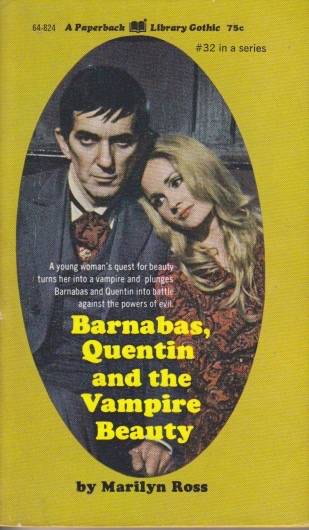
I believe in improvement.  Even for a journeyman writer like W. E. D. (Marilyn) Ross.  At least in his Dark Shadows books.  For much of the series the plot is largely the same: a young woman is threatened and finds herself in Collinwood.  Often the threat comes in the form of a mysterious stranger.  The woman falls in love with Barnabas Collins, but in the end it doesn’t work out.  The bad guys are stopped, however, whether they’re supernatural or not.  In Barnabas, Quentin and the Hidden Tomb things have moved on somewhat.  The main female character, Ellen, a southern belle from just after the Civil War, doesn’t fall for Barnabas.  She is attracted to him, of course, but not really in love.  That’s a plus.  And Barnabas is temporarily cured of his vampirism in this story.  Quentin is, despite earlier story lines, really pretty good, if misunderstood.

This installment begins in the Hudson Valley where Ellen’s intended lives.  Unbeknownst to her, her fiancé has died and has been substituted with his identical twin vampire brother.  This northern family lost their fortune during the war and need the marriage to bring Ellen’s cash into the coffers/coffin.  Ellen is rescued by Barnabas, who is a family friend.  He takes her to Maine, figuring she’ll be safe there.  Unlike other women in the series, she has already fallen in love with someone other than Barnabas, so the tension is focused elsewhere.  The disguised enemies come, of course, but this story feels a bit less formulaic.

As I’ve confessed numerous times regarding this series, these are guilty pleasure books from my childhood.  I don’t read them expecting belles lettres, but rather a rush of nostalgia.  They seldom fail to deliver on that front.  There are a limited number of them.  They hearken to a different time when the ability to crank out book after book (Ross published at least 24 novels the year this one appeared—that’s the rate of two per month) didn’t hurt your ability to find a publisher.  Some of his fiction, I’m told, is quite good.  Others, such as the Dark Shadows books, are of a different purpose.  They were meant to supplement the income on an unexpectedly successful soap opera that would go on to become a cultural icon.  It will be no surprise that Barnabas and Ellen prevail in the end.  The enemies are unmasked and, strangely for the series, the vampire is destroyed.  And the legend lives on.


In the Air

It’s a strange but strong connection.  Between Halloween and me, that is.  I’ve always loved the holiday.  I don’t like being scared, however, and gory horror movies aren’t my favorites.  Still, I’m not alone with my fascination.  Lesley Pratt Bannatyne has written a couple of thorough books on the holiday.  Halloween Nation: Behind the Scenes of America’s Fright Night looks at various aspects of Halloween as it’s celebrated in America.  It’s both an imported and exported holiday, of course.  The raw materials came in mostly from Celtic countries—Ireland in particular—and got mixed in with other traditions here before being sent out to the rest of the world as it’s now known.  The thing about Halloween, or any holiday, is that it’s impossible to capture all of it in a book.  Halloween has many associations and a good few of them are explored here. Halloween’s in the air as retail stores know. So let’s take a look.

Bannatyne’s chapters on ghosts, witches, and pumpkins are particularly good.  The pumpkin connection, which is an American innovation, is particularly telling.  It’s been a few years since I’ve carved a jack-o-lantern, but it is one of the fond memories of childhood.  The challenging orange palette that has a wonderful evocative smell and feel.  Bannatyne gives good information about pumpkins and how they’ve become central to the holiday.  Indeed, the symbol that gives Halloween away is the jack-o-lantern.  I found many little gems throughout the book.

Halloween Nation is amply illustrated, in full color, no less.  Bannatyne has a good idea of what Americans do for fun.  Capturing the fulness of the holiday in one book may be impossible, but here you’ll have tours of zombie walks, fan conferences, the Greenwich Village parade, over-the-top haunted house attractions, naked pumpkin runs, and pumpkin beer breweries.  You’ll learn about the history of trick-or-treating and how grown-ups came to embrace what really took off as a day for childish pranks.  Halloween is an expansive occasion.  Holidays also have their own local flavors.  My early memories are of small town celebrations where even poor folk like us could join in the fun.  Nashotah House, for all its problems, did Halloween well when I was there.  To really do it right takes time that seems difficult to come by these days.  It’s just as easy to cue up a horror movie and promise to do better next year.  Still, every year I hope to cut through the jungle of obligations and give the holiday its due.  It’s usually a work day (Tuesday this year), but at least now I’ll be better informed about what I wish I were doing instead.


Fear and Reviewing

I have a confession to make.  I don’t always read reviews of my books.  I’m always a little scared, even though they made it through the review process and were accepted for publication, there will be those who don’t like them.  I’ve only seen three full reviews of Nightmares with the Bible and two of them were negative.  Eventually, however, I generally come around to taking a look.  Yesterday I found the first review of The Wicker Man on FilmJuice.  It took some time before I could settle down to read it, and to my great relief it was a positive review.  You see, I knew I was taking a chance by writing this book because I was approaching the movie from an unexpected angle.  That often makes fans uncomfortable.  I’m glad that at least one reader found it worth his time. (By the way, I tried to leave a thank you but WordPress, ironically, wouldn’t let me log in—hey guys, I’ve been blogging here for 14 years!)

I’ve watched horror movies since I was a kid.  I started writing about them in 2009, back when I started this blog.  It was tentative at first, being trained as a religion scholar as I was.  I think many of my early readers didn’t know what to make of it when I wrote about horror—wasn’t this a blog about religion?  Well, actually it’s a blog in the old sense of the word, a log.  Ship logs and diaries both depend on what’s going on at the time.  I still work with religion for a job, but I rely on horror films to help me make sense of life.  Since I watch them, I write about them.  Holy Horror was a bit of an experiment for me.  It didn’t exactly become a best seller, but it brought me into the conversation.

Holy Horror was the first book where I discussed The Wicker Man.  I’d discussed it many times on this blog, of course, but having a book published means that somebody’s invested in your thoughts, or at least thinks they can make a buck or two from them.  (This blog is entirely non-profit.)  I knew the Devil’s Advocates series was lacking a volume on The Wicker Man so I asked the series editor if he’d be interested in a new angle.  That set the direction for the next couple years of my life.  Despite my skittishness, I’m delighted to have a positive review on my reading of the film.  If negative reviews come (and they likely will) I’ll at least have the satisfaction of knowing one reader gets what I’m trying to do here.  And I confess that it feels good.


Young Fear

The amazing thing about people is that even when you’re aging you remember what it was like to be young.  I used to have to stop and consciously think of that if I wanted to realize it when talking to those older than myself.  Now that I’m no longer young I don’t need to have it explained.  I’m not afraid to read teen literature.  Those who write it well (John Green comes immediately to mind) make you feel like you did when you were a teen.  I read Jessica Verday’s The Hollow because of, well, the Hollow.  Sleepy Hollow, that is.  This is a young adult novel and even before I was half-way through I got the strong impression that to be satisfied with the story I’d need to read the entire trilogy.  This was a relief since I’ve read Sleepy Hollow novel series before where I had no real desire to press on beyond volume one.

The story isn’t a modern-day retelling of Washington Irving’s legend.  It is set pretty much in the present (although, I notice, tech changes so fast that it’s immediately clear that this was set a decade ago.  Has anyone considered how this constant change will affect literature?) where Abbey, the protagonist, is trying to come to terms with her best friend’s death.  Since her best friend was really her only friend (some of us know what that can be like), she finds solace among strangers.  Those strangers, it becomes clear late in the novel, are not what they seem to be.  Throughout the novel both quotes from and discusses Irving’s story—how could any tale set in Sleepy Hollow not do so?

In any case, this is a quick read despite its size.  Verday captures what it’s like to be a teenager.  My experience of teenage girls was always limited, but I have no reason to doubt that she represents that part accurately.  The funny thing about being an adult is that you learn that you don’t really know how to be one.  For me, dips into youth help to center me when this whole adult thing just doesn’t seem to make any sense.  I don’t want to give any spoilers for the story here, but I’ll likely move on to the second novel in the series before too long, and by the time you get to second in the series it’s okay to assume those reading about it won’t mind a bit more information.  At least that’s the way I think about it, having once been young.


Ghostly Book

Recently I’ve been thinking about internet searching—how some information is difficult to find.  This book provides an example.  I saw what we in the biz call a “new book announcement” (NBA for bookish sorts).  Since I’ve been reading about the Hudson Valley the subtitle of Ghosts in Residence (Stories from Haunted Hudson Valley) caught my eye.  I assumed it was a new book and eagerly awaited its release.  When it arrived I discovered that it was a “new in paperback” (NiP) edition of a book published in 1986.  This edition, published this year, didn’t update things, including author information.  Given that H. A. von Behr was born in 1902, I doubt he’s still alive, but the book simply borrows the LCCP (Library of Congress Cataloging-in-Publication) data from 1986, showing the author’s dates as 1902–  .  Perhaps unintentionally appropriate for a book about ghosts.

This is an odd book, all around.  Although published in 1986, much of it deals with even earlier times—the author’s recollections of the forties—as well as some more recent events.  Hans von Behr cuts the image of a country gentleman while his neighbors in the Valley go on fox hunts and he has what seem like daily cocktail parties on the lawn.  He dashes off an article about his favorite dog and gets a healthy check from Outdoor Life.  This is a different world.  But then there are the ghosts.  But more than that, also strange happenings.  The ghost tales are intriguing, and some of the other strange events head-scratching.  The whole has a quasi-autobiographical aspect to it, but while not revealing too much.  A couple chapters deal with hauntings in Germany.

My web searching for H. A. von Behr revealed very little.  He was a retired scientist and photographer (he had some high profile clients) and the book contains many of his photographs of the locations discussed.  This short book explains how he came to purchase a haunted farmhouse upstate for a second home (again, a different world), how he discovered it was haunted, and how many of his friends and acquaintances revealed, over time, that their houses also had ghosts.  The book is charming in its own way, and a quick read.  Still, it’s a little disorienting when you can’t find more information about someone online.  The options are to do library research (my favorite kind) but am I really that curious about this author?  I wanted to read about the ghosts, and that I did.  And many other incidental things besides.


Speaking of The Wicker Man

The TheoFantastique website is older than my blog and, I suspect, has more followers.  I was immediately struck when I first found it in my early days of blogging.  Seeing that the fantastic—genres that include sci-fi, horror, and some adventure material—often comments on and often uses religion as its milieu, the site features many posts about topics I find compelling.  Over the years I’ve had the opportunity to get to know John Morehead, the creator and builder of the site and he has kindly agreed to interview me about each of my books that deal with these topics.  The links to those interviews (which can all be found on YouTube) are on the “Social Media & Interviews” page of this blog.  Just yesterday John recorded and posted an interview on The Wicker Man.

There is a small community of us that explore these connections between religion and pop culture.  My interests, as careful readers will know, is really with monsters but I’m still learning how to write about such things and, more importantly, to do so with limited resources.  That often means analyzing films because they are accessible whereas research trips to libraries and locations that monsters dwell isn’t really conducive to a 9-2-5 job with no sabbaticals or even summer or holiday breaks (capitalism is relentless).  I can take in a movie or two over a weekend without leaving home and I can use my writing time to explore them.  Thus Holy Horror, Nightmares with the Bible, and The Wicker Man were born.  And interviews about them can all be found on TheoFantastique as well.  There’s also much, much more there.

By the way, John is also quite a capable author and editor.  He’s got wonderful books to his credit as well.  Some of them appear on this website and the others I haven’t got around to reading yet.  (My “to read” list is about as long as the Burj Khalifa is high.)  I often think that being a full-time reader should be a job.  It is, I guess, if your own books sell well enough.  Otherwise you need to work around the long days at the office to make ends meet.  But I digress.  In this era of information via recorded media, online interviews are key to getting word out about your book.  Coincidentally, quite unexpectedly a single hardback copy of The Wicker Man arrived just yesterday as well.  That always helps when it comes to bookends.  But it may help to watch the interview before just diving in.


Curious Valley

Another of my guilty pleasure reading categories is local history, written by locals.  As a genre these books may not always go back to primary sources, and they may get a fact or two wrong, but still they’re endlessly fascinating and I always learn something (which is the point of reading, after all).  I enjoyed Allison Guertin Marchese’s rambles along the Hudson Valley.  I’d encountered some of these tidbits before, but most of them were new to me and show just how interesting a place this particular river valley is.  Living in a strange world is so much more beguiling than a prosaic, predictable place.  Still, you’ve got to accept that anything can happen.  Unlike many such books, Hudson Valley Curiosities does not focus on paranormal, although ghosts and UFOs turn up a time or two.

Since this region is about 145 miles from end to end, the book divides it into lower, middle, and upper regions and gives about equal time to each.  The curiosities range from mastodons to prohibition busters, from shipwrecks to Shakers.  I’d never made the connection with the Shakers and the Hudson Valley before.  While the Shaking Quakers had their origins in England, they eventually migrated to the New World, settling in the northern end of the Hudson Valley.  The book points out that they were noted inventors, living by their own means as they did, they came up with their own solutions to problems.  Another aspect of these curios is the number of them that involved women who took on the cause of women’s rights.  The first female candidate for President of the United States, Victoria Woodhull, is discussed, as is Deborah Sampson, the woman who dressed as a man to fight in the Revolutionary War.

Marchese provides a helpful bibliography as well.  As someone trained in historical method, I like to go back to the sources.  Of course, that means assessing both publisher and author, and taking into account what passed for facts at the time.  History is an endlessly fascinating enterprise.  Many historians, however, leave out the controversial or questionable materials that a local historian is inclined to leave in.  That’s what makes books like this such a guilty pleasure.  Who doesn’t like to look behind the curtain now and again and see what’s happening out of the public eye?  And it’s helpful to keep in mind that by far the most of history takes place far from the headlines.  That’s where real life happens, no matter how strange.  And it’s a guilty pleasure to read about it from a local who finds, gathers, and preserves the stories.


Ending Worlds

It takes a kind of talent to write a long novel where I don’t have any feelings for any of the characters.  I’ve studied writing enough to know that “Mary Sues”—characters who have no flaws—are to be avoided.  Yet, writing so that no characters over a span of about 300 years seem to be able to garner at least pity (and my therapist tells me I a very sympathetic person) is a feat.  All of which is to say I didn’t much enjoy the award-winning World’s End by T. C. Boyle.  This novel is set in the Hudson Valley, which is one of my current obsessions, and I thought the sense of place would draw me in.  Stories where everyone drinks all the time, and mostly they get high after that, and then wonder why tragic things happen when they drive, really aren’t for me.  I accept and admit that the onus is on me. (I freely confess to preferring speculative fiction.)

Successfully writing a novel that ties several families together over the generations is, however, an achievement of literary architecture.  It’s just that not all novels work for everyone.  There is a sense of maybe a little cosmic justice at the end, but it feels at times almost as if the side that’s being cheered on is the wealthy one.  Maybe it’s reflecting the way life works.  Or maybe I’m not a subtle enough of a reader to understand.  For whatever reason, it really didn’t speak to me.  It could also be that I need to reflect on it more.  Growing up poor with an alcoholic father and seeing firsthand the entrenched ways of the wealthy and how they effectively keep other people down, such tales tend to set me off.  None of this is to gainsay the artistry since it clearly condemns the land theft from American Indians and unrepentant wealth.  

It’s this last point from which the novel really takes its strength—ownership of the land.  As mortal creatures we have a strange idea that we can own something that will outlast us.  In the novel’s resolution that ownership shifts, unbeknownst to the wealthy, back to the original owners through an illegitimate child.  There may be some social commentary intended here and this makes the story less of a justification of white ownership.  I guess many of us are very sensitive to fascist characters since the Trump administration.  Perhaps had I read the novel in the late eighties, when it was first published, this would’ve seemed less troubling because we would’ve thought then that such a thing could never happen.  But three centuries is a long time and we simply can’t tell, although World’s End suggests justice might be served in the long term.


Devil Talk

Around here, an after-school Satanic Temple club, prompted by an after-school evangelical club, led to a lawsuit where our tax dollars are being wasted.  Many local people wondered what was going on and I knew I had a book on my shelf that would help to answer that but I had to find the time to read it.  Joseph P. Laycock has been writing fascinating books for a few years now.  I picked up his Speak of the Devil: How the Satanic Temple Is Changing the Way We Talk about Religion just after it was published, but it always takes some time for me to get to books that I know I’ll have to spend time with.  I was right about spending time—there’s a lot packed in here that requires some thought.  I was vaguely aware of what the Satanic Temple is but had difficulty distinguishing it from the Church of Satan.  (I have a book on the latter, but it’s quite big and I haven’t found the time for it yet either.)  Laycock spells it out clearly.

The book begins by discussing how the Satanic Temple entered public consciousness in 2013.  Yes, it’s only been about a decade.  If you think it’s more than that, you may be confusing it with Anton LaVey’s Church of Satan.  They are different organizations.  One thing they have in common is that neither promotes belief in a literal Satan.  Both also rely on shock tactics to get their point across.  The Satanic Temple is a socially conscious organization that reacts to provocations of conservative Christian groups to try to establish their brand of Christianity as the officially sanctioned state religion.  And the evangelical groups have been making in-roads for years.  Playing the innocence card, “We’re just mainstream America saying what everyone’s thinking,” they put religious monuments in public spaces, start public meetings with Christian prayers, and receive state funding for their programs.  Often unchallenged.

Laycock’s not discussing evangelicals, but rather how the Satanic Temple arose in response to efforts to establish one form of Christianity as state sponsored.  There’s a ton of information in this book.  Among the many takeaways for me was the discussion of how good and evil are determined.  This is obviously directly relevant when Satan is involved, especially since the Devil is a post-biblical development.  The Satanic Temple, which doesn’t teach that there’s a literal Devil, attempts to counter the standard narrative by doing good deeds in the name of humanism.  You might be able to guess the conservative Christian response to that.  If you can’t, this book will help to spell it out for you.