First Choice

One of the first things I do when I finish a book, unless I know about the author already, is ecosia (google) her or him.  I want to know who it is that wrote this, and the internet’s right there!  So it came as a surprise to see my first (two-star) review for Nightmares with the Bible on Amazon, where the reviewer did no follow-up.  The reviewer is quite upset that I don’t take the Bible literally, but at least s/he bothered to leave a review.  A more positive rating might bring me up to three stars, but I’ve failed classes before.  I’m a big boy, I can handle it.  In any case, if you ecosia me you’ll quickly come upon this humble website that’ll tell you what you need to know.  No, I am no longer a Fundamentalist.  And the book was about demons in movies.  (I was actually searching for reviews of the series.)
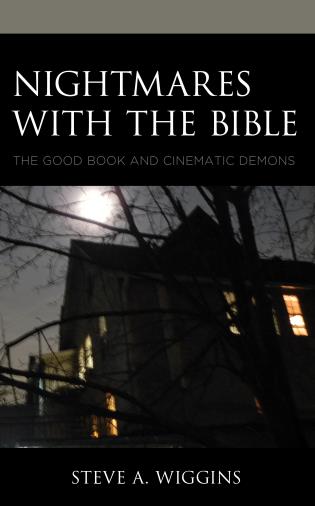
I scrolled down.  The named reviews solicited for the book I knew, so I was surprised, and delighted, that further down the page I had a Choice review.  Even a disgruntled evangelical couldn’t bring me down after that!  In case you’re not a librarian, or an academic publisher, Choice is THE periodical librarians use for deciding on which books to buy.  It is very difficult to get a review in it—I work at a prestige publisher and seldom see our books in there.  If you’re a trade author that’s not so important, but if the only sales, or majority of sales, are for libraries, to get a “recommended” status is a big deal.  That’s worth celebrating.

If you’re wondering, authors do not get notified of reviews.  Some editors will let them know (my editor at McFarland hasn’t been in touch for years).  The journals are too busy doing what journals do to send every author a copy of their review.  So I swung by Amazon’s Holy Horror page.  I’ve got four ratings there now, mostly on the lower end of the scale.  If you’ve read it and liked it (not something I assume, of course) a nice review would go a long way.  Disgruntled evangelicals (aren’t they all, these days?) may make the books look bad, but colleagues who’ve read them seem to think differently.  I hold to the publishing adage that there’s no such thing as a bad review, but good reviews feel so pleasant.  I’ve only written one negative book review in my life, and that was because I felt any other would be utterly dishonest in that particular case.  It’s a choice I make because of the Bible: “For with what judgment ye judge, ye shall be judged: and with what measure ye mete, it shall be measured to you again.”
Social Horror

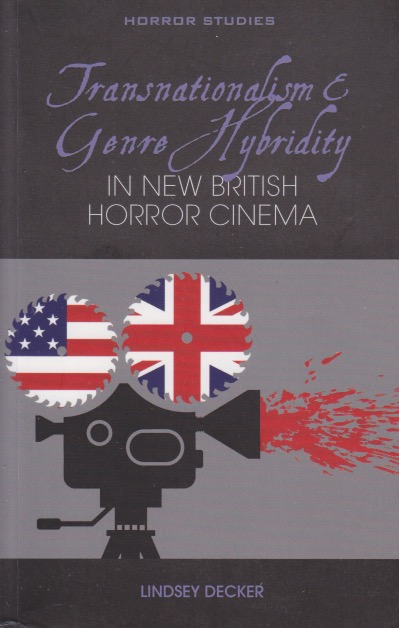
Some books get you thinking in ways you don’t expect.  That’s one of the pleasures of reading.  Lindsey Decker’s Transnationalism and Genre Hybridity in New British Horror Cinema may sound terribly specific—there are a lot of qualifiers in that title—but it actually has some very broad implications.  I was reading it specifically from the horror angle for a project I’m currently working on, but I was surprised at the social commentary I found while doing so.  One of Decker’s main ideas is to show that British horror is, well, transnational while maintaining its Britishness.  She focuses mainly on five films in the book, only two of which I’ve seen.  Very aware of the history of British cinema, she points out many characteristic features and situations that make British horror what it is.

The social commentary comes in when discussing “hoodie” horror films.  These are movies showing how the working class, particularly the youth, are dangerous and anti-society.  The more I read the more it occurred to me that imperialist, capitalist systems are built on the corpses of the poor.  Even good kids from bad situations have difficulty getting ahead in life and those above them on the “social ladder” more or less despise them and make policies to keep them in poverty.  This leads to anger and resentment, and often, in reality, this spills over into violence.  It all comes down to those who benefit from the system refusing to make it more equitable.  When the inevitable happens—those pressured without sufficient means boil over—they are blamed for their own circumstances.

Having grown up in a working class system and having struggled all my life to somehow maintain a comfortable existence for my family, I know the kinds of obstacles faced.  In my particular case, retirement is not a likely outcome.  I’ve worked, except for (and often even) when I was in higher education, since fourteen.  I’ve seen others with connections, educated parents or influential friends, get ahead.  I’ve also watched while many of us get shunted aside because, well, who are you?  Some people wonder why I watch horror.  There are many reasons for it, and at times I think maybe I’ve seen enough.  But then I look around at the corpse-strewn foundations of our current system and I see how reality plays into that fear.  Decker, I’m pretty sure, was meaning for her words to apply to mainly the fiction of horror, but there was a different kind of hybridity there as well, at least for me.


The Truth, for Free

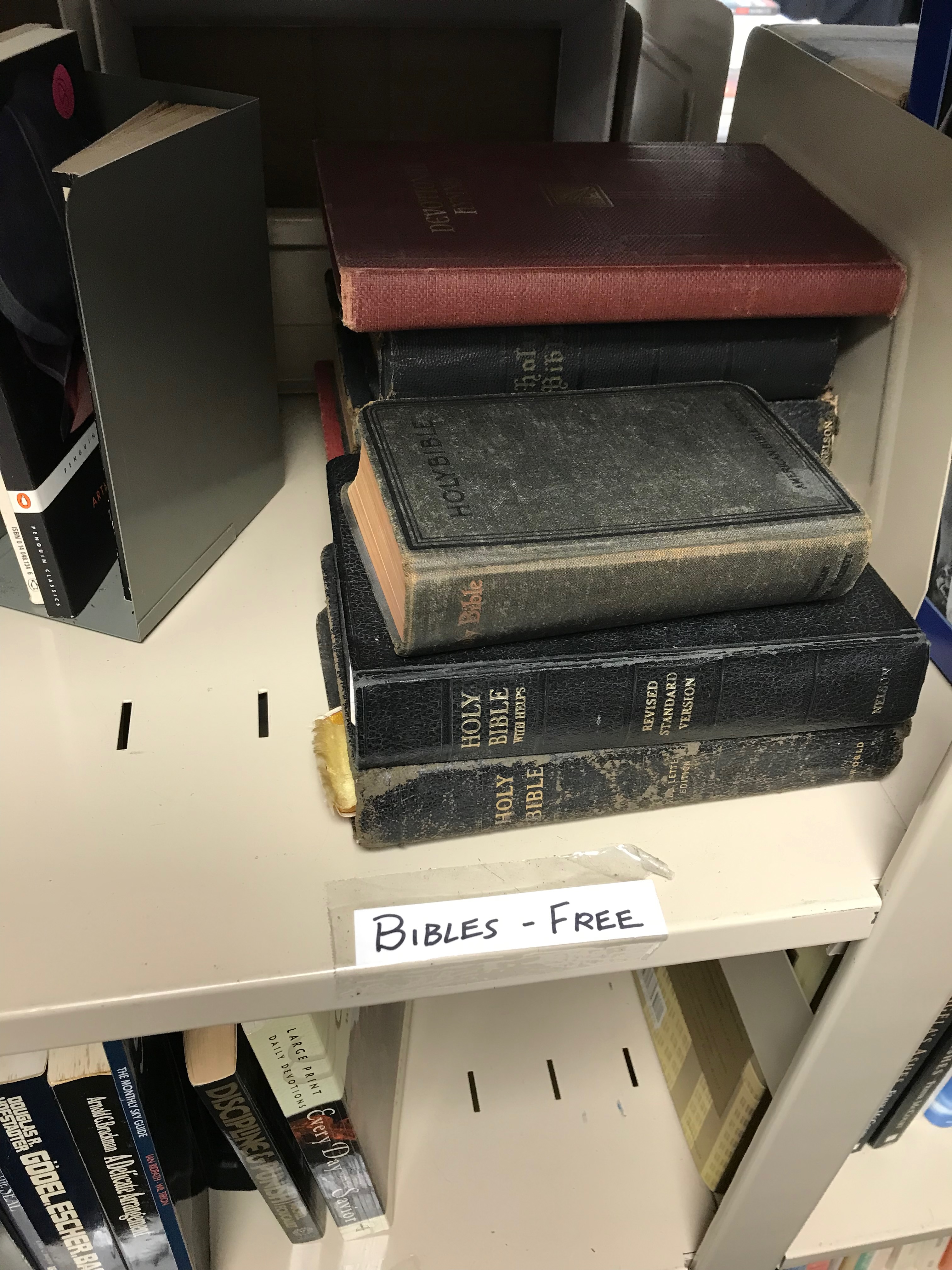
The Book of Common Prayer, reaching back to my Anglican days, is and always has been in the public domain.  Although the poetic language and culturally relevant phrases could by charged for use, they’re not.  The idea seems right-headed to me.  Although the Church of England, like many other religious bodies, has its own specific theology and approach to things, which it believes is right, as opposed to all other belief systems, it shows its conviction in making its sacred text free.  Copyright exists to protect intellectual property.  If an individual or an institution, or a company, creates something, copyright assures them that nobody else can monetize it without the creator’s permission, and often such permission involves a royalty.  The C of E has foregone that.  Print away!

I tarried many years among the Episcopalians before it became clear to me that I wasn’t exactly the kind of saint they were looking for.  I’ve had to move on, but I very deeply appreciate the integrity of an institution that says, “I made this, but you can have it.  I really believe in it.”  If you’ve decided to print and sell religious books, however, beware the Bible.  Most of the common translations in circulation (apart from the good old King James) are covered by copyright.  Unlike the Church of England, the bodies that sponsor Bible translations expect to be paid for the use of said translation.  This is, in part, a business decision.  They have valuable property—for many the keys of salvation itself—and if you want it you should be willing to pay for it.

This contrast has often struck me as very odd.  How capitalist religion has become!  In what do Bible translating bodies really believe?  Believe me, I know that any large publishing effort requires a lot of work.  Resources.  Still, those who do the translating generally have church or university jobs.  They’ve already got a steady stream of income, no?  And yet they will expect to be paid their billed hours for bringing the truth to the world.  I’m not a good investment thinker.  Money doesn’t really motivate me.  This is one of the reasons I have tried several times to find acceptance as a clergy person.  My values seem out of sync with the rest of the world.  I even bothered to learn the original languages in which the Bible was written, the better to read, mark, and inwardly digest them.  Still, I wonder if those who truly believe would not feel more authentic giving away all they have in order to attain the kingdom of Heaven.


The Time Is Nigh

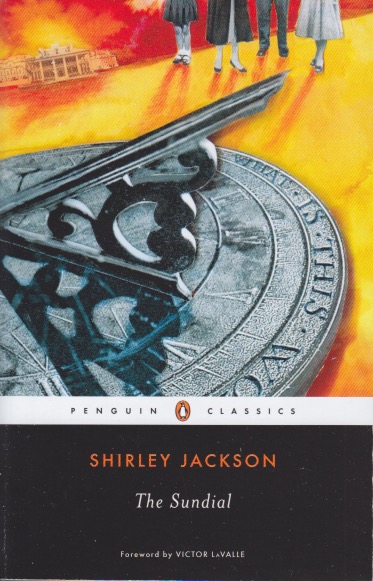
Although I have many authors I like to read, I haven’t fully explored the oeuvre of many.  I’m an eclectic reader and I’m also often limited by bookstores as to what I pick up.  I’ve read Shirley Jackson’s two biggest successes, The Haunting of Hill House and We Have Always Lived in the Castle, as well as her famous short story, “The Lottery.”  I knew she had written much else, but I couldn’t really tell you what.  When I go into a small, independent bookstore I hate to leave with nothing, and seeing Jackson’s The Sundial on the shelf, I decided to give it a try.  In some ways it was quite a departure from her usual style in that it is openly humorous.  Nevertheless, it’s clear that this is the same thinker who gave us the Castle.

Plotwise, the story is about anticipating the end of the world.  The Halloran family lives in a large mansion on the money made by the original patriarch,  but is beset by interpersonal issues.  A wealthy family, there are at least three contenders for control of the fortune.  When one of the family members has a premonition about the end of the world, they come to believe it and prepare for the event with personality quirks becoming more and more pronounced as they realize the only people that are going to be left to judge them will be themselves.  Various guests stop by and the matriarch decides on who might stay, and survive, and who must go.  A group of twelve, including two domestics, is finally settled upon.

As with all Jackson novels, there are layers here.  Things to think about.  One of the funny scenarios involves the goodhearted maid—perhaps the most innocent of all the survivors—revealing to a local villager what’s about to happen.  Not believing her, he refers her to a group of religious believers that have come to a similar conclusion.  This leads to a meeting between the matriarch of the Halloran family and the leaders of the religious group.  Not surprisingly, it turns out that their versions of the end of all things are different, and Mrs. Halloran turns them away since she can’t relinquish her secular beliefs about the matter.  As the time grows closer, the reader is drawn in by the conviction of those in the house.  Their isolation and reflections on life with no other people beyond themselves grows in intensity.  After putting the book down a sense of doom lingers.  And that, it seems, is what Shirley Jackson is very capable of doing, even if in a comedic gothic setting.


Headlines

I see many headlines in a day.  One from Book Riot caught my attention with its linked story on BoingBoing.  This particular story is poignant and points to the ridiculous polarization politicians are stoking to play for our votes.  (I swear, politicians should be made into their own country so they can ruin their own lives without affecting the rest of us.)  This headline deals with the remarkable person George Dawson.  The son of a farmer, and descendant of slaves, Dawson made a living as a laborer in Texas.  His life was probably no more noteworthy than those of many other working-class individuals, but Dawson had a story to tell.  Illiterate, he learned to read at the age of 98—let that sink in.  At two years shy of a century he decided to improve his life.  He subsequently wrote a memoir, Life Is So Good.  So far, so good.

For reading, not banning!

His story was so inspirational that the Carroll Independent School District named a middle school for him.  He became a adult “poster child” for literacy.  Now, here’s where the headline comes in.  The very school that is named after him is trying to ban his book.  As part of the reactionary Republican response to race relations, politicians—local and national—are trying to rewrite American history so the white guy is always right.  Always good.  Always Christian.  Always moral.  It doesn’t matter how many times he cheats on his wife and his taxes, he is the paragon of virtue and respectability.  To suggest that he promoted slavery and treated Black people as property and beat and lynched and left them in poverty, well, that’s just too powerful of a pill to swallow.

Banned Book Week begins this month, on the 18th.  Every year I try to read a banned or challenged book in honor of the occasion.  Censorship has been on the playlist of fascists from the beginning.  Propaganda works.  All you need to do is use emotional appeal to short-circuit the rational faculties and then laugh all the way to the bank.  Slavery?  What’s slavery?  Do you mean to suggest that white men used slaves?  Poppycock.  We have always been as upright with the same moral rectitude as the Donald.  And the Ronald.  And all white men who stand under the big R.  Pay no attention to the Black man who learned to read at an age when most of us are dead.  Is that such a big deal?  What need do you have to read when Fox News can provide all the (mis)information you need?


Wicker Back

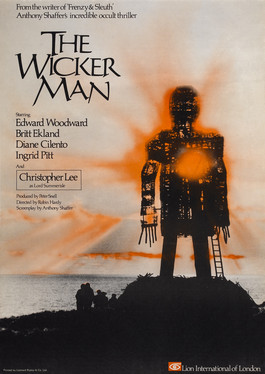
The dilemma of my eclectic interests sometimes runs up against the natural slowness of publishing.  My book on The Wicker Man has been given the green light by Auteur Publishing and should be out next year.  I just received the readers’ reports and they were positive enough to make me blush.  The thing is, I submitted the manuscript back in January and I’ve nearly finished writing my next book since then.  It’s on a different topic for which I’ve been collecting sources since January.  I really hope this next one won’t publish with an academic press.  The endless rounds of revision from peer review can wear a body out.  Reviewers, you see, have university jobs.  Libraries at their fingertips.  Sabbaticals.  (I work with authors who won’t write unless they have one of the latter.) Now my reading shifts back to Summerisle.

For those of us with 925s that get a paltry number of holidays per year (which are spent holidaying) and paid like most working stiffs, with no academic library access, this can present somewhat of a challenge.  I see peer reviews all the time.  Academics so deeply into the subject that they don’t (can’t) think of the practicalities.  When I see a reviewer write that a book is ready for publication, but if the author could only restructure the whole thing and approach it from this angle instead… I have to chuckle.  During my teaching career I worked in situations that didn’t allow for sabbaticals.  Even among academia those given such rare benefits are privileged.  It’s a wonder that so many books get written, all things considered.

Like waking from a dream world, I suddenly have to downshift to a previous project.  I haven’t really thought much about the Wicker Man since January.  My next book, which is eclectic, has been slowly gestating over the months.  My reading has been geared towards it and is financed personally.  I’ve tried contacting the local college and university libraries.  I can’t borrow, or do inter-library loan, so the weird resources I need I have to buy.  Preferably used.  One thing reviewers like to do is point out new resources.  And yes, I have to agree that my argument would be stronger with them.  I have a strategy to the way I write my books, now that I’ve found a receptive readership, so none of this is mishap, I hope.  (Ironically, now I get quite a few readers of my revised dissertation asking me questions about ancient West Asian studies.)  That trireme paddled from shore long ago.  I’ve moved my current project to another burner, and you’ll be hearing more about The Wicker Man in coming weeks.  Next year is the film’s fiftieth anniversary, so I have a deadline that I just can’t miss. It’s time to get reacquainted with an old friend.


The Burton of Thought

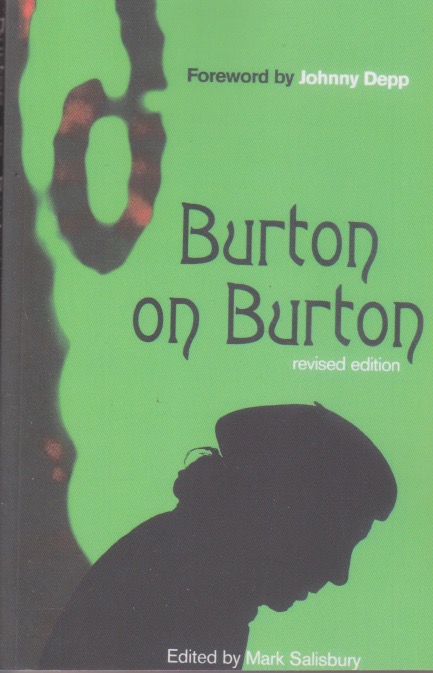
I haven’t seen all of his films.  Some of them I have seen I didn’t really like.  When Tim Burton does strike a chord, however, he does so hard.  Burton on Burton is one of a series of books of interviews with directors.  This one covers all of Burton’s films up to Corpse Bride with free-ranging answers to what are really more remarks than questions.  (The book is edited by Mark Salisbury.)  Although I’ve not experienced his entire oeuvre, it’s pretty clear that I share quite a few sensibilities with Burton.  He expresses that what he’s looking for in movies is feeling.  A good plot helps, but it’s the emotion he’s after.  And he knows that the dark isn’t bad.  At many points I had to shake my head and say, “I thought I was the only one who thought like that.”

This memoir is also full of information on the way movies get made—not the technical side, but from the studio or creative side.  Someone has an idea.  It may be original or it may be an adaptation of a well-known tale.  Sometimes, especially in Burton originals, they begin as a series of sketches.  Anybody who’s watched DVD extras knows about storyboarding.  A movie is sometimes laid out in a series of cards that show, step-by-step, the action.  Before that, or maybe during, a script is written.  In order to get funded—for all this costs money—a studio or production company has to pick up the concept.  The person pitching it might be a screenwriter or a potential director.  And, as in every avenue of life, money talks.  Once you’ve had a breakout success they start to pay attention to you.

Although Burton and I grew up with similar outlooks, he notes that he never did like to read.  Being a visual artist (he got his start at Disney), that’s perhaps no surprise.  You start to realize, once you get a sense of the number of people involved, why film credits go on and on.  It takes a village to make a movie.  Not only that, directors may be involved with several projects simultaneously.  That’s not so different from being an (unofficial) writer, I suppose.  At any one time, from my experience, I’ve got at least a half-dozen projects going.  Some will never be finished, most will never be published.  And who knows?  Maybe someday one of my fiction stories might catch a sympathetic (or perhaps simply pathetic) director’s eye?  In the meantime, we go on creating.


Aging Writers

The fact that V. C. Andrews didn’t have any success as a novelist until her late fifties (a benchmark that has already slipped for me), gives me hope.  Another thing I didn’t realize about Cleo Virginia Andrews is that she was confined to a wheelchair.  She didn’t want that fact advertised and she didn’t want peoples’ pity.  She wanted to write.  Many of the books published under her name were ideas she had but that were only brought to fruition by others after her death.  She became a legacy.  Writers are fascinating people.  I only recently learned that Anne Rice was transgender.  I had assumed from her public persona something that I had taken for granted.  Gender is a complex thing, no matter how loudly religions shout.  The sheer number of people born intersex should make that obvious.

Writers express the human experience.  Some perspectives aren’t really considered worth pursuing, as I know from personal experience.  But learning about writers’ lives always gives me hope.  There are those whose lives will always contain mystery—was Washington Irving homosexual or just inept with women?  What really happened to Edgar Allan Poe in Baltimore?  Who was Homer, really?  No matter how much those of us inclined to write do so, there are still huge swaths of life that are left off the page.  (Much of it boring, spent at work, or mowing the lawn.  I try to imagine Herman Melville on a riding mower, but I just can’t do it.)  Writing successfully involves a publisher or agent willing to take a chance on you.  But if you’re old enough to be a one-hit wonder (sorry John Kennedy Toole), they don’t see dollar signs down the road, so move on down to the next door, please.

I had a novel under contract a decade and a half ago.  It never materialized, so don’t look for it.  My nepenthe consists of learning about writers, whether one-hit wonders or not.  I can still look to the Frank McCourts, Laura Ingalls Wilders, and Harriet Doerrs of the literary world.  For most writers it’s the story of what happened before success that is the most compelling part.  Especially those who were older and just kept on trying.  Some had to die, ironically, before the world realized they had something important to say.  You can’t blame the world.  The world’s busy.  But the fact is nobody would remember what it was like if somebody hadn’t bothered to write it down.  So we continue to chronicle the human experience.


Scary Cosmology

In many ways a harrowing book, A Cosmology of Monsters, by Shaun Hamill, is a real achievement.  A monster story, it’s less a story about monsters than it is about people—which, upon thinking it over, is generally the case.  This story is about the suffering people undergo, sometimes simply for being who they are.  Hamill gets his hooks in early and drags you through this wonderful, terrible story.  Even now that I’ve finished it I’m not quite sure what to make of it.  What’s it about?  Maybe I can try to give you a few signposts and pointers.  To find out more you’ll need to read it and check my work.

The Turner family, through no fault of its own, has been living under a strange kind of curse.  It involves monsters, from what is probably another dimension, kidnapping and enslaving them.  The Turners aren’t alone in this.  Others who’ve been suffering from various causes are also targeted and treated.  Perhaps this is partially a parable on suffering and depression.  The Turner family faces death, missing children, forbidden love, and regret.  They run a local haunted house around Halloween, which the father’s regular job finances.  They do it for fun and it’s free.  It keeps them going when a terrible diagnosis is given.  Stressed financially and emotionally, they barely manage to stay together.  Noah, the narrator and only son, checks out the competition, including a Christian Hell House.  There he meets the girl he’ll eventually marry.  But the monsters don’t stop coming.  He befriends one.

An intricately interwoven story, you might call this horror but you would probably be closer to the truth with literary fiction.  There are uncomfortable facts about families.  Things we tend to overlook or ignore in order to keep society running smoothly.  These kinds of issues are brought out into the open here and mixed in with monsters.  On both the human and monster sides, the emotionally wrenching ideas have to do with relationships.  Noah, who was born just as his father was dying, establishes relationships both with his family and a monster.  As the story progresses over the years, his wife is added to this complex of relationships and they all end up, in a way, competing.  Decisions have to be made and someone you love must lose.  This novel makes monsters and humans the objects of the reader’s sympathy.  What’s more, it works.  I hope I haven’t given too many spoilers here, because this is quite an accomplishment, and well worth a reader’s time.


Burdens

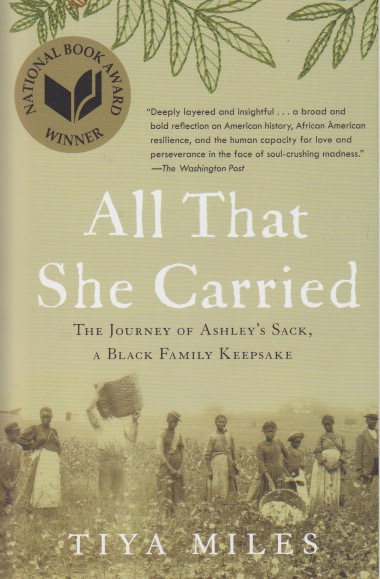
Listening is very important.  Sometimes there’s nothing really to say but “I hear you.”  This kept occurring to me during All That She Carried: The Journey of Ashley’s Sack, A Black Family Keepsake.  Tiya Miles is a history professor, and she helpfully includes an afterword telling how she came upon the topic for this book.  Ashley’s sack is just that, a sack.  On it, the owner, a female descendent of enslaved African-Americans, stitched a short inscription about the history of the sack, how her grandmother had given it to her mother when the latter was a child under ten, sold away from her mother in South Carolina.  This isn’t an easy book to read.  I have difficulty being faced with what “religious” “white” folks did to Blacks and justified themselves that people can be bought and sold.  Listen, I told myself, just listen.

Those who would deny that any of this ever happened need to learn to listen.  In order to capitalize on the resources this country offered, our ancestors engaged in morally reprehensible acts.  And the cruelty didn’t end with the shipping and the selling.  The treatment of unfree Black people itself was a crime, and their white captors knew full well what they were doing.  Preventing their slaves from having nice things while they themselves lived in luxury.  Beating, raping, and murdering when they didn’t get their way.  Selling their own offspring born of slaves to make a profit.  All the while claiming to be good Christians.  It’s often this part that I have trouble understanding.  Even a literalistic reading gives no license for treating other human beings this way.  Only money does that.

The style of history in this book isn’t that to which many of us are accustomed.  At the point of raising mental critiques I repeated, “You must learn to listen.”  Those who have made the rules showed themselves to be corrupt, and they must be willing to consider alternative ways of telling a story.  Miles makes the point that the history of unfree Blacks was largely erased, leaving the possibilities for histories and heritages slim; if the regular rules are themselves oppressive then it may be time to listen to those of others.  It seems impossible in the age of the world-wide web and all that it implies that we live on a planet where people repeatedly deny their sins while clutching their Bibles in their fists.  We need to learn to listen.


Yelp Me

Do you remember the Yellow Pages?  Or even phonebooks, for that matter?  (Or wall phones?)  They certainly weren’t perfect, but they tended to be updated yearly (at a great cost in trees).  That meant that they tended to be almost up-to-date.  You’d find the business you sought, and call them to ask for their hours, or directions.  Now we rely on the internet, of course, and the number of businesses that you can find has exploded.  And they open and close with bewildering rapidity.  It took me a couple years of googling to figure out that Yelp was a rebranding of the Yellow Pages.  I also feel sorry for any company that has to try to keep up with the current status of things.  It does seem, though, that Yelp could use some help.

Although it might seem impossible, many businesses still exist without websites.  And if you’re looking for a type of business in a specific city or town, you need to know, first of all, what’s there and what’s not.  The big boxes are never a problem, of course.  When I travel to a new location, however, I want to know what bookstores I’m likely to find.  I’ve done this a number of times recently.  Type in a city name and “bookstore.”  (In the case of Reading, the city name didn’t help at all.)  Yelp helpfully shows up at the top but it lists many establishments that have closed.  Even some of those that are open are virtual and don’t have a store you can wander around.  More than once I’ve come to a place only to discover there’s no longer anybody home.

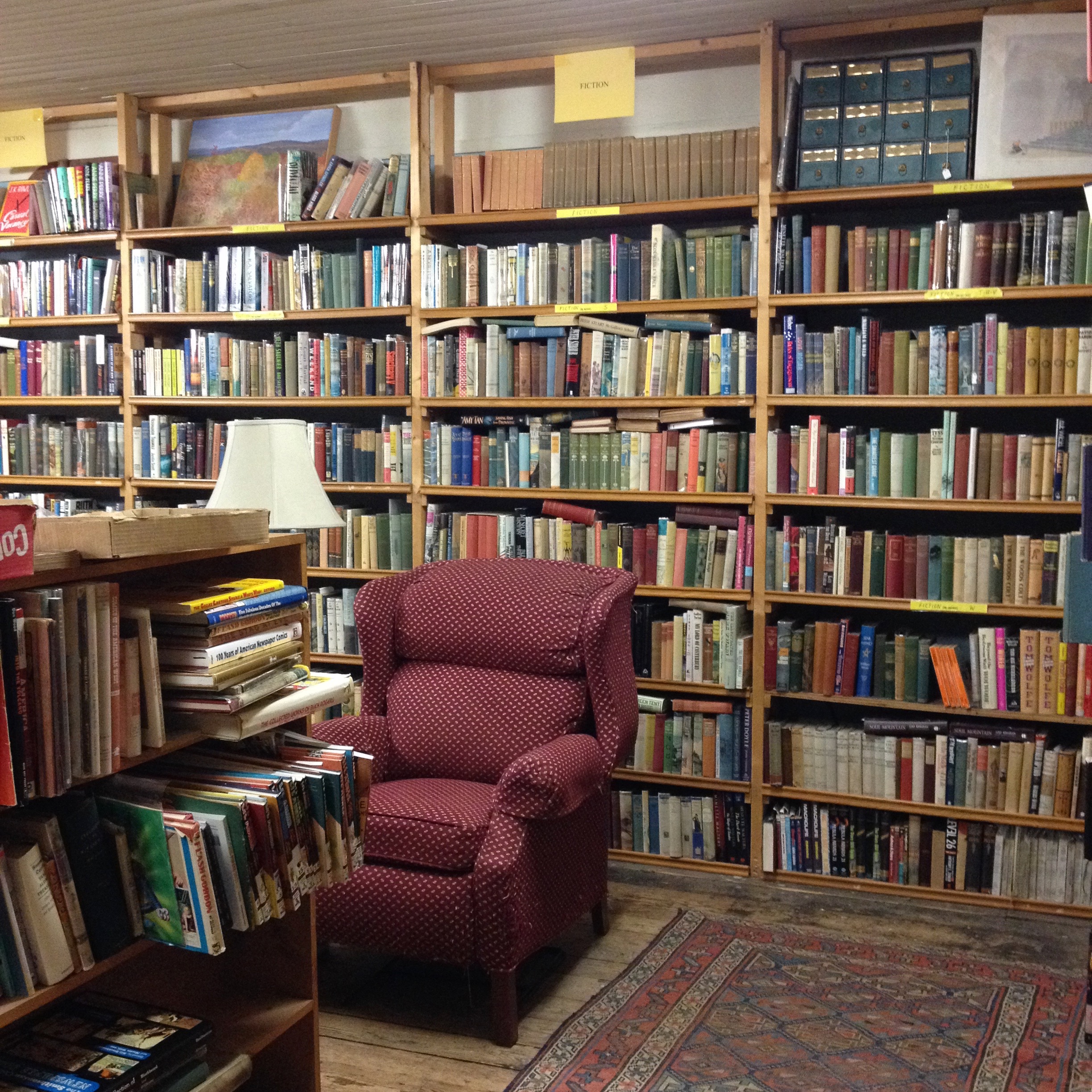
Independent bookstores have been doing pretty well through the pandemic.  Many people have rediscovered reading.  Since they are seldom crowded, they feel like safe spaces during Covid.  And chances are that people who hang out in bookstores have been vaccinated and will likely be wearing a mask.  The problem is finding such places.  I have to say that Pennsylvania seems to have a healthy population of bookstores.  There are several in the Lehigh Valley and I’ve been pleased with the treasures I’ve discovered elsewhere as well.  Finding them hasn’t always been easy.  One of my favorite used bookstores here in the Valley folded during the pandemic.  Fortunately there are others.  Google maps sometimes work better than Yelp, but nothing beats getting out and exploring on your feet, except sitting at home later and reading what you’ve found.


Beastly Story

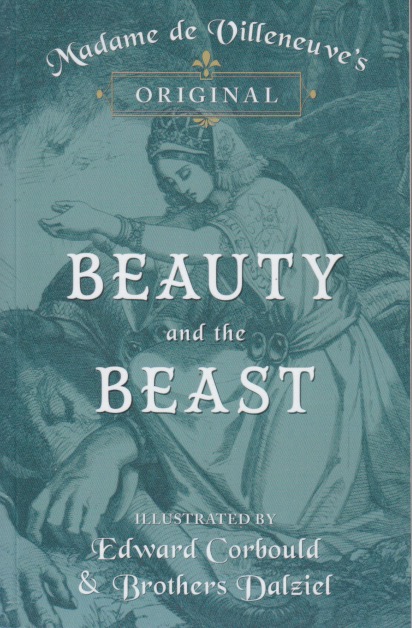
You think you know a story.  You know, you’ve heard it before, or seen it in a movie, so you think you know how it goes.  I’m not the biggest Disney fan in the world, but I have seen many of their movies.  Occasionally those movies are my first introduction to a story.  That was the case with Beauty and the Beast.  I saw this when my daughter was young, and in general found it a good story.  I’ve seen it a couple of times since, and I thought I knew how it went.  I got curious, however, regarding the origins of the tale.  Was it Grimm?  Other ancient folklore?  The reimagining of a classical tale like Pygmalion?  Well, it turns out it was a story from the eighteenth century written by Gabrielle-Suzanne Barbot de Villeneuve.

I decided to read it.  The story is quite different than the Disney version, as is to be expected.  To begin with, Beauty has eleven siblings.  Her father is a merchant rather than an inventor.  The beast is described as having an elephant’s trunk and scales, not fur.  Once Beauty agrees to move into his palace in place of her father Beast is nothing but polite, if somewhat dull.  In broad outline the same action takes place—beauty falls in love with the beast and magically he transforms to a handsome prince.  Any story, as it’s retold, is re-envisioned.  There’s no such thing as the literal retelling of any tale.  As the Italians say, “translators are traitors.”  (Of course, I didn’t read the story in its original French, having had the aid of a traitor.)

As was perhaps the style back then, once the happy ending came the story had to be fully explained.  Indeed, this constitutes half its length, telling, not showing, the backstory.  To Disney’s credit, they do all this in a minute or two of animation time.  The modern reader, unless obsessed with the rules under which fairies operate, and the power struggles among them regarding those rules, will likely find this add-on a bit tedious.  But that’s often the way with original texts.  Think The Iliad.  Think the Bible.  Modern writers seldom explain things fully.  Ambiguity is valued among the literati.  Still, stories have origins.  They start someplace.  Those of us who are curious about those origins are inclined to dig, it seems.  Disney has become our storyteller for children.  It’s a good idea to look behind the curtain now and then, just to see what the original creator wrote.  To see how the story really goes.


The King

Stephen King.  I haven’t read all of his books, but I’ve done quite a few.  I’ve watched movies based on some.  I read my first story by him in Junior High School.  I’ve even read books about him.  From what I can tell, he’s actually a man with his head on straight.  While some may find that a strange thing to write about a horror writer, it’s been my experience that those who enjoy horror, either as producers or consumers, are generally good people.  Recently King was testifying against the proposed buyout of Simon & Schuster by Penguin Random House.  Penguin Random House is already the largest trade publisher in the world.  The buyout would probably benefit King personally, but he testified it would make things worse for other writers and for independent bookstores.

How many people these days argue against things that benefit them personally?  Certainly not elected officials, particularly of what used to be a grand old party.  It’s all about me!  That seems to be the mantra of late capitalism.  King has publicly called for his own taxes to be raised.  This is nothing short of heroic.  While the Good Book advocates over and over for this kind of behavior, “Bible believers” have somehow overlooked it.  Leave it to a horror writer to get to the heart of the message.  I have no idea if King is part of any religious group or not—he certainly uses a lot of religious imagery and many religious concepts in his writing.  Of course, you don’t have to be in such a group to embody their proclaimed principles.

Thinking of the needs of others was drilled into me as child raised in a Fundamentalist faith.  Looking around me these days, I don’t see many Fundamentalists that hold to that any more.  Enamored of power—especially the power to control other people’s lives—they flock after rich pretenders who care nothing for the Gospel.  Sacrifice (for that’s what we’re talking about here) is something horror writers know well.  It’s never easy giving up something that’s valuable to you.  Or even thinking about it.  Writing, while very enjoyable, is hard work.  Training your mind is like physical exercise—it doesn’t just happen.  I’ve got a few Stephen King novels on my “to read” pile.  They’re big books, often intimidatingly so.  Once I start reading, however, I know I’ll find the work engaging.  And if I pay attention, there will be a message there too.

Not that kind of book.

Paperback Reader

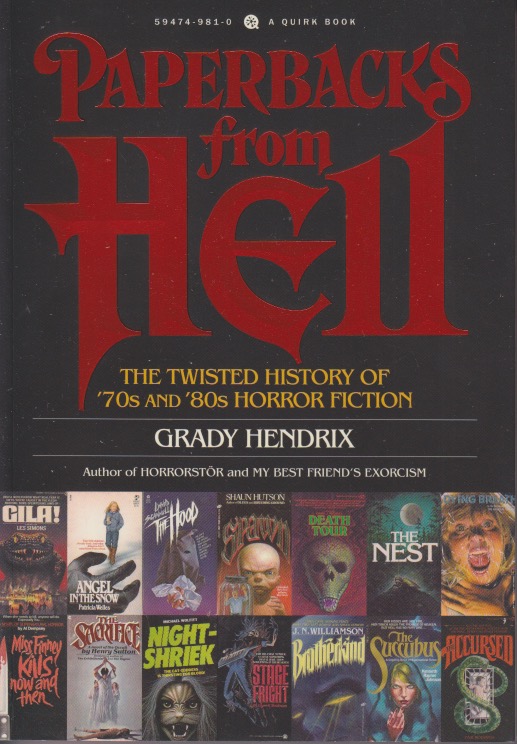
Sometimes I wonder why I do it.  Horror is a strange category for books and films, but one thing that may be a draw is that they take me back.  Life, it seems, is cyclical.  I liked monsters as a kid, and grew out of it when college and graduate school taught me to be serious.  As a working academic this genre can spell death to your career, so when my career died anyway, I was left grasping at my childhood to try to make any sense of this.  Grady Hendrix’s Paperbacks from Hell took me back.  Not that I’ve read all the books listed here—I came away with a list I want to read—but the lurid covers are a reminder of the kinds of things that caught my young imagination.

Subtitled The Twisted History of ‘70s and ‘80s Horror Fiction, this is actually a very fun book to read.  Hendrix has a light touch and had me nearly laughing out loud (quite an accomplishment) a time or two.  And I learned a lot.  Although I write books about horror, the genre is a large and sprawling one and this book takes a clear focus at the paperback market.  Just a reminder: paperback originals were designed to be sold and consumed quickly.  No waiting around for 18 months while profits from the hardcover roll in.  Hendrix really knows what he’s talking about when it comes to the history.  It also seems like he may have read more horror than is necessarily good for you.  He clearly knows how the publishing business works.

Several of these books were big enough that I knew about them.  He starts off with Rosemary’s Baby and The Exorcist.  (And The Other, which I’m now obligated to find and read.)  In fact, the first chapter focuses on religion-themed horror.  This is something that only began in earnest in the late ‘60s.  While the horror paperback market may have tanked in the ‘90s, the film side of the genre has been doing quite well and continues to do so.  The late sixties also got that kick-started.  It seems that when people stopped running from the fact that religion is scary, horror itself grew up.  I was shielded from that part as a child, but now, looking back, I can see that things weren’t quite what they seemed.  This full-color, grotesquely illustrated book has great curb appeal.  And if you’re not careful, you can learn a thing or two as well.


Who’s It For?

I suspect editors see this all the time.  I also suspect that I’ve unknowingly participated in it as well.  If you’re a book writer, you have to be clear of your readership.  As an academic editor I receive many proposals for books that either cry for popular treatment, but are too academic, or books that are written for laity on topics of interest only to academics.  A writing life is a struggle to find that correct balance.  Particularly for your typical academic.  You see, doctoral programs don’t generally include instruction on how publishing works.  Or in writing.  It’s assumed that any string of 100,000 words from a credentialed expert is worth publishing.  Worse, as Steven Pinker has pointed out, academics are rewarded for writing poorly.  No wonder people are confused!

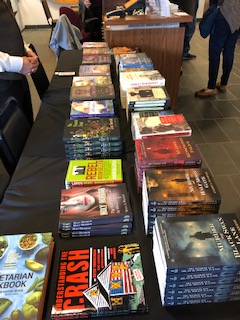
Lately I’ve been on a kick about people not paying attention.  It is important to observe.  When writing a book it’s important to gauge who might want to read your potential book.  Indeed, this is something seldom asked early enough in the process.  Who is this book for?  Will they want to read it?  You see, we have this lone ranger attitude to book writing.  In actual fact, most books you see in bookstores are the clear result of teamwork.  Yes, authors do most of the writing.  In many books editors do quite a bit of the fixing of the writing.  Agents, marketers, publicists, sales reps—there are a host of people behind successful books.  It’s easy to think, while writing, that your book will be a bestseller, no matter how academic.  That you will see it in Barnes and Noble and point it out, ever so casually, to your friends.  That it will sell for less than $20.

It’s important to pay attention to what other people think.  We’re all busy, I know.  We have our own lives to live and plans to enact.  Who has time to bother thinking about who might read their book?  Obviously, other specialists such as themselves.  But how many people is that, really?  With the sheer number of books published each year, are there topics that will draw in thousands, instead of hundreds (or less) of buyers?  Writing a book naturally makes you think the topic is important—vital, even.  It’s easy to transfer your personal interest onto the masses.  My advice, for those few who ask or care, is to think carefully about who you wish to reach.  Be honest with yourself.  And try to think from the point of view of somebody else.