Witches of September

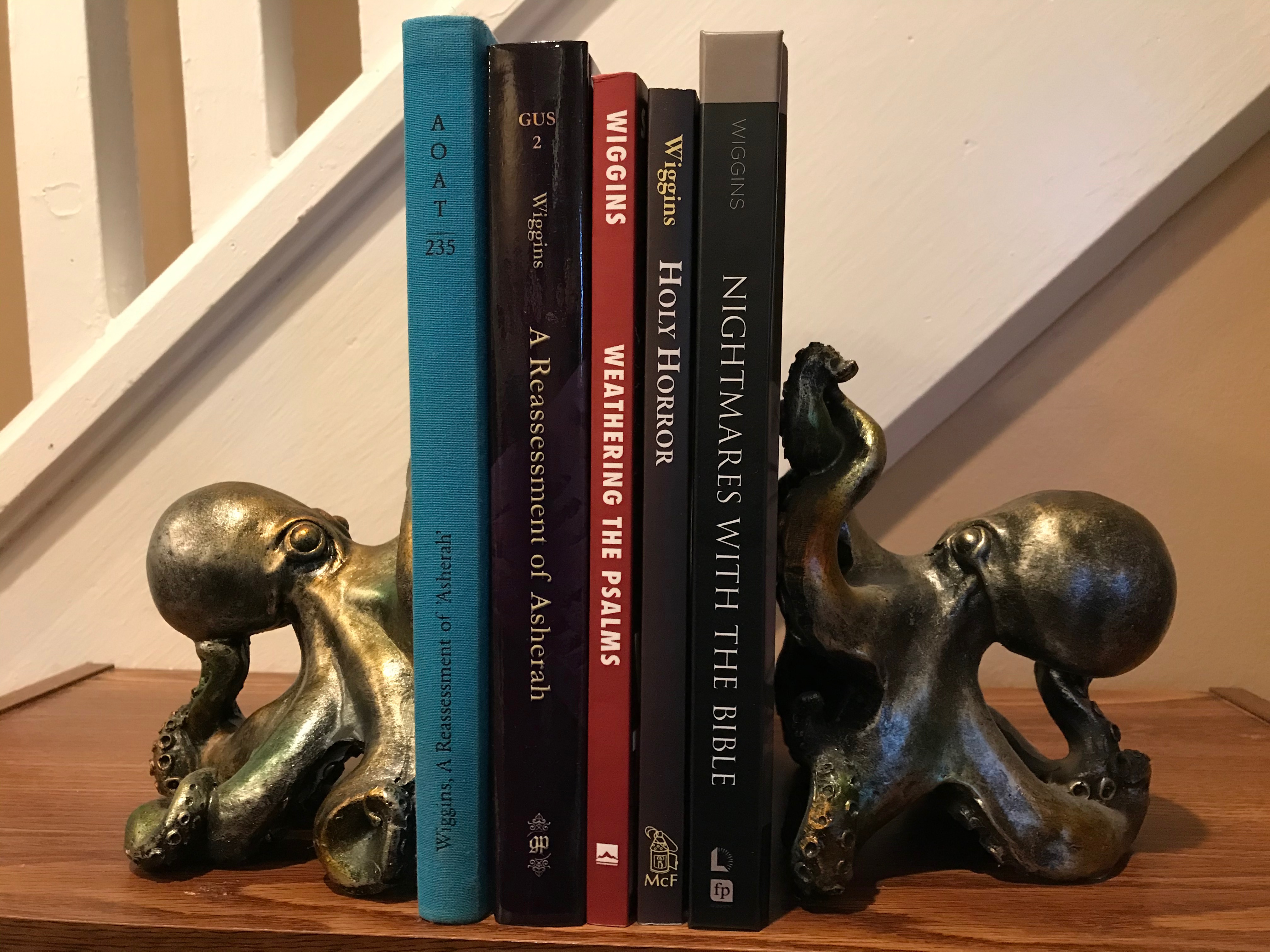
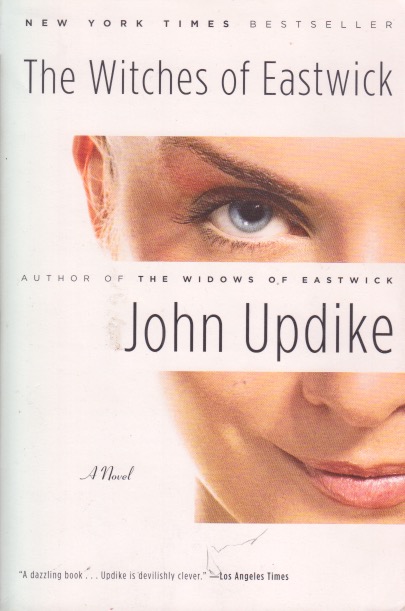
I’ve never read any John Updike before.  I understand that his novels foreground religion, which I didn’t realize.  I have watched The Witches of Eastwick, in movie form, a time or two.  In fact, I wrote a bit about the film in one of my books.  This got me curious to read the novel and I found a copy at a used book sale up in Ithaca some months back.  Now that September’s here, it seemed like an opportunity to see what the original story had to say about witches.  There is a problem, of course, in having watched the movie first.  Not only does it tell you which actors the characters should look like, but it also predisposes your orientation to what will happen.  In this case all that will mislead you.

The movie centers on Jack Nicholson’s Darryl Van Horne—like most Nicholson movies, his character takes over—whereas the novel is definitely centered on the three witches, Alexandra, Jane, and Sukie.  They don’t fall into the background, but neither do they always work in concert.  The movie tells, in other words, a very different story.  Updike’s literary treatment focuses on female characters and the mischief they cause.  Nor is it entirely clear that Van Horne is demonic, as in the movie.  A church features prominently in both versions, amusingly Unitarian in the novel, with Van Horne not upstaging the sermon but giving an invited one himself.  No fear of sacred places here.

The wrath of the witches isn’t directed toward Van Horne either.  A character left out of the film, who marries Van Horne and whose brother is his real target of affection, is hexed and killed by the witches instead.  In many ways this could be construed as a kind of gentle horror story, although it’s never marketed that way.  I kept waiting for certain scenes in the movie to be narrated, as it were, in the flesh.  This led to the revelation that these scenes were invented for the cinematic version.  Both novels and movies are stories.  When shown on the big screen, we expect them to be adapted.  My personal preference is for the film to present the same story.  It can’t always be done, of course.  In this case the movie left some questions open that I hoped the novel would answer.  Since the stories are so different, the questions remain.  I have a feeling I’ll read more Updike down the road, but I’ll avoid watching the movie first.
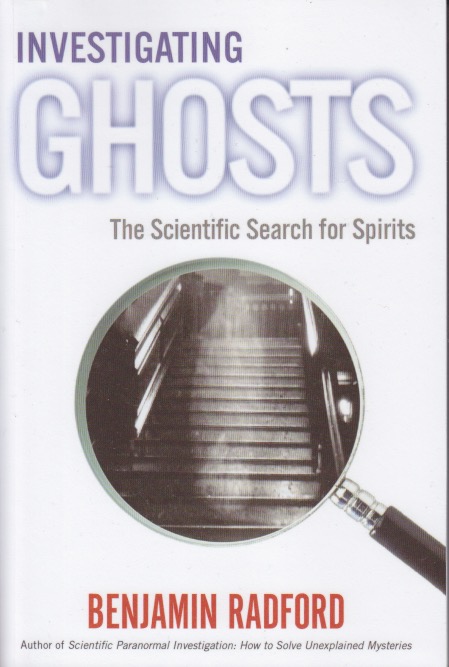

Who Ya Gonna Call?

The haunting season is nearly upon us.  Apart from the usual fun of ghost stories, those of us with appreciation of science wonder about whether there’s any hope of confirming some of these tales.  Benjamin Radford’s Investigating Ghosts: The Scientific Search for Spirits is a handy guidebook for those who don’t wish to be gullible.  Radford demonstrates just why much of popular ghost hunting reality television really isn’t scientific at all.  Knowing how science works, Radford is unusual in that he’s open to the possibility of ghosts.  He points out, however, that from the point of view of science there’s a conundrum—there is no consensus on what a ghost actually is.  Different readers and experimenters and experiencers have different ideas about them—everything from the spirits of the dead to “recordings” made by the environment to demons to time-travelers.  Radford’s quite right that to test an hypothesis you need to agree on what you’re testing for.

Ghost hunting groups, as he points out, are actually gathering evidence hoping to prove the existence of ghosts (whatever they are).  Evidence gathering isn’t the same as science, however.  If you’ve ever watched any of these shows you’ll likely enjoy Radford’s take-down of their flawed methodology.  Wandering an unfamiliar location at night with the lights off and gadgets in hand, they go here and there, possibly contaminating each others’ “evidence.”  Their theories behind why ghosts do this or that—make cold spots, turn lights on and off, make white noise into EVPs, or electronic voice phenomena—don’t match the science of basic ideas of ambient temperature, wiring, and audio pareidolia.  These things are well understood, but you have to read about them to apply them. 

The larger question, however, remains.  If ghosts exist, and if they choose (if they have will) not to cooperate, how can we learn about them?  Radford makes the valid point that coming in for one night with lots of equipment and little knowledge of what we might term “the deep history of a location” stands very little chance of achieving results.  It may be fun, and entertaining, and it may catch a legitimate anomaly or two, but it doesn’t, can’t scientifically prove the existence of ghosts.  We still seem to be stuck with the materialism that only measures the physical.  This fact may indeed fuel skeptics to suggest it’s “only this and nothing more.”  But science isn’t the only way we know the world.  It’s a pleasure to read a book from an investigator of this topic who has his head on straight.


Bookshop

I still remember when I first heard of Amazon.  It was getting on in my years at Nashotah House and one of my students, a former university faculty member that I’d know prior to his decision to attend seminary, mentioned that’s where he ordered books.  I used the internet with caution in those days and I still ordered books by mail directly from publishers.  My library grew slowly back then, in part because faculty pay wasn’t exactly competitive.  Amazon quickly grew to the point that it became a household word, and, like Google, became an internet giant.  Publishers have felt the pressure from Amazon’s bargaining power and, arguably, its market dominance led to the downfall of Borders.  Despite my love of independent bookshops, I do miss Borders still.

I don’t have a similar, singular memory about Bookshop.org.  It may very well be because I found out about it online and studies have shown that online learning is less effective than the old fashioned way.  We put up with it because it’s convenient and we can cram more stuff in that way.  It’s all about getting more.  In any case, I do recall that I was impressed with what Bookshop was doing.  At a recent seminar I learned it was even better than I’d previously heard.  The organization supports independent bookstores so that when things become more normal again they’ll still be there.  The book industry is a rather strange one, and it operates a little differently than many others.  Places like Bookshop really do help when one vendor becomes too dominant.

Reading widely is a form of education, and the key, it seems to me, is to get books people find interesting to them.  I stopped by a local independent on a recent Saturday to find it quite full.  The weather was good, of course, and lots of people were out and about.  Still, nothing is quite as encouraging as finding a bookstore doing good business.  When that happens it’s clear society is improving itself.  I’m trying to make a habit of stopping by Bookshop before the default of ordering on Amazon.  Amazon clearly has the logistics of delivery down to a science, but the world is a less rich place for not having physical bookstores in it.  Making one’s name synonymous with the product on offer is a sign of success, at least on the business side.  Balance, however, is important too.  And that’s where the Bookshop story has to fit.


Moral Compass

Where have all the morals gone?  Well, not exactly song-worthy, but it is a question I think about a lot.  You see, I work in publishing.  Publishing, above all, is a business.  People make their livelihood at it, and so they have to find a market that pays.  Money and morals don’t mix well.  A recent New York Times story pointed out that the political polarization that’s tearing America apart is reflected in bestsellers.  Political nonfiction bestsellers have topped the charts since Trump was unfortunately elected.  Books both pro and con have flooded the market.  What’s this got to do with morals?  Well, I believe publishing should be in the business of educating.  If you’re going to publish nonfiction, it should be material that doesn’t cause more problems than it helps solve.

When I look at a book, after checking the title and author, I next look at the publisher.  Some publishers are conservative, and that’s fine.  That’s what they do.  Most, however, consist of highly educated professionals who realize the severe, and continuing damage that Trump caused.  These publishers, however, will produce pro-Trump books if the numbers look good.  There’s gold in them thar hills!  I often have these scruples working for an academic press.  Some ideas are clearly distorted.  I’m no elitist—I’m still pretty much working-class all the way down to the bones—but education reveals when something very bad (fascism) is happening.  Others see it too.  Still, the temptation of all those dollars… it’s a real pressure, almost like being at the bottom of the ocean.  There’s money pressing on us and we want it.

The gray lady story bothered me.  Instead of publishers looking out their windows and seeing the political grand canyon of this nation, they see profits.  This is business, after all.  Just business.  Is there any such thing?  Morality informs the way you live, the choices you make.  Do I promote education, reflection, and sound reasoning or do I promote a very real 2024 threat of a man who leads by refusing to lead?  After elected Trump immediately began campaigning for his next term, loving the rallies, the cheers, the adulation.  Who doesn’t want to be worshiped?  But is that what we want to see three Novembers from now?  I remember the shock the morning after election day 2016 in New York City.  I see the damage four years of environmental degradation caused just when the effects of global warming were becoming obvious.  I see women demeaned.  I see voting rights quashed.  And now I look at the bestseller list and wonder where the morals have gone.


Existential Horror

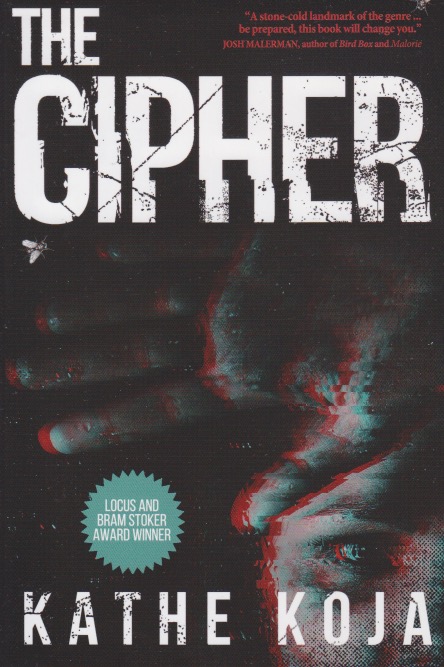
It’s a strange and disturbing novel.  I leaned about Kathe Koja’s The Cipher from a book about women horror writers that I read some time ago.  I figured I’d get around to reading it eventually and now that I have I’m wondering what I just read.  In that regard it reminds me of House of Leaves by Mark Z. Danielewski, which I really didn’t find that scary.  The thing about Koja’s novel is that it leaves you feeling empty.  It is perhaps the most nihilistic fiction I’ve ever read.  A slow build to nowhere and really no explanation either.  If you like your coffee dark, this is a story for you.  It’s a story of slow decline and loss of self.  In that respect it’s pretty scary.

One of the points I made in Holy Horror—although it’s about movies instead of books the same principle applies—is that different things scare different people.  The Cipher is existential horror.  There really aren’t any moments of sudden gasps of surprise—this is a train you can see coming—but that doesn’t mean the inevitable is pleasant.  My edition comes with an afterword by Maryse Meijer that really helped name the horror.  There are no heroes here, as she points out.  These are characters who get themselves into bad situations and sometimes don’t even know why they do what they do.  As I said, this is existential horror.  It all swirls around an unexplained “Funhole” that takes over the characters’ lives.

Everyone in this book is working class and creative.  They don’t find any recognition, of course, because that’s the way of working class life.  They do, however, find meaning in the art they make, after work.  Indeed, as everyone gets more and more drawn toward the Funhole one of the worries that constantly hangs over their heads in the face of sometime truly supernatural, is work.  When to quit your job because something not natural is taking over your life?  Who’s going to pay the rent?  In my own existential crises, I often think that capitalism with it’s unvarying nine-to-five certainly doesn’t help.  When something extraordinary happens, you’d better hope it’s not during a weekday, or if it is you’d better have some vacation days you can cash in.  So it is that the young characters here, drinking and dreaming, have to come up with some way of dealing with an unexpected existential threat.  I’m trying not to give too much away.  This is unlike any other horror story I’ve ever read.


Still Too Close

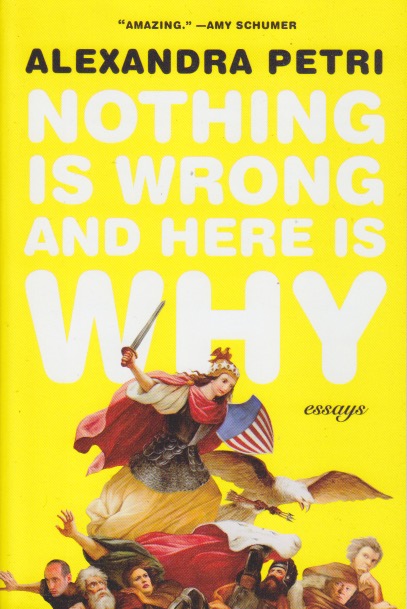
Parody is sometimes the best way to deal with a crisis situation.  As soon as I learned that Alexandra Petri had come out with a new book I was eager to read it.  Her last book, which I reviewed here some years ago, was such a delight—sharp and funny—that I fell in love with her writing.  Although she works for the Washington Post, I don’t regularly read newspapers (no time, if I want to read books) and therefore I don’t get regular doses.  Nothing is Wrong and Here Is Why is clearly a book written in a time of national crisis.  Yes, it’s funny, but the wound of the Trump years is still too raw to be able to laugh much about it.  Too many of his followers still don’t realize they were (are) being played and want him back.  It’s scary.

The first, and longest, section of the book are essays about the absolute ridiculousness of life under Trump.  It was a difficult and dangerous time for thinking people and although Petri excels as a satirical writer, the freshness of the terror—look at the Taliban and see if they are laughing—is just a little too intense.  Petri makes a great case for giving female leadership a try.  Any candidate, no matter which party, needs to know how the game is played.  And they must care about other people.  A pathological narcissist has no business being president of anything, let alone a democracy.  If you’re not familiar with satirical writing you’ll misunderstand just about everything Petri writes.

Once she gets beyond the section about Trump (shudder), the essays start to pick up some topics that it’s possible to laugh about.  Some of them are quite funny.  Although I enjoyed the book—when I started to put it down to get ready for work each morning I found myself saying, “I’ll read just one more.”  And three or four essays later I’d find myself rushing upstairs nearly late.  If it hadn’t been for the national tragedy called Trump, Petri’s second book might’ve been funny from the start.  Parody can be a defense mechanism.  At times things are just too painful to bear and those of us who write find ourselves doing our best to keep the mood light while society crumbles around us.  When things are ridiculous laughter is really what we need most.  We’re lucky to have Petri to provide it.  Here is why—she can bring a smile, or at least a smirk, even in a crisis.


Reduce, Reuse

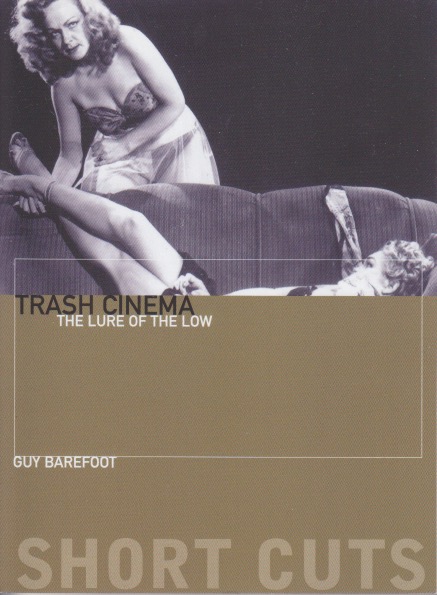
Today’s trash day in my neighborhood. I suspect I’m not alone in having a soft spot for bad movies.  Perhaps it’s because I don’t like to see things wasted.  That, mingled in with my dislike of A-list culture where the people with all the advantages get all the notice.  I appreciate those who struggle.  Maybe that’s why I picked up Guy Barefoot’s Trash Cinema: The Lure of the Low.  That, and because I’ve read other books in the Short Cuts series and found them intelligent and informative.  And yet again, many horror movies are considered “trash”—indeed, Barefoot mentions quite a few of them—which makes me curious.  You see, even back when I was a grad student it was still thought, among some, that film wasn’t sufficiently intellectual to justify academic treatment.  The fact that media now dominates culture gives the lie to that assertion, especially since so many cerebral movies exist now.

In any case, Barefoot takes the subject seriously, using great care to define “trash.”  Given that the series stipulates brief books, this isn’t a comprehensive treatment, but it has a big takeaway for me.  Trash is simply what the majority of people don’t want.  As our landfill crises show, it never really goes away.  (We began composting when we bought our house, and the amount of trash dropped precipitously.  Food scraps can also become something useful.)  There are any number of reasons a producer or director might attempt trash—it’s quick and cheap, it shocks viewers, or it says something about our society.  Yes, even trash can teach us about ourselves.  Really, there’s a value to keeping things and trying to find the beauty where others see only garbage.

From my youngest days experiencing cinema (it was a rare treat then), I realized this was a powerful medium.  I still remember movies I saw as a child, imperfectly no doubt, even today.  And they still speak to me.  Some of them are great and others were almost forgettable.  Some are like gems while others seem like trash.  That doesn’t mean they shouldn’t be watched, however.  A great number of trash films have become cult classics.  They may not reach the esteemed halls of academy award winners, but they are sometimes honest efforts without the money behind big studios.  I tend to root for the underdog.  Having said that, I haven’t seen most of the films discussed here.  Another way of looking at it is that my wishlist has grown.  


Review Copy

You reach an age, or maybe a stage, where it’s difficult to recall details.  Too many emails about too many things and you just have trouble recalling where you read this or that.  Someone a few months ago, perhaps on this blog, lamented not being able to afford Holy Horror.  I wanted to let that person (or any other interested party) know it is now available free—for review—on Reading Religion.  Feel free to drop me a comment if you don’t know how to get this thing started.  When I was a grad student I learned about reviewing.  It was the way to get ahold of expensive books for free.  I’m no longer able to do them (conflict of interest), but I still think they’re one of the greatest perks for the literate.

Reading Religion does not require a Ph.D. to permit an interested party to volunteer.  Since it’s a religion site, many clergy do reviews.  If you’ve been talking to anyone about Holy Horror (and I’m just sure you have!) and they want to read it, let them know.  There’s nothing more embarrassing to have nobody wanting to read your book when it’s available for free.  Besides, reviews are how people find out about books.  Over half-a-million new websites are created each and every day, my friends.  We’ve got to help each other out!  I’ve been providing free content here daily for twelve years now—I need someone to review my book.  I know people are busy.  There are an estimated 1.7 billion websites, many with multiple pages.  Who has time?

I try to post about lots of books here on Sects and Violence in the Ancient World.  I know it’s not a frequently visited website (I’m a realist) but I know at least two publishers have taken blurbs from my words here to promote their books.  Those of us who read have to stick together.  Writing, to me, is how you pay back for all the reading you get to do in life.  It helps, of course, if people know about your books.  By the way, if you have an interest in religion at all you should check out Reading Religion.  It’s a great site to figure out what’s going on in books.  And you might even find something there you’d like to read.  I’d do reviews myself, but that’s no longer permitted.  I’ll put my thoughts here on this blog, though.  It’s only doing to others what I would appreciate being done back.


Fear of the Other

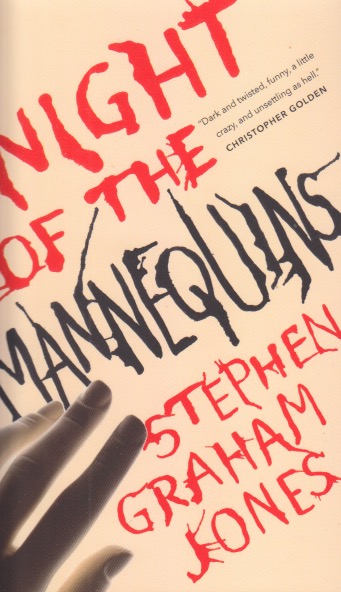
Two things: I’ve been reading about and materials by American Indians lately, and I learned about Stephen Graham Jones through a video of him reading one of his stories.  I was immediately hooked.  It seems to me that those of us who’ve gone through trauma—either personally or ethnically—are disproportionately represented among those who like horror.  I’m not suggesting a simple equation, but simply noticing a trend.  Jones has been winning awards as a horror writer and I was anxious to get started.  Night of the Mannequins didn’t disappoint.  Jones is a member of the Blackfeet nation and, according to the author bio, a real slasher fan.  This story isn’t really a slasher but it is an exploration of what happens when an idea takes over someone’s life.

More about growing up in Texas than being First Nations, it follows a group of teens who find an abandoned mannequin and a practical joke that goes terribly wrong.  It’s a story will a real feel for what it means to grow up beneath the middle class.  The realities for those who do are somehow quite different than from those who can take some measure of financial security for granted.  It also makes a good setting for horror stories as the protagonist tries to figure out what’s going on without the aid of authorities and adults.  It makes for a compelling read.  Jones’ no-nonsense style draws you in and it doesn’t let you go.

The book is fairly recent and I don’t want to give too much away.  I do often think about how a writer’s personal experience leads to the books s/he writes.  The horror genre is wide-ranging and can be deep and intelligent.  Despite its brief extent, there’s a lot of depth here.  The straightforward writing style gives the book verisimilitude.  You could see this actually happening.  Monsters, after all, are frequently in our minds.  That doesn’t make them any less real.  Mannequins tend to inhabit the uncanny valley—they’re human and yet, at the same time they’re not.  There are aspects of growing up in “white” culture that must suggest the same to those who’ve been and who continue to be, oppressed by that culture.  There is a real fear to being controlled by others whose intentions, it must be clear by now, are to make themselves rich.  The world is a richer place, however, for having books by Stephen Graham Jones in it.  I’ll be coming back for more.


Strange Reading

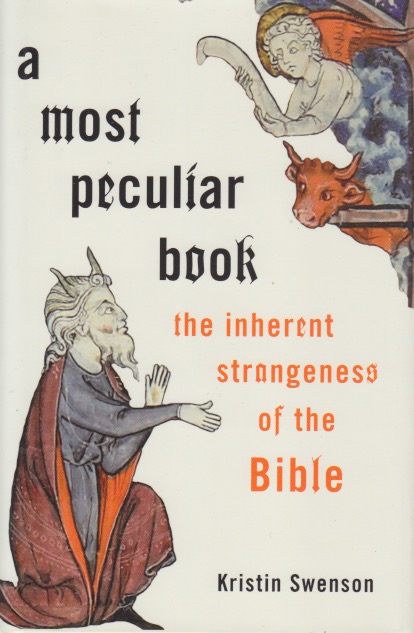
What more can you say about the Bible?  A lot’s been said already.  So much, in fact, that nobody can read all of it in a lifetime.  That realization started to come to me as I was trying to find everything that had been written about Asherah—who’s mentioned in the Bible—to write my dissertation.  I didn’t find everything, but I found a good deal of it.  Enough, in any case, to write my cautionary words about the subject.  Kristin Swenson’s A Most Peculiar Book brings the insights of a fellow traveler to the fore.  In a serious yet lighthearted way, she points out, as the subtitle says, The Inherent Strangeness of the Bible.  In other words, it’s not what most people—especially those who speak the loudest about it—think that it might be.

There are many angles from which to approach the Good Book.  One size most definitely doesn’t fit all.  A book like this would benefit from being read by those who take the Bible literally, but one of the problems is that literalists have no motivation to read such a book.  Indeed, their trusted leaders actively warn against it.  Such treatments are dangerous at best, and are possibly demonic.  One of my professors once put it well: fundamentalism isn’t a theological position, it’s a psychological problem.  In any other area of life those exact same literalists will apply reason and logic.  When it comes to their beliefs, however, refusal to engage with the tools that make their lives otherwise successful becomes an eleventh commandment.

Swenson points out things that will likely be old news to biblical scholars.  Having been through all this in a way ourselves, we remember what it was like to become “woke.”   To those raised as literalists, this is no small ask.  It stabs at the heart of everything you’re raised to believe.  The fear is that there’ll be nothing on the other side, at best, Hell at worst.  These are very real fears.  They may never completely leave, no matter how long you’ve been awake or how much rational coffee you’ve drained.  Such fears deserve a sympathetic hearing.  Without it I’m not sure any progress can be made.  Strip below posturing and bravado and you’ll find fear.  I do hope A Most Peculiar Book will find its way to such folks.  Swenson shows there is life after biblical studies and her book has some fun facts for those unfamiliar with the book about which there’s somehow never enough to say.


Not Archives

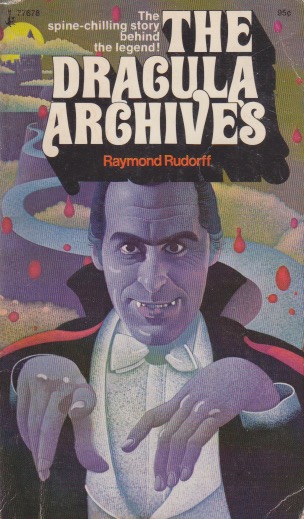
There was a historical Dracula.  The cognomen of Vlad Tepes, or Vlad III of Wallachia, Dracula’s association with vampirism surprisingly dates back only to Bram Stoker’s Dracula.  And much of what I read about Vlad III as a child has been reevaluated, with much of it being reassigned to exaggeration.  (I often wonder if this isn’t part of the reason so many of my generation have become conservative—it can be unsettling to have the certainties with which you were raised topple like so many dominoes.)  In any case, I started reading about vampires when I discovered our high school library had historical books on them, and so I recently picked up Raymond Rudorff’s The Dracula Archives at a book sale, despite its lurid cover.  The reason?  The back cover classification is “nonfiction.”

Clearly that was a marketing ploy, and although the book cost me merely pennies on the dollar for a mass-market paperback from that era (1973), I was a little disappointed to find it was a novel.  I figured it out within a page.  (You have to understand—at a book sale the normal rational faculties don’t always apply.  Anyone who’s been to a library book sale in Scotland knows that little old ladies throw elbows to get at a book they want, and you have to think fast if you’re on the fence.)  So The Dracula Archives is intended to be the prequel to Dracula.  Mirroring the latter, Rudorff’s work is comprised of diary entries and letters, slowly building up a fictional identity for Stoker’s titular character.  It isn’t as fast paced as the cover blurbs indicate, but it does manage to sound historical although it’s clearly not.

Reading such a book during a crisis of truth makes me question the marketing wisdom of the back cover label.  Yeah, it’s kinda cute, I admit.  And Trump didn’t seem like a national threat in the seventies.  But still, the mixing of the fundamental category of book (fiction or non) doesn’t seem quite fair.  Of course, caveat emptor applies to small purchases as well as large.  I go into book sales with a list, and I try to limit myself to it.  But then, I’ve not heard of every book—not by a long shot—and finding an unknown treasure is part of the draw.  Raymond Rudorff wrote several books but hasn’t merited a Wikipedia page yet.  This one is by far his most famous novel.  It’s a fun read and a reasonable prequel, but it won’t likely scare anyone as much as Republican politics do these days.


The Price of Independence

Recently I was updating my Amazon author page.  Since this is purely a self-promotional place (my books aren’t exactly priced to move) I try to approach it with a sense of humor.  I need to be in the mood to write funny, and some followers of this blog often mistake what I’m doing when I try it here.  (Satire and irony, at least to me, have quite a bit of inherent humor.)  In any case, the trick with Amazon author pages—or any internet sites really—is being an “independent scholar.”  To both the academy and to educated laity, that moniker suggests you’ve somehow failed to impress the academic establishment.  No institution wants to claim you, and why should anyone listen to someone who “blows their own horn”?  If you sell enough books you’ll gain some credibility, but at these prices?

Still, I try.  The marketers and publicists I know all talk about building a platform (“shares” and “likes” help).  Platforms require a lot of planks.  One plank I recently learned about was JSTOR (a not-quite acronym for Journal Storage).  Well, I’ve actually known about JSTOR for decades but only recently have been able to use it.  JSTOR scans and indexes academic journals.  While that may not be exciting to the average layperson, for academics (and independent scholars), this is a great tool.  Prior to JSTOR you had to spend hours plowing through various indexes to learn what had been published on a certain topic.  Then you had to go into the stacks and look the material up.  And probably end up photocopying it.  JSTOR makes all of that obsolete with a few keystrokes.  The problem was you could only get in with your university’s subscription.

I stand and applaud JSTOR because they have now made it possible for independent scholars (we are a growing demographic!) to access 100 free articles a month.  Even though “independent scholar” often means you have a nine-to-five with no sabbaticals, that’s quite a lot of articles you can now access.  While I think this is a great move, I do wonder if it’s part of the writing on the wall for higher education.  Around the world universities (except those well endowed, or supported by federal funds) are having trouble staying solvent.  Knowledge is free on the web, until you run into that paywall at internet speed.  Well, at least for now we have JSTOR and access to otherwise inaccessible journal articles.  But that’ll have to wait until after work.  And after I update my Amazon author profile.


Paid Reading?

It’s like when you slowly pull a cotton ball apart.  Interrupted reading, that is.  Some people never cotton onto reading—we’re all different—but some of us find it such a beguiling exercise that we neglect other aspects of life so that we can engage it.  Almost an altered state of consciousness.  That moment when you have to close a good book, though.  There’s nothing else like it.  It’s difficult to pinpoint whether images or words make up the continuity a reader experiences.  For me it’s like a continuous conversation.  Since my life may be too regulated (“nine-to-five” jobs are like that), every day at work begins with interrupted reading.  If you’re awake early, you’ll find there’s no other uninterrupted time like it.  No librarian has to shush anyone at three a.m.

My job is largely reading.  It’s also a good deal of customer service.  As an author myself I guess I get that.  Content is what the world wants, and if you find a writer who does what your press likes, well, you try to keep her happy.  Why doesn’t enforced reading feel like reading by choice, though?  It’s that reading before work that feels like the pulling apart of fibers that’ve organically grown together.  By nighttime, which is still light in summer, it’s not so much pulling apart cotton balls.  Bedtime reading is more like stumbling through a forest.  When you come to that part of the path you know you’ve been on before—perhaps multiple times—it’s time to put the book down and hopefully reboot.

There may be jobs which consist entirely of reading for pleasure.  If there are I never learned about them in high school or college.  I have a friend who’s a musician.  Many years ago I asked him what he like to play for fun.  He looked at me and said “Music, for me, is work.”  I have to believe that somewhere deep inside he still found it enjoyable, but I instinctively grasped what he meant.  Once you take your passion and convert it into a source of income the magic goes out of it.  Once I get out of work the thing I want to do immediately is read, but what I want to read. And although studies show that the reasonable way to get your best work out of your employees is to give them more time off, employers tend to disagree with the data.  The more hours you put in the more “dedicated” you are.  But then, some of us are in publishing because we love to read.  But even now, as work time approaches, the cotton ball begins to shred.


Reading Wicker

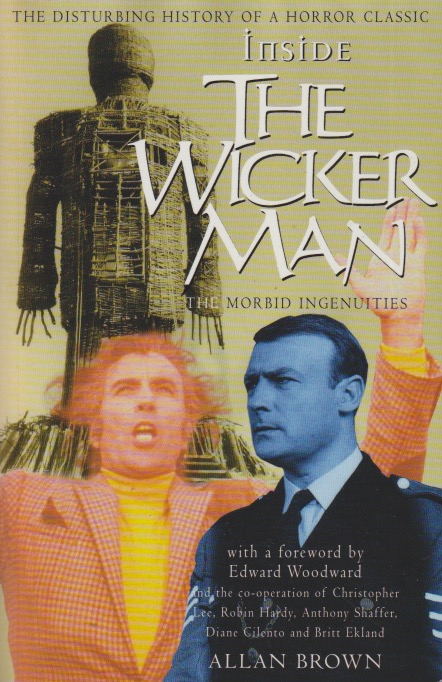
Have you ever read a book where factual errors make you question the larger picture?  I suppose being trained in research makes me more bothered by small inaccuracies.  Don’t get me wrong, I’ve made mistakes myself.  Even in publications.  But when they come near the beginning it’s rather unfortunate.  That’s not to say I didn’t enjoy Allan Brown’s Inside The Wicker Man.  I actually enjoyed it quite a lot.  There’s a real treasure trove here for fans of this cult classic.  I suspect it’s the definitive treatment of the misfortunes the film faced after it was shot, and even during the shooting process itself.  It’s somewhat surprising that so many of us have even heard of it.  When the film’s production company turns against the project it must present special difficulties. Errors are human. Most of the mistakes in the book were about religion.

For Wicker Man fans this book is a great resource.  Not only does it tell the story, but it serves as a useful reference. It includes information on locations, script excerpts, and behind-the-scenes stories.  You get to feel that you know the people involved beyond simply seeing them as characters in a play.  One of the points that Brown makes, while obvious in retrospect, is crucial:  The Wicker Man works as horror not in spite of religion, but because of religion.  I struggle to articulate what the two share in common, but it is useful to be reminded that a prime example comes in this unusual movie.  I wrote about it in Holy Horror, but there’s much even there that I left unsaid.

Brown had the distinct privilege of interviewing many of the people involved in the making of the film.  Most of the cast and crew have since died—the movie was, after all, nearly half-a-century ago.  Even so, when attempting to get at what a novel, movie, song, or piece of visual art means, the realization soon dawns that it’s often in the mind of the observer.  Some songs, for example, speak intensely to some people while being ignored by many others.  The Wicker Man never swam into the mainstream.  I discovered it during an intense period of watching as much quality horror as I could get my hands on.  Immediately I was struck by its intelligence and its strong message.  I’ve watched it several times since, making me, I suppose, a fan.  Enough of one to read this book and enjoy it, in any case.  And to recommend it to others who may be interested in the fascinating film it explores, along with its religion.


To Write in Black and White

It can be seen as a black and white issue: either you’ve written a book or you haven’t.  Many people do write books.  Many more want to.  In a survey I saw sometime in the past few months—I can’t recall exactly where—a survey indicated a high percentage of Americans wanted to write a book.  What exactly does that mean?  There are many different kinds of books and several motivations for writing them.  And, depending, your work may or may not be taken seriously, even if you publish.  As someone who’s published four nonfiction books, all of them obscure, I often think about this.  Working in publishing I have some privileged access to the ins and outs of how this works, but that doesn’t necessarily help in writing success.  So what are the motivations?  Is there any way to tell the difference?

Obviously, I can’t speak for others’ motivations but I can see the results.  Most of the writers with whom I work are academic writers.  Their books are generally written for fellow academics and they’re the result of years of research in specialized libraries often off-limits to non-academics.  Those are pretty easy to tell at a glance.  Another class of nonfiction writer is the journalist.  It’s assumed by the industry that someone who majored in journalism is a talented writer.  If, after reporting on a topic for a few years, a journalist wants to write a book based on experience, that frequently gets a publisher’s interest.  The results may not be academically reliable.  I recall that as a grad student it was assumed there were even certain established publishers not to trust—mainly those that weren’t university presses, but not exclusively.

The self-published book has a more difficult trajectory to trace.  Some authors, no matter how good or insightful, just can’t get a standard publisher’s attention.  Others are convinced of their own wisdom and now have an easy route to become a published author.  Yet others realize some money can be made from writing (although making a living at it is very hard work).  I’ve been reading a book by a journalist that has lots of factual errors in it.  I try not to judge, but I do wonder when I know it’s shelved as nonfiction.  Now, these aren’t the kinds of errors that will cost a life if dosed incorrectly or will set off a war between dominant personalities that are heads of state.  I also know that most books do contain inadvertent errors—books are written by humans and we don’t have all the answers yet.  Still, I think of the readers and how we define nonfiction.  What counts as a book anyway?  Things are seldom black or white.

Writing my first book