Love Letter

One of the more insidious things about religions is their claim to exclusivity.  The belief than any religion is the “only true religion” is bound to run up against the fact that there are many religions in the world, most of them sincerely believed.  We have much to learn from religions outside the one (if any) we were raised in.  I’ve known about Thich Nhat Hanh for quite a few years now.  One of his books was published (perhaps republished) by Routledge.  As their religion editor I was familiar with it, but as he was not “my author” (that’s the way publishing works), I didn’t contact him.  One of the most famous Buddhist religious teachers, Thich Nhat Hahn strives to transcend religion, which seems like a noble goal.  His Zen approach is simple and important.

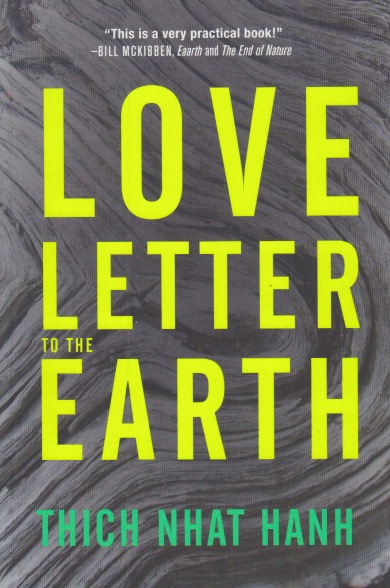
This book’s title, Love Letter to the Earth, indicates what it is.  A reflection on environmental sensibility, it includes literal love letters to the planet.  Arguably it is probably a book best read in small batches with time to contemplate between each reading.  Although some aspects are clearly Buddhist, there are also noticeably Christian elements as well.  Christian spiritual leaders, such as Thomas Merton, knew there was no inherent conflict between Christianity and Buddhism.  Thich Nhat Hanh is also remarkably prolific, having written over 150 books.  World religious leaders need to take a lesson here concerning speaking out about environmental justice.  Certainly there are those who will disagree with aspects of his theology, as reasonable and important as it is.  The message is larger than that.

This book is based on the truth that we are all made of this universe and we contain within ourselves that universe.  The earth is our mother, understood by Nhat Hahn in an almost, if not literally, literal way.  While this isn’t news it is nevertheless profound.  When religions are used as excuses to attack the earth they cease to be true in any sense.  Those who don’t buy that perverted outlook are being condemned by those who do.  The earth is our home and it is our responsibility to preserve it not only for our own sake, but that of all creatures.  Thich Nhat Hanh does without being judgmental.  He instead calls for a religion that takes other religions as part of a non-conflictual belief system.  Religion starts wars.  Wars, of course, come at great cost to the planet, quite apart from the human suffering.  There is much wisdom in this slim book which would benefit many to read.

Ghosts Again

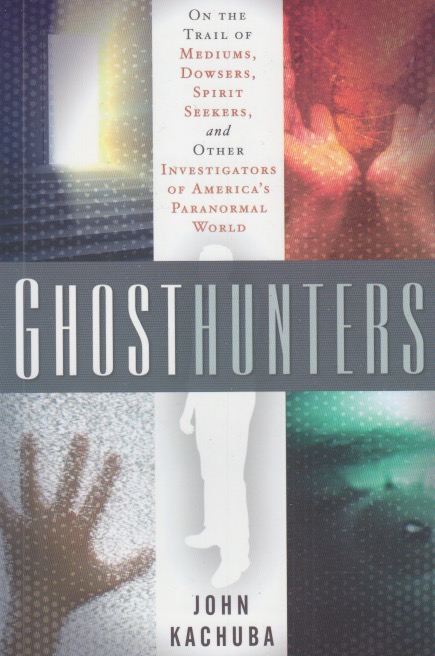
In keeping with my holiday ghost interest, I read John Kachuba’s Ghosthunters: On the Trail of Mediums, Dowsers, Spirt Seekers, and Other Investigators of America’s Paranormal World.  Yes, that subtitle is a mouthful.  The book is a series of essays without an overarching thematic arc, but it does contain some interesting accounts.  If you’re hoping to walk away with proof of ghosts this probably isn’t your book, but a few of the people the author interviews have some pretty convincing stories.  Ghosts remain one of the great unknowns.  People of all intellectual backgrounds, every socio-economic class, and every religion have encountered them, and this is true throughout history.  Ghost hunting isn’t a science and has no developed methodology, but then ghosts don’t seem to perform on demand.

I was particularly interested to see what Kachuba had to say about Ed and Lorraine Warren.  They were the original ghost hunters and their work was controversial from the beginning.  One of the consistent problems with the paranormal is that advanced degrees tend to make you quite skeptical.  You look for proof in the fields recognized by your peers and although a few departments of “parapsychology” have cropped up from time-to-time, mainstream science is doubtful and drives doubt into all comers.  Those who investigate ghosts suggest that if you don’t believe you won’t see.  Here’s the basic paradox between faith and proof.  And it only raises questions when you learn that science doesn’t prove but rather provides the best answer, given the data as currently understood.

Kachuba presents himself as neither a firm believer nor a dismisser.  He clearly enjoys ghost hunting himself and several times mentions his Ghosthuntermobile.  He interviews not only Lorraine Warren (Ed had had a stroke by this time) but also a variety of mediums, Spiritualists, and ghost whisperers.  He writes about various haunted locations, but in the accounts he shares he doesn’t see anything that can’t be explained.  Some of the essays are written with a humorous take on the subject, while others are entirely serious.  It’s kind of a grab-bag of a book in that regard.  Like many readers, I suppose, I hope to pin down something certain when it comes to the unknown.  My guess is that if anything definitive appeared we’d know about it.  Given the goings on in the world these days it probably wouldn’t be front-page news, as much as any information on eternity should be.  In the meanwhile we can read and wonder.


Salvation by the Book

I’ve never been to Iceland.  Part of me says that if I ever get to go I’d want it to be on Christmas Eve.  Ah, the light would be in short supply, no doubt, and it would be cold.  But the draw of Jolabokaflod is strong.  Jolabokaflod isn’t a difficult word to figure out, if you’re familiar with Indo-European languages. “Jol” (maybe the “a” is included) looks a lot like Yule.  “Bok” is English book missing an “o” (again, maybe the “a” is part of it).  And “flod,” likewise with another “o” becomes “flood.”  The Yule Book Flood.  The tradition is to give books on Christmas Eve and spend the long hours of darkness reading.  Iceland has the reputation for being a very literate culture.  I’ve read a number of books (in translation) by Icelandic authors.  If there’s ever to be peace on earth and goodwill to all, it will be through books.

If you observe Christmas, today is that great time of anticipation, Christmas Eve.  Churches, whether virtual or in person, will be humming places this day.  Last-minute shoppers will be out and frantic.  Some will be insisting we keep Christ in Christmas while others will be dreaming of sugarplums and fairies.  Some will be tracking Santa on NORAD.  In Iceland they’ll be exchanging books.  Politicians will continue their calculated plotting but I dearly wish they’d spend the day reading instead.  Perhaps there would be fewer tanks at the Ukraine border if those in Moscow would curl up with a good book.  Check the progress of their Goodreads challenge.  Open up the flood-gates and let the books pour in.

There are those who believe this world should be consumed by God’s awful fire, and that right soon.  But God, as I understand it, is a writer of books.  Perhaps the divine plan is different than so many suppose.  Even the angels sang about peace on earth in one of those books.  You never know what’s going to be under the tree, but in our house books are always a certainty.  The words that describe this season—joy, peace, goodwill—can come in a few ounces of paper, ink, and glue.  And if God’s own book tells us to love one another, who are we to argue on Christmas Eve?  And if it’s true today won’t it be true also tomorrow and every other day beyond that?  Iceland has grown out of its warlike past.  And today they’re exchanging books.  Perhaps there’s a lesson there for all of us.


Literary Thoughts

A book is a physical object.  It is printed on paper and has a cover.  It has a publisher who undertakes to have it printed and bound (and with any luck, marketed and publicized).  This, I would contend, it what most authors have in mind when they sit down to write a book.  It isn’t just “content,” of which you can find far too much on the internet.  It is an object of pride that you can slot onto your shelf with a great sense of personal achievement.  It has taken a lot of work, and headaches, to get to this point.  Several months or even years of your life.  An idea that can’t be addressed in a couple dozen pages.  A book is born!

Publishers are more and more pushing the ebook, however.  The ebook is not a book in the same sense as a printed object is.  In some sense it may be more durable.  It’s certainly easier to get quickly.  But how do you get excited over writing an ebook?  Whenever I’m writing a book, there’s clearly an object in mind, not a cloud of electrons.  Ebooks have their place, but as people start talking about a post-literate future I start seeing visions of my own tombstone.  It gives me a strange kind of comfort to know that all of my books so far reside in the Library of Congress.  Some university libraries even buy copies.  Would a carpenter take pride in an electronic table she built?  Can you set your book on it?  If you don’t carve your “Kilroy was here” in stone, how will you ever prove it?

As handy as ebooks are, nothing matches the sensation of walking into a room full of books.  The sense of rapture is palpable.  Such rooms are monuments to our culture.  A screen with metaphorical tons of content may be a tribute to technology, but is any of it real without ink connecting with paper?  There’s nothing wrong with “content;” I produce some every day.  The thought process is different from book writing, however; just like the process of writing poetry differs yet again.  The publisher always looks at the bottom line.  (And I don’t mean the last line of a poem.)  And to keep “books” profitable the conversion to “content” seems attractive.  It breaks down, however, if writers no longer think in terms of books.  The book has a storied history and a long future, if we keep in mind that it’s something far more refined than mere content.


Another Article

Some insecure people feel the compulsion, but really don’t know why.  Speaking strictly for this insecure person it’s because (I think) I’ve been ignored most of my life.  I didn’t cause trouble so teachers seldom paid me any mind.  (I’m pretty good about obeying rules.)  I was a middle child with less than a year at youngest status.  I was abandoned in a house at the age of one for God knows how long when my father went out on a bender.  Who knows?  In any case, this piece isn’t really about any of that.  It’s about the compulsion to write articles.  I don’t know why I keep volunteering to do this.  They get me nowhere.  You’re not paid for them, and you get little exposure.  I seem to be addicted to appearing in print.

This blog is purely an electronic phenomenon.  It exists nowhere in print.  I post on it every day in the hope that, like a Pioneer probe, it will connect with somebody who comprehends.  As a non, but erstwhile, academic I am not compelled to write.  In fact, it sometimes complicates things.  (If you believe that freedom of written expression exists you’ve never read a publishing contract.)  So print publication appeals to me.  I had an email from a volume editor the other day and I couldn’t place the name.  I opened it to read that the volume had been accepted as I was struggling to remember what I promised I would write for him.  I had to do an email search to locate the chain.  So that’s what I said I’d do! (The previous article I’d committed to I remembered well, since the proposal was long overdue.) 

Print publication, you see, takes a long time.  An erstwhile editor (likely an academic), gets an idea.  They wrestle with it a while and then write it down.  Pitch it to a publisher.  The in-house editor has to pitch it to the editorial board.  Often after peer review.  It can, in my defense, take months—plenty of time to have forgotten I said I’d contribute.  Then the book has to be written.  That part can take years, but in edited collections many hands make light work.  After the disparate pieces are finally cajoled in (one editor had to keep after me for four months), the editor, well, edits them.  Then they finally get sent off to the publisher.  The production process takes about a year.  The volume comes out and you get a congratulatory email or two, and then it’s forgotten.  I’m not sure why I do it, but I’ve been published by university presses for taking these on.  When I was teaching I couldn’t seem to get their interest.  Now that I’m writing about horror they’re starting to notice.  But then, that’s how monsters behave.


Not Really Nervous

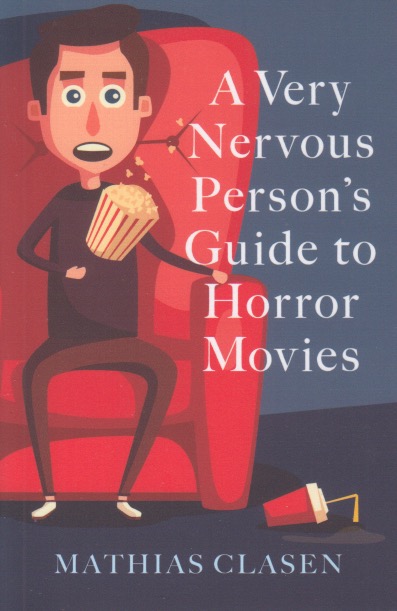
Embarrassment is a not uncommon reaction.  People who knew me as a religion professor or who now know me as a volunteer leader in my local congregation wonder why I watch and read horror.  It helps to know that you’re not alone.  Mathias Clasen is an author I’ve mentioned before.  I read his first book on horror and I was excited to see his A Very Nervous Person’s Guide to Horror Movies, recently out.  I’m not really a very nervous person in this particular regard.  As those who know me will attest, I’m nervous in many aspects of life, just not this one.  Still, after having heard the author describe what his university sponsored fear lab does I was curious how he’d approach horror for the nervous.

Clasen is an academic who clearly enjoys writing.  He’s fun to read.  He admits to being somewhat nervous around horror himself, not watching horror alone.  In fact, the book has several tips—such as not watching horror alone—on how to survive the experience for the curious but cautious.  What I inevitably take away from studies such as this is a couple of things: watching horror isn’t something only I do, and it’s actually good for you.  Studies (and here’s where Clasen is able to point to actual sources) have repeatedly demonstrated that horror has adaptive benefits.  Kids like scary stories, and there’s a reason for that.  The interest in horror generally peaks at the onset of adulthood and tends to decline from there.  Some of us, however, are perhaps arrested at that stage.  Or rediscover it.

There’s a great utility in being able to discuss horror intelligently.  Another point Clasen addresses is that horror is often intelligent but since those who don’t watch it often set the social standards it’s addressed as if it’s juvenile and unsophisticated.  Yes, there’s trash out there.  There is in every genre.  For many people, however, the popularity of slashers in the eighties forever defined horror as naughty teens getting murdered by a bloodthirsty maniac with some kind of blade.  That’s only part of the picture.  Horror has a history as old as cinema itself and the earliest exemplars were based on literature.  It has been an innovative genre from the beginning and when a particularly noteworthy horror film comes out critics and pundits are quick to relable it as a thriller or drama or anything but horror.  We need to give horror its due.  It’s always a pleasure to read a book by someone who has an appreciation of what horror has to offer, even if he’s nervous about it.


Ghosts and Puritans

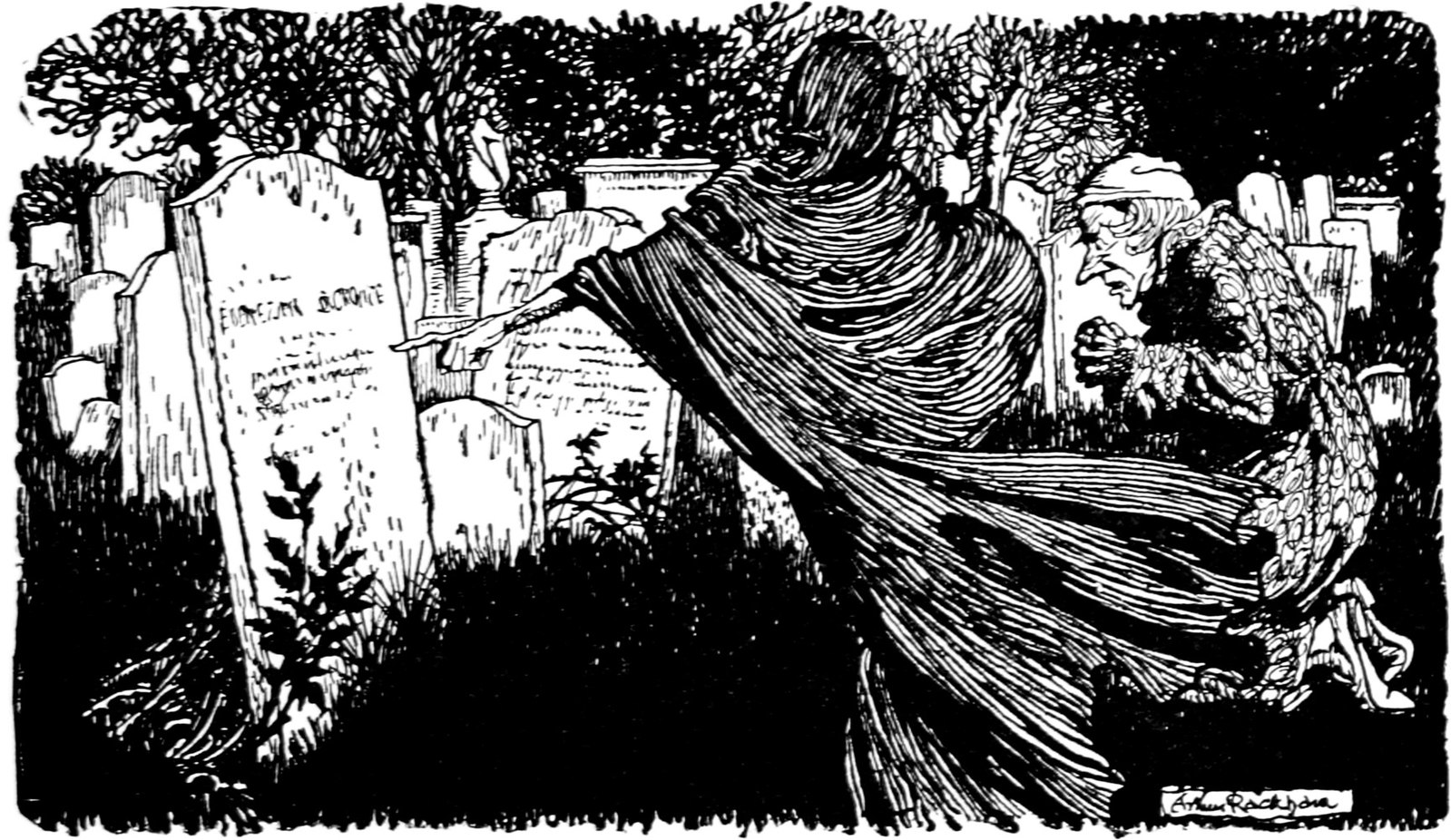
One of the victims of capitalism is the tradition of telling ghost stories at Christmas time.  We tend to relegate such downers to Halloween.  Christmas is a cozy time of getting new things, right?  Who wants to think of ghosts?  I recently read Charles Dickens’ A Christmas Carol.  An article in the Smithsonian  a few years back makes the point that Dickens was cashing in on a venerable tradition.  Instead of sending children to bed expecting Santa Claus, it used to be the custom to tell ghost stories on Christmas Eve.  That makes sense in context.  Christmas was established near the date of the Roman festival Saturnalia and the germanic Yule.  These festivities celebrated the passing of the equinox and the slow, but steady increase in light.  A liminal period.  It seems a natural time to tell ghost tales, no?

Image credit: Arthur Rackham, public domain via Wikimedia Commons

The article by Colin Dickey (who has a history of writing about ghosts), calls for bringing back the tradition.  Do we want our cozy capitalism interrupted by revenants?  Why not?  For me the Christmas season is largely about time off of work.  I spend the time working on fiction writing that I tend to put off when I have a book under contract.  Most of those stories I write are some species of horror, often ghosts.  The real haunting factor is I don’t have time during the rest of the year to do the amount of writing that recharges my batteries.  Work seems to take more and more time and the Scrooge-like results are, I think, pretty obvious.  It’s time to bring back the Christmas ghosts.

Dickey points out that one reason Christmas ghost stories never caught on in America was that Puritans had little taste for them.  The more I look at society the more amazed I am at how Puritan we still are, but without their religious ideals (apart from various prohibitions of human behavior).  The fact that this article appeared in the respectable Smithsonian makes me feel a little more accepted for my disposition.  I know there are many horror fans out there.  Poll after poll indicates that people like horror, but, it seems, most don’t like to admit it.  At least among those I know in the neighborhood.  There are a slew of Christmas monsters.  For those who keep track of holiday horror as a sub-genre the most common holiday represented is Christmas.  In fact, I just had a Christmas horror story published (under a pseudonym, of course).  Maybe ghosts will be able to frighten off the specter of capitalism and bring us back the holiday spirit.


Human Agency

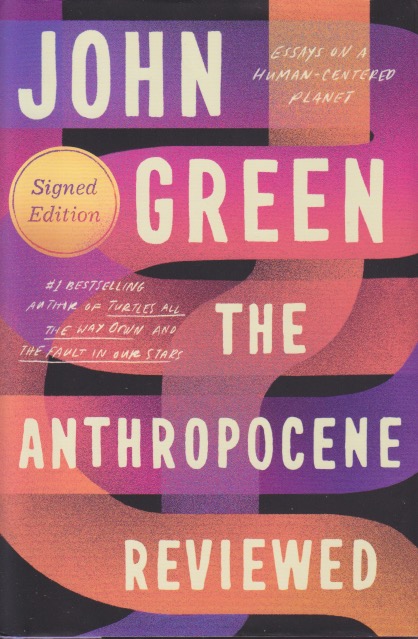
Goodreads Choice Awards elected John Green’s The Anthropocene Reviewed as the Best Nonfiction for 2021.  It’s easy to see why.  Green has long been known both as an internet personality and as a fiction author.  His fiction tends to fall into the Young Adult category, but I’ve read a couple of them as an adult and found them compelling.  Green has an uncompromising way of writing about difficult topics and evoking what it was like to be young.  His main fan base is probably much younger than me, but I always enjoyed his fiction, so why not non?  To understand the context of The Anthropocene Reviewed, it’s important to realize that it is a podcast.  Some of the segments have been written up into a five-star rating system that has been done with quite a bit of humor and some very real tears.  That’s the book version.

For me personally, reading this book was quite a bit like walking the mental paths already in my own mind.  Although we’ve led very different lives, John Green and I share many of the same anxieties, the same love of writing, and similar theological backgrounds.  I don’t know him, of course, but I get the sense that we both still wonder what we want to be when we grow up.  The selection of topics in this book represent Green’s interests well.  Topics are researched and fascinating stories emerge.  It takes quite an author to make me keep reading when sports are invoked.  Some of the topics are sentimental and some of those must be so.  In fact, some of the topics he addresses are things I’ve blogged about.  Some of them even use similar phrases to describe our experiences.

The book is subtitled Essays on a Human-Centered Planet.  From Green’s point of view, this human-centricity isn’t always a good thing.  He nevertheless never loses sight of the fact that humans are fascinating creatures.  Fascinating and disturbing.  We destroy our own environment and each other.  Yet we’re capable of such incredible feats and loving and caring.  Green wrestles with his own neurodiversity here.  He doesn’t shy away from the difficulties that mental illness can present.  He’s also an example of one of us who succeeds despite this liability.  Indeed, our neurodiversity is one of those unacknowledged things that make us so very human.  We expect a world to obey the laws of logic, which it stalwartly refuses to do.  When we notice this we can either cry fowl or we can think about it and invite others to do so.  Read this book and think.


Christmas Classic

While it’s a story I know well, I’d never read the book.  I suppose I tend to think of Christmas when it’s already hard upon me, or perhaps I’m just making excuses.  After all these decades I’ve finally read Charles Dickens’ A Christmas Carol.  The story is so well known there’s no point in laying out the action here.  A filmic version of this has been part of our family tradition for many years now and sometimes it’s difficult not to think the cinematic version has somehow got it right while the book might’ve somehow missed something.  I’m generally disposed to read the book before watching the movie, but I believe I saw this as a young person and we had no Dickens in the house.  Besides, who could miss the endless parodies?

It’s a ghost story, yes, but it’s primarily about redemption.  It’s difficult for me to watch (or read) without getting a bit misty about the eyes.  Our world, especially during the Trump years, seemed a hard and heartless place.  Winter all the time while somehow being Hell also.  It will take many years—perhaps I won’t live to see it—before people unlearn the bad habits they saw being modeled each and every day of those four long, long years.  Every year as I watched the movie I thought, “I wonder if 45 has ever seen this?”  Always the answer came back in a resounding “Humbug.”  A miser who cares only for himself doesn’t change as easily as Scrooge.  So the world had to suffer, and so it will suffer yet a good long time.

The thing about redemption is that it can’t be privatized.  It’s on free offer to anyone who desires it.  While A Christmas Carol may not be Dickens’ best work, it nevertheless bears a message well worth the repetition.  Perhaps there aren’t ghosts enough in the world.  We need to learn to listen.  Were it not for the haunting Scrooge never would have changed.  The sad part is that there are people actually of his ilk.  I hold out hope for redemption to all of them.  I’ve known too many people who seem to care only for themselves.  I need to remind myself that they may not have the reinforcement of this tale every year.  The world could perhaps be better if that were the case.  Dickens clearly had fun as a writer.  Sometimes it seems to get in the way.  But if it makes one’s heart light in December, what can the harm be in that?


Sects and Violence

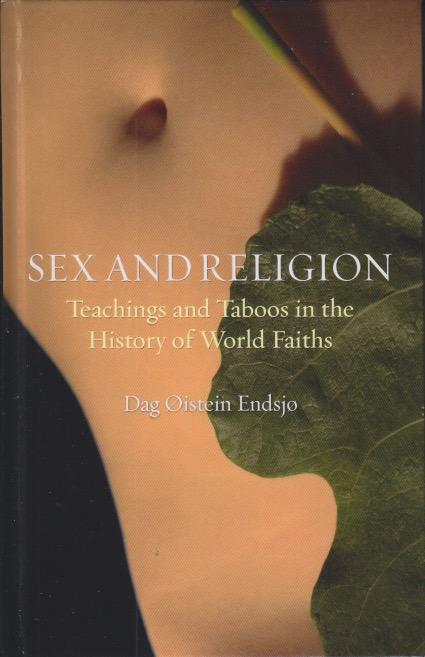
Important books often suffer because of poor distribution.  There are really only five publishers in English (“the big five”) that can reliably get their books into commercial bookstores.  I was reminded of this when reading the very important book Sex and Religion: Teachings and Taboos in the History of World Faiths, by Dag Øistein Endsjø.  The book is virtually unknown here in the States for a number of reasons.  It was originally written in Norwegian.  The author isn’t a household name.  The publisher who bought English rights is British.  It’s not comfortably priced.  None of this, however, gainsays its importance.  This book has much to teach us about hypocrisy and how religions codify prejudices, and, despite rhetoric, still value women less than they value men.  Religion is intimately connected to sex.  As I’ve written before, no religion ignores it completely.

Endsjø offers here a reasoned, logical, and religiously expert analysis of several aspects of human (and to a degree, animal) sexuality.  Contrary to much monotheistic teaching, sex is often treated as a good thing—within limits—in world religions.  Of course, that allows monotheists to step in and claim all others are pagans and debased, a tactic as old as the Good Book itself.  Religions’ real enemy, it seems, is education.  We should be open to compare what others believe—the wisdom their elders have passed down, just like the disciples.  And we should be honest about the fact that we change the rules to suit our situation.  One of the starkest examples of this Endsjø points out is that the Bible is much more stridently against divorce (which evangelicals now freely use) than homosexuality.  But guess which is the political issue?

Religions change, no matter what any true believer says.  We adapt to all kinds of new situations and new information, except when it comes to sexual behaviors we don’t like.  Even though most religions prohibit murder, the punishment for sexual offenses is frequently more stringent.  In other words, as Endsjø points out, religions care less for human life than for their own sexual prejudices.  The fact is just about all monotheistic religions have a male god and favor males over  the other half of the human race.  It even seems likely that Muslim over-reactions to homosexuality arose from copying evangelical Christians in the west.  This is an important book and if religious leaders of all stripes read and comprehend it, we would find ourselves in a much more human, and humane, world.


Read Red

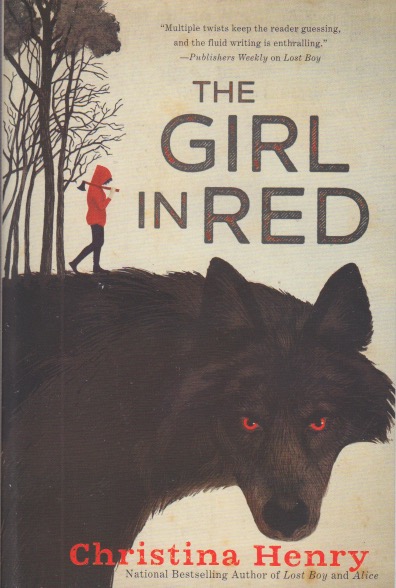
Fairy tales can be pretty gnarly.  I recently picked up a new translation of Grimm but I haven’t read it yet.  For some time I’d been aware of Christina Henry’s The Girl in Red.  As soon as I discovered it I wanted to read it.  The BISAC code says it’s science fiction but I’d call it horror.  More than that, I’d say it is the most tense book I’ve read in years.  Henry knows how to keep readers on edge.  Yes, it’s a take off from Little Red Riding Hood, but in a way that I wasn’t anticipating.  Red is a strong, believable protagonist who finds herself in a pandemic-ravaged world (imagined before Covid-19) where she has to get to her isolated grandmother’s house.  Everything between will surprise, scare, and stun.

The writing carries you along.  A government with secrets, the ever-present threat of roving groups of bandits and militias who are always on the lookout for girls, and the uncertainty of how this will all end make for a powerful tale of what people are capable of.  And not necessarily for good.  Making Red “disabled,” and black, Henry has given us a protagonist we need.  And it’s always a delight when a character finds that watching horror movies has been good training for a world where order has broken down into a Trumpian anarchy.  Scary and witty, the story has so much to like it’s difficult to know where to start beyond the recommendation to read it.

Those who analyze literature sometimes say that the great story-lines have already been taken and that the best modern writers can do is to adapt them.  There may be an element of truth to that, but even if there isn’t the clever retelling of old tales can be quite enjoyable.  This isn’t so much a retelling as a reimagining.  It’s also a poignant reminder that when things start to break down—or even in the status quo—women are put at risk.  Men too quickly resort to guns and violence.  As the story unfolds it becomes clear that Red is capable of surviving in this world, even when at a disadvantage.  There’s also no overcoming of the military.  It’s too well established and too heavily armed.  Red’s run-ins with them allow her to impress those who assume white male superiority.  In that way this is a parable within a fairy tale in a modern guise.  I’ll be reading more of Christina Henry’s books.


Devils and Witches

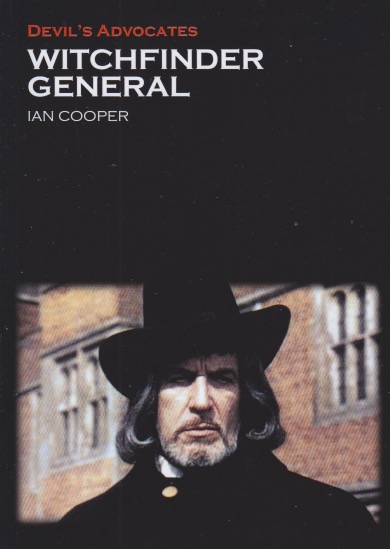
If you’re a regular reader (thank you!) you know that I’m currently under contract to write the Devil’s Advocates series volume on The Wicker Man.  As an editor myself I’m aware that academic series, often unlike fictional series books, tend to vary quite a bit from one another.  I want to try to get my submission close to the goal, however, so I’ve been reading volumes by other authors.  You may also know that The Wicker Man is part of an “unholy trinity” of early British folk-horror, with the other films being Witchfinder General and The Blood on Satan’s Claw.  Of the three my least favorite is Witchfinder General, so I’ve put off reading the particular volume on that film by Ian Cooper.  That has nothing to say about the author, but rather a lot to say about the base film.

The book is quite good.  Cooper is clearly aware of the controversy surrounding the movie and he points out some of the difficulties with it as well as what it does well.  His treatment is quite insightful.  The movie is violent and it’s an representation of the historical violence we thought we outgrew.  Matthew Hopkins was an historical “witch hunter” who was, in reality a serial killer,  mostly of women.  Fearing witches, while getting paid to find them, he was responsible for over 200 deaths.  As Cooper makes clear, the film lingers a bit too long on the abject nature of many of the tortures, not allowing us to look away.  For this reason many critics found the film distasteful.  I personally found it hard to watch.  Education isn’t always easy.

There’s quite a bit of film history in the book.  Cooper does a great job placing the movie in its cinematic context.  Like The Wicker Man, Witchfinder General is sometimes said not to be a horror film.  Indeed, there’s nothing supernatural about it.  Still, it fits the bill for many of those in-between movies that cross over into horror.  In this case it’s due to the violence.  For me, monsters are preferable to human monstrosity.  They’re easier to walk away from.  Although the witch hunts ended centuries ago, violence against women has remained.  Whether it’s legislative or physical or economic, women deserve better treatment than they’re offered by the male establishment.  Movies, and books about movies, like this one may be difficult to watch/read, but they carry important reminders that power continues to corrupt and it must be challenged and changed when it reverts to the mentality of Matthew Hopkins.  His spiritual kin, unfortunately, continue to thrive. 


Remarkable and Beautiful

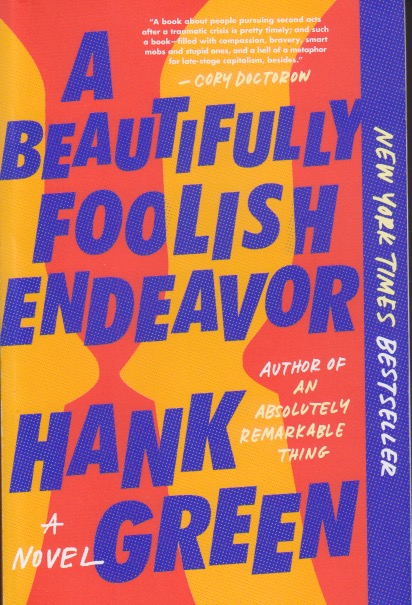
Last year I read and commented on Hank Green’s An Absolutely Remarkable Thing.  I knew there’d be a sequel, but it took some time for it to come out in paperback, and it took a day of flying to give me dedicated time to finishing it.  A Beautifully Foolish Endeavor picks up where the first novel left off, bringing April May back to life.  It’s a story about good and evil and how humans, as flawed as we are, are nevertheless worth saving.  This story takes a further sci-fi and dystopian turn than the first part, moving it more into the regular novel than the “new adult” that seems to better fit the initial book.  Really only six months have passed since the first story, but the still young protagonists have aged in the way experience doles out to people who think they understand the world better than they do.

The world of A Beautifully Foolish Endeavor is dystopian in the sense that corporations have too much power and can (and do) drive the direction of human development.  It’s clearly a novel written after a couple years of repressive Trump rule where autocrats will do anything to keep in the public eye, even destroy their own world.  It becomes Manichaean, or maybe even Zoroastrian in that the extraterrestrial entity Carl, who was the subject of the first novel, reveals that he has an evil “brother” that encourages the corporations in their efforts to rule the world.  The goal of this evil intelligence is to get humanity to destroy itself as a failed experiment.  There’s plenty of metaphor here since the way to get people to destroy themselves is through virtual reality.

As someone who finds quotidian reality difficult enough, I have no desire to see how well some technocrats can imitate what nature already does so well.  Stepping outside with a cold November wind blowing down my collar, threatening snow and driving me back indoors I know I’m in a world not custom built for our comfort.  I am one of billions of scurrying, resistant, persistent creatures doing my best to survive.  I’m sure that virtual reality is an amazing experience, but so is stepping out into that November wind.  Hank Green is gifted at writing compelling, conflicted characters.  From his own internet platform he’s become a significant influencer, gathering the interest of even the White House.  His two novels form a thoughtful set that, like the books of his brother John, make us stop and think what it is to be human.


Celts and Gods

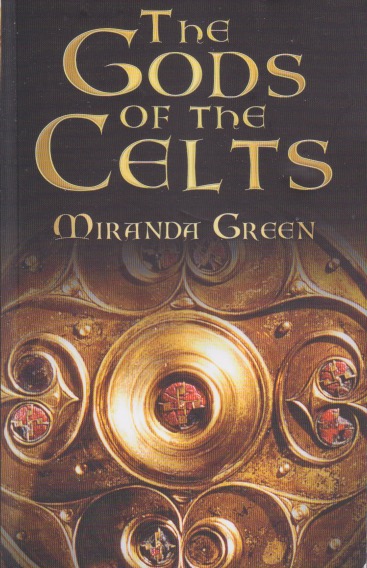
We’re accustomed to religions being written out.  Indeed, many world religions have sacred texts from the Avestas to Dianetics.  Some ancient cultures, however, didn’t have written traditions and when they disappeared, as all cultures eventually do, their religion became nearly impossible to understand, or reconstruct.  Miranda Green has tried to provide, in written form, a summation of her understanding of The Gods of the Celts.  Celtic mythology, interestingly, had long ago caught the attention of New Religious Movements, as well as the New Age movement.  Much of the Wiccan calendar is based on Celtic religion and many New Age practices trace their roots to the ideas of Ireland, Scotland, and Wales lost to the mists of time.  What we actually do know about these cultures is about as fascinating as what’s been reconstructed.

Green’s study shows us a religion that grew out of profound respect for nature as well as human prowess at fighting.  (The “fighting Irish,” indeed may touch on an historical pulse.)  Celtic gods reflected a large swath of thinking throughout western, and parts of eastern, Europe.  Their names may be less familiar to us, and some may well have been lost to the vicissitudes of time, but there was a vibrant devotion to them that went as far as human sacrifice.  We know that it occurred, but it probably wasn’t frequent.  Although polytheistic, Celts were moral in their own understanding of their world.  Morals tend to come from human understanding of their place in a world they didn’t create.  How do you live in somebody else’s property?

Unlike the more literate Greeks, or even the Semitic religions on which they drew for their stories, we have no narrative Celtic mythology.  We have fragments and glimpses.  Nobody had a recorder while sitting around the fire, recounting the activities of the gods.  Later, sources such as the Mabinogion were written down, which surely held some memories of such fireside tales.  The originals, however, we’ll probably never have.  Such is the way of conquered peoples.  What the Romans started the Christians finished.  We’re left with some deities, such as Brigit, made into saints, but their stories forgotten and not originally written down.  Our time looking back isn’t ill-spent.  It teaches us who we are and guides who we might become.  Our own violent politicians, threatening to murder those who are different, clearly have learned nothing from history, ancient or modern.


Next Books

The other day an older friend asked about my writing.  My answer was brief because it’s complicated.  Not because I do it from three to four a.m.  Not because many of my older friends don’t know what a blog is.  No, it was complicated because my next book is about a movie few Americans know, especially many of my friends.  I really don’t know many horror fans.  Academics, yes, but normal folk, no.  This is a little odd because statistically most adults like horror.  I feel I always need to explain why I bother writing such books.  (There is a reason and there’s even a book I’m working on to try to explain it.)  It’s easiest, in such circumstances, just to say “I’m keeping busy with it.”

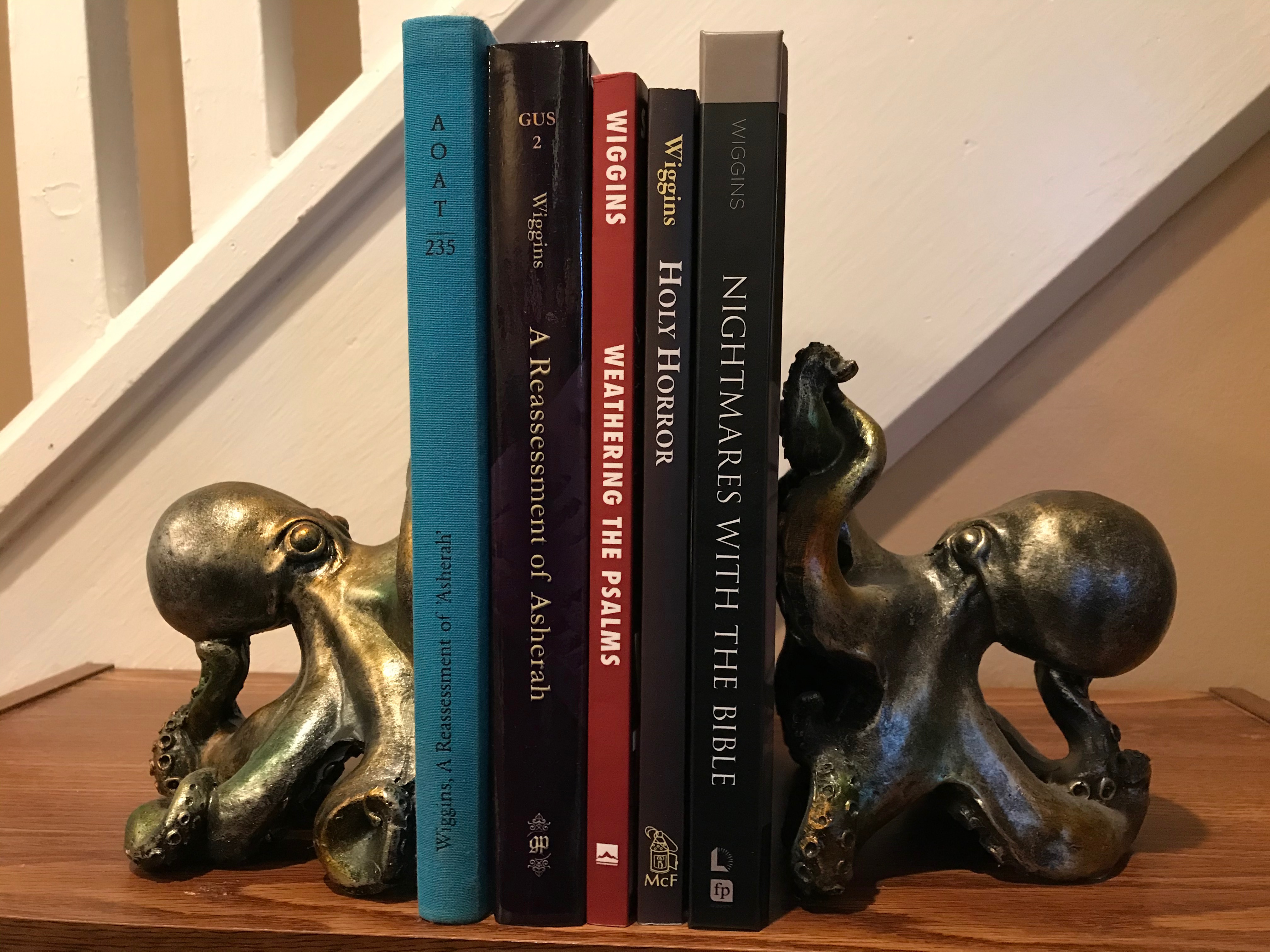
The fact is the draft of my book on The Wicker Man is done.  It has been for a few weeks.  None of my published books are the same as their drafts initially were.  (This is the difference, say, between a dissertation and a first monograph.  Let those seeking advice take note.)  The draft follows the approved proposal pretty closely, but I now kind of do research backwards.  Or at least while the book is in process.  Unlike a professor with a library and sabbatical and summers off, I find my sources as I write.  My books, despite what might seem a narrow focus, range pretty widely.  My reading goes in directions not even I anticipated when I began.  Ideas lead to other ideas.  Soon there’s enough of them for an entirely new book.  So I’m reading my draft and reading other books and creating the Frankenstein monster that will be a codex.

Every time I reach that point where I say, “this will be the last book I need to read for this project,” only a matter of days later I find another.  And another.  Book writing involves both creativity and distillation.  It takes a lot of books read to make one book written.  All writers know that.  Some have trouble knowing when to cut off the research because, and this is a truth for all of life, there’s always one more.  The very month of my doctoral defense a new book on Asherah was published.  The external examiner brought it to my viva.  Obviously he knew that I couldn’t have read it by then (it had to be in German, of course).  It ended up on my bibliography.  So I plod along with my book already written, but not yet begun.  I said it was complicated.