Leg Up

It’s amazing how often J. D. Vance’s Hillbilly Elegy comes up in conversation.  The book struck a nerve.  Reading it wasn’t easy because there were so many shades of my own childhood that I felt uncomfortable at several points.  Not from the same circumstances as Vance (his family seems to have been better off than mine, from the descriptions), I was more a hillwilliam (shoutout to the author of Verbomania for the portmanteau) than a hillbilly.  We weren’t educated people, but my mother’s family wasn’t as poor as the one she married into.  We were socially mobile alright, but in the wrong direction.  Anyone who hasn’t come home from school to find carp swimming in the bathtub simply can’t understand.  The way of the poor is inscrutable, but something Vance gets spot on—it is almost impossible to improve yourself without a leg up.

The chapter where this really hit me was as he was describing how easy his life was after being admitted to Yale Law School.  He made connections and learned to work them.  That part never came in my case.  Like Vance I grew up without a father.  Unlike him, I didn’t have grandparents to come to the rescue.  It’s a long story, but when I left home my life became a search for a father figure only to discover than nobody really wants to help somebody else’s kid.  Although I was accepted into the high profile schools, I had no one to coach me to go there.  Even now people barely recognize Edinburgh for the wonder that it is.  It didn’t connect me the way Yale Law apparently does.  My career has been in freefall a time or two because of this lack.  As Vance explicitly notes, when you grow up poor you don’t have the training or family experience to know what to do.

Many people, I realize, are much worse off than I was growing up.  What Hillbilly Elegy, written by a Republican, shows is that the government simply does not care for the poor.  In what used to be the wealthiest nation on earth there is a tremendous amount of poverty.  Vance has a keen analysis of what the abnormal psychology of want does to people.  I grew up more of a Pennsylvania redneck than a full-blooded hillbilly, but many of the same lessons apply.  While some of us can muster the willpower to escape, we know we are in the minority.  We learn as adults that others don’t share our concern for those who struggle daily to get by.  This is an important elegy, and if only it were read seriously by those able to make policy there might be some glimmer of light in these dark hills.  The right leg up can do wonders.

Religion’s Trickster

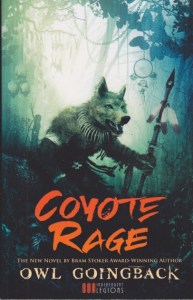
I’m not sure I’ve read any fiction by Native American writers before.  Owl Goingback has established a reputation among horror writers for his blending of Indian concepts and the horror genre.  Coyote Rage is a novel that blends worlds.  Coyote is, of course, a trickster figure.  Upset with human abuse of the world and our indiscriminate killing of animals, he decides to wipe out the human race.  Since all animals, including humans, plead their causes in the council in Galun’lati, the original world, he decides to take humans out by killing their last representative on the council, an elderly Native American in a nursing home.  The fact that his victim has a daughter unaware of her heritage, means that Coyote has two people to hunt.  As a shapeshifter able to travel between worlds, Coyote is a formidable enemy.

I don’t want to put any spoilers here, but it is worth considering the spiritual aspects of the story and how they blend so well into horror.  I’ve commented before on how religion plays into the genre.  Here is yet another example.  Galun’lati is presented as reality.  Not only do the animals talk there, it is a place that has its own dangers.  It’s a forest world, appropriate to Native American experience and context.  It’s very much a natural, supernatural world.  The novel splits its time between Galun’lati and the New World—this world—as humans try to prevent their own extinction while most people have no idea there’s even any threat.  Oblivious, we carry on.   Religion can play into horror that way.  While there are plenty of examples of purely secular horror, in my experience tales that have supernatural sources of threat are the scariest.

It may come back to the issue of ultimate concern.  When our spiritual wellbeing is taken into account, we often approach it with some trepidation.  The physical world feels so real and occupies much of our time.  If, however, we need to add spiritual concerns on top of everything else, it can become overwhelming.  What if physical threats, such as the coronavirus, and any other of a myriad of dangers, are only part of the picture?  What if there is another entire world in which we also have a stake?  If that world is beyond normal perception, we must rely on those who understand it.  Much effective horror knows to tap into this area of natural uncertainty.  Owl Goingback uses it remarkably well in crafting a horror tale that makes you think.


Misreading Melville

I make it a practice not to discuss books I’m still reading on this blog.  There’s no reason I shouldn’t, I suppose, but it just feels like cheating getting more than one post for a book.  Besides, there’s so much other stuff to blog about!  I’ll make an exception this time, because it involves an unusual typo.  Well, it’s not so much unusual as it is apt.  In chapter 82 of Melville’s classic, Moby Dick, “The Honor and glory of Whaling,” he discusses the mythical history of whaling.  In typical Melvillian style, he takes mythical stories to support his contention of how honorable whaling is.  After Perseus and St. George and the dragon, he mentions the curious biblical episode of Dagon and the ark of the covenant, found in 1 Samuel 5.  It’s here that my edition has a typo.  Melville writes “this whole story will fare like that fish, flesh, and fowl idol of the Philistines, Dagon by name” but my edition reads “Dragon by name.”

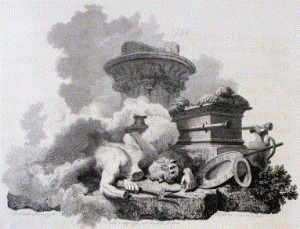
Image credit: Vignette by Loutherbourg for the Macklin Bible 12 of 134, via Wikimedia Commons

My very first academic publication was on this story about Dagon (I had intended to write my dissertation on that deity).  I had no idea of H. P. Lovecraft’s appropriation of Dagon at that point.  The interest was purely based on the fact that you couldn’t find much information on this curious god.  It was clear that he was well known among ancient cultures of West Asia.  He was attested at Ugarit, specifically as the father of Baal.  (Both would later be assumed to be demons.)  Further east, he was apparently a fairly major deity in Mesopotamian religions, although we are still awaiting a readable synthesis of that massive corpus of texts and the religions toward which it points.  In other words, Dagon is mysterious.  Lovecraft likely picked him up from the biblical story.

The tale in 1 Samuel is provocative.  After defeating Israel, the Philistines (who would eventually give Palestine its name) took the ark to the temple of Dagon as spoils.  The image of their god fell face-down before the ark overnight.  Disturbing as this was, the next morning after they’d replaced him, Dagon was again tumbled but also decapitated and with his hands broken off.  That meant his body was all that was left.  Somewhere along the line the name Dagon (close to the Hebrew word for “fish”) was interpreted as a maritime entity.  This seems unlikely, given what we know of his origins, but the idea stuck, leading to some compelling horror fiction.  Dagon does indeed become a kind of dragon in that realm.  My edition of Moby Dick has a typo that we today would blame on autocorrect, but in reality was likely the result of a copyeditor not knowing his or her Bible as well as Melville did.


White Rabbit

There are books that make you feel as if everything you know is uncertain.  D. W. Pasulka’s American Cosmic is such a book.  Its subtitle, UFOs, Religion, Technology, only pauses at the brink of the rabbit hole down which this study will take you.  Over the years I admit to having been jealous of colleagues who’ve been able to make an academic career stick.  The credentials of a university post open doors for you, even if you’re a professor of religion.  Pasulka has opened some doors here that I suspect many would prefer to have kept closed.  This is a compelling book, threading together many themes tied to religious studies.  There are things we might see, if only we’ll open our eyes.

Although immediately and automatically subjected to the ridicule response, UFOs are a fascinating subject.  This book isn’t about UFO religions—of which there are many—but rather it connects this phenomenon to the study of religion itself.  In Pasulka’s related field of Catholic studies, there are those anomalous accounts of saints who did the impossible.  Like UFOs, they are subjected to the ridicule response, making serious discussion of them difficult.  Might the two be related?  As you feel yourself spinning deeper and deeper down that hole, technology comes into the picture and complicates it even further.  Pasulka was a consultant on The Conjuring.  I’ve written about the movie myself, but what I hadn’t realized is how media connects with perceptions of reality.  Yes, it has a religious freight too.

Every once in a while I reflect that my decision—if it was a decision; sometimes I feel certain my field chose me—to study religion might not have been misplaced.  Perhaps all of this does tie together in some way.  American Cosmic is a mind-expanding book that assures me all those years and dollars learning about religion weren’t wasted after all.  I had a discussion recently with another doctoral holder who’s been relegated to the role of editor.  We both lamented that our training was in some sense being wasted on a job that hardly requires this level of training.  Still, if it weren’t for my day job I probably wouldn’t have known about this book, and that is perhaps a synchronicity as well.  Life is a puzzle with many thousands—millions—of pieces.  Some books are like finding a match, but others are like informing you that you’ve got the wrong box top in hand as you try to construct the puzzle with the pieces you have.  If you read this book be prepared to come close to finding the white rabbit.


Paper or Electronic?

Publishers are scrambling (and who can blame them?) to get ebooks out.  Since bookstores have been closed (I’d classify them as essential businesses, in an ideal world), they need to get “product” to customers.  Still, I’m thinking back to my recent interview with an undergraduate about Holy Horror.  She told me the cover really generated interest as she walked around school with it.  (This was before the pandemic.)  That’s old school book advertising.  Although I do learn about lots of books online, I very, very seldom buy ebooks.  It seems like buying air to me, and I wonder if publishers are missing out on the free advertising of the person carrying an interesting book around.

Back before the pandemic I’d noticed how just about everybody was walking around with that awkwardly proud “I’ve got a cup of Starbucks in my hand” look.  It was everywhere.  No matter where I went, for there was free travel in those days, people had only one hand free, showing the world their craft coffee.  If only it were so cool to be seen carrying books!  I stopped commuting about two years ago, for all practical purposes.  When I did get on a bus, however, I always had a book in my hand.  Did publishers see any bumps from curious New Jerseyans who saw the strange cover of the weird book I happened to be reading at the time?  You never got a seat to yourself on New Jersey Transit, and I know I was always curious about other readers (there weren’t many).  I hardly have the profile to define “cool” and “some guy on the bus” probably doesn’t cut it for many people, but still, the thought of someone curious about a book because of the cover is very compelling.

Book covers are artworks.  At least some of them are.  I recall the ennui I felt approaching some academic books with just words on cloth for the cover.  (I later found out the cloth is usually paper made to look like cloth—there are layers in everything.)  It was difficult to muster the energy to open the book because you knew there would likely be hard slogging ahead.  That’s why I decided to stop writing academic books.  The next trick is to find nonacademic publishers so that prices in the range of real readers might be offered.  If people opt for the ebook version, how will others see it?  And viruses only last on paper for about a day.  That’s a quarantine I can live with.


Ancient History, Part 3

It was an old idea.  I had it when I was still teaching at Nashotah House, that’s how ancient it is.  It seemed to me that if brains evolve with the rest of us, our perceptions of gods might change over time.  I’d been working on this for an Ugaritic conference held in Sherbrooke, Quebec.  The conference took place, but I’d been ousted from my position at Nashotah House.  The conference organizer, in what was an amazingly magnanimous move, came up with funding for me to attend.  I delivered the paper and Jean-Marc Michaud, of blessed memory, encouraged me to submit it to the tome with the very academic title Le Royaume d’Ougarit, de la Crète à l’Euphrate. Nouveaux axes de recherche, Actes du Congrès International de Sherbrooke 2005, Faculté de théologie, d’éthique et de philosophie, Université de Sherbrooke, 5-8 juillet 2005 (Coll. POLO–Proche-Orient et Littérature Ougaritique 2).  Unemployed and unable to access libraries, I had to decline the publication.

In one of those great ironies of life, I began to be approached to take on projects after I lost my academic position.  (This continues to happen; I received an invitation to contribute just last week.)  I often have to turn them down because I still have no access to an academic library and academics generally have no idea just how draining a nine-to-five is, with or without the commute.  In any case, a Festschrift for Simon B. Parker was announced.  I knew Simon as a student at Boston University School of Theology, and he wrote many letters of recommendation for me.  His sudden death shocked many of us.  Herb Huffmon, of Drew Theological Seminary, asked me to contribute to the Festschrift.  I still had this article that required some work, so I decided to try to finish it.  I received a note that the volume is about to go to press with Pickwick.  Academic publications won’t let me go.

If I had my druthers, I’d be getting along with my fiction.  I’ve had over twenty short stories published, and I’ve got many more in the works.  Every time I think, “Now I’m in the clear, I can focus on writing that is fun to read,” I get another academic invitation.  Those invitations don’t come with job offers, so I wonder why I have such trouble saying “no.”  Anyone who writes wants to be remembered.  We have ideas that we hope others will find engaging.  In academia you publish to keep your job.  Most of your work will be forgotten unless you’re groomed as an academic superstar (yes, they exist!).  I’ve never been groomed.  I write because I have ideas that beg to be expressed.  One of those ideas, many years old, will soon be available for consumption at Pickwick Press.


Thoroughly Earth Day

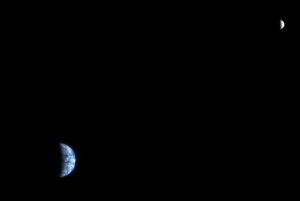
It’s difficult to say, since I don’t get outside much, but reports have come in that the earth is healing itself while we’ve been sequestered.  Rivers usually polluted have begun to run clean.  Smoke-smuggered skies have turned blue.  Animals have begun to explore human-made environments abandoned while we all shelter in place.  Could there be a more poignant statement about the reason for Earth Day?  If our worst behaviors are ceased even for a little while, the damage we do to our home planet begins to come undone.  To me that has been the most profound hope brought to light by this crisis.  Living more simply might be a virtue after all.

From NASA’s photo library

Going without can be difficult.  Every time the fleeting thought comes that I need to run to the store for this or that—and I’ve been taught that shopping is normal and natural and good for everyone—I have to stop and weigh the options.  Do I really need whatever it is?  Can I do without it?  Even bank accounts, for those fortunate enough to be able to keep working, have started to recover.  The frenzy we normally live under—earning money to keep buying things we don’t really need—is suddenly cast into perspective.  Times like this Earth Day I think of Henry David Thoreau.  Sometimes we like to laugh about our American saints, but his desire to live more simply does have appeal.  

Like many students who find themselves in Boston, I once made pilgrimage to Walden Pond.  The day I went there with some friends I believe we were the only car in the lot.  We lived simply in the way that grad students do, being under the sword of educational debts and loans, but we had come to see the place where nature had called one harried philosopher to solitude.  I knew, even as I stood by the marker of the cabin site that we couldn’t all live like this and still enjoy the benefits of medical science and technology (such as it was in the 1980s).  Perhaps it is possible, however, to reflect on better ways of living now that we’ve all been placed in a kind of enforced solitude.  I’ve begun reading more poetry.  I’ve started painting again.  Life has, in the midst of a pandemic, begun to feel more healthy.  It’s Earth Day.  Normally I’d be looking for an opportunity to join a community cleaning event, or even to go out and pick up trash on my own.  Since these are ill-advised, I stand before my bookshelf and reach for Walden instead.


See Monster

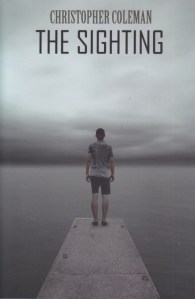
What happens when someone encounters something anomalous?  In real life this is often described as a religious event.  In fiction that sometimes happens as well, as in Christopher Coleman’s The Sighting.  Set on a beach somewhere along the Atlantic, the story is about a woman who encountered a sea monster and decided it was a god.  Gods, of course, require sacrifice, and thus the tale turns on her effort to placate the beast in its current appearance cycle.  Such sacrifice doesn’t come willingly, and this introduces a murderous main plot.  Unlike the gods of lore, however, this one literally eats, tipping the reader off that its divinity is somewhat of an illusion.  The hungry beast becomes the divine only to its blind follower.

I’ve not read any of Coleman’s fiction before, and this self-published novel appears to be a good introduction to his story-crafting.  His monster, like a god, comes with no explanation.  It simply is.  Since religion isn’t really susceptible to being examined under a microscope, the truth of not being able to locate an origin for gods seems natural enough.  Still, people are curious about monstrous origins.  Mary Shelley tells us the genesis of Frankenstein’s monster, but Bram Stoker leaves Dracula’s ultimate origins somewhat misty.  In the present day, with its ubiquitous cell phones and information, we do wonder if monsters can’t simply be explained.  Even if that simple explanation is complex.  Coleman’s title page tells us this is book one, so further elucidation perhaps comes later in the series.

The sea, in classical thought, gives rise to monsters.  Coleman’s creature comes from the Atlantic.  All the world’s oceans are organically connected, and their surface area is so massive that we really haven’t figured out all of what’s under there.  Stories still appear in newspapers announcing this or that unidentified creature that has washed out of the sea.  Its depth and relative impenetrability make it a natural birthplace for monsters.  By the end of The Sighting the reader is really still only given a glimpse of what this god might be, or why, indeed, it is considered a god at all.  Origin stories make monsters less scary sometimes—Shelley’s genius was to take it in the opposite direction.  Often in horror stories, the humans are more frightening than the monsters.  So it is here.  What makes this story so disturbing is the unquestioning human acceptance of belief, for it is often here that gods can become monsters.


Bug Eyes

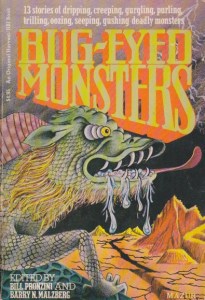
Science fiction and horror are close kin.  Once relegated to the cheap rack of “genre fiction,” both have now developed considerable literary sophistication, perhaps in the wake of their ability to bring in money.  I used to attend used book sales.  Two of the big ones in central Jersey were the Bryn Mawr sale, held just outside Princeton, and the even larger Hunterdon County Friends of the Library sale.  Both were springtime events and highlights on my calendar.  I always had a list with me when I went, but there were also so many books I’d never heard of and that looked fascinating.  One such book was the science fiction anthology, Bug-Eyed Monsters, edited by Bill Pronzini and Barry N. Malzberg.  The garish cover was half the appeal, and, well, monsters go without saying.

Although I’ve mostly moved to the horror end of the spectrum, there were some good stories here.  Bug-eyed monsters were a staple of 1950’s sci-fi, gracing the covers of pulps, often menacing women with their tentacles.  Some of the tales here share that kind of wide-eyed wonder at the sheer power of imagination, while others are much more subtle.  Monsters, of course, lurk between genres, bursting into consciousness when something unexpected is discovered.  They also have strains of religious awe associated with them.  That’s obvious in a couple of the stories as well.  Since I’m trying to read through my own books while stores are closed, I decided to spend some time with my monsters.  The problem with story collections, however, is you can’t discuss them all in the short format to which I limit myself here.  Besides, some of them I didn’t like.

Monsters deserve to be treated with respect.  In the “golden age” of sci-fi they were often played for titillation.  Most of the monsters in this collection are from outer space.  Some are homegrown, generally in the scarier tales.  We are afraid of those who are different.  Monsters, as more than one of these stories indicate, can be more humane than humans often are.  It’s no surprise that they tend to represent the foreigner, the person whose culture and appearance are different than our own.  Titillation apart, these narratives often ask us to stop and consider what might happen if we really did listen.  Would we not improve ourselves if we could learn from those we fear?  In these days of government-approved xenophobia, perhaps we should dust off our copies of the old genre fiction.  Even in those days we were encouraged to be open minded like our monsters.


Learning To Fly

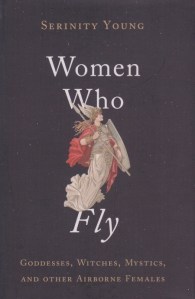
It’s perhaps the most deeply rooted human dream.  Flying.  Women Who Fly, by Serinity Young, is a fascinating book.  Subtitled Goddesses, Witches, Mystics, and Other Airborne Females, the book covers all of these and more.  The dream of flying is played out in many ways here, but often the narrative comes back to how patriarchy imprisons women.  Is it any wonder they want to fly?  Very wide in historical scope, the book can’t cover all cases in equal depth.  It nevertheless demonstrates how pervasive the idea is.  Beginning with ancient female figurines bearing bird-like features, Young moves through the related concepts of captivity, transcendence, sexuality, and immortality, showing how female characters are related to these idea in universal and unrelenting ways in the form of flying females.

There are many lenses through which to view patriarchy.  It can be explained as a consequence of settled agricultural existence with its subsequent division of labor.  Such a scenario raises questions of whether women dreamed of flight before that, and I believe the answer must be yes.  For as long as we’ve observed birds and associated the sky with gods we have longed for flight.  Although birds make it look easy, it is an incredibly difficult and costly adaptation.  Still, women dream of travel without obstacles (let the reader understand) to the realms where deities dwell.  It is difficult to summarize a book that covers so much historical territory.  Young doesn’t limit herself to western religions but also spends a fair bit of time among Buddhist, Hindu, and Daoist ideas of flying women.  She covers mythical, folkloristic, human, and historical flying females all the way up to modern astronauts.

As I was coming to the close of the book the real message hit me—I can be thick at times, although much of my own writing is metaphorical—men have actively tried to clip women’s wings for a long time.  Often under the auspices of religion.  Think of it: for centuries of existence the major monotheistic traditions have refused female leadership.  The one (inevitably male) god has set up a boys’ club of sacerdotal leadership.  As Young points out, even the named angels in the Bible are male.  I used to comfort myself with the explanation that male leaders were simply too self-centered to consider others, but it is becoming clearer, the more I read, that men have always had a tendency to try to keep women down.  And thus they fly.  There’s much in this book for both women and men to ponder.


Reading Connections

It’s flattering to have someone notice your work.  The other day I had the very first email from someone who’d read Holy Horror and wanted to discuss it.  It was from an undergraduate, no less, who was doing a report on religion and horror.  She’d read my book (and yes, it’s undergrad friendly) and wondered if I’d be willing to talk about it.  I can’t express how surprised I was (and still am).  You see, I have emailed authors after reading their books.  Many of them show no interest in carrying on a conversation with someone they’ve “met” through email.  I’ve had so many single-sentence responses with no enthusiasm whatsoever that I’ve begun to think of those employed in academia as hopelessly stuck in tunnel vision.  If you write a book you’re wanting conversation with those who read it, I should think.  At least I am.

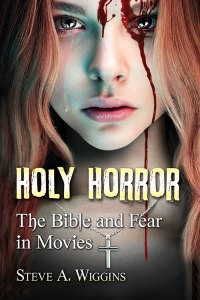
Those of us outside academe don’t have tenure committees to please or effectiveness committees to placate.  We write books to try to engage readers.  Unfortunately Holy Horror is priced for the library market.  During our phone interview, my interlocutor asked about the cover.  She said something publishers should hear: when walking around with Holy Horror her friends asked what the book was about because the cover is intriguing.  (It’s actually based on Chloë Grace Moretz from the reboot of Carrie, discussed in the book.)  In the midst of a pandemic, this first show of interest made my day, like seeing the first crocuses after a long, hard winter.  I do welcome conversation about my book.  I don’t have a classroom of students to force to buy and read it.  It’s out there for discussion.

Nightmares with the Bible is nearly finished.  Of course, publishers have hit a bit of a slow patch with many of their business partners shutting down.  Some publishers have gone into hibernation during the pandemic.  Books, though, will get us through.  A colleague of mine said the industry reports are showing that novels continue to sell while nonfiction is suffering.  Well, I’m no expert, but I do wonder if nonfiction might do better if authors would be willing to respond to this who express an interest in their work.  I know it’s a radical idea.  I also know that my books reach nowhere near what most publishers consider a viable readership.  What people are looking for during enforced isolation is a sense of connection.  Reaching out to find someone reaching back.  Books can do this, even if we never physically meet.


More Than Books

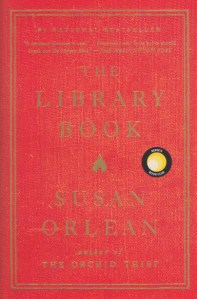
Careers.  A pandemic is no time to think about changing jobs unless you’re forced to, but I often wonder if I got it wrong.  No matter what my job was, I wanted it to be about books.  When I was considering ministry it was largely because of the Good Book, and I did a lot of reading of books about it.  Over time my mindset morphed to that of a professor and the book-lined study was my icon.  I admit I’m fixated at that stage.  Now I’m an editor.  Life would’ve been different if I’d become a librarian.  Susan Orlean’s The Library Book is a volume that opens up the cloistered lives of librarians and shows just how vital libraries remain.  I have to confess that before reading this I don’t recall ever having heard of the central Los Angeles library fire of 1986.  Now I can’t forget it.

More than just an account of the fire—although a suspect was arrested it still isn’t clear that he was guilty—this is a book about libraries.  An account of the fire alone would not have been so interesting.  Orlean tells us about this history of the Los Angeles Public Library and the importance of libraries around the world.  She introduces us to several librarians and gives us insight into why they became such and what it is they do.  Here’s a hint: it’s a lot more than re-shelving books.  And there’s the sad tale of an unsolved fire that destroyed millions of dollars’ worth of books.  Having had hundreds of books destroyed by water myself, some parts of this book were difficult to read.  Books are vulnerable, like butterflies they must be treated with care.  The idea of them burning, then being soaked, is distressing.

Like many people, I suspect, I began this book thinking libraries were on the way out.  The internet has changed things.  What I didn’t fully appreciate is that libraries have been evolving to keep up with the times.  And that they provide social services, such as a place out of the weather for the homeless.  I experienced this myself in Montclair, New Jersey.  When accompanying my wife there on Saturdays when she had to work, if I finished with the bookstores early I’d head to the library.  You could sit there for free.  I always have books with me, so I could read.  I could use their wifi for free.  Libraries, you see, are all about giving.  They give so much to the community.  Now that we’re living hermetically sealed lives, it might seem strange to think of libraries as places of social gathering.  And of course they’ll have books.  Orlean’s account makes me think perhaps my career has been off-track.  Perhaps I should’ve been a librarian.


Not Sterling

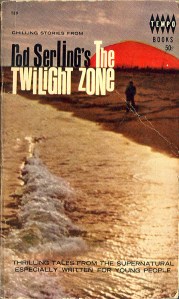
Only indirectly has the coronavirus pandemic influenced my decision to read books of short stories.  Indirectly because bookstores are closed and I have several such volumes gathered here at home.  This particular collection includes a book “especially written for young people” called Chilling Stories from Rod Serling’s The Twilight Zone.  This is a book I had as a young person, discarded, and then regretted discarding.  I have to say that most books I discard I eventually regret.  When you’re young and moving from apartment to apartment, though, you can’t keep all your books.  Anyway, I re-acquired it several years back.  The book doesn’t list an author.  Instead, the title page says “Adapted by Walter B. Gibson.”  Gibson was best known for writing The Shadow series.  The end result is that I don’t know who wrote the stories in this book.  They have the ideas of Rod Serling, but the writing isn’t in his style.

When I buy a book (I got this one used on the internet, back when it was young) I like to know the author.  WorldCat lists Serling as the author, but the book was published pre-ISBN days, back when publishers could be a bit less than transparent about such things.  Other websites put Gibson first under authors, followed by Serling.  The publisher, Tempo Books, was an imprint of Grosset & Dunlap, which eventually came under the Random House/Penguin umbrella.  Originally publishing primarily children’s books, Tempo lists this book for young readers, although as an adult reader I wonder if it could appeal to young people today.  There’s no sex and any violence is really implied rather than explicit, but there’s some adult-level subtlety going on.  Books for young readers are much different these days.

Just recently my daughter introduced me to the increasing sophistication of levels of book genres.  Like most readers and writers I’m encouraged at how young adult books have taken off.  A future generation of readers is cause for hope.  There are now “new adult books.”  These are targeted at those college aged or just over.  Unlike young adult titles they’ll have sex and adult language.  My Twilight Zone book lacks these, and it also lacks the sparkle of Serling’s teleplays.  Serling was a playwright and screenwriter.  These stories clearly contain his ideas but not his ability.  I didn’t know that as a child.  I do know that I never finished the book before now.  One of the reasons, I expect, is that it didn’t really seem like I was reading Serling, even to my young self.  Still, ghost stories during a pandemic have their own appropriate place, and who doesn’t want to be young at heart?


Occam’s Disposable Razor

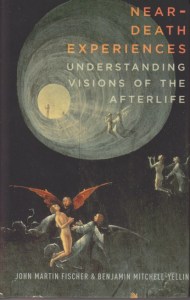
Since new books are kind of rare right now, I’m reading through some of those I’ve collected but haven’t actually read.  One is Near-Death Experiences: Understanding Visions of the Afterlife, by John Martin Fischer and Benjamin Mitchell-Yellin.  I bought the book because the topic, as addressed by a university press book, is interesting.  Fischer and Mitchell-Yellin approach the subject as philosophers.  Their main focus is on the widely accessible and successful books by Eben Alexander and Todd Burpo.  Also the somewhat less well known efforts of Jeffrey Long and Pim van Lommel.  (Instead of taking up blog space with all these titles, just email me if you’re curious, or read my Goodreads post.)  Applying standard scientific methods to spiritual experiences isn’t easy, and Fischer and Mitchell-Yellin are clear that they aren’t trying to take the value out of Near-Death Experiences (NDEs), but rather they are challenging how these authors try to make them authentic.

Philosophers parse words finely.  The authors show that “real” is not the same thing as “authentic” and demonstrate how some of the more spectacular NDEs can possibly be explained by science.  Those who’d temporarily died might’ve caught onto things that happened just before or just after brain activity ceased or restarted, for example, and then misremembered them.  As a still-living guy who can’t remember where he left his wallet half the time, misremembering is an authentic reality.  Still, I couldn’t help but wonder.  Science and religion ask different questions.  One of the mainstays of scientific method is Occam’s Razor—the solution that requires the least mental gymnastics to explain something is the most likely to be true.  Many times this razor is flashed in the face of those trying to make a religious case for something.

Ironically, the authors here dismiss Occam’s Razor.  They state that sometimes the more complicated solution is the right one.  I happen to agree with them on this, but it proved a real distraction in reading the book.  Many scientists use the exact opposite argument against spiritual things.  It also struck me that a book so brief (less than 200 pages) would necessarily struggle to explain a complex phenomenon convincingly.  Trade books, such as those by Alexander and Burpo, aren’t meant to be held up to the stiff standards of peer review.  They are meant for selling lots of copies.  Their authors aren’t philosophers.  It’s almost a mismatch in categories.  Some academic presses are now publishing on NDEs and asking plenty of questions about them.  It’s no surprise that philosophers favoring physicalism would do the same.  It seems a little hairy, however, to do so with Occam left firmly in the shaving kit.


New Habits

We are a family of readers.  Still, during the pandemic things change.  Not only is my wife working from home, my daughter is also here, doing the same.  This seemed to be the most logical thing, given that her housemates weren’t working from home, and who needs pointless potential exposure?  What became clear to all of us is that pandemic normal was actually close to our normal normal.  I mean, I don’t get out as much on weekends now, but other than the panic, Monday through Friday are pretty much the same as always.  Awake obscenely early.  Start work before sunrise.  Finish work, eat supper, go to bed.  The real change has been on my reading habits.

When things are “normal” (if that word can ever apply to me), during the time my wife drives home from work, I read.  I also read in the morning and before going to bed, but that latter doesn’t last long if I’m tired.  Now, however, we’re all here and after work is over family time begins.  I don’t begrudge this for a nanosecond, but it does affect my reading habits.  You see, self-isolation has been a way of life for me long before the pandemic began.  Not necessarily because I wanted it this way, but I have always tried to preserve time for books.  I don’t have the reading time of a professor, so I have to carve it out of personal time.  In situations like this even bibliophiles have to admit that people are more important than books.  Still, with only essential businesses open, and Amazon delivering only essential items, books have fallen between the cracks.  Some of us consider them essential.

My daughter said the other day that not being able to buy books was worrying.  Indeed it is.  We’re pretty well stocked here for reading material.  I’ve got plenty of books I want to read, but I lack the time.  Also, one of my reading challenges specifies the particular types of books I need to target, including recent ones.  How am I to get them?  Our local library is closed.  As are the bookstores.  It’s beginning to feel like an episode of The Twilight Zone—being isolated but not having access to new books.  At work they’re suggesting which television shows to binge watch during the long hours of enforced alone time.  Me, I standing in front of my bookshelves staring in wonder and indecision.  Pandemic or no pandemic, it is time to read.