Utterly Indifferent

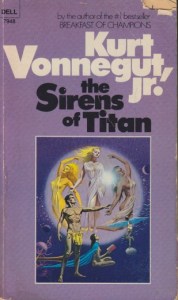
One of the main purposes of this blog, apart from being a kind of daily tablet for my thoughts, is to demonstrate that religion continues into the age of secularity.  It would be an uncomfortable stretch of the imagination to suggest Kurt Vonnegut was a religious writer, but it would also be a disservice to him to ignore just how much religion shows up in his novels.  Often the remarks are subtle and perhaps easily missed, but one of his early works, The Sirens of Titan, treads pretty solidly in that territory.  From the fact that monument to the twelve great religions was made by artisans who don’t know what those religions are to the founding of a new religion to unify humankind, this story never strays far from it.  It’s also, in my experience, the most science-fictiony of Vonnegut’s books.

The Church of God the Utterly Indifferent is the goal of Winston Niles Rumfoord’s doomed Martian attack on earth.  Because the Martians are actually brainwashed earthlings, they are sacrifices to the grand vision of all people sharing a single religion that recognizes God does nothing to help humans and humans, therefore, should not worry about serving God.  Clearly a religion that functions the opposite way of most actual religions—which try to keep God happy, often by harming other humans—Rumfoord’s vision is a united Earth.  One of the pawns in his scheme is his unhappy wife, and another is the biblically named Malachi Constant.  Constant built a ship to take humans to Mars.  Christening it The Whale, Constant took the pseudonym Jonah, which is something readers are increasingly ill-equipped to understand, but which demonstrates Vonnegut knew his Bible.

Religion plays throughout Sirens of Titan in ways that both poke fun at the seriousness with which religion is treated and with a certain respect for its power.  Vonnegut’s famous nihilistic leanings pervade the novel with an almost Job-like portrayal of Rumfoord, and several ethical questions lie beneath the apparent space-travel story.  Genre fiction, as I’ve intimated before, is intended to be slotted easily into recognized categories.  Critics reserve the sobriquet of “literary fiction” for those pieces that don’t really fit other patterns—not all fiction obeys the rules—and that’s where I’d put Sirens.  Yes, people zoom around in flying saucers and invasions from space are standard sci-fi tropes.  Engagement with religion, even if it is to question it, tends to move fiction into more serious categorizations, excluding, of course, novels written to promote a particular religion.  None of them would suggest a Church of God the Utterly Indifferent.  Unless, of course, they came from Kurt Vonnegut.

Evolving Tales

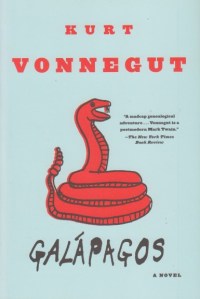
There’s nothing like a six-and-a-half hour flight to get some reading done.  I’d made good progress on Kurt Vonnegut’s Galápagos before leaving for England, but the plane ride gave me time to finish it.  While nobody, I think, can really claim to understand Vonnegut, there are clearly some trends in this novel that demonstrate his struggle with religion.  There may be some spoilers here, so if you’ve been saving this book for later you might want to wait before reading the rest of this.

As the title suggests, it’s a story about evolution.  Charles Darwin had his first divine epiphanies about evolution while visiting the Galapagos during his voyage on the Beagle.  Land creatures isolated from others of their species adapted to the environment in which they found themselves, and over eons passed on useful traits to their progeny.  If humans only had as much foresight!

With his trademark cast of quirky characters about to set out on a cruise from Equador to the Galapagos, Vonnegut has war break out.  Riots and pillaging take place.  Vonnegut takes broad aims at capitalism and business-oriented thinking, and how these represent the devolution of our species.  Of course, being Vonnegut, he does it with wit and verve.  Vonnegut was a writer not afraid to use the Bible in many ways, including what experts would call misuse.  As the surviving passengers make their way onto the stripped, but functional ship, he notes that they are like a new Noah’s ark.  They end up populating Galapagos with humans that evolve a million years into the future.

A thought that caught me along the way was a line where he wrote that in the long history of David and Goliath conflicts, Goliaths never win.  This kind of sentiment could do the world some real good right now.  In fact, although the book was written decades ago, one of the characters, Andrew MacIntosh, reads very much like a foreshadowing of 2016, down to the descriptions of how he regularly mistreats others.  In Galápagos MacIntosh gets killed during a rebellion, showing that grime doesn’t pay.  The cruise goes on without him.  Galápagos is a book that points out the evils that our system encourages, or even necessitates.  There can be another way.  The survivors land on the barren islands and set about adapting because they have no other choice.  A more egalitarian scenario evolves largely because females are in mostly charge.  While not intended as an actual solution to social ills, Galápagos is nevertheless not a bad guide, especially when shipwreck seems inevitable.


Not for Men

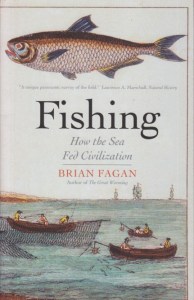
Does anyone else think that feeding fishmeal to herbivores so that they, in turn can be eaten, is weird?  Brian Fagan in his Fishing: How the Sea Fed Civilization describes the long history of eating seafood.  In evolutionary terms it makes sense, but so does veganism.  One thing that becomes clear from this study, however, is that human civilization simply could not have developed the way that it did without fishing.  Food for those performing massive public works came from the abundance of the ocean.  Theology played its part too.  Roman Catholicism established a habit that still exists of eating fish on Friday.  In Catholic areas of this country Friday fish fries, and the occasional fish boil, are cultural icons.  As Fagan points out, part of the reasoning behind this was the belief that God gave humans fish to exploit.

We find, interestingly enough, that religious thinking often stands behind tragic results.  Although I’m a vegan, I find it distressing that the oceans—so vast in extent—have been depleted by human activity.  The main problem, which we’re slow to learn, is that technology has made fishing too efficient.  This isn’t some kid with a rod and reel on the bank of a muddy river, but rather the industrial-scale trawling that begins by locating fish schools with sonar.  Not only that, but the land habitat to which we bring the fish is also being depleted.  I’m probably not the only one who gets the feeling that Fagan’s writing about more than just fish.  Where there is abundance, we take it as an invitation to exploit.  Tech makes it so easy!

In the early history of humankind, seafood was a necessity.  As Fagan shows, it was sometimes reserved for hard times.  Now we feed fishmeal to domesticated animals not because it’s what they naturally eat, but because—you guessed it—it’s cheap.  I’m still not allowed to give blood because of the Mad Cow Disease scare that rocked Britain when I lived there.  In part it was caused by feeding herbivores feed that consisted of meal made from other herbivores.  I no longer eat fish.  With the world population what it is, and global warming stressing agriculture, it seems we need to be thinking about what’s for dinner.  Quite apart from the fact that fish are, despite proclamations of ecclesiastical bodies, animals just like any others, we’ve managed to scour the ocean so thoroughly that recovery may be impossible in some locations.  The reason often given is that God gave us the oceans to use.  And that kind of thinking always leads to disaster. 


Best If Used

Used bookstores are like a box of books—you never know what you’ll get.  I perhaps overindulge this particular vice, but it doesn’t feel too sinful to me.  Part of Modern Mrs. Darcy’s reading challenge for the year is three books by one author.  I decided since I’ve been on a Kurt Vonnegut kick that he would be the one.  I figured (mostly wrongly) that his books would be all over the place in used bookstores.  I always found a plentiful supply at the now mourned Boston Book Annex.  At a used shop in Easton I asked where they might put Vonnegut.  “In science fiction,” the owner promptly replied.  I don’t think of Vonnegut as a science fiction author.  Some of his work does fit, but this little exchange got me to thinking about genres again.

Writers, unless they’re strictly commercial, don’t think of genre.  We write.  The novel I’ve been trying to get published for the last decade doesn’t fit into any neat category at all, and that’s probably part of the problem.  Neither fish nor fowl—what is this thing?  I’ve noticed this with my brother-in-law’s books.  Now, I’m holding out on retirement to dig into Neal Stephenson’s books because they require more time than I have in my workaday world, but they aren’t always science fiction.  Still, that’s often where you find him in bookstores.  I was in a local shop in Bethlehem the other day and there he was, in sci fi.  Although I understand why booksellers (and critics) want to use genres, but it seems to me that they limit human creativity.

The past couple of non-fiction books I’ve written aren’t really in genres.  They’re not academic books, but academics (once guilty, always guilty) have a hard time convincing publishers they can do anything else.  Non-fiction may be a more difficult gig than fiction after all.  Holy Horror and Nightmares with the Bible don’t comment on horror necessarily, at least not directly.  They’re not religious books either.  When I try to explain them in one sentence, it quickly becomes run-on.  I began both the same way—I noticed something and began writing about it.  With a little structuring and a little time, you’ve got an entire book.  It may not find a publisher.  It may not fit a genre.  Nobody on Medium is going to come looking for your advice.  And if you’re lucky you’ll find yourself put on a shelf with others who don’t conform to genre expectations either.


See Above

As we slide beneath the hegemony of technology, I’m impressed by the redefinition of vocabulary it demands.  Because new printing technologies assume, for example, that the XML (one of the many mark-up languages) is primary, directional references in texts are inadequate.  An example might help.  If you’re a human being reading a book, and the author has discussed something a few pages ago, s/he might write “see above.”  Now, it’s not literally above in the sense of being higher up on the same page (but it may be considered literally if the book is closed.   And lying face up).  The pages you already read are above those where you left the bookmark.  I remember the first time I encountered this language; having been raised a literalist (and a naive realist) my eye hovered over the header and I wondered about the accuracy of “see above” or “see below.”  The terminology soon became second nature, however, and I knew it wasn’t a literal reference.

In the days of XML (“eXtensible Markup Language,” therefore literally EML), the sense of play is now gone from writing.  I’ve heard editors explain to authors that, in an ebook there is no above or below because there are no pages.  A time-honored metaphor has been sacrificed on the altar of a tech that sees the world in black-and-white.  You can’t point vaguely in the direction from which you’ve just come and say “it’s back there somewhere.”  I sense, given all of this, that most copyeditors haven’t written a non-fiction book (for this is mostly an academic affectation).  As a human being writing, you get into the flow and you don’t think, “Ah, I mentioned that in paragraph 2749; I’d better say it’s there.”  And the reason you need to know the paragraph number is so the ebook can have a hyperlink.  The argument itself suffers for XML precision.

As someone who writes both fiction and non, I am bound to look at this from the viewpoint of a human author.  I’ve been known to paint and make sketches on occasion.  All of these forms of expression have flow in common.  At least when they’re good they do.   If you want to stop a project cold, just say “Hey, I’m writing!” and watch yourself drop like a cartoon character who’s run off a cliff and just realized it.  I’m sorry, I can’t point you to exact where that’s happened.  It’s in many vague recollections of many cartoons I watched as a child.  If the technomasters aren’t watching I’ll just say, “see above.” 


Taking and Giving

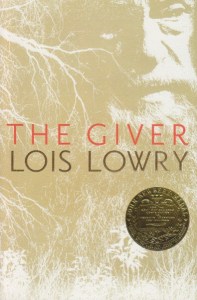
Dystopias are among my favorite kinds of literature.  Things tend to go wrong in human society, and although we’ve made great progress over the past couple of centuries, in many ways we’ve set ourselves back.  Dystopias are searching, thoughtful ways of addressing that slippage and they warn us of what me might become.  (Especially if Republicans remain in power.)  Lois Lowry’s The Giver is young adult literature, but I’ve been curious about it for some time.  Set in an undefined time and place, a highly structured society exists where things seldom go wrong.  There are no animals and people take pills to eliminate “stirrings” so that sex won’t complicate relationships.  Families are constructed by algorithm and children are assigned from a pool so they will match expectations.  In order to continue this bland lifestyle, memories have to be repressed in the person of the Receiver—the keeper of communal memories.

At first things seem pleasant enough.  Life, however, lacks color and music.  It lacks emotional engagement.  Those who, in real life, idealize the 1950s as before the madness of the sixties began, have trouble conceiving of how societies go wrong.  The dilemma is that no society is perfect and as time goes on we look for improvements.  For a very long time in American history, for example, nobody had bosses.  The majority of people were independent farmers.  They prospered by luck and hard work, but they worked for no one but themselves.  Now we mostly work for bosses who have bosses who have bosses in some kind of endless regression of power.  Our ability to change things is quite limited, even in professional positions.  Is this better than the uncertainty of farming?  With all the rain this year it might seem so.  Of such things dystopias are made.

The Giver follows a protagonist, Jonas, who when he becomes twelve is assigned to become the new Receiver.  As he gains memories of how things used to be, he’s fascinated.  Learning his society’s darkest secret, however, spurs him to try to make a change.  A lot of questions remain at the end.  (The novel is part of a series, as most young adult fiction tends to be, but it can be read as a stand-alone story.)  Those of us who’ve been around the block a time or two might be able to guess where this is going, but for younger readers to be introduced into the way of human problem solving this is a gloves-off approach.  Those accustomed to dystopias will find themselves in familiar territory.  As will those who live under Republican regimes.


Let It Lie

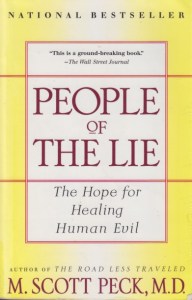
At the grave risk of over-simplifying, the list is brief: destructive scapegoating behavior, intolerance of criticism, concern with public image, and deviousness.  These characteristics, back in 1983 (note well the next year), were widely considered the description of evil.  Now look at the White House.  What do you see?  I know that I’m reading into the current situation, but how can one not?  I have never read anything by M. Scott Peck before.  Growing up I saw The Road Less Traveled on many, many bookshelves of friends and clergy.  I recently picked up Peck’s People of the Lie because, along with Malachi Martin’s Hostage to the Devil, it convinced many in my generation that demons actually exist.  At the time, still pretty much a Fundamentalist, I didn’t require any convincing.  Reading Peck’s People, however, in the era of Trump is a frightening thing.  And not just for the politics.

I always find books by psychologists and psychiatrists difficult to read.  I admit to having had a less-than-ideal childhood, and although self-healing is possible such books make me think I should spend my free time in therapy rather than writing.  In any case, People of the Lie is difficult in another respect as well—the labeling of evil.  Peck advocated for the scientific study of evil.  Good and evil, however, have generally been considered values rather than facts.  Science studies the latter while religion and philosophy deal with the former.  Not that lines in the sand are intended to be permanent.  Still, what one person calls evil may not be what others call evil.  Peck focuses primarily on narcissism and laziness as sources of evil.  He may very well be right, especially with the narcissism aspect, but some of the patients he described certainly didn’t seem evil to me.

Many aspects of this book could be discussed on a blog like this.  No doubt many of them will be, in sublimated form, in future posts.  Books, however, are part of the context in which they’re read.  In Peck’s day, the great political evil still fresh in many minds was the Vietnam War.  Today’s world, however, is one where Vietnam, Watergate, and even to a great extent the tragi-comedy of the W administration have all been eclipsed.  The cult of personality headed by one of the most obviously narcissistic individuals this nation has produced makes what Peck labeled “evil” seem perfectly normal.  And those who have the authority to do something about it either sit idly by, or worse, use it for their own means.  Roads less traveled indeed.


Identified or Not

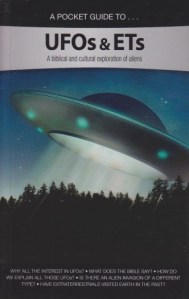
Okay, so this will require some explanation.  It came about like this: I was in a used bookstore.  (This in itself requires no explanation, of course.)  I noticed a slim book, cover out, called A Pocket Guide to UFO’s and ETs: A biblical and cultural exploration of aliens.  Biblical?  I picked it up only to discover it was from Answers in Genesis.  Please note: I do not buy books or paraphernalia of Fundamentalist groups unless I can get it used.  I don’t want to support this particular weirdness in any way.  Well, the money for this used book was going to support a used bookstore and not a religious aberration, so I figured it would be good to see what the Fundies have to say about a topic that seems to have started to engage public interest again.

The book begins by helpfully pointing out that if there’s life on other planets the Bible doesn’t mention it.  And since the only way it could’ve got there is by evolution—for surely the Almighty would’ve said something about it in his book, if he’d invented it—the whole idea is a non-starter.  Evolution, as everyone knows, is a satanic idea meant primarily to challenge the Bible and secondarily explain the diversity of life forms on earth.  And since earth is the only planet the Bible recognizes, it is the only one with life.  So, UFOs, it stands to reason don’t exist.  Well, that’s not quite fair.  They do exist but most can be explained away and those that can’t may well be demonic.  Since there can be no aliens, and since some sightings can’t be otherwise explained, then demons—which the Bible does mention—must be responsible.  They (demons) can also explain why other world religions exist.

There’s plenty in here to offend just about everyone apart from the Answers in Genesis crowd.  The screed spends quite a bit of time knocking down ancient astronaut ideas, and taking Erich von Däniken to task.  Science is useful in explaining how pyramids were built, but not in how the rock used to build them was formed (it takes far too long to make limestone the old fashioned way; God simply used a variety of different rock types to make the one inhabited planet more interesting geologically).  And those UFO religions?  Inspired by demons, no doubt.  In fact, even reading a little book like this could lead you to become interested in the subject, so be careful!  In fact, the safest thing of all (and I’ve only got your well-being in mind) is to leave it on the shelf.


Premature Burial

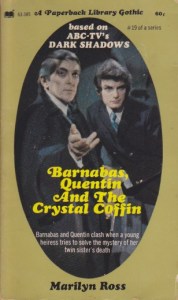
I have recently finished writing an article for a collection of essays on the Bible and horror.  Have no fear—I’ll pass along details once it’s published.  I do have to wonder, though.  All those years I was teaching and publishing regularly in ancient Near Eastern studies nobody ever approached me about contributing.  It took coming out of my monster closet for that to happen.  Monsters, you see, are a guilty pleasure topic.  They’re so much fun that they hardly seem like work to write about.  Or read about.  I was a child when Dark Shadows aired as a daily soap opera on ABC.  For reasons about which I’m beginning to speculate I found this series strangely compelling.  Marilyn Ross (W. E. D. [William Edward Daniel] Ross) based some 32 of his over 300 novels on the series.  I collected them as a kid and then got rid of them when I went to college.  I’ve been collecting them again in a fit of nostalgia over the past several years.

I just finished Barnabas, Quentin, and the Crystal Coffin.  The story was actually quite different than typical Collinwood fare.  What drew me to these novels as a child was their atmosphere and, if I’m honest, the fact that Barnabas was a vampire.  Memories of youth are fleeting things at my age, but it may be that Barnabas Collins was my introduction to vampires.  I was four when the series first aired, and I’m not sure if I discovered it before I came across Dracula or if it was the other way round.  Dracula, once I was experienced enough to have an opinion on such things, was my favorite monster.  I liked the others as well, but he was rich and immortal—the things sickly kids in poverty idealize.

In my fascination with Dark Shadows I’m not alone.  Despite Tim Burton’s movie version, Johnny Depp (who is my age) admitted growing up wanting to be Barnabas Collins.  Friends about my age have discovered PBS’s recent re-release of the original series in all its campy glory.  For whatever reason, however, it is the books that always draw me back in.  They, for me, defined the Gothic novel.  Ross’s writing is formulaic and predictable.  His adjective choices feel forced and subtleness was never his strong point.  Still I can’t stop myself from occasionally dropping into the world he manages to recreate in the woods of Maine.  Afterwards I move on to more profound writing, but then, his work is the very definition of a guilty pleasure.


Adversaries

Satan isn’t who we think he is.  Inheriting a tradition from across centuries, it can be easily supposed that modern ideas help to explain the reality of that tradition.  Sorry, let me try this with more specificity.  The character of “Satan” does not occur in the Hebrew Bible.  By the time of the Gospels, however, he’s there.  We tend to use modern ideas of Satan to understand the enigmatic person of “the satan” in the Hebrew Bible.  Peggy L. Day explored this idea decades ago in her revised Harvard dissertation, An Adversary in Heaven: śāṭān in the Hebrew Bible.  Reading this took me back to those heady days when I consumed Harvard Semitic Monographs like breakfast cereal.  To those of us not from Harvard we pretty much knew what to expect, but we read anyway.  Scholars are like that.

In any case, Day here explores what is sometimes surprising to those who read the Devil back into the Hebrew Bible: the satan is mentioned in only four passages and in none of them is he “Satan.”  In Numbers the satan is identified as a good angel sent to knock Balaam off his ass.  In the book of Job the satan is a member of the divine council and he does his job by accusing Job.  Day shows, by the way, that his accusation is really against God and not the mere human sufferer.  Her outlook on Job is still amazing after all these years.  After Job, the satan appears in the short book of Zechariah to accuse Joshua the high priest of the restoration era.  He’s no Devil here either.  The final reference comes in Chronicles where instead of God tempting David to take a census a satan does.  By this time the reader already knows a satan is an accuser and need not be superhuman.

This monograph raises the perennial issue of how to understand ancient texts without chaffing under the weight of tradition.  The character of the Devil developed over many centuries and, when he appeared, he was only one of many iterations.  The New Testament made Satan “biblical” and later readers tried to explain the Devil (who came from Zoroastrian mythology) as part of the Christian divine economy.  In Judaism he went on to play a much lesser role.  Once Christian writers established this character, he was read back into the Bible, even where the original writers didn’t see him.  Day isn’t the first to have noticed this, but she handles it very well and her book is still thought-provoking after all these years.


Evil Origins

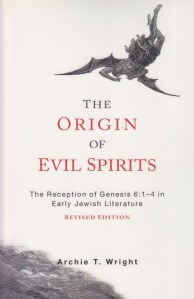
I remember well the eerie, uncanny feeling I had as a child reading Genesis 6.1-4.  This wasn’t a story we heard in Sunday School, and it wasn’t in any children’s Bible or Arch Books.  It was mysterious and strange, and not understanding what sex was made it even weirder.  The sons of God, or perhaps angels, came down from Heaven to mate with human women.  Although not stated directly, their offspring seem to have been giants.  Abruptly the story ends.  Archie T. Wright was clearly fascinated by this story as well.  His book, The Origin of Evil Spirits: The Reception of Genesis 6:1-4 in Early Jewish Literature, isn’t so much about demons as it is about the influence of this very brief, extremely odd story.

As a young person I knew about the book 1 Enoch.  Living in a rural town with no bookstore and no library (there was one in the town three miles away, but I didn’t drive and out-of-towners had to pay for a card), I had no way to read it.  Wright writes quite a bit about it here.  (In case you’re wondering, yes, in subsequent years I did read it.)  His history of transmission is a little suspect, but he explores the impact of these four brief verses on what can perhaps best be described as a diegesis.  This universe includes Watchers (the first part of 1 Enoch is called The Book of the Watchers), archangels, angels, evil spirits, giants, and demons.  Later Judaism moved away from this world, while early Christianity grew fascinated with it.  The mythology that emerged from it is sprawling and quite bizarre.  All encapsulated in a few verses before the flood.

Wright’s book is academic; it’s a revised dissertation.  Still, it’s a source more credible than a lot of what you find on the internet.  This particular biblical episode is an example of what happens when you don’t explain enough.  Granted, the writer likely had no idea that this brief account—shorter than a blog post—would eventually make it into a book that some people would consider from the anthropomorphic mouth of God himself, but because of this brevity questions, like angels, hung in the air.  As Wright shows, these verses were incorporated into ways of explaining the existence of evil in the world.  It was known by many names, and even took on personification in the form of Satan and his ilk.  This is a world of the unexpected, and it readily took me back to a childhood of wonder concerning the inexplicable passages in the Good Book.


Trees and Cities

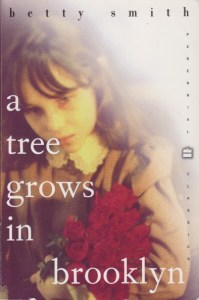
Some years ago I decided I’d read A Tree Grows in Brooklyn.  I had no idea what it was about, but I’d heard cultural references to it over the years.  So I decided to read it.  Then I saw how thick it was.  I confess I shouldn’t do this, but when I sign up for reading challenges, I want to make sure I can finish them.  Books tipping the scales at over 400 pages make me nervous.  Although I work with books, I’m a slow reader, and I panicked when I saw the size of Betty Smith’s ouvre.  All of which is to say that I’ve finally done it.  I’m glad I did, although, as someone who grew up in quite humble circumstances, with an alcoholic father, some of the story hit pretty close to home.

What really stood out, however, was how women and girls were treated in the early part of the last century.  They couldn’t vote.  Full-time work was often difficult for them to find, and when they did it didn’t pay well.  Francie Nolan, however, overcomes this because she’s smart, driven, and literate.  Her reading ultimately rescues her family after her father dies prematurely.  I’m certain there are other messages in this novel.  Other lessons to be learned.  Reading is nevertheless a great takeaway from any book.  As a symbol of its time, Francie learns to read from the Bible and Shakespeare.  These days that combination can get you into trouble.

Perhaps the most disturbing part of the book, for someone who writes instinctively, is that Francie gives up her writing in a deal with God.  When her mother goes into labor and Francie fears she’ll die, she makes a bargain that, strangely, she doesn’t seem to regret too much at the end of the story.  Some of us find writing as natural as breathing or eating.  I can forget to do both when I’m thoroughly into the zone.  I can’t image having that taken from me.  Smith notes that as she reflects on her unholy deal with the Holy One, that she now better understands God.  Indeed, in a kind of Kierkegaardian moment about halfway through she declares she no longer believes in God at all.  Her teacher doesn’t understand her writing.  Ah, but that’s a familiar dilemma to those of us who dare to attempt this craft.  For its size, the book was a fairly smooth read.  It took several weeks, but I learned about myself as a writer, and that makes it worth it.


Wag the Book

I was pulling together a bibliography, you know, like one does, when I realized just how outdated the usual formats are.  Particularly the trinity invoked at the end of Chicago/Turabian—city: publisher, date.  Now, to their credit a number of more recent formats have dispensed with the “city” part.  Most presses have multiple offices and even those of us in the biz can’t always tell which one produced the book, which was, in all probability, printed elsewhere anyway.  Why list the city?  In this internet age, no physical copy of the book may have even been in the office.  The real problem, however, is the date.  Scholars want to know when something was published.  Publishers want to prolong the copyright (seventy years after an author’s death apparently isn’t long enough).  They can do this by using the next year as the copyright, as long as a book’s published in the latter half of the year.

Maybe you’ve had this happen too.  You put a book in your bibliography which, at the time, has a date a year later than it is in real-time.  You’re writing the future, apparently.  Or maybe publishers are just optimistic.  The fact is it’s a fiction.  Citations were invented so that you could find where an idea originated.  Dates can be important for a book that’s gone into multiple editions and you want to be sure to look in the correct one.  I had any illusions about permanency shattered when I realized that publishers routinely fix errors in books with no indication that they’ve done so.  It used to be that, if you knew how to read the printer’s key on the copyright page you could even figure out which printing of a book you held.  All of this fun disappears when we go electronic.

This sense of temporariness is problematic.  People ask me “Why don’t you get a Kindle?”  Books are an investment.  Consider iTunes.  How many times have you had to “rebuy” a song because you changed devices?  Or has your battery died right in the middle of something?  Have you tried to sell an MP3 you no longer listen to in a yard sale?  Books are physical objects—more than the words they contain.  They may be dated before they’re published, but they do have staying power.  Besides, citing an electronic source, what with broken links and all, is a tenuous business.  Those who write books want some indication that what they labor over for so long has a real presence in the world.  Even if you can’t say, precisely, when or where it was published.


Revisiting Mesopotamia

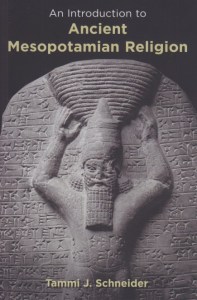
As a refresher on my own ancient history, I picked up Tammi J. Schneider’s An Introduction to Ancient Mesopotamian Religion.  This was one of those books that spawned several internal conversations simultaneously as I realized just how much modern lenses color our perceptions of past societies.  Before commenting on that, however, a few necessary points must be made.  Our knowledge of Mesopotamia is in its infancy.  There are only a handful of universities around the world that have the resources to prepare young Assyriologists adequately.  Once prepared, those young folk will be introduced to the job market of those with far lesser education because there are practically no jobs in the field.  Seems a poor way to treat the civilization that invented wheels, arches, and beer.  Or so I’ve read.  In any case, many tablets in ancient languages have never been translated because there simply aren’t enough people to do it.  Any conclusions, therefore, must remain tentative.

Ancient religion in western Asia was extremely political.  From our perspective, this seems odd—although it’s happening again in real time.  Ancient societies relied on the cooperation of religious and political leaders and each institution helped the other.  They didn’t have the added complication of monotheism to deal with.  In trying to keep all the gods happy, they simply reasoned that if things fell apart, another god had grown to a superior position.  Certainly they believed the gods were there—we do too.  We call them cash, the stock exchange, and commodities, but we still worship and adore.  And they keep the government going.  (I kind of liked it better when they were old-fashioned gods; at least they had sympathy for the human condition.)

After getting to know the gods, Mesopotamians recognized that humans were to do the work for them.  Gods, after all, owned the land and priests and kings were powerful individuals.  You didn’t want to cross them.  Rituals were developed to ensure the smooth continuation of seasons and agriculture.  As Schneider points out, we don’t have enough information to understand all of this.  Our information comes from across millennia and from locations sometimes hundreds of miles apart.  If this is a puzzle well over half the pieces are missing.  We glimpse people like us, trying to survive.  Gods are unpredictable, but you can try to read a liver or two to find out what’s on their minds.  And some of the kings thought they were gods.  The more things change, the more, it seems, they stay the same.


Drowning in Words

One of the features of this blog, which as inclined more lately toward books of all sorts rather than simply religion, is that I only write one post per book read.  There’s no law that says this should (or must) be the case, but I’ve held myself to that standard for about a decade now, and if I have trouble recalling a book this blog is generally a kickstarter for my memory before hauling myself off to the attic to find the physical copy—long live print!—to do a bit more detailed work.  This method sometimes leads to crises of my own making.  Long books take some time to get through.  And despite the action-packed picture you get of my life from this web log, many long weeks are spent doing work and I can’t really share the details here.  And so it goes.

Like many people I read multiple books at a time.  Although I have a kind of general plan, the actual books being read at any one time often depend on my ability to lay my hands on a copy.  And since I’m in the final stages of Nightmares with the Bible, I tend to prioritize books I really should read in whole for that tome.  I also read (and write) fiction.  Normally I reserve my fiction for bedtime reading; it’s more pleasant to prepare for sleep with an engaging story that I know isn’t factual enough to haunt me.  Sometimes the fiction is a long book too.  Two lengthy books going simultaneously feels like trying to pass a truck going uphill.  Or swimming underwater.  The insistence of the necessity of taking a breath (writing a blog post on a book) strains against me as I look up and see the surface still some distance away.  Drowning in words, however, isn’t that bad.

As I confessed to a friend the other day, I am a graphomaniac.  I write incessantly.  To do that it helps to read incessantly.  At any one time I’ve got several books going, and I’ll let you know when I reach the end of any of them.  This is, I suppose, the bookish life.  Ironically I read more now than when I was a professor.  Those days were filled with lesson prep, teaching, and reading student papers.  Grading tests.  Fulfilling administrative duties.  On the days when I feel like lamenting my lack of time (and those are most days) I need to remind myself that a great deal more of my effort is now spent with books than it used to be.  You’ll have to trust me on that since I don’t always get to write about reading until the long books are done.  And that’s okay by me.