Let It Lie

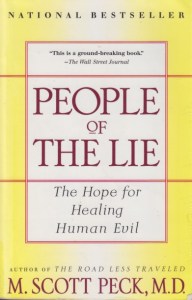
At the grave risk of over-simplifying, the list is brief: destructive scapegoating behavior, intolerance of criticism, concern with public image, and deviousness.  These characteristics, back in 1983 (note well the next year), were widely considered the description of evil.  Now look at the White House.  What do you see?  I know that I’m reading into the current situation, but how can one not?  I have never read anything by M. Scott Peck before.  Growing up I saw The Road Less Traveled on many, many bookshelves of friends and clergy.  I recently picked up Peck’s People of the Lie because, along with Malachi Martin’s Hostage to the Devil, it convinced many in my generation that demons actually exist.  At the time, still pretty much a Fundamentalist, I didn’t require any convincing.  Reading Peck’s People, however, in the era of Trump is a frightening thing.  And not just for the politics.

I always find books by psychologists and psychiatrists difficult to read.  I admit to having had a less-than-ideal childhood, and although self-healing is possible such books make me think I should spend my free time in therapy rather than writing.  In any case, People of the Lie is difficult in another respect as well—the labeling of evil.  Peck advocated for the scientific study of evil.  Good and evil, however, have generally been considered values rather than facts.  Science studies the latter while religion and philosophy deal with the former.  Not that lines in the sand are intended to be permanent.  Still, what one person calls evil may not be what others call evil.  Peck focuses primarily on narcissism and laziness as sources of evil.  He may very well be right, especially with the narcissism aspect, but some of the patients he described certainly didn’t seem evil to me.

Many aspects of this book could be discussed on a blog like this.  No doubt many of them will be, in sublimated form, in future posts.  Books, however, are part of the context in which they’re read.  In Peck’s day, the great political evil still fresh in many minds was the Vietnam War.  Today’s world, however, is one where Vietnam, Watergate, and even to a great extent the tragi-comedy of the W administration have all been eclipsed.  The cult of personality headed by one of the most obviously narcissistic individuals this nation has produced makes what Peck labeled “evil” seem perfectly normal.  And those who have the authority to do something about it either sit idly by, or worse, use it for their own means.  Roads less traveled indeed.


Identified or Not

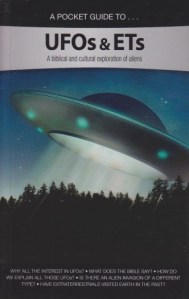
Okay, so this will require some explanation.  It came about like this: I was in a used bookstore.  (This in itself requires no explanation, of course.)  I noticed a slim book, cover out, called A Pocket Guide to UFO’s and ETs: A biblical and cultural exploration of aliens.  Biblical?  I picked it up only to discover it was from Answers in Genesis.  Please note: I do not buy books or paraphernalia of Fundamentalist groups unless I can get it used.  I don’t want to support this particular weirdness in any way.  Well, the money for this used book was going to support a used bookstore and not a religious aberration, so I figured it would be good to see what the Fundies have to say about a topic that seems to have started to engage public interest again.

The book begins by helpfully pointing out that if there’s life on other planets the Bible doesn’t mention it.  And since the only way it could’ve got there is by evolution—for surely the Almighty would’ve said something about it in his book, if he’d invented it—the whole idea is a non-starter.  Evolution, as everyone knows, is a satanic idea meant primarily to challenge the Bible and secondarily explain the diversity of life forms on earth.  And since earth is the only planet the Bible recognizes, it is the only one with life.  So, UFOs, it stands to reason don’t exist.  Well, that’s not quite fair.  They do exist but most can be explained away and those that can’t may well be demonic.  Since there can be no aliens, and since some sightings can’t be otherwise explained, then demons—which the Bible does mention—must be responsible.  They (demons) can also explain why other world religions exist.

There’s plenty in here to offend just about everyone apart from the Answers in Genesis crowd.  The screed spends quite a bit of time knocking down ancient astronaut ideas, and taking Erich von Däniken to task.  Science is useful in explaining how pyramids were built, but not in how the rock used to build them was formed (it takes far too long to make limestone the old fashioned way; God simply used a variety of different rock types to make the one inhabited planet more interesting geologically).  And those UFO religions?  Inspired by demons, no doubt.  In fact, even reading a little book like this could lead you to become interested in the subject, so be careful!  In fact, the safest thing of all (and I’ve only got your well-being in mind) is to leave it on the shelf.


Premature Burial

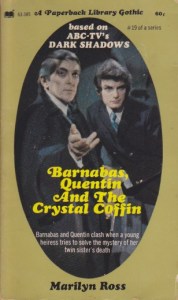
I have recently finished writing an article for a collection of essays on the Bible and horror.  Have no fear—I’ll pass along details once it’s published.  I do have to wonder, though.  All those years I was teaching and publishing regularly in ancient Near Eastern studies nobody ever approached me about contributing.  It took coming out of my monster closet for that to happen.  Monsters, you see, are a guilty pleasure topic.  They’re so much fun that they hardly seem like work to write about.  Or read about.  I was a child when Dark Shadows aired as a daily soap opera on ABC.  For reasons about which I’m beginning to speculate I found this series strangely compelling.  Marilyn Ross (W. E. D. [William Edward Daniel] Ross) based some 32 of his over 300 novels on the series.  I collected them as a kid and then got rid of them when I went to college.  I’ve been collecting them again in a fit of nostalgia over the past several years.

I just finished Barnabas, Quentin, and the Crystal Coffin.  The story was actually quite different than typical Collinwood fare.  What drew me to these novels as a child was their atmosphere and, if I’m honest, the fact that Barnabas was a vampire.  Memories of youth are fleeting things at my age, but it may be that Barnabas Collins was my introduction to vampires.  I was four when the series first aired, and I’m not sure if I discovered it before I came across Dracula or if it was the other way round.  Dracula, once I was experienced enough to have an opinion on such things, was my favorite monster.  I liked the others as well, but he was rich and immortal—the things sickly kids in poverty idealize.

In my fascination with Dark Shadows I’m not alone.  Despite Tim Burton’s movie version, Johnny Depp (who is my age) admitted growing up wanting to be Barnabas Collins.  Friends about my age have discovered PBS’s recent re-release of the original series in all its campy glory.  For whatever reason, however, it is the books that always draw me back in.  They, for me, defined the Gothic novel.  Ross’s writing is formulaic and predictable.  His adjective choices feel forced and subtleness was never his strong point.  Still I can’t stop myself from occasionally dropping into the world he manages to recreate in the woods of Maine.  Afterwards I move on to more profound writing, but then, his work is the very definition of a guilty pleasure.


Adversaries

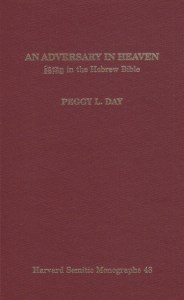
Satan isn’t who we think he is.  Inheriting a tradition from across centuries, it can be easily supposed that modern ideas help to explain the reality of that tradition.  Sorry, let me try this with more specificity.  The character of “Satan” does not occur in the Hebrew Bible.  By the time of the Gospels, however, he’s there.  We tend to use modern ideas of Satan to understand the enigmatic person of “the satan” in the Hebrew Bible.  Peggy L. Day explored this idea decades ago in her revised Harvard dissertation, An Adversary in Heaven: śāṭān in the Hebrew Bible.  Reading this took me back to those heady days when I consumed Harvard Semitic Monographs like breakfast cereal.  To those of us not from Harvard we pretty much knew what to expect, but we read anyway.  Scholars are like that.

In any case, Day here explores what is sometimes surprising to those who read the Devil back into the Hebrew Bible: the satan is mentioned in only four passages and in none of them is he “Satan.”  In Numbers the satan is identified as a good angel sent to knock Balaam off his ass.  In the book of Job the satan is a member of the divine council and he does his job by accusing Job.  Day shows, by the way, that his accusation is really against God and not the mere human sufferer.  Her outlook on Job is still amazing after all these years.  After Job, the satan appears in the short book of Zechariah to accuse Joshua the high priest of the restoration era.  He’s no Devil here either.  The final reference comes in Chronicles where instead of God tempting David to take a census a satan does.  By this time the reader already knows a satan is an accuser and need not be superhuman.

This monograph raises the perennial issue of how to understand ancient texts without chaffing under the weight of tradition.  The character of the Devil developed over many centuries and, when he appeared, he was only one of many iterations.  The New Testament made Satan “biblical” and later readers tried to explain the Devil (who came from Zoroastrian mythology) as part of the Christian divine economy.  In Judaism he went on to play a much lesser role.  Once Christian writers established this character, he was read back into the Bible, even where the original writers didn’t see him.  Day isn’t the first to have noticed this, but she handles it very well and her book is still thought-provoking after all these years.


Evil Origins

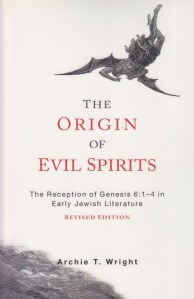
I remember well the eerie, uncanny feeling I had as a child reading Genesis 6.1-4.  This wasn’t a story we heard in Sunday School, and it wasn’t in any children’s Bible or Arch Books.  It was mysterious and strange, and not understanding what sex was made it even weirder.  The sons of God, or perhaps angels, came down from Heaven to mate with human women.  Although not stated directly, their offspring seem to have been giants.  Abruptly the story ends.  Archie T. Wright was clearly fascinated by this story as well.  His book, The Origin of Evil Spirits: The Reception of Genesis 6:1-4 in Early Jewish Literature, isn’t so much about demons as it is about the influence of this very brief, extremely odd story.

As a young person I knew about the book 1 Enoch.  Living in a rural town with no bookstore and no library (there was one in the town three miles away, but I didn’t drive and out-of-towners had to pay for a card), I had no way to read it.  Wright writes quite a bit about it here.  (In case you’re wondering, yes, in subsequent years I did read it.)  His history of transmission is a little suspect, but he explores the impact of these four brief verses on what can perhaps best be described as a diegesis.  This universe includes Watchers (the first part of 1 Enoch is called The Book of the Watchers), archangels, angels, evil spirits, giants, and demons.  Later Judaism moved away from this world, while early Christianity grew fascinated with it.  The mythology that emerged from it is sprawling and quite bizarre.  All encapsulated in a few verses before the flood.

Wright’s book is academic; it’s a revised dissertation.  Still, it’s a source more credible than a lot of what you find on the internet.  This particular biblical episode is an example of what happens when you don’t explain enough.  Granted, the writer likely had no idea that this brief account—shorter than a blog post—would eventually make it into a book that some people would consider from the anthropomorphic mouth of God himself, but because of this brevity questions, like angels, hung in the air.  As Wright shows, these verses were incorporated into ways of explaining the existence of evil in the world.  It was known by many names, and even took on personification in the form of Satan and his ilk.  This is a world of the unexpected, and it readily took me back to a childhood of wonder concerning the inexplicable passages in the Good Book.


Trees and Cities

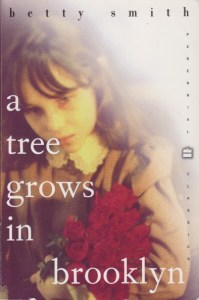
Some years ago I decided I’d read A Tree Grows in Brooklyn.  I had no idea what it was about, but I’d heard cultural references to it over the years.  So I decided to read it.  Then I saw how thick it was.  I confess I shouldn’t do this, but when I sign up for reading challenges, I want to make sure I can finish them.  Books tipping the scales at over 400 pages make me nervous.  Although I work with books, I’m a slow reader, and I panicked when I saw the size of Betty Smith’s ouvre.  All of which is to say that I’ve finally done it.  I’m glad I did, although, as someone who grew up in quite humble circumstances, with an alcoholic father, some of the story hit pretty close to home.

What really stood out, however, was how women and girls were treated in the early part of the last century.  They couldn’t vote.  Full-time work was often difficult for them to find, and when they did it didn’t pay well.  Francie Nolan, however, overcomes this because she’s smart, driven, and literate.  Her reading ultimately rescues her family after her father dies prematurely.  I’m certain there are other messages in this novel.  Other lessons to be learned.  Reading is nevertheless a great takeaway from any book.  As a symbol of its time, Francie learns to read from the Bible and Shakespeare.  These days that combination can get you into trouble.

Perhaps the most disturbing part of the book, for someone who writes instinctively, is that Francie gives up her writing in a deal with God.  When her mother goes into labor and Francie fears she’ll die, she makes a bargain that, strangely, she doesn’t seem to regret too much at the end of the story.  Some of us find writing as natural as breathing or eating.  I can forget to do both when I’m thoroughly into the zone.  I can’t image having that taken from me.  Smith notes that as she reflects on her unholy deal with the Holy One, that she now better understands God.  Indeed, in a kind of Kierkegaardian moment about halfway through she declares she no longer believes in God at all.  Her teacher doesn’t understand her writing.  Ah, but that’s a familiar dilemma to those of us who dare to attempt this craft.  For its size, the book was a fairly smooth read.  It took several weeks, but I learned about myself as a writer, and that makes it worth it.


Wag the Book

I was pulling together a bibliography, you know, like one does, when I realized just how outdated the usual formats are.  Particularly the trinity invoked at the end of Chicago/Turabian—city: publisher, date.  Now, to their credit a number of more recent formats have dispensed with the “city” part.  Most presses have multiple offices and even those of us in the biz can’t always tell which one produced the book, which was, in all probability, printed elsewhere anyway.  Why list the city?  In this internet age, no physical copy of the book may have even been in the office.  The real problem, however, is the date.  Scholars want to know when something was published.  Publishers want to prolong the copyright (seventy years after an author’s death apparently isn’t long enough).  They can do this by using the next year as the copyright, as long as a book’s published in the latter half of the year.

Maybe you’ve had this happen too.  You put a book in your bibliography which, at the time, has a date a year later than it is in real-time.  You’re writing the future, apparently.  Or maybe publishers are just optimistic.  The fact is it’s a fiction.  Citations were invented so that you could find where an idea originated.  Dates can be important for a book that’s gone into multiple editions and you want to be sure to look in the correct one.  I had any illusions about permanency shattered when I realized that publishers routinely fix errors in books with no indication that they’ve done so.  It used to be that, if you knew how to read the printer’s key on the copyright page you could even figure out which printing of a book you held.  All of this fun disappears when we go electronic.

This sense of temporariness is problematic.  People ask me “Why don’t you get a Kindle?”  Books are an investment.  Consider iTunes.  How many times have you had to “rebuy” a song because you changed devices?  Or has your battery died right in the middle of something?  Have you tried to sell an MP3 you no longer listen to in a yard sale?  Books are physical objects—more than the words they contain.  They may be dated before they’re published, but they do have staying power.  Besides, citing an electronic source, what with broken links and all, is a tenuous business.  Those who write books want some indication that what they labor over for so long has a real presence in the world.  Even if you can’t say, precisely, when or where it was published.


Revisiting Mesopotamia

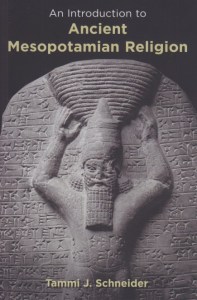
As a refresher on my own ancient history, I picked up Tammi J. Schneider’s An Introduction to Ancient Mesopotamian Religion.  This was one of those books that spawned several internal conversations simultaneously as I realized just how much modern lenses color our perceptions of past societies.  Before commenting on that, however, a few necessary points must be made.  Our knowledge of Mesopotamia is in its infancy.  There are only a handful of universities around the world that have the resources to prepare young Assyriologists adequately.  Once prepared, those young folk will be introduced to the job market of those with far lesser education because there are practically no jobs in the field.  Seems a poor way to treat the civilization that invented wheels, arches, and beer.  Or so I’ve read.  In any case, many tablets in ancient languages have never been translated because there simply aren’t enough people to do it.  Any conclusions, therefore, must remain tentative.

Ancient religion in western Asia was extremely political.  From our perspective, this seems odd—although it’s happening again in real time.  Ancient societies relied on the cooperation of religious and political leaders and each institution helped the other.  They didn’t have the added complication of monotheism to deal with.  In trying to keep all the gods happy, they simply reasoned that if things fell apart, another god had grown to a superior position.  Certainly they believed the gods were there—we do too.  We call them cash, the stock exchange, and commodities, but we still worship and adore.  And they keep the government going.  (I kind of liked it better when they were old-fashioned gods; at least they had sympathy for the human condition.)

After getting to know the gods, Mesopotamians recognized that humans were to do the work for them.  Gods, after all, owned the land and priests and kings were powerful individuals.  You didn’t want to cross them.  Rituals were developed to ensure the smooth continuation of seasons and agriculture.  As Schneider points out, we don’t have enough information to understand all of this.  Our information comes from across millennia and from locations sometimes hundreds of miles apart.  If this is a puzzle well over half the pieces are missing.  We glimpse people like us, trying to survive.  Gods are unpredictable, but you can try to read a liver or two to find out what’s on their minds.  And some of the kings thought they were gods.  The more things change, the more, it seems, they stay the same.


Drowning in Words

One of the features of this blog, which as inclined more lately toward books of all sorts rather than simply religion, is that I only write one post per book read.  There’s no law that says this should (or must) be the case, but I’ve held myself to that standard for about a decade now, and if I have trouble recalling a book this blog is generally a kickstarter for my memory before hauling myself off to the attic to find the physical copy—long live print!—to do a bit more detailed work.  This method sometimes leads to crises of my own making.  Long books take some time to get through.  And despite the action-packed picture you get of my life from this web log, many long weeks are spent doing work and I can’t really share the details here.  And so it goes.

Like many people I read multiple books at a time.  Although I have a kind of general plan, the actual books being read at any one time often depend on my ability to lay my hands on a copy.  And since I’m in the final stages of Nightmares with the Bible, I tend to prioritize books I really should read in whole for that tome.  I also read (and write) fiction.  Normally I reserve my fiction for bedtime reading; it’s more pleasant to prepare for sleep with an engaging story that I know isn’t factual enough to haunt me.  Sometimes the fiction is a long book too.  Two lengthy books going simultaneously feels like trying to pass a truck going uphill.  Or swimming underwater.  The insistence of the necessity of taking a breath (writing a blog post on a book) strains against me as I look up and see the surface still some distance away.  Drowning in words, however, isn’t that bad.

As I confessed to a friend the other day, I am a graphomaniac.  I write incessantly.  To do that it helps to read incessantly.  At any one time I’ve got several books going, and I’ll let you know when I reach the end of any of them.  This is, I suppose, the bookish life.  Ironically I read more now than when I was a professor.  Those days were filled with lesson prep, teaching, and reading student papers.  Grading tests.  Fulfilling administrative duties.  On the days when I feel like lamenting my lack of time (and those are most days) I need to remind myself that a great deal more of my effort is now spent with books than it used to be.  You’ll have to trust me on that since I don’t always get to write about reading until the long books are done.  And that’s okay by me.


Price of Learning

Holy Horror, as some are painfully aware, is priced at $45.  Even those of us in publishing have lessons we must learn, and one of them is that writing a trade book involves more than just a “friendly narrator” style and non-technical language.  It also involves a subject the public finds engaging (or at least what a literary agent thinks the public will find engaging).  Holy Horror throws two apparently disparate topics together: horror films and the Bible.  The fans of each don’t hang out in the same bars—the fans of the latter, in some circles, don’t go anywhere near bars!  My thinking was that this juxtaposition was odd enough to qualify as trade, but I also knew that you have to work your way up to that kind of readership.  That’s why I’m on Goodreads, Twitter, and Facebook (followers and friends welcome!).  It’s not like I’ve got tons of spare time, but platforms must be built.

Book publishers face a dilemma: they have to sell books, but as I’ve noted before, they must do so profitably.  There are people like yours truly who’ll occasionally pay essentially a dollar a page (or at least a two-page spread) for a book that’s essential to their work.  As the capitalists grin, it’s “what the market will bear.”  I never thought of myself as a market.  To me, knowledge is priceless.  The effort that it takes to write a book is truly unimaginable to those who haven’t done it.  Obstacles exist almost from the inception.  Getting the resources you need, unless your employment comes with a free library pass, involves sacrifice.  I still look at other books I must read priced at about $45 and groan—how can I justify the expense?  It’s a strange club to which to belong.

My mother asked about Weathering the Psalms: “Is it the kind of book you get money for?”  In theory, yes.  I’ve yet to see any kind of profit from it since the tax forms you need to file for royalties cost more than the actual checks contain.  At least it’s not vanity publishing.  And you truly learn what it means to rob Peter to pay Paul.  It has nothing to do with gentiles.  Publishing is the price you pay for following your curiosity.  My books are very different from each other, a fact that comes with an invisible price tag that has little to do with money exchanging hands.  Well, maybe it does.  And maybe it does have something to do with gentiles.  Or maybe it’s an appeal to a higher power.  In a capitalist nation we all know what that is; herein lies holy horror.


The Heart of Publishing

My heart goes out to academic authors.  It really does.  They labor over a book important to their field and see it come out costing near triple digits and wonder why it’s not in the local bookstore.  There is, however, a very wide gap between academic and trade publishing.  It is bridged here and there by authors who value readers over reputation, but unless you deliberately try to learn how all of this works, it is bewildering.  Academics, you see, are area specialists by and large.  You don’t write a dissertation on the Bible, for example, but on a specific part of the Bible (New Testament or Hebrew Bible).  And within that section your specialization is not a single book, but often a small part of a book, or a theme.  I’ve seen dissertations written on a single Hebrew word.  Specialization.

With all of this tight focus, it’s easy to forget what browsing in a bookstore’s like.  Even with some of the incredible brick and mortar stores in Edinburgh, technical books had to be ordered—this was before Amazon.  When you check the books of colleagues out of libraries it doesn’t always occur that you do this because libraries are the only places that buy such books.  And with the explosion of doctoral degrees in shrinking areas of studies (there are no jobs here, folks!) the number of published dissertations has skyrocketed.  Even advanced scholars forget the average reading public would find their work impenetrable.  It’s not going to be in the local bookstore, and it costs so much because it sells so few copies.  I do feel for academic authors.

In addition to all the area specialization, it would make sense to research the academic publishing industry.  Yes, it is an industry—it has to try to turn a profit when sales are minimal.  And with so many books being published, libraries can’t keep up.  The end result is high prices.  I’m as guilty as the next academic at wishing economics would just go away and leave me alone.  I want to believe in the pursuit of knowledge for knowledge’s sake.   That’s not the way the world works, however.  At least not the publishing world in a capitalistic context.  The internet itself has become competition.  Much of the information’s out there for free.  So your academic book, when it comes out, will be priced out of your comfort range (been there, done that).  It’s not that your publisher doesn’t believe in you, but that they have to try to turn a profit.  All it takes to understand why is a bit of research.

Not that kind of book.


Digging Bad?

Academics, as a rule, focus on books by other academics.  Theirs is a specialized vocabulary with specific goals (tenure, then an Ivy League position).  It’s easy to see, sometimes, why they distrust books by those of us outside the academy.  We aren’t as constrained, and can say some speculative stuff.  I just finished Evil Archaeology: Demons, Possessions, and Sinister Relics, by Heather Lynn.  Now, most academics I know won’t take seriously a book where the author is cited by “Ph.D.” on the cover.  That’s a sure sign of trying to impress a lay readership.  This book is clearly heartfelt, and personal, but it does raise a host of questions regarding sources and details. I found myself wondering where the author found out so much about Pazuzu when I, who hold a doctorate in ancient West Asian studies, had such trouble locating sources.  Then I checked the bibliography.

Even academics have been known to cut a corner or two, now and then.  For my last book I didn’t have access to a university library so I had to make do with what I could get my hands on.  (JSTOR is not cheap for individuals, in case you’re wondering.  If you teach and you get free access from your library, you don’t know how lucky you are!)  So it is with my present research.  I muddle along, often buying used copies of the books I need, sometimes from eBay.  Researchers can be driven that way.  Lynn’s book covers a lot of territory, and not all of it seems related to demons.  Little of it covers archaeology in any detail.  But then, it’s not intended for academic readers.  I learned a thing or two.  I also distrust a thing or two she claim (having once been in the academy), but there’s no doubt she’s trying to do a service in this book.

Demons cut a wide swath.  Lynn discusses bits and pieces from here and there, and at times her treatment is rather a gallimaufry of anecdotes.  There are interviews, personal experiences, and urban legends.  It does seem hard to believe that scientists worldwide are studying demons in order to explain illnesses, though.  For me, finding a new book on demons just when I was finishing my draft on the same topic, it was imperative to read what she had to say.  It’s clear she’s seen some of the same movies I have.  I like to think that, as an inbetweener I can still read academese as well as regular writing.  You always find interesting things there in the middle.


A Nightmare or Two

Some books are complex enough to require a slow reading.  Alan E. Bernstein’s The Formation of Hell: Death and Retribution in the Ancient and Early Christian Worlds is such a book.  For those of us raised in a faith primarily geared toward avoiding Hell, the concept becomes a lifelong nightmare.  It doesn’t help that, depending on your clergy you’re taught different, sure-fire ways of achieving that avoidance.  Often it hinges on “believing” the “right” thing.  Fundamentalists tend not to call it “doctrine” since that sounds rather Catholic, but the idea’s the same; it’s a tenet of faith.  As Bernstein shows, however, Hell is an idea that developed over a very long time with several different views of what happens after death.  There’s no single, linear progression, but rather a conglomeration of ideas from a variety of sources.

No single volume can cover all the background to Hell.  Bernstein focuses on Egypt for the early material, as well as Babylonia.  These early civilizations demonstrate that people have always wondered what comes next, and what happens to those who oppress others—the bullies of this life who don’t deserve the same eternal rest as the rest.  Usually some form of punishment awaits, but not always.  In the Hebrew Bible one of the great issues was the fact that everyone goes to Sheol, good and bad alike.  As in classical Greece and Rome (on which Bernstein spends a great number of pages) the concept of the netherworld is gloomy, but not torture.  Except in exceptional cases, of course.  The Greeks had Tartarus as a place for those who dissed the divine.

Even early Christianity didn’t have a uniform view of it.  The New Testament is decidedly divided on the topic.  Revelation seems to be the last word, but it’s not.  Later thinkers such as Origen and Augustine (who came to different conclusions) weighed in.  Catholic Christianity lavished great love on the latter and Augustinian views became disproportionately influential.  Reading his lack of compassion can cause nightmares, although he justifies it theologically.  The one thing I missed in Bernstein’s lengthy treatment was the Zoroastrians.  This religion of ancient Persia introduced a distinct dualism into the biblical world; it perhaps represents the first relatively developed concepts of Hell and Heaven.  Zoroastrianism suffers from lack of documentation, however, and it is difficult to parse it as meticulously as Bernstein does the other cultures covered.  This book requires much pondering as it’s read, and if you were raised believing this kind of thing it’s sure to bring back a nightmare or two.


On Publishing

I fear I may be transitioning.  I may actually be becoming someone who knows something about publishing.  Reading about the merger between Cengage and McGraw Hill actually seemed interesting.  What’s happening to me?  Actually, the largest impact has been the realization that scholars need to become more aware of the world around them.  As a doctoral student I was taught to find an unexplored subject and write obscurely on it.  Then, when it’s time to publish, to say to the editor that general readers will understand and find it compelling.  It took some time, however, even though I frequented Waterstones and Blackwells, to realize that the books they housed were not the kinds of books I’d been taught to write.  Back in America, where the brands were Borders and Barnes and Nobel, the same thing applied.  People want books they can understand.

Two articles that caught my attention recently addressed the plight of the academic monograph.  One was “Worried About the Future of the Monograph? So Are Publishers” from the Chronicle of Higher Education.  The other was “Making Monographs Open” from Inside Higher Ed.  Both share some common themes: scholars write books so obscure that even academic libraries won’t buy them and since it’s “publish or perish” it becomes the publisher’s problem.  Listen, I understand that mentality.  Isolated in the woods of Wisconsin with the wind howling through the trees, writing about weather in the Psalms seemed perfectly natural.  Forgetting that the average reader doesn’t know Hebrew, I assumed everyone would find my disquisition irresistible.  Even back in the early 2000s publishers disagreed.  Life is so interesting!  There are so many minutiae to explore!  If you haven’t had the pleasure of following in the tracks of a thought that won’t let you go, you’ve never been really seduced.  But then, somebody’s got to pay for all this.

Scholars are reluctant to acknowledge that publishing is a business.  Indeed, higher education is now a business as well.  Everything’s a business.  To stay solvent publishers have to sell enough books to cover the cost of making them.  As these articles point out, that cost isn’t negligible.  The scholar who explores the publishing industry (as rare as that may be) will discover plenty of resources to help rethink academic writing.  Even without reading the industry rags, just paying attention when you’re in your neighborhood bookstore can be an eye-opening experience.  I was looking for a book (hardly even academic) last time I was in Ithaca, New York.  If any town is likely to have such books on the shelf, it’s Ithaca.  I had to ask and leave empty-handed.  There are lots of books out there, colleagues!  And if you want to get yours published, it pays to do a little research.  Your time will not be wasted.  And I fear I’m becoming someone who knows a little about such things.


Writing Life

Writers are a conservative lot, in many respects.  Consider the epigraph.  I’ve written about this before—in modern-day publishing epigraphs require permission to reuse and serve little purpose beyond two negotiable factors: to prove the writer is well-read, and that someone else just summed up your chapter in a single sentence.  Most modern books have stopped using epigraphs, but scholars read old books produced before aggressive copyright laws.  There is a trick you can use, however, that brings an epigraph into the realm of the fair use doctrine.  It involves moving it into the body of your chapter.  Make it a quote.  Comment upon it.  For all their research skills, many academics do not take advantage of easily found advice on academic publishing.  Just ask an editor.

We all, I’m sure, have tunnel-vision.  Life is so incredibly busy and demanding that choices have to be made.  For most academics publishing is part of the rubric for tenure.  Perishing is the only other option.  Been there.  Done that.  Those of us who make a more modest living on the other side of the book sometimes write for different reasons.  We may need to supplement our income (as if academic publishing really ever helps with that!), and thus we must pay attention to the finer details of the business.  Write what people want to read.  Think like a reader.  And, yes, get rid of the epigraphs.  We know you’re smart; you’ve written a book.  Another reason for writing beyond the tenure-dome is the compulsion.  The need to do it.

While the struggling artist is a tired trope, it’s also true.  Many of the writers most admired today had lifetimes of struggle and obstacles which often stopped them too soon in life’s tracks.  I often think of the Brontë sisters.  In a family apparently cursed with premature death, living in a time when women writers were rare, three sisters set themselves the task of becoming novelists.  Not one of them lived to forty.  Anne, who wrote The Tenant of Wildfell Hall, made it to twenty-nine.  Emily, author of Wuthering Heights, died at thirty.  Charlotte, who gave the world Jane Eyre, survived to thirty-nine.  They defined, in many ways, the English novel.  And while they lived to see some measure of success in their brief lives, they wrote against the obstacles of life and the specter of early death.  Writing is a passion.  A craft.  And even academic authors provide a favor to the world if they do it well.

Brontë sisters by brother Branwell