Gothic Novelties

I’m a sucker for a good gothic novel.  Dilapidated houses on the moors, suggestions of ghosts, the kind of encompassing darkness that enfolds you.  Women facing a man’s world just as Victoria took to the throne.  Hints of the supernatural.  So when offered a review copy of Kate Cherrell’s Begotten, I jumped at the chance.  Gothic it is, that I’ll give you that.  Perhaps I’m getting more discriminating in my tastes, but the classics are hard to beat.  I’m particularly fond of Jane Eyre and Wuthering HeightsBegotten’s not up to that level, of course, but I found the pacing slow and the narrator difficult to sympathize with. It has the kind of ending that sets me off, as I’ve written about before. (No spoilers here!)   Given that I’ve never succeeded in having a novel published (not for not trying), I am impressed.  

Novel writing is difficult.  Let me qualify that—good novel writing is difficult.  It’s more than simply stringing a story out over two-hundred-plus pages.  There are so many things to keep in mind.  That element you introduced on page 50—was it necessary?  Does it show up again in some significant way?  Secondary or tertiary characters that you introduced; will readers wonder about them after they depart the story?  Have you given them too much emphasis and therefore you need to provide them with a proper send off?  Do the characters sound like they fit in the time-frame you’ve chosen into which to set the story?  The history element is crucial for me.  A book set in the early nineties that has characters using the world-wide-web is suspect.  Or in the case of a gothic story, did Victorians express themselves that way?

I’m struggling writing my current novel.  I’ve completed seven others, some of which have hung together better.  A wise man once told me that to write a novel you should write 100,000 words and throw them away.  Or maybe it was 200,000.  Or five.  In any case, I passed that benchmark decades ago.  The novels I think worth publishing are those I’ve gone over a few times, polishing and editing as I go.  Maybe someday they’ll be ready to face the blue pencil, but until then I keep working at them, making them as worthy of a reader’s time as possible.  Not all writers do this kind of intensive revision.  Tales with unreliable narrators are often very hard to pull off convincingly.  But I know what it’s like to have a story living inside you bursting to be spilled on paper.  And if it’s gothic, that can cover a host of sins.


Scholars and Villains

Having read M. L. Rio’s novella Graveyard Shift, I turned to her debut novel, If We Were Villains.  It must be a heady feeling having your first novel become a bestseller, but reading it confirms why.  Rio came to my attention because of dark academia.  This novel is written as realism, so there’s really no speculative material.  At least not directly.  It’s the story of seven friends at the Dellecher Classical Conservatory.  They are the fourth-year students majoring in acting and they are essentially a Shakespearean troupe.  Dellecher only puts on Shakespeare plays, so much of the story is built on the Bard.  There may be some plot give-aways below, and I think this is a book you might want to read—so be advised.  I’ve continued to read Shakespeare beyond high school, mostly sticking to his better-known plays, so this was enjoyable to me.

The crisis begins when the largest and strongest member of the troupe—the leading man—becomes offended by not getting assigned the role he feels entitled to.  He begins acting out against his classmates, bullying them onstage so they can’t call out his bad behavior.  To make things more interesting, one of the troupe is his girlfriend and another of the women is his cousin.  Since they all value what they do so much, and it’s their last year, nobody wants to challenge him.  Until it gets out of hand.  Although Dellecher is exclusive, there’s quite a lot of partying that takes place.  Drinking and drugs seem freely available.  One night when the leading man is drunk, he takes out his hostility on his troupe-mates but is found nearly dead in the lake by dawn’s first light.  And then things start to spiral.

Dark academia is a genre that explores the dark part of higher education (and sometimes secondary education).  I think that most people, even if they enjoyed college (as I did) saw there were tenebrous aspects to it.  This particular genre focuses on those negatives, but not to the exclusion of the very real draw of continued learning.  Since college is when many people receive their first taste of independence, and what passes for adulthood, many emotions come to the fore.  Love, jealousy, fear, and passion among them.  These are powerful motivators and much of our lives are spent learning to control them so that we can live together as a productive society.  This novel, like much dark academia, lingers in those places where unresolved emotions and unchecked bullying collide.  All with a Shakespearean touch.  Classic.


Making More Monsters

It’s endlessly frustrating, being a big picture thinker.  This runs in families, so there may be something genetic about it.  Those who say, “Let’s step back a minute and think about this” are considered drags on progress (from both left and right), but would, perhaps, help avoid disaster.  In my working life of nearly half-a-century I’ve never had an employer who appreciated this.  That’s because small-picture thinkers often control the wealth and therefore have greater influence.  They can do what they want, consequences be damned.  These thoughts came to me reading Martin Tropp’s Mary Shelley’s Monster: The Story of Frankenstein.  I picked this up at a book sale once upon a time and reading it, have discovered that he was doing what I’m trying with “The Legend of Sleepy Hollow” in my most recent book.  Tropp traces some of the history and characters, but then the afterlives of Frankenstein’s monster.  (He had a publisher with more influence, so his book will be more widely known.)

This book, although dated, has a great deal of insight into the story of Frankenstein and his creature.  But also, insight into Mary Shelley.  Her tale has an organic connection to its creator as well.  Tropp quite frequently points out the warning of those who have more confidence than real intelligence, and how they forge ahead even when they know failure can have catastrophic consequences for all.  I couldn’t help but to think how the current development of AI is the telling of a story we’ve all heard before.  And how those who insist on running for office to stoke their egos also play into this same sad tale.  Perhaps a bit too Freudian for some, Tropp nevertheless anticipates much of what I’ve read in other books about Frankenstein, written in more recent days.

Some scientists are now at last admitting that there are limits to human knowledge.  (That should’ve been obvious.)  Meanwhile those with the smaller picture in mind forge ahead with AI, not really caring about the very real dangers it poses to a world happily wedded to its screens.  Cozying up to politicians who think only of themselves, well, we need a big picture thinker like Mary Shelley to guide us.  I can’t help but think big picture thinking has something to do with neurodivergence.  Those who think this way recognize, often from childhood, that other people don’t think like they do.  And that, lest they end up like Frankenstein’s monster, hounded to death by angry mobs, it’s better simply to address the smaller picture.  Or at least pretend to.


Belting Beltane

Things have been so busy that I forgot that today is Beltane.  That’s all the more ironic because yesterday I’d been on a panel to address the British Association of Film, Television and Screen Studies special interest group on Horror Studies, about The Wicker Man.  Lest you get the wrong idea, BAFTSS did not approach me to talk about my book (which has largely disappeared, as far as I can tell), but another recent Devil’s Advocate author approached them about having a panel featuring recent titles.  This special interest group has a program called Weekday Night Bites where they gather virtually to have speakers talk about horror.  Yesterday there were seven of us, discussing five books, one of which was The Wicker Man.

The theme of the panel was No Safe Space, about place and space in horror.  This meant I spoke briefly about The Wicker Man as folk horror.  As I told the assembled group, I actually interpret Wicker Man as holiday horror—it’s based on May Day, and I didn’t even think to mention that it was today—instead of folk horror.  One of the the hallmarks of the Devil’s Advocates series is that it tries to approach horror films from unexpected angles.  When I first contacted the editor who started the series at Auteur (who has, unfortunately left), he told me that they didn’t have a Wicker Man volume because everyone was pitching it as folk horror.  He wanted to see a different interpretation.  I’d been writing a book about folk horror and decided to give that a try.  The critics liked it, and thus my book was born.  And here it is, May Day, and I’d forgotten all about it.

There was a reasonably sized group present for the discussion and it was a lot of fun.  It reminded me of my Miskatonic Institute for Horror Studies course on Sleepy Hollow two years ago.  Both of these were efforts to stir some interest in my books.  Horror and religion is a new avenue of approach and there are a handful of us working in this area.  The others, it seems, have a knack for getting their books published in places where you don’t have to take out a mortgage to afford them.  I’m more in the group whose books are relegated to the Summerisle of sales.  Either that, or I’m actually Sergeant Howie, unwittingly flying there to help someone I think is in trouble. Who knows?  Anything’s possible on Beltane. 


New Hope Nightmare

One of my favorite places along the Delaware River is the town of New Hope.  Across the river is the very nice town of Lambertville, New Jersey, but New Hope has a feel to it.  When I learned that a new horror museum had opened there—Nightmare in New Hope—we scrambled to change plans to get there right away.  We went the Saturday before Easter.  We’d planned to spend some time touring the rest of the town as well since it’d been years since we’d done so.  We managed to find parking and, since the museum opens at one, grabbed some lunch and went to Farley’s Bookshop.  Independent Bookstore Day was actually the following weekend, but bookstores need no special occasion.  Farley’s has changed a lot since our last visit.  It’s smaller (as has happened with many indies) and brighter.  I found plenty to like there, but I did miss the darker, dustier feel to the first incarnation of the store I’d known.

We made our way to Nightmare in New Hope.  And waited.  And waited.  Several people passed by, noting that they’d have gone in if it were open.  One of our party messaged the website since telephoning did nothing.  Eventually the owner indicated that he was closed for Easter.  Of all things.  A horror museum, open only on weekends, closed for the first nice weather we’d had on a weekend?  That was the main reason we’d driven an hour to get there.  We found a place with vegan ice cream and fed the ducks on the river.  I was sad that the main objective of the trip, the museum, hadn’t turned out.  And I knew it would be quite some time before we could try again.

My daughter, knowing my tendency to get depressed over such things, suggested we could go to Peddler’s Village instead.  My wife and daughter had visited it before, and so we decided to round out our Saturday trip there.  Peddler’s Village is a set of speciality shops that was born about the same time that I was.  These days there are about 60 shops with items that may or may not be strictly necessary.  Although we’d been to Farley’s, I couldn’t pass up the Lahaska Bookshop, part of the Village.  It was warm that day and we saw maybe only five or six shops.  At least one of them was an independent bookstore.  Not exactly the day we’d planned, but a day spent in and around New Hope is never wasted.  But really, closed for Easter without even putting a notice on the website?

(See updates here and here.)


Playing Sleepy Hollow

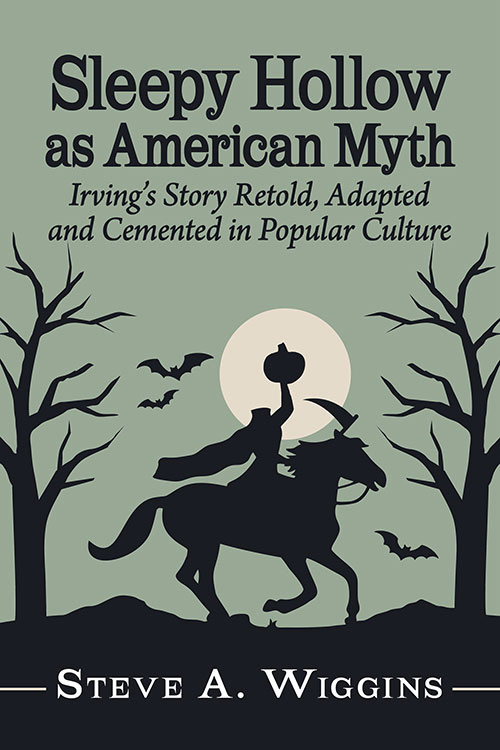
In my teenage years I wrote a short play or two.  I haven’t done it since.  I’ve read plenty over the years but my fiction takes the form of short stories and novels—narrative fiction.  Playwriting, and scriptwriting, take a special talent.  One time-honored way to doing this is to utilize source material.  One of the points that I make in Sleepy Hollow as American Myth is that movies, in particular Tim Burton’s Sleepy Hollow, inspired a number of other movies and even novels, both narrative and graphic.  Others saw the potential this short story could have.  I spend some time in the book going over the various adaptations and the innovations they make.  The point is that “The Legend of Sleepy Hollow” has become an American myth.  Anyone who examines its long history can see the impact that it has had on the American imagination.  And on Halloween. 

Christofer Cook’s The Legend of Sleepy Hollow is a two-act play, adapted from Washington Irving’s story.  Some of it is taken directly from the story, but as most of those who have adapted the story know, it requires some help to become a performance.  Cook’s play is an interesting take on the story.  I’m not sure what other sources Cook may have seen and/or read, but there are some elements here found elsewhere that have become part of the tale.  For example, a duel between Brom Bones and Ichabod Crane.  I’ve seen that in other treatments, and it seems logical enough, given the circumstances.  Irving, however, it is not.  Perhaps the most surprising shift Cook makes is that the famous horse chase takes place with both Ichabod and the horseman (named Hermann Von Starkenfaust) on foot.

Had I known of Cook’s adaptation before submitting my manuscript, I would’ve been glad to have included it in my book.  Many movies have their own scripts that they use to bring the tale to life on stage and screen.  This only underscores my point—myths are endlessly adaptable and capable of serious transformation.  Some elements of the story we now assume to be part of the original were added many years after the story was written and its author had died.  Yet we all tend to expect these things.  Nobody has the final word when it comes to what happens to Ichabod Crane.  Washington Irving assured that in his story.  Those who come after bend, twist, and stretch the tale in new and fascinating directions.  This little play is one such and would be, I suspect, great fun to see.


Shadow off Campus

I’ve been to quite a few academic conferences in my life.  Some have been held in neighborhoods declared “unsafe.”  I even had a job interview in a hotel room (such can’t happen now) with a college that didn’t want to pay the fee for using the society’s services.  (A friend who’d also interviewed with the same school said to me afterwards, “I thought they were going to jump me!”)  (Neither one of us got the job.)  I even went to a conference where I had to drive through a crime-ridden neighborhood to get to an off-site hotel.  But I’ve never been to a conference where someone was murdered.  That’s the premise behind Kathleen Kelley Reardon’s Damned If She Does.  Reardon’s keenly aware of the kinds of issues women face in the professorate.  There are some unsavory guys in the profession and power is very difficult to wrest from those who hold it (generally white men).  In this follow-up to Shadow Campus, she tells Meg and Shamus Doherty’s experience with murder, and more, at an academic conference.

Academics are so necessary for studying things closely, opening up true understanding.  They are, however, people too.  And people can be petty, vindictive, and selfish.  They’re usually not inclined to murder, however.  I’ve been meaning to read that book about the murder of a religion professor at the University of Chicago several years ago precisely because such things are so unusual.  In dark academia, however, events like that are fairly common.  The thing is, many academics are also quite smart.  If someone were to put their mind to an undetectable murder, hmm.  The old gray matter starts churning.

In Damned If She Does, the apparent motive is publication in prestige journals.  In the end, it turns out that there’s more to it than that, but it’s somehow believable that a matter like publication could lead to homicide in academia.  As an editor, and writer, myself, I know how important publication with specific presses can be.  Even after doing this for over thirty years, an acceptance notice creates a sense of validation like no other.  Dark academia explores such territory.  I suspect that I’ve always been a bit naive when I’ve attended conferences.  I go, present papers, and keep interactions, well, academic.  I’ve heard whispers of them being places of temporary flings and I’ve seen colleagues use them as places to party.  On occasion I’ve seen established scholars very inebriated.  They’re people too, of course.  And as long as nobody is murdered, the code seems to be that what happens at a conference stays at the conference.


More Than Zombies

I was near fifty, if I hadn’t already passed that threshold, before I saw Night of the Living Dead.  Whispered about in my high school as one of the scariest movies ever, I had avoided it.  When I saw it, I immediately recognized its draw.  I’ve watched several George Romero movies since then, appreciating his devotion to Pittsburgh, and to monsters.  Adam Charles Hart’s Raising the Dead: The Work of George A. Romero, showed me much more than I’d ever watched.  For one thing, Hart had access to the Romero archives.  Although the book does spend time on the movies that Romero actually got made, it fleshes out the picture with those that remained unfilmed.  Or were filmed and disappeared.  And Hart also discusses the fact that Romero didn’t really think of himself as a horror auteur.  He had other ideas, other projects he wanted to shoot.  But he’s remembered for zombies.

Some of this is to be expected.  Although zombies had been around before, Night of the Living Dead made them into modern monsters.  As much as Romero hoped the cred from that film would get him noticed, as will predictably happen in capitalism, funders wanted more of the same from him when it was noticed.  Zombies went on to become a major worldwide craze.  Tons of movies, long-lasting television series, zombie walks in major cities—zombies rivaled vampires for dominance among the undead.  For those holding the purse strings, they were a sure thing.  And those wanting to gain more lucre love a sure thing.  Romero had other stories he wanted to tell, but the funders wanted more zombies.

Writers tend to have wide interests.  Stephen King doesn’t only write horror.  One of the more intriguing facts in this book is that Romero had even considered a remake of “The Legend of Sleepy Hollow.”  Given my particular interest in that tale, I wondered what that might’ve been like, had it ever been made.  Interestingly, Hart notes that it was in a folder from 1998, the year before the Burton film Sleepy Hollow was released.  (I could’ve used this information before Sleepy Hollow as American Myth went to press!)  In any case, this is a fitting tribute to a guy with principles who, although he never became a director with household name recognition, managed to help change the horror genre forever.  He avoided the big studios and paid the price for doing so.  But he left behind a legacy, and that’s about the best that can be hoped for a writer.


Around Us

Our Wives Under the Sea is a gentle, but chilling horror story by Julia Armfield.  Two women are married and one of them is a marine biologist being sent on a submarine to explore deep ocean life.  A planned three-week voyage becomes six months and when the sub finally surfaces again, Leah, the biologist, has “come back wrong.”  She’s transforming.  Something happened to her under all that water.  Told alternately by Leah and Miri, the story is one of loss and mourning and lack of any reasonable explanation.  Haunting, in a word.  The writing is exceptional.  And probing.  I quite enjoyed this book.  I can’t recall how I first heard about it—it was published in 2022—but I knew I wanted to read it even then.  The sea is that way.  Moby-Dick, cited in an epigraph, has always been my favorite novel.  One of my early reading memories is Rachel Carson’s The Sea Around Us (also cited here).  The story is a winner.

There’s something about the ocean.  We, in reality, know little about it.  Penetrating the crushing depths requires a well-funded science, something we’ve moved away from in favor of personal greed.  Life takes unexpected forms deep under the surface, even as we deplete the resources we can reach—over-fishing and consuming.  We’re never told what it is Leah and her crew-mate see so far down.  We all know of lantern-fish (lately in the news) and other sub-surface terrors.  We don’t know the potential life we might discover if we only cared to look.  The company that sent Leah down, however, is as shadowy as the government.  Promising help but not answering the phone when you call.  Yes, this is a haunting book.

Mostly, however, at least in my reading, it is about coping.  We attach our lives to others and when something changes them we have to try to adjust, because love is that way.  Caregivers understand.  The novel evokes both the endless draw of the ocean and its mystery.  Even as a child I wanted to live on the stormy east coast, preferably in Maine.  I wanted to be near the water.  As my mother was in her final decline, one of her dearest wishes was to return to the ocean.  She’d spent a fair bit of her childhood in New Jersey and always felt the draw of the sea.  She was no swimmer, but just being near the ocean was something she loved.  And that has passed down, it seems, to my generation.  Fearful yet drawn.  It is the dilemma that can lead to effective horror stories that make you both think and feel.


Mass Market

The mass market paperback.  This may very well be one of the best symbols of my younger years.  One of the largest distributors of mass market paperbacks (Readerlink) has announced that it will no longer distribute them.  It seems that the writing, instead of in readers’ hands, is on the wall.  Mass market paperbacks are the least expensive formats of books to buy.  Publishers have increasingly been tending to push trade size (about 6-by-9 inches)—they can charge more for them.  They don’t fit easily in your pocket, however, and well, they cost more.  Often, as someone who reads in public, I find myself wishing more literary fiction was still produced in mass market form.  Only the best selling authors ever make it down to that size.  I miss being able to stick a book in my pocket.  

The mass market paperback’s story began with railroad books, once innovated by my erstwhile employer, Routledge.  The form we recognize today only really took off in 1935.  When I was growing up, I considered all other formats somehow too big.  My book collection and reading habits began with mass market size.  When we moved to our house a few years back, I repurposed an old dresser as a bookshelf.  The top drawer slots were just tall enough for mass market books.  I discovered that I really didn’t have enough of them to fill that shelf.  Books have grown bigger.  Now, working in publishing I realize profit margins are thin in this industry.  Many publishers need the big sellers to help make up for disappointing sales of other titles.  (You have to have thick skin to be an author, I know from experience.)  They need to stay solvent.

But still, this feels like the end of an era.  Books in this format have been around really only less than a century.  Literacy—reading for pleasure—among the masses hasn’t been around much longer.  Books were expensive and were afforded by the elite, then cheaper forms and formats became available.  The electronic revolution has made much of life more convenient but some of us miss the challenge of having to fold a road map and never really knowing, for sure, where we are.  We’re also the ones who likely have a book in the car.  On the occasions when I don’t, I often regret it.  And one of the ways to encourage people to take books with them is to make them of a size that would sell thousands.  So many, in fact, that they would be given the title “mass market.”


Seeing the Forster

The thing about exploring dark academia is that its recognition is fairly new.  It seems that the “concept” emerged only ten years ago and the longer that it’s around the more sources it gathers, like a dust bunny growing under the bed.  I’ve never read E. M. Forster before, although I’ve seen movies based on his novels.  He was an interesting chap, trying out sci-fi (or at least dystopian fiction) as well as his literary novels.  Maurice was not published during his life because it explored homosexuality.  Forster was gay when it was technically illegal, and this novel reveals much of the struggle faced by homosexuals during the early decades of the twentieth century.  The novel has been cited as an example of dark academia, I suspect because much of the early part takes place in Cambridge.  Although it has a happy ending it’s not an easy novel to read.

Quite apart from the hideous paranoia of society at the time towards any kind of homosexuality, Forster’s style was, for me, difficult to decipher.  I know this is my issue, and not his.  His use of British expressions underscored for me how difficult it is to understand idiom in another culture.  At more than one place I was unsure what the speaker meant because the British slang used was so different from what I encountered living in the UK in the early nineties.  Not that the story is difficult to follow.  It is movingly written, demonstrating the torment of those who realized their orientation as they faced in an intolerant society.  Maurice even tries to “cure” his homosexuality, but efforts fail.  There is a darkness here, appropriate for dark academia.

Forster died in 1970, just when homosexuality was beginning to be understood not as a sickness, but a disposition.  It’s not a choice, and as the animal kingdom tells us, it’s certainly not limited to human beings.  The novel makes note of the fact that Greece, the origin of much of western culture, approved and promoted homosexual relationships.  Maurice is told that he could move to France of Italy where such relationships were not illegal.  There’s no question that the societal stance toward homosexuality was based on particular understandings of biblical texts, some now thoroughly discredited by biblical scholars (Sodom was not destroyed for homosexuality as biblical intertexts clearly show).  Generations of people, including Forster, were put through lives of torment in order to keep a prejudice alive.  Academia may be dark indeed.


Craving Enchantment

I really want to know, but just can’t figure out, how to write like Katherine May.  My wife and I read her book Wintering and now have added Enchantment.  In many ways I seem to be like May; we may be different shades of neurodivergent, but I understand what she says.  Indeed, at one point in Enchantment she talked me down from a writer’s dilemma that had me worked up for days.  But I can’t write like her.  I have times when my rhetoric for a blog post or two might come close, but I have tried to sustain it for an entire book, so far without success.  My background was perhaps too sullied by academic writing, although May is also an academic, so I may simply be making excuses for lack of talent.

That’s too bad because Enchantment is meant to improve your outlook.  Subtitled Awaking Wonder in an Anxious Age, it consists of life lessons the author learned during the pandemic.  I often, if I allow myself in this constant struggle for my time, experience the sense of wonder May describes.  I enjoy walking in the woods, watching heavenly bodies, staring into a river or pond, and trying to draw lessons from such things.  Lately, however, I find myself rushing through them because I have something else I have to do.  Daily, it’s the 9-2-5, of course.  That schedule overloads my weekends with things that have to be done even if I want to spend time appreciating the enchantment I can find, if I have the time.  Sorry, I’m letting the anxious part take center stage.

This is a wonderful book.  I admire the way that May is able to face down her own struggles with grace and remain open to possibilities.  I found such things much more readily when I was at Nashotah House.  There were moments between classes and there were semester breaks.  We lived in the woods.  By a lake.  There was wonder there, for the taking.  Having a young child to introduce to the wonders of nature definitely helped as well.  Children force you to see through new eyes (it’s not a surprise that May has a young son when writing).  Too quickly we grow up and let capitalism tell us what to do.  It takes so much from us and gives so little.  I’m looking out my window at nature, as I write this.  I know it has enchantment to offer.  I also know that work begins in fifteen minutes.


Late Shift

M. L. Rio is best known for If We Were Villains, a book I have on my shelf but haven’t read yet.  She’s one of those rare PhDs who can write, and her punchy, irreverent style has a way of drawing you in.  Graveyard Shift is actually a novella (a cynic would say a way to get you to pay a full novel price on a piece a bit too short to qualify), so it’s a quick read.  It’s a little difficult to classify, genre-wise.  The copyright page suggests thriller, which means not-quite-horror, but with elements of it.  Taking place over one night (and just over 100 pages), its the story of how a college student journalist and her friends crack the case of a mysterious shallow grave they discover one night at their usual hangout, behind an abandoned church, Saint Anthony the Anchorite.  Edie, the journalist, has to find a story to headline the next day’s edition, and the grave provides it.

The story involves mushrooms and rats, sleep deprivation, and lots of smoking.  Still, it’s a well-crafted tale that holds your interest.  Of course, I noticed the centrality of the church to the story.  It’s so much a part of things that the disparate group of friends identify themselves as Anchorites.  An anchorite is essentially a hermit—a monk who prefers not to live communally (cenobites, a name taken up by the Hellraiser franchise, are monks in community).  Of course, the friends aren’t monks, just young people in a college town who like to be out at night, and maybe solve mysteries.  The church is both a focal point and a kind of vector in this world where unusual activities take place after dark.  It shouldn’t be a spoiler to say the friends solve the mystery and begin to help address one another’s problems.

I like brief books.  I don’t mind moderately long novels—when they start getting over 400 pages I get a bit anxious.  I have to admit that Goodreads has made me conscious of how many books I read in a year.  And since I like to blog about books, it also helps to finish them in a timely way.  Besides, escapism is especially important at the moment.  If you like stories about college kids, under-employed professors, bartenders and others who manage to eke out a living before family and mortgage change everything in your life, you’ll probably like this one.  It’s not really a horror story, but it’ll keep you turning pages, which is what books of any size are meant to do.


Think

Those of us who write books have been victims of theft.  One of the culprits is Meta, owner of Facebook.  The Atlantic recently released a tool that allows authors to check if LibGen, a pirated book site used by Meta and others, has their work in its system.  Considering that I have yet to earn enough on my writing to pay even one month’s rent/mortgage, you get a little touchy about being stolen from by corporate giants.  Three of my books (A Reassessment of Asherah, Weathering the Psalms, and Nightmares with the Bible) are in LibGen’s collection.  To put it plainly, they have been stolen.  Now the first thing I noticed was that my McFarland books weren’t listed (Holy Horror and Sleepy Hollow as American Myth, of course, the latter is not yet published).  I also know that McFarland, unlike many other publishers, proactively lets authors know when they are discussing AI use of their content, and informing us that if deals are made we will be compensated.

I dislike nearly everything about AI, but especially its hubris.  Machines can’t think like biological organisms can and biological organisms that they can teach machines to “think” have another think coming.  Is it mere coincidence that this kind of thing happens at the same time reading the classics, with their pointed lessons about hubris, has declined?  I think not.  The humanities education teaches you something you can’t get at your local tech training school—how to think.  And I mean actually think.  Not parrot what you see on the news or social media, but to use your brain to do the hard work of thinking.  Programmers program, they don’t teach thinking.

Meanwhile, programmers have made theft easy but difficult to prosecute.  Companies like Meta feel entitled to use stolen goods so their programmers can make you think your machine can think.  Think about it!  Have we really become this stupid as a society that we can’t see how all of this is simply the rich using their influence to steal from the poor?  LibGen, and similar sites, flaunt copyright laws because they can.  In general, I think knowledge should be freely shared—there’s never been a paywall for this blog, for instance.  But I also know that when I sit down to write a book, and spend years doing so, I hope to be paid something for doing so.  And I don’t appreciate social media companies that have enough money to buy the moon stealing from me.  There’s a reason my social media use is minimal.  I’d rather think.


A Different Lord

I just wanted to learn the basic outline of Lord Byron’s life without having to commit to the hundreds of pages most of his biographies boast.  Something brief, but authoritative.  Something for which I could be sure the author was vetted.  I hadn’t read any of the Writers and their Works series before.  It gets good reviews and here was the story of Byron in less than 100 pages!  I was excited to get started.  Then I discovered this is mostly about his poems rather than his life.  It contains 21 pages of biography and 60 of poetic analysis.  I really should’ve checked more reviews.  I’m not really into poetic analysis.  I know that those of us who create tend to think of our creations as extensions of ourselves.  I’ve made 3-D art (kind of like sculpture), I’ve drawn, I’ve painted, I’ve written.  These are parts of me that exist in the world.  But really, I just wanted to know what Byron’s life was like.

Actually, I did learn the answers to some of my questions.  Although a “lord,” he didn’t inherit much wealth.  Indeed, the opposite.  His eventual wealth came from his poetry.  This is nearly an impossible dream these days, of course.  His fame brought the spotlight onto his personal life and politics.  A man who easily “fell in love”—he was a Romantic, after all—he had affairs and his politics weren’t those of the majority.  He left England at the advice of a friend, never to return.  He was friends with Percy Shelley, which is common knowledge.  As he made a home, actually several homes, in Europe, he continued to earn good money for his poems.  He was famous and feared, it seems.  Although the book doesn’t describe it, he gave the world its Byronic hero.

I haven’t read much of Byron’s poetry.  That style of writing has never appealed to me.  The poetic life, however, is of endless interest.  Shelley drowned on a boat trip home after visiting him in Italy, and Byron was present at the cremation.  (And I got yelled at in the New York Public Library for trying to snap a picture of the fragments of Shelley’s skull that were on a special display.  Byron had been there in person, of course.)  A few short years later Byron also died while helping to plan and finance the Greek war for independence.  Still, there is more I’d like to know.  But probably not enough to read a biography of several hundred pages, though.