Trees, Please

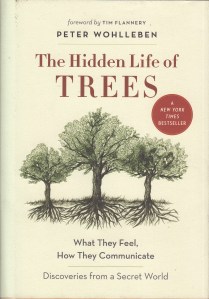
One thing we know about nature is that we don’t know much about nature. We can be a pretty self-absorbed species. Peter Wohllenben’s The Hidden Life of Trees is a good corrective for that. When we’re young we’re taught the difference between plants and animals. What Wohllenben shows is that such differences are more a matter of degree than we realize. Trees move, but slowly. Their timescale can be vast, compared to our brief, get-rich-quick outlook on life. It has been demonstrated pretty clearly that trees communicate with one another. They help one another, and they can, in their dendritic way, think. They cooperate with fungi to maintain connections between their root systems. Trees might even have what we would call personalities, were they fortunate enough to have been born human.

In a little like a medieval fantasy world, Wohllenben is a German forest keeper. He knows trees and their ways intimately. The trick, of course, is that we have a difficult time seeing things in timeframes that exceed our own. There are living trees that are 9,000 years old. That’s before the Sumerians ever showed up to invent writing. In human eyes, a lot has happened since then. And although we don’t know how to define consciousness, we’re sure that it’s limited to our species alone. Grudgingly we may admit some “higher” animals to the club, but our predilection for conquest of our world would be sorely diminished had we not other creatures to dominate. Looking at the world through a sympathetic lens, however, the fact that we’ve evolved these traits from the common ancestor we have with the animals should tell us something. As Wohllenben points out, animals diverged from plants at some stage, but we do ultimately come from the same stock.

Even on a practical level, we can’t live without plants. No matter how gourmet our foodies may be, our nutrition cycle begins with plants photosynthesizing food from pure light. There is perhaps a danger in recognizing our kinship with trees too closely. We depend upon them for food, shelter, warmth, and the oxygen we breathe. We might be inclined, as Wohllenben notes, not to use them at all. The key word here, however, is exploitation. We evolved along with plants and other animals and we all rely on each other. We are all connected. We should care for those with whom we share the planet. Trees have a much longer view than we do. When the desires of one species set the terms for all the others, we soon feel the pain of the trees.

Sense or Ship

I can tell I’ve been too busy when I haven’t planned for Banned Book Week. A kind of unofficial holiday since, well, it’s about banned things, the point of this observation is that we should be free to read. A fairly large portion of the fiction I read anyway, at one point or another, ends up on the banned list. Not surprisingly, most banned books have diversity content—racial or sexual minorities portrayed in sympathetic ways. Trump has shown us clearly how dangerous such thinking can be. It’s well known that such perspectives are allied with some evangelical Christian interests, or, perhaps I should say, lack of tolerance. There are lots of ways of looking at the world out there, and many of them aren’t evil. I should’ve planned ahead.

Censorship implies a certain arrogance. One way of looking at things is right and all others are wrong. Although we all know that any logical system runs up against its limits (we call them paradoxes) we’re reluctant to let go of that which we suppose, with or without justification, to be right. Banning is an effort to control minds. It’s no coincidence that many of the titles on banned and challenged lists are intended for younger readers. Those who favor censorship want to close the eyes of the young and pretend the real world will just go away. Yes, many of the banned books are fiction, but fiction tells us truths. Those who ban books are uncomfortable with such truths. That’s not to say all literature is created equal, or that all banned books are great literature. As someone who writes fiction, though, I can attest how difficult it is to get it published. That in itself tells us something.

It’s banned book week and here I am without a banned book to read. I’ve got some ideas, of course. My wife and I both take on book reading challenges each year. One of this year’s books (at least) was a banned title, but one that I read too far in advance. Besides, although we have too many books in our apartment already, I used Banned Book Week as an allowance to go to the bookstore. What better way to fight literary fascism than to buy a book? The problem is deciding which one. The lists are long and grow longer each year. Intolerance, it seems, knows no limits. I’m about to do my civic duty for this time of year. I’m about to go to a bookstore and buy a banned book.


Warnings Ahead

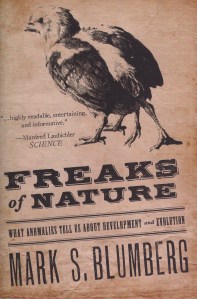
As a noun, “freak” is akin to a swear word. To refer to another person in such terms is often considered derogatory and degrading. Still, we all know what it means—an individual who doesn’t conform to expected models. I was a little worried about Mark S. Blumberg’s Freaks of Nature: What Anomalies Tell Us about Development and Evolution, then. It had the word “evolution” in the subtitle, and that sounded scientific enough. Besides, those of us interested in monsters know, deep down, that they are essentially freaky things. Indeed, Blumberg starts his book with teratology, the study of monsters. And monsters come from religious backgrounds. Their name is related to the root “to warn.” I’m a squeamish sort, though, and reading about freaks of nature requires a constitution I sometimes lack. Especially when it comes to science.

Yet I couldn’t put the book down. To begin with, the concept of developmental evolution (devo evo, for those in the know) is utterly fascinating. If you grew up, like I did, being taught that genes govern evolution solely, this book will surprise you. Evolution can happen at the level of the phenotype, based on environmental pressures. This is well documented and hardly a matter of dispute. Bodies can change according to what they need. Blumberg offers case after case where this dynamic may be seen. The idea that we are “programmed” falls, ironically, at the feet of biology itself. We, and all animals, are adaptive creatures. Humans may not be able to regenerate lost limbs, but many amphibians can. Sometimes it’s a matter of age, and sometimes it’s a matter of matter. I found such a quantity of astonishing stuff here that I overcame my queasiness to see what the next page might reveal. When I hit the chapter on reproduction I realized once again that nature does not agree that “man plus woman equals marriage.”

This must be one of the most threatening areas of science to Fundamentalists. The sheer variety of ways that “genders” interact in nature, and appear in human bodies, will have purists calling out for heavenly clarification. Reproduction, in other words, isn’t in the service of conservatism. Fish, for example, that change “genders” instantaneously after mating, taking turns being female and male with a mating partner, must surely call for theological justification of some sort. And female lizards that don’t require males to reproduce, but are helped along by being mounted by another female so as to jog some ancient reptilian memory, require us to rethink our rather simplistic terms of endearment. Not for the the faint-hearted, but amazing for those who dare, this book takes our appreciation for “life finding a way” to a whole new level. Even if it’s a little freaky.


Clown King

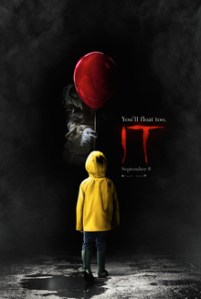
Like many people, I enjoy a Stephen King novel from time to time. King has a talent for drawing you into his tales, and whether or not they’re scary you feel a kind of relief when they’re over. A few years back I read IT. I was prepared to be scared because many people talked about fears of bathrooms after reading it, and, of course, of the terrifying clown. Not being a fan of serialized television movies, I never saw the 1990 movie adaptation. Besides, reading a novel that long is a serious investment of time, and since I like to hear lots of different voices in my reading, I spread out the wealth. In any case, the novel didn’t scare me beyond the neighborhood bullies (who’ve since moved to Washington DC) and I moved on to other things. The new film adaptation has people talking about IT again, and clowns, and clowns always remind me of college.

During the late 1970s and early ‘80s, it was fashionable for Christians to clown around. Taking cues from Paul’s one-liner about being fools for Christ, evangelicals began to experiment with clowns as a means of witnessing. I got involved my freshman year at Grove City College. I researched clowns. Where had they come from? What was the proper way to do it? Was there a deeper meaning? A friend recently sent me a video from Origin of Everything on the subject. I see a lot has been added to the history that I once studied. The idea of the circus clown is one of the more recent innovations of a character that was, in origin, a bit frightening. In classic horror movie style, heavy makeup functions like a mask and we rely on faces to know if someone is friend or foe.

We were taught, in our rudimentary training, that clowns do not talk. To express yourself you had to exaggerate gestures. I learned that makeup did indeed free you from social constraints. The Christian clown, however, had to be good. We weren’t meant to scare anyone into heaven. As nights are growing longer and people’s thoughts are coming to grips with the end of summer, clowns make good companions in the dark. IT may not be King’s scariest novel, but he did understand that bullies and clowns are fears that never go away. And when you combine the two, and move them into the White House, vaunting white faces and corrosive social values, well, maybe it’s time to go to the movies and try to have artificial fears for a while.


Reason to Believe

Gods, the experts say, are on the way out. Have been for some time. The loudest voices in this arena are the New Atheists who suggest science alone explains everything. Problem is, the gods won’t let go. My wife recently sent me an article from BookRiot. (That’s a dangerous thing to do, in my case.) Nikki Vanry wrote a piece titled “Dallying with the Gods: 16 Books about Gods and Mythology.” Most of what she points out here is fiction, and that makes sense because gods and fiction go together like chocolate and peanut butter. The first book she lists is Neil Gaiman’s American Gods—a book I read years ago and which has subsequently become an American phenomenon. There’s even a television series based on it now. Like Angels in America, only more pagan.

What surprised me most about this list is the books I hadn’t read. Or even heard of. After American Gods, I got down to number 10—Christopher Moore’s Lamb—before reaching another I’d read. Then down to 16, Till We Have Faces, by C. S. Lewis. There are, as Vanry notes, many more. Our experience of the world, as human beings, suggests there’s more to it than what we see. Not everyone would call these things gods, nevertheless there certainly does seem to be intentionality to many coincidences. Things pile up. Then they topple down on you all at once. Seeing such things as the works of the gods makes for a good story. At least it helps explain the world.

Many materialists do not like to admit that humans believe. Call it the curse of consciousness, but the fact is we all believe in things. Even if that belief is as strange as thinking fiction only comes from electro-chemical reactions in a single organ in our heads. Gods often appear in fiction. Frequently they’re in the background. Sometimes they’re called heroes instead of deities. At other times they’re right there on the surface. Such books carry profound messages about believing. It doesn’t matter what the authors believe. Believe they do. And such books sell. As a culture, we may be in denial. What we sublimate comes out in our fiction. There are gods everywhere. Singular or plural. Female, male, or genderless. Almighty or just potent. Reading about them can be informative as well as entertaining. We’ve got to believe in something, so why not gods?


Contemporary Scripture

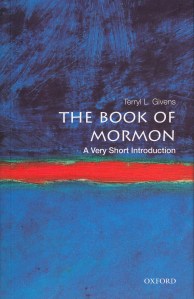
Being born into a religion makes all the difference. I say this as someone who was born into a family that would now be labeled Fundamentalist. That orientation stays firm unless a reason arises to question it. And that reason must be compelling. Many today wonder how, for example, Mormons can believe the narrative of golden plates told by Joseph Smith and that led to the Book of Mormon. Like many non-LDS members, I am curious. While this isn’t the main question in Terryl L. Givens’ The Book of Mormon: A Very Short Introduction, he does address it. The answer comes in the form of a community of belief. The idea is perhaps surprising in an age of individualism, but communal belief has been, historically, the mainstay of religion. A few individuals in any tradition dig deeply and ask questions. They rise into leadership roles, and steps along the way confirm their convictions. Most, however, are everyday believers.

The Book of Mormon is an interesting scripture. The idea of tribes from Israel colonizing the New World has its challenges. The Bible itself tends to go silent about what happened to the northern tribes (“Israel” proper) after the exile. This opens the door to all kinds of possibilities. Various cultures have claimed to be the remnant. Native Americans, of course, tend not to apply the idea to themselves. As Givens points out, the Book of Mormon states that the Israelites of the New World died out long ago. Probably when the Latter-Day Saints are few centuries older, it may happen that metaphorical views toward the Book of Mormon might become prevalent. It took over a millennium before “mainstream” Christians began to ask some pointed questions about their own Scriptures.

Scriptures are products of their own periods. No matter how sacred or inspired they are thought to be, they were written down in human time and human space. Hints are often left along the way regarding authorship, origin, bias, and perspective. The Book of Mormon is rare in having a known publication date, and that in the nineteenth century. Autographs—original texts—are available, even if the golden tablets are not. It’s a rare opportunity to watch a scripture come into being. We know who wrote the Book of Mormon, and when. Its printing history is known, as is its context in the Second Great Awakening. All that’s needed are a few more centuries for scholars to see how things develop. Those who study scriptures are inclined towards the long view anyway.


Hieroglyphs

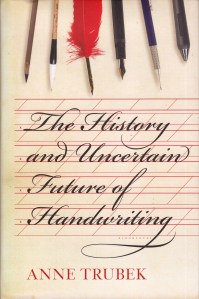
The word “hieroglyph” translates to “sacred writing.” If you’re like me, your first attempts to learn writing were probably not very sacred at all. Tongue pressed to the corner of my mouth, eyes staring fixedly at the paper flat in front of me, my hand going anywhere but where I wanted it to, writing was a burden. I soon grew to love it though, not realizing it was changing my brain even as I was assimilating how to do it. Anne Trubek introduces quite a few new angles to the story in The History and Uncertain Future of Handwriting. She begins at the beginning, cuneiform, not hieroglyphics, and offers a brief sketch of how handwriting developed into the phenomenon we know today. And how it is now becoming something very different than what it once was.

Trubek’s book is full of delightful surprises about the development of scripts and the technologies that attend them. Like most non-specialists in cuneiform suppose, she suggests handwriting is basically anonymous therein. In fact, it’s not. Molding clay into a smartphone-shaped tablet doesn’t seem like technology, but the process of writing took a leap forward when someone figured out how to do this. Those who work with cuneiform can learn to identify handwriting. In the Ugaritic corpus, the tablets “signed” by Ilimilku can be distinguished from those written by others, and not just by his name. Technology has been devised to measure depth and order of stylus strokes in the clay, the angle the stylus was held, and many other seemingly insignificant features. Handwriting was present from the very beginning.

Perhaps what is most striking about Trubek’s study is how religion enters the discussion at almost every stage. Very early on writing was identified as a sacred activity. This continued through the middle ages when monks were those who performed writing as part of their non-secular duties. Even those who piloted penmanship in the modern period often noted that a person’s moral, Christian disposition could be measured by how said person made their letters. Writing, as those who do it for a good while know, becomes a sacred activity. Most world religions have holy books. Many of those books were the reason for an interest in literacy in several cultures. Even a surprising number of secular writers have understood the activity to have spiritual dimensions. Trubek’s book gives bibliophiles plenty to ponder. She doesn’t see the rise of keyboarding as a threat to writing because even in the computer age, individuality comes through. And for those who truly understand hieroglyphs, all writing is sacred.


Shocking Truth

The electrician recently stopped by. We’re renters and although I don’t mind doing minor household repairs to benefit the landlord, I draw the line at electricity. It’s a scary thing. I’ve been shocked too many times to want a jolt bigger than I can handle. I even once accidentally grabbed the metal prongs when unplugging something as a child (it was a microscope light, I remember) and that helpless feeling of being unable to drop the plug even while my body jerked uncontrollably left me with a healthy respect for those who actually understand insulation, capacitors, and those impossible electrical diagrams. So when the pull chain came out of the ceiling light I wasn’t going to try to fix it.

The electrician, like most people who see our apartment, commented on the books. “You like to read,” he said. I can’t help but feel guilty about that. It’s almost as if you should apologize for requiring the stimulation of so many tomes. I confessed that I did, but I wanted to justify it. “I work in publishing,” I feebly offered as an excuse. Concentrating on the fixture above his head, he said, “I don’t ever read a book unless I have to.” He fixed the pull chain and left. I couldn’t have fixed the thing so quickly, or safely. He even had a metal ladder. I was grateful for the light, but once again felt somewhat freakish for my bibliophilia.

Those of us who write books must read books. You can’t learn how to do one without the other. Because of movies and television, we picture writers as people with large houses and separate rooms as libraries where they can sit surrounded by books as they type away at their next bestseller. Those of us who work for a living seldom have such luxury. A separate room just for books? I like letting my books reside in whatever room they feel like. Most affordable apartments don’t come with a study. There are living room books that you want people to see, and kitchen books that suggest good things to eat. There are bedroom books that you might not want others to see. What I don’t have is a library. A book zoo. My books roam freely about my home. It occurs to me that one area lacking in my collection is one about household wiring. Maybe instead of feeling weird I should get wired. I’m sure there are books out there that will tell me how. Or at least that will let me know that a wooden ladder makes a poor conductor.


Church of Advent

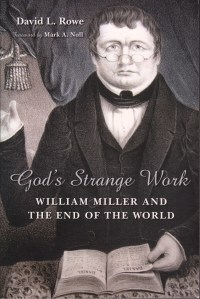
It’s a common name. You might know one yourself: William Miller. Indeed, for many years of my own life I borrowed that surname from my stepfather before returning to my birthright after seminary. But the ordinariness of the name alone doesn’t explain it. Joseph Smith, a fellow creator of a new religion, also bore an innocuous name, and he was a Junior. While many people might have trouble placing William Miller among religious founders, they would likely know of Seventh-Day Adventism, a religion that sprang from the root of his teaching. During his lifetime the preferred title was Millerite, but Adventist also worked. David L. Rowe presents a sympathetic, but not hagiographic account of this somewhat remarkable life in God’s Strange Work: William Miller and the End of the World. For Miller, you see, predicted the year Jesus would return.

A self-taught farmer, Miller became convinced that the Bible indicated 1843 would be the end. This idea was based on calculations derived from cryptic books such as Daniel and considering their days to be years. A touch of math and before you know it, it’s all gonna burn. During the intense period known as the Second Great Awakening upstate New York was perhaps the most religiously creative place on the planet. New ideas bumped into each other and, as if the bounds of Christianity were too constraining, flew out into new forms of belief. People grew convinced that the world might indeed end in 1843. When it didn’t, they called it the Great Disappointment and carried on. Adventism is still with us today.

Rowe also makes the point that for being such an obscure individual, Miller influenced the great religious movements that would give us modern day Fundamentalism as well as Jehovah’s Witnesses. These groups trace their spiritual ancestry to the convictions of a not-so-simple farmer who could fill an auditorium with his plain speaking and clear exposition of the scriptures. He devised his end times scenario with the use of only a Bible and concordance. No seminary or advanced theological reading was necessary. Millerites did not reach the numbers of Latter-Day Saints. They were disowned by the Baptist Church that gave them birth. They got the date of the end of the world wrong. Yet they persisted. It is a curious story with a long afterlife that still helps elect extremist presidents to this day. William Miller, ever unassuming, managed to change the very world that he was certain would end even before the midpoint of the nineteenth century.


First Look

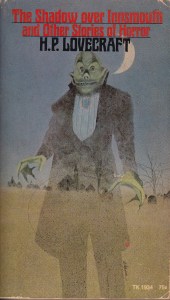
Youth might be described in a number of ways. One, of course, is in biological years. Another may be in exposure to experiences which change your life. There was a time, for example, when you can’t believe you were ever so naive. No matter how youth might be defined, a patina of fond memories tends to cling to images from that time with the passage of years. For me, unsurprisingly, those images are frequently books. I still recall the cover images of books from my tweenage years, and often think that if I found such books in a second-hand store, I would buy them for their ability to conjure past times. One such book comes not from my physical youth, but from my days teaching at the University of Wisconsin, Oshkosh. It was at that time, when the internet was also still young, that I began to try online research into H. P. Lovecraft. I found an edition of his stories titled The Shadow over Innsmouth for sale on a used book website. I was under-employed, but it was cheap and my curiosity inflamed.

Mainly I was interested in what I would now call the reception history of Dagon. Dagon is an ancient Mesopotamian deity mentioned briefly by name in the Hebrew Bible. He is also part of the pantheon of gods borrowed and invented by Lovecraft to populate his eldrich, watery world. I purchased this book for the titular story, where Dagon doesn’t actually appear, but his worshippers do. It is often claimed to be Lovecraft’s best story. As I sat down to read the whole book, however, I was struck by the strangeness of the collection. This edition, from 1971, included such unusual choices as “The Transition of Juan Romero,” “In the Walls of Eryx,” and “The Festival.” Also bundled here was the Houdini ghostwritten “Imprisoned with the Pharaohs.” When I first purchased the book I’d only read “The Shadow over Innsmouth” and “The Colour out of Space.”

As my interest in Lovecraft grew, I acquired other, more representative editions of his work and have consequently read most of his oeuvre. It was that sense of yesteryear, however, that led me back to this browning, aged collection. It was, in truth, the cover. Looking at it brings back that very office in Oshkosh where I sat as I found the edition online for less than five dollars. No doubt, I was younger then. The call of Cthulhu has echoed across the web since then. For me, however, the first exposure will always be a beat-up paperback that I ordered secondhand.


Hurricane Warming

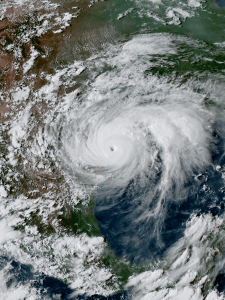
Image credit: NOAA, public domain via Wikimedia Commons

My heart goes out to those suffering from Hurricane Harvey in Texas and Louisiana. Natural disasters like this are often tied to the “wrath of God” model, and outdated though it is, it still captures how it feels. The sheer amount of rain dumped by this one storm is literally inconceivable. Trillions of gallons. Coupled with a completely ineffectual president, the disaster is even greater. Like many others, I’ve been watching since the weekend as the numbers and statistics of woe rise. Lives lost. Property washed away. Once more it reminds us just how small we are in the face of the weather. Some of this same awe was in my mind as I wrote Weathering the Psalms. Ancient Israel did not experience hurricanes—the bodies of water nearby aren’t large enough to generate them. A single thunderstorm, however, is enough to put the fear of God into a person. In ancient times, with an under-developed meteorology, all of this was the provenance of providence. How else could you begin to explain such tragedy?

One of the books that got me started on my meteorotheological quest was Erik Larson’s Isaac’s Storm, about the Galveston hurricane of 1900. Thousands died in that storm, and it remains the most deadly natural disaster in US history. Although Hurricane Harvey developed quickly, there was warning. The death toll is remarkably small (at least at the moment) compared to the fury of the storm. The natural tendency of human psychology is to look to supernatural explanations for such devastation. What have I done to deserve this? How could God do this? Are we being punished? Questions such as these come to mind, although we know that hurricanes are entirely normal features of this planet. Somewhere in the back of our minds, though, we probably are aware that global warming causes more radical weather.

Even as Trump continues to surround himself with climate change deniers, we see what global warming looks like. The weather is an intricate mechanism. Small things effect it. Large-scale changes throw it into chaos. Those who see climate change as a pain in the pocketbook will do anything they can to deny its reality. More powerful than a freight train or battleship, the weather can’t slam on the brakes and suddenly resume a more milder form. No, we’ve already started the process, no matter how many billionaires disagree. My heart goes out to those who continue to suffer from the hurricane. We need strong leadership and clear thinking at such times as this. We will need more of that in years to come. But we must also keep in mind this isn’t the anger of God. Unfortunately the wrath of human greed can be just as devastating as the wrath of the Almighty.


Planet A

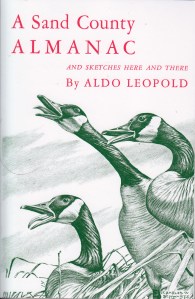
Two of the classics of ecology, A Sand County Almanac, by Aldo Leopold, and The Sea Around Us, by Rachel Carson, were published by Oxford University Press. In its present-day iteration the press has a Green Committee, on which I’ve sat from very nearly the beginning of my time there. As a committee, we’re reading these classics to see what we might learn some half-century-plus after they were published. I’d never read A Sand County Almanac before. It’s a pity, since I lived in southeast Wisconsin, from which the book takes its genesis, for about a dozen years. The writing is poetical prose, but the ideas are solid science—the land on which we’ve evolved knows how to take care of itself. When one species becomes too greedy, all suffer. Leopold ends his book by suggesting a land ethic should be put in place. Now, a human lifespan later, has it?

Hardly. Watching the Trump Administration doing everything it can to commodify any aspect of the environment that might make a buck—or at least a buck for the wealthy—is alarming in the extreme. There is no soul in the land, to this way of thinking. They believe that because they themselves lack a functional soul. A soul cannot exist without ethics. What we do to this planet is one of the largest ethical issues imaginable. No species, rational or not, destroys its own habitat. Except our own. Arrogant to the point of supposing ourselves divine, we think we can take what we want and give nothing back. And everything will be just fine. I wonder that we’ve had this inexpensive, readable guidebook this last seven decades and have continued to ignore its sage advice. Maybe we’re too busy making money to read something that sounds suspiciously like poetry.

One of the observations I had about the Almanac was how attuned to the philosophy of nature it is. Philosophy has many enemies these days, from prominent scientists to Republicans. Nobody seems to value the capacity for deep and thorough thinking through of a problem that is unbeholden to any orthodoxy. The philosopher can ask “what if?” without regret. When it comes to the environment, humans aren’t the only philosophers. We’ve convinced ourselves so completely that we’re more advanced than other species that we suppose they can’t teach us anything. One thing they do, however, without our interference, is create balance in nature. It’s an ethic to which even our species might aspire. If only we would listen to the wisdom of those who pay attention to the world that has given them life.


Fighting Nightmares

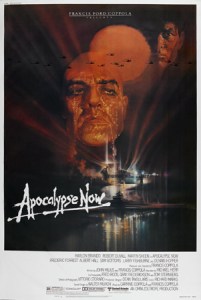
Some things are so personal, and inexplicable, that they’re difficult to put into words. Not only that, but they often involve other people and I try not to comment on those who actually know me in person. Still, having just watched Apocalypse Now for the first time, I feel I must. One of the people I admire most was a high school teacher. Although I never really said as much to him directly, he is one of the most formative people in my life. He served, and was shot up in Vietnam as a youth. His outlook on life, one that I’ve tried to emulate especially when my petty foibles overwhelm me, is an inspiration. I’m sure that he doesn’t know it, but every time I think of Vietnam he’s always in my mind.

Never a fan of war movies—I’m baffled that anyone can think of war as anything other than pure barbarism—I generally can’t watch them. Apocalypse Now, however, was widely discussed when I was in high school. It was released in 1979, just four years after the war had ended. It illustrates well the fog of war, and the Doors have been seeping in my head ever since the movie faded to black. When my wife and I began renting movies—VHS, of course—we made a list of must-see titles. First, partially for alphabetic reasons, was Apocalypse Now. That it took us almost two decades to get to it says something about the nature of life. And also my fear of war movies. Still, I knew I needed to see it. I figure that unless someone is even more behind the times than me, nearly forty years is safe from spoiler alerts.

The idea, based on Joseph Conrad’s Heart of Darkness, is that Colonel Kurtz has gone insane and Captain Willard has been called in to assassinate him. As he makes his way upriver Willard finds out that Kurtz is treated like a god. He has a cult following and does appear to have lost touch with reality. In the climatic scene, Willard hacks Kurtz to death as a cow is being hacked to death outside as a sacrifice. Ending with Conrad’s original words, “the horror, the horror,” an ambiguity lingers over what a people will do once their god has been killed. In fact, language of people being gods occurs early in the film as well, bookending this concept. The truth, of course, is that there are no gods here at all. I can’t guess what Conrad would’ve thought of this adaptation of his story. I know that when I saw it my thoughts returned to one man whose impact on my life continues in ways unexpected and deeply hidden.


Zounds Like

Liberation from the confines of academia allows for the occasional indulgence in taboo subjects. I can’t remember when I first heard of stigmata. I didn’t grow up Catholic, and, like many Protestants, distrusted much of what came from Rome. Still, I was interested in the supernatural. When I learned that people in this modern day and age sometimes developed unexplained wounds corresponding to crucifixion, I was intrigued. Ted Harrison’s book, Stigmata: A Medieval Mystery in a Modern Age, is the first I’ve actually read on the subject. It has some fascinating observations to share. It was some time after seminary that I learned that Francis of Assisi (aka St. Francis) was the first stigmatic. I had admired Francis for turning down wealth to assist the poor and commune with nature—what’s not to like?—but I didn’t realize that he had initiated this rare, but real phenomenon.

Harrison considers the question of why it was only in the 13th century that the stigmata began to occur. They have occurred ever since, in very small numbers, primarily in Italy and primarily among women. But why then? He points out that the church, shortly before this time, began to emphasize the physical suffering of Jesus on the cross. We’re probably all familiar with some of the gruesome images that emerged from the church and its artists at that time. As such images proliferated, people were given a visual focus that directed their devotions. Every great once in a while, this led to stigmata. Why women? As Harrison points out, men with intense spiritual needs could become priests. Women could not. The church would not forbid personal devotion, and if such devotion led to stigmata, well, a person arguably had a direct line to the divine. That was something normally preserved for priests through the Eucharist.

Stigmata have to be understood in the context of mysticism. The more recent cases studied by Harrison include some non-Catholics and some other unexpected candidates for what is, after all, a very intense spiritual experience. What emerges is a thoughtful, one might dare say contemplative, approach to the issue. Some stigmata have been self-inflicted. Some have not. Medical personnel have witnessed and examined these improbable wounds and have not explained them away. Once, during a faculty meeting at the New College of Edinburgh University (I was post-graduate student representative) one faculty member groused after one of my advisors had presented a challenging idea: “you’ve dropped us in a mythological world. I want to get us out.” There it is in a nutshell. Some people can live in a world where stigmata occur. Others have to explain it away. The difference is all in the matter of perspective.


Power in the Blood

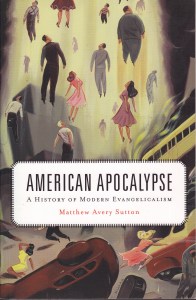
Converts, they say, are often the worst. It matters less what the conversion is to or from, since the zeal of the newly enlightened is impossible to match. The textbook example with religion, especially in America, is Evangelicalism. Those who’ve “found Jesus” are eager and too willing to tell others about it. You don’t often hear, however, of those who grew up Evangelical, but then had second thoughts. Often they disappear quietly. Evangelicalism is a potent force in American life. Intellectuals, embarrassed by it, tend to pretend it doesn’t exist. Or it’s on its way out. No need to approach, with nervous laughter, those who actually believe this stuff. Evangelicals, however, can get presidents elected and their zeal can take away any number of freedoms deemed “godless” by those who may have no more education than the local bartender. Matthew Avery Sutton’s American Apocalypse: A History of Modern Evangelicalism is masterful. Although not comprehensive (the movement is too large for that) this book does not shy from the unifying fact behind radical evangelicalism—the belief that the end is nigh.

Oh, I know. Those of us who are educated have no need to take such nonsense seriously, right? Sutton may change your mind on that. When you realize just how close to disaster after disaster this thinking has led (and continues to lead, under the current administration) us, you might want to take the Fundamentalists a bit more seriously. They constitute the largest religious bloc in the nation. One of the baffling things about them is their protean nature. What’s the difference between an Evangelical and a Fundamentalist? And what’s with the obvious differences between a Timothy LaHaye and a Billy Graham? And where do these people get all their money? (Fundamentalists have always been close to nearly endless, well, funding.) Republican presidents from far before Nixon realized that big business and conservative theology, although strange bedfellows, are remarkably compatible. (Each thinks the other side doesn’t realize it’s being used.)

American Apocalypse is an important book. Written before perhaps the strangest turn in US history last November, it might have helped to show that Trump was a serious threat from the beginning. If only the educated took it seriously. Evangelical antipathy to women’s rights, civil rights for minorities, and socialized medicine run very deep. It’s the Old Boys’ Club with a vengeance. Recent events have shown yet again how important it is to understand these ways of thinking. And those of us with insider knowledge have never been welcome in the academy. That’s okay, though. If I go back to my roots I’ll realize the world’s about to end any day now. Those who’re smart might think about taking equestrian training because I’m sure there will be white horses involved. If only I could get myself converted back.