Frankly Frankenstein

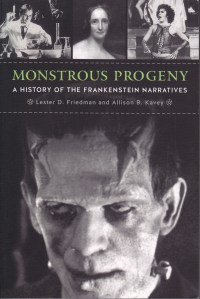
As a novel, like its monster, Frankenstein trespasses all kinds of boundaries. Is it science fiction or horror? Is it Gothic or presciently modern? Is it feminist or conventional? One thing about it is certain: it has been immensely influential. Lester D. Friedman and Allison B. Kavey have created for the world a truly wondrous treatment of this meme. Monstrous Progeny: A History of the Frankenstein Narratives is perhaps the most engaging monster book I’ve ever read (and there have been many). One of the main reasons for this is that Friedman and Kavey are keenly aware that binaries don’t necessarily exclude their opposites. Frankenstein is about both science and religion, and it treats both profoundly. Considering that Mary Shelley was only 21 when the novel was published bespeaks a rare genius in blurring boundaries and making those on each side think.

Monstrous Progeny considers multiple issues associated with Frankenstein. Should science be approached alone, or should peer review be involved at every stage? Is religion eschewed by this woman so strongly influenced by atheism, or is it the very crux of the matter? And what about the incredible and continuing afterlife of Shelley’s story? Friedman and Kavey survey not only the novel but several movies associated with, or based on ideas from, the book. Modern science, if we’re to be honest, also owes much to the fictional musings of a 19-year-old girl on a dark and stormy night. The tale of the tale is nearly as fantastic as its progeny. Challenged to write a ghost story, Shelley produced an undying Zeitgeist feature instead. Monstrous Progeny delves deeply into this unexpectedly profound idea, showing how it grips the heart of many contemporary nightmares.

Genres can be deceiving. Shelley wrote her tale as a “ghost story.” It received literary acclaim, becoming one of the best selling books in England in the nineteenth century. Only when Universal found success with Dracula in 1931 and followed it up with Frankenstein the same year did film critics want something to call movies like this. The term “horror film” was invented. There is certainly horror in Frankenstein, but there’s much more to it than that. The relationship between religion and science, and the very real ethical issue of making something because we can, are never far from the reader’s mind. Giving life to the creature only underscores the conflicts and contradictions of life in a world where to be gods risks destroying any possibility of heaven. Monstrous Progeny is a thought-provoking book that will, in its own way, brings our present fears to life.
Happy World Book Day

In times of distress, as well as of joy, I turn to books. Since about November there have been more of the former than the latter, so I’m cheered that today is World Book Day. The United Nations Educational, Scientific and Cultural Organization has designates World Book Day to promote literacy internationally. If only the White House would pay a little more attention to the UN maybe the world situation would improve. In any case, books are always worth celebrating. At any given time I’ve got three or four book-reading projects going on simultaneously. Well, not literally simultaneously; I have books I read in the morning, different books for the bus ride, and books I read before bed. Often there are others scattered in there as well, such as books that I take with me in case I get unexpectedly delayed somewhere and want something to read. It’s a life full of books. It’s a wonderful life.

I can’t imagine enduring the mental vacuity that must come from not reading. It sounds like torture to me. Yes, I’ve occasionally been caught up in the action-packed episode of travel and adventure (or what passes for adventure for a guy like me). Hours spent with other people in locations not at home when there’s something to do every minute of the day. But then, when the fun’s over, I open a book. I read before bed even when I’m traveling, and since I’m an early riser I read before anyone else is awake. It’s a form of communion. Having access to the intelligent minds of others is a rare privilege that shouldn’t be scorned. World Book Day should be an international holiday.

Books, strictly speaking, didn’t necessarily originate as sacred texts. Very early in the process of writing, however, such holy documents began to appear. Civilization itself grew through the cultivation of writing. Bibles, Qur’ans, Books of Mormon—for all the troubles sacred texts may cause, they’re reminders of the importance of reading. And once reading starts, it’s impossible to stop. Reading is resistance to the Zeitgeist that’s haunting the politics of the day. Had voters been informed, it is absolutely certain, neither Brexit nor Trump would have happened. We need to read, and be seen reading. Ignorance is the final enemy to be defeated. Celebrate World Book Day. Wish people happy World Book Day. And for the sake of civilization itself, get caught reading.


Witching Well

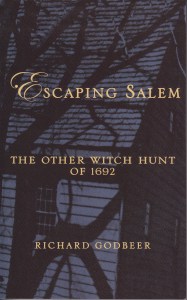
Salem, Massachusetts, brings to mind images of intolerance and a culture ossified in superstition. That’s not really fair, of course. Even in the late seventeenth century the people of Salem were living during the Enlightenment and they understood enough of science to question the legitimacy of the spectral evidence of the kind that would stand in Washington DC today. With twenty direct deaths due to witchcraft accusations and many more lives disrupted or ruined, this tragic episode has perhaps unfairly cast New Englanders as credulous rubes willing to believe just about anything. If you’re like most of us, you may not be aware that other witch trials were going on around that same time period, but with differing results. Richard Godbeer’s Escaping Salem: The Other Witch Hunt of 1692 recounts the events in Fairfield County, Connecticut in Salem’s haunted year. As in Salem a young woman began experiencing fits. Medical explanations—rudimentary as they were—didn’t explain everything away, so supernatural causation was considered. Witchcraft was suspected. Accusations were made.

In the case of Kate Branch of Stamford, as Godbeer shows, Connecticut was learning the lessons of Salem in real time. The belief in witches and witchcraft was just as real, but realizing the bad press their northern neighbors were receiving, the Connecticut Yankees insisted on more stringent evidence. Indeed, judges dismissed the jury to reconsider their decision and even overturned it based on reason. These were people who knew that human lives were at stake. They also knew that Salem was doing nothing to vindicate the cause of either Puritans or justice. We don’t hear about it so much, I suspect, because those in power did the right thing. Given present circumstances, reading about Americans who actually learned from history is encouraging. We read daily of a president woefully unaware (and proudly so) of his own nation’s history. What could possibly go wrong?

Witch hunts are sad miscarriages of justice in the best of times. In days when minorities are being scapegoated for the problems capitalism itself causes, we have to wonder if, apart from those in contemporary Connecticut, we’ve learned anything from Salem at all. Wasn’t it clear that targeting women—many of them social outsiders, and pretty much all of them recently descended from immigrants—was in itself just plain wrong? We pride ourselves on having outgrown belief in magic, and yet we go into that voting booth without a rational reason to elect a self-evident bigot and abuser of women and do it anyway. Reading, knowing where we’ve come from, prevents all kinds of tragedies. And this isn’t alternative factual history. It happened in the very shadow of the calamity of Salem, Massachusetts.


Who Knows What?

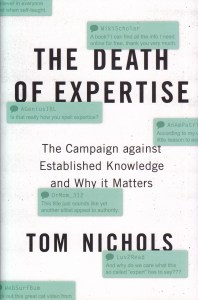
Nobody likes to have their shortcomings pointed out. I suspect that’s why many people might find Tom Nichols’ The Death of Expertise: The Campaign against Established Knowledge and Why it Matters a little uncomfortable. Nichols doesn’t pull any punches. Nor does he claim to be an expert on everything. What he does claim, however, is very important. He shows how America has taken a distinctly hostile attitude toward experts and specialists. Somewhere along the line hoi polloi began to mistake everyone has a right to their opinions for “everyone has the right to be an expert on what they express in those opinions.” This isn’t a new problem, but there’s no doubt that the Internet has exacerbated it. We’ve got people arrogant of their lack of training claiming alternative facts that are “just as good as” established facts. One of them resides in the White House. There’s no arrogance in claiming you have extensive, highly specialized training if you do. It’s a simple, non-alternative, fact.

A perfect book for our times, The Death of Expertise should be—must be—widely read. It’s not likely to change the minds of those who’ve already decided that with the Internet giving them a voice they’ve become the gurus of a new generation of the “Know Nothing Party.” The rest of us, however, should read and ponder. Nichols doesn’t shield himself in his ivory tower—he admits there’s plenty that he doesn’t know. He’s not shy, however, in saying he’s an expert on what he does know. I remember when facts used to stand for something. Winning at Trivial Pursuit was a matter of pride. Now everyone’s a contestant on Jeopardy and Alex Trebek has taken the express train home. All answers are right, for all people are experts. Seems like we have a surplus economy in arrogance these days. And that surplus just keeps growing.

An area where Nichols isn’t an expert is religious studies. He wouldn’t claim he is. I did find it interesting, however, that when he wants to make some of his strongest points he quotes C. S. Lewis. Any evangelicals out there should read The Screwtape Letters again and check what Nichols says. Lewis would not have been a Trump supporter. Not by a long shot. And he uses the word “ass” in his books, even when he’s not referring to literal donkeys. He may have been onto something. We have an anti-expert president who has appointed anti-experts at the head of major government agencies. He anti-expertly launches missiles at Syria illegally. C. S. Lewis was an expert Anglican. 45 may be an expert of the sort Lewis wasn’t afraid to name. We need to be educated. Read Nichols and give our nation a fighting chance. There’s always more to learn.


Publisher’s Breakfast

I recently had the opportunity to discuss publishing to a room full of academics. (Ooo, I can feel the envy rising already!) Although I discuss books quite frequently on this blog, I generally don’t discuss publishing much. One of the reasons is that publishing isn’t easy to tie into religion sometimes. Another—and this may be the bigger factor—is that publishing is work. This blog, which is technically a form of publishing, is more for letting my mind wander outside the paddock after being penned in at work for too much of my adult life. Still, I’m glad to give publishing advice for those who want it.

The focus of these talks (of which I’ve given precisely two) is how to get published. My main approach to this question is to point out that higher education and publishing are diverging rapidly. The reasons for this are complex, but simply put, publishers need to make money. Having been on the receiving end of tuition statements for a good deal of my life, I have no doubt that institutions make ready money. They may have trouble meeting the costs of all those administrators for whom they keep creating positions, like any good business, so each semester the bill creeps up a bit until suddenly you realize your bank account’s empty and you’d better get to commissioning some more academic books. After all, this is all about money, is it not?

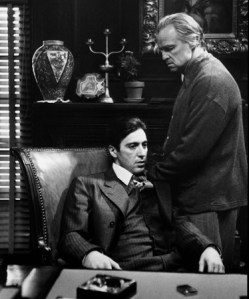
Like many in higher education, I courted academia as a hopeless romantic. I believed that love of subject and ardent devotion with ample proofs of said love would woo the academy into a permanent relationship. I’ve always been an idealist. Now I’m on the side of the desk where colleagues approach me to ask favors. It’s kind of like The Godfather, really. Only those who kiss Don Corleone’s ring tend to do so knowing that favors require some kind of reciprocity. The academy may not welcome you but would you mind helping us out now that you’re in a position to do so? No fear of horse heads here. Perhaps by now you understand why I don’t write much about publishing on this humble little blog. The focus of The Godfather, after all, is really young Michael Corleone and his devolution from an upstanding citizen (shall we say “academic”?) to a mafia crime boss. I’ll leave the other side of the equation blank. Trade secrets, after all, are worth money.


Dark Lite

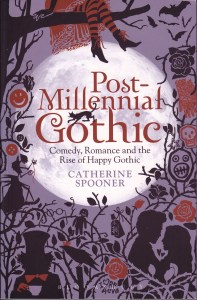
Maybe you’ve noticed it too. While certainly not universal, many forms of Gothic cultural expression (novels, movies, television, etc.) have a playfulness to them. As if taking the genre too seriously might be a misrepresentation. Even Edgar Allan Poe can be caught smirking from time to time. I’ve often wondered about this unusual combination of darkness and light. Catherine Spooner obviously has too. In Post-Millennial Gothic: Comedy, Romance, and the Rise of the Happy Goth she takes on a number of these cultural expressions—both Goth and Gothic—and tries to understand the lighter side that they often present. Sometimes it’s comedy and sometimes it’s irony, but those fascinated by darkness aren’t always as gloomy as they seem.

This book is a real hodgepodge of both British and American explorations of the smiling dismal. It’s a cultural contradiction, maybe, but it certainly feels authentic if you look closely enough. Although Spooner doesn’t discuss it directly, I couldn’t help but think of that great progenitor of the Gothic—the medieval church. Perhaps it was the very real fear of the plague and the nearly constant warfare of the time in Europe, but liturgy, when done right, has a palpable darkness to it. References to ourselves as “miserable sinners” begging God to “have mercy upon us” clearly call to mind some of the deeper elements of the Gothic sensibility. Having attended Anglo-Catholic services for years I came to know many who were compelled by this intensity. A Gothic chasuble is a thing of beauty forever.

Spooner, however, focuses on popular culture. Beginning with the Goth movement of the 1980s, a subculture formed that brought much of this darkness to light. She’s careful to point out that being Goth isn’t the same as being gloomy all the time. It is an expression of creativity, and, as Spooner notes, closely associated with Steampunk. Such things, however, require a recognition on the part of participants that in order to taken seriously, such expressions must become part of daily life. There are risks, however. Even in enlightened cultures we are not yet fully tolerant of those who are different. And really, much of the book is about this—accepting those who are not like ourselves. There is quite a bit going on here that’s beneath the surface. And depth is something the world could use a bit more of. There’s nothing wrong with having some fun while acquiring it, either.


Superstar Detective

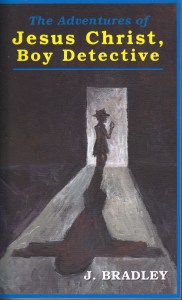
One of the reasons I accept reading challenges is that they take you places you otherwise wouldn’t go. Not all the books I read for the Modern Mrs. Darcy 2017 challenge make it onto this blog (to find the full list you need to see what I post on Goodreads.com), but some I can’t help but talk about. My wife had noticed a book that ended up in her Christmas stocking and for which I had admitted curiosity: J. Bradley’s Jesus Christ, Boy Detective. Now, Jesus is no stranger to fiction. In fact, he appears in lots of books as either the main character or as fulfilling some supporting role. In some books you have to really squint to find him. In others he’s obvious. In Bradley’s novel he’s a bit of both.

There’s a good bit of theology going on in the background of Jesus Christ, Boy Detective. As the title suggests, Jesus functions through a new incarnation in the body of a, well, boy detective. With some assistance from a criminal uncle and Saint Peter, he investigates bizarre murders and other crimes. There seems to be an ulterior motive, however, since he’s trying to get his father to own up for all the suffering he’s caused humanity. That’s right, this book is a modern theodicy.

Theodicy is a word for considering how a single deity can be both all powerful and all good. Since there’s plenty of suffering in the world we all experience, the question naturally arises: why doesn’t God do something about it? Theologians are fond of reminding us that we can’t see the bigger picture. It’s like global warming—it’s easy not to believe since we only live a few decades and the climate takes a lot longer than that to react to our pouring toxic stuff into the ecosystem. Maybe, theologians say, we have to suffer because we don’t see everything. Only God does. The boy detective disagrees. The deity in this story is truculent and culpable. A strong-willed divinity. If he doesn’t sound familiar, take another look at the Bible. I don’t know if J. Bradley has any theological training—I don’t even know his first name—but it’s clear that he’s down here with the rest of us wondering how all the pieces fit. And where there are clues it’s not a bad idea to call in a detective.


Being Boarded

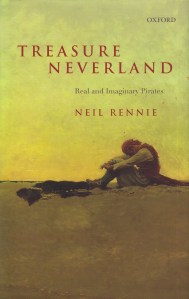
It might seem superfluous to be reading about pirates when such serious issues face us these days, but my answer to most of life’s problems is to look at the history. Besides, like many people in the early new millennium I was swept into the swashbuckling romance of the purified pirate. I suspect, given the time period, that I hadn’t really thought of pirates for a couple of decades. I knew that in reality a pirate was simply a thief on the seas, a bloke on the water who had looking out for number one down to a capitalist science. I thought maybe Treasure Neverland: Real and Imaginary Pirates, by Neil Rennie, might say a bit about the most famous fictional pirates of the modern era, but alas (or “avast”?). For a book that says in its cover copy “the long dissolve from Captain Kidd to Johnny Depp,” it has only a single paragraph about the modern Hollywood pirate from the Caribbean. That’s not to say that the historical and fictional information aren’t interesting—I especially enjoyed the chapters on Long John Silver and Captain Hook, and women pirates—but the book wasn’t quite what I was expecting.

Rennie does a good job of exploding myths that mostly trace their origins to a bottleneck of historical sources on the subject. It’s good for academics to revisit the origins of ideas, I find. Beginning with the days of Henry Every, the early material is quite interesting. I had no idea that Madagascar was such a pirate haven, being mostly aware of the Caribbean variety. But there are also contemporary swashbucklers about.

Consider, for example, that our country seems to be run by pirates. Thieves are those who claim for themselves what they have no right to take. We have a president and cabinet who are pretty much all of that description. We also have majorities in both houses of congress who seem, on many issues, willing to climb aboard a stolen vessel. In Iceland they have the probity to call themselves “the Pirate Party.” At least you know what you’re getting when you cast your vote for those who say what their intentions are so obviously. Not that Trump didn’t make clear in his words and deeds of a lifetime that he would only look out for himself. People can’t be troubled to check the facts, though. It’s better just to let your anger drive you when you’re behind the curtain. Who looks at Wanted posters anymore? Of course, I would say that. I’m the kind of person who looks at history to solve problems.


The Deal

Intellectual property is a concept that only arises where thought can be monetized. Think about that. (But don’t charge me, please!) It is a strange idea, when you ponder it. In any case, one of the problems with writing book reviews is that the reviews themselves become the intellectual property of the journal in which they appear. In a mental ménage à trois, everyone gets something out of it: the publisher gives away a book for free publicity, the journal gets copyright content of value to its readers, and the reviewer gets a free book. In the best of these encounters everyone goes home happy. I began doing book reviews when teaching at Nashotah House. Academic books are expensive and although professors make more than editors do, they are still hard-pressed to pay academic press prices. After my strictly platonic affair with higher education, I stopped doing reviews for a while, but now that I have hours on a bus to read, I’ve picked up the habit again.

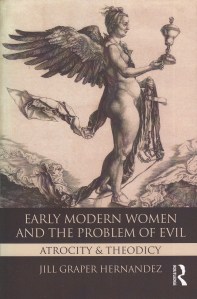
Most often I review books for the two societies of which I’m a member—the American Academy of Religion and the Society of Biblical Literature. There might, however, be a conflict of interest here. One of the main things I do on this blog is talk about books. Since I’m no longer a professor, but I still think like one, I figure it’s a compromise I can live with. The conflict arises because I post daily on my blog while publishers take weeks, or even months, to publish reviews. Despite technology, publishing is a slow business. That means that I read books I can’t really talk about until the review has appeared. That’s the case with Jill Graper Hernandez’s Early Modern Women and the Problem of Evil: Atrocity & Theodicy. I can’t say here what I say in my review since the review isn’t my intellectual property anymore. There’s another trade-off here: publishers get your name out there in return for owning your content—everything can come down to the level of business, it seems.

Still, I can use this post to reflect on theodicy—the justification of God in the face of evil. Since I don’t address this fact in my review I can say here that since Trump’s election it’s difficult to read a book about suffering without tying it to the current political situation. Many of the incumbent’s ardent supporters are coming to see that he doesn’t really care for them or their issues, and conservatives as well as liberals have four years of suffering to face. I was surprised how often in reading this philosophical treatise that our present national shame came to mind. Perhaps that’s inevitable in a book that discusses how women have been repressed in a world where they too have been relegated to the level of a commodity. Intellectual property seems less a concern when human beings are still trafficked as chattel. That’s not just bad business, it’s evil.


Crossing Beowulf

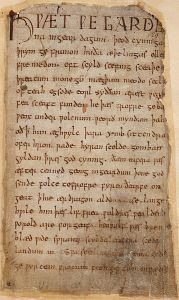
Beowulf, from Wikimedia Commons.

Slaying dragons is costly. In much of the western hemisphere the ultimate metaphor for the perils that await humanity in a world imperfectly understood, dragons were the bane of the medieval imagination. And earlier. Dragons are mentioned in the Bible and were stock creatures in the bestiaries of the Mesopotamian imagination. And, of course, it is a dragon that causes Beowulf’s fall. Almost a type of a latter-day Gilgamesh, Beowulf likewise holds an early, if non-negotiable place in the western canon. In this month’s Atlantic, James Parker discusses the dynamic of this pre-Christian poem in our post-Christian context. Specifically he addresses how modern renditions, perhaps inadvertently, Christianize the story. A popular subject for movies and graphic novels, Beowulf is a monster-hunting story that begs for baptism.

The story itself is familiar to most alumni of American high schools. Perhaps before we’re ready to be exposed to Old English, we find ourselves assigned a story of drinking, rage, and violence. Make no mistake—Beowulf is a hero. A deliverer like the judges of old. Grendel, after all, is the spawn of Cain, the evil seed that continues into a moody world of stygian nights and dismal swamps. Parker’s brief article demonstrates the reception history of the poem nicely. It also raises the question of what’s going on when heroes fight monsters. When the Christian imagery that’s deeply embedded in our culture comes to play Beowulf can’t help but become a Christian monster slayer just as Grendel becomes the enemy of God. All of this may be quite unintentional. What we see, however, isn’t imaginary. That’s the way reception history works.

Parker suggests that, although Beowulf is a pre-Christian poem, the cosmic order laid out in the tale is a Christian one. Even today in a post-Christian America it’s vital to understand how important religion remains. It’s not so much that churches are overflowing (unless they’re mega-churches stating that you can get rich by attending) as it is a recognition that centuries of Christian identity can’t help but leave their mark on culture. We see crosses in the handles of swords. Or even in the grid patterns laid out in city streets. Telephone poles. What’s so remarkable is that we see such things naturally and think nothing of it as we go on our secular way. There may be monsters out there. What may not be so obvious is that in slaying them we’re engaging in a religious activity as old as Gilgamesh, if not as obvious as a crucifix held up to a vampire in the present day.


Classic Fiction

The Epic of Gilgamesh is one of the ancient documents still widely recognized, at least by name. Many introductions to literature, or the western canon, refer to it. It is, in some senses of the phrase, the world’s first classic. I’ve read Gilgamesh enough times not to know how many times it’s been. During my doctoral days I was focusing on the literature of neighboring Syria (long before it was called “Syria”). As an aside, Syria seems to have gotten its name from the fact that non-semitic visitors had trouble saying “Assyria” (which was the empire that ruled Syria at the time). Leaving off the initial vowel (which was actually a consonant in Semitic languages) they gave us the name of a country that never existed. In as far as Syria was a “country” it was known as “Aram” by the locals. Back to the topic at hand:

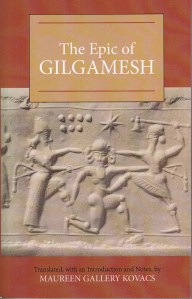
Although the story of Gilgamesh may be timeless, translations continue to appear. It won’t surprise my regular readers that I’m a few behind. I finally got around to Maureen Gallery Kovacs’ translation, titled simply The Epic of Gilgamesh. Updating myself where matters stood in the late 1980s, it was nevertheless good to come back to the tale. For those of you whose Lit 101 could use a little refreshing, Gilgamesh was a Mesopotamian king who oppressed his people. (And this was well before 2017.) The gods sent a wild man named Enkidu as a kind of distraction from his naughty behaviors. In an early example of a bromance, the two go off to kill monsters together, bonding as only heroes can. They do, however, offend the gods since hubris seems to be the lot of human rulers, and Enkidu must die. Forlorn about seeing a maggot fall out of his dead friend’s nose, Gilgamesh goes to find the survivor of the flood, Utnapishtim, to find out how to live forever. He learns he can’t and the epic concludes with a sadder but wiser king.

The fear of death is ancient and is perhaps the greatest curse of consciousness. When people sat down to start writing, one of the first topics they addressed was precisely this. Gilgamesh is still missing some bits (that may have improved since the last millennium, of course) but enough remains to see that it was and is a story that means something to mere mortals. Ancient stories, as we discovered beginning the century before mine, had long been addressing the existential crises of being human. Thus it was, and so it remains. No wonder Gilgamesh is called the first classic. If only all rulers would seek the truth so ardently.


Non-Lending Library

One of the hidden benefits of the coming societal collapse is the chance for the resurgence of print books. Since I’ve spent most of my life surrounding myself with volumes thick and thin, dense and light, I’ll have plenty to read between bouts of skulking out for food like a feral cat and clawing off those who follow me home, thinking that it’s edible stuff I’m stockpiling. Won’t they be surprised to learn it’s only books! My wife sent me an Atlas Obscura story the other day about book curses. The description of the life of a medieval scribe sounded oddly compelling to me—hunched all day over a writing desk, copying books by hand. Not having to worry about catching the bus before sunrise or being too tired to answer your personal email in the evening. The point of the piece, however, was the book curses.

I’ve been an avid reader since moving to a small town where the main occupation of kids my age was recreational drug use. I was one of the very few who didn’t inhale. Reading became my escape from the loneliness I felt. And I used to lend books to people who’d ask me. I quickly learned that others didn’t share the same care for books that I had. Lent books seldom made their way back to me. We were poor and there were no bookstores nearby and Amazon wasn’t even a meme in Jeff Bezos’ eye yet. Replacing books wasn’t easy. Once I lent out a book I’d already read (but you couldn’t tell it, I’d been so careful). The borrower actually did return it, but the spine was all creased and cracked so that you couldn’t even read the title anymore. I soon began to regard books like those medieval monks who put curses on them so nobody would steal them. I stopped lending them out.

The thing I’m banking on is that books will retain their barter value when society implodes. Of all possible universes only in that one will I be considered wealthy. Those who visit our little apartment inevitably comment on the number of books. What they don’t realize is that there’s a strategy involved here. Like those medieval monks, I have a suspicion that knowledge—including facts that don’t have alternatives—will one day in our dystopian future be valued above all the tweets and lies Washington seems to suggest we follow blindly. And blindness will make a great curse, now that I think about it, to protect these books from being stolen. Or “anathema-maranatha,” as my medieval mentors used to say. Or as Sarah Laskow ends her piece, “May whoever steals or alienates this book, or mutilates it, be cut off from the body of the church and held as a thing accursed.” Maybe this isn’t so strange for a guy whose first academic appointment was at a school that reminds many of The Name of the Rose. (Which was the last book I lent out, for the record.)


Direct Address

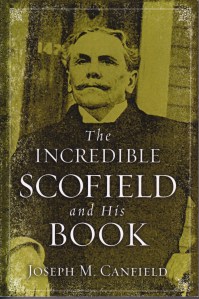
For a man as amazingly influential as he was, Cyrus I. Scofield hasn’t been the object of much curiosity. In the venerable academic tradition of ignoring those you disagree with, serious scholars dismiss Scofield as some kind of evangelical aberration, a theological leper, if you will. It’s difficult to locate book-length treatments of the man, although he may claim considerable credit for the elections of Ronald Reagan, George W. Bush, and the current incumbent. Somewhat skeptical of the obviously polemical The Incredible Scofield and His Book by Joseph M. Canfield, curiosity drove me to read it as an accessible and thoroughly researched account. Now, one evangelical going after another isn’t a pretty sight, but if you can get past the “this is what the Bible really means” oneupmanship, there is clear evidence of a sharp mind with legitimate historical accuracy as its priority in Canfield. This is especially clear where he demonstrates that scholars shown the evidence will choose to ignore it to preserve the sanctity of a man hardly a saint.

The strange religion that has developed from the Scofield Reference Bible has had an astoundingly long reach. If you know what “the Rapture” is, it’s probably because those who took their cues from Scofield’s Bible ensured that it became a standard American trope. It generally doesn’t have to be explained, even though the idea doesn’t occur in the Bible. It’s based on a set of “dispensations” developed among the Plymouth Brethren, a fairly small British and Irish sect that influenced the world through its prophet Scofield. (Scofield himself was not a member of the Brethren, but he learned his system of “history” from them.) Although the Scofield Reference Bible wasn’t technically the first study Bible, it was the first widely influential one. It is, in a sense, America’s Bible.

Scofield himself was hardly clergy material. Canfield documents this clearly and doggedly. Among the evangelicals, however, an admission of guilt—no matter how insincere—has to be taken at face value. If you’re caught “backsliding” after that, all you have to do is admit that too. They’re obligated to forgive you 490 times, if they’re truly literalists. We can see this at work in the bizarre evangelical backing of Trump, a Christian only by the loosest possible definition. If you say you’ve accepted Jesus they have to believe you. It’s the ultimate scam. Scofield himself seems to have been aware of this. Particularly wrenching was the account of how, after he was making a respectable income from his Bible, he refused to give money to one of his daughters from his first marriage when she wanted to buy a house. His will left no money to any charitable organization at all. You can take it with you, apparently. And so, we’re left with a world devised by such a man with no theological training. Since he’s so obviously low brow, however, we lack scholarly biographies that take the care of Canfield in exposing information readily available to those with open eyes.


Animal Fights

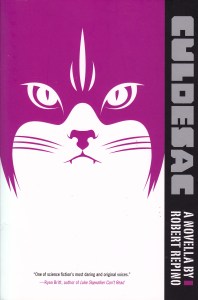
What does it mean to be human? The answer’s not as straightforward as it might seem. Reading Robert Repino’s Culdesac, that question came back to me time and again. This novella takes off from the story of Mort(e), about which I blogged shortly after its publication. Humans and animals that have acquired some human characteristics are at war. Most see those on the other side as inferior and that can make a human being reading the tale just a touch uncomfortable. We don’t have a great track record when it comes to dealing with non-human animals. We are all, after all, members of the same “kingdom.” Even down to the level of phylum and genus many of us show more general similarity than stark differences. Culdesac is a morphed bobcat who remembers all too well how humans treated animals before the war. And memory is a powerful thing.

Repino has a way of sweeping the human reader (here the enemy) into the story and making those foundational questions ring as if struck with a hammer. What does it mean to be human? Granted, reading such provocative work under the current administration adds a layer of poignancy that wasn’t there when Mort(e) stood alone. In fact, it is a question that we have to ask just about every day when we see the headlines. There’s no leadership on this point coming from above. The idea of other humans as chattels has a long and disgraceful history. You can differentiate anyone on some basis or another: female or male or intersex, black or white or brown, rich or middle class or poor, large or average or small. Differences working together might be the very definition of culture. Culdesac shows what can happen when one sees only the distinguishing characteristics rather than the commonalities. It’s a parable.

Education, the one weapon in our arsenal that actually dismantles prejudice and intolerance, was one of the first targets our government sought to dismantle after 11/9. Indeed, the antipathy—if not downright hostility—toward education has been a characteristic of which Americans have long been unduly proud. We are not self-made, none of us. We all had our teachers. We all had our books. As we stand on the rim of this smoking crater and wonder how hatred toward one’s own species could be allowed to be nominated, let alone win, I believe the answer lies in our personal belief in education. We must all use the opportunities we have to educate. Get caught reading a book. Or helping a stranger. Or just being kind. As Culdesac emphasizes, wars are long-term events. Results won’t change after only one skirmish. If we all valued education—reading, learning—enough such aberrations as this could never happen. If you’re casting about for something to read that will make you ponder things at a most human level, I would suggest Culdesac.


Childhood’s End

I believe it was C. S. Lewis who wrote that in reading autobiographies he always found the earliest years the most interesting.. In my experience the same applies to biographies; what made the person famous enough to merit a biography—auto or not—started in the innocent years. I try not to extrapolate from my own case because I never read Alice in Wonderland and Through the Looking-Glass until I was in college. (It was only in college that I first saw Mary Poppins as well.) Beloved childhood classics weren’t really part of my childhood. Like many adults, then, I wonder who was Alice, really? Everyone knows there was an Alice but what do we know of her inner life? What’s the story with Lewis Carroll?

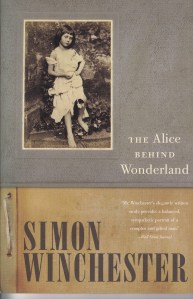
In my mind Simon Winchester is an historian associated with large pictures. Maps of the entire world, huge volcanoes, big oceans—the meaning of everything. I only discovered his The Alice behind Wonderland by accident. As soon as I spied it I knew I’d have to read it. As I expected, the younger years are most intriguing. Those of us who cut our classical teeth under the tutelage Liddell and Scott may not realize said Liddell was the father of Alice. But it’s not the father that impresses so much as the daughter. And Charles Dodgson himself—the cast of characters is compelling even with little action beyond photography and story telling. Yet we’re riveted. What was the dynamic that led a bachelor cleric to write a world classic for children?

Who doesn’t, even in less-than-ideal circumstances, long for the carefree days of childhood? Looking at photos of our younger selves evokes a world accessible only in our heads. The world that made us who we’ve become. Winchester bases this brief study on perhaps the most controversial photograph of Alice Liddell that Charles Dodgson ever took. Even the story of wet-plate collodion photography allures the reader with its promise of stories untold. We know little of why the Liddell family grew apart from Dodgson, so much so that the adult Alice didn’t even attend the funeral of the man who’d made her an immortal. What happened here? When we find out we’ll perhaps be a step closer to finding out why becoming an adult means sacrificing a child. We may be a step closer to finding a girl known to most of the world simply as “Alice.”