Take Your Time

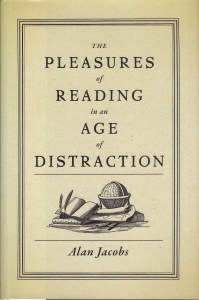
PleasuresOfReadingReading is fundamental. Those of us who grew up hearing that slogan have never forgotten it. The part that I wish had stuck better is just a touch shorter: reading is fun. Or it can be. Should be. Alan Jacobs’ little book The Pleasures of Reading in an Age of Distraction is like an extended essay on the subject. As a professor of literature, Jacobs has considerable experience encouraging people to read, and in his book he makes a case for reading what you want to read (reading on a Whim, he calls it). Wisely he recognizes that many would-be readers are discouraged by being instructed to read that which they don’t find appealing. I learned quite a lot from the suggestions contained herein, and I’ve been reading so long that I thought I knew pretty much what I needed to know about it. Perhaps the most fundamental issue (apart from reading itself) is that many of us expect to be told what to read. We second-guess our own judgment, feeling we need an expert to tell us how to do it. Like singing in public, it’s intimidating to come across someone better read than oneself. Jacobs advocates reading what gives you pleasure and not worrying about what others think.

Recognizing that readers are spoiled for choice, Jacobs addresses, among other topics, rereading. And taking notes. And reading slowly. I recall speed-reading courses advertised, ironically, on television. At college you could take courses in improving your quota of pages turned. There is a specific kind of reading, as Jacobs notes—reading for information—where this may be helpful. This is different than reading for pleasure, or even reading for understanding. In the case of the Bible (Jacobs taught at Wheaton before moving on to Baylor) many people, he suggests, read for information rather than for understanding. When reading for pleasure taking your time is a virtue. Getting to know a book requires rereading. We need to make time for what is important.

Jacobs makes the point that readers are a minority sect. There have always been fewer of us than there have been of those who don’t read. We are, in his words, a tribe. We can generally spot one another. Those of us who can’t walk past a bookstore will recognize ourselves in the pages of this meditation. Those who spend long hours with books become like them, in some respects. Familiar, layered, and requiring more and more attention. Like the reading that it advocates, this book itself is a delight to read. There is so much in this brief volume that it’s difficult to summarize in the short-form writing that I use on this blog. I found myself wishing for an index so that I might find my favorite passages again. Then I realized that perhaps this absence was intentional. Maybe I’ll have to reread it, taking notes as I go. What a wonderful thought.
Let Us Prey

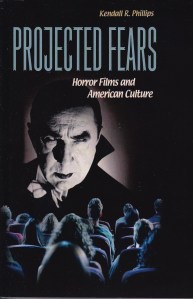
ProjectedFearsI grew up with horror films. Not that my mother encouraged or approved this behavior, but I was a kid with a lot of phobias. With no father around to protect us from what dangers might lurk out there, I tried to learn how to cope by watching others face monsters. That innocent childhood pass-time, like most simple pleasures, disappeared into the adult world of analyzing and being serious and making money. Then it came back. After a series of unsuccessful relationships the old rejection phobias led me back to my beloved monsters. I suspect that’s why I like reading about horror films so much—it’s an exercise in self-understanding. Kendall R. Phillips’ Projected Fears: Horror Films and American Culture is a pleasant Saturday afternoon’s viewing, but for adult monster boomers like myself. Phillips admits up front that academic respectability is hard to come by for horror movies, but that is starting to change. We are beginning to read the script.

Phillips walks the reader not only through the ten movies he’s selected, but also through what was happening in American culture at the time. The horror movie proper is not yet a century old, having begun with Universal’s 1931 monster pair of Dracula and Frankenstein. Phillips shows that what scares a culture changes over time. Indeed, one gets the sense that it is horror movies that lead us in our fears. Highlighting ten culturally significant films, this book guides us through the highs and lows of the last century. The last entry in the book dates from 1999, nicely encapsulating what made us afraid during a most remarkable and, if we’re honest, a most messed up century. Clearly those who purvey horror will have their own choices for significant entries. Phillips does an admirable job of justifying his choices: Dracula, The Thing from Another World, Psycho, Night of the Living Dead, The Exorcist, The Texas Chainsaw Massacre, Halloween, The Silence of the Lambs, Scream, and The Sixth Sense. Each reflects its age, and each impacted its culture.

It should come as no surprise that religious elements—both in culture and in the movies—are up for discussion here. Consciously or not, religion deals with our fears and frequently moves us into the realm of horror. Now that we’ve entered a new era—much has happened already this millennium—the nature of our fears has been changing. To assess cultural impact we need some distance. Books like this help us to understand ourselves, but only after sufficient time has passed. I am confident, however, that when future analysts look back on this insane time that they will find unexpected answers to questions we can only begin to utter. We stare at the monster in the room with us, paralyzed and unable to scream. Or even text. And they will note that religion played a role in our nightmares even as we expected technology to save us.


Simply Beautiful

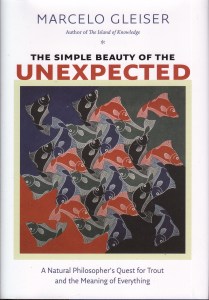
Simple BeautyThe scientific method has been a boon to humanity. Knowing how to sharpen the rational faculties has demonstrated its benefits time and time again. Sometimes, however, overemphasis on rationality contains hidden costs. Humans are not always rational, and sometimes this is a very good thing. Culturally we’re told that reason trumps emotion and that evolution has somehow led us to this. That’s only part of the story. Marcelo Gleiser’s excellent The Simple Beauty of the Unexpected serves as a wonderful corrective to this one-sided view. Although I’ve been trained in rationalistic thinking, my humanities background lacks the credibility of similar training in the sciences. Gleiser, as a physicist, demands respect. As he notes throughout this book, physics asks the hard questions. The only proper response, he rightly declares, is humility. Arrogance in any human endeavor may make for a good story, but it is bad citizenship on this planet.

I have to confess to being one of those poor souls who really doesn’t care about fishing that Gleiser mentions early on in his book. That doesn’t mean that I don’t agree with his outlook and mature thoughts on the subject. Using fly-fishing as a kind of bait, he draws the reader in to consider some deep and meaningful questions about life. Although he describes fishing literally, he clearly has a metaphorical usage in mind as well. Rare is the scientist who will admit that science can’t answer all questions, and moreover, wouldn’t want it to. Showing the limits of rational thought can feel like taking one’s clothes off in front of a crowd for those wedded to empirical evidence. Applied science clearly works very successfully. That’s not the same as having all the answers. Gleiser beautifully illustrates this, acknowledging that the spiritual has a role to play even among the rigorously trained and actually employed of the intelligentsia. This is a very important book.

Admitting that some things happen for which there is no rational explanation, Gleiser advocates for appreciating the wonder rather than trying to force science into situations where its explanatory power fails. This doesn’t happen often—indeed, rarity is what makes the unexpected so wondrous—but when it does happen we need to, like a fisher, accept it as part of the way the art unfolds. In Gleiser’s terms, not every fishing trip is successful. If you always had success, what would be the point in trying? He ventures into the murky waters of religion a time or two, but this is catch-and-release, not for the kill. The Simple Beauty of the Unexpected is an example that includes itself. Those who read it will learn what this means.


Sea Change

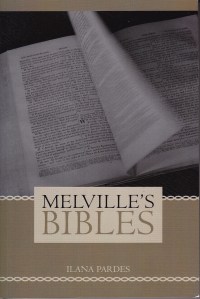
MelvillesBiblesMy reading list is long, and it grows longer all the time. I read both fiction and non-fiction with equal avidity. Given that there are so many books I want to read, it is unusual to read entire books a second time (they should be kept for reference’s sake, of course). Two exceptions to the multiple reading trend have been, for me, the Bible and Moby-Dick. In reading Ilana Pardes’Melville’s Bibles, I discovered I’m not alone in according Melville nearly biblical status. As a book itself, Melville’s Bibles went on my reading list as soon as I learned of it. You see, Moby-Dick was added to my personal Deutero-Canon as soon as I closed its cover. Perhaps before. It was an assignment for a seminary biblical studies class on wisdom literature. My high school wasn’t one that required the novel, and all I knew about it previously was that it was a big book about whale hunting. I knew so little.

Pardes looks at Moby-Dick, and other literature, both by Melville and others, through the lenses of biblical characters. Of course there’s Ishmael. And Ahab. Melville, however, knew his Bible well, and to understand his work on a deeper level so must his reader. Job’s there. As is Jonah. Jeremiah, Elijah, Micaiah ben-Imlah, and even Rachel. Pardes takes these characters and shows how they appear, generally in Moby-Dick, spread across a variety of characters. More than one Ahab and Ishmael walk these decks. All the while, she notes, Melville himself wasn’t a typical “believer.” He struggled with the deity that he just couldn’t find. The end result is a compelling analysis of literature and human nature.

This brief study has a disproportionate number of insights. I frequently found myself stopping to ponder what I’d just read. Perhaps that’s to be expected in any book that brings two weighty canonical works together in such a gam. (If you can’t recall what a gam is, reading either Pardes or Moby-Dick will remind you.) Encountering Moby-Dick the first time was like finding a lost book of the Bible. I had no idea, however, at the depth of comparison. Pardes shows just how deep that ocean is. Melville’s well-thumbed, indeed, annotated Bible does play a role in all of this. Perhaps he didn’t intend all the connections readers like Pardes find, but that doesn’t make the connections tenuous. They’re clearly there. Canonical works are like that. Moby-Dick, indeed, is an iconic book and Pardes is a very capable Captain to guide a reader through it.


For Love of English

One of my most frequent imaginary dalliances is wondering what I would have done with my life if I hadn’t been raised religious. Like many young boys I found “exciting” jobs enticing—soldier, firefighter, explorer—but scientist also loomed large in my imaginary horizon. By the time I was a teen I was firmly ensconced in books. My upbringing meant that many of these books were religious in nature, and my concern with ultimate consequences meant religion was the only possible career track to make any sense. It certainly never made dollars. As someone who professionally looks backwards, I’ve found myself wondering if I shouldn’t have focused on English rather than Hebrew and Ugaritic as a career. After all, the Bible has been available in English for centuries now. Besides that, the canon is larger—from Beowulf to Bible and beyond. Reading is, after all, fundamental.

Beowulf, from Wikimedia Commons.

Beowulf, from Wikimedia Commons.

I only discovered BookRiot recently, and that through the mediation of my wife. For the writer of a blog I really don’t spend that much time online outside of work. I like real books, and being outdoors. Too much time staring at a screen brings me down. Nevertheless, BookRiot has stories that cause me to question my career choices from time to time. For instance, I have never knowingly heard of The Exeter Book. Dating to the tenth century, this medieval manuscript is among the earliest of English writings. Showing the interests of the monk who likely inscribed it, it has religiously themed material and riddles. As E. H. Kern’s post on BookRiot points out, The Exeter Book has inspired many later writers and has, through them, made its way into mainstream popular culture. Not bad for a book that I suspect many, like myself, have never heard of.

Old English has the same kind of draw as other ancient languages. Not nearly as dusty as ancient Semitic tongues, it contains the roots to the form of expression I find most familiar. I love looking back at the Old English of Beowulf and spotting the points where my native language has remained relatively unchanged over the centuries. Modern English even begrudgingly owes a considerable debt to the Bible of King James. Our language is our spiritual heritage. We have trouble expressing our deepest thoughts without it. Perhaps had BookRiot existed when I was young, I might have made a rather more informed decision about the direction of my career. Or, then again, religion might have found me nevertheless. From some things there is just no hiding.


The Cost of Chaos

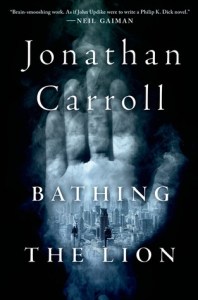
BathingTheLionJonathan Carroll’s novels are always thought-provoking. My reading patterns tend to be driven by book sales and secondhand stores since my reading vice is particularly aggressive. The Ghost in Love is now already years in my past, but I found a copy of Bathing the Lion that I could afford and I was soon dropped into a world of chaos and order. I won’t try to summarize the complex plot here, but I would note the story’s participation in one of the oldest themes of literature—the struggle of order against chaos. The characters called “mechanics” in this book are those who attempt to maintain order throughout the cosmos. Many retire to earth. There, or here, they continue to work against the ever-encroaching chaos.

According to Genesis 1—not the earliest literature, but still fairly ancient—creation is God making order out of chaos. The universe, prior to creation, consists of uncreated, chaotic raw material. Order is what makes our world recognizable. Elsewhere in the Bible creation takes the form of a struggle against a conscious monster that represents chaos. This motif is reflected elsewhere in the ancient world in texts such as the Enuma Elish. Actually, the theme is so common as to be classified as a standard trope of ancient religions with its own name—Chaoskampf. Chaos is always waiting in the wings, ready to break back in and make a mess of our nicely settled existence. The flood story, placed as it is just after creation, is an example of what happens when chaos regains the upper hand.

The battle to maintain order represents a kind of ancient awareness of entropy. If energy isn’t expended, that which is accomplished becomes a wet, stinking mess and anyone who survives has to start all over again. This story is deeply embedded in human consciousness. To our way of thinking, we’re integral to the running of this universe. Spending time in nature gives the lie to this thought. There aren’t that many predators left, but those that are here—cougars and grizzly bears especially—remind us that in the eyes of nature we can be just another meal. Our outlook cannot accept such a low position. As Carroll has the mechanics say, they are not gods. Like human beings, however, they take on a role next to that of divinity. Chaos is the enemy, even garbed in the colors of making us great again. There are still those who will bathe the lion.


Literally Smitten

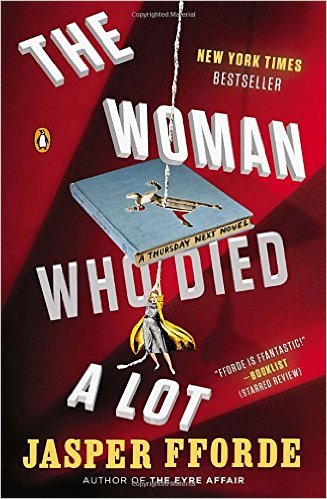
FfordeWomanDiedJasper Fforde is one of those writers who blends nonsense, deep thought, constant plot twists, and polished writing into compelling novels. His labors are always fun to read and often leave me with something profound to ponder. I haven’t followed his Thursday Next stories in any kind of strict sequence, but I figure that I can sacrifice a few of his abundant references to previous events to read through the latest installment I can get my hands on. The Woman Who Died a Lot was the most recent of these books for me. Thursday Next is a literary detective and her exploits often lead, certainly intentionally, to a feeling that in Fforde’s world libraries and reading are even more than fundamental. Everyone wants to be prided on literary achievement. His universe wouldn’t exist without books and those who love them.
In The Woman Who Died a Lot (and since I haven’t read all the books in the series I have to confess that this theme might’ve been developed earlier) in Fforde’s Swindon, religions have been united into the Church of the Global Standard Deity (GSD) and this GSD drives much of the plot. As Thursday races to solve the latest literary crime, the GSD has decided to smite Swindon. A number of global smitings have already taken place and everyone knows what to expect. A plasma-like discharge, of precise dimensions, wiping out a specified sinful part of the city. The sin here is greed and such smitings have lead to new kind of tourism where the morbidly curious gather outside the boundaries to watch the show, much like Jonah outside Nineveh. As in most Fforde novels there is both a touch of ridiculousness and social critique combined here. I can’t tell you how the smiting ends or you might not read the novel yourself.

The story is populated with peculiar religious orders that always evoke a laugh, and even a Ministry of Theistic Defense charged with finding a way around the smiting of a God willed into existence by the very people the GSD will destroy. I sometimes wonder if Fforde was ever a seminarian. We fabricate our own doom in this literary universe. It’s all in good fun and is reverently irreverent. Virtue is rewarded and in many respects the religion is conventional. The deity can be bargained with, but the law, once laid down, is inviolable. Casuistry is, of course, always an option. It’s a story told with tongue solidly in cheek, but also with brain fully engaged. Fforde is an author not afraid of religion. Indeed, he knows it can lead to a remarkable plot with consequences that will leave a reader scratching one’s saintly head.


The Canine Mystique

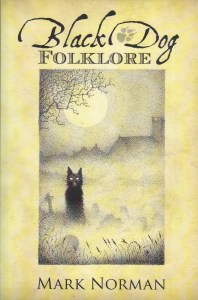
BlackDogAnyone who spends long enough in the United Kingdom will hear about them. Not everyone believes in them, but reports of their presence are pervasive. Some call them ghosts while others call them protective spirits. They are the black dogs. As Mark Norman points out in his new book Black Dog Folklore, the tales of these spectral canines go back centuries and they also appear in other parts of the world. The majority of the lore comes from the British Isles and even there they are concentrated into certain parts of the country. Norman isn’t setting out to prove that they exist, though. This book is an exploration of folklore and the question of the reality of the phenomenon isn’t the point. The fact is people have reported encountering similar kinds of black dogs that vanish in similar ways frequently enough that secondary characteristics can be described and the accounts can be treated as lore.

Dogs were the earliest domesticated animals. Long before cattle and sheep could be tamed, humans and dogs had learned the mutual benefits of each other’s company. This very long association between species has, however, not always been smooth. Dogs retain something of the ancestral wolf in their nature, even as we harbor our inner ape. Some people fear dogs, and indeed, dogs are still used for security and can be trained to attack, or even kill, people. Their millennia-long association with humans, however, has assured them a place in our mythologies. Ancient cultures frequently mythologize dogs, making them prime candidates for an afterlife in folklore.

Traditionally, dogs are chthonian creatures. That word tripped me up the first time I encountered it. “Chthonian” is literally something like “of the earth,” but in mythology it is used to designate that they are associated with the underworld. As in life, dogs may act as guides in mythology, and one of their regular associations is with the realm of the dead. It’s no wonder, then, that dogs came to be associated with ghosts. As Norman demonstrates, the lore was pervasive enough to engage Sherlock Holmes in The Hound of the Baskervilles, and perhaps even Bram Stoker used the image in Dracula. Winston Churchill referred to his depression as a black dog. Norman’s book won’t convince the reader that such things actually exist, but what it does do is draw the tales together to determine what there is to analyze. Since dogs have been our companions for so long, they have become part of our narrative tradition, participating in what it means to be human. As with all good folklore, there are those today who still swear these spectral dogs still haunt those who are willing to believe.


Consciousness Times Eight

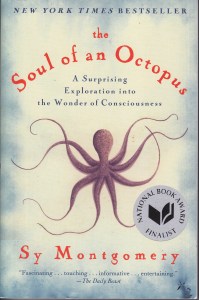
SoulOctopusPerhaps the characteristic that marks our species most distinctly is its arrogance. Conscious of who we are (we think) we stake the claim for minds for ourselves alone while all the evidence points away from that very conclusion. Naturalists are castigated for “anthropomorphizing” animals by stating that they have consciousness too, or—oh the heresy!—personality. Any of us who’ve spent time with two or more of the same non-human species, however, know that personality is a given. Animals think and feel and, yes, act on their own view of the world. I have to admit I fell in love with Sy Montgomery’s The Soul of an Octopus. I’ve read animal books from my youngest days, but finding an author so forthright about the feeling of getting to know another species is rare. And I learned tentacles full of information about octopuses. I had already known that octopuses are intelligent—I hadn’t realized just how smart—but since my interactions have only been with sleeping cephalopods on the opposite sides of aquaria glass, I had little to go by.

Throughout her charming book, even if the evidence is anecdotal, Montgomery reveals the personalities of the octopuses she got to know at the New England Aquarium. The reader can be left with no doubt that these are animals with personality, different from one another and strikingly conscious. We can’t define what consciousness is, but I tend to agree with Montgomery that it is what many people call “soul.” She admits that her religious tradition would likely frown upon her willingness to share such a valued commodity with an animal—an invertebrate, no less—but surely she is right. Many, if not all, animals have a form of consciousness. Heaven will be a much more interesting place for it.

Please don’t confuse my enthusiasm with sentimentalism. Those of you who regularly read this blog will know that books on animal intelligence by a variety of scientists make up a steady part of my literary diet. Biology, however, often has a difficult time in a world where physics and chemistry are treated with reductionistic glee. I was strangely satisfied when Montgomery mentioned that Stephen Hawking signed the Cambridge Declaration on Consciousness which proclaims humans alone are not the guardians of this phenomenon we don’t even understand. The Soul of an Octopus was one of those books that I couldn’t wait to keep reading, even if it meant being on my long commute each day. And I can’t help but think of how much intelligence we squander by claiming that only our own kind possesses it.


Up, Up and Away

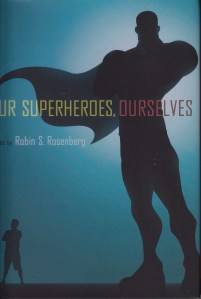
OurSuperheroesIntellectuals often have difficulty, it seems, taking popular culture seriously.  I remember feeling slightly guilty taking a class on Science Fiction in college and actually getting credit for it.  At the time—I remember the Dark Ages—a course on comic books, or even superheroes, would’ve been laughed out of the academy.  And not in a good way.  Monsters, likewise, were considered the opiate of the small-minded.  I’m not sure what happened to turn all of this around, but I think my generation growing up may have had something to do with it.  Scholars began to pay attention to more than the cheap paper and eye-catching, if impractical, costumes.  There were, unnoticed by standard readers, messages embedded in comics.  Superheroes may have been telling us something about ourselves.  Now tenured professors can write about various caped crusaders without fear of ridicule.  Some of the books are quite good.

Robin S. Rosenberg’s Our Superheroes, Ourselves, is a rare example of a uniformly fascinating edited volume.  Contributions from a variety of psychologists and psychologists explore several of the deeper aspects of  the superhero phenomenon.  Insightful and thought-provoking, this little book gives the lie to the frequent admonition of my youth that reading such things was a waste of time.  Anything but.  Now, I didn’t have the level of commitment to comics that Big Bang Theorists do, but I recall being entranced by much of what I read.  Some comic panels are still vivid in my head, although I haven’t seen the original in more decades than I’d like to admit.  They are, as one of the essays suggests, a form of modern mythology.  Another form of modern mythology is the movie.  Superhero movies are discussed as well as the print versions.  These cheap, easily read books were more, it seems, than meets the eye.  I’ve fallen a little behind in my superhero movies, but perhaps it is time to start trying to catch up with Superman.

What is really striking, to me, is the discussion of super-villains.  As more than one contributor points out, you can’t have a superhero without the nemesis of an arch-criminal.  This quite naturally leads to the discussion of abstracts: good and evil.  Early comics tended to be Manichaean in this regard.  In our world evil may be much more subtle than it appears on the outside. The book appropriately ends with a reflection on morality. More than one ethical system may be found in superhero tales. Super-villains, apart from becoming role models for some political candidates, allow us to explore our own dark sides. In the end, however, we know that Batman must overcome the Joker, no matter how appealing he may be.


Biblical Literature

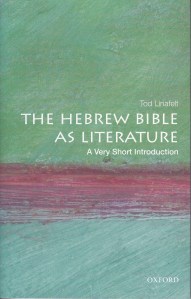
HB as LitIt must be difficult to write a Very Short Introduction. Although the series is published by Oxford University Press, I’m not being a shill. As someone who writes the equivalent of several of these little books a year, I imagine it must be nearly impossible to confine what you need to say to such a small space. I recently read The Hebrew Bible as Literature: A Very Short Introduction, by Tod Linafelt, and I imagined the anguish of my colleague as he had to decide what to leave out. Professors these days appreciate short books because there is an actual chance that students might read them. The Bible itself is intimidating as a textbook—massive and brooding as it is. Then, in addition to the Ding an Sich, the instructor also has to provide interpretive tools. One of the most common these days is that of the Bible as literature.

This obvious assignment is not without dispute, however. Literature is defined by some as a secular category. The Bible, as a set of one, is a holy book. That is to say, it can’t be considered literature at all. As a collection of written texts, however, the Bible can be understood as a literary venture as well as a sacerdotal one, and for many schools this is the only way the Bible can be legally taught. Not only that, but almost all scholars now realize that, protestations aside, the Bible is literature. It is one of the great books of the western canon. Civilization for huge swaths of the planet was based, in some way, on this book (the Bible, that is). Understanding it as literature is the venture of a lifetime, and condensing that down to an easily digestible Very Short Introduction is no mean task. Linafelt performs his duty admirably. The basics of prose and poetry are covered, as well as their interaction. The examples he chooses are compelling and I learned quite a bit myself, even having taught the Bible many years.

As I read, it struck me that the main objection to the Bible as literature revolves around the concept of truth. Linafelt raises this question early, and it stayed with me throughout the book. In a kind of sacred exceptionalism, “Bible believers” treat literature literally. Ironically, this can lead to grave misunderstandings. Truth, however, is a difficult concept to pin down. Many people equate literature with fiction and truth with fact. Truth is actually a bit more fluid than that. As any poet knows, some truths can’t be expressed in prose. Or history. Or philosophy. And some truths are best expressed in fiction. That brings us back to literature as a form of truth. I suppose that’s a good thing too, because were I to write much more I might be in danger of accidentally composing a Very Short Introduction. As long as I’m being a shill, just consider this a very short introduction to a Very Short Introduction.


For the Dogs

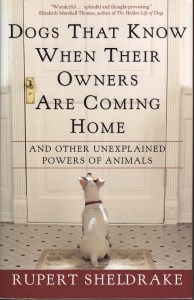
DogsThatKnowYou know that feeling of being dropped into a very strange place?  Sure, it’s disorienting for a while, but once you get used to it, you start to enjoy your surroundings.  Now ask yourself: what if my entire way of looking at life is based on a faulty paradigm?  Many, I suspect, will drop out at that point.  There’s strange, and then there’s going too far.  For those wedded to the idea of finding the truth, however, weirdness is part of the journey.  I just finished reading Rupert Sheldrake’s Dogs That Know When Their Owners Are Coming Home.  Yes, it felt like the room was spinning (actually, I read it on the bus, so that might’ve been true a time or two), but it confirmed something I’ve suspected for many years.  The reigning, mechanistic universe paradigm is wrong.  Please don’t take this as an anti-science statement.  Sheldrake is a bona fide scientist, and I’m an avid reader of science books.  It’s not so much that science is wrong as it is that science doesn’t go far enough.  Ever since the Industrial Revolution—not coincidentally—we’ve been informed that the universe is really a giant machine.  We can figure out how it works using this squishy stuff in our heads that insists we can find Pokemon everywhere we look when it’s not busy solving the riddles of the mulitverse.

Sheldrake, who is given a wide berth by many scientists, states what any of us who grew up with pets knows: they know more than they’re saying.  Admitting up front that much of the evidence is anecdotal, Sheldrake provides empirical studies to demonstrate what folk say.  Dogs do know when their owners are coming home, before they are within sight, hearing, or smelling range.  His study, however, isn’t limited to dogs or to knowing when someone’s coming.  Animals, by virtue of their own minds, have abilities that we do not.  Since they don’t speak our language, we assume they are dumb.  In fact, as this book shows, a great many animals know a great deal more than we do.  The question is, if this is the truth why don’t we hear more about it?

We prefer, it seems, our truth to be qualified.  There’s a lot at stake here.  The reigning paradigm keeps us plugged into this corporate machine we’ve devised.  Our lifestyle cannot subsist without the subordination of animals.  We can’t give them abilities we lack, apart from tastiness.  If the universe isn’t a machine, it might open the door for a broader view of reality.  Maybe it is better to be post-Christian, but religion has proven benefits to humans (and perhaps animals).  Why does religion remain in a mechanistic universe?  Perhaps what we call “souls” are the same as “minds” and perhaps they aren’t the same as brains.  If we really do have minds, it is in our best interest to care for them, develop them, and improve them.  It may seem like a strange world indeed where your dog informs your view of reality.  Read Dogs That Know When Their Owners Are Coming Home, however, and see if you don’t find yourself wagging your tale, just a bit.


Nazi Religion

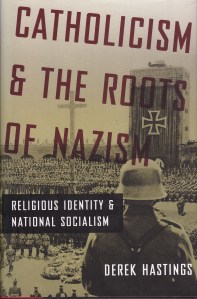
CatholicismRootsAs a lifelong pacifist, I’ve never been a fan of war books. Indeed, war seems to be to an utterly useless waste of life and a source of herculean suffering. The fact that wars happen, and books about them depress me, causes me to avoid them. Still, Derek Hastings’ Catholicism and the Roots of Nazism is less about war and more about, as the subtitle phrases it, Religious Identity and National Socialism. As I read through this history of the early Nazi movement, it occurred to me that this was probably the first actual book I’ve ever read about it. My knowledge of the Nazis had previously come from articles, movies, and documentaries. And Hogan’s Heroes. Being largely of germanic pedigree, I suppose I bear some residual guilt. I have to remind myself that my ancestors had left Europe before Germany had even existed as a unified state. I like to think they would’ve left during the rise of the Nazis, if they hadn’t already left generations before.

In any case, I had no idea of how the Third Reich dealt with organized religion. I have heard anecdotal opinions from time to time that the Catholic Church should have been stronger in its condemnation of the atrocities that wartime Germany perpetrated, but I had no sense of their official outlook toward each other. Hastings makes clear that although Catholicism and Nazism came to distrust each other implicitly, at the beginning of the Nazi movement they were considerably more chummy. In fact, anti-Semitism was something they had in common. Many of the early member of the party were Catholics—some of them priests—who felt an accord with the developing ideology. As Hitler’s rise to power increased, his personal antipathy to Christianity widened the growing gap between his own outlook and that of the early Catholic Nazis.

The book has no schadenfreude for the church, however. This is academic history. As Hastings notes, few studies have focused on the early developments of Nazism. In today’s political climate, that struck a chord with me. It seems vitally important to be aware of how such movements start so that we can recognize them as they attempt to rise again. I have little confidence, reading the news, that we are any better in the 2010s than people were in the 1920s when political instability, economic distress, and hatred of those who were different led to a reactionary, fascist regime. Could it happen again? I look around at a culture in love with guns and endless, selfish gain, and distrust of those of different ethnic origins and I wonder. The early stages are, I think, the most crucial to recognize. Surely no German Catholics could’ve anticipated just what Nazism would become.


Joban Vampires

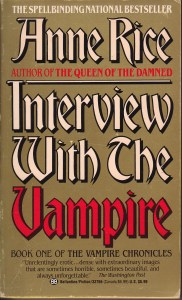
Interview VampireThe first vampire novel I ever read, I remember correctly, was one of the Dark Shadows series written by Marilyn Ross. I don’t recall which one, since I had to buy my books from Goodwill or some such vender utilized by the poor. Now, I’m really a squeamish guy and the sight of blood bothers me. Barnabas Collins, however, was a compelling character—deeply conflicted and a reluctant vampire. The combination of his sadness and the setting in coastal Maine kept me looking for Dark Shadows books every time we went shopping. It surprised me, given all that, that I had such difficulty getting into Anne Rice’s Interview with the Vampire. I started reading it years ago (it was also a second-hand copy, and, interestingly, the color scheme of the cover nearly matched Dark Shadows novels) and some eighty pages in put it down only to forget about it. Starting from the beginning a few weeks ago, I gave it another try. Although Louis is a conflicted vampire, the pace is languid and it was almost as if the self-pity was overdone. I was determined this time, however, to see it through.

One of the recurring themes of the book, and I presume the Vampire Chronicles series, is that vampires are not evil because of the Devil. In fact, there is nothing Satanic about them. Blame tends to fall on God for their state. The more I thought about it, the more the theodicy of the vampire began to resemble that of Job. Like Job, death for a vampire takes a long time. There is much suffering along the way. Louis can love, in a measure, and can loath himself. He never really understands what it is to be a vampire. The other undead he meets help to define him, but he can’t get too close. His life is a kind of Hell without Satan.

Rice’s vampires don’t fear crucifixes or shun churches. In fact, Louis takes a priest as one of his victims, sacramentally near an altar in a church. Religious imagery and discussion abound in the book. It truly is a vampire theodicy. Perhaps, for its day, it was the next step in vampire evolution. Bram Stoker, while the most famous contributor to the modern vampire myth, didn’t corner the market on defining the undead. When Louis meets vampires of the old world, they are mindless, plodding killing machines that even other vampires avoid. Rice’s vampires feel, think, and yes, theologize. I feel strangely satisfied now that I’ve finally finished the Interview. It was a vampire at my bedside for so long that it feels like an accomplishment to have finally laid it to rest.


Kidnapped by Religion

The title is, unfortunately, not mine. My wife sent me a story on NPR entitled “Humility Is Embedded In Doing Science, But What About Spirituality?” by Barbara J. King. The piece is largely an interview with physicist Marcelo Gleiser about his new book, The Simple Beauty of the Unexpected. Of course, now it’s on my reading list. The interview treads the well-worn path of science versus religion. Science is presented as humble (which I don’t doubt, when in the right hands—or the right minds, rather) while religion is arrogant, claiming to know everything. Gleiser states that spirituality has been “kidnapped by religion” but still has a place in the life of a scientist. I wish there were more of them like Gleiser.

Now, I have to admit my data are limited. I read science books—I have since I was a teenager—but with a layman’s eye. My scientist dreams were dashed against the unyielding rocks of complex mathematics, something evolution cruelly withheld from my gray matter. I wouldn’t have survived high school pre-calc without my younger brother’s help. I’ve nevertheless read the pre-chewed, partly-digested science regurgitated for the formulaically challenged, and find myself, like Glieser, awed at the wonder of it all. Still, I also find many scientists—at least those with the loudest voices—claiming that what they’ve discovered is all there is. There is only matter, and we with our three-pound brains have figured it all out, by the gods, without the gods! We know all that can possibly be known will conform to the system our brains have developed, and there are no gods out there and no spirits in here and that pang you’re feeling in your gut is merely physiological, not spiritual.

I haven’t read The Simple Beauty of the Unexpected, but I have found many scientists walking the same trail I’m on. We are those who are seeking the truth, and who don’t assume the answers. Religion need not be arrogant. At its best, it’s not far from science. As a species, we have developed rationality extremely well (even if we fail to use it). Much of biological existence, however, is emotion, or feeling. That we sometimes leave behind. It participates in reality as much as rationality does. I’m reminded of this every time I hear someone in the business world refer to “soft” skills. What mere humans bring to this rationalistic business of making money. We’re just the squishy stuff that CEOs can’t live without because wealth mean nothing if you can’t compare it to someone else’s. Humility? I agree, Dr. Gleiser, we must maintain a sense of wonder. For those of you who say we’re just a number waiting to be quantified, I would humbly ask for 42, if it’s not already taken.

DSCN0633