Re-Ruins

I discovered Scott B. Smith’s The Ruins after having seen the movie version.  The film is scary but the book is scarier.  I wrote about the movie last year, so I won’t worry about spoilers here.  I will say that even with its bleak ending the film has a happier resolution.  If you read my post, and remember it, the following summary may not be necessary, but here goes: two couples and two friends vacationing in Mexico set off in search of one of the friends’ missing brother.  They travel to a very remote location and discover that the missing brother is dead.  Worse, that he was killed by the natives for trying to escape a vine-covered ruin.  The vine is carnivorous, and, unlike in the movie, clearly intelligent, and sentient.  It tricks the young people into harming themselves and then it begins to eat them.  It especially preys on open wounds, but it can smother a person if it so desires.

The book is full of tension.  Although a couple of injuries take place early on, it’s over halfway through before someone actually dies.  And the others don’t follow quickly.  The narrative asks probing questions about ethics and mercy.  When (if ever) is it okay to kill someone who clearly has zero chance of survival?  Is it still murder?  Complicating things, for me, was the fact that I couldn’t remember clearly how the movie ended.  Eventually it came back to me, but this is one of those cases where the film and book, although with the same writer, diverge a bit.  The characters are clearly sketched here but defy expectations and stereotypes.  And it is sometimes the case that you aren’t sure who might be telling the truth and who might be trying to protect themselves through prevarication.

An effectively written novel, it had me looking askance at plants from time to time.  We have a quite aggressive vine in our yard that seems determined to be the Trump of all the plants.  I suspect someone planted it long before we moved in, unless it’s simply a successful exploiter of happy happenstance.  I’ve tried uprooting it every year, but I can’t seem to get to the brain of the operation.  It’s easy to believe that if plants were sentient, and could move a bit faster than they tend to, that such a scenario as in The Ruins might unfold.  The question remains whether the local Mayans simply can’t eradicate it or if they might indeed have some worshipful regard for it.  The two may end up being nearly the same thing as human power is unable to tell nature what to do.


Hugo’s Invention

After watching Hugo, and wishing that the story were history, I found a copy of Brian Selznick’s The Invention of Hugo Cabret.  Martin Scorsese’s adaptation is fairly close to the book but there are, of course, additions and omissions.  One key character is left out and some subtleties to the book didn’t find their way obviously into the movie, or at least not until having read the book.  The story of Georges Méliès’ life in the book is largely accurate.  Hugo, however, and Isabelle, are fictional.  As is the automaton around which the story is based.  The lovable train station vendors in the movie are quite a bit less lovable in the book.  And the station inspector isn’t shown until late in the story and he doesn’t have the leg brace that lends a kind of steampunishish vibe to the film.

Apart from being a tale of redemption—in real life Méliès’ rediscovery didn’t lead to an end of his poverty—the story is an exploration in psychology.  Méliès lost his dream job due to competition after the First World War.  The book makes clear that the clicking of heels drives him to rage because his films were reputedly melted down to make shoe heels.  The story in the book goes so far as to say that ghosts follow those who clack their heels loudly.  The ghosts, of course, are those of Méliès’ lost success as a filmmaker.  One of the reasons this story appeals to me is that I too lost a job that gave my life a sense of purpose.  My writing largely does that now, even if it doesn’t sell.  I can relate to a man who is ready to retire but can’t, daily reminded that he once had a satisfying job but now has to sit behind a desk all day.

The Invention of Hugo Cabret is a book for younger readers.  About half of the book’s 500-plus pages are illustrations.  The images include stills from Méliès’ surviving films, but mostly drawings by Selznick.  The focus on the young people makes this a children’s book, but the truths it tells of adults with lost dreams are especially appropriate for those who’ve learned that life isn’t always kind to dreamers.  The book, like the movie, inspires me to seek out the surviving films of Georges Méliès and think of what can indeed happen to those who dare to dream, even when the world has already discarded them as irrelevant.


Storytelling

Those who know me personally say that I’m a good storyteller.  My own head houses, however, my harshest critic.  Since I tend to work alone this creates an inherent conflict.  This is most evident in my fiction.  I finished a draft of my eighth novel earlier this year, but it still needs work.  (No, really it does—not just harsh critic speaking.)  Part of the problem is obviously time.  My morning writing period is frequently held hostage by my moods.  Some of my past novels are, I think, publishable.  I’ve tried repeatedly with one of them, getting as far as having a signed contract, but things collapsed after that.  It sits brooding on my hard drive.  Another—I think it may be number four or five—seems publishable but it requires reworking with magic pixie dust.  Sometimes my supply of it runs low.  (Moods again.)

I sometimes wonder if I read too much nonfiction.  I’m a curious sort of chap, interested in the world around me.  When that world seems to be falling apart, however, fiction is my friend.  I’ve been reading a lot of novels and I’m often struck by the beauty of the prose.  Head critic says, “why can’t you do that?”  Then I recall the writing advice that I picked up from Stephen King’s nonfiction, On Writing.  Adjectives may be bad for your health.  Just tell the story.  With style.  My current novel (eight) tells an interesting story, I think.  If I’m honest I’ll say that I started working on this before any of the other completed novels (except number one, and that was a throwaway).  It was an idea that just wouldn’t go away.  I knew the beginning and the ending, and part of the middle.  I even found a potential publisher, but it has grown too long for them.

About three chapters from the end I realized that I hadn’t tied things up as well as I’d initially thought.  What I need is time away from work to think about it.  Thinking time is rare, even in the time I manage to wrestle from the 9-2-5.  There’s always more to be done, trying to stay healthy and out of the weather.  And really, maybe I should be reading even more fiction.  But what about the “real world” out there, which requires nonfiction to face it boldly and with informed decisions?  It’s dramatic, isn’t it?  Like a protagonist (hardly a hero) on the edge of a cliff.  How does the story end?  Perhaps an actual storyteller might know.


Nanowrimo Night

Nanowrimo, National Novel Writing Month—November—has been run by an organization that is now shutting down.  Financial troubles and, of course, AI (which seems to be involved in many poor choices these days), have led to the decision, according to Publisher’s Weekly.  Apparently several new authors were found by publishers, basing their work on Nanowrimo projects.  I participated one year and had no trouble finishing something, but it was not really publishable.  Still, it’s sad to see this inspiration for other writers calling it quits.  I’m not into politics but when the Nanowrimo executives didn’t take a solid stand against AI “written” novels, purists were rightfully offended.  Writing is the expression of the human experience.  0s and 1s are not humans, no matter how much tech moguls may think they are.  Materialism has spawned some wicked children.

Can AI wordsmith?  Certainly.  Can it think?  No.  And what we need in this world is more thinking, not less.  Is there maybe a hidden reason tech giants have cozied up to the current White House where thinking is undervalued?  Sorry, politics.  We have known for many generations that human brains serve a biological purpose.  We keep claiming animals (most of which have brains) can’t think, but we suppose electrical surges across transistors can?  I watch the birds outside my window, competing, chittering, chasing each other off.  They’re conscious and they can learn.  They have the biological basis to do so.  Being enfleshed entitles them.  Too bad they can’t write it down.

Now I’m the first to admit that consciousness may well exist outside biology.  To tap into it, however, requires the consciousness “plug-in”—aka, a brain.  Would AI “read” novels for the pleasure of it?  Would it understand falling in love, or the fear of a monster prowling the night?  Or the thrill of solving a mystery?  These emotional aspects, which neurologists note are a crucial part of thinking, can’t be replicated without life.  Actually living.  Believe me, I mourn when machines I care for die.  I seriously doubt the feeling is reciprocated.  Materialism has been the reigning paradigm for quite a few decades now, while consciousness remains a quandary.  I’ve read novels that struggle with deep issues of being human.  I fear that we could be fooled with an AI novel where the “writer” is merely borrowing how humans communicate to pretend how it feels.  And I feel a little sad, knowing that Nanowrimo is hanging up the “closed” sign.  But humans, being what they are, will still likely try to complete novels in the month of November.


No Ordinary Picnic

I will be including spoilers in this review, so please be advised!  Joan Lindsay’s Picnic at Hanging Rock is a novel that began as speculative but then turned naturalistic.  Mostly, anyway.  Born in 1896, Lindsay published the novel just after she turned 70.  Since she was Australian, it stands to reason that the story is set there.  Hanging Rock is an actual place and, according to multiple sources, Lindsay ended the book with a speculative chapter that explained the mystery.  What is the mystery?  On Valentines Day 1900, the girls at Appleyard College set out for a picnic at, well, Hanging Rock.  While there, three of the girls and one of their chaperones disappear.  Since everyone travels by literal horse power, getting back and forth from the scene of the mystery takes hours.  The head mistress of the college is frantic, mostly because she’ll be losing tuition because of this.

Eventually one of the girls is found, somewhat mystically, by a young Englishman with whom a romance starts and seems to end abruptly.  The found girl remembers nothing of what happened that day.  Further investigations are held, but the mystery is never solved.  Meanwhile, Mrs. Appleyard, the mistress of the college, takes a strong dislike to one of the girls who was devoted to one of the missing.  After one of the girls’ governesses, recently dismissed, burns to death, the headmistress appears to have murdered the girl she disliked (or she fell/jumped from a window; the novel isn’t explicit on the point).  Mrs. Appleyard, realizing she is ruined, goes to Hanging Rock where she dies by suicide, throwing herself down the rocky side of the outcropping.  The speculative ending—no longer part of the novel—had the missing girls disappear into a kind of time warp.  Lindsay’s editor had her remove that chapter.

The novel became quite well known in Australia, and to the wider world when a movie was made from it.  The interesting thing is that the novel presents itself as describing factual events, like the Blair Witch Project.  This is so much the case that the rumor grew that the events really did happen.  A book was even written, suggesting a solution regarding what happened to the missing girls.  Had the excised chapter been published with the book, it would’ve been clear that this was a fictional tale.  Lindsay had a savvy editor, however.  Nothing sells like a dramatic story that readers believe to be true.  Witness The Amityville Horror.  Even though naturalistic, a bit of the speculative still hangs about the story, making for a good gothic novel without a firm resolution.


Dead, Not Sleeping

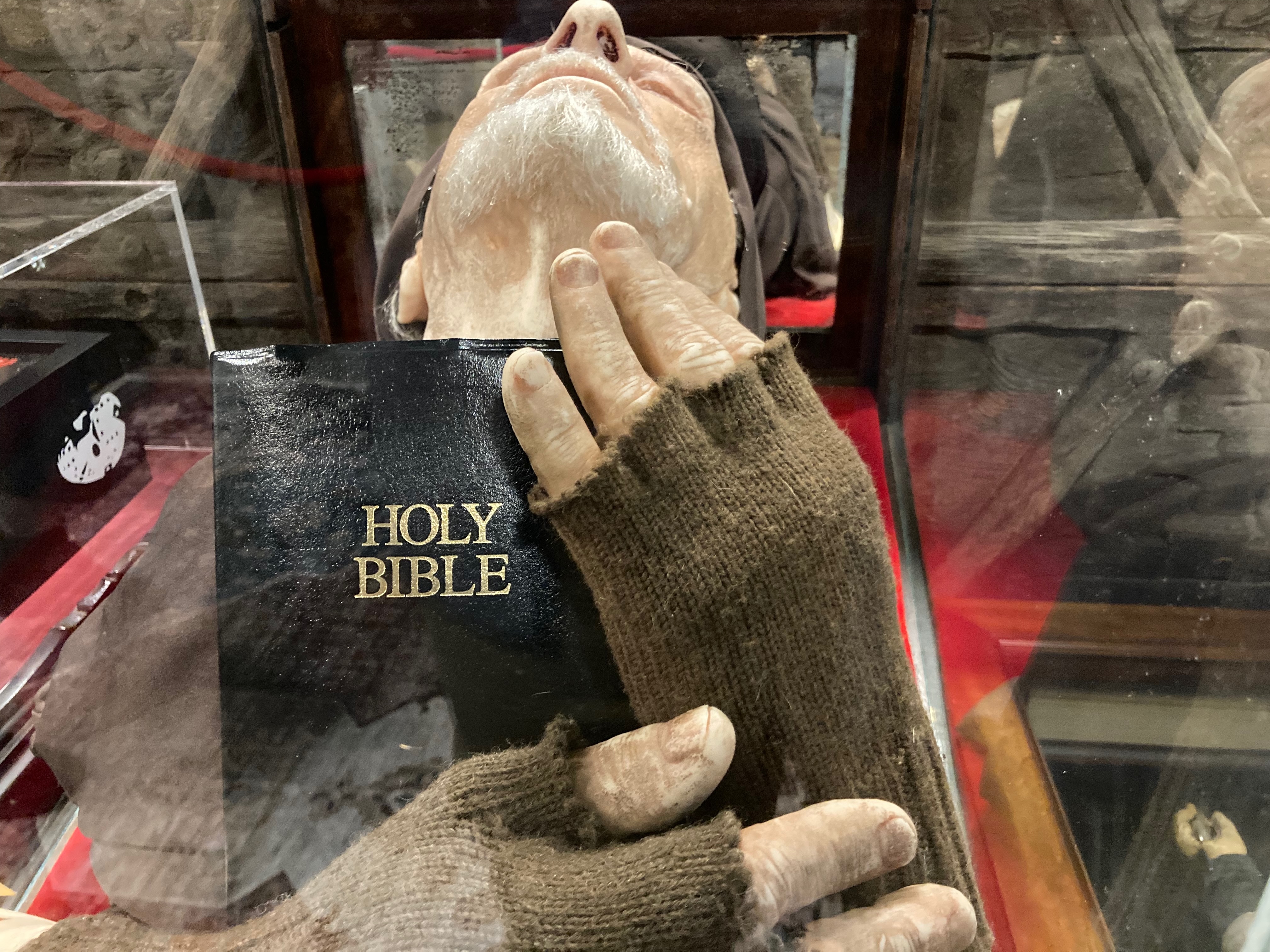
A Nightmare in New Hope is a fairly intimate space.  The owner told us that the collection will change and grow, given that he’s still collecting.  Having a particular interest in Tim Burton’s Legend of Sleepy Hollow—having a book (ahem) on the subject coming out soon (cough)—I was particularly anxious to see what props they had.  To make sense of this it helps to have seen the movie, but you’ll catch on, even if you only know the Disney version of the story.  There were three main items from the movie that they have on display.  One is the wax seal used for the Van Garrett will, used as the movie opens.  The seal is quite large.  Of course, movies substitute props from time to time, blended by celluloid magic.  CGI doesn’t leave as many tracks.

The second artifact is one that wouldn’t have occurred to me to have even existed.  This was the animatronic horse’s head for Daredevil, the Headless Horseman’s mount.  There are a couple scenes in the film involving horse acting, and I’d just assumed that trained animals were used.  Being up close and personal with this artificial head, a couple thoughts came to mind.  One is that right next to it, it’s quite obvious that it’s artificial.  The second thought was just how much thought and effort goes into a big-budget movie.  For a few seconds of a close-up horse head, this model had to be constructed and used and then set aside.  I asked the owner about how such things were acquired, and he noted that production companies don’t keep everything.  He also noted that movie artifact prices have skyrocketed.  Both because horror is now popular and because CGI, as noted, doesn’t leave tracks.

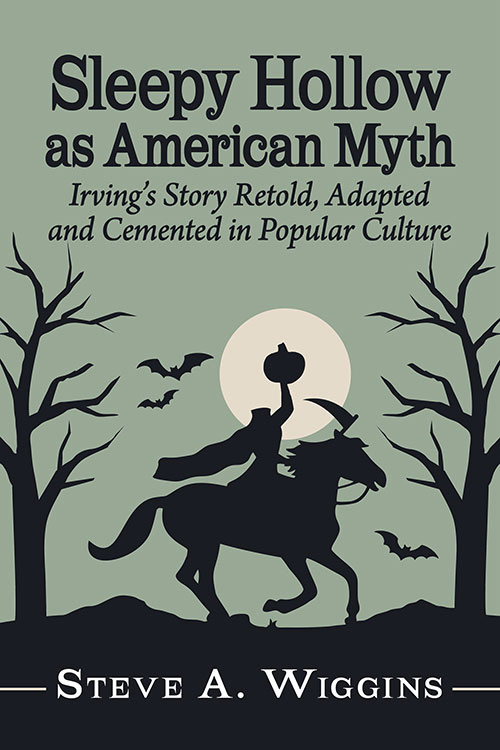
The third, and most proudly displayed Sleepy Hollow piece is the Headless Horseman’s sword.  This appears in the movie far more often than either Daredevil’s head or the wax seal.  One of the aspects of Washington Irving’s story I discuss in Sleepy Hollow as American Myth is that the Horseman’s weaponry changes over time.  I won’t say more since, like museum owners, those who write books hope that they well sell a few copies.  I’ll be revisiting A Nightmare in New Hope from time to time.  For the items on display, I’d seen probably 90 percent of the movies, and a few of them I’d discussed in some detail in either Holy Horror or Nightmares with the Bible.  Of course, the Sleepy Hollow book is forthcoming (ahem).


A Father’s Day

Some thoughts I hope I’m allowed to share on Father’s Day: I recently saw a review of The Wicker Man that pointed out (rightly) that my treatment of gender was outdated.  Similarly, the (few) readers of Nightmares with the Bible make a not dissimilar observation about my use of Poe’s formulation of women in danger.  I am very much aware that gender studies (which wasn’t even a potential major when I was in college) have done much needed work in clarifying just how complex a phenomenon it is.  I have posted several times on this blog about precisely that.  Still, we all write from a position.  My training is not in horror studies, and it’s not in gender studies.  My writing, despite the price, is intended for non-academic readers, but I too may be between categories here.  I’m trying to escape the academy that has already exiled me, but the framing of my questions is too academic.  I get that.

I also write from the perspective of a man. There’s no denying that I write as a straight, white male.  This is how I experience the world.  And how I experience horror.  Returning to Nightmares, I think my point might’ve been better expressed as noting that writers, directors, producers, and others in the film industry understand that viewers of their particular films may be more moved by a female possession than a male.  Or, in Wicker, that publicly expressed concerns about rape and sexual violence are more commonly expressed by women.  Statements can always be qualified, but that happens at the expense of readability.  There’s no such thing as a free lunch after all.

Academics can’t be blamed for doing what they do.  They critique, poke, and probe.  My books since Holy Horror have been intended as conversation starters.  But they’re conversation starters from the perspective of a man who watches horror and tries to understand why he reacts to it the way he does.  There is an incipient ageism, I fear, that sometimes discounts how people raised to use “man” when referring to mixed or indeterminate genders—taught so earnestly by women who were our teachers—sometimes take our earliest learning for granted.  Those early lessons are often the most difficult to displace.  I try.  Really I do.  I’ve had over six decades looking at the world through a straight man’s eyes.  I welcome comment/conversation from all.  Of course, my intended readership has never been reached, and they, perhaps would have fewer concerns about my view.  Romance (hardly a feminist-friendly genre), after all, is one of the best selling fiction categories, even today.  And many of the writers—generally women—express the gender-expected point of view. That’s a genre, however, outside my (very limited) male gaze.


Night Voices

So this is really why I watched The Lady in the Water.  A friend had recommended The Man Who Heard Voices: Or, How M. Night Shyamalan Risked His Career on a Fairy Tale, by Michael Bamberger.  The book was published in 2006 and I found a “very good” used copy on sale for six bucks.  It’d been on my to read list for a year or two.  The book arrived and I discovered it was about a Shyamalan movie I’d never heard of.  I have friends who refuse to even mention his The Last Airbender.  (I’ve seen the original animated version and it’d be difficult to think a movie would improve on it.)  Indeed, The Lady in the Water was a box office disappointment, and The Happening (which I kind of like) and The Last Airbender were critically castrated.  M. Night Shyamalan’s name does draw crowds, but I prefer his horror to his fantasy, but that’s just me.

In any case, reading Bamberger’s book was like cinematography 101.  It’s a nonfiction account of how this movie was made, written by a sports writer also from the Philadelphia area.  He begins by narrating how he met Shyamalan at a party.  How that meeting led to the idea of writing a book about his movie-making process.  Lady in the Water isn’t Shyamalan’s best work, but this book goes through how terribly personal the project was to the writer-director.  It’s a gripping account, especially for those who try to create any form of art.  It also gave me a renewed respect for what Shyamalan tries to do with his movies.  Early career success made him rich, and then he was in a place to follow his dreams.  Or bedtime stories.  Of course, a book written nearly a two decades ago couldn’t project where Shyamalan would be today.

His career surged again, beginning with The Visit—definitely creepy—and has continued to ride fairly high.  Although I haven’t seen all his films, I was interested enough to read about his creative process.  Although The Village wasn’t as highly regarded as The Sixth Sense or Unbreakable, it’s still my favorite among his movies.  Part of that is because it was the first of his films I saw.  It was recommended to me by my brother, which also helped.  Mainly, that movie made me trust Shyamalan as a writer-director.  I’m not sad to have seen The Lady in the Water so that I could read a book about it.  The whole thing was a lesson in creativity.


Hop In

Especially the first part, of Mona Awad’s Bunny, is so well written I almost laid down my pen for good.  I really enjoyed this one.  Once the story gets deeper, into the second and third parts, questions begin to arise as to what’s going on.  One reason for this is the story becomes speculative in nature and Awad’s not about to give away what’s “really happening.”  Set among a set of five graduate students at the prestigious Warren University (the name is a hat-tip), the novel is often considered dark academia.  It starts out pretty light, and although Awad maintains her deft hand, it grows progressively darker as the tale goes on.  Samantha Heather Mackey is enrolled in the writing program with a cohort of four “perfect” women—the kind many guys go for.  Sam’s an outsider, though, writing dark and troubled stories while her classmates garner the professor’s praise.

The “perfect” women call each other “Bunny” and they eventually invite Sam into their clique.  This annoys Sam’s best friend and sometimes roommate, a local artist who isn’t a student.  But Sam is caught.  She learns that the Bunnies actually transform rabbits into their ideal boyfriends.  They haven’t got the process down pat, though, and the resultant hybrids often have various deformities.  Sam is the only one who can’t do this transformation.  Until she does.  But it doesn’t turn out like anyone expects.  I’d better draw my plot summation to a close there, otherwise I might hop into spoiler territory.  I wouldn’t want to do that because I recommend reading this one for yourself.  Awad’s writing is beautiful and compelling.  I did wonder if I’d interpreted everything correctly when I finally put the book down.

Dark academia comes in a rainbow of colors.  Here, although comi-tragic, there’s something seriously wrong at Warren University.  There are plenty of books and classes, as well as intrigues among ingenues.  And also some serious reflection on expectations and how they affect relationships.  Friendship and what it really means.  Loneliness, and how it creeps into the lives of creative people.  It’s also a story about writing and learning to write.  As noted above, it succeeds wildly in this.  There are definitely horror vibes about the tale, but it’s so well told that you might lose track of the fact that they’re there.  When Margaret Atwood praises a book, it’s worth paying attention.  While not dark and dreary, Bunny shows the sub-genre off as one of great potential.  It’s worth twitching your nose over.


Island Life

The spirituality of place.  Although it’s largely secular, Robert L. Harris’ Returning Light, his memoir of spending three decades working on Skellig Michael, is about spirituality of place.  Poetically written, his is the account of being one of the caretakers on an island about seven miles west of southern Ireland.  Some call the book nature writing, and I suppose in a sense it is.  He describes his companions—puffins, razorbills, and gannets—and life among the ruins of a monastery from the Medieval Period.  There’s no straightforward narrative arc here.  This is a set of reflections produced by a wind-swept, weather-beaten man who, when on the island, lived with very little.  His writing, as is often the case with those who isolate themselves, tends toward the reflective.  It may raise more questions than it attempts to answer.  And it fires the imagination with monks seeking such an inaccessible place to pray.

My wife and I came to read this book somewhat accidentally.  Someone we know was having a difficult time getting through it—looking for that missing narrative arc—and suggested that it might appeal to us.  In our three years and change in Scotland, we never did make it to Ireland.  From the pictures of Skellig Michael, it’s like Skye (which we did reach), only more so.  And smaller.  More intimate.  We did spend a pleasant time on Iona.  The photos didn’t turn out because, in those days you had to mail your slide canisters in the Royal Post for processing and the poor thing got crushed, exposing the film to light.  Iona is less sharp, less demanding.  More accessible.  But the idea of finding yourself an island, even if only tidal, like Lindisfarne (which we also did see), is a time-honored way of reconnecting with your soul.

Harris doesn’t write in a traditional Christian idiom, but he focuses on light.  The monks’ cells, at least some of them, share the early Celtic monument alignment with angles of the sun illuminating rooms with no artificial lights.  Illumination is, it seems, what he was seeking,  It came as no surprise that his words evoke those of Thomas Merton for some.  Harris observes, thinks, and contemplates.  Sometimes bursts into poetry.  His is a memoir of a man who spent quite a lot of time alone.  Who befriended, briefly, sea birds.  Returning Light isn’t really a book to rush through, but one to engage slowly.  In a sense, I suppose, by isolating yourself on an island where monks once hid and prayed.


Museum Life

Allentown is the third largest city in Pennsylvania after Philadelphia and Pittsburgh.  Here in the Lehigh Valley it abuts Bethlehem and is just a few miles from Easton.  Getting an early jump on Memorial Day this year my family visited the Allentown Art Museum.  My daughter had been there before and let us know that it’s not huge, but certainly worth seeing.  They do have a Rembrandt among their collection, and a few Medieval pieces, including a tapestry that I could swear I saw on a book cover once.  In any case, I would recommend it.  We’re still fighting with rain around here, so it was a great Friday diversion.  We’re museum people, and I’ve pursued creative outlets my entire life.  I like to look at those good enough to be on public display.  As I told my family, when I was young I was curious about art and checked out books from the library on the great masters so that I could learn to identify paintings I hoped some day to see.  And as a bonus, the Allentown Art Museum is free.

One of the features of the facility is a personal library designed by Frank Lloyd Wright.  The books on display aren’t his actual books (I don’t think), but being a book person I had to look over the titles.  Washington Irving was well represented.  Since Sleepy Hollow as American Myth will be out shortly, I was curious to see if they had The Sketchbook of Geoffrey Crayon, Gent.  This is the book in which “The Legend of Sleepy Hollow” first appeared.  It seems they have all of Irving’s books because I did indeed find the Sketchbook.  Such an unexpected connection was a bonus on what was already an enjoyable visit.  I wandered out into the paintings again and found Tompkins Harrison Matteson’s “The Return of Rip Van Winkle.”  As I discuss in the book, “Rip Van Winkle” is also in the Sketchbook.  Not for the first time, I’d made a personal connection with art.

Visiting art museums always leaves me in a liminal space.  For a while my soul was mingling with those of others driven by creativity.  I’ve made a few art works myself over the years but I’ve really had no training.  I did take a drawing and painting class in college, but I kept none of my output.  I enjoyed making it, however.  My daughter asked why I don’t do more and the issue always comes down to time.  Work takes the lion’s share and now weed control (they love the rain) takes most of the rest.  And writing, of course.  That’s why I need to go to museums.  To become fully human again.


University Death

This is an important and thoroughly depressing book.  Despite globalization, I fear that a book from down under might fail to be readily found in the United States, where it’s also needed.  Peter Fleming’s thesis is spelled out in the subtitle.  Dark Academia: How Universities Die.  I’ve read a few other books like this, but I was attracted by the title of this one.  Fleming points out much of what I already knew, but with the stats to back it up, as well as compelling personal stories.  Few people worry about professors.  We’re conditioned to think their lives are easy and carefree.  I doubt they ever were, but since the eighties, when universities started to act like business ventures, the cracks showed in the foundations and their lives grew harder.  Capitalism ruins everything.  Fleming discusses the political maneuvering in the UK and Australia, as well as in the US.  We’re all facing the same nemesis.  Greed.

Politicians began attacking universities likely because they realized that educated individuals can see through the shenanigans that people like Trump, and Reagan and Bush before him, pulled.  They didn’t want alternative voices.  Debate is anathema.  The easiest solution was to make education a business because businesses always want more money.  Now, I’m shooting from the hip here, but Fleming pulls such things together with evidence.  I have witnessed firsthand some of what he describes—living as an adjunct instructor, barely making enough to cover the bills.  At the same time learning the university I was working for had been hiring “managers” (hundreds of deans, associate deans, etc.) but couldn’t afford to hire faculty.  That sports (something Fleming doesn’t address) were allocated far more money than teaching.  Yes, things were bad.

Fleming points, rightly, in my opinion, to neoliberalism as the culprit.  That’s the form of liberalism that’s wedded to free market capitalism while spouting the causes that traditional liberals support—care and concern for all people.  The older I get the more I see that neoliberalism is what the Republican Party used to be.  They’ve veered hard right and since, in America, liberals have never really had a chance to hold power since Roosevelt, they’ve become neoliberals.  Thus began the transformation of higher education before I ever started my doctorate, but I didn’t know it.  I’m no political scientist.  I’m a teacher interested in the past.  And religion.  Having grown up poor, I invested all my scant resources into getting qualified to teach, only to discover that the ivory tower was being sold to the highest bidder.  Dark academia indeed.


Gothic Novelties

I’m a sucker for a good gothic novel.  Dilapidated houses on the moors, suggestions of ghosts, the kind of encompassing darkness that enfolds you.  Women facing a man’s world just as Victoria took to the throne.  Hints of the supernatural.  So when offered a review copy of Kate Cherrell’s Begotten, I jumped at the chance.  Gothic it is, that I’ll give you that.  Perhaps I’m getting more discriminating in my tastes, but the classics are hard to beat.  I’m particularly fond of Jane Eyre and Wuthering HeightsBegotten’s not up to that level, of course, but I found the pacing slow and the narrator difficult to sympathize with. It has the kind of ending that sets me off, as I’ve written about before. (No spoilers here!)   Given that I’ve never succeeded in having a novel published (not for not trying), I am impressed.  

Novel writing is difficult.  Let me qualify that—good novel writing is difficult.  It’s more than simply stringing a story out over two-hundred-plus pages.  There are so many things to keep in mind.  That element you introduced on page 50—was it necessary?  Does it show up again in some significant way?  Secondary or tertiary characters that you introduced; will readers wonder about them after they depart the story?  Have you given them too much emphasis and therefore you need to provide them with a proper send off?  Do the characters sound like they fit in the time-frame you’ve chosen into which to set the story?  The history element is crucial for me.  A book set in the early nineties that has characters using the world-wide-web is suspect.  Or in the case of a gothic story, did Victorians express themselves that way?

I’m struggling writing my current novel.  I’ve completed seven others, some of which have hung together better.  A wise man once told me that to write a novel you should write 100,000 words and throw them away.  Or maybe it was 200,000.  Or five.  In any case, I passed that benchmark decades ago.  The novels I think worth publishing are those I’ve gone over a few times, polishing and editing as I go.  Maybe someday they’ll be ready to face the blue pencil, but until then I keep working at them, making them as worthy of a reader’s time as possible.  Not all writers do this kind of intensive revision.  Tales with unreliable narrators are often very hard to pull off convincingly.  But I know what it’s like to have a story living inside you bursting to be spilled on paper.  And if it’s gothic, that can cover a host of sins.


Scholars and Villains

Having read M. L. Rio’s novella Graveyard Shift, I turned to her debut novel, If We Were Villains.  It must be a heady feeling having your first novel become a bestseller, but reading it confirms why.  Rio came to my attention because of dark academia.  This novel is written as realism, so there’s really no speculative material.  At least not directly.  It’s the story of seven friends at the Dellecher Classical Conservatory.  They are the fourth-year students majoring in acting and they are essentially a Shakespearean troupe.  Dellecher only puts on Shakespeare plays, so much of the story is built on the Bard.  There may be some plot give-aways below, and I think this is a book you might want to read—so be advised.  I’ve continued to read Shakespeare beyond high school, mostly sticking to his better-known plays, so this was enjoyable to me.

The crisis begins when the largest and strongest member of the troupe—the leading man—becomes offended by not getting assigned the role he feels entitled to.  He begins acting out against his classmates, bullying them onstage so they can’t call out his bad behavior.  To make things more interesting, one of the troupe is his girlfriend and another of the women is his cousin.  Since they all value what they do so much, and it’s their last year, nobody wants to challenge him.  Until it gets out of hand.  Although Dellecher is exclusive, there’s quite a lot of partying that takes place.  Drinking and drugs seem freely available.  One night when the leading man is drunk, he takes out his hostility on his troupe-mates but is found nearly dead in the lake by dawn’s first light.  And then things start to spiral.

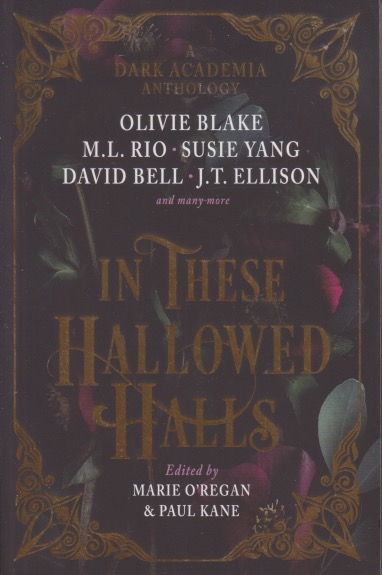
Dark academia is a genre that explores the dark part of higher education (and sometimes secondary education).  I think that most people, even if they enjoyed college (as I did) saw there were tenebrous aspects to it.  This particular genre focuses on those negatives, but not to the exclusion of the very real draw of continued learning.  Since college is when many people receive their first taste of independence, and what passes for adulthood, many emotions come to the fore.  Love, jealousy, fear, and passion among them.  These are powerful motivators and much of our lives are spent learning to control them so that we can live together as a productive society.  This novel, like much dark academia, lingers in those places where unresolved emotions and unchecked bullying collide.  All with a Shakespearean touch.  Classic.


Making More Monsters

It’s endlessly frustrating, being a big picture thinker.  This runs in families, so there may be something genetic about it.  Those who say, “Let’s step back a minute and think about this” are considered drags on progress (from both left and right), but would, perhaps, help avoid disaster.  In my working life of nearly half-a-century I’ve never had an employer who appreciated this.  That’s because small-picture thinkers often control the wealth and therefore have greater influence.  They can do what they want, consequences be damned.  These thoughts came to me reading Martin Tropp’s Mary Shelley’s Monster: The Story of Frankenstein.  I picked this up at a book sale once upon a time and reading it, have discovered that he was doing what I’m trying with “The Legend of Sleepy Hollow” in my most recent book.  Tropp traces some of the history and characters, but then the afterlives of Frankenstein’s monster.  (He had a publisher with more influence, so his book will be more widely known.)

This book, although dated, has a great deal of insight into the story of Frankenstein and his creature.  But also, insight into Mary Shelley.  Her tale has an organic connection to its creator as well.  Tropp quite frequently points out the warning of those who have more confidence than real intelligence, and how they forge ahead even when they know failure can have catastrophic consequences for all.  I couldn’t help but to think how the current development of AI is the telling of a story we’ve all heard before.  And how those who insist on running for office to stoke their egos also play into this same sad tale.  Perhaps a bit too Freudian for some, Tropp nevertheless anticipates much of what I’ve read in other books about Frankenstein, written in more recent days.

Some scientists are now at last admitting that there are limits to human knowledge.  (That should’ve been obvious.)  Meanwhile those with the smaller picture in mind forge ahead with AI, not really caring about the very real dangers it poses to a world happily wedded to its screens.  Cozying up to politicians who think only of themselves, well, we need a big picture thinker like Mary Shelley to guide us.  I can’t help but think big picture thinking has something to do with neurodivergence.  Those who think this way recognize, often from childhood, that other people don’t think like they do.  And that, lest they end up like Frankenstein’s monster, hounded to death by angry mobs, it’s better simply to address the smaller picture.  Or at least pretend to.