Banned Monk

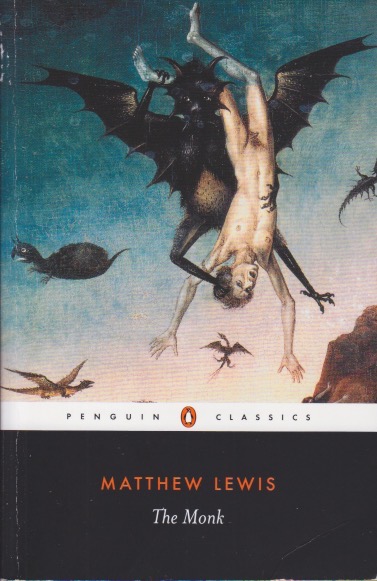
One of the strange things about gothic fiction is that, although often set on the continent, the early practitioners—inventors, if you will—were English.  Three names among them stand out in many treatments of the genre: Horace Walpole, Ann Radcliffe, and Matthew Lewis.  I’ve read the former two and have long supposed I should read the latter’s The Monk.  This 1796 novel made the author famous, but it is long.  And written in the often florid style of the age.  Still, there are plenty of swoons and thunder-plagued nights.  Set in Madrid with a cast of closely related characters, the novel has a twist ending that I did not see coming, which is pretty amazing considering that the book has been out for over two centuries.  (I may have read about the ending before, but had forgotten, if that was the case.)

The novel intertwines two stories that revolve around Antonio, the eponymous monk.  A paragon of righteousness, he heads an abbey in Spain and all are in awe of his piety.  Until sex breaks through his vanity (so we are told; his piety was based on too high a self-regard).  Once seduced, he can no longer maintain his status as chaste, and this sets in motion a tragedy that will leave innocent people dead and lives ruined.  Lewis, it’s famously known, used the novel to critique excesses of the church.  Its power, the novel demonstrates, corrupts.  Still, at the end I was left feeling sorry for Antonio.  He was set up by the Devil and his chances of winning were quite slim from the beginning.

Although PG-13 by today’s standards, the novel scandalized English society when it came out.  The sex scenes were too explicit for the day, especially since they involved the clergy.  The story has quite a leisurely layout, and only after 200 pages (in the edition I read) does the supernatural enter the picture.  Once it does the pace begins to pick up.  The weird thing is, despite its length, this story works.  It’s considered a classic—although often dismissed because gothic literature generally is—it nevertheless delivers.  Antonio is shown to be subject to weakness, and while vain, not inherently evil.  He’s a victim of human vulnerability.  Readers in the late eighteenth century couldn’t see beyond the sex, but there is a tragic human story here.  Castles, abbeys, ghosts, and subterranean passages, murder and torture, it’s gothic through and through.  Although it took most of September to get through it, it feels like I accomplished something worthwhile.  And I finished just in time for Banned Book Week.


Pagan Fear

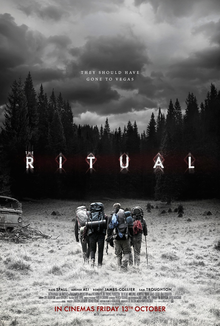
We still fear pagans.  Religion and horror are often tied up together, but when it comes to monsters we trust Catholics and fear pagans.  Of course, when Startefacts recommended The Ritual it was in the context of five pagan horror movies you should see.  I’d seen three of the others, so The Ritual seemed the next logical step.  Four friends are hiking through Sweden to honor the wishes of a fifth friend killed during a robbery.  When one of the them injures his knee, they decide to take a shortcut through the forest where a combination of the Blair Witch Project and Midsommar and Antlers takes place.  After finding a freshly gutted elk in a tree, they take shelter in an abandoned cabin surrounded by runic signs on the trees.  Soon they’re being hunted by a huge creature they can’t see clearly.

The final two are captured by a pagan group that worships one of the Jötnar—the monster that’s been hunting them.  The final boy escapes by getting out of the forest, where the Jötunn can’t go.  The choice of a Germanic monster is a bit different, and the creature design is fascinating.  Jötnar apparently straddle the line between gods and monsters, being a kind of frost giant.  The pagan group sees it as a deity that keeps them safe in return for sacrifices.  Given the number of bodies in the trees, other hikers had decided the shortcut was worth taking in the past.  But still, the pagans are cast as the bad guys.  This is in spite of the fact that the friend whose death started the whole thing was killed in England.

The religious convictions of the English robbers aren’t made clear, but they were raised in a Christian context and are every bit as brutal as the pagans.  In fact, the pagans, although they sacrifice strangers, do try to talk kindly to them (at least if they have the mark of the Jötunn on them).  Not just the pagans are savages.  At least they have a moral reason for what they’re doing, in their own minds.  The criminals are in it only for themselves.  We still fear those of other religions, although they’ve come to their beliefs in a way similar to how we’ve come to ours.  Whether born into it or converted, believers generally come to their conclusions honestly.  In the world of the film, this Jötunn is real.  And, until the end, it protects those who worship it.  So yes, this is a pagan horror film, but it makes the viewer wonder whence the horror really comes.


What You Can’t Show

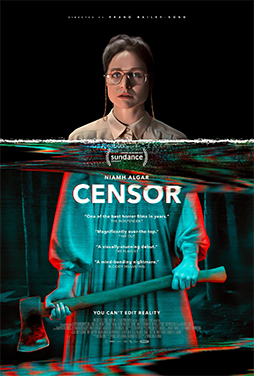
As I spend my life trying to figure out why I do what I do, I take book and movie recommendations.  I really should note who recommends what because it often drives me crazy trying to figure that out after the fact.  A friend recommended Censor, and since this friend told me where it was streaming for free I’m sure I got the right one.  Like several one-word title movies, there are several with the same sobriquet.  This was the 2021 movie and it’s a British horror film which raises the question of why we watch horror.  It does this through the eyes of the eponymous censor (Enid) who’s particularly tough on movies.  Set during the “video nasty” scare of eighties Britain, the question is whether such movies motivate real violence but with the twist that the censor is the one who turns violent.

Enid is haunted by her missing sister and she finds a video nasty star who looks like her sibling and becomes convinced that it’s her.  Enid gets to the set where her movie’s being shot (a remote cabin in the woods) and ends up killing the star and director (after accidentally killing the producer earlier, in self-defense).  She kidnaps her “sister,” and in her imagination—rainbows are everywhere—takes her home.  That’s where the real social commentary comes in because during this imaginary drive the radio announcer says these kinds of movies have stopped, and all crime and violence have ceased, and social harmony has returned to Britain.  This is revealed, of course, as a delusion.

Left to my own devices, I probably wouldn’t have watched this movie.  I don’t like blood and gore—I’m more looking for gothic themes like haunted houses—but it turns out that this is a smart film.  That’s probably why it was recommended to me.  Intelligent but also with tongue in cheek at times.  Still, it’s a movie about reconciling with childhood trauma, which is something that speaks to me personally.  That’s a wound I don’t always like to have poked.  It’s one of those movies on which I’d like to see more analysis, maybe talk to Prano Bailey-Bond, the writer and director.  Horror with female directors is often thoughtful, and movies are really meant to be discussed (just like books are).  The question remains—why do we watch disturbing movies?  I know I’m not the only one who does.  And in this case I remember who recommended it, so perhaps I’ll be able to get some closure.


Release the Wicker

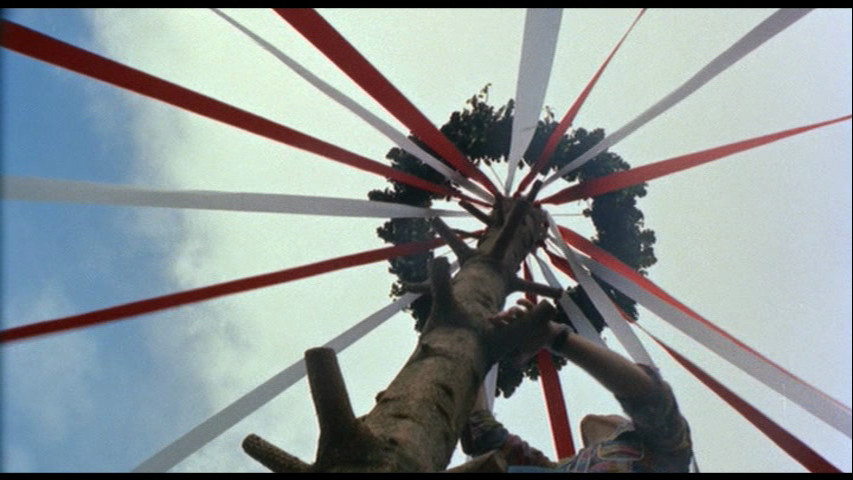
One of the many fascinating things about The Wicker Man is that even its release date can cause confusion.  There should be nothing so simple as to look up when a movie first hit theaters, but especially in trans-Atlanic efforts the dates are often different between the UK and the US.  The Wicker Man had a limited UK release on June 21 (quite close to Midsummer, it turns out) of this year.  It’d been released before, of course.  The initial UK release date was December 6, 1973 (twenty days before the US release date of The Exorcist).  Making its way to the US, it was first released on May 15, 1974—not long after May Day.  One of the features of the curious history of the movie is that it lacked support from its own studio.  Not surprisingly, it performed better overseas, particularly in America.

Release dates can be important, and can make a difference in a film’s success.  Again, the quirkiness of The Wicker Man reveals this—although set in late April-early May, it was filmed in November.  Actors had to suck on ice chips to prevent their breath from being visible.  And who’s thinking about May Day when getting ready for Christmas?  All of these factors swirl around in a mythology that the movie has developed.  My book went to the printer yesterday.  It should be out in August-September, hopefully in time to catch the interest of those who’ve gone to see it in theaters again.  I’ve lost track of how many times I’ve seen it.  I’ve watched all three released versions.  It feels like an old friend.

From the beginning, the plan was to release my book this year, due to the fiftieth anniversary of the movie.  It’s funny how simply surviving half a century can make something interesting to people.  There are plenty of 1973 movies that aren’t getting any particular boost this year.  The thing about The Wicker Man is that it became a cult classic.  Although it was never a mainstream hit, it has sent out its tentacles far and wide.  I notice references to it is unexpected places.  If you’re attuned to this you say to yourself, “that movie really made an impact.”  And it did.  When I first pitched this book idea to the editor of Auteur, I told him I’d do whatever I could to make a 2023 release.  Of course, I started writing it before Nightmares with the Bible came out.  My next book after the Wicker Man doesn’t have an anniversary release in mind.  That’s good, because like a moon-shot it’s nerve-racking to aim for such a narrow target, years in advance.


Meeting Places

It’s one of those quirky British television plays that’s its own movie.  It was part of the Play for Today series.  I turned to Penda’s Fen after receiving some very distressing news, as a means of self-healing.  (I may seem distracted for some time, please forgive me.)  Sometimes considered folk horror, it really isn’t a horror film although it may be treated as one.  The dialogue is heavily religious, involving a lot of theological discussion of Manichaeism, the “heretical” belief in the struggle between the powers of light and powers of darkness.  It plays out through the maturing of Stephen Franklin, son of the local vicar who is, unbeknownst to himself, adopted.  He also discovers his homosexuality as he begins to rebel against the strictures of his private school education.  Underlying all this is the fact that he lives in Pinvin, in reality Penda’s Fen.

The story deals with the past interrupting into the present as Penda’s pagan kingdom never really fell.   A local writer claims that there is an entire escape city beneath the British landscape to which those deemed “important” to the government are to be evacuated in case of emergency.  In reality, the kingdom beneath, and overlapping, Pinvin is that of Penda.  Penda was an actual Anglo-Saxon king and here he encourages Stephen to know himself—one of the mottos of the school.  That knowing involves coming to question the conservative, Christian belief system he has wholeheartedly embraced.  His adoptive father, the vicar, has broader beliefs, including the reality of other gods.  Stephen discovers this and learns of his adoption, making for some heartfelt religious dialogue.

My reason for watching, apart from the much-needed therapy, was that it had been recommended as a piece of religion and horror.  There are some horror moments, but generally it’s difficult to say whether they’re hallucinations of Stephen or they’re really happening.  One is presented outside his viewing, which suggests that they are meant to be real.  One involves a demon, but not the scary kind of The Exorcist, which had been released just a few months ahead of Penda’s Fen.  In all, it’s a thoughtful movie, the kind you might expect when based on a play.  Given the themes, I’m not sure it was the best therapy, but it did engage the religion and media dialogue.  I hope to come back to it some day under better circumstances.  The dialogue is worth engaging with more depth than I’ve been able to muster here right now and there’s much I still don’t understand.


Wicker Proofing

I’m currently reading the first proofs of The Wicker Man (due out in August).  While necessary, proofreading is a pain (and I work in publishing!).  You have to put everything else aside and concentrate on what you’ve already written, and if you’re like me, moved on from, to get your earlier work out.  I’m extremely time conscious.  I have many things that I would like to accomplish in the time I have left.  Right now one of my priorities is book six.  It’s already written, but I’m revising it for the umpteenth time.  Then the proofs come.  This is one of the issues a graphomaniac faces.  It’s part of trying to make a life from words.  And it distorts time.  I submitted my Wicker manuscript back in December.  Since then my mind has largely been elsewhere.

Proofreading—or is it proof reading?  I’m not a proofreader—isn’t the same as it used to be.  These days you proofread a PDF and use the markup tools for changes.  I had developed a kind of nostalgia for the old-fashioned proof markings.  Now you highlight the offending text and add a note to explain what you would like changed.  This makes me worry about time too, since I’m probably among the last generation who will even known what proof markings are, apart from historians of publishing (and yes, there are historians of publishing).  I am fortunate in having had a good copyeditor for The Wicker Man.  S/he didn’t change much but pointed out where my wording was ambiguous.  Those of you who’ve read me for a while know that some of that ambiguity is intentional, no?

A quick turnaround time on proofs is necessary.  Of course, mine would arrive on a Wednesday.  That very same day I was asked to be a reader-responder to a journal article, also with a brief turnaround time.  I wanted to say “No,” but as an editor I know how difficult it is to find reviewers.  Anyone who publishes should consider it a moral obligation to review when asked.  Just like jury duty.  Thursday and Friday mornings were spent reviewing the article (which I hope will be published, whoever wrote it).  All of this was done without picking up a pen (as much as I wanted to) or leaving my laptop.  As much as I enjoy those proof markings, nobody has the time for them anymore.  Even now I’m playing hooky from proofreading to write this blog post.  I’d better get back before someone notices that I’m gone.


Wicker Wondering

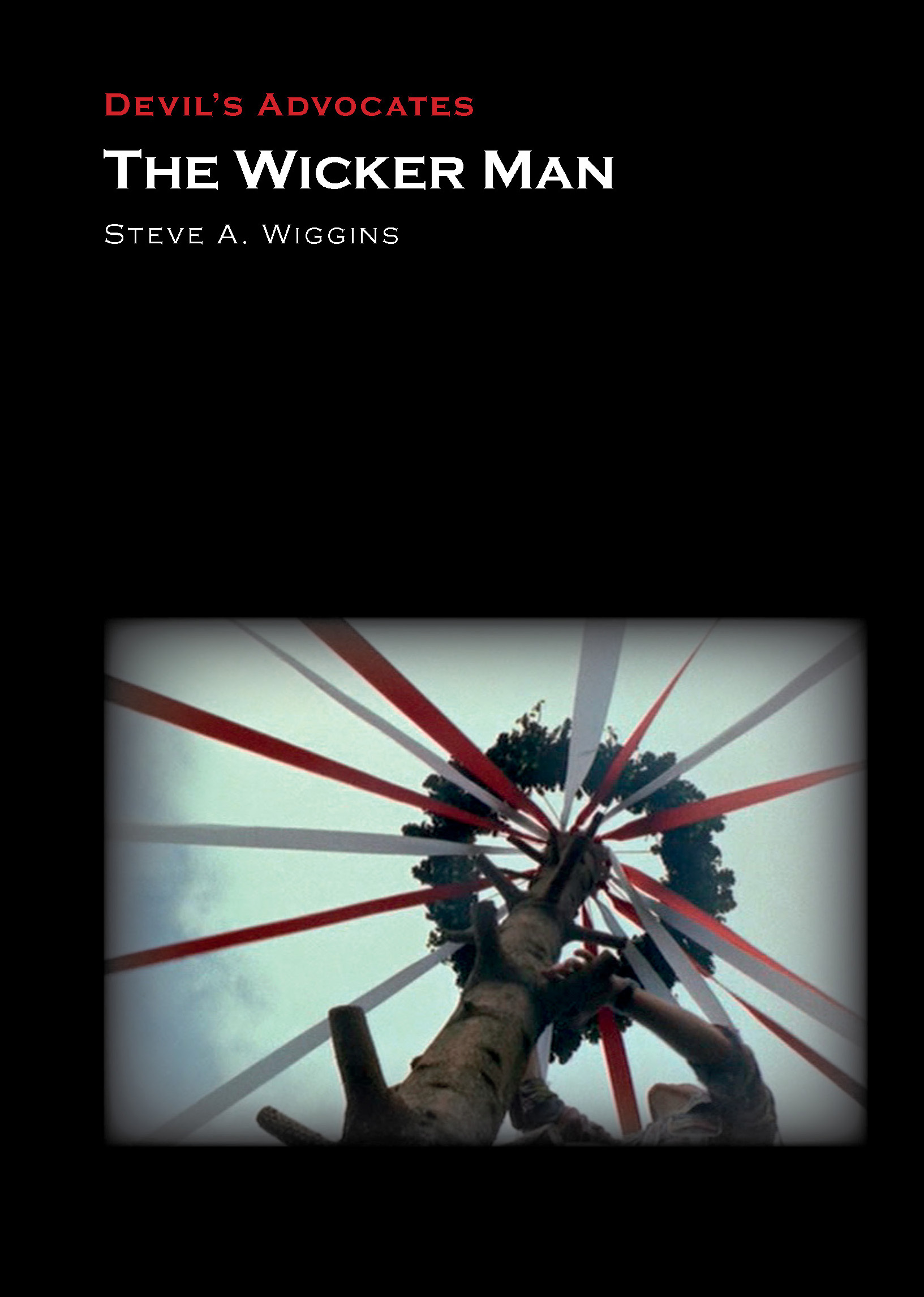
Why The Wicker Man?  It’s a fair question.  My book is now starting to appear on Amazon and other venues (it’s on Goodreads!), so it’s time to try to get the word out.  The BBC ran a recent story, “Why The Wicker Man has divided opinion for 50 years,” and that offers a springboard into the “why” question.  I’m not Scottish, but my wife and I lived in Scotland for a little over three years.  That’s one reason.  While there I did some research into Scottish folklore—historians of religion are curious people—and traveled widely, and that’s another.  As one of those writers who’s never been able to break out of the academic market, the third and most direct reason is that I’d begun a book on holiday horror.  A friend pointed the series Devil’s Advocates out to me.  Back then the series books were priced in the twenty-dollar range, but the pandemic put an end to that!

I’ve always thought The Wicker Man derived its fear from the strangeness of the holiday.  I’ve also often wondered why Anthony Shaffer and Robin Hardy didn’t make more use of “Beltane” in the dialogue.  Maybe the unfamiliar was too unfamiliar?  I suggest a different reason in my book, but I won’t reveal that here.  Writing a book on The Wicker Man would allow me the opportunity to share my thoughts about holiday horror without trying to convince an agent that people actually do like to read about horror as well as reading horror itself.  Come on, agents!  It’s called pop culture because it’s popular!

I pitched the idea and the series editor liked it.  So did the reviewers.  They were tired of hearing/reading about The Wicker Man as folk horror, as if there was nothing more to the movie.  Like most films that grow an afterlife, this one is complex and can be approached from many angles.  In fact, there’s another book, one by John Walsh, coming out on the movie just weeks after mine.  I wasn’t the only one who knew the fiftieth anniversary was on the horizon like a Beltane sunset on Summerisle.  For those who prefer a more television-like explanation, I’ve posted a video on The Wicker Man on my YouTube channel.  This blog, I realize, doesn’t get enough hits to drive traffic that way, but it’s nevertheless part of the package.  Why The Wicker Man?  The answers likely lie in several posts on this blog, a few years in Scotland, and a love of strange movies.


Coronation Bible

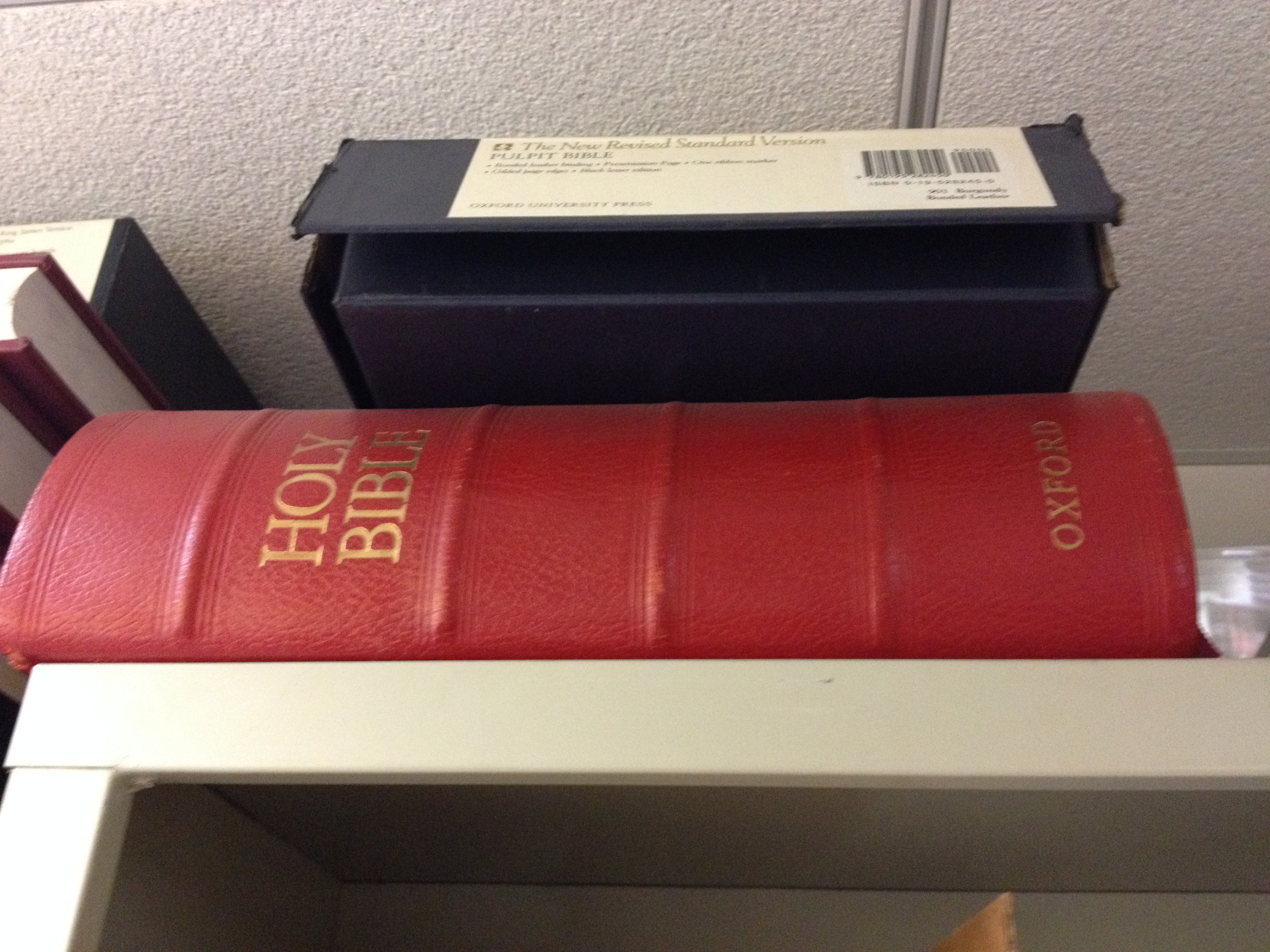
The scene from The King’s Speech doesn’t show it at all, but there was even more drama around the coronation of George VI than the movie reveals.  It may not be obvious, especially to Americans, but there is a great deal of prestige in being the supplier of a coronation Bible.  The two ancient presses in the United Kingdom, Cambridge and Oxford, vie for that honor.  In 1937 Oxford had won out.  Coronation Bibles are works of art and are extremely rare.  You’ll never find one at your local library’s used book sale.  As a recent Oxford University Press blog post indicates, the Bible at George VI’s ceremony was a last-minute replacement.  What could possibly go wrong with a ceremonial Bible, of all things?  Quite a lot, but this one had to do with an aging cleric.

Despite being the eve of war time, an elaborate Bible had been designed and manufactured.  Symbolism is important.  Britain faced not only the aggression of Hitler, but also the abdication of Edward VIII.  Instability was in the air.  In such times, as we’ve seen in American politics, leaders look to the Bible for support.  Printed on special paper, chased with gold on its cover, the coronation Bible was a work of art.  However, the Bishop of Norwich, Bertram Pollock, couldn’t lift it.  At 73 he wasn’t in the best of health, and he had a role in the ceremony.  At the last minute a lighter, replacement Bible was sent.  According to the OUP blog post, the Archbishop of Canterbury issued a rare apology to the press, but also noted “I cannot but wish that you had given some more consideration to the physical infirmities of those who would have to carry it.”

A big Bible

Swearing on the Bible is an archaism that seems likely to persist into the foreseeable future.  The future of the British monarchy (which I do not follow) itself seems in doubt, but to quote the Good Book, “The grass withereth, the flower fadeth: but the word of our God shall stand for ever.”  As long as many people believe this, such swearing will persist.  Even if such belief fades, the solemnity of swearing on a Bible is likely to continue.  The Bible has, in its tangible way, become a stand-in for God.  And as another archaism, a king, is sworn in today, it is to be hoped that the bishops involved have kept their muscle tone intact.  At least to heft, for a little while, a ceremonial Bible.


50 Years Ago on May Day

Word is starting to get out about The Wicker Man.  One of the most intelligent of horror movies, it turns fifty this year.  Aware of the coming anniversary, I pitched a volume in the series Devil’s Advocates on the movie a few years back.  I was delighted that my take on the film was unique enough to qualify and my volume has now appeared on Liverpool University Press’ website.  And, as an added bonus, a blog post I guest wrote on the book will also appear shortly.  And it’s May Day.  The Wicker Man is the third person of the unholy trinity of folk horror.  The other two films are Witchfinder General and The Blood on Satan’s Claw, both of which I’ve reviewed here.  But 1973 was also the year another person of another unholy trinity, The Exorcist, was released.  This other trinity began with Rosemary’s Baby and concluded with The Omen.  If you’re curious about it, I wrote quite a bit about it in Holy Horror.

Fiftieth-year anniversaries are significant, given how young the film industry is.  Depending on the publisher, it may be difficult to get advance notice out.  My colleague Joseph Laycock, along with Eric Harrelson, wrote The Exorcist Effect.  This is a book I’m very excited for, although it’s not yet on its publisher’s website.  Academic publishing can be slow that way.  Another fiftieth anniversary Wicker Man book is coming out in October—John Walsh’s The Wicker Man: The Official Story of the Film.  The publisher, Titan books, not hampered by university press processes, had the book well advertised a couple of months back.  I’m looking forward to reading that one as well.  These fiftieth anniversary books are a boon for those who watch intelligent horror.

Academic publishers, you see, classify books in different ways than trade publishers do.  If you’re not sure what a trade publisher is, it is essentially anyone whose books you see in actual bookstores.  Academic publishers tend to focus on library sales and sales to academics who are willing to shell out fifty, a hundred, or sometimes more, bucks for a book.  (In my teaching days, although we had no expense budgets at Nashotah House, I would occasionally (very rarely), after careful family consultation, shell out the academic press price for a book I needed for research and the library wouldn’t buy.)  My last three books have been written for wider readerships, but have been published by academic presses.  On this fiftieth anniversary year, I’m planning on reading a couple of good books.  And thinking about May Day fifty years ago.


Search Your Engines

It’s been fascinating to watch.  We tend to think things appear instantaneously on the internet, and sometimes they do.  Book announcements, however, are less prone to that.  The Wicker Man, my book for the Devil’s Advocates series, was first announced to the world (apart from me) on Oxford University Press’s website because they distribute books by Liverpool University Press.  It took several weeks before it appeared on LUP’s site (I’m projecting here, it still hasn’t showed up there).  Like an anxious father, I checked every few days to see if word was getting out.  After about two weeks it showed up on Barnes and Noble’s website, but not Amazon or Goodreads.  Then it appeared on ecampus, a textbook seller.  Days later it appeared on Amazon’s site in Spain only.  Word gets out slowly.

Some things hit immediately, of course.  Everyone in the world knows about them seconds after they happen, whether they should or not.  Some young folks, who grew up with the internet, are having trouble letting go of the, well, troubles of the world that jet through the 24/7 news cycle.  Books by unknowns travel much more slowly.  Of course, I’ve been trying to reinvent myself.  In as far as I’m known, I’m known as an ancient Semitic goddess scholar.  (The ancient part is correct, in any case.)  I turned to writing about religion and horror about a decade ago and if web searches mean anything, my most searched book seems to be Holy Horror.  That makes sense since Nightmares with the Bible is so expensive that I can’t afford additional copies even with the author discount.  The Wicker Man will be up near forty dollars, but that’s cheap these days.  At least it will be paperback.

Maybe I have been checking more than I let on, but I’ve also noticed something else odd.  Ecosia, the tree-planting search engine, comes up with more results (based on the ISBN) than Google does.  That astonished me.  Google apparently isn’t as good at searching as it would have us believe that it is, at least for obscure information.  (In my case, very obscure.)  Ecosia even outperformed Bing.  With this internet full of stuff, you’re obviously missing out if you don’t use multiple search engines.  Yahoo added yet one more site with the book.  I’m wondering when the actual publisher, or Amazon’s main site, will catch up.  Giants do move slowly, I guess.  Maybe once the cover image is released…


Hard to Say

There’s no easy way to say this, so I probably shouldn’t try at all.  Still, I feel compelled to.  You see, I’ve sat on admissions committees and I’ve written my fair share of letters of recommendation.  The former (admissions committees) have a difficult kind of calculus to compute.  Schools need students and their tuition money—this is, after all, the capitalist way.  (Yes, there are alternatives, but boards of trustees have severe deficits of imagination.)  Some schools get around this by being elitist.  Generally they have endowments of very old money and can weather all but the most severe of storms.  Such universities are in the minority and so the rest, and various small colleges, need to compromise from time to time.  Money or integrity?  You cannot serve both God and mammon.

At the graduate level this becomes even trickier.  Grad students bring in more money, and getting into grad school used to (and here’s the difficult part) require what some admissions folks secretly call “special intelligence.”  The paperwork and in-person interview reveal it clearly—this candidate (not always from a privileged background) displays a canniness that suggests they might really have a truly unusual ability to reason things out.  This is someone who should be admitted for advanced work.  But if you apply that principle not only will you be called “elitist,” you’ll also run out of lucre.  The solution is simply economic—let those who don’t have this kind of special intelligence in.  I have seen Ph.D.s after names from schools that I had no idea offered doctoral-level research.  And they legitimately call themselves “Doctor.”

When choosing a grad program—go ahead, call me elitist, but then interview me and see that it’s not true—I knew it had to be at a world-recognized research institution.  I ended up at Edinburgh, and my bubble was already deflated when I told family from western Pennsylvania and they supposed I was going to Edinboro College (now Edinboro University of Pennsylvania), located maybe 50 miles from where I grew up.  I had been accepted at Oxford and Cambridge, however, neither of them could offer scholarships to a penniless Yank, but the famously frugal Scots were far more generous.  And let’s face it, Scotland is more exotic than England.  You have to admit that much.  Of course, the deciding factor was, in my case, money.  You have to wonder if there’s any possible way of escaping it.  From all appearances, mammon wins.


Gothic Days

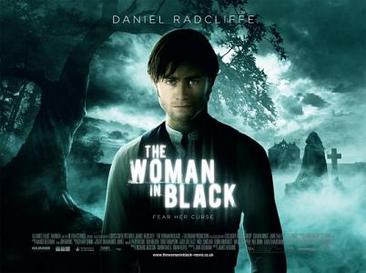
The tradition of telling ghost stories during the months of long darkness has evolved over time.  Since the time seems right, I watched a movie for which I read the book some years ago.  I recall that The Woman in Black is moody, and gothic.  What I don’t remember is how it ends.  More than one source—at least one from someone I know and one from a book—suggested I should see this movie, and I’m glad I did.  It’s a haunted house movie, set in a haunted village and the production values (unlike some movies I’ve recently watched) are quite high.  This film was a reboot in a couple of ways; there was an earlier film version, and it was also a new Hammer production.  In the latter capacity it broke records for Hammer box office earnings.

You see, Hammer, in its first incarnation, struggled for any kind of respectability.  The company almost single-handedly kept horror movies alive while US studios moved more toward sci-fi-themed projects, before the rebirth of modern horror.  Fans knew to go to Hammer for their monsters, but society folks (and those who wish to be society folks) don’t find horror worth any attention.  From my amateur point-of-view, such movies give the viewer a lot to think about.  The problem, as with most underdogs, is that a few bad examples tend to get all the attention.  Life is scary.  That doesn’t mean we shouldn’t try to live it, but it does mean that we might learn something from other people’s mistakes.  Or we might find ourselves haunted.

The Woman in Black is set in Edwardian times.  (I often ponder why we still refer to historical eras by the British monarchs—Elizabeth, Victoria, Edward, etc.—in a world finally moving away from imperialism.  Still, it’s convenient.)  Perhaps not quite as evocative as the Victorian Era, but still moody enough.  Although there are some disturbing scenes, this is no slasher.  Like the novel it’s the tale of a vengeful ghost, wronged in life and out for revenge.  While the end of the movie isn’t the same as the novel (okay, so I looked it up!), it’s similar.  And perhaps it’s best considered a parable of parenting.  No amount of training can prepare you for it, and although it’s supremely rewarding, it’s also very scary.  Susan Hill, the novel’s author, lost a child and that sense of haunting pervades both book and movie.  Gothic is often about grieving, and perhaps about learning something from it.


Seasonal Viewing

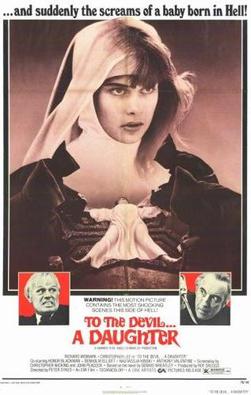
Any movie that begins with an excommunication ought to be good.  Especially with its list of stars you’d think To the Devil a Daughter might’ve turned out better.  Still, it is a good example of religion and horror mingling together.  I’ve never read any Dennis Wheatley novels, but reputedly he didn’t like this film adaptation of his book.  It certainly has a convoluted plot.  So an excommunicated priest has started a new religion that worships Ashtaroth.  He has to baptize a child, now 18 (three-times-six, don’t you see), with the blood of the demon so that she can become his (Ashtaroth’s) avatar.  This is apparently the eponymous daughter to the Devil.  She was baptized initially by her mother’s blood at her birth.

The girl’s father, who survived her birth—unlike his wife—has decided at the last moment to save his daughter.  He appears to be independently wealthy yet he talks an author of occult books into doing the saving for him.  The girl, it turns out, is a nun in this satanic religious order and is only too willing to do what she can to serve “our Lord.”  The way that all of this plays out is confusing and Byzantine, but it does raise a serious question: what if a child is reared in a bad religion?  (And there are some.)  Who has the right to decide if a religion is good or bad?  Children are easily indoctrinated and not too many question the faith in which they were raised.  Yes, we all think the religion we believe is the right one.  The problem is everyone else thinks the same thing.

One of the things this movie got right is that the “heretics” are portrayed as sincerely believing that their religion is for the improvement of the world.  Calling themselves Children of the Lord, they believe Ashtaroth is good.  And a good lord wants what is best for the world, right?  This is the dilemma of exclusive religions that teach only their own outlook can possibly be the correct one.  Otherwise you have to give adherents a choice and another religion may be more appealing.  Or worse, they may reason out that if you’re given a choice that means your own religion is also merely one of many.  Historically religions have gotten around this by valorizing true believers who never question anything.  To the Devil a Daughter isn’t a great movie.  It’s not even a very good one.  Nevertheless, it raises some questions that lie, of course, in the details.


Green Pagan

The folk tradition doesn’t encompass folk horror only.  I’ve been working on The Wicker Man, one of the initial folk horror classics, long enough that I sometimes need to remind myself of that.  Of course, it was the cover image featuring said movie that drew me to David Huckvale’s A Green and Pagan Land: Myth, Magic and Landscape in British Film and Television.  The descriptive subtitle more or less informs the reader what the book is about although it reaches further than that.  Huckvale also interprets novels, short stories, and classical music pieces according to landscape.  And sometimes it ranges beyond Britain, especially to other Anglo-Saxon cultures.  Richard Wagner, for example, plays a prominent role in one of the chapters.

Having written about popular media myself, I’m aware of how such issues can easily arise.  A movie too good not to discuss falls out of the precise range you’ve set for yourself.  And no matter how much media you can consume there will be tons more that you could, had you the time, add to your experience of it.  This book looks at mostly British media with an eye toward the pagan landscape.  That doesn’t always mean horror, but sometimes it does.  Huckvale always has interesting things to say about the media he addresses.  Whether the pieces go back to Arthurian legend or to more recent fictional pasts, the landscape has a role to play.

Indeed, folk horror is generally defined by landscape.  That makes sense considering that it’s all around us.  Many people in urban settings may have to struggle to find it.  Indeed, when they want to get away they head for it.  In Britain—and anywhere in which invasion has taken place—the earlier pagan ideas are imprinted on the land.  In Britain they’re perhaps more obvious; think of Stonehenge.  As later interlopers modern people see them and wonder.  And then we create stories—literary, musical, or visual—about the experience.  I’m so used to reading about folk horror that I’d finished the book before I realized it wasn’t really the focus of the entire thing.  While I don’t live in a major city, I too have blinders on for much of the time.  I’ve got a book deadline and I wanted to read this before making final revisions.  I’m glad I did.  There were places where I was just in the backseat, along for the ride, but there were also chapters where The Wicker Man was a crucial component.  And it reminded me of why I enjoyed living in that landscape for a few years.


Social Horror

Some books get you thinking in ways you don’t expect.  That’s one of the pleasures of reading.  Lindsey Decker’s Transnationalism and Genre Hybridity in New British Horror Cinema may sound terribly specific—there are a lot of qualifiers in that title—but it actually has some very broad implications.  I was reading it specifically from the horror angle for a project I’m currently working on, but I was surprised at the social commentary I found while doing so.  One of Decker’s main ideas is to show that British horror is, well, transnational while maintaining its Britishness.  She focuses mainly on five films in the book, only two of which I’ve seen.  Very aware of the history of British cinema, she points out many characteristic features and situations that make British horror what it is.

The social commentary comes in when discussing “hoodie” horror films.  These are movies showing how the working class, particularly the youth, are dangerous and anti-society.  The more I read the more it occurred to me that imperialist, capitalist systems are built on the corpses of the poor.  Even good kids from bad situations have difficulty getting ahead in life and those above them on the “social ladder” more or less despise them and make policies to keep them in poverty.  This leads to anger and resentment, and often, in reality, this spills over into violence.  It all comes down to those who benefit from the system refusing to make it more equitable.  When the inevitable happens—those pressured without sufficient means boil over—they are blamed for their own circumstances.

Having grown up in a working class system and having struggled all my life to somehow maintain a comfortable existence for my family, I know the kinds of obstacles faced.  In my particular case, retirement is not a likely outcome.  I’ve worked, except for (and often even) when I was in higher education, since fourteen.  I’ve seen others with connections, educated parents or influential friends, get ahead.  I’ve also watched while many of us get shunted aside because, well, who are you?  Some people wonder why I watch horror.  There are many reasons for it, and at times I think maybe I’ve seen enough.  But then I look around at the corpse-strewn foundations of our current system and I see how reality plays into that fear.  Decker, I’m pretty sure, was meaning for her words to apply to mainly the fiction of horror, but there was a different kind of hybridity there as well, at least for me.