Relatively Unknown

The Edinburgh Festival draws people from around the world to experience culture and fun in one of Europe’s most beautiful cities.  The festival also attracts the fringe—artists not associated directly with the festival, but who get included in what used to be a huge, thick catalogue that would keep us busy for hours, considering what a student and spouse could afford, and what you could not afford to miss.  One year a group called Outback was performing at an area church.  It featured Graham Wiggins on the didgeridoo—an Oceanic aboriginal instrument that is essentially a tree branch hollowed out by termites.  It’s so long ago now that I can’t recall if I knew ahead of time, but the leader of the group, the didgeridooist, was Graham Wiggins.  While not exactly a rare surname, Wiggins isn’t common either and when I saw him a strong family resemblance was immediately obvious.  So much so that after the concert we went to meet him only to find out his Wiggins side was from Oxfordshire.  Mine was from South Carolina.

Graham Wiggins, who was a month younger than me, was known as “Dr. Didg” because he held a D.Phil. in solid-state physics from Oxford University.  While an American, he had decided to stay in the UK to make a living from his music.  Some months later, on a Christmas break, we saw him busking in Bath on a chilly night.  We bought the band’s second CD from him that evening.  When my wife put on our Baka disc the other day, I grew curious whatever became of him.  I was surprised and saddened to learn that Graham Wiggins had died three years ago.  I knew we shared a surname and a family resemblance, as well as UK doctorates, but I learned he went to the British Isles from Boston University, which is where I had studied before attending Edinburgh.  He left the year I arrived.

Websites are reluctant to say of what Wiggins died.  I learned of this just days after finding out that a high school classmate had passed away, so mortality has been on my mind.  Wiggins, unlike this Wiggins, was a talented musician with a brilliant mind.  We saw him interviewed on television about the physics of didgeridoo playing.  I never did find out if we were distantly related.  The US Wiggins clan from South Carolina doesn’t have strong genealogical interests, although we know they started out in North Carolina many years ago.  It stands to reason they had come from England at some point, since it’s an English surname.  I only met Graham of the clan twice, but now I can’t get the fading didgeridoo sounds from my mind.


If Onlyists

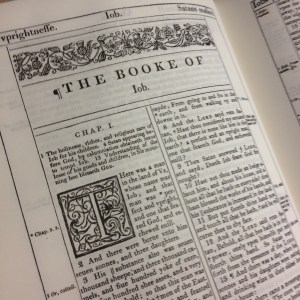
A special brand of Fundamentalism called King James Onlyism is a particularly odd variety of faith simply because of its required backing and filling.  In brief, this particular evangelical position claims that the only inspired translation of the Bible is the King James Version.  It’s best not to look too closely at the KJV, however, or the problems start.  Primary among them is that the version most Onlyists cite is not the original King James.  Published in 1611, this translation is immediately evident by its use of “I” for “J” and for the long s (the one that looks like an f).  Perhaps more troubling for Onlyists, it also includes the Apocrypha.  There was still some debate at the time concerning the status of these deuterocanonical books, and they were part of the actual KJV.

The typical King James used by Onlyists is a revised KJV.  In England, where the translation was done, revisions were made from time to time, leading to an Oxford version (Blayney text of 1769) and a Cambridge version (Scrivener text of 1873).  On these shores further adjustments were made leading to the rather strange situation where there is no single King James Version of the Bible.  There are many King James Versions.  Attempts to control Scripture often end up like that.  The underlying problem is the belief that there is a single version of Holy Writ.  Inerrantists are pledging their faith to something that doesn’t exist.  Defending this approach many would claim that the revisions are minor, but small changes can make huge differences.

The belief in one single version relies on the belief that God inspired not only the original writers, but the translators as well.  It denies that the better manuscripts that have come to light since the early seventeenth century (including the Dead Sea Scrolls) contain any authentic information of what the Good Book says.  Textual criticism, in the absence of any original manuscripts, is the best way we have of discovering what the original likely said.  Onlyists argue that the manuscripts from which King James’ translators worked were the divinely selected ones and their work was inspired—a position against which no empirical proof can be offered.  This faith trades in certainties that only bringing in direct heavenly control can achieve.  And it means that Catholics are wrong, despite King James’ inspired error to include the Apocrypha.  That’s the thing about a trump card like inspiration—once it’s played there’s no way to overcome it.


Common Tyrants

“Common tyrants, and public oppressors, are not intitled to obedience from their subjects.”  The words aren’t mine, nor are they from this century.  That, however, makes them no less true.  Jonathan Mayhew was an eighteenth-century clergyman arguing that Bible’s admonition to obey government officials did not apply to those who abused power.  In reading these words I felt a sense of loss in a very basic way.  No, I’m not a fan of turning back the clock—it can’t really be done anyway—but when the word of a single book was not disputed those tempted to follow tyrants could be made to justify it with a Good Book that could also be used to refute it.  We no longer have a common frame of reference, but tyrants still exist.

Shouting matches have been substituted for discussions because those who support tyrants can’t see how they are also being oppressed.  It’s one of the ironies of history.  This internet age has only found a way of magnifying people’s differences on the political scale, even as it has brought us to the common marketplace of culture.  Who doesn’t use Amazon?  Tyranny, by definition, is the arbitrary use of power.  One might think of, oh, declaring a national emergency when none exists just to get what one wants.  One might think of surrounding oneself with criminals against the nation just to get what one wants.  One might think of business practices meant to ruin others just to get what one wants.  There seems to be a common theme here and it’s one on which the Bible has a great deal to say.  The only Scripture that gets quoted is that which supports tyranny, eh, Mayhew?

When the debate was about the Good Book we were largely all on the same page.  Not all colonials wanted to break with King George III.  Some profited from the connection.  Others thought Holy Writ prevented revolutions rather than inspiring them.  Tyrants have always been with us.  You’d think that with all the media we have these days that we’d be able to spot one fairly easily.  The camera, however, has a way of giving the lie to the Good Book.  Anyone can say they read it.  Or claim they obey it.  Its own test seems to be “by their fruits you will know them.”  The words aren’t mine.  They’re from a distant century past.  But it seems the fruit is dying on the tree, even as spring begins.


Caveat Emptor

When you work in academic publishing, various higher education news sources find you.  Not able to distinguish faculty from industry professionals that rely on them for their by-products, these sites often offer friendly advice on how to succeed in academia.  Having had not a little experience in that venue (if you’ll pardon my litotes), I noted a recent headline before clicking the delete button.  I can’t reconstruct it word-for-word, but the gist of it was that if you wanted to earn more as an academic, you should study overseas.  Your salary, the article implied, would be higher if you did.  Now I recognize that things constantly change, but in my field of study if you want to get any job at all, let alone a good paying one, you study domestically.  Specifically at Harvard.  Academics, just like publishers, rest on their laurels.

The funny thing about this headline is that it contained the same advice that I received all the way back in the 1980s.  I followed up on it, choosing Edinburgh after having been accepted at Oxford, Cambridge, Aberdeen, and St. Andrews.  Only later did I learn that of those schools only Oxford opened the door to positions in my native United States, being, as it is, the Harvard of the United Kingdom.  Defying the odds, I did get a job that, when I became Academic Dean with access to industry stats, I discovered was among the lowest paying of its peers.  Studying overseas, in other words, had the exact opposite effect than the headline promises.  Perhaps things have changed in the intervening years.  Even today I have to remind people that Edinburgh is a world-class research university, one of the four ancient schools in the kingdom of the Scots.  Some of the most famous minds in human history studied there.  Ach, well, a job by any other name would smell of sweat.

Xenophobia isn’t unique to the GOP.  It exists in higher education too.  Academics are extremely tribal, and if you try to break in from the outside—no matter where you study—you’ll learn that your money might be spent more wisely learning a trade.  As a homeowner, I’ve discovered that just about any practical job that doesn’t require college pays better than what you can get with the detritus of a doctorate on your résumé.  In fact, during times when work was scarce I tried to hide it.  One of the skills I picked up in my educational journey was not to believe everything you read.  Problem is, you only pick that up after you’ve already paid that tuition bill.  The delete button is right there; don’t be afraid to use it.


Something Blue

I’ve worked for two British publishers.  This probably has nothing to do with the fact that I lived in the United Kingdom for over three years, but the two situations have this in common: they’re bloody complicated.  I say that for a reason.  I’ve always wondered why “bloody” is considered swearing in Her Majesty’s realm, but not over here.  Profanities tend to be culturally specific, of course, while some forms (scatological and blasphemous, in particular) are generally universals.  I had always assumed “bloody” had something to do with religion, kind of like the more tame “zounds” is an abbreviated form of “God’s wounds.”  In fact, the folk etymology of bloody suggests just that.  Folk etymologies, I learned as a budding philologist many years ago, aren’t the same as scientific etymologies.  In other words, like folklore, they aren’t entirely accurate.

One of the lessons I learned in Britain was that if you wish to cite a lexicon, it should be the Oxford English Dictionary.  It’s The authority.  So I thought I’d bloody well check it out on this.  There, it turns out, the emphatic use of bloody has to do with breeding, not bleeding.  Back in the seventeenth and eighteenth centuries there were rowdy aristocrats, or “bloods,” that gave the phrase it’s referent.  These privileged wealthy classes, as befitting the stereotype, could afford idle drink.  They did not work, so life was a matter of passing the time with aristocratic pursuits, such as imbibing.  This led to a phrase “blood drunk,” which, disappointingly, didn’t refer to Dracula, but meant drunk like a blood.  It was only a short, tipsy walk to “bloody drunk.”

Antoine-Jean Duclos, from Wikimedia Commons

Disengaging the adjective—like the saucer part of the Enterprise pulling away from its iconic Star Trek hull—you get stand-alone “bloody.”  This swear has nothing to do with sacred blood, but rather blue blood.  Which brings us to the realm of sacre-bleu, in which the word “blue” (bleu) features.  But this has nothing to do with the color blue (such as Marian blue, known from mythology of the virgin) but from the fact that bleu rhymes with dieu, and using the name of a deity (although “god” is actually a title, not a name) is swearing.  In fact, it is technically what is meant by blasphemy.  Working for British-based publishers has been its own kind of education.  It’s easy to get lost in etymological labyrinths.  But is that the bloody time?  I’ve got to get to work.


Turnabout

Fair play, so the adage dictates, includes turnabout.  Well, that may be overstating it a bit, but after reading Joe Nickell I decided to give the other side a shot.  Guy Lyon Playfair’s account, This House Is Haunted: The Amazing Inside Story of the Enfield Poltergeist, was originally written in the aftermath of the truly bizarre happenings at that location in the late 1970s.  My reason for reading the book, as maybe you’ve guessed, is that Ed and Lorraine Warren had a hand in the story.  Or at least a finger.  The movie The Conjuring 2 was based on the Enfield case and it placed the Warrens front and center in its resolution.  This is Hollywood, however, and since I’m working on a book on demons I need to try to dig beneath the surface a bit, into regions where tenure-seeking academics often fear to tread.

Interestingly, the Warrens are not even mentioned in Playfair’s book.  The edition I read was updated in 2011.  Playfair himself was one of the two primary investigators from the Society for Psychical Research.  The other was Maurice Grosse (who features in the movie).  Before eyeballs start rolling, it’s worth noting that the Society for Psychical Research is actually a respectable academic association.  As Playfair makes clear in his book, many of the members are skeptical and few believed that the evidence gathered by Grosse and Playfair indicated anything paranormal at all.  The book isn’t shy about dropping the names of the many investigators who dropped in—some uninvited—to either study or debunk the infamous poltergeist.  The incident, however, went on to inspire the movie Poltergeist by giving it free license to change almost all of the details.  Of the many investigators the Warrens remain unmentioned.

On this blog I’ve been chronicling the on-going struggle of trying to figure out what Ed and Lorraine Warren were up to.  Those who met and interviewed them invariably state that they were/are sincere.  They didn’t accept payment for their investigations, and often seem to have been genuinely interested in helping the people plagued by what mainstream science claims simply can’t exist.  Nevertheless, they had and have detractors even amid the parapsychology crowd.  Playfair’s account is quite interesting.  Called in early after the onset of strangeness on Wood Lane, Playfair recorded and recounted what he saw.  He caught some trickery and wasn’t shy about pointing it out.  At the end of the episode, however, he remained convinced that something unexplained had happened there.  Nickell dismisses it all with a sentence or two.  In the interest of fair play it would seem only right to hear the other side of the story.


Now Hiring?

In keeping with my recent theme of jobs you never knew you could have, I recently read a story a friend sent me from The Vintage News.  The story concerns a spiritual counselor who is planning to marry a ghost.  I didn’t know that spiritual counselor was an available job.  You see, I had taken enough psychology courses in college that I could’ve had it as a minor, but I didn’t declare it.  At the time I was destined, or so I thought, for a career in ministry and psychology seemed a good subject to assist with that.  Also, I naturally tend to try to figure out what motivates people.  Like most career options, not having a science background prevented me from pursuing psychology as a fall-back career.  But spiritual counselor?

The woman in the story lives in the United Kingdom.  Here in the United States, where unhappy people seek any opportunity they can find to sue someone, having a job as a spiritual counselor probably involves ordination.  Even if you’re ordained, as I learned from long years both attending and teaching in seminaries, you always refer those who come to you to a licensed psychologist.  Clergy can easily be sued for providing bad advice.  That’s why the counselor part of this job seems so odd to me.  That, and the woman the story features is only 27.  I suppose that’s time enough to finish a doctorate, for the truly ambitious, but apparently she doesn’t have a terminal degree.  Just a post-terminal lover.

Also, I learned that spectrophilia is a condition with a name.  The idea of intimacy with spirits is nothing new, of course.  The ancient idea of incubi and succubi reflect this concept, and a number of the stories in the Ed and Lorraine Warren oeuvre include sexual attacks by demons or ghosts.  What’s different here is that the young woman wants to marry a spirit she can’t see.  Unlike most such reputed cases of spectrophilia, she claims spirits are superior to physical lovers.  Despite the oddities that make such a story newsworthy (in a sense) a potentially important point could emerge from all of this.  Love is not a physical phenomenon.  We all know it when we feel it.  I suspect that other such feelings, like finding the perfect job that matches your skills and interests, are likewise intangible.  The problem is finding out that such jobs even exist.


Mastering Ravens

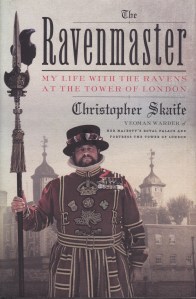
One of the most difficult things in modern life is to keep up with all the new jobs available.  That’s not to suggest that unemployment isn’t a real problem—it is—but that the game has changed since the days I went to the guidance counselors’ office and thumbed through the box of microfiche to learn about potential colleges.  (And what strange people the guidance counselors were!)  Since 1981, when I graduated from Oil City High School, the Internet has been invented and has changed employment forever.  I understand that making YouTube videos can now be a full-time job, with benefits.  Who knew?  So when I was kindly presented with a copy of Christopher Skaife’s The Ravenmaster: My Life with the Ravens at the Tower of London I wasn’t too surprised to learn that there is such a job.

Delightfully written, The Ravenmaster goes into the ins and outs of life in what is a ceremonial job.  That the Brits are fond of tradition is no secret, and this little book is so full of them that it becomes a delightful gallimaufry that includes, I kid you not, dog biscuits marinated in blood.  Although Skaife takes you on a few detours through his own life, the book is mainly about ravens.  We’re so used to materialists telling us that everything is simply cause and effect of neurons firing that I wonder how they might react to the obvious intelligence and personalities of ravens.  Reading about their antics as well as their wisdom it’s difficult not to surmise that consciousness isn’t a purely human preserve.  With the ravens and the wolves we are a piece.

Intelligence is more common in the animal world than in the White House these days, and this book may help to show why.  Ravens can plot, plan, and be cruel.  They can also be kind, compassionate, and friends.  I’ve long had a fascination with corvids, and I tried to befriend some before moving out of New Jersey.  It was a bit tricky with the strictures of my own Tower of London—the commute, the bus, the job—and so my friendship with the local crows in the back yard of our apartment remained strictly casual.  We lose so much by not paying attention to the natural world of which we are, increasingly, so unnatural a part.  When humanity disappoints and the ridiculousness of human behavior haunts, I recommend reaching for The Ravenmaster.  It’s comforting to know that real minds exist out there in the wild.


Holly Days

Thirty years ago today, my wife and I were penniless grad students.  Trying to be logical about when to marry—I’d been accepted at Edinburgh University shortly after we’d decided on a May wedding and the latest I could matriculate was April—we decided the holidays would be the best time.  Not Christmas, of course.  Or New Year’s Day.  As students we held to the illusion that others observed the natural caesura between the two.  We considered it from the feast of Stephen to New Year’s Eve, days when everyone is recovering from the intensity of Christmas or staying up late to welcome in 1989.  We settled on December 30.  The church was already decorated for Christmas, saving that expense.  Having moved up the date by some five months we did ask them to remove the banner that read “For unto us a child is born.”  Our reasons were purely academic.

I generally avoid writing too much about my personal life on this blog, but a thirty-year wedding anniversary is somewhat extraordinary.  Being a working-class kid I told my wife when I proposed that I couldn’t promise much but I could assure her our life together would be interesting.  That slippery qualifier has proven correct time and again.  Our first three years as a couple were spent in Edinburgh, and quite unexpectedly, the next fourteen at Nashotah House.  The first two of those years involved being apart from Sunday through Wednesday as I commuted from Champaign-Urbana to Delafield to teach my courses.  And, of course, to attend chapel.  Our daughter was born while we lived at the seminary and a Fundamentalist takeover led to the loss of my first (and to date only) full-time academic job.

The academic job market had been tough when I started and it had tanked in the meantime.  We had to uproot and move to New Jersey to find any work at all.  Publishing proved remarkably unstable and yet we stuck together.  This year we bought a house and moved to Pennsylvania.  It took three decades, but we’ve finally achieved what some would term normalcy.  The fact is, though, that long-term marriages are to be celebrated.  Many of the vicissitudes we’ve faced could easily have capsized our little boat.  Looking back over the years I can see that we never did prosper in any kind of financial or career situation.  Life has indeed been interesting.  I don’t blog much about my personal life, but today I can’t help but think of how incredibly fortunate I am to have found a soul-mate willing to stick with a guy who still thinks like a penniless grad student.  Thirty years of schooling and it’s not nearly enough.

A young couple’s anniversary in Wales.


I’ll Be Googled

It’s a strange sensation to do an innocent web search only to find yourself cited.  (And no, I was not googling myself.  At least not this time.)  I was searching an obscure publisher and my own pre-publication book, Holy Horror, came up on Google books.  Now, the computer engineers I know tell me that Google remembers your searches, and this has a way of being unintentionally flattering; when I search for my book it pops up on the first page because I have searched for it before.  Still, it was a bit of a surprise to find myself where I had no idea I’d been cited.  All of this drew my mind back to my “post-graduate” days at Edinburgh University.  To how much the world has changed.

One of the first things you learn as a grad student is you can’t believe everything you read.  Granted, most of us learned that as children, but nevertheless, with academic publishing a new bar is raised.  That which is published by a university press is authoritative.  So we’re led to believe.  But even university presses can be fooled.  This prompts the fundamental question of who you can really believe.  Our current political climate has elevated that uncertainty to crisis levels, of course, and the vast majority of people aren’t equipped to deconstruct arguments shouted loudly.  Where you read something matters.   Even publishers, however, are fallible.  So what am I to make of being cited by the web?  And is my book already available before I have seen a copy?

Even credibility can be bought and sold.  Colleagues make a much better living than me with the same level of training, but with more influential connections.  It was just this reason that I decided to try to shift my writing to these who don’t need credentials to impress each other.  Some of the smartest people I ever knew were the janitors with whom I started my working life.  As a fellow post-grad in Edinburgh once said, professors are always ready to fail you for your lack of knowledge but most can’t tell you what an immersion heater is.  (That’s one of those Britishisms that no amount of graduate courses at Harvard will teach you.)  I suppose when it’s all said and done nobody else will ever search for the obscure publisher that brought my book to Google’s attention.  No matter, at least Google will always flatter me.


Classic Education

A few months ago now, just after moving, our garage flooded.  Our books, unpacked, were stored there at the time, resulting in many casualties.  As I sorted through what was destroyed—a process still ongoing—I decided that if I replaced books I would re-read them as I did so.  Emily Brontë’s Wuthering Heights was the first replaced, and therefore re-read, volume.  For those who never had the opportunity to attend seminary, I would note that it is the ideal time for reading.  One of my professors, Harrell Beck, although he taught Old Testament, encouraged wide reading.  The Bible, he suggested, didn’t stop at the last verse of Revelation.  It was in seminary that I discovered the Brontë sisters and their remarkable literary achievements.

Wuthering Heights is fine autumnal literature and Heathcliff one of the greatest protagonist villains of literature.  An interloper among the privileged classes, Heathcliff finds delight in making others share in his suffering.  One of the more memorable characters is Joseph, the Bible-toting, Bible-quoting caretaker who sees nothing good in the younger generation.  Even Emily Brontë, the daughter of a clergyman herself, spies the hypocrisy so clear in the lives of literalists.  Joseph enjoys scolding as much as reading Scripture, and even the other servants find him tiresome.  Born in the year Frankenstein was published, Emily had Gothic sensibilities.  With the protracted death scenes and atmosphere  of loss and mourning, this classic can be a restorative in an era such as ours.  In more than one way.

Since Wuthering Heights is a classic, there’s no need to recount the story of lost love and damaged human beings.  What is important is to realize that we continue to support a social structure that repeats the sins of nineteenth-century England.  And like that setting, we do it firmly believing we are a “Christian” nation.  Joseph would surely nod in agreement.  Stripping the safety nets from the vulnerable so that the privileged classes might enjoy more of their ill-gotten gain, we live the hypocrisy of the self-righteous.  It the era of the Brontë sisters, women were not encouraged to write.  They, like the servants of the wealthy, were believed to exist for the comfort and pleasure of the master.  Not paying attention to the classics, we’ve come back to that era, claiming that wealthy white men are the true victims in all of this.  The denizens of the swamp will find their place in history next to Josef Stalin, Mao Zedong, and Benito Mussolini.  Wuthering Heights, like 1984, will, however, remain a classic that sees through hypocrisy.


Pretty as a Prayerbook

Stolidity.  Canons all across this deck are known for it.  Visions of unchanging texts, however, tend to be false perceptions.  Even the canon of the Bible differs, depending on who you talk to.  So it is to be applauded, I suspect, that the Episcopal Church is planning to revise the Book of Common Prayer.  The last revision was 1979, and before that, 1928.  This schedule should be telling you something—the BCP, or simply “Prayerbook” as it’s commonly called, was never a changeless canon.  We mere mortals rely on experts to change the words by which the Almighty is approached, and although Episcopalians are thin on the ground in this country, world-wide they’re a formidable sect.  They’re united mainly by their commitment to the BCP.  And with good reason.

The days of the British Empire are long gone, but when it ruled the waves (and even before) this island state contributed a number of religious elements to the world.  The Prayerbook was born out of struggles with Rome for secular power disguised as sacred.  We try to live with a fiction of separation, but churches and states have always had mutual influence—just consider the way secular Trump has changed Christianity and you’ll see.  The BCP was to define English Christianity and in doing so became a Scripture in its own right (or rite).  Phrases from the Book of Common Prayer pepper the English language so as to rival the Good Book itself.  When church attendance was an expectation, you couldn’t help but internalize it.

A certain seminary, nameless here forevermore, will not be pleased with such change.  When I taught there many still clung to the 1928, claiming the church had erred (a strange position for someone in a voluntary organization and who vows to support its decisions) by adding “inclusive language” in the ’79.  This, they averred, was a man’s religion.  And they meant biological males.  Stolid.  Or perhaps stale.  Like the fiction of unchanging canons, the myth of the rational male hierarchy exists only to be exploded.  The two longest reigning British monarchs have been queens, after all.  World wars tend to be the legacy of male rulers.  So, although a tiny seminary in the woods of Wisconsin will likely rage, the BCP could use a bit of a makeover.  The world has changed substantially since the 1970s.  Mainline churches have been steadily shrinking and redefinition with a declining financial base makes good sense.  “This is another day, O Lord. I know not what it will bring forth, but make me ready, Lord, for whatever it may be.”  Even if it be changing canons.


Who’s Hungry?

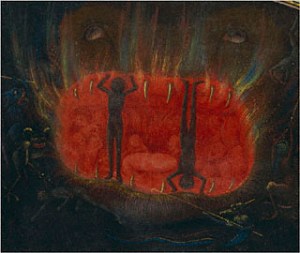
I flatter myself to think that some people enjoy my daily musings, although they’re sometimes grim. Religion often is. One curious example of this is the “Hell-Mouth.” Some time back a friend sent me a link to a British Library blog post “Highway to Hell.” The story is about illustrated medieval manuscripts depicting the Hell-Mouth—a monster with wide, gaping jaws and a gob crammed full of human souls bound for eternal torment. Not a pretty picture. The BL post reasonably suggests that the image originates in early Anglo-Saxon literature. We know the Teutonic penchant for the gothic, so all is fine and good. In fact, however, the image is far older than that.

In sorely neglected and almost forgotten Ugarit there is a fascinating mythological text. Known to ancient northwest semitic nerds as KTU 1.23, the text is strange even by Canaanite standards. El, the chief god whose name translates as, well, “god,” seduces two young goddesses (presumably). The young ladies give birth to monsters—devourers with one lip reaching to the heavens and the other to the underworld. Every living thing is swept in. What is this if not a Hell-Mouth? Indeed, if I might indulge in my past passion for Ras Shamra just a touch more, the deity Mot (whose name translates to “Death”) is portrayed with an equally voracious appetite. Everything gets gobbled up, even Baal.

These lurid images of all-consuming mouths, however, aren’t direct ancestors to the Hell-Mouth. Although some of the ideas from Ugarit survived in the culture that would eventually emerge as the Israelites, the city itself was destroyed for the last time before Moses picked up his chisel. The people of Ugarit were long gone before he licked his thumb and applied his quill-pen to Genesis. Ideas, however, may be the closest to eternity that humans can come. The Bible doesn’t describe any Hell-Mouths as such, but Revelation can come close. Ras Shamra was only rediscovered in the 1920s, so no Anglo-Saxon had access to its vivid images of the Hell-Mouth that existed even before Hell itself became a thing. Humans are endlessly inventive. Ideas go underground for centuries at a time only to reemerge when the moment’s propitious. The Middle Ages with their Black Deaths and highly stratified society and burgeoning witch hunts and inquisitions were such a time. Looking over the current landscape I have to wonder if the recent revival of the Hell-Mouth might not have something to do with the time in which it has gained renewed interest as well. Some appetites will never be satisfied.


Clean Living

One of the fun things about the Oxford Dictionaries blog is that you learn unexpected things about words. In fact, you can often find something profound in a matter of a couple of seconds that will make you stop and scratch your head. A recent post by Gary Nunn titled “Good clean fun? The shaming language of food and disease” makes the point that English, like other languages, shames by default. That’s worth considering. Religions are engines of social control, and many of them have highly developed techniques of shaming people into adherence. One of the most famous is the shunning practiced by some Anabaptists, but it certainly isn’t the only tradition that brings guilt to bear.

Some people, psychologists say, suffer from high levels of personal guilt. Shaming is particularly painful to such people and language, it seems, might not be their friend. Others, however, can take quite a verbal hiding and still not feel any remorse. In other words, shame doesn’t seem to work on them. If some people don’t need it and others are immune to it, why do languages excel at inducing shame? The article by Gary Nunn is looking at how “clean,” which was generally used to mean tidy, healthy, free from vermin, came to mean “standard behavior.” From its original usage, “clean” moved to describe—often by its antonyms—things that really don’t fall into that category; foods and sexual behaviors, for instance, can be labeled unclean or dirty, even if they are hygienic and natural. The purpose of this evolving usage seems to be another way to shame someone.

Human beings are social creatures. Although fascinated by violence, most people do not like to use it unless it’s necessary. We’d rather settle things civilly. One way to do that is by using words instead of weapons. Our languages are built for that. We all know individuals who can bring us down with a few harsh words. No physical pain has to be induced, or even threatened. Collectively, the will of the people—at least, so I’m told, outside the United States—influences decisions that governments make. I’ve mentioned before that even non-literate creatures, such as the great apes, will not tolerate injustice in their communities. Sure, alphas may be a necessary evil, but when they abuse their station the collective brings them down. In our culture where nearly all the wealth—by far the vast majority of it—is controlled by 20% of the population, and among them, the majority in the top 1%, we need some stronger words for shame. Or it may be that some people are simply immune.


Death Challenged

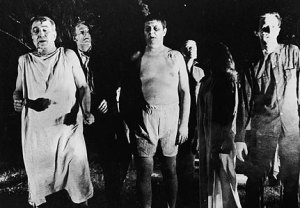
Long before the Walking Dead, and even before Twilight or Buffy the Vampire Slayer, people took the undead seriously. Now, I know ratings are important (they attract advertisers and their money, after all), but when the fear is reality the stakes are upped a bit. Two readers sent me a Guardian story this past week of Yorkshire villagers mutilating the dead. In the Middle Ages, that is—it’s perfectly safe to die in Yorkshire now. The story by Maev Kennedy describes how archaeologists have been studying deliberately defiled corpses, well, actually the bones from those corpses to be precise, to solve a centuries-old mystery. Their conclusion? Medieval folk really did fear the dead coming back from the grave.

Now, Easter’s just around the corner and resurrection’s on a lot of minds. Outside the context of the Bible, however, resurrection of the dead is one of the most ancient and persistent of human fears. Nobody’s quite sure why. Dreams and visions of the recently departed are extremely common. Belief in ghosts is ancient and fairly universal. The destruction of the bodies of people already dead is not. We treat our gathered ones with respect. To me it seems to come down to the puzzle of consciousness. Call it a soul if you like, but I have a feeling things would be getting rather crowded in here if too many distinct entities claimed this body as home. Mind, soul, spirit, psyche, consciousness. We don’t know what it is because it can’t be studied empirically. We know that something like it exists and opinions of what happens to it after death vary. The body, we can all agree, has a more prosaic end.

That’s what makes fear of the undead so fascinating. They are only bodies. Bodies without souls. Rather like leaders of the Republican Party. We fear them because when we look into their unblinking eyes we see no vestige of human warmth or sympathy. Those who walk among us and who don’t care about those of us not yet undead remain a perennial fear. In the case of the Yorkshire corpses these were people already buried. Putting them back in their graves seemed kind of pointless when they would only climb out again. We don’t know what it was like on the ground in the Middle Ages. History, however, has an ironic way of repeating itself. We’re entering a new age when I suspect we’ll want to make sure the remains of some remain well and truly gone once they’ve finally given up the ghost.