Black Swain

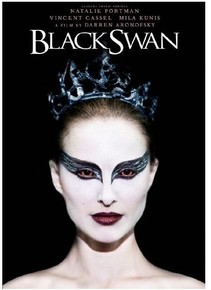
In a somewhat rare move, I watched a film that was released less than five years ago this weekend. Black Swan is difficult to classify since it crosses so many genres with relative ease and it left me strangely reflective. Although called a “thriller,” the frenetic pacing and sense of outside menace of most thrillers is lacking. Black Swan includes some horror elements, but little in the film defies rational explanation if Nina Sayers is really going insane. The underlying story, however, is something that every religion would recognize—the need for transformation. Even before John Calvin dreamed up the laughable doctrine of total depravity (and for any Presbyterian readers, I was predestined to write that), all religions have at their heart the concept that people need to change. Sometimes the transformation is subtle and gentle, at other times fiery and dramatic. If you end life the same way you began it, you are a religious failure. This premise lies behind every movie where a character transforms into something else, be it werewolf, Mr. Hyde, Mrs. Doubtfire, or a wereswan.

Our perceptions of who we are cause us considerable introspection. Nina Sayers is a timid yet ambitious girl, living with her mother yet wanting to be the seductive black swan. She really doesn’t comprehend what she is wanting to become, but she knows that it must be better than what she presently is. Again, the parallels with religion are striking. I have known good people who’ve transformed into black swans under the influence of noble religions such as Christianity and its monotheistic siblings. People who have become intolerant and judgmental, insisting that their way is the only possible correct way. In the mirror they see a white swan, but the audience sees the black one.

Black Swan is heavily symbolic and provocatively mythic. Like any honest account of life it refuses to provide any definitive answers. Since each experience we undergo leaves its mark upon us, we cannot help but transform. Volition, however, can lead us toward paradise or perdition and any ambiguous place in between. Is the Nina Sayers dying on stage the greatest sinner of all, or a saint who has been beatified as fully human? The answer to the riddle the film stubbornly refuses to relinquish. So it is with life. We will transform over its course. Religion will declare whether it is good or bad, right or wrong. At the end of the script, however, we are both the white and the black swan.


Friday the Sixth

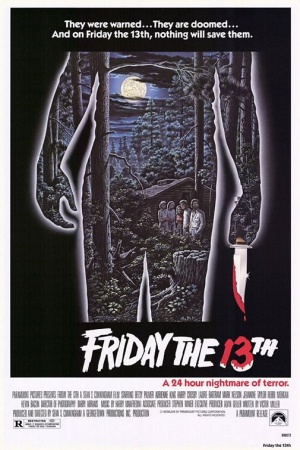
I tend to run behind on the movie front.  In some cases, decades behind.  I have never been a fan of slashers, although I did take a date to A Nightmare on Elm Street in the staid, dry town of Grove City while in college.  We broke up shortly after.  Still, I have a soft spot for “the classics,” and Friday the 13th has spun enough sequels to qualify.  “Jason” is a household name for the heartless serial killer, and the movie is set in New Jersey.  And it was hot outside and lazing on the couch trying not to stick to myself seemed about as much of a challenge as I could handle. Besides, a week from today is Friday the thirteenth. Now that I’ve finished with the excuses, here is a declarative sentence: I finally got around to watching Friday the 13th.  After many other films I’ve seen, I have to say that it didn’t really qualify as scary.  You know in advance that the counselors, by rote, must by killed in what are supposed to be shocking ways.  Shadowy corners and rainy woods and aluminum canoes are to be avoided, if the movie and its successors have taught us anything.  Nevertheless, the religion and scary film equation still applies.  And a strange kind of throwback to an unexpected classic (the literal kind).

The religious element comes in the form of the stock crazy local named Ralph.  Ralph warns the kids that they will die and says he’s been sent by God to warn them.  Of course they don’t listen.  If they had, there would have been no movie. As a child I was always offended by the caricature of the religious crazy, but I have come to see that this stock character is itself a symbol of fear.  Although ubiquitously laughed off, the person passionately driven by religion is indeed a potential danger to society.  In the days of my innocence we had little hard data upon which to hang such fears.  In the post-9/11 world it seems there are far too many sky-hooks for that purpose. Some of those sky-hooks are a little closer to the ground, but they inspire fear nonetheless. I’ve known all along that one of the reasons I watch scary movies is to give myself some advance warning of what might go wrong.  Not that it would help in any real way, but sometimes avoiding the shock by anticipating the worst seems like the only human thing to do.

What about the literal classic that I mentioned? Beowulf falls outside the Greco-Roman period, but is clearly a classic of English literature.  (Spoiler alert for anyone even more behind the times than me—) The only thing scarier than Grendel was, of course, Grendel’s mom.  So in Friday the 13th, the killing is done by Jason’s mom.  Like Grendel, Jason dwells underwater and surfaces to pull down his victim(s).  Like Grendel’s mother, Jason’s mother is decapitated by a sword (actually, a machete in the modern version), on the shore of the Crystal Lake.  After the mother’s death the child (Jason/Grendel) is resurrected.  Whether it was intentional or not, there is a lot going on here. The sacrificial mother is an inherently religious theme although many formal religions make it a male prerogative. The death of the mother brings the son back to life.  I wonder how Christianity might have differed if instead of three male deities, there had been a divine mother.  In such cases resurrection of the son comes only at a very steep price. Just like watching Friday the 13th on a hot summer night.


Just You Wait, Professor Higgs

They finally found him. Peering deep into the invisible world of the sub-atomic universe, his hiding place has practically been discovered. I knew that when it happened my alma mater, Edinburgh University, would be part of the equation. That’s just the kind of thing you know deep down in your sub-atomic parts. Scientists are now coming very close to announcing definitive proof of the “God particle,” or Higgs boson. Named for theoretical physicist Peter Higgs, who predicted the particle, this elusive piece of physics has been nicknamed the “God particle” by journalists who want to express just how great its explanatory value is. The average citizen knows very little about the inner workings of science—thus we have Creationists and Tea Partiers—so we require striking neologisms to help us comprehend that this is not only important, but really, really important. For explaining the way the universe works, the Higgs boson has been likened to Newton’s discovery of gravity, although apples had always fallen from trees even before he learned why.

I have always found it curious that when we need a superlative we dash back to the biblical worldview. As John Heilprin and Seth Borenstein of the Associated Press make clear, “God particle” is not utilized by physicists (although coined by one), but is used “more as an explanation for how the subatomic universe works than how it all started.” To get us to read about science they have to use mythology. The more we understand about science and the way our minds work, the more perplexing it becomes. Humans are meaning-seeking creatures and we often find story more meaningful than fact. Facts, however, determine what actually happens or what actually is. The Higgs boson is getting close to facticity. We whimsically call it the “God particle.”

Could the great gulf between science and religion, I sometimes wonder, be bridged by good, liberal arts education? The liberal arts, particularly the humanities, are all about understanding what it is that makes us, well, human. They aren’t precise like science, or profitable, like business. At the end of the day, however, in those few quiet moments, don’t we dwell among the realm of humanity? When we stop posturing for our co-workers, the media, or our neighbors, when we are who we truly are—then we are engaging in the humanities. Education can be in the service of becoming human as well as becoming rich. In one of its latest triumphs, it has produced physicists who have discovered the footprints of the Higgs boson, potentially revolutionizing the universe as we know it. And many of us would have never even heard if they hadn’t called it the “God particle.”

Like atoms over our heads


Heat Wave

Stewing in the heat of the wave washing over much of the east, my thoughts sometimes turn to the cool, refreshing flood of Genesis. I’ve been Tweeting the Bible for some months now, and I am in the midst of the stories of the flood. Noting the many contradictions and discrepancies, it is a wonder to me how many of the religious are able to overlook or harmonize infelicities for the sake of a consistent faith. Most famously the story states that Noah took one pair of the clean animals, but also seven pairs of clean animals. The rain came down forty days. Or was it 150? One of the reasons that people continue to believe this story may be its specificity. No approximations or guesses, the numbers are precise, as if written down by an eyewitness at the scene. In actual fact, the story is among the oldest of recorded civilization and has its origins at least as far back as ancient Sumer. For as long as people told stories about the gods, they told stories about world-wide floods.

As a species that is able to think ahead, we have long been concerned with the fate that might befall us. Consider the amount of hype about the end of the world that has accompanied the random calendrical dates we’ve assigned to the cosmos: the world has been expected to end nearly every year since 2000, and that is only the most recent incarnation of this foreboding. If there are gods out there, they must have it in for us. The very fact of our being human seems to anger the deities. Even after God promises the world will never again be destroyed, he adds a caveat—not by flood, anyway. By the time we reach the letters near the end of the Christian Scriptures the future torment has turned to fire. There’s always something out there looming on the horizon.

“Prometheus teacher in every art brought the fire that hath proved to mortals a means to mighty ends,” so reads the quote from Aeschylus behind Paul Manship’s statue of Prometheus. Prometheus was the Greek god (Titan, actually) favorably disposed toward humanity. His name means “forethought.” When humanity cowered and shivered in the dark, Prometheus brought the light and warmth of fire. It is easy to suppose the Greeks to have been more enlightened than earlier or contemporary civilizations, but Prometheus had offended Zeus and was subject to eternal torment for his thoughtful gift. Perhaps it is just the divine way—gods are jealous of us although they hold all the power. As I continue to tweet the good news of an angry god, I am starting to understand the power deities will always have over their vulnerable creatures.


Alien Deities

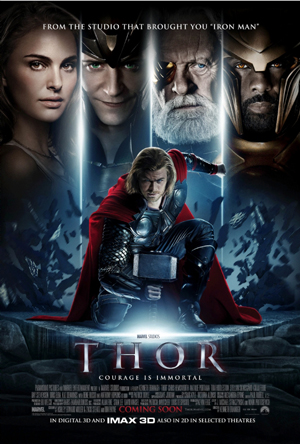
What with The Avengers making such a big pre-summer splash this year and all, I decided to refresh my memory and watch Thor again this weekend. In many ways it is a very impressive movie—very loud in the theater last year, and necessarily quieter in our apartment over the weekend. Often when I see a movie on the big screen I can’t keep track of all that is said or implied, especially when there’s so much action going on. Of course, Thor is an unusual hero in the Marvel Universe, being a god. Being supernatural is not limited to deities in that universe, but the other mutants are the results of science: the Hulk and his gamma rays, Captain America’s experimental treatment, and Iron Man’s good, old-fashioned engineering. They are modified humans. Thor comes from a different place. Upon rewatching the movie, the line about the Norse gods as beings from another dimension worshipped as gods came through loud and clear. Jane Foster comes to believe in the ancient alien hypothesis.

As a solution to the lack of omnipotence on the part of the gods, casting Thor and Loki into the role of aliens serves comic-book universes very well. In reality there are well-meaning and serious people who believe that any entity recognized as a god by human religions might have been a space traveler mistaken for divine. This is an idea I first encountered in Erich von Däniken’s Chariots of the Gods? (Hey, I couldn’t help it—I grew up in the seventies!) The world has enough high strangeness without von Däniken’s hypotheses, but in the case of Thor we have a fictional realm that explains how heroes gain their strength. The same could be postulated, I suppose, for Superman, but then, he never commanded a formal cult in antiquity.

Beyond the theological conundrum, Thor also participates in the nearly universal theme of resurrection. Realizing that his arrogance has led to the troubles of the human race, Thor faces the Destroyer (a creature with origins in the Hebrew Bible and Israelite mythology) and willingly lays down his life. This is generally the prerequisite for resurrection in any effective mythology. Of course, Thor returns and, like any good savior, rescues the world. Setting the story in New Mexico only assists in reasserting the mysterious events at Roswell where, like in the movie, something strange fell from the sky. In this subtext the feds rush in and commandeer the data, for people are not capable of making the correct decision. Yet, they leave the god behind. Marvel Studios has been rightly praised for its mastery of the genre. For those willing to look deeply, even Thor has its social commentary.


Religious Aliens

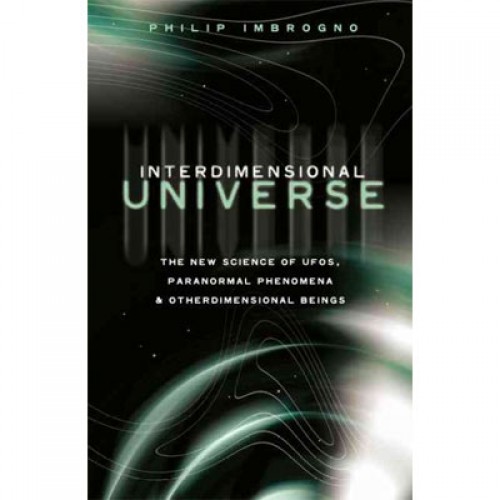
While surveying books purchased as texts in religion courses (something that an editor sometimes does), I came across a book called Interdimensional Universe by Philip Imbrogno. As I’ve often suggested on this blog, the study of the paranormal is related in people’s minds with the study of religion. I suspect a large part of it is because both deal with matters that go beyond mundane, daily experience. Indeed, the tiresome caricature of those interested in the paranormal is that they are individuals dissatisfied with their lives who project their disappointments into bizarre beings or situations to make up for the emptiness. Sometimes the same thing is said of those who are religious. What is really lacking in both fields, it seems to me, is people with strong critical thinking skills who remain open minded. There are serious scholars who study the paranormal—not many of them—and it is clear from the market-informed choices that Hollywood makes, people are intensely interested. So I decided to read Interdimensional Universe.

On the bus, however, I fidgeted to find ways to hide the cover and contents of the book. I don’t want some urban, Manhattan sophisticate seeing the letters U-F-O in my reading material. Still, like most honest, open-minded people, I have to admit curiosity. After a couple of chapters Imbrogno’s work appeared to be a standard UFO book. Then it started to get weird when he suggested that angels and jinn are, like aliens, interdimensional beings. He went from citing declassified Air Force and FBI documents to quoting the Bible. And not just quoting. He assumed the historicity of biblical accounts that scholars have extensively exegeted (oh, that word!) and demonstrated to have more plausible explanations. For the jinn he draws extensively on Islamic lore, believing that they are responsible for much of the trouble in the world, tricksters like the Marvel Universe’s Loki.

I put the book down disappointed. I still consider myself open minded. I admit to not knowing what is really going on with paranormal phenomena. If the number of reports alone are anything to go on much of the human race is either insane or is seeing some unusual things. The subject requires some real academic consideration. When self-proclaimed experts, however, veer into mythology to start explaining the unknown, we are getting no closer to finding the truth that, as Fox Mulder assures us, is out there. At the University of Wisconsin Oshkosh I taught a course entitled Myth and Mystery. It was some of the most fun I had in the classroom. It was also one of the most difficult classes for which I’d ever had to prepare. Is there intelligent life in outer space? I don’t see why not—the universe is awfully big to rule it out categorically. Are there jinn literally lurking in the closet? For that I’m afraid for that there is a much more prosaic answer.


Latin Goddesses

Armed with her shield and trident, as if blending those ancient rivals Athena and Poseidon, Britannia sits proudly atop buildings and plinths of the United Kingdom. She is an hypostasis of the island itself, and as Britain catapulted toward empire status, the goddess was adopted as her protector. She even appears on the coin of the realm. Literally. Across the Atlantic Ocean, those coming into New York City via boat (and occasionally jet) see the familiar green lady standing in the harbor. Generally called the Statue of Liberty, the woman is actually Libertas, another Latin goddess, the personification of freedom. She too has appeared on the coinage of her adoptive nation, although she has been replaced mostly by the more human heads of state and symbols of civil religion. In Great Britain, Charles Darwin appears on the reverse of the ten-pound note.

I’m sure that Britain and the United States are not the only nations to honor goddesses in their national mythology. Whenever nations want to display what is truly noble and to symbolize their highest aspirations, they choose goddesses. Ironically, some of the nations to do so hold a stringently Christian view of themselves, as if Yahweh were battling it out with an old, divorced spouse. Civil religion, however, should not be confused with doctrinal belief systems and dogma. These insidious agitators have forged the weapons with which religions daily clash. Masculine religions brook no rivals.

As Britannia sits in my pocket, and Libertas reigns in my head, I think of the nations run with male agendas and their goddess consorts. The temples to Britannia and Libertas are in the Square Mile and on Wall Street, for lucre always assumes the superior position in any relationship. I fondly recall the days when goddesses had actual power. Of course, the skies have always been empty, with the exception of our imaginations, but once the belief that protective goddesses were there gave humans cause for hope. Maybe they grew a little ambitious now and then, but the Latin goddesses always had the best interest of their patrons in mind. Have we outlived our need for goddesses? That will only happen when mothers and nature’s best protectors are no longer necessary. The Latin goddesses will long outlive our civilization.


Battle Billboards

Perhaps the oddest intangible accompanying democracy is the concept that all things are negotiable. Add to that a capitalist sensibility that everything has its price and even truth itself feels like a matter of debate. We see this all the time with Creationists so desperately wanting the Bible to the “true” that they twist science into a fairy tale noose from which to hang their literalist god. The tendency, however, does not stop with them.

Surely one of the most tense stretches of pavement in the country is NJ 495 leading into the Lincoln Tunnel. The aorta pumping countless metallic cells into the heart of Manhattan, drivers and passengers often sit motionless in it for seemingly endless periods to crawl forward like an inchworm entering the Olympics. It is there that Battle Billboards takes place.

I have followed the Atheist billboard development with some interest. In my limited experience with the Lincoln Tunnel, I have noted the digital billboard on the Jersey side bears the message of atheist.org near the major Christian holidays, so as Easter approaches the newest one reads “Celebrate Living Without God” to promote a rally on the Mall in DC. Both religion and science make claims of how to know the truth. Truth with a capital T should be non-negotiable by definition. The problem is that nobody has the Truth. We’re still trying to figure it out. Atheist.org holds a firm conviction that life would be better without religion. Clearly not everyone agrees. Clarity, it seems, is the chimera of debates over Truth.

A few seconds after the atheist.org ad flashes off the big screen, an ad for Wrath of the Titans (coming soon to theaters) flashes on. Irony can be sweeter than honey and as bitter as the Dead Sea. The most recent Clash of the Titans (2010) borrowed little from classical mythology beyond the names and large plot lines. An atheistic Perseus just doesn’t fit the classical taste. In the new film, Zeus—surely one of the prototypes for modern conceptions of God—is captured by Hades and has to be rescued by his unbelieving son. Could any movie be a more thinly disguised Easter story? Atheists? Wrath of the Titans? Which way to jump? Fortunately for me, traffic going into the Lincoln Tunnel in these lanes is one way. That’s the kind of certainty we all can live with.

Light from above or hopeless ambiguity?


Grapes of Mirth

Growing up in a teetotaling family, when I first encountered Greek mythology I paid scant attention to Dionysus. Assuming him to be “just the god of wine,” I had no interest in the wares he was peddling. Of mythology itself there was no end of fascination, and many of the great classics have been toned down to Disney, or even more insipid, for the entertainment of children. What we often fail to appreciate is that this is religion. Mythology that does not address the very real human concerns of sex, intoxication, and false dealing is really of no help at all. If in doubt, read your Bible. (Not the children’s version.) When I came back to Greek mythology as an adult, it became clear that Dionysus differed from other gods in considerable ways. While teaching my mythology classes, I decided to read more about this intriguing god. Well, it was just like the Fates that I would get a new job before reading Walter Otto’s book, Dionysus, but the urge was still strong and I was glad I’d read it.

Otto wrote in the days of Frazer’s technique of comparing sometimes questionable sources, and yet he produced a masterful, and poetic study of Dionysus. What quickly becomes clear is that the popular association of Bacchus with wine is a gross oversimplification. Dionysus is the god of madness, of blurring distinctions, and of losing control. He is the most frequently represented god in Greek art because, like us, he sometimes loses it. Greek society is famed for its rationality and order. It is sometimes overlooked by the reasoning mind that creativity, emotion, wildness are part of the complexity of humanity. Dionysus is the god who understands the need to let go once in a while. This is not hedonism, nor is it debased. Bacchus represents the human in full form. He is the god who comes to humanity, the god of appearing. Dionysus, the friendly god.

In the early days of Christianity in the Greek world, many Greeks supposed that the Jesus preached to them was Dionysus (to the chagrin of many missionaries). The connections, however, are remarkable. Like Jesus Dionysus has a god for a father and a human for a mother. He lives a carefree life and is the god who actually comes down to live with people. He is a god who dies and who is resurrected. Like Jesus, he enjoyed a glass of Bordeaux every now and again. And his followers were fanatical. As Otto makes clear in his dated, but insightful, book, Dionysus left a deep imprint on culture itself that continues to affect us even today. Even if we’re teetotalers, we can appreciate the depth of character and the complex nature of a god like Bacchus. And if we’re honest we’ll admit that there are times when we just have to let it go.


Persistence of Demons

Although released in April, Insidious is a film for the long nights of winter. At least with my schedule of keeping up with a culture that is moving too fast, this feels like a reasonable rationale for having just watched it. I tried not to read reviews of the movie when it came out since I prefer to experience the thrills first hand when I watch a film. Like many horror movies, Insidious revolves around the supernatural. Specifically, Insidious takes on the specter of the afterlife. Unlike The Exorcist, the demon in Insidious is not expelled by a priest, but by a psychic, borrowing a few celluloid feet from Poltergeist. Adding a couple of ghost hunters to the plot reinforces the idea of the secular demon that so often appears in the learned discussions of the TAPS team as they tilt with unseen entities on SyFy.

In an increasingly secular society, the fear of the dead is very much alive. Even a casual stroll through Barnes & Noble (the only show in town now) will demonstrate the popularity of the paranormal. Somehow sitting in pews listening to a sweaty orator go on about what he (sometimes she) thinks God is wanting us to do has disconnected us from the realm of the dead. Paul Tillich famously declared that God is a person’s “ultimate concern.” In an age when technology is hovering on the edge of keeping consciousness alive forever, people wonder what happens to the self when the body dies. Call it soul, consciousness, mind, or personality, we can’t deny—no matter how secular—that something inside makes each of us unique. The myth of flying about with angels playing harps doesn’t match everyone’s expectation of an afterlife any more. At least some of us hope for electric guitars.

Insidious opts for a realm like Limbo known as “the Further.” This is a place we have been before. The hopelessly corny The Seventh Sign gave us “the Guf” as a now empty federal reserve of souls. The Greeks gave us Tartarus and the Zoroastrians “the place of worst existence.” No matter what we call it, our brains like to believe there is some place out there that we go when the biomass we drive each day finally hits the wall. Increasingly it has become a negative place where darkness reigns. Insidious’s “the Further” is a hopeless realm of the dead, acting out their evil intent. There are no angels, but demons abide. It seems that we’ve outgrown the concept that angels are watching over us, but we can’t escape the creeping sensation that diabolical entities are peering at us from the shadows. During these long nights of winter, Insidious invites us to take a journey to where there is no heaven, but hell is surely not hard to find. All we have to do is close our eyes.


Tebow or Not Tebow?

It is time to bow to the inevitable. I am not now, nor have I ever been, a sports fan. Every web page I open, however, seems to feature Tim Tebow, as if the media had never seen an evangelical before. Where have people been? What is even more amazing is that this athletic kid has invented an entirely new human gesture, “the Tebow.” Incredible what young folks can accomplish these days. And as Saturday Night Live has showed us, Jesus really isn’t that much of a football fan after all.

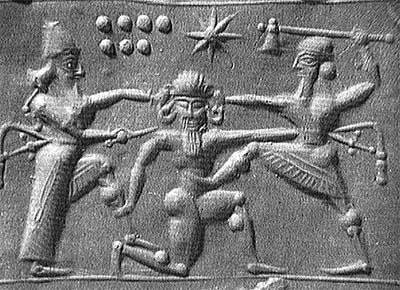
Ashamed at my naiveté, I decided to research the history of tebowing. What I found shocked and amazed me. Like so many modern day marvels, Tebowing seems to have been invented by those prescient Sumerians. Even before humans perfected the Tebow, semi-divine characters showed them how. This cylinder-seal depicts the monster Humbaba illustrating the correct posture to Gilgamesh and Enkidu. They do not, apparently, take kindly to his correction.

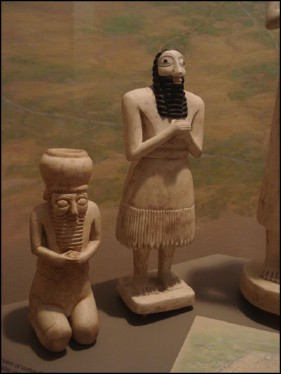
In the example below we see a rare double-kneed Tebow performed by an Asian football god while a hopelessly underchurched Joe Paterno looks on, hopelessly standing.

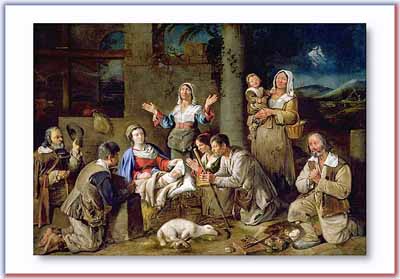
Fast forward a few centuries to a seasonal scene and we find shepherds tebowing to some baby. It is a fair guess that they suppose the baby to be a football incarnate.

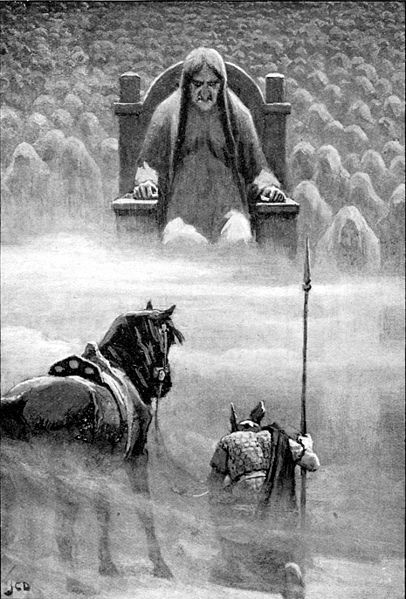
Lest we think the Tebow has been coopted by the Christian crowd, we must remember that no religion has a copyright on humility. In this scene from Norse mythology, a clearly pagan Hermod tebows before the goddess Hela. She does not look amused.

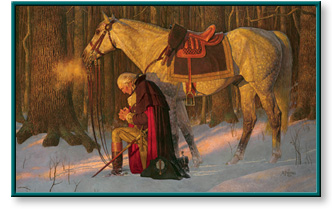
Americans, who after all claim to have invented the Tebow, can trace the gesture back to our founding father himself. In this famous painting of George Washington at Valley Forge, just after the crucial touchdown, the great man can be seen tebowing in the snow.

The snow is a great segue to the Cold War. Here, in a government photo, we see Soviet naval infantry tebowing as they contemplate the big game. They are not now, nor have they ever been, Broncos.

Now, none of this resembles the education I received during my three degrees in religious studies. No matter. ‘Tis the child becomes the man, as they say. And since a little child shall lead them, we can all learn to tebow as if there were no tomorrow. If the actual Tebow is as bright as the sports-scholarship students I taught at Oshkosh, Rutgers, and Montclair, the education of the future will include a lot lower academic expectations and, I suspect, lots and lots of Levis with holes in the knees.


Darkest Night

One of the more endearing of human weaknesses is our fear of the dark. For those who live north of the equator, we have just experienced our longest night. It is no coincidence that the religious holidays that occur in winter feature light. In our helplessness against the encroaching darkness, we light our Christmas trees and Hanukkah candles, adding just a bit more light to the world. Among the oldest of all holidays is the day that marks the birth of light’s resurrection. One need not be a pagan to appreciate the solstice and the inherent hope it bears for the return of the sun.

In this season we often see signs and hear laments about the absence of Christ from Christmas. Jesus was not born in winter, according to our best reckoning. One of the carols that drives me mad with distraction is “In the Bleak Midwinter” with its maudlin description of “snow on snow on snow”—clearly written by someone with limited experience of winters in Israel. Christmas falls near the solstice because people have from earliest memory recognized the sacredness of this season. When Jesus was born nobody knew he was to become so famous as to have one of the most popular Facebook pages ever, and so nobody thought to write it down. Even the Gospels the disciples never give a rousing chorus of “Happy Birthday” while on the dusty highway. What we’re celebrating is that night will not reign forever.

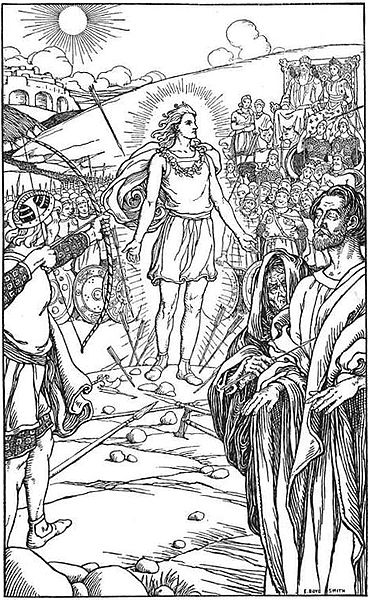
Having evolved to favor our eyesight, but lacking the standard mammalian nocturnal nature, we feel vulnerable in the dark. Even if Jesus hadn’t been born we’d be celebrating at this time of year. It might have been the re-living of the mythic Golden Age of humanity under Saturn that the Romans called Saturnalia, or it might have been the rejoicing over the resurrection of the beloved god Balder among the Norse. We might have had to wait until the days were noticeably longer to fete the goddess Brigid with the Celts at Imbolc, but we would have marked the occasion. Instead of cursing the pagan darkness, as the saying goes, we would light our feeble candles as a sign of hope. The reason for the season is the fact that the longest night is over and once more our days will slowly return light to our lives.

Here comes the sun


Old Myth

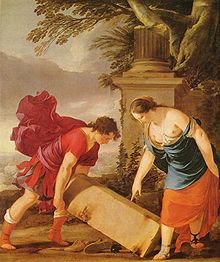
The Greek gods are in the ascendant again. They seldom disappear completely, but the big movie studios have rediscovered the special effects boon that only gods can deliver. When I first began to teach my Mythology course at Montclair State University, the Clash of the Titans remake and Percy Jackson: The Lightning Thief were both released just as the class was getting underway. It seemed like interest had been lost since the original Clash of the Titans back in 1981 when I was still a student. Special effects then meant Ray Harryhausen. Now they are measured in terabytes and whatever is larger than that. So Immortals was released recently, but I haven’t seen it yet. Picking up on the sometimes forgotten hero Theseus, the Athenian answer to Hercules, the movie promises to bring the divine into the theater.

In the spate of movies showing gods, America is not yet ready for a movie featuring Yahweh. Oh, certainly there have been films where the god of Israel has loomed very large behind the scenes, but with a prohibition of making images—no paparazzi need apply—it seems unlikely that we’ll see a special effects extravaganza featuring the Almighty. Besides, few Americans have reconciled themselves with the mythic nature of many Bible stories. As politicians and televangelists insist, these stories are fact, not entertainment. GCI Yahweh always stops at the somewhat comic George Burns or Morgan Freeman figures. Charleton Heston, where have you gone? Yahweh of the Bible is a gun-toting, hard-talking, pestilence-slinging, American-style deity. And action is where it counts.

Critics say Immortals suffers on the side of story-line at the expense of gore and action. A factor that is often overlooked, however, is mythology’s inherent mutability. “The Classics,” as we grandly call them, do not derive from a super-Scripture of literalist myths. Each writer told his (less often, her) story in his (her) own way. Although there were those who took such stories literally, as Socrates will silently confess, I suspect not a few knew these were stories told to make a point. There is no right way to tell a myth. From Harryhausen’s Jason and the Argonauts to Disney’s Hercules to Singh’s Immortals, mythology transcends the mere mortals telling it. This is the greatest shame of the modern world—we have traded the beauty of myth for a paltry handful of literalism approaches to religion. And the literary (and cinematic) world is much the poorer for it.

Theseus looking for immortality


Bad Eggs

Over the past few months I’ve discovered Jasper Fforde. While my leisure reading tends toward heavier material, Fforde has an amazing sense of wit that makes his writing nearly irresistible. I recently read The Big Over Easy, a gritty detective novel about the case of Humpty Dumpty. Throughout the story nursery rhymes are presented in literal and improbable ways, juxtaposed with the daily life of a down-on-his-luck cop. The reason that I mention the book on this blog, however, has to do with the character of Prometheus (some mythological characters also make their way into the story). Having taught Classical Mythology over the past two years, I’ve had occasion to read quite a bit about Prometheus. He is one of the more intriguing mythological characters posited by the Greeks. The creator of humans, Prometheus has a soft spot for our development that angers the other gods, jealous as they are of their privileged places.

In The Big Over Easy, Prometheus is explaining to the protagonist and his family why he thought it was worth having his liver pecked out daily in order to give humanity fire. He then tells them that he also gave people the fear of death. When asked why, he declares that the fear of death makes mortals appreciate life. There are the negative side effects such as war, hate, and intolerance, but Prometheus maintains, “I’ve seen the alternative. Eternal slavery under the gods.” Greek creation myths leave no doubt on this point; people were created to serve the gods. If we challenge that decree that we simply inherited, we are guilty of hubris, stepping over that line that separates them from us. Gods appreciate no such challenges.

It is ironic that nations based on the ideal of freedom so readily bind themselves to the strictures of the divine. The latest aggressions in which our nation has involved itself purported to be in the cause of “liberty,” “freedom,” and “democracy.” These sentiments were uttered by politicians who believe such principles ought to be bound by archaic instructions handed down through a mythological lawgiver. Our freedom ought to be circumscribed by mythology. The irony is so thick here that it is difficult to believe anyone can take such rhetoric seriously. Perhaps Prometheus brought us fire in vain. Not to worry, however. Jasper Fforde is an author of fiction only, and the arbitrary storms of Zeus no longer strike us when the gods are angry. Unless, of course, you have forgotten Hurricane Irene. Old myths never die, and, like bad eggs, once encountered they are not easily forgotten.


Troying Around

While discussing Homer with my relatives, it was decided that we should watch the movie Troy. Although conceived as a blockbuster retelling of the Iliad, the presentation reminded me significantly of The Clash of the Titans (2010). In both instances the directors and writers attempted to portray a realism of sorts, making Achilles and Perseus into just regular guys with issues. There is something of the fallen hero here, and perhaps a misunderstanding of the way the Greeks understood their greats. While it can’t be denied that heroes were intended as figures of unattainable stature, they were in some sense conceived as role models for mere mortals. The Iliad is an exploration of the anger of Achilles and the unpredictable influence of the gods.

As the critics pointed out when the movie was first released, the absence of the gods from the film is a serious departure from the Iliad. Without the gods, Achilles takes on a level of prominence never intended by Homer (whoever he was) and the playing out of his revenge begins to feel like a bad western. Although the Iliad does focus on Achilles, it requires an ensemble cast. None of the characters are evil like the movie portrays Agamemnon. He, along with his brother Menelaus, is the hapless inheritor of the curse of the house of Atreus. No matter what Agamemnon does, he is doomed. This fatalism is cut short in Troy as Menelaus, Ajax, and Agamemnon fall in the foreshortened battle of Troy.

The Trojan War is a myth. There is no history to portray accurately here. Instead there are gods and heroes. In removing the gods—a subtle nod toward many modern sensitivities—the movie loses its soul to beat the bank. And so perhaps it is a modern parable for a society that values money above all else. Whether the gods are real or not is immaterial, for they are but projections of the human spirit. Without them we are mere molecules conglomerated into biological entities with no purpose. Troy is a movie that falls short of truly mythical status, but at the same time holds a mirror to modern culture and asks “are you so sure that you can live without the gods?”