Patriarchal Goddesses

My fascination with goddesses began when I decided to research Asherah. Having grown up in a monotheistic milieu, goddesses were strangely, but not surprisingly, irrelevant. I had, of course, read about them in mythology classes, but they seemed less defined than the gods who had strong, striking characteristics. Now that I’m revisiting many classical goddesses in the course of preparing my class on Mythology, I’m discovering a renewed appreciation for the feminine divine and its contribution to the ancient world.
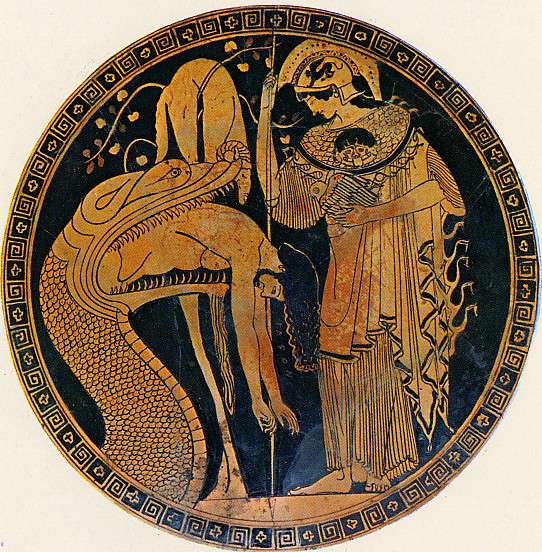
Athena saves a hero

Athena and Artemis have been on my mind for the past several weeks. Among the Olympian deities they are among the strongest female figures (Aphrodite, of course, provides her own feminine form of power, and Hera, although mighty, remains largely in the background). Perhaps what creates such a striking form for Athena and Artemis is that they blend the traditional masculine and feminine roles in a way that the ancient Greeks were prescient to devise – they both possess weaponry and strength that frequently brings mortal men to their demise. They don’t wile with “feminine charms” like Aphrodite; instead they meet men on their own tuft – hunting and warfare, bravery and muscle. They are virgins, not needing male approval. Together they form the basis of many ancient aspects of divine nobility.
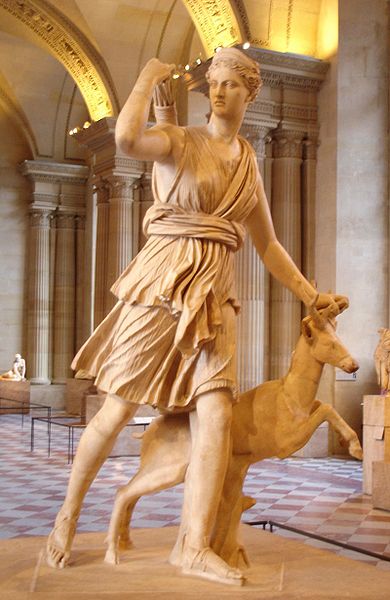
Artemis and her man-dog

Today, however, when we think of Olympians Zeus and Poseidon come to mind almost immediately as the two major figures. No one disputes the unstoppable power of Zeus’ thunderbolt or Poseidon’s earthquake. The goddesses, however, display their power on the human level. They may set the fortunes of armies going to war or individuals out for personal glory or fame. They touch the characters on a more human level. They also have their counterparts, unfortunately often eclipsed, in the world of the ancient Near East. Astarte is still poorly understood, and Anat, although more fully fleshed out at Ugarit, largely remains an enigma. The importance of Athena and Artemis thus stands out in sharper relief for having survived the overly acquisitive masculine ego to remind people everywhere that goddesses also will have their due. Given enough time, perhaps even the gods will understand.

St. Valentine’s Day

In keeping with my holiday series for young people, I present here my lighthearted essay on Valentine’s Day. This holiday was actually the starting point for the book project. My daughter had to do a school paper article on the holiday and had a difficult time finding information on the history of Valentine’s Day that was suitable for children. I starting writing this book at that time since there was nothing on the market. Still isn’t. In any case, here goes —

Hearts and cupids and tasty candy are a long way from the origins of this holiday! To get a grip on St. Valentine’s Day we have to go back to the Romans again. Remember that the Romans took over the known world in the first century B.C.E. Nobody has accused the Romans of having a great sense of humor! Like most empire-builders they had the serious business of looking out for their own best interests in mind.

Before Constantine (if you skipped New Year’s Day, there’s more there) the Romans worshipped lots of gods. Their religion didn’t really have a name, but it had plenty of gods, gods to spare even! So when they conquered the land where Jesus would show up, Judaea (aka “Israel”), they didn’t really need any more gods. There were so many religions around, in fact, that the Romans hated new religions.

One of the favorite Roman sports was killing Christians, because Christianity was a new and illegal religion. By a remarkable coincidence two guys by the name of Valentine were priests in the early days of the church. Although St. Valentine’s Day gets cootie points for some, the name actually means “valiant.” Well, these two Valentines were both traditionally killed on February 14 in the 200s (C.E.). So Valentine’s Day starts with blood and gore!

Read the rest here (under Full Essays).


Mythology in Cinema and Belief

My snow day activities yesterday would not have been complete without the viewing of a classic science fiction film for relief from my Mythology course prep. Still having mythology on the brain, I selected Dr. Cyclops, a 1940s movie that presages many of the concerns evident in the more famous members of the genre over the next decade. There were, even before the atomic bomb, clear concerns with radioactivity and its control by unstable elements of society. The fact that Dr. Thorkel is stereotypically Germanic would certainly resonate with audiences of the day. Given the title I focused on the classical elements and they eventually came through. As the radioactivity shrunk the cast, with the exception of Dr. Cyclops (Thorkel), Odysseus’ plight in the cave of Polyphemus emerged clearly. The doctor is symbolically blinded by the hiding and breaking of his glasses, and the shrunken prisoners escape like Odysseus’ crew. In one scene where the rival Dr. Bullfinch (surely no accident) addresses the much larger Thorkel the writers make it clear for the viewers that Bullfinch is really Ulysses (Odysseus).

Odysseus and Polyphemus

Presumably filmgoers in 1940 were still required to have read the classics in school so that such references would have been obvious from the start. Less obvious to viewers then and now is the fact that ancient mythology was a form of religion. Over the past week or so I’ve been participating in an exchange on Sabio Lantz’s blog, Triangulations, on the topic of metaphorical versus literal truth. I maintain that mythology reflects truth as perceived by ancient believers, whether they “believed” in an actual pantheon on Mount Olympus or not. Myths are intended to convey truth – although ancient religions were more often about correct practice rather than correct belief. Placating angry gods was the job of the priesthood, not the average citizen.

The question unanswered is when religion shifted from correct practice to correct belief. Correct belief can only truly apply in a monotheistic context – if there are many gods there are potentially many beliefs. With one god, one personality, the potential for believing incorrectly infiltrates a religion that is primarily concerned with keeping the many gods satisfied. So perhaps what Dr. Cyclops sees through his one good lens is a metaphor for seeking a single truth rather than the many. In the film, before he meets his demise in the radium mine, Dr. Thorkel is the only character with the stature of a god.


Paul Does the Classics

I first became aware of Greek mythology in fifth grade. My teacher in an industrial, rough and yet rural school, believed in the benefits of teaching aspiring drug addicts and laborers the stories of gods and heroes. I immediately adored the stories we heard and read. Raised in a religious household, however, I feared enjoying the tales of what were admittedly pagan gods after all, too much. In the educational topography of my youth, we were on the brink of this brave new electronic world we’ve entered, and mythology was not considered a terribly useful part of the curriculum after that. I left the gods behind. In a class on the Christian Scriptures in college, however, my instructor suggested we all go see Clash of the Titans (the 1981 version) for its appreciative (if a little hokey) presentation of the Greek world. I enjoyed the movie and even took a class in the literature department on mythology.

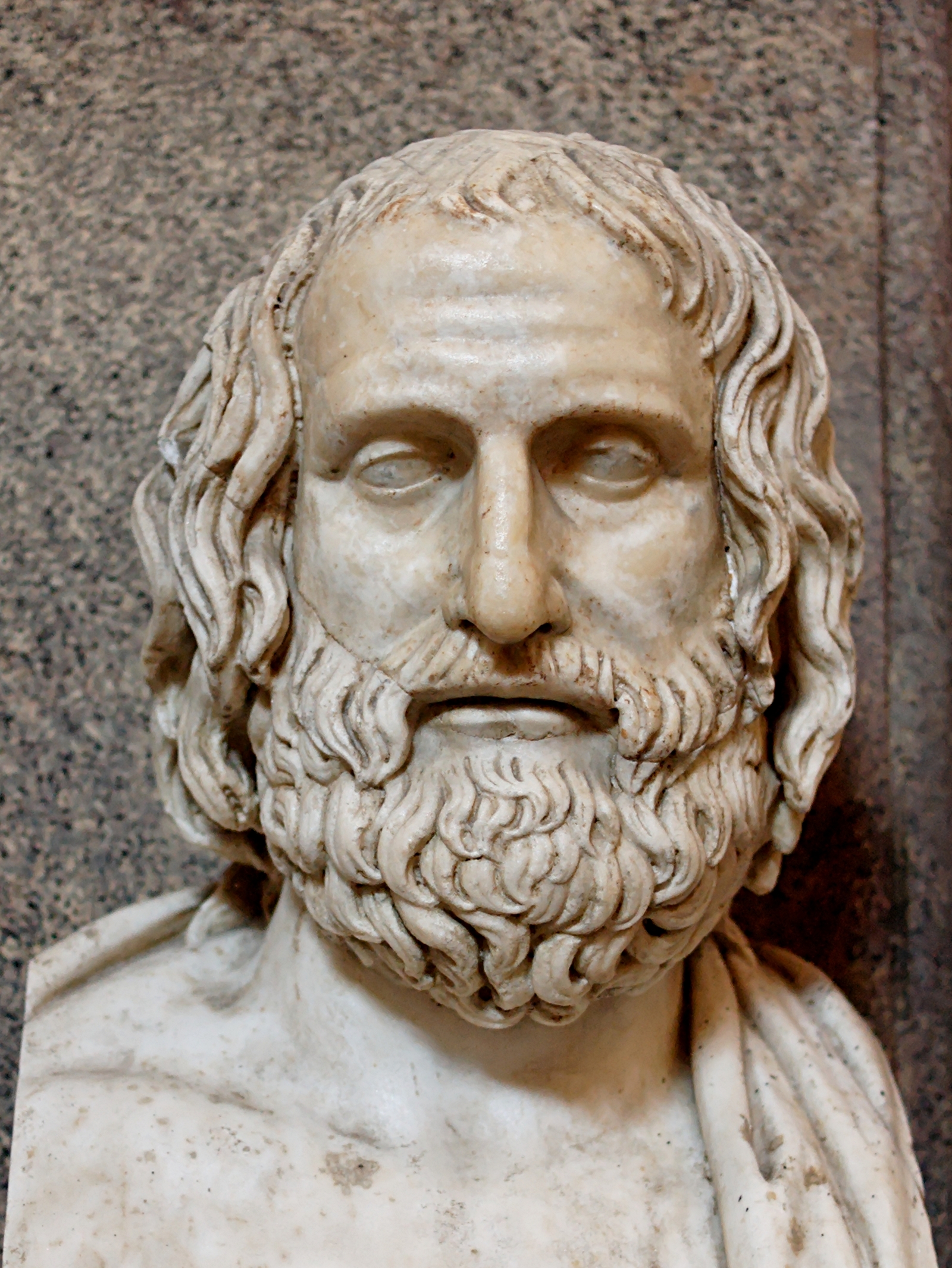
Over the years I have touched and gone on Greco-Roman mythology while specializing in the mythology of Ugarit. Now that I’m teaching a course on mythology, I’m going back to my classical roots and rereading the stories of times not quite so ancient as the fertile crescent civilizations’, but older than what is considered practical nowadays. While rereading Euripides’ play The Bacchae, the concentration of images, concepts, and actions that recur in the Bible stood out in chiaroscuro. Especially noticeable were references to Paul in the book of Acts.

Like Paul, Dionysus comes to be imprisoned. Not recognized as a divine figure, King Pentheus of Thebes locked him in chains until he could demonstrate that Dionysus is just the wild imaginary figure of repressed women. An earthquake, however, soon rattles the city and Dionysus emerges, chains shed, to the astonishment of Pentheus. The scene reads like Paul and Silas’ escape from jail in Philippi (Acts 16). Admittedly this could be coincidence. A few lines later, however, Dionysus, free from prison, tells Pentheus, “Don’t kick against the goad – a man against a god,” (Act 3, Paul Roche’s translation). Even so, Paul on his way to Damascus sees a vision of a god and is asked, “Why are you persecuting me? It is hard for you to kick against the goads” (Acts 26.14). Perhaps Luke had read his Euripides?

Now I’m no scholar of the Christian Scriptures (although I have taught courses on them a time or two), but when obvious parallels exist it is incumbent upon modern readers to pay attention. The parallels of Dionysus and Jesus were evident to early Christians, so what I noticed was nothing new. When the followers of Dionysus, however, strike a rock with their sticks and water flows out, I wondered if Euripides had read his Torah!

Paul's bedtime reading


A Sigh for Cybele

As we fall out of the holiday season into that distinctly chilly and sometimes cheerless February, Cybele comes to mind. Over the past several weeks I have added posts focused on the holidays associated with December and January. In the course of my research for a children’s book on American holidays (not published), I was astonished at how frequently Cybele appeared among the origins of current holiday practices. Having researched ancient Near Eastern mythology long enough to complete a doctorate in the field, and to write a book on an ancient goddess (Asherah), the lack of reference to Cybele in my sources was unexpected. I pushed this question mark to the back of my mind, but as I was reading H. P. Lovecraft’s story “The Rats in the Walls,” I found Cybele once again.

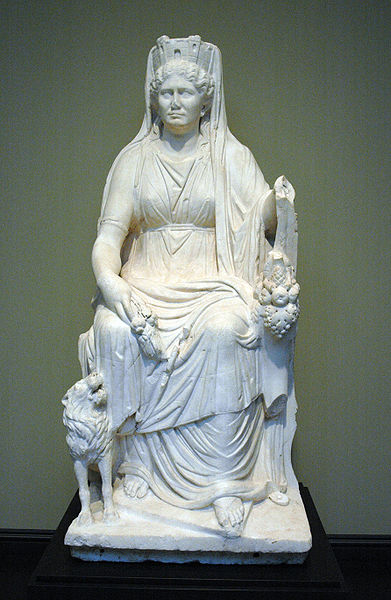
Cybele eventually became a major Roman goddess, although she was never among the Greek Olympians. Her importance shows in her connections with several Roman festivals and practices of antiquity, some of which have survived even to the present. Greco-Roman adherents to Cybele worship considered her to have been of Phrygian origin. Many scholars, however, see in her name and character echoes of a Semitic goddess named after Gebal, or the native name for Byblos in Phoenicia. If so, she is one further piece of the puzzle connecting the classical world with that of the fertile crescent.

Wikipedia Commons Cybele

A standard title for Cybele was Magna Mater, or “great mother.” As such, she was frequently associated with the earth itself, widely considered to have been a primordial female deity in the ancient Near East. In many respects she resembles Asherah, although the two are never explicitly identified. In myths where she is associated with Atys (later Attis), she becomes the spouse of a “dying and rising god.” She is prominent in festivals around mid-March, at the time of the renewal of fertility in the Mediterranean basin. Matronly, stolid, and powerful, Cybele lurks in the background of religious sensibilities. Her association with spring offers something to look forward to as the overly long, yet short, month of February starts to become visible.


Eager for Eden

In a recent email from the Clergy Letter Project, Michael Zimmerman reports that the movie Creation is shortly scheduled to be released in the United States. To quote from the Project newsletter:

“You may have heard that the film, Creation, about Charles Darwin and his struggle with his faith after his daughter, Annie, died had trouble finding a US distributor because it was seen as being too controversial for the American public, particularly after being attacked on Movieguide.org, an influential site which reviews films from a supposedly ‘Christian perspective’.”

It is disturbing that a non-fiction film has been blocked from American viewers because distributors found the content too controversial. The controversy has nothing to do with sex or violence, but an assault on the fantasy of a literal interpretation of Genesis. Disturbing fact challenges comfortable fantasy.

In a related story, an article on CNN.com explores the sense of depression that several viewers of Avatar felt after the movie ended. While the reasons are deep and complex, the overall theme seems to be that these viewers can’t shake the image of a pristine world that seemed so real for two-and-a-half hours. They long for a paradise that doesn’t exist. A paradise that has never existed. I am not unsympathetic. Although I could not view the film, I left from the theater with a similar, if less intense, feeling. It is a similar emotion to that when a truly special event takes place and the mind plays it over and over like a new and significant song. Impressions and hazy images and euphoria wash over you, and a longing for a moment that can never be recaptured consumes your consciousness. These are some of the most bittersweet moments of life. They are the very heartbeat of fantasy.

There never was an Eden. Human existence has been brutal and harsh since we first stood upright and wondered why we could think. America is a nation in deep denial about this harsh reality. We would rather believe the biblical Eden is a literal paradise and that our aching imaginations are somehow giving us glimpses of a fabled utopia where life was perfect. Well, almost perfect. The movie Avatar presents a paradigm that many Americans can relate to: an electronic world of endless possibilities shielding us from the stark realities of illness, pollution, tragedy, and death. We are insulated in our surreal environment that we have created for ourselves.

The human capacity for wonder is perhaps the greatest asset that consciousness has deigned to bequeath us. We can imagine a world where all creatures live in harmony with their environment and love and peace flourish. But that is not our world. A good corrective to these tempting fantasies is to read some good old classic Greek tragedies. These imaginative explorations of the human condition are as true to life as dreams of utopian worlds are removed from it. It is all a matter of perspective. And the Greeks were writing B.C.E. — Before the Computer Era — when reality had not been hidden behind a haze of ephemeral electrons.


The Blessing/Curse of Janus

Janus wonders about January

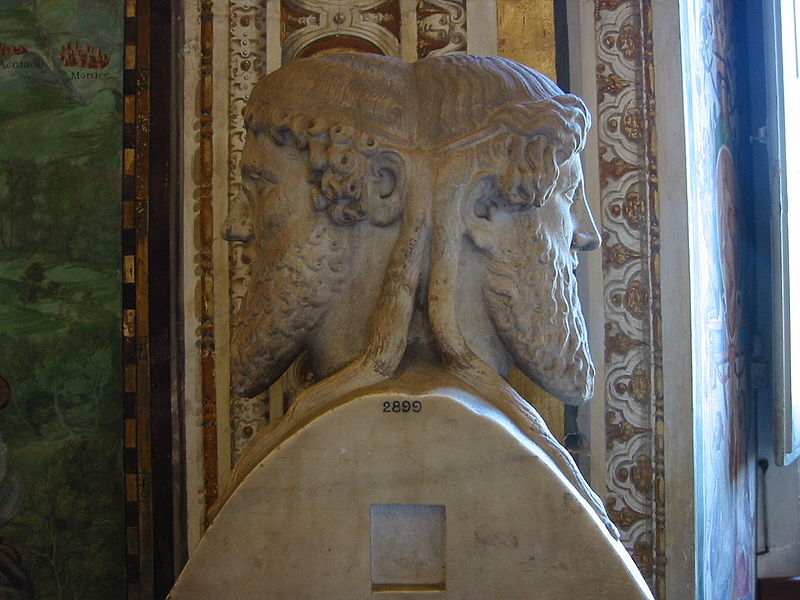
As the world stumbles into another new year, my thoughts turn to Janus. The namesake deity of January (since the Romans gave us a winter New Year’s day), Janus is a poorly understood ancient deity. Since he is overseer of beginnings and endings of all sorts, he is often portrayed with two faces or heads — one facing forward and the other facing back. There are no attendant mythological stories to this god, although he appears to have been very important in early Roman religion. He comes to mind as I prepare to teach a course on mythology that I haven’t prepped for since Oshkosh; my brief holiday break has been spent reading classical mythology.

Not only to we face a new year, but the beginning (or ending, it matters not which to Janus) of a new decade. Looking back over the muck-up made of the first decade of the twenty-first century, often because of religious extremists, I wonder what Janus sees down the road. There are many who feel optimistic about our firm bridle on technology and its ability to make our lives easier. Some of us believe that society has lost its appreciation for the classical study of the humanities and that we have lost our way because simplistic religion has seized the reigns from sensible mythology. In an age of information clutter, there is no one able to synthesize reason out of any of it. Perhaps it is the human condition.

Janus likely originated in the Ancient Near East. Once he reached Rome he continued to evolve into a major deity until eclipsed by the Olympians (many of whom first appear in the Ancient Near East as well). Not ironically, religious tolerance and religious intolerance both seem to have derived from the Near East also: Cyrus the Great’s declaration of religious freedom emerged in the midst of theocidal demands on the part of jealous gods. Now as we stand on the brink of a new decade, Janus only knows which way the unfeeling pendulum will swing.


It Was a Small World After All

Podcast 17 addresses one of the prevailing orthodoxies of the ancient world: the relative lack of communication between regions. It is clear from evidence that continues to emerge that ancient cultures knew about and borrowed from each other. The most obvious of these exchanges across distinct cultures concerns Hellenistic and Semitic contact. The Greeks clearly borrowed from their Semitic neighbors, as Cyrus Gordon worked so hard to convey. Although still not universally acknowledged, it is becoming increasingly difficult to maintain that ancient societies were singular, isolated, and self-sufficient.